Dun Bradstreet vs Kaspr: Which B2B Data Tool Wins in 2026?
Dun & Bradstreet sells firmographic depth at enterprise prices. Kaspr sells LinkedIn phone numbers at $65/month. They solve different problems — here's which one your team actually needs.
Dun Bradstreet vs Kaspr is a matchup between two tools that barely overlap. One is an enterprise company database. The other is a LinkedIn contact extractor. Here is the short version first, then the detail.
TL;DR
- Dun & Bradstreet is a firmographic and credit-risk database — company hierarchies, DUNS numbers, financial health scores. It is not a prospecting tool, and it is not priced like one.
- Kaspr is a LinkedIn-first contact extractor — mobile numbers and emails pulled from profiles you're already viewing. Paid plans start around €65/month per user.
- They barely compete. D&B answers "is this company real, solvent, and part of a larger corporate family?" Kaspr answers "what's this specific person's cell phone?"
- If you're an SMB or mid-market sales team, D&B is almost certainly overkill and Kaspr is almost certainly incomplete on its own.
- Most teams end up needing a third thing: reliable work-email discovery at a flat, predictable price. That's where a dedicated email finder fits.
What Are Dun & Bradstreet and Kaspr, Actually?#
Start here. Most comparison posts frame this wrong. These two products are not two versions of the same thing.
Dun & Bradstreet has been in the business-information trade since 1841. Its core asset is the D-U-N-S Number, a nine-digit ID given to more than 500 million business records worldwide. Attached to that ID are corporate linkage, credit scores, and firmographic attributes. Procurement teams use D&B to vet suppliers. Finance teams use it to set credit terms. Marketing teams use it to segment their market by revenue band, employee count, SIC/NAICS code, and parent-subsidiary links. That runs through D&B Connect, D&B Hoovers, or the Rev.Up ABM platform.
Kaspr launched in 2018 in France and was acquired by Cognism in 2022. Its asset is a Chrome extension that sits on top of LinkedIn. You open a profile or a Sales Navigator list, click the Kaspr icon, and it returns phone numbers, direct emails, and sometimes both. Its stated strength is European mobile coverage. That data is hard to build, and most US-first vendors are thin there.
The mental model: D&B is the census bureau. Kaspr is a phone book that only works while you're standing in the room with the person.

Dun Bradstreet vs Kaspr: How Do They Compare Head to Head?#
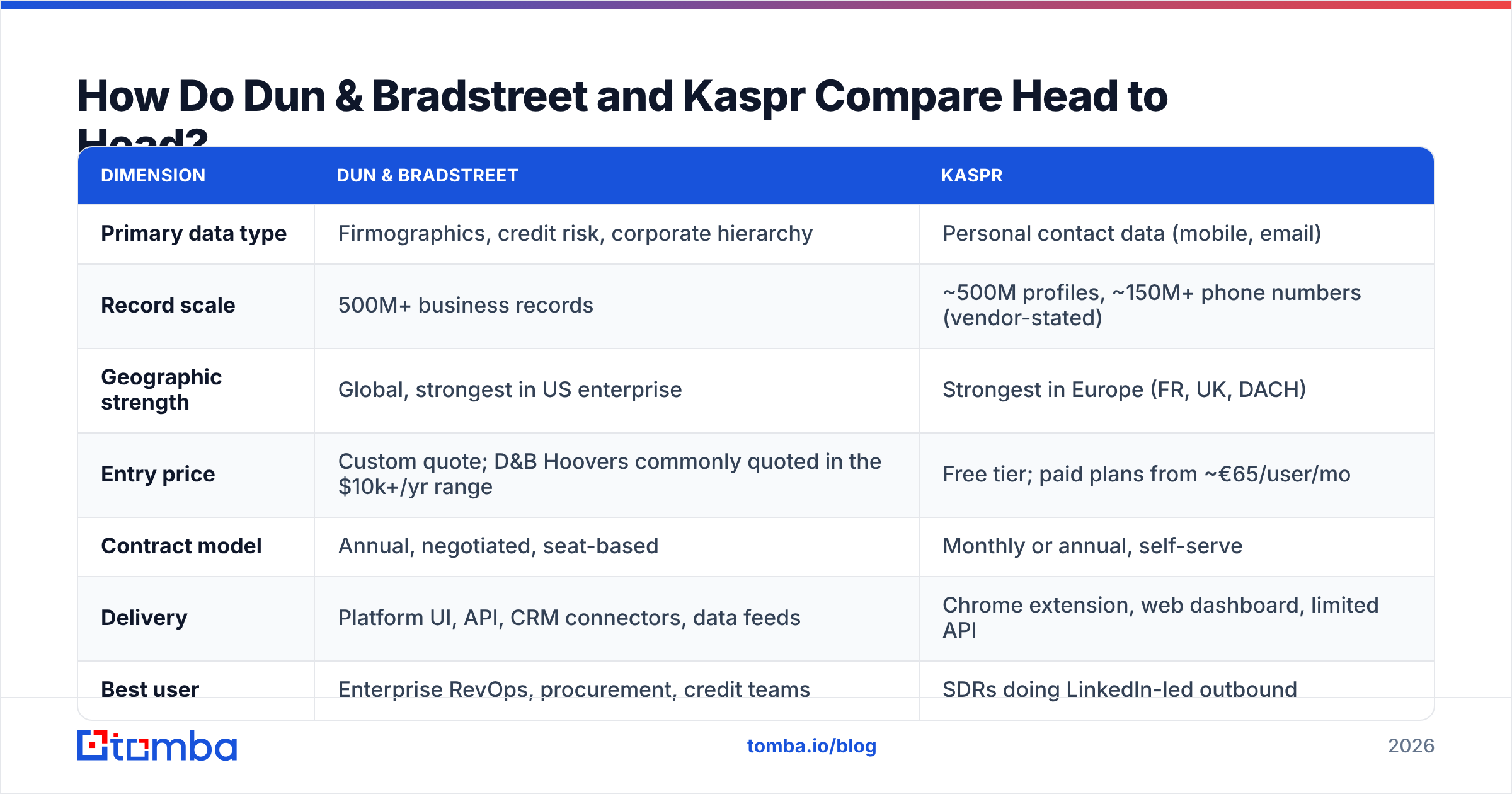
| Dimension | Dun & Bradstreet | Kaspr |
|---|---|---|
| Primary data type | Firmographics, credit risk, corporate hierarchy | Personal contact data (mobile, email) |
| Record scale | 500M+ business records | ~500M profiles, ~150M+ phone numbers (vendor-stated) |
| Geographic strength | Global, strongest in US enterprise | Strongest in Europe (FR, UK, DACH) |
| Entry price | Custom quote; D&B Hoovers commonly quoted in the $10k+/yr range | Free tier; paid plans from ~€65/user/mo |
| Contract model | Annual, negotiated, seat-based | Monthly or annual, self-serve |
| Delivery | Platform UI, API, CRM connectors, data feeds | Chrome extension, web dashboard, limited API |
| Best user | Enterprise RevOps, procurement, credit teams | SDRs doing LinkedIn-led outbound |
| Onboarding time | Weeks (implementation + data mapping) | Minutes (install extension) |
| Buying intent data | Yes (D&B Rev.Up, Bombora partnership) | No |
| Free trial | Demo-gated | Yes, free credits monthly |
The table makes the split obvious. You would never brief a procurement analyst to use Kaspr. And you would never hand an SDR a D-U-N-S hierarchy file and tell them to hit quota with it.
Which One Is Better for Outbound Prospecting?#
Kaspr, without much argument — but with a real caveat.
Kaspr is built for one motion: a rep finds a person on LinkedIn and wants to reach them today. The workflow is three clicks. View profile, reveal contact, push to CRM or a sequence. There's no list-building ceremony, no data-mapping project, no procurement cycle. For a five-person SDR team running LinkedIn-sourced outbound in Europe, that's a good fit, and the pricing reflects it.
The caveat is coverage shape. Kaspr's data is only as good as the profile you're on. If your ICP isn't heavily active on LinkedIn — think plant managers, regional distributors, public-sector procurement, most of APAC outside major hubs — reveal rates fall off fast. You also can't easily go the other direction. "Give me every decision-maker at these 400 target accounts" is a list-building question, and Kaspr's list features are thinner than dedicated prospecting databases.
D&B, meanwhile, is not competing for this job. Its contact-level data exists through D&B Hoovers, but it is not the center of the product. The contact records skew toward corporate switchboards and stale titles. Teams that buy D&B for SDR prospecting usually end up disappointed, then buy a second tool anyway.
If your outbound leans on email rather than phone, neither tool is the natural answer. A dedicated domain search returns every discoverable address at a company, with confidence scores and pattern detection. That covers list-building better than either tool. A separate email verifier then protects your sender reputation before send.
Which One Is Better for Account Intelligence and RevOps?#
Dun & Bradstreet, decisively.
Say you need to know that Acme Logistics GmbH is a subsidiary of a US-listed parent, employs 2,400 people, carries a specific credit-risk score, and shares a corporate family with three accounts you already sell to. That's a D&B question, and Kaspr has no answer for it. Corporate linkage is hard to build, and D&B has been building it for 180 years.
This matters for four concrete jobs:
- TAM sizing and territory design. You cannot cut territories fairly without consistent firmographics. Employee-count fields scraped from LinkedIn are wrong often enough to cause comp disputes.
- Account deduplication in CRM. The D-U-N-S Number is the closest thing B2B has to a universal company key. Matching on domain alone breaks on holding companies and rebrands.
- Credit and risk gating. If you extend payment terms, D&B's PAYDEX and Failure Score are the industry defaults. No prospecting tool touches this.
- Compliance and supplier vetting. Procurement and third-party risk teams often mandate D&B records outright.
None of that is prospecting. That's why the honest answer to "Dun Bradstreet vs Kaspr" is usually "different budgets, different departments, possibly both."
What Does Each One Actually Cost?#
This is where the comparison gets uncomfortable for D&B.
Kaspr publishes pricing on its site. There's a free plan with limited monthly credits, a Starter tier around €65 per user per month, and higher tiers with more credits and team features. You can sign up with a credit card. You know your annual spend before you talk to anyone.
Dun & Bradstreet does not publish pricing. Deals are quoted per seat, per module, per record volume, and per contract length. Public reports from buyers on G2 and Capterra put D&B Hoovers in the five-figure annual range for small teams. That climbs sharply with seat count and API access. Then add implementation, and add the near-universal annual-only commitment.
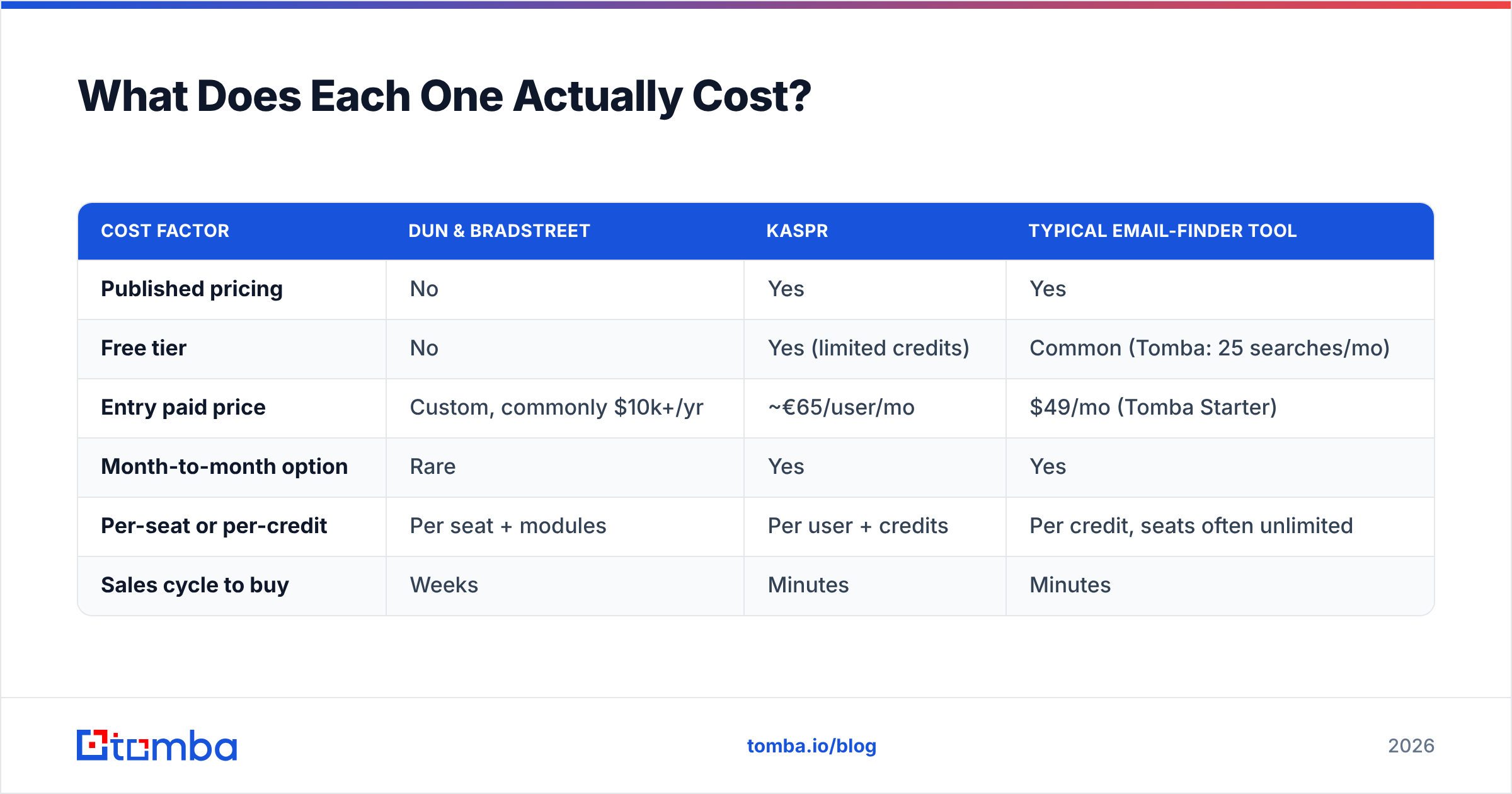
| Cost factor | Dun & Bradstreet | Kaspr | Typical email-finder tool |
|---|---|---|---|
| Published pricing | No | Yes | Yes |
| Free tier | No | Yes (limited credits) | Common (Tomba: 25 searches/mo) |
| Entry paid price | Custom, commonly $10k+/yr | ~€65/user/mo | $49/mo (Tomba Starter) |
| Month-to-month option | Rare | Yes | Yes |
| Per-seat or per-credit | Per seat + modules | Per user + credits | Per credit, seats often unlimited |
| Sales cycle to buy | Weeks | Minutes | Minutes |
For a team of three SDRs, the gap is not marginal. It's the difference between a tool you expense and a tool you build a business case for. Predictable Tomba pricing — $49/mo Starter, $99/mo Growth, $249/mo Pro — sits in a different budget category from a negotiated enterprise data contract.

What Are the Real Weaknesses of Each Tool?#
Neutral means saying the unflattering parts out loud.
Dun & Bradstreet's weak points:
- Data freshness on contacts. Firmographics update reliably, but people data lags. Titles and direct dials go stale faster than the refresh cycle catches them.
- Opaque pricing and renewal pressure. Multiple buyer reviews cite steep renewal quotes and difficulty right-sizing seats mid-contract.
- Interface age. D&B Hoovers works, but it feels like enterprise software from a decade ago next to modern GTM tooling.
- Overkill for SMB. If you sell to companies under 200 employees, corporate hierarchy data adds almost nothing.
Kaspr's weak points:
- LinkedIn dependency. No profile, no data. The workflow breaks if LinkedIn changes its UI or throttles automation, and it has done both.
- Geographic skew. Excellent EU mobile coverage, but noticeably thinner in North America and APAC than US-first vendors.
- Credit anxiety. Credit-based reveals mean reps ration lookups, which is exactly the wrong incentive.
- Limited bulk workflows. It's a per-profile tool at heart. Enriching a 5,000-row spreadsheet is not its comfort zone.
- Compliance surface. Scraped personal mobile numbers need careful GDPR handling. Cognism publishes notification processes. Make sure your legal team reads them before you scale European calling.
Do You Actually Need a Third Tool?#
Often, yes — and this is the part most vs-posts skip.
The gap between D&B and Kaspr is work-email discovery at scale. D&B gives you the account list. Kaspr gives you a phone number for the person you're looking at right now. Neither gives you "here are verified work emails for the 300 people matching my persona across my 80 target accounts, exported to CSV, with catch-all domains flagged."
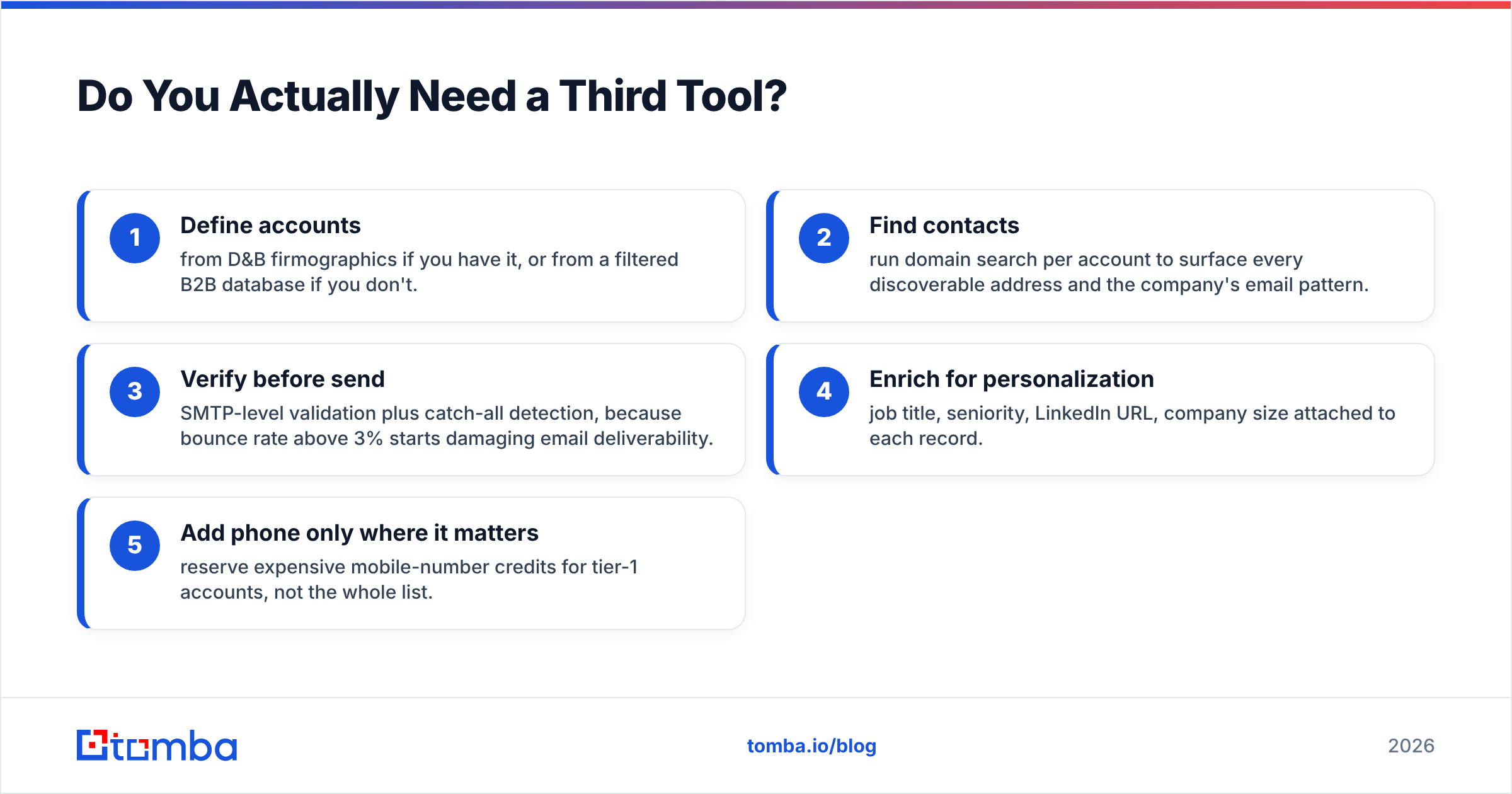
That's a distinct job, and it's the one that drives pipeline for email-led outbound. The workflow that actually works looks like this:
- Define accounts — from D&B firmographics if you have it, or from a filtered B2B database if you don't.
- Find contacts — run domain search per account to surface every discoverable address and the company's email pattern.
- Verify before send — SMTP-level validation plus catch-all detection, because a bounce rate above 3% starts to damage email deliverability.
- Enrich for personalization — job title, seniority, LinkedIn URL, and company size attached to each record.
- Add phone only where it matters — save expensive mobile-number credits for tier-1 accounts, not the whole list.
Steps 2 through 4 are where a dedicated email-finding stack earns its keep. They are also where both D&B and Kaspr leave you reaching for another tab. Tools like Cognism, Apollo, and Tomba each attack that middle layer differently — Cognism through phone-verified B2B data, Apollo through a bundled all-in-one, Tomba through accuracy-focused email discovery with a published free tier.
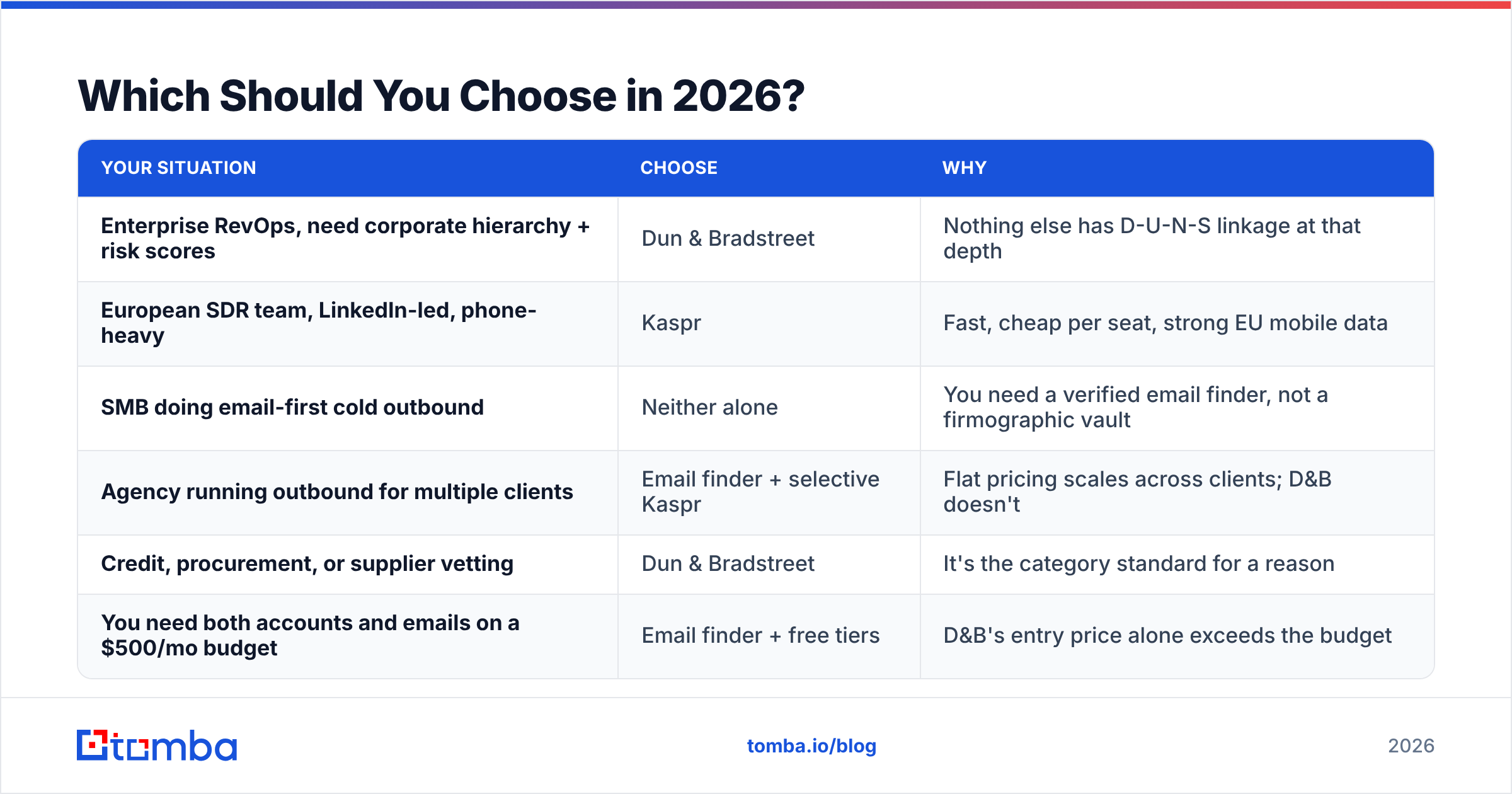
Which Should You Choose in 2026?#
Pick by job, not by brand.
| Your situation | Choose | Why |
|---|---|---|
| Enterprise RevOps, need corporate hierarchy + risk scores | Dun & Bradstreet | Nothing else has D-U-N-S linkage at that depth |
| European SDR team, LinkedIn-led, phone-heavy | Kaspr | Fast, cheap per seat, strong EU mobile data |
| SMB doing email-first cold outbound | Neither alone | You need a verified email finder, not a firmographic vault |
| Agency running outbound for multiple clients | Email finder + selective Kaspr | Flat pricing scales across clients; D&B doesn't |
| Credit, procurement, or supplier vetting | Dun & Bradstreet | It's the category standard for a reason |
| You need both accounts and emails on a $500/mo budget | Email finder + free tiers | D&B's entry price alone exceeds the budget |
A few decision shortcuts:
- If you can't get a quote approved in under two weeks, D&B isn't a realistic option this quarter. Its buying cycle assumes an enterprise procurement process.
- If fewer than 40% of your buyers are active on LinkedIn, Kaspr's reveal rate will disappoint you. Test with the free plan before you commit to seats.
- If your primary channel is email, buy for email accuracy first. For most SaaS and services outbound, phone data is an add-on, not a foundation.
- If you already pay for Cognism, you may already have Kaspr-equivalent access. Check before you double-buy — Kaspr is a Cognism company.
For teams that need broad, self-serve access to verified business contacts without an enterprise contract, peers like BookYourData offer pay-as-you-go list building. That sidesteps the seat-license model entirely, and it's a reasonable third path to price alongside both tools here.
How Do You Test Both Before Buying?#
Run a controlled bake-off. It takes an afternoon and saves quarters of regret.
- Build a 100-row truth set. Real people at real target accounts, spread across your actual geographies — not just the easy ones.
- Run each tool against it. Record match rate (did it return anything?) and accuracy rate (was it right?). These are different numbers, and vendors love to conflate them.
- Verify independently. Push every returned email through a neutral verifier, so you're not grading a vendor with its own answer key.
- Cost per usable record. Total spend divided by contacts that were both found and verified. This is the only pricing metric that matters.
- Check the export path. Can you get data into your CRM without a CSV round-trip? Look at the integrations each vendor actually supports, not the logos on the homepage.
Most bake-offs end the same way. The enterprise database wins on account intelligence. The LinkedIn extractor wins on speed to a phone number. Neither wins on cost per verified work email. That third slot is usually still open.
The Bottom Line#
In the Dun Bradstreet vs Kaspr matchup, the two tools are not really rivals. D&B is infrastructure for knowing who companies are. Kaspr is a fast lane to a mobile number for someone you already found. Buy D&B when compliance, credit, or territory design demands it and your budget has a five-figure line item. Buy Kaspr when your reps live in LinkedIn and sell into Europe. Buy both only if both jobs are real in your org.
But if what you need is verified work emails for a defined list of accounts, at a price you can approve without a procurement review, start with the tool built for exactly that. Tomba's Email Finder returns professional addresses by name, company, or domain, with confidence scoring and built-in verification. The free tier covers 25 searches a month, and paid plans start at $49. Test it against your own truth set before you sign anything annual.
Related guides#
Ready to find emails that actually work?
Join 150,000+ professionals who stopped guessing and started sending. Free credits on signup — no credit card required.
Get the Tomba newsletter
Practical outbound tactics and product updates — once every two weeks.
About the author