E Leads Explained: How to Source and Qualify Them in 2026
E leads are cheap to collect and easy to waste. Here is how the main digital lead channels compare in 2026, plus the verification steps that stop a bad list from wrecking your sender reputation.
TL;DR
- "E leads" means electronically sourced leads: contacts you acquire through web forms, digital ads, scraped or licensed databases, LinkedIn, chat, and intent platforms rather than by walking a trade-show floor.
- A separate audience searches "e leads" looking for Elead CRM, the automotive dealership CRM now owned by CDK Global. If that is you, skip to the disambiguation section.
- Volume is not the constraint anymore. Between form spam, role accounts, and roughly 25 to 30 percent annual data decay, most raw e-lead lists are 30 to 50 percent unusable before your first send.
- The channels that convert best in 2026 are the ones with a real trigger behind them: product signups, website visitor reveals, and hiring or funding signals. Bought bulk lists sit at the bottom.
- The fix is boring and it works: enrich, verify, dedupe, then route. A $49/mo finder plus a verifier costs less than one bounced campaign.
What are e leads?#
An e lead is any prospect record that arrives through a digital channel and lands in your system as data rather than as a conversation. The "e" is a holdover from the early 2000s, when dealerships and insurance carriers needed a word to separate walk-ins and phone calls from the new stream of internet inquiries.
The term stuck because the distinction still matters operationally. A walk-in gives you intent and identity in the same moment. An e lead gives you a fragment: an email address with no company, a company with no contact, a LinkedIn profile with no reachable inbox. Everything you do downstream is an attempt to reassemble that fragment into something a rep can actually work.
That is why e leads behave differently from every other lead type. They are cheap, abundant, fast to acquire, and structurally incomplete. Treat them like inbound demo requests and you will burn your domain reputation within a quarter.
Why do some people searching "e leads" mean something else?#
Two searches share this phrase, and they want opposite things.
The first group is looking for digital lead generation, which is what the rest of this guide covers. The second group is looking for Elead CRM (often written eLEAD or Elead One), a dealership-focused CRM and desking tool used widely in North American auto retail and now part of CDK Global. In that world, "e leads" is dealership shorthand for internet leads arriving from third-party marketplaces and OEM sites into the Elead inbox.
The underlying problem is identical in both cases: a stranger submitted a form, the data is thin, and speed-to-lead decides whether you win. Auto dealers just solved it a decade earlier and with worse tooling.
What types of e leads are there?#
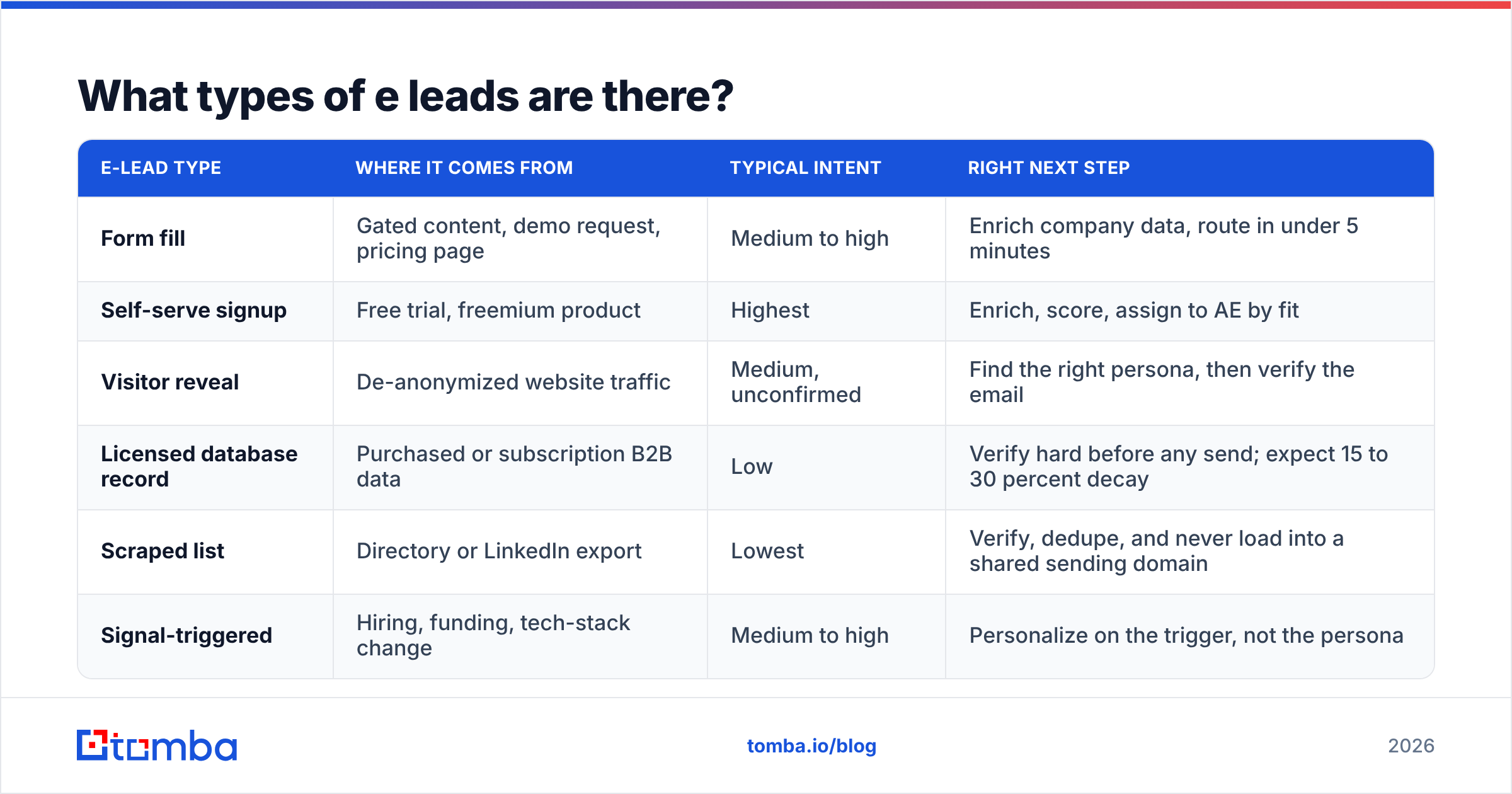
Not all electronic leads deserve the same handling. Sorting them by origin tells you exactly how much verification and enrichment each one needs.
| E-lead type | Where it comes from | Typical intent | Right next step |
|---|---|---|---|
| Form fill | Gated content, demo request, pricing page | Medium to high | Enrich company data, route in under 5 minutes |
| Self-serve signup | Free trial, freemium product | Highest | Enrich, score, assign to AE by fit |
| Visitor reveal | De-anonymized website traffic | Medium, unconfirmed | Find the right persona, then verify the email |
| Licensed database record | Purchased or subscription B2B data | Low | Verify hard before any send; expect 15 to 30 percent decay |
| Scraped list | Directory or LinkedIn export | Lowest | Verify, dedupe, and never load into a shared sending domain |
| Signal-triggered | Hiring, funding, tech-stack change | Medium to high | Personalize on the trigger, not the persona |
Read that table as a spend guide. The bottom three rows need the most cleaning and produce the least reply, which is the inverse of how most teams allocate budget.
Which e-lead channels actually convert?#
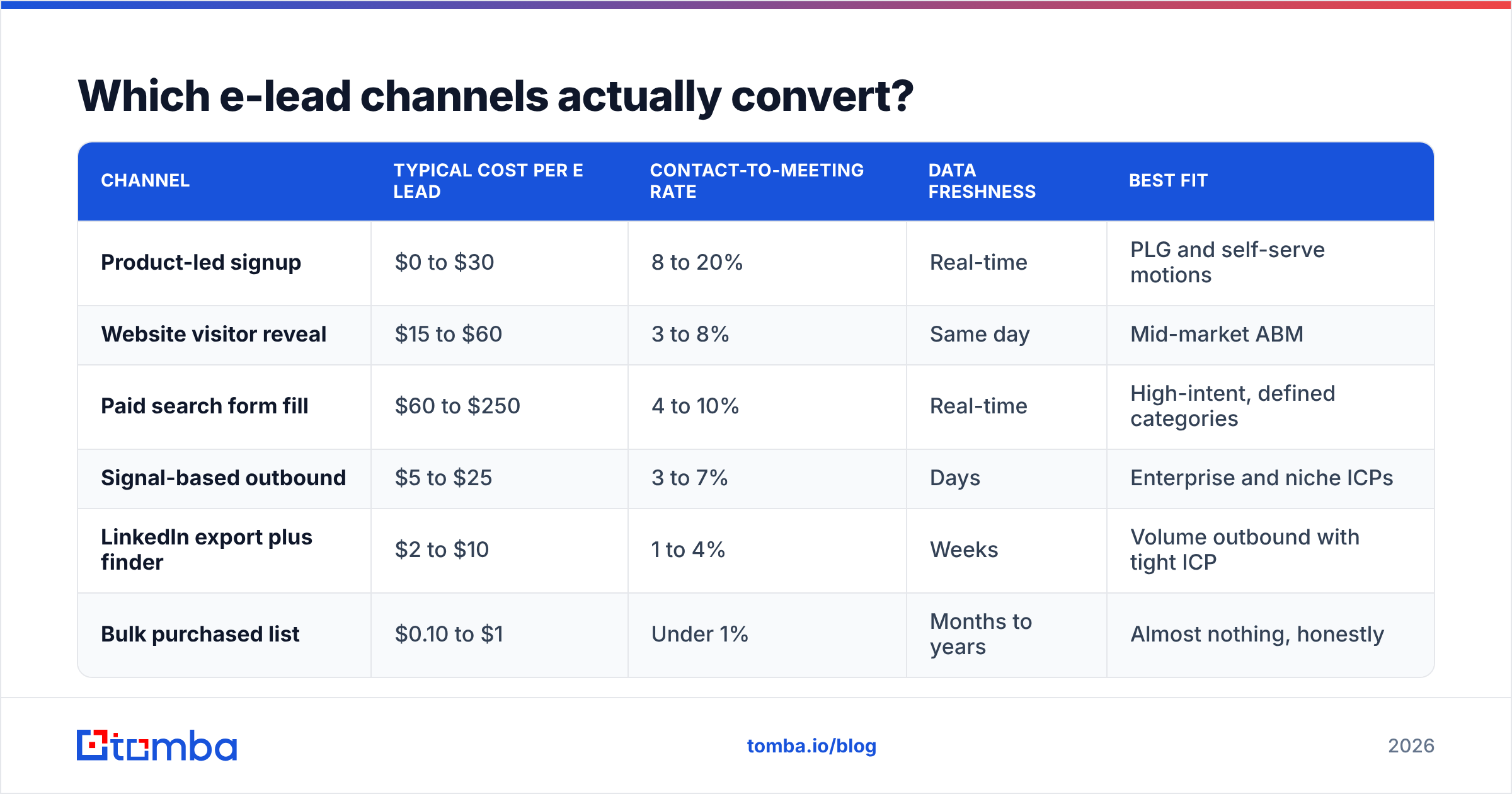
Here is the honest comparison. Ranges reflect what mid-market B2B teams typically report; your numbers move with ICP tightness and offer quality more than with channel choice.
| Channel | Typical cost per e lead | Contact-to-meeting rate | Data freshness | Best fit |
|---|---|---|---|---|
| Product-led signup | $0 to $30 | 8 to 20% | Real-time | PLG and self-serve motions |
| Website visitor reveal | $15 to $60 | 3 to 8% | Same day | Mid-market ABM |
| Paid search form fill | $60 to $250 | 4 to 10% | Real-time | High-intent, defined categories |
| Signal-based outbound | $5 to $25 | 3 to 7% | Days | Enterprise and niche ICPs |
| LinkedIn export plus finder | $2 to $10 | 1 to 4% | Weeks | Volume outbound with tight ICP |
| Bulk purchased list | $0.10 to $1 | Under 1% | Months to years | Almost nothing, honestly |
The pattern is not subtle. Cost per e lead moves inversely to conversion, and the cheapest sources cost the most once you price in bounces, spam complaints, and rep time wasted on records that were never real.
How do you qualify an e lead before it reaches a rep?#
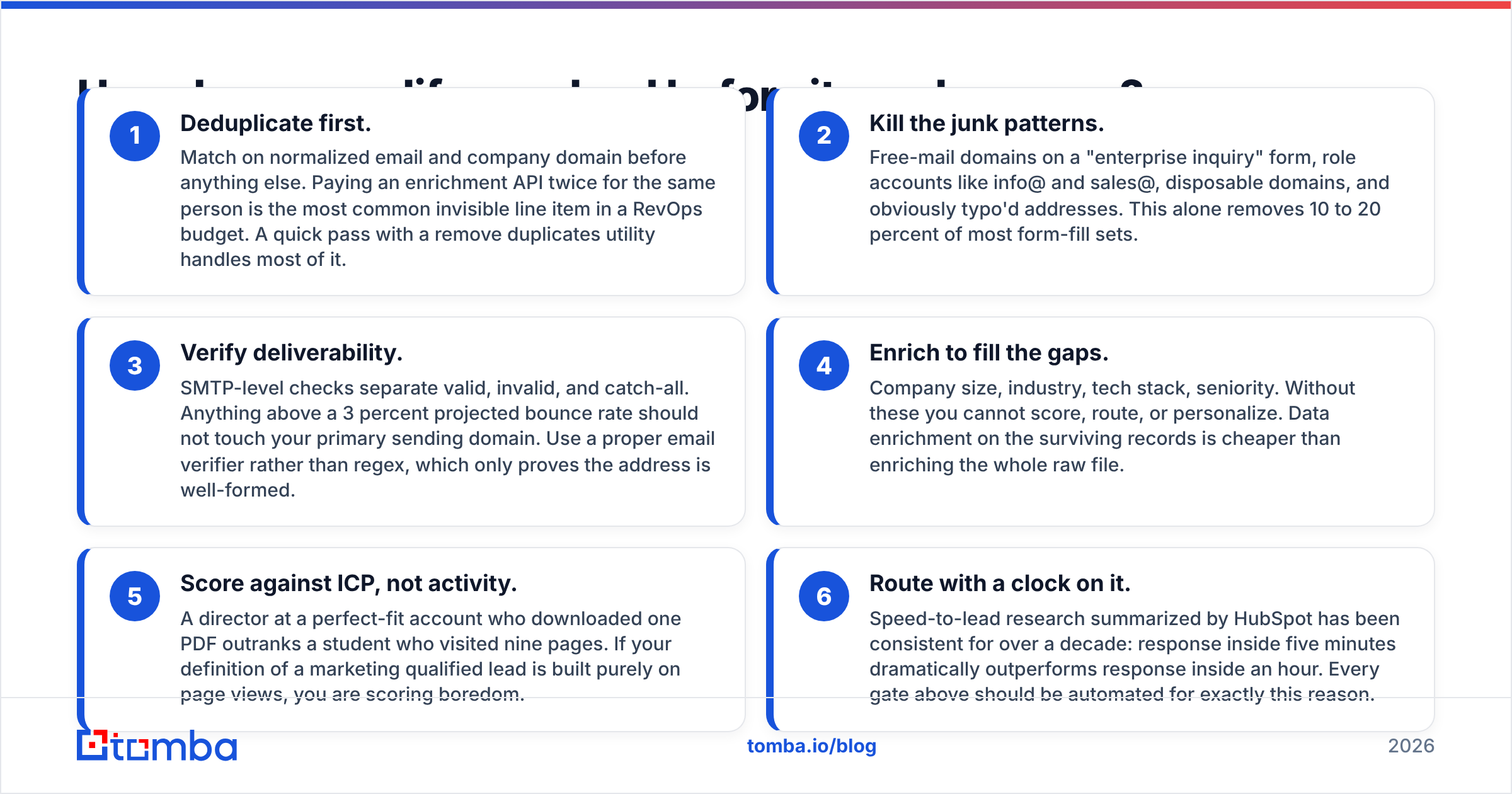
Run every inbound record through the same five gates. The order matters, because each step removes volume the next step would have charged you for.
- Deduplicate first. Match on normalized email and company domain before anything else. Paying an enrichment API twice for the same person is the most common invisible line item in a RevOps budget. A quick pass with a remove duplicates utility handles most of it.
- Kill the junk patterns. Free-mail domains on a "enterprise inquiry" form, role accounts like info@ and sales@, disposable domains, and obviously typo'd addresses. This alone removes 10 to 20 percent of most form-fill sets.
- Verify deliverability. SMTP-level checks separate valid, invalid, and catch-all. Anything above a 3 percent projected bounce rate should not touch your primary sending domain. Use a proper email verifier rather than regex, which only proves the address is well-formed.
- Enrich to fill the gaps. Company size, industry, tech stack, seniority. Without these you cannot score, route, or personalize. Data enrichment on the surviving records is cheaper than enriching the whole raw file.
- Score against ICP, not activity. A director at a perfect-fit account who downloaded one PDF outranks a student who visited nine pages. If your definition of a marketing qualified lead is built purely on page views, you are scoring boredom.
- Route with a clock on it. Speed-to-lead research summarized by HubSpot has been consistent for over a decade: response inside five minutes dramatically outperforms response inside an hour. Every gate above should be automated for exactly this reason.
Why do e leads decay so fast?#
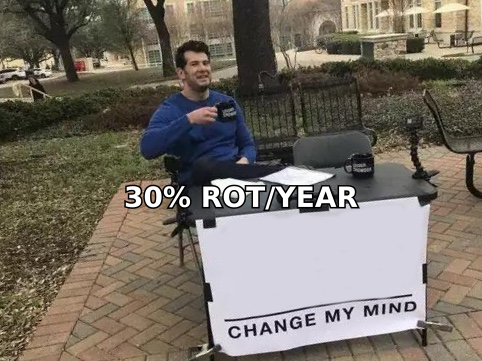
Because the data describes people, and people move. B2B contact data degrades at roughly 25 to 30 percent per year through job changes, company renames, acquisitions, and domain migrations. In high-churn segments like early-stage SaaS or agency services, the real number is worse.
Three failure modes follow from that:
- The stale list. A file bought 18 months ago is now roughly half wrong. Sending to it produces bounces, and bounces produce reputation damage that outlasts the campaign.
- The catch-all trap. Many corporate domains accept everything at the gateway, so a verifier returns "unknown" rather than valid or invalid. Guessing here is how teams get blocked. Route these through a catch-all verifier and segment them into a separate, slower sending stream.
- The pattern drift. Companies change email conventions after migrations. A format that resolved as first.last@ two years ago may now be firstinitiallast@. Pattern-based guessing without live verification quietly stops working.
None of this is solved by buying more e leads. It is solved by re-verifying at send time instead of at purchase time.
What does an e-leads stack look like in 2026?#
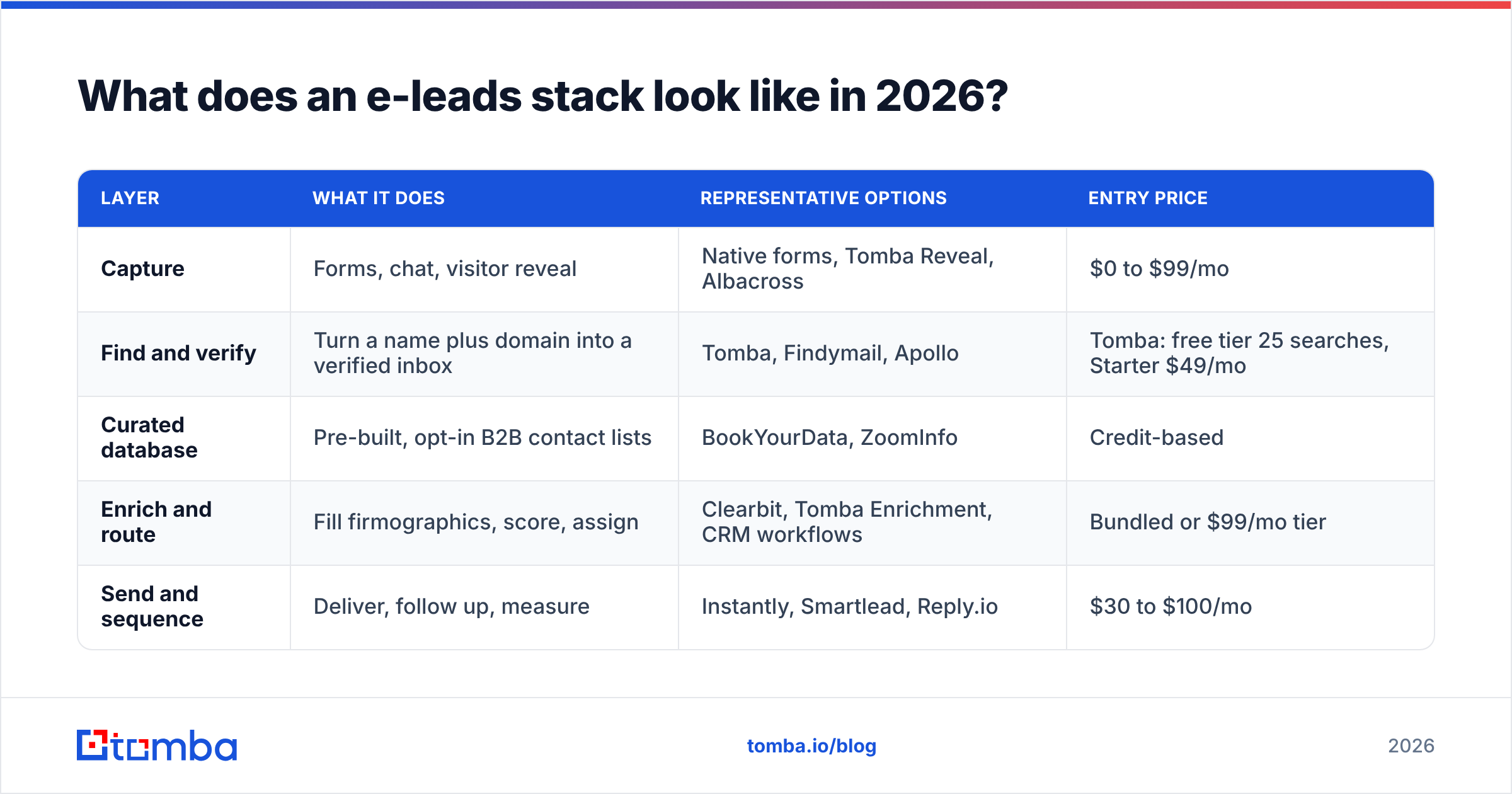
You need four layers. Most teams over-buy at the top and under-buy in the middle, which is why their CRM is full and their reply rate is not.
| Layer | What it does | Representative options | Entry price |
|---|---|---|---|
| Capture | Forms, chat, visitor reveal | Native forms, Tomba Reveal, Albacross | $0 to $99/mo |
| Find and verify | Turn a name plus domain into a verified inbox | Tomba, Findymail, Apollo | Tomba: free tier 25 searches, Starter $49/mo |
| Curated database | Pre-built, opt-in B2B contact lists | BookYourData, ZoomInfo | Credit-based |
| Enrich and route | Fill firmographics, score, assign | Clearbit, Tomba Enrichment, CRM workflows | Bundled or $99/mo tier |
| Send and sequence | Deliver, follow up, measure | Instantly, Smartlead, Reply.io | $30 to $100/mo |
Two notes on picking inside each layer.
For the find-and-verify layer, what matters is not raw database size but the ratio of verified-valid results to credits spent. A tool returning 60 percent valid on 100 credits beats one returning 90 percent coverage where a third bounce. Tomba's Tomba pricing runs a free tier at 25 searches per month, Starter at $49/mo, Growth at $99/mo, and Pro at $249/mo, with verification included rather than sold as a separate SKU. Compare category reviews on G2 before committing to an annual contract.
For curated data, a permission-based list vendor like BookYourData solves a different problem than a finder does. Vendors like that are the right call when you need a ready-made list for a segment you have no seed data for; a finder is the right call when you already know the accounts and need the specific humans inside them. Many teams run both, and that is a reasonable architecture, not a redundancy.

How should you measure e-lead performance?#
Stop reporting lead count. Report the four metrics that survive scrutiny in a pipeline review.
- Verified contact rate. Of the e leads acquired, what percentage produced a deliverable, correct-person email? Below 70 percent, your source is the problem, not your copy.
- Cost per verified contact. Cost per lead is vanity. Divide total channel spend by contacts that passed verification.
- Contact-to-meeting rate. The only number that connects data quality to revenue. Track it per source, always.
- Bounce and complaint rate by source. Tag every record with its origin so that when your email deliverability drops, you can identify the guilty list in minutes rather than guessing.
Run these per source, monthly. Within two cycles you will find that one or two channels produce most of your qualified pipeline and that at least one line item deserves to be cut entirely. Analyst coverage from firms like Gartner has been pointing the same direction for years: fewer, better-targeted touches beat volume in every segment where buying committees are large.
What are the most common e-leads mistakes?#
- Sending to unverified records from your main domain. One 12 percent bounce campaign can cost you months of inbox placement. Warm a secondary domain and keep verification mandatory.
- Enriching before deduplicating. You pay twice and then merge conflicting records.
- Treating a form fill as intent. Someone wanting your PDF is not someone wanting your product. Score fit first.
- Buying coverage instead of accuracy. A vendor claiming 500 million contacts is claiming a number nobody can audit. Test 100 records against your own ICP and measure valid rate.
- Ignoring the catch-all bucket. Excluding every unknown result throws away real prospects. Segment them instead.
- No re-verification cadence. Re-verify any list older than 90 days before reuse. It is a few dollars against a reputation risk you cannot buy back.
Where should you start?#
Pick your best-performing account list, not your biggest one. Take 200 target companies, find the two or three real decision-makers inside each, verify every address, and run one tightly written sequence. That is 500 verified contacts, which is a single month on a Starter plan, and it will tell you more about your market than 50,000 purchased records ever will.
When you are ready to build that list, the Tomba Email Finder turns a name and a company domain into a verified professional email, with domain search for mapping whole companies, catch-all handling built in, and a free tier of 25 searches so you can test accuracy against your own ICP before paying anything. Start there, measure your verified contact rate, and let the data decide which e-lead channels earn next quarter's budget.
Related guides#
Ready to find emails that actually work?
Join 150,000+ professionals who stopped guessing and started sending. Free credits on signup — no credit card required.
Get the Tomba newsletter
Practical outbound tactics and product updates — once every two weeks.
About the author