Easy Email Verification vs SalesIntel: Full 2026 Comparison
One tool cleans the list you already have. The other sells you the list. Here's an honest breakdown of Easy Email Verification vs SalesIntel — pricing models, accuracy claims, and which one your outbound motion actually needs in 2026.
Easy Email Verification vs SalesIntel is a comparison of two tools that solve different problems. One cleans the list you already have. The other sells you the list. Here is what each one costs, how accurate it is, and which gap in your pipeline it fills.
TL;DR
- These two products do not compete. Easy Email Verification is a bulk list-hygiene tool. It tells you whether an address will bounce.
- SalesIntel is a B2B contact database. It sells you the addresses in the first place.
- Bounce rate at 9% and your domain getting throttled? A verifier fixes that for a few dollars per thousand records. SalesIntel will not.
- 40 target accounts and no contacts? A verifier is useless. You need a data source — SalesIntel, Tomba, or a scraping-plus-enrichment stack.
The cost gap is huge. Verification runs roughly $2–$7 per 1,000 emails, pay as you go. SalesIntel is a quote-based annual contract, and buyers usually report five figures. For most teams under 20 reps, the cheapest correct answer is one subscription that finds and verifies — which is where Tomba pricing starts, at $49/mo.
What is Easy Email Verification?#
Easy Email Verification is a single-purpose list-cleaning service. You upload a CSV or hit an API endpoint with an address. It returns a verdict: valid, invalid, catch-all/accept-all, role-based, disposable, or unknown.
The mechanics are the same across every verifier on the market. They are worth knowing, because vendor accuracy claims all hinge on the same four steps:
- Syntax check — does the string parse as a valid address per RFC rules? Free, instant, catches typos like
john@gmail,com. - Domain and MX check — does the domain resolve, and does it publish mail exchanger records? Kills dead domains and parked pages.
- SMTP handshake — the verifier opens a conversation with the receiving mail server. It asks whether the mailbox exists, without sending mail. This is where real accuracy comes from. It is also where servers increasingly refuse to answer honestly.
- Risk classification — disposable domains (mailinator, temp-mail), role accounts (
info@,sales@,billing@), and catch-all domains that accept everything get flagged separately.
That last category decides whether a verifier is worth paying for. A catch-all domain accepts every address at the SMTP layer, so a naive verifier marks asdfgh@company.com as valid. Serious tools run extra pattern and reputation signals to guess whether the mailbox is real. Catch-all setups are common at mid-market and enterprise domains. On those lists, this is the difference between a 2% bounce rate and a 15% one. Tomba splits this out into a dedicated catch-all verifier instead of a single yes/no verdict.
What Easy Email Verification does not do: it will not find you a single new contact. It has no company database, no job-title filters, no intent data, no phone numbers. It is a filter, not a faucet.

What is SalesIntel?#
SalesIntel sits at the opposite end of the stack. It is a B2B contact and company database for mid-market and enterprise sales teams. Its best-known claim is "human-verified" data: a research team re-checks part of the database on a rolling cycle, rather than trusting automated crawling alone.
Its feature set is what you would expect from an enterprise data platform:
- Contact and company search with filters for title, seniority, department, headcount, revenue, location, and technology installed.
- Direct dials and mobile numbers, its strongest differentiator. Most email-first tools have thin phone coverage.
- Firmographic and technographic data for account scoring and territory planning.
- Buyer intent signals through partnerships, surfacing accounts researching your category.
- CRM sync and enrichment into Salesforce and HubSpot, plus a Chrome extension for LinkedIn.
- Research-on-demand: if a contact you need isn't in the database, you can request it and their team goes and finds it.
That last feature is the one nothing on the self-serve end of the market replicates. It is a real reason enterprise teams sign, and a real reason the contract costs what it costs.
Where SalesIntel gets criticised in G2 reviews is consistent across the category. Coverage is stronger in North America than in EMEA or APAC. Credit systems create friction. And the annual commitment hurts if your headcount shrinks mid-term.
Easy Email Verification vs SalesIntel: are they really competitors?#
No. If a comparison page told you otherwise, it was written for search traffic, not for buyers. The two tools sit on different rungs of the same pipeline:
- Sourcing — deciding which companies to target. Neither tool is the whole answer; SalesIntel plays here with firmographic filters.
- Finding — turning "VP of Engineering at Acme" into an actual address. SalesIntel does this. Easy Email Verification cannot.
- Verifying — confirming that address won't bounce before you send. Easy Email Verification does this. SalesIntel does it implicitly, at the moment of export.
- Enriching — appending phone, LinkedIn, company size, tech stack. SalesIntel is strong here; a verifier does nothing.
- Sending and monitoring — sequencing tools handle this; neither product is in the game.
The genuine overlap is a single square on that grid: step 3. SalesIntel says its records are verified on export, so in theory you skip the separate verifier. In practice, most teams still run a verification pass. Every database record starts decaying the moment it is written. B2B contact data goes stale at roughly 2–3% per month as people change jobs. That is a quarter of your list in a year.
So the real question is not which tool wins. It is which gap in your pipeline costs you the most money right now.
How do pricing models compare?#
This is where Easy Email Verification vs SalesIntel diverges most sharply, and where the comparison gets genuinely useful.
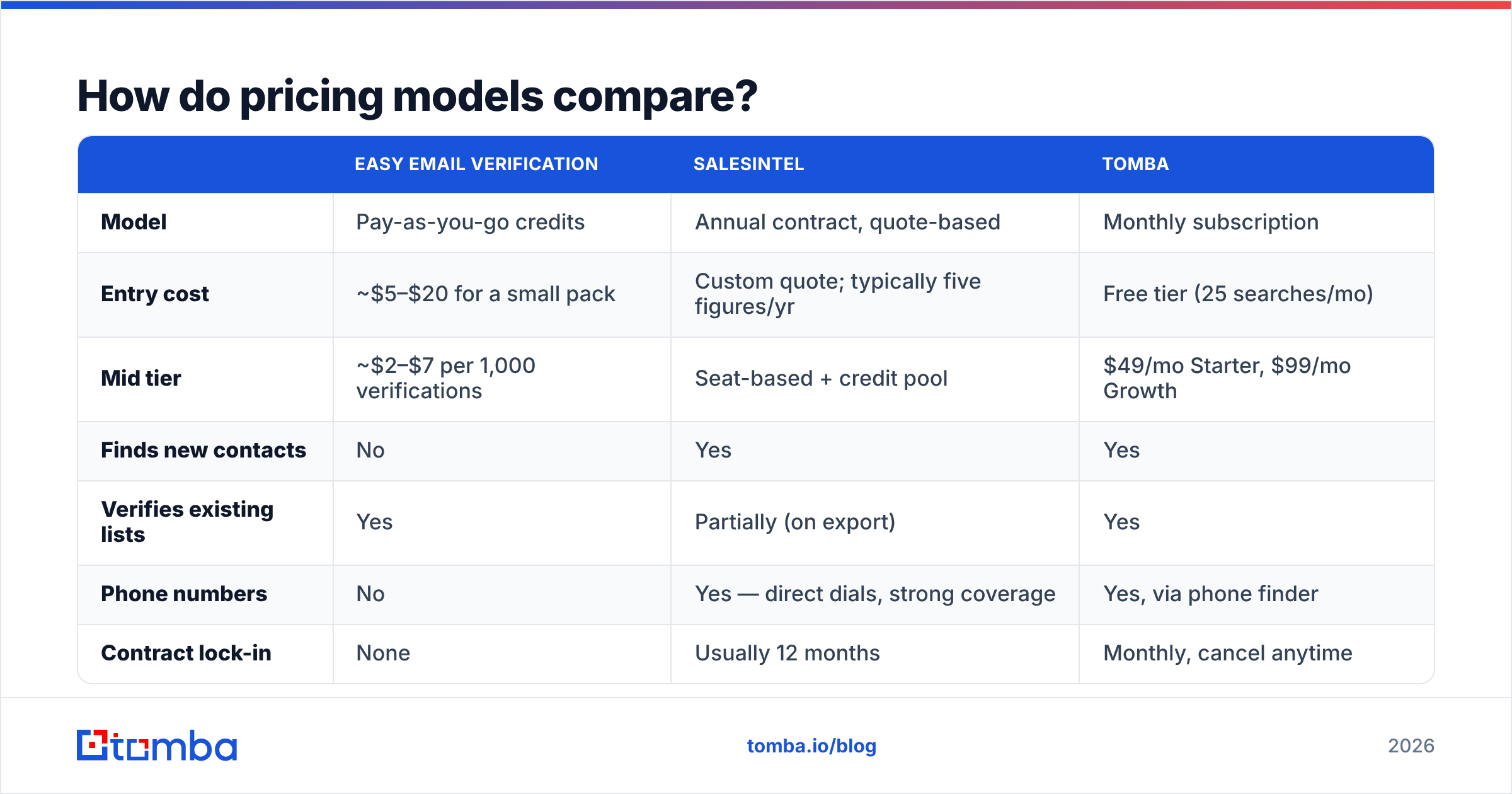
| Easy Email Verification | SalesIntel | Tomba | |
|---|---|---|---|
| Model | Pay-as-you-go credits | Annual contract, quote-based | Monthly subscription |
| Entry cost | ~$5–$20 for a small pack | Custom quote; typically five figures/yr | Free tier (25 searches/mo) |
| Mid tier | ~$2–$7 per 1,000 verifications | Seat-based + credit pool | $49/mo Starter, $99/mo Growth |
| Finds new contacts | No | Yes | Yes |
| Verifies existing lists | Yes | Partially (on export) | Yes |
| Phone numbers | No | Yes — direct dials, strong coverage | Yes, via phone finder |
| Contract lock-in | None | Usually 12 months | Monthly, cancel anytime |
| API access | Yes | Yes, on higher tiers | Yes, all paid tiers |
| Best for | Cleaning a list you already own | Enterprise ABM with dial-heavy motion | SMB/mid-market find + verify |
Verification pricing moves often and volume discounts are steep, so check the current published rate before you budget. SalesIntel publishes no list pricing at all. That is standard for enterprise data vendors, but it means a demo, a discovery call, and a quote shaped by seat count and credit volume.
The practical implication is simple. Verification is an operating expense you can switch on and off. Enterprise contact data is a committed cost you carry for twelve months, whether or not your team hits quota. Model that before you sign anything.
Which one is more accurate?#
Wrong question — they measure different things.
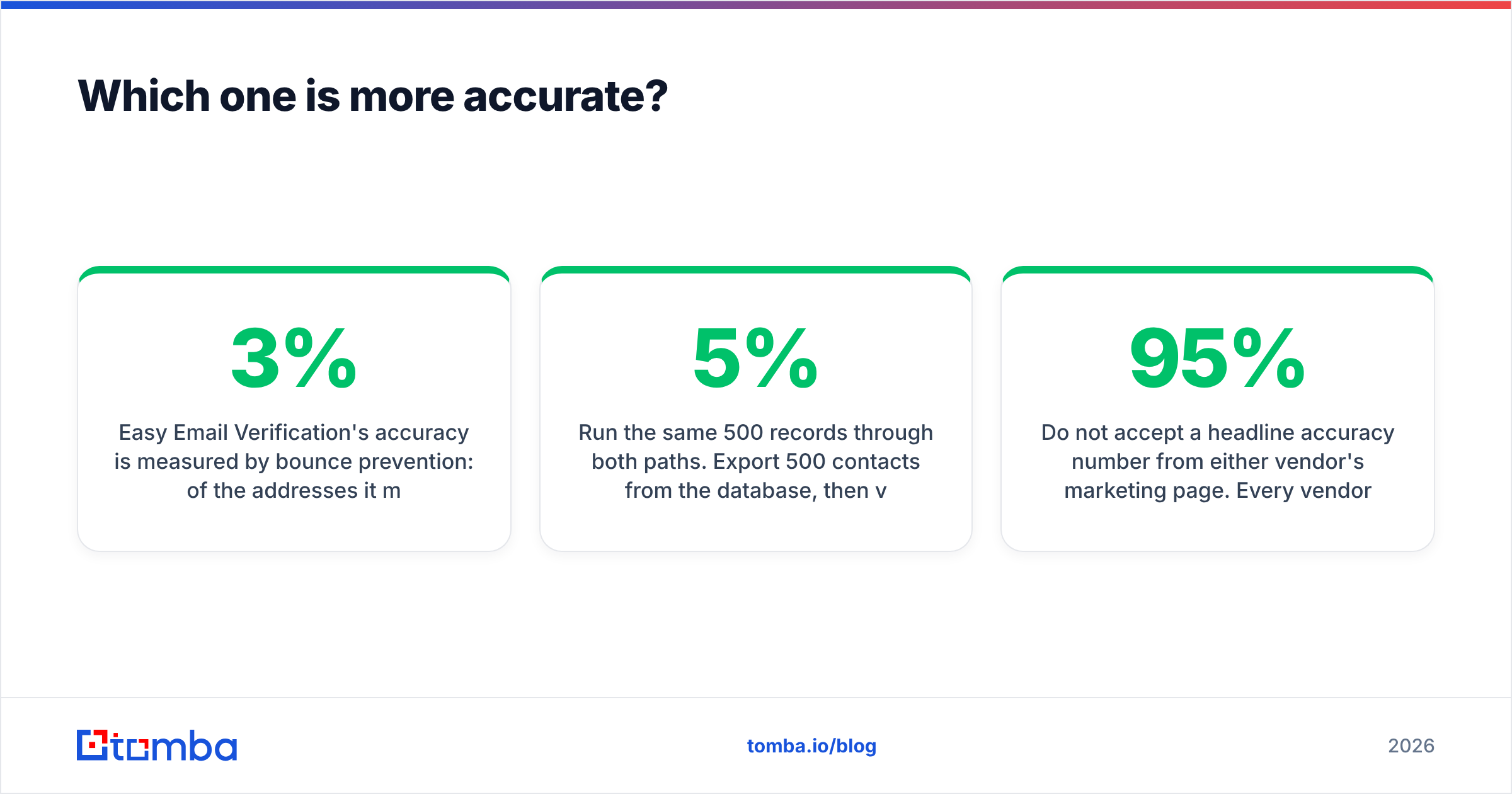
Easy Email Verification's accuracy is measured by bounce prevention. Of the addresses it marked valid, how many actually delivered? Any competent verifier should keep you under 2–3% bounce on a normal B2B list. Above 5%, you are in email deliverability trouble. Google and Microsoft both read a high bounce rate as a spam signal. Once your sender reputation drops, no amount of clever copywriting rescues the campaign.
SalesIntel's accuracy is measured by coverage and freshness. Of the contacts you searched for, how many did it have, and were the records current? The human-verification pitch targets exactly this, and the claim is defensible: a researcher confirming a title change catches something no crawler will.

Two things to test in any trial, whatever the vendor:
- Run the same 500 records through both paths. Export 500 contacts from the database, then verify them independently. If more than 5% come back invalid or risky, the "verified on export" claim is not doing enough work. You need the standalone verification step anyway.
- Measure coverage on your own ICP, not the vendor's demo list. Every data vendor looks excellent on US SaaS companies with 200–2,000 employees. Run your real target list — the German manufacturers and the 15-person agencies included — and count the misses.
Do not take a headline accuracy number from either vendor's marketing page. Every vendor here quotes 95%+ using its own definition of the denominator.
What does the full feature comparison look like?#

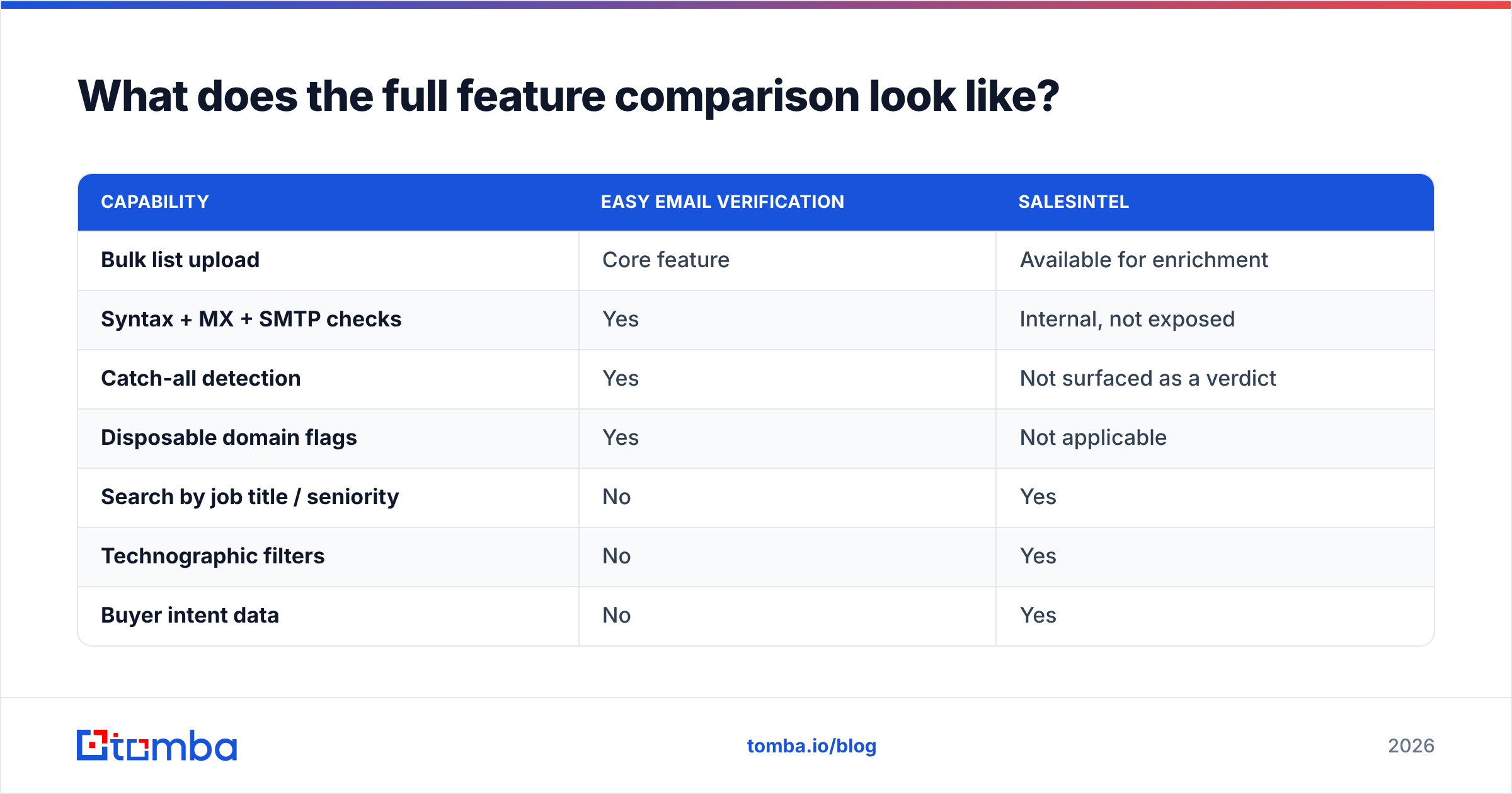
| Capability | Easy Email Verification | SalesIntel |
|---|---|---|
| Bulk list upload | Core feature | Available for enrichment |
| Syntax + MX + SMTP checks | Yes | Internal, not exposed |
| Catch-all detection | Yes | Not surfaced as a verdict |
| Disposable domain flags | Yes | Not applicable |
| Search by job title / seniority | No | Yes |
| Technographic filters | No | Yes |
| Buyer intent data | No | Yes |
| Direct dial phone numbers | No | Yes — a core strength |
| Research-on-demand for missing contacts | No | Yes |
| CRM native sync | Limited | Salesforce, HubSpot, others |
| Chrome extension | No | Yes |
| Self-serve signup | Yes | Demo required |
Read that table as two shopping lists, not as a scoreboard. If the rows you care about cluster in the top half, buy a verifier. If they cluster in the bottom half, buy a database. If you circled rows in both halves — which most teams do — keep reading.

When should you pick each one?#
Pick a standalone verifier like Easy Email Verification when:
- You inherited a list — a trade show export, a webinar signup sheet, a previous rep's spreadsheet — and you don't know how old it is.
- Your bounce rate crossed 4% and your deliverability is degrading.
- You already have a data source you like, and you just need a hygiene layer in front of your sending tool.
- Your volume is spiky. Pay-as-you-go means a 50,000-record cleanup in March costs you nothing in April.
Pick SalesIntel when:
- You run account-based marketing against a defined enterprise list and need depth per account, not breadth.
- Phone is a real channel for you. If your reps dial, direct-dial coverage justifies much of the price gap on its own.
- You need intent signals feeding your territory planning and your revenue operations reporting.
- You have the budget and headcount for an annual commitment, plus someone who will own data hygiene inside the CRM.
Pick neither when: you're a founder, a two-person sales team, or an agency running outbound for clients. At that scale an enterprise contract is unjustifiable, and a verifier alone leaves you with nothing to verify.
Where does Tomba fit between the two?#
Tomba covers the middle ground that neither tool addresses alone. It finds the address and verifies it in the same workflow, on a monthly subscription.
The practical workflow looks like this:
- Start with a company domain. Run domain search to pull every discoverable address at that company, with roles and confidence scores attached.
- Target specific people. Feed a first name, last name, and domain into the email finder and get the address plus the company's detected pattern.
- Verify before sending. Every result runs through the email verifier, catch-all handling included, so you don't stack a second subscription on top.
- Enrich what matters. Add phone numbers, LinkedIn profiles, and firmographics through data enrichment where a record justifies it.
- Scale it into your stack. The Tomba API, Chrome extension, and Google Sheets add-on cover the three ways teams actually work.
Where Tomba does not match SalesIntel: research-on-demand, deep intent data, and the enterprise-grade dial coverage SalesIntel has spent years building. If those are the reasons you're evaluating, SalesIntel is a legitimate buy, and no self-serve tool will replace it. If they're not, an enterprise contract is a lot of money for features you'll never open. Most teams just need accurate addresses at a sane price, with verification built in.
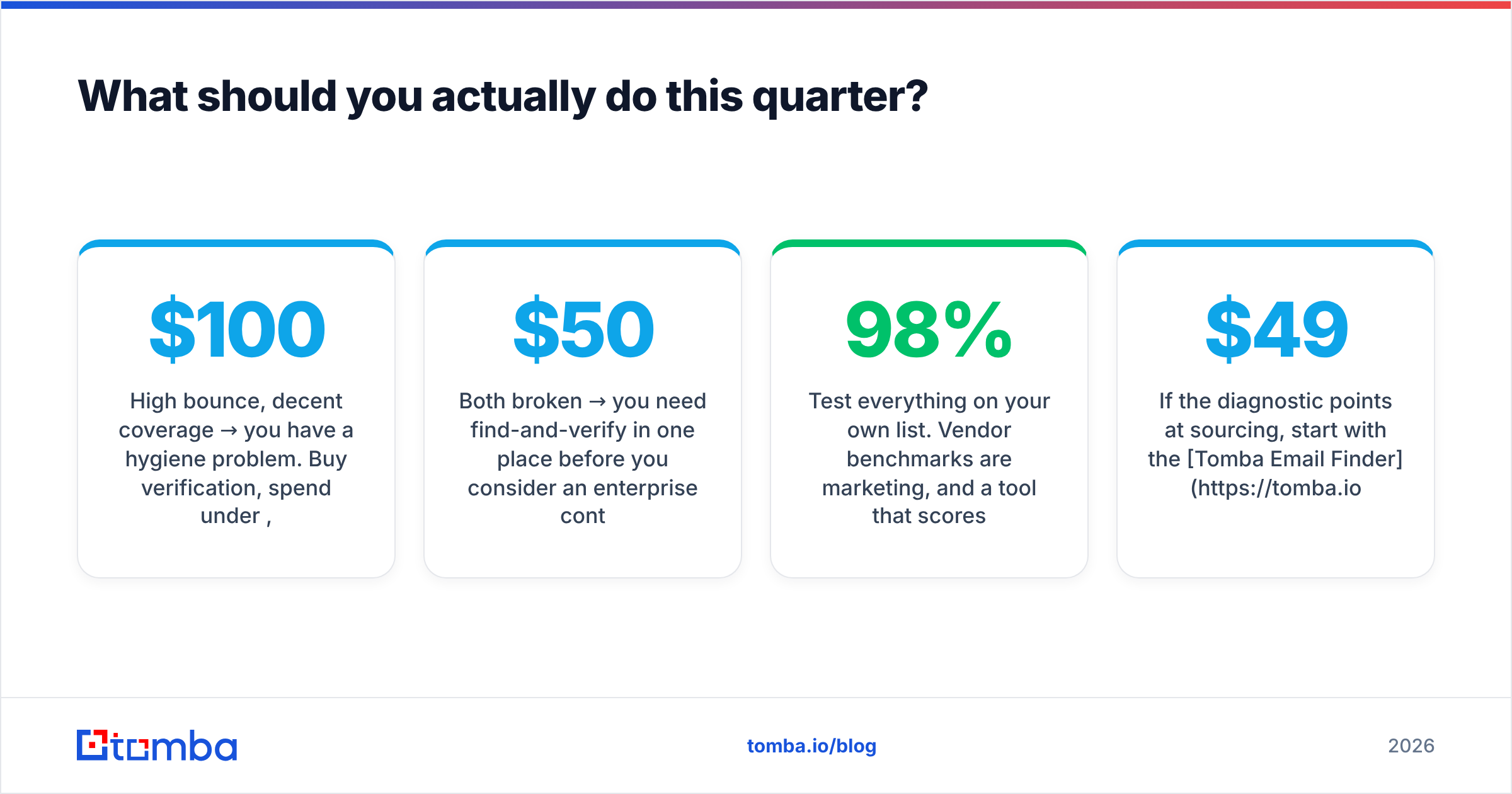
What should you actually do this quarter?#
The honest answer to Easy Email Verification vs SalesIntel depends on your own numbers, so run the diagnostic before you run the demos. Pull your last 1,000 sends and count three things: hard bounce rate, reply rate, and how many target accounts you could not find a single contact for.
- High bounce, decent coverage → you have a hygiene problem. Buy verification, spend under $100, fix it this week.
- Low bounce, poor coverage → you have a sourcing problem. Verification changes nothing. Trial a data provider against your real ICP list.
- Both broken → you need find-and-verify in one place before you consider an enterprise contract, or you'll pay enterprise rates to solve a $50 problem.
Test everything on your own list. Vendor benchmarks are marketing. A tool that scores 98% on US tech companies can score 60% in your market.
If the diagnostic points at sourcing, start with the Tomba Email Finder. The free tier gives you 25 searches a month to test coverage against real target accounts — no demo call, no annual commitment. Paid plans start at $49/mo with verification, domain search, and API access included, not sold as separate line items. Find the addresses, verify them in the same pass, and put the saved budget into the channel that books meetings.
Related guides#
Ready to find emails that actually work?
Join 150,000+ professionals who stopped guessing and started sending. Free credits on signup — no credit card required.
Get the Tomba newsletter
Practical outbound tactics and product updates — once every two weeks.
About the author