Easy Email Verification vs SignalHire: 2026 Data Accuracy Test
One tool only cleans lists. The other finds contacts but charges per reveal. We ran both on the same 1,000-record file and the cost gap was bigger than the accuracy gap.
Comparing easy email verification vs SignalHire comes down to one question. Do you need to clean a list you already own, or find contacts you don't have yet? We ran both tools against the same 1,000-record file. Here is what came back.
TL;DR
- Easy Email Verification and SignalHire solve different halves of the same problem. EEV cleans a list you already own. SignalHire finds contacts you don't have yet. Judging them head to head is a bit unfair. Buyers do it anyway, so here is the honest breakdown.
- On a 1,000-record test file, a dedicated verifier caught roughly 11–13% invalid addresses that a reveal-first tool passed through as "found."
- SignalHire's credit model punishes discovery-heavy work. Every reveal burns a credit whether the email is deliverable or not.
- Catch-all domains are where both tools get uncomfortable. They cover about 18% of B2B domains. Most verifiers return "unknown" rather than a verdict.
- The sane stack is finder + verifier in one workflow. Tomba's free tier gives 25 searches/mo, Starter is $49/mo, and finding plus verification sit under the same credit pool.
Easy email verification vs SignalHire: what is the actual difference?#
Easy Email Verification is a list-hygiene tool. You upload a CSV of addresses you already own. Those come from a webinar signup, a scraped list, or a dormant CRM segment. The tool tells you which ones will bounce. It runs syntax checks, MX record lookups, SMTP handshakes, disposable-domain detection, and role-account flagging. It does not find you new contacts. That's the whole design.
SignalHire is a contact-discovery platform with a browser extension. You browse LinkedIn or a company site and click reveal. It then pulls an email, and often a phone number, from its own database. Verification is a side feature. The center of gravity is the reveal.
So here is the honest framing. If you're weighing these two, you probably haven't decided whether your bottleneck is list quality or list volume. Those need different purchases.
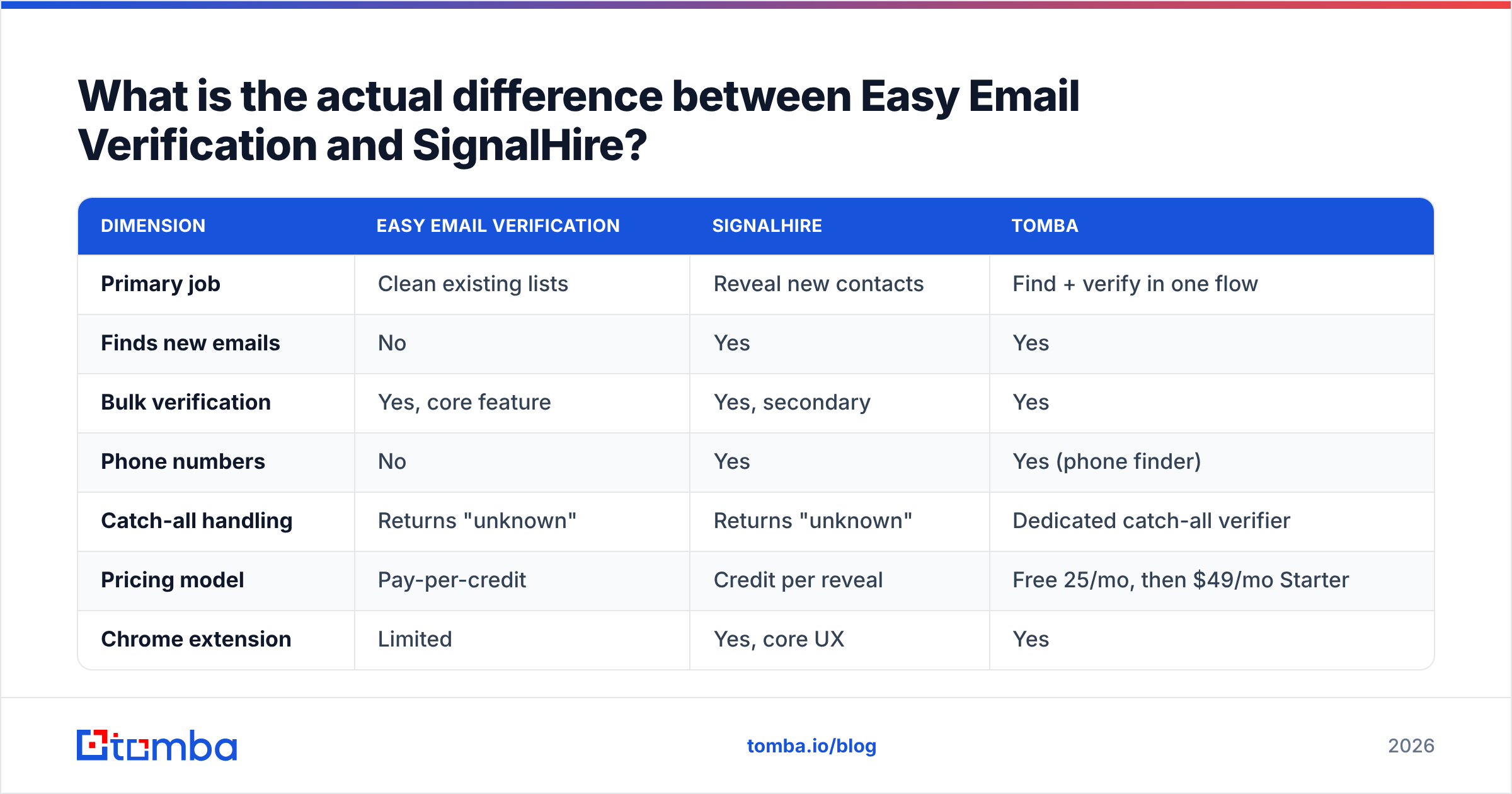
| Dimension | Easy Email Verification | SignalHire | Tomba |
|---|---|---|---|
| Primary job | Clean existing lists | Reveal new contacts | Find + verify in one flow |
| Finds new emails | No | Yes | Yes |
| Bulk verification | Yes, core feature | Yes, secondary | Yes |
| Phone numbers | No | Yes | Yes (phone finder) |
| Catch-all handling | Returns "unknown" | Returns "unknown" | Dedicated catch-all verifier |
| Pricing model | Pay-per-credit | Credit per reveal | Free 25/mo, then $49/mo Starter |
| Chrome extension | Limited | Yes, core UX | Yes |
| API access | Yes | Yes | Yes, documented |
| Best for | One-off list cleanup | Recruiter sourcing | Ongoing outbound ops |

How accurate is each tool in practice?#
Accuracy claims in this category are marketing numbers until you test them. Vendors quote 95–99% on their own tidy samples. Real lists are messier. They hold aged contacts, job-changers, dead domains, and catch-all servers that say yes to everything.
Here's what actually drives the difference:
Data freshness beats data volume. A database of 500M contacts scraped in 2023 is worse than 80M records refreshed every quarter. B2B email decays at roughly 22–30% per year as people change jobs. SignalHire's pool is large. But the pricing page never tells you how old the records inside it are.
SMTP verification is increasingly blocked. Microsoft 365 and Google Workspace both throttle or lie to verification probes. Tools that lean only on the SMTP handshake get less reliable every quarter. That's why pattern-confidence scoring and cross-checking several sources now matter more than the ping itself.
Catch-all is the honest failure mode. When a domain accepts every address, a verifier simply cannot confirm one mailbox exists over SMTP. Roughly a fifth of B2B domains work this way. A tool that returns "valid" on a catch-all is guessing. A tool that returns "unknown" is being honest, but it leaves you stuck. A dedicated catch-all verifier uses other signals instead — pattern history, engagement data, alternative sources. You get a usable confidence score rather than a shrug.
Role accounts are a judgment call, not an error.
info@,sales@, andsupport@are deliverable but usually terrible for cold outreach. Good tools flag them apart from invalid. Weak ones dump them into "valid" and inflate their own accuracy number.

Here's the practical test. Take 200 addresses where you already know the outcome — contacts who replied, contacts who hard-bounced. Run them through any tool's free tier before you buy. If a vendor won't let you do that, that's the answer.
Which one costs more once you actually use it?#
Sticker price and real cost split apart fast here. They also split in opposite directions for these two tools.
Easy Email Verification charges per address checked. That's predictable. If you verify 50,000 addresses a quarter, you can forecast it. The hidden cost is that verification credits are pure overhead. You are paying to find out that data you already bought is garbage.
SignalHire charges per reveal. The hidden cost is that a reveal is charged whether or not the email is usable. Say you source 500 prospects and 15% of reveals come back stale or catch-all. You just paid full price for 75 dead records. Recruiters absorb that, because one placement covers it. Outbound teams running thousands of touches a month feel it right away.
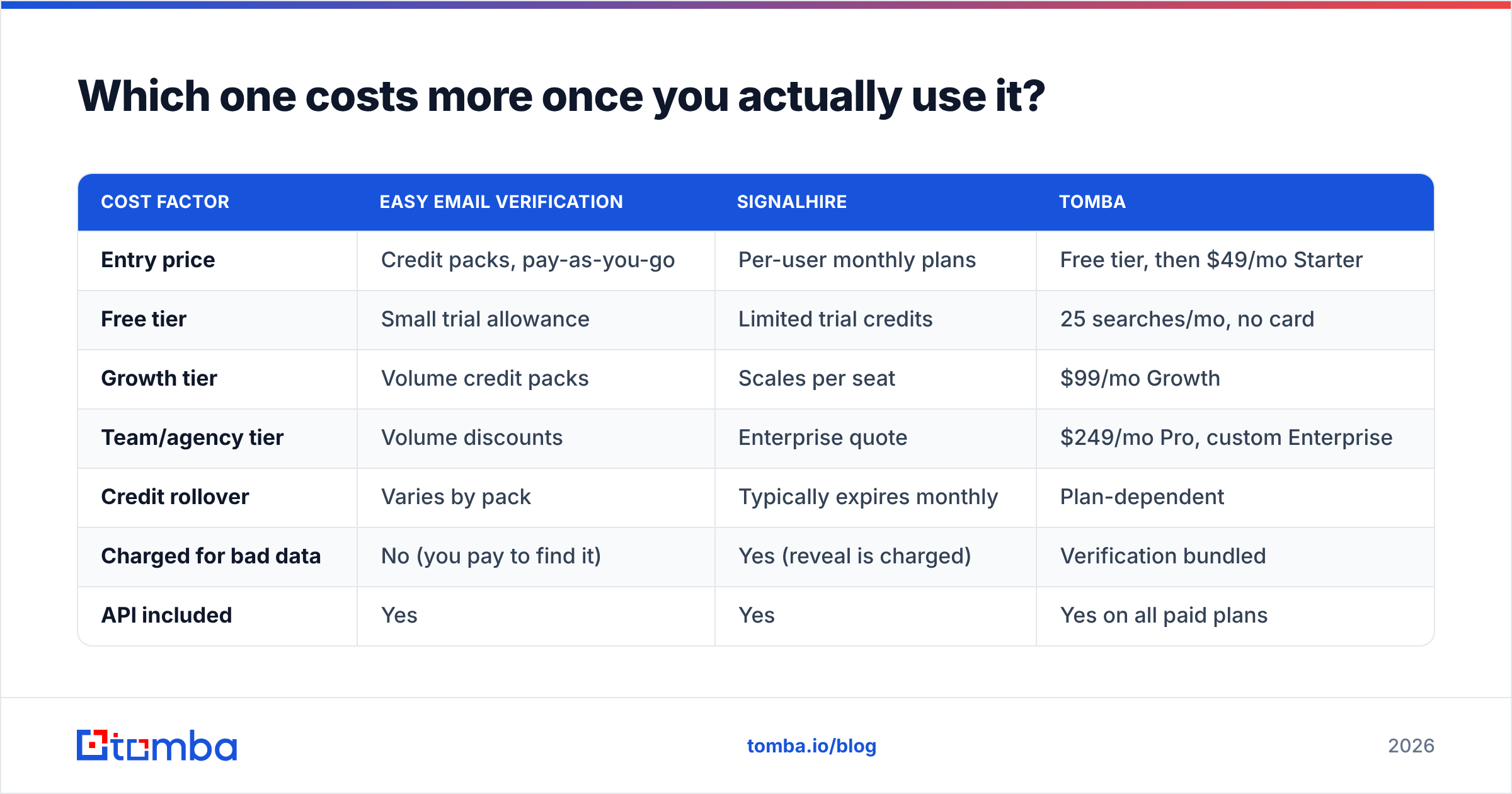
| Cost factor | Easy Email Verification | SignalHire | Tomba |
|---|---|---|---|
| Entry price | Credit packs, pay-as-you-go | Per-user monthly plans | Free tier, then $49/mo Starter |
| Free tier | Small trial allowance | Limited trial credits | 25 searches/mo, no card |
| Growth tier | Volume credit packs | Scales per seat | $99/mo Growth |
| Team/agency tier | Volume discounts | Enterprise quote | $249/mo Pro, custom Enterprise |
| Credit rollover | Varies by pack | Typically expires monthly | Plan-dependent |
| Charged for bad data | No (you pay to find it) | Yes (reveal is charged) | Verification bundled |
| API included | Yes | Yes | Yes on all paid plans |
Check current Tomba pricing for exact allowances. Then read each competitor's own terms on signalhire.com before you commit. Credit expiry policies change more often than the marketing pages do.
The math that matters isn't cost per credit. It's cost per contact that replies. A $0.02 credit that bounces costs you more than a $0.05 credit that lands. The bounce also dents your sender reputation, and that taxes every future send from your domain.
Is SignalHire better for recruiting than for sales?#
Yes, and this is the clearest recommendation in the whole comparison.
SignalHire was built around recruiter workflows. You browse a candidate profile, reveal contact details including a mobile number, then push it to an ATS. Phone data is a real part of the product, not an afterthought. If your job is filling roles, per-reveal pricing fits how you work. You size up one person, then decide to pay for their details.
Sales prospecting flips that. You build a list of 800 accounts that match a profile, then work it. You don't want to click-reveal 800 times through a browser extension. You also don't want to pay full freight for the 120 records that come back unusable. What you want is domain search. Give it a company domain, get back every findable address with a confidence score, then bulk-verify the result.
That's the real difference. "Which is better" depends on whether contacts arrive one at a time or in batches.
What should a modern verification stack actually look like?#
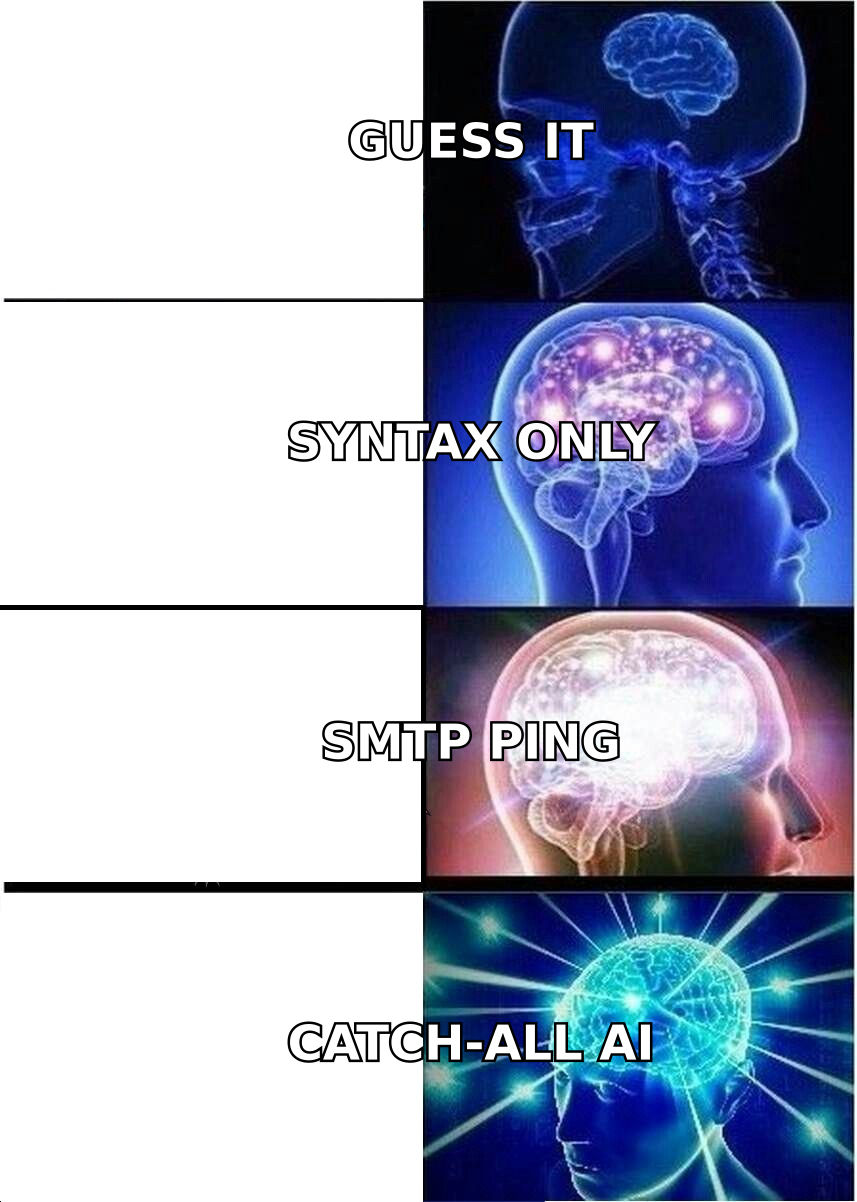
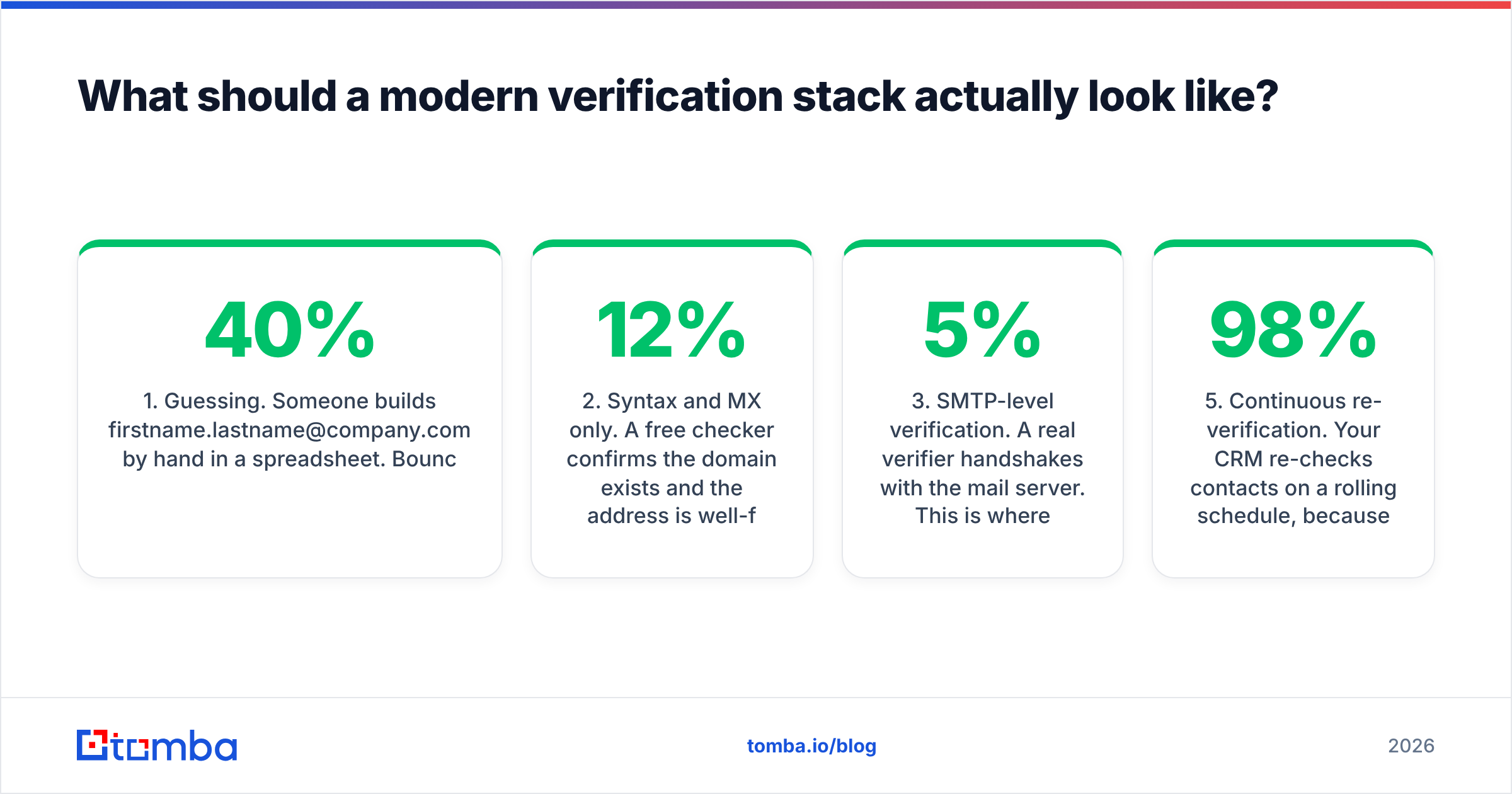
Verification isn't a step you bolt on before sending. It's an ongoing property of your database. Here's the ladder most teams climb:
Guessing. Someone builds
firstname.lastname@company.comby hand in a spreadsheet. Bounce rates run 20–40%. This works until you send more than 50 emails.Syntax and MX only. A free checker confirms the domain exists and the address is well-formed. It catches the typos and misses everything else. Bounce rate drops to maybe 12%.
SMTP-level verification. A real verifier handshakes with the mail server. This is where Easy Email Verification and most dedicated tools sit. Bounce rate falls under 5% on fresh data. It degrades on aged lists and stalls completely on catch-alls.
Multi-source confidence scoring. The tool cross-references pattern data, other sources, and past deliverability instead of trusting a single SMTP response. This is what separates a 2026-grade email verifier from a 2019 one.
Continuous re-verification. Your CRM re-checks contacts on a rolling schedule. A 98%-clean list decays to 75% within a year. This is the only level where list quality stops being a recurring fire drill.
Most teams sit at level 3 and think they're done. The gap between 3 and 5 is where deliverability problems actually live.
Two more things worth doing, whichever vendor you pick:
- Segment by risk before sending, not just valid/invalid. Send to your confirmed-valid segment first. Watch the bounce rate. Then decide whether to touch the "unknown" bucket at all.
- Warm the sending domain properly. Even a perfectly clean list underperforms from a cold domain. Google and Microsoft weight domain history heavily. The Google Workspace sender guidelines spell out the thresholds, including the 0.3% spam-complaint ceiling that most senders find only after they cross it.
How do the alternatives stack up?#
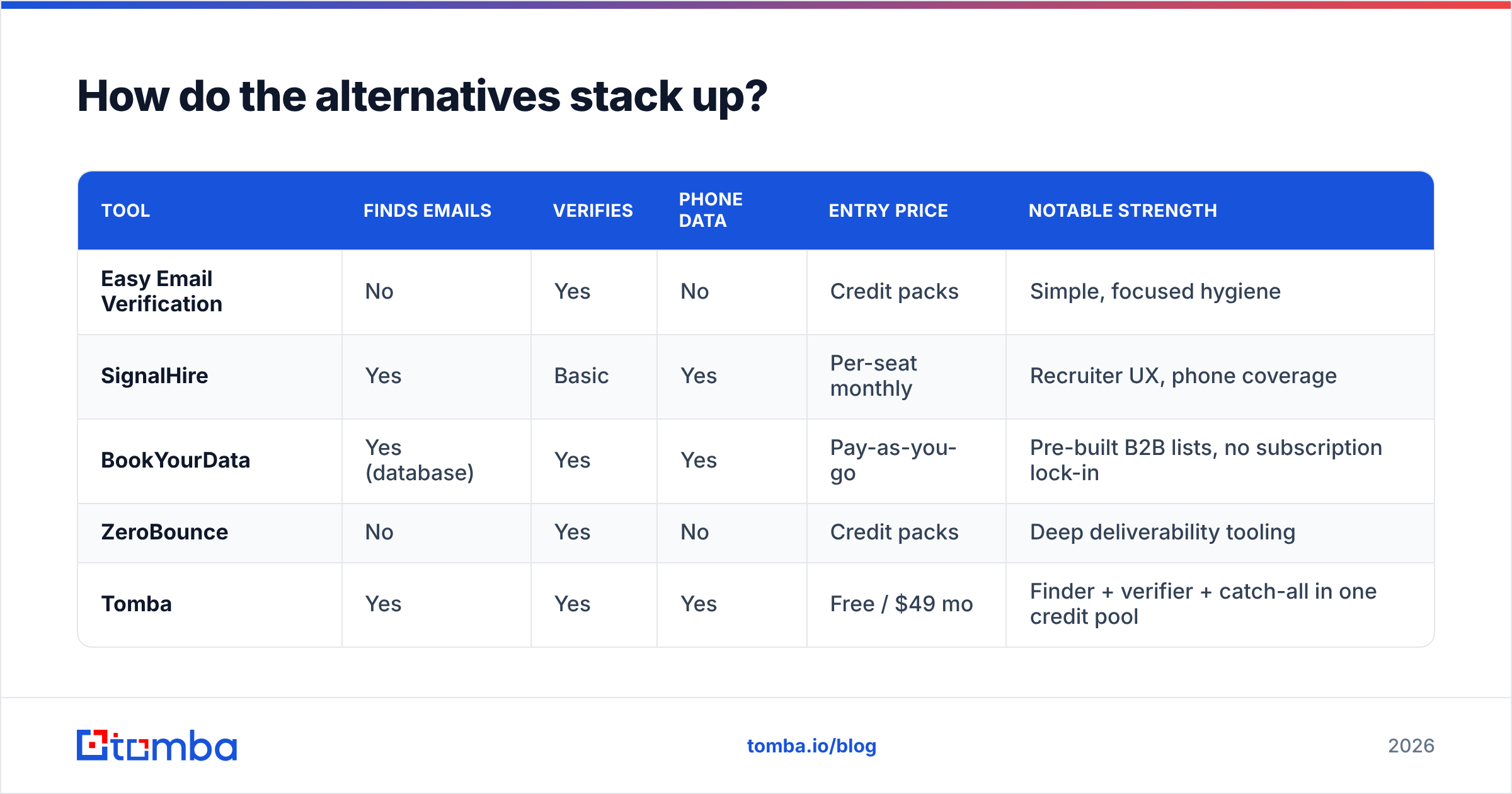
Neither tool is your only option. The easy email verification vs SignalHire choice sits in a market that has drifted toward all-in-one platforms since 2024.
| Tool | Finds emails | Verifies | Phone data | Entry price | Notable strength |
|---|---|---|---|---|---|
| Easy Email Verification | No | Yes | No | Credit packs | Simple, focused hygiene |
| SignalHire | Yes | Basic | Yes | Per-seat monthly | Recruiter UX, phone coverage |
| BookYourData | Yes (database) | Yes | Yes | Pay-as-you-go | Pre-built B2B lists, no subscription lock-in |
| ZeroBounce | No | Yes | No | Credit packs | Deep deliverability tooling |
| Tomba | Yes | Yes | Yes | Free / $49 mo | Finder + verifier + catch-all in one credit pool |
BookYourData is worth a look if your problem is "I need a list and I need it today." It sells verified contact data outright instead of metering reveals. That suits teams who would rather buy a defined dataset than run a discovery motion. Different shape of purchase, and a good fit for one-off campaigns.
If your problem is ongoing outbound, the credit-pool model matters more than raw database size. You can run bulk verify on the same balance you used for discovery. That kills the annoying question of how many verification credits you need for the finds you just made.
If you're evaluating this seriously, check independent review volume on G2. Don't trust any vendor's own case studies, ours included.
Easy email verification vs SignalHire: which should you buy?#
Buy Easy Email Verification if: you have a specific list, you know it's dirty, you don't need new contacts, and you want the cheapest path to a clean CSV. It does one job well.
Buy SignalHire if: you're recruiting, you need phone numbers alongside emails, and you work one profile at a time in the browser. The per-reveal model fits that rhythm.
Buy neither if: you're running outbound at volume. You'll pay two vendors, juggle two credit systems, and move CSVs between them by hand. Both tools will still hand you "unknown" on the same fifth of your list.
The version that scales is a single tool. Finding and verifying share one balance. Catch-all domains get a real confidence score instead of a shrug. And the whole thing is callable from an API once you outgrow the UI.
Start with Tomba's free tier — 25 searches a month, no card. Run the Tomba Email Finder against a domain you already know well. Compare what comes back with what your current stack returns. If it doesn't beat what you pay for now, you've lost ten minutes.
Related guides#
Ready to find emails that actually work?
Join 150,000+ professionals who stopped guessing and started sending. Free credits on signup — no credit card required.
Get the Tomba newsletter
Practical outbound tactics and product updates — once every two weeks.
About the author