Easy Email Verification vs ZoomInfo: Which Tool Wins in 2026?
One tool cleans lists for pennies. The other sells a full GTM data platform at enterprise prices. Here's the honest breakdown of where each one earns its cost — and where a cheaper stack beats both.
Easy Email Verification vs ZoomInfo is a comparison of two very different tools. One cleans the list you already have. The other sells you the list. Here's how to tell which one your budget actually needs.
TL;DR
- They solve different problems. Easy Email Verification is a list-hygiene tool. It tells you whether an address will bounce. ZoomInfo is a full go-to-market data platform, selling contacts, intent signals, and CRM enrichment. Comparing them only makes sense when you're deciding where your next data dollar goes.
- Price gap is roughly 30x. Verification runs at fractions of a cent per email. ZoomInfo contracts typically land in the $15,000–$40,000/year range, with annual commitments and seat minimums.
- Verification does not fix bad targeting. A clean list of the wrong people still fails. ZoomInfo's value is filtering and firmographics, not deliverability.
- Most teams under 20 reps don't need either extreme. A combined finder plus verifier (Tomba, BookYourData, Findymail) covers 80% of the workflow for a fraction of ZoomInfo's cost.
- The right test is bounce rate and reply rate together. Optimize only one and you'll waste budget on the other.
Easy Email Verification vs ZoomInfo: what is the actual difference?#
Think of it like buying groceries. A verifier is the person at the checkout who checks whether the milk has expired. ZoomInfo is the supermarket itself — it decides what's on the shelves in the first place. You can have the best expiry checker in the world and still go home with the wrong food.
Easy Email Verification belongs to the standalone verifier category, alongside ZeroBounce, NeverBounce, Bouncer, and Debounce. It does one job. You hand it an address you already have. It runs syntax checks, MX record lookups, SMTP handshakes, disposable-domain filters, and role-account detection. Then it returns one verdict: valid, invalid, catch-all, or unknown. That's the whole product. It's cheap, it's fast, and it's judged on one number — how close your bounce rate gets to zero.
ZoomInfo is a data platform. It sells a contact and company database, and claims well over 100 million professional profiles. On top of that sit intent data (via Bidstream and its Clickagy acquisition), technographic filters, org charts, a Chrome extension, and sequencing through ZoomInfo Engage. It also writes data back into Salesforce and HubSpot. Verification is a small feature inside all of that, not the product.
So the honest framing isn't "which is better." It's this: are you paying to clean data you already have, or paying to acquire data you don't?
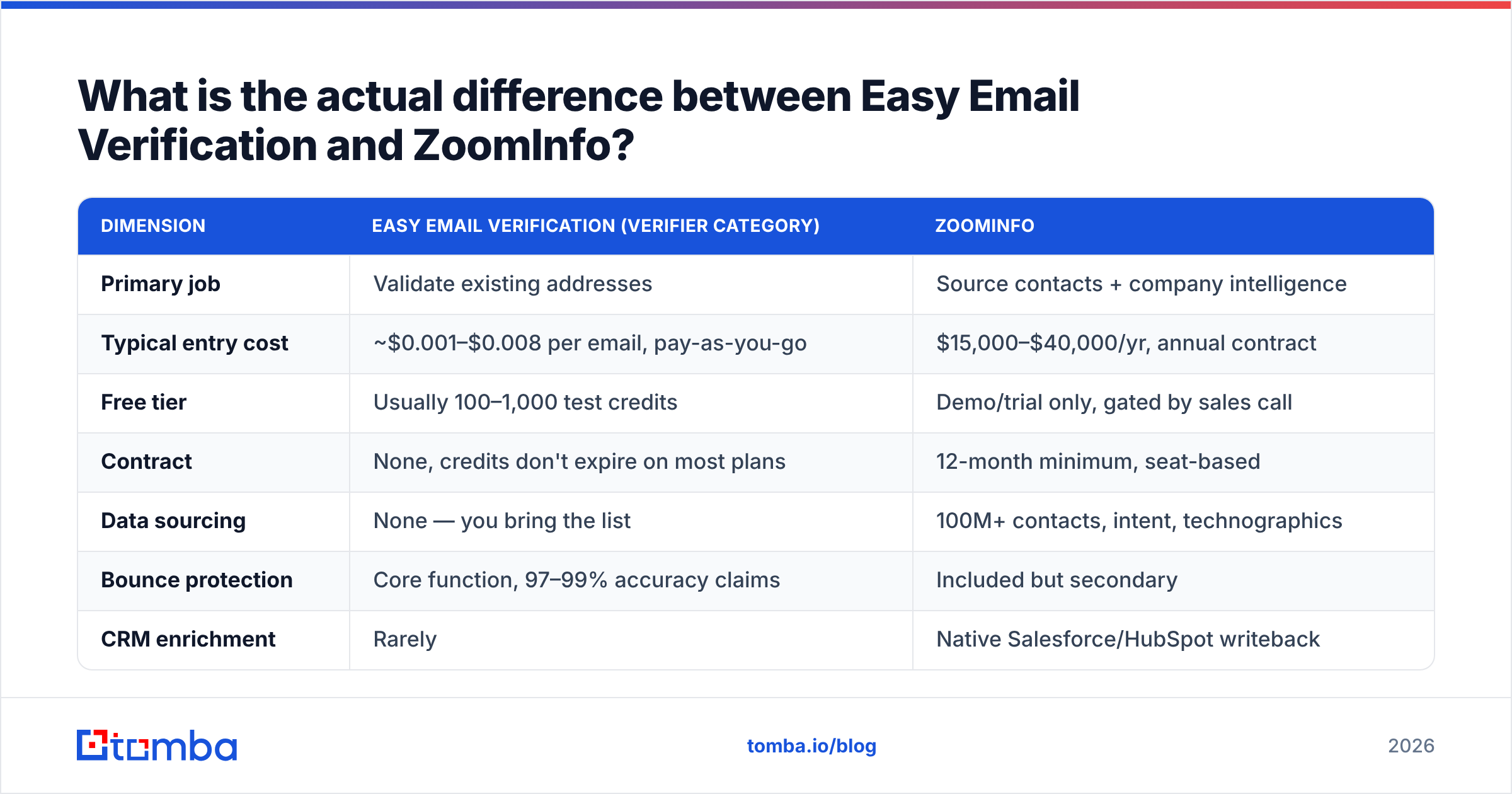
| Dimension | Easy Email Verification (verifier category) | ZoomInfo |
|---|---|---|
| Primary job | Validate existing addresses | Source contacts + company intelligence |
| Typical entry cost | ~$0.001–$0.008 per email, pay-as-you-go | $15,000–$40,000/yr, annual contract |
| Free tier | Usually 100–1,000 test credits | Demo/trial only, gated by sales call |
| Contract | None, credits don't expire on most plans | 12-month minimum, seat-based |
| Data sourcing | None — you bring the list | 100M+ contacts, intent, technographics |
| Bounce protection | Core function, 97–99% accuracy claims | Included but secondary |
| CRM enrichment | Rarely | Native Salesforce/HubSpot writeback |
| Best for | Cleaning scraped or aged lists | Enterprise ABM and territory planning |
| Ramp time | Minutes | 2–6 weeks with onboarding |
Is ZoomInfo worth the price for a small team?#
Short answer: usually not. Their own pricing model tells you why.
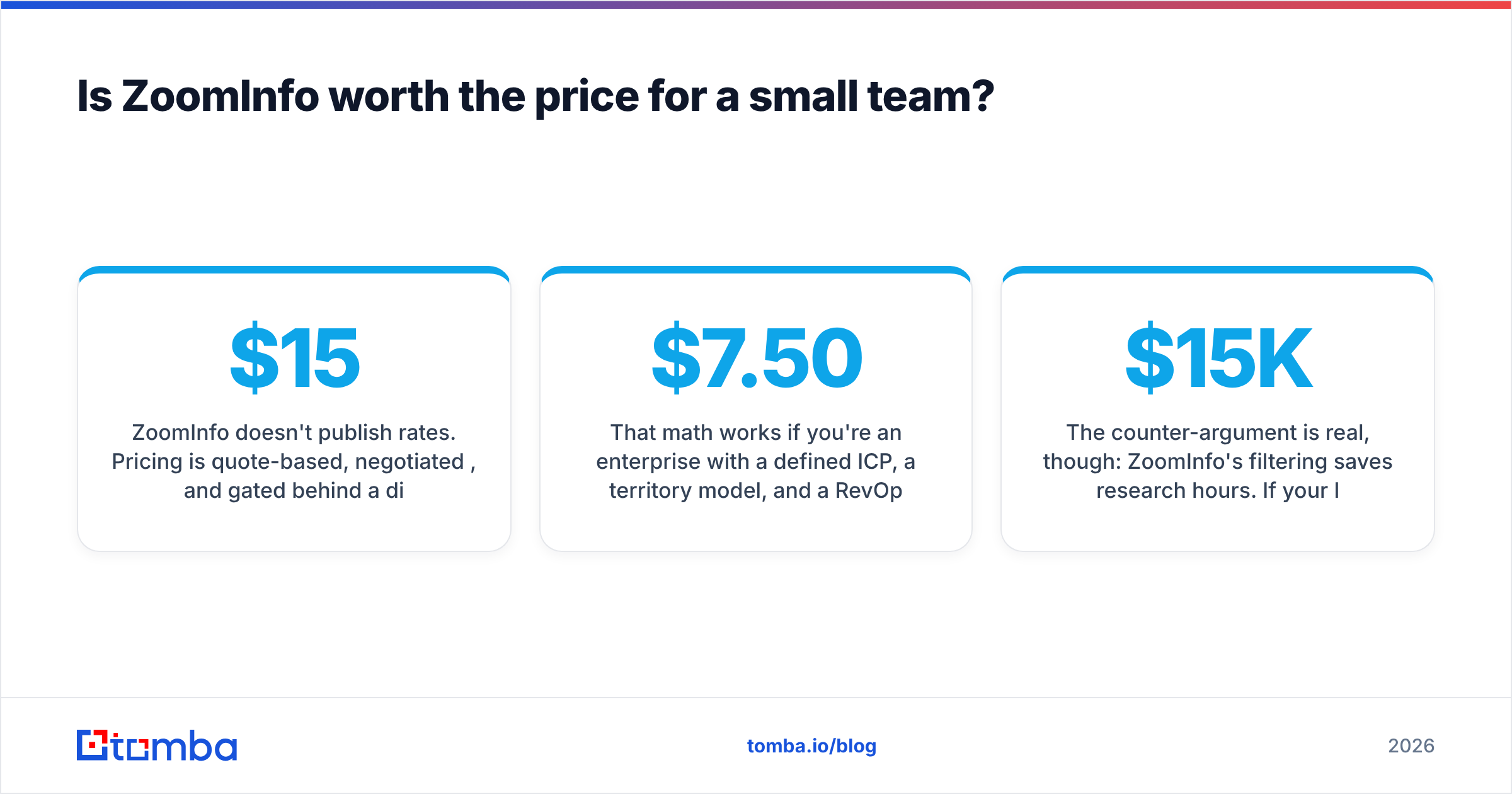
ZoomInfo doesn't publish rates. Pricing is quote-based and negotiated per seat. You have to book a discovery call to get a number — you can confirm that on zoominfo.com. Public user reports on G2 and Capterra point to entry contracts near $15,000 a year for a small seat count. That number climbs fast once you add intent data, Engage, or extra exports. Credit caps on contact exports are a common complaint. Teams describe hitting their export limit mid-quarter, then being asked to buy an add-on package.
That math works if you're an enterprise. You need a defined ICP, a territory model, and a RevOps team that can turn intent signals into real plays. It works badly for a five-person team sending 2,000 emails a month. At that volume you pay roughly $7.50 per contact touched — before you write a single line of copy.

The counter-argument is real, though. ZoomInfo's filtering saves research hours. Say your ICP is "VP of Engineering at US SaaS companies with 200–1,000 employees using Kubernetes." Building that list by hand burns a lot of SDR time. ZoomInfo returns it in one query. Whether that saving beats $15K a year is simple arithmetic, and it turns on your fully-loaded cost per rep.
Does email verification actually improve deliverability?#
Yes — but only the part it controls. And that part is smaller than most vendors imply.
Verification prevents hard bounces. Hard bounces feed into sender reputation, and mailbox providers weigh them heavily. Google's guidance for bulk senders caps spam complaints at 0.3%. It also expects authenticated mail with SPF, DKIM, and DMARC — see Google's sender guidelines for the current rules. A list with a 12% bounce rate will get you throttled or filtered, no matter how good your copy is.
What verification does not fix:
- Authentication gaps. No SPF, DKIM, or DMARC record means filtering, whatever your list quality. Run an SPF checker before you blame your list.
- Cold domain reputation. A brand-new sending domain has no history, so it gets throttled even with a perfect list. Warmup is a separate discipline.
- Spam complaints. Valid addresses can still mark you as spam. That's a targeting and copy problem.
- Content triggers. Link-heavy HTML, spammy subject lines, and mismatched reply-to headers cause filtering that verification never touches.
- Volume ramping. Sending 5,000 emails on day one from a clean list still looks like an attack to mailbox providers.
The practical takeaway: verification is necessary but not enough on its own. Budget for it as table stakes, not as a deliverability strategy. For the whole picture, read up on email deliverability fundamentals first.

How do accuracy claims compare in practice?#
Every verifier claims 97–99% accuracy. Every database claims 95%+ data accuracy. The two numbers are measured differently, and neither is auditable from the outside.
Here's what those claims actually mean:
- Verifier accuracy usually measures one thing: how often the tool's verdict matches the mailbox provider's real response on a benchmark list. It leaves out catch-all domains, which are the hard cases. A tool can report 99% accuracy while marking 30% of your list "unknown." It has quietly handed the problem back to you.
- Database accuracy measures whether a record was correct at the last refresh. ZoomInfo refreshes often and runs a large contributory network, which is a genuine strength. But B2B contacts change jobs at roughly 25–30% a year. Even a well-kept database drifts between refreshes.
The catch-all question is where most comparisons fall apart. Roughly 15–25% of B2B domains accept all mail at the server level. A standard SMTP handshake can't tell you whether a specific mailbox exists there. Some tools mark these "risky" and stop. Others score pattern confidence and behavioral signals to give a real verdict. That's what a dedicated catch-all verifier does, and it's the single biggest gap between verification tools in 2026.

What does a combined finder plus verifier stack look like?#
This is the option most comparison posts skip. It's also the one that fits the majority of teams.
Instead of buying a $15K database contract plus a separate verification subscription, you use one platform. It finds addresses by domain or name, then verifies them in the same call. The workflow collapses from four tools to one.
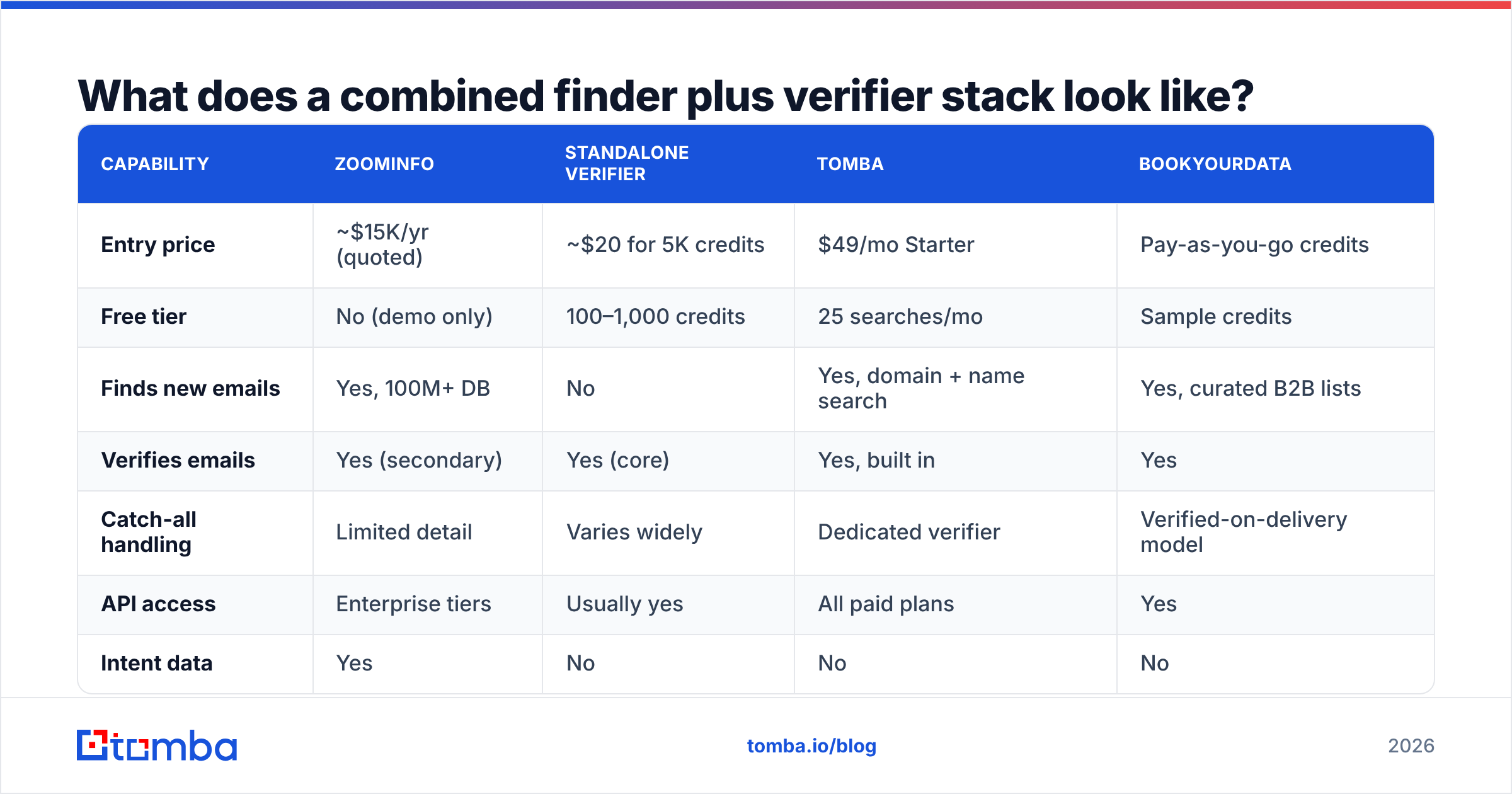
| Capability | ZoomInfo | Standalone verifier | Tomba | BookYourData |
|---|---|---|---|---|
| Entry price | ~$15K/yr (quoted) | ~$20 for 5K credits | $49/mo Starter | Pay-as-you-go credits |
| Free tier | No (demo only) | 100–1,000 credits | 25 searches/mo | Sample credits |
| Finds new emails | Yes, 100M+ DB | No | Yes, domain + name search | Yes, curated B2B lists |
| Verifies emails | Yes (secondary) | Yes (core) | Yes, built in | Yes |
| Catch-all handling | Limited detail | Varies widely | Dedicated verifier | Verified-on-delivery model |
| API access | Enterprise tiers | Usually yes | All paid plans | Yes |
| Intent data | Yes | No | No | No |
| Contract | 12-month minimum | None | Monthly | None |
BookYourData is worth naming because it takes a different position. It doesn't sell database access and leave you to sort out validity. It sells verified contacts with a delivery guarantee. If your objection to ZoomInfo is "I'm paying for records that bounce," that model answers it directly — and without the enterprise contract.
Tomba's angle is different again. It's built around the email finder as the main product. The email verifier, domain search, phone finder, and enrichment sit alongside it. Tomba pricing starts free at 25 searches a month, then $49/mo Starter, $99/mo Growth, and $249/mo Pro. No annual commitment. No seat minimums. No discovery call. If you need 2,000 valid contacts a quarter, that's the whole job.

When should you actually choose ZoomInfo?#
Being fair to the expensive option: there are cases where nothing else works.
Choose ZoomInfo if:
- You run account-based marketing across hundreds of target accounts, and you need org charts, not just email addresses.
- Intent data really changes what you work first. You have the RevOps maturity to route those signals into a live play, not just a dashboard nobody opens.
- Territory planning depends on firmographic precision: headcount by department, revenue bands, tech stack.
- You have a CRM enrichment problem at scale — 50,000+ stale records that need automated refresh.
- Your average contract value is high enough that one extra closed deal a year pays for the platform.
Skip ZoomInfo if:
- Your ICP is narrow enough to list by hand, or your target companies are known by name.
- You're under 20 reps and have no RevOps function to put the data to work.
- You send fewer than 10,000 emails a month.
- Your bottleneck is copy and offer, not list volume. (It usually is.)
- You sell mainly outside North America. ZoomInfo's coverage skews heavily US, and EMEA/APAC data quality drops noticeably.
That last point matters more than it gets credit for. If your market is European, GDPR-compliant sourcing and regional coverage beat raw database size every time.
What should you measure to know if either tool is working?#
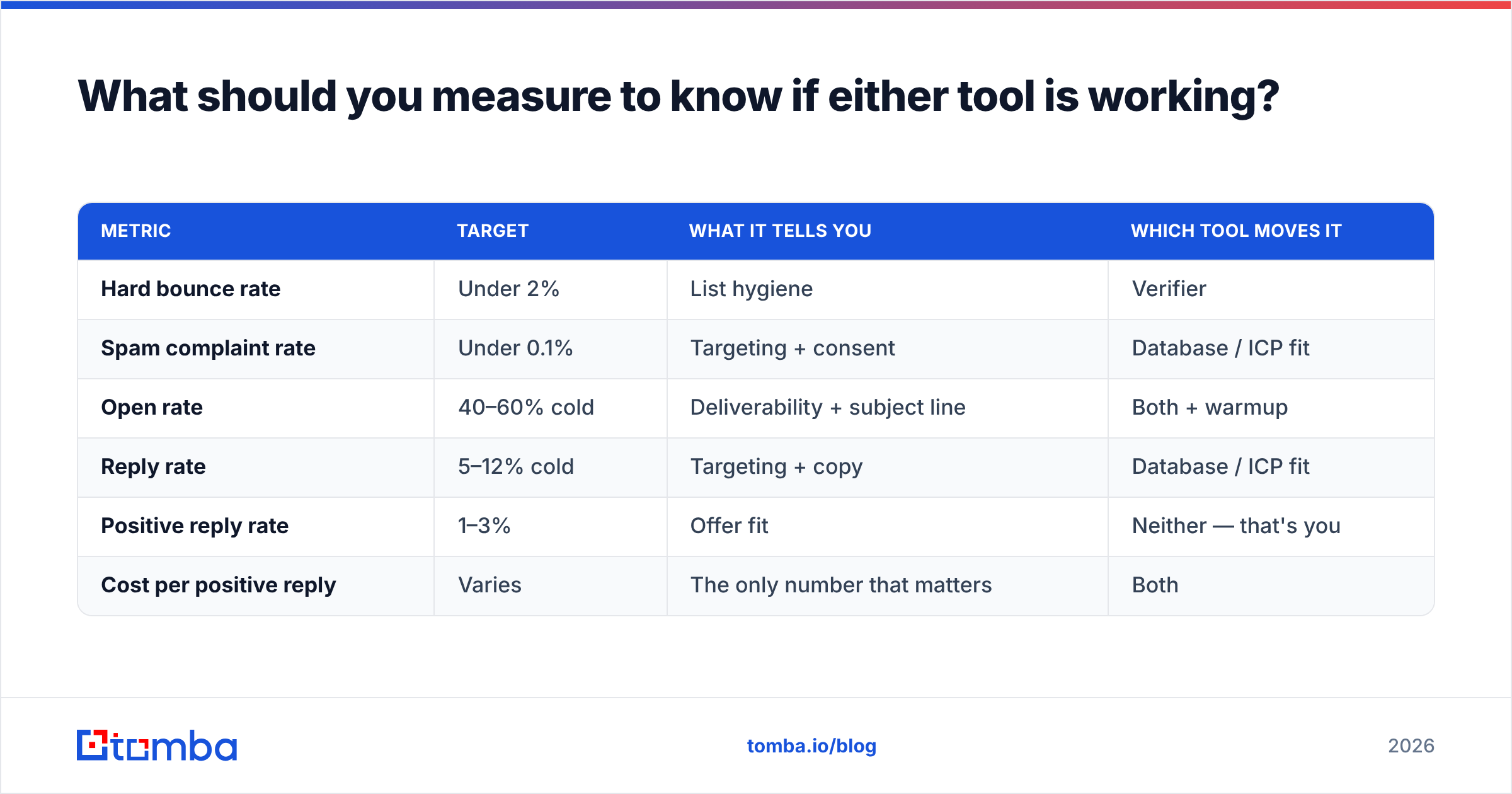
Pick metrics that isolate the variable each tool controls. Otherwise you'll credit the wrong tool for a win.
| Metric | Target | What it tells you | Which tool moves it |
|---|---|---|---|
| Hard bounce rate | Under 2% | List hygiene | Verifier |
| Spam complaint rate | Under 0.1% | Targeting + consent | Database / ICP fit |
| Open rate | 40–60% cold | Deliverability + subject line | Both + warmup |
| Reply rate | 5–12% cold | Targeting + copy | Database / ICP fit |
| Positive reply rate | 1–3% | Offer fit | Neither — that's you |
| Cost per positive reply | Varies | The only number that matters | Both |
Run the last row before you renew anything. Total tool spend divided by positive replies gives you a number you can compare across stacks. A team paying $15K a year for 60 positive replies is at $250 each. A team paying $1,188 a year for 40 is at $30 each. The expensive stack has to produce dramatically better meetings to justify that gap. Sometimes it does. Often it doesn't.
Also track your unknown/catch-all rate over time. If a verifier returns "unknown" on a quarter of your list, you're doing the verification work yourself — and paying someone else for the privilege.
Easy Email Verification vs ZoomInfo: what's the honest verdict?#
They're not substitutes. So the verdict depends on which problem is actually costing you money.
If your emails bounce, buy verification. It's cheap, it works, and one avoided reputation hit pays for it. If you don't know who to email, verification won't help at all. You need a data source instead.
But the "verifier vs ZoomInfo" framing hides the option most teams should take. A combined platform finds and verifies in one workflow, month to month, with no procurement cycle. That covers the find-and-clean job for a fraction of enterprise database cost. Save ZoomInfo for the case where intent data and org charts change how you sell. That case is real. It's just narrower than their sales motion suggests.
Test with real volume before you commit. Take 500 known-good contacts. Run them through each option. Compare the verdicts against your actual send results. Vendor accuracy claims are marketing; your bounce log is data.
Ready to test it? Start with the Tomba Email Finder. The free tier gives you 25 searches a month with no card required. Benchmark it against whatever you use today before you spend anything. If it holds up on your domains, Starter is $49/mo with verification built in — no annual contract, and no sales call between you and your first list.
Related guides#
Ready to find emails that actually work?
Join 150,000+ professionals who stopped guessing and started sending. Free credits on signup — no credit card required.
Get the Tomba newsletter
Practical outbound tactics and product updates — once every two weeks.
About the author