EasyLeadz vs Exellius: Which B2B Data Tool Wins in 2026?
EasyLeadz sells mobile numbers by the credit. Exellius sells done-for-you lead lists as a service. They solve different problems — here's the honest breakdown, plus who should pick neither.
TL;DR
- EasyLeadz is a phone-first contact tool. Its Mr. E extension pulls direct dials and mobile numbers off LinkedIn profiles, sold in credit packs. Strongest in India and APAC, thinner in North America and Western Europe.
- Exellius is a service, not a self-serve database. You brief a team, they build and deliver a targeted lead list (and often run the outreach). Pricing is quoted, not published.
- They are not real competitors. One is a tool you operate; the other is an agency-style output you buy. Comparing them on "credits" alone will mislead you.
- Email quality is the gap in both. If your motion is cold email rather than cold calling, you need a dedicated finder + verifier layer — that is where a tool like Tomba slots in at $49/mo.
- Pick by motion: heavy phone outbound in APAC → EasyLeadz. No SDR bandwidth and you want lists handed over → Exellius. Email-led outbound at scale → neither; buy a verified email stack.
What is EasyLeadz?#
EasyLeadz is an Indian B2B contact-data company best known for Mr. E, a Chrome extension that reveals direct phone numbers when you're viewing a LinkedIn profile or company page. You install it, browse, click "Reveal," and a credit is burned in exchange for a mobile or direct-dial number.
The positioning is unusually narrow, and that's a feature. Most contact databases treat phone numbers as a bonus field bolted onto an email record. EasyLeadz built the product the other way round: phone first, everything else secondary. For teams whose primary channel is the dial — recruiting, insurance, real-estate tech, Indian SaaS selling into Indian mid-market — that focus pays off.
Where it gets shakier: coverage outside its home region. Reviewers on G2 consistently describe strong India and Southeast Asia data with more variable hit rates in the US and EU. That's not a scandal, it's a sourcing reality — phone data is regionally fragmented in a way email is not.
What is Exellius?#
Exellius operates on a different model entirely: lead generation as a delivered service. Rather than handing you a search UI and a credit meter, the team takes an ICP brief — industry, headcount, geography, job titles, trigger events — and returns a built list, usually enriched and sometimes paired with managed outreach.
That changes the buying decision completely. You're not evaluating a database's recall rate against your test domains. You're evaluating a vendor relationship: turnaround time, how well they interpret a brief, what happens when the first batch misses.
The trade-offs are the classic build-vs-buy ones:
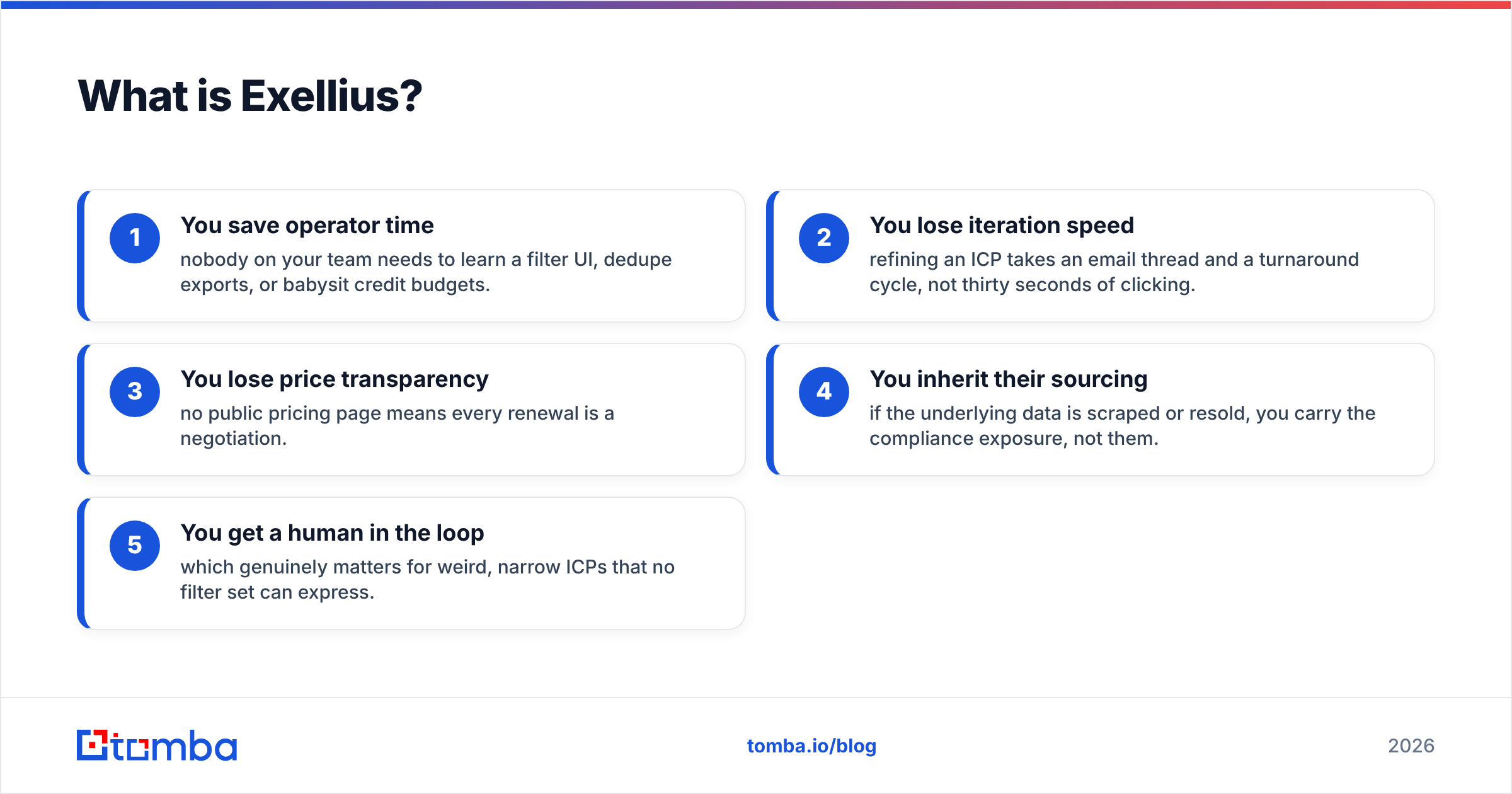
- You save operator time — nobody on your team needs to learn a filter UI, dedupe exports, or babysit credit budgets.
- You lose iteration speed — refining an ICP takes an email thread and a turnaround cycle, not thirty seconds of clicking.
- You lose price transparency — no public pricing page means every renewal is a negotiation.
- You inherit their sourcing — if the underlying data is scraped or resold, you carry the compliance exposure, not them.
- You get a human in the loop — which genuinely matters for weird, narrow ICPs that no filter set can express.

How do EasyLeadz and Exellius actually compare?#
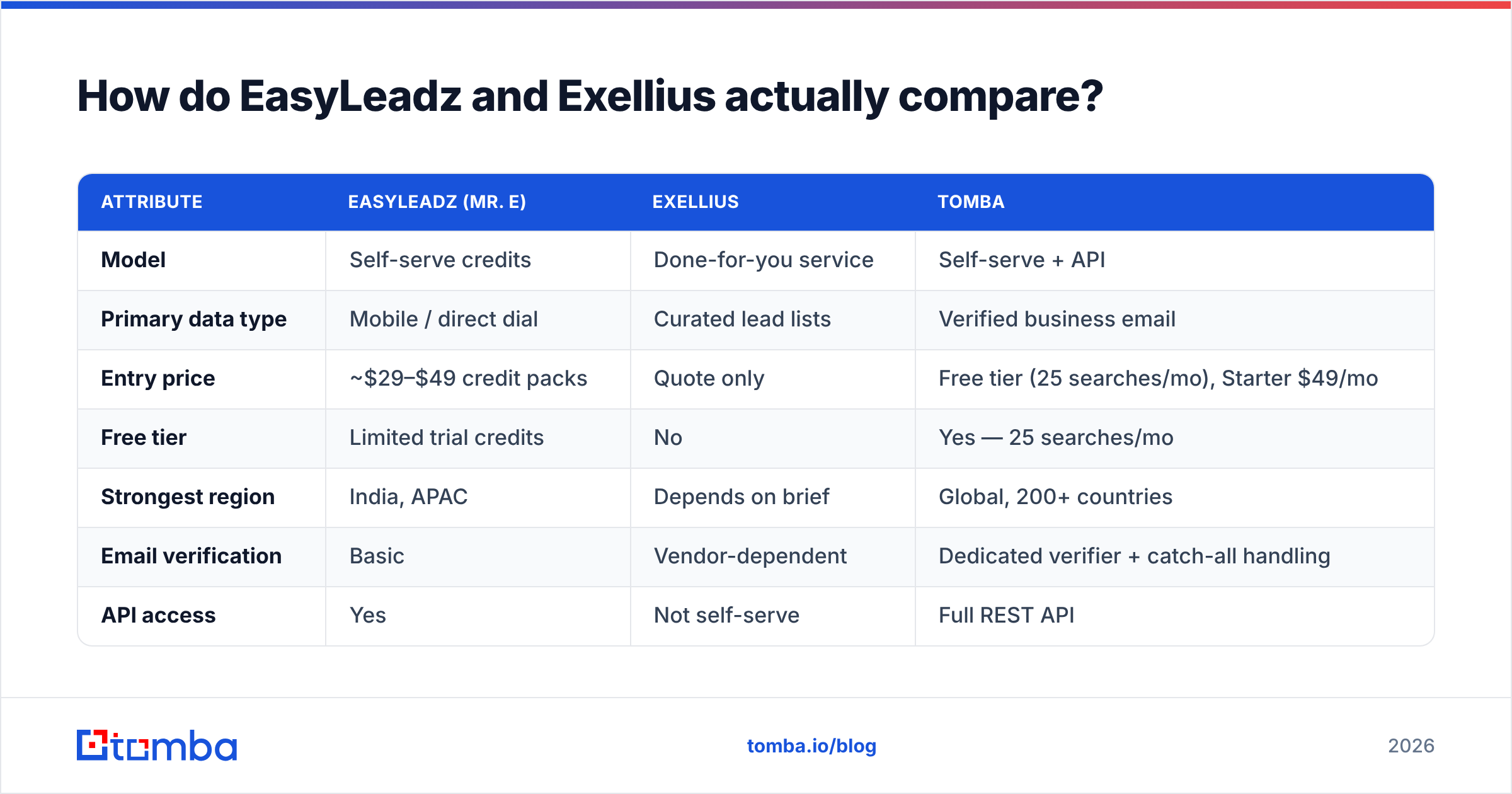
Here's the head-to-head on the attributes that change a buying decision. Treat published pricing as directional — both vendors move numbers, and Exellius quotes case by case.
| Attribute | EasyLeadz (Mr. E) | Exellius | Tomba |
|---|---|---|---|
| Model | Self-serve credits | Done-for-you service | Self-serve + API |
| Primary data type | Mobile / direct dial | Curated lead lists | Verified business email |
| Entry price | ~$29–$49 credit packs | Quote only | Free tier (25 searches/mo), Starter $49/mo |
| Free tier | Limited trial credits | No | Yes — 25 searches/mo |
| Strongest region | India, APAC | Depends on brief | Global, 200+ countries |
| Email verification | Basic | Vendor-dependent | Dedicated verifier + catch-all handling |
| API access | Yes | Not self-serve | Full REST API |
| Turnaround | Instant | Days per batch | Instant |
| Best for | Phone-led SDR teams | No-bandwidth founders | Email-led outbound at scale |
The row that matters most is model. If your team runs weekly ICP experiments, a service-based vendor will feel like sand in the gears. If your team is two founders with no SDR, a self-serve credit meter is just another tab nobody opens.
Which one has better data accuracy?#
Different question for each, which is why a single "accuracy %" comparison is misleading.
For EasyLeadz, accuracy means: when Mr. E reveals a number, does a human answer? Reported connect rates cluster well in India and drop in North America. The honest test is a 100-record pilot against accounts you already know — reveal, dial, log. Twenty minutes of work beats any review site.
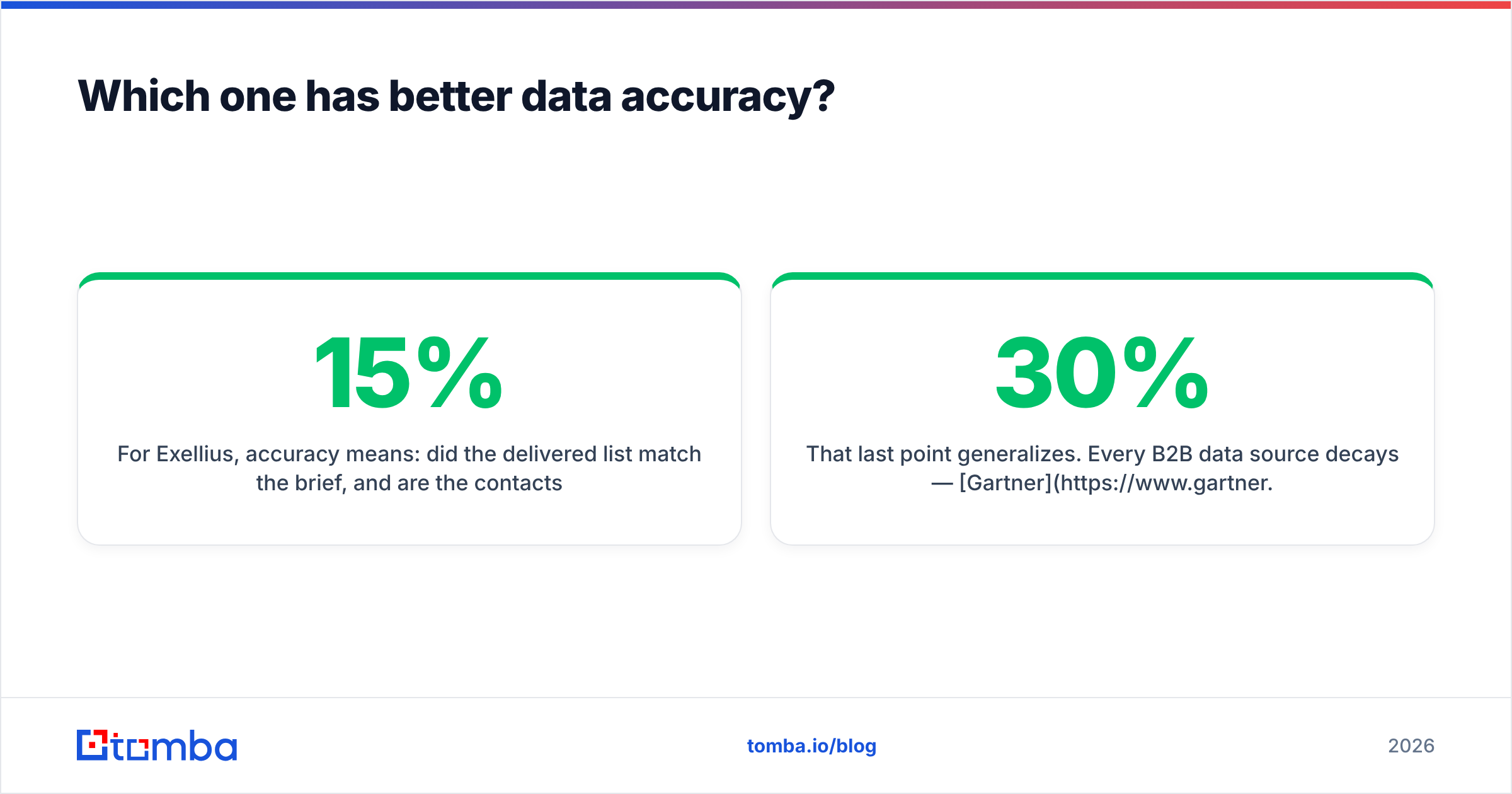
For Exellius, accuracy means: did the delivered list match the brief, and are the contacts still employed there? Service vendors typically enrich from the same underlying providers everyone else uses, so the differentiator is the human filtering, not magic data. Ask for a sample list before signing, and run it through an email verifier yourself. If 15% bounces, you have your answer.
That last point generalizes. Every B2B data source decays — Gartner has long put annual B2B contact-data decay in the 25–30% range, and job-change velocity since 2023 has not helped. The vendor who claims 99% accuracy on a static file is selling you a snapshot and calling it a subscription.
Practical accuracy checklist before you buy from either:
- Run a known-account test — 50 contacts you can independently confirm.
- Check catch-all handling — ask explicitly what happens on catch-all domains. Most tools mark them "valid" and let you eat the bounce. A dedicated catch-all verifier resolves them properly.
- Check the refund policy on bad records — credits back on invalid data is a strong signal of confidence.
- Ask where the data comes from — vendors who publish their data sources are easier to defend in a GDPR review than vendors who won't say.
Is EasyLeadz better than Exellius for cold outbound?#
Depends entirely on your channel — and this is where most comparison posts go vague. Let's not.
If you cold call: EasyLeadz wins outright. Exellius may deliver phone-enriched lists, but you're waiting on batches while your dialer sits idle. A rep who can reveal a mobile mid-research and dial in the same minute is a rep with a shorter cycle. Pair it with a phone validator to strip disconnected lines before they hit the dialer.
If you cold email: neither is the right primary tool. EasyLeadz's email side is secondary to its phone product, and a serviced list arrives as a static file that starts decaying the day it lands. Email outbound demands three things a phone-first or list-delivery vendor doesn't prioritize:
- Pattern-level discovery — finding the right address at a company you can't find on LinkedIn, via domain search.
- Verification at send time, not purchase time — a record verified six weeks ago is a coin flip today.
- Catch-all resolution — roughly a fifth of B2B domains are catch-all, and guessing on them is how you torch a sending domain.
If you run both channels: the realistic 2026 stack is a phone source, an email source, and a sequencer — not one vendor pretending to be all three. Budget accordingly; consolidation sounds efficient until the one consolidated vendor is mediocre at the channel that actually books your meetings.

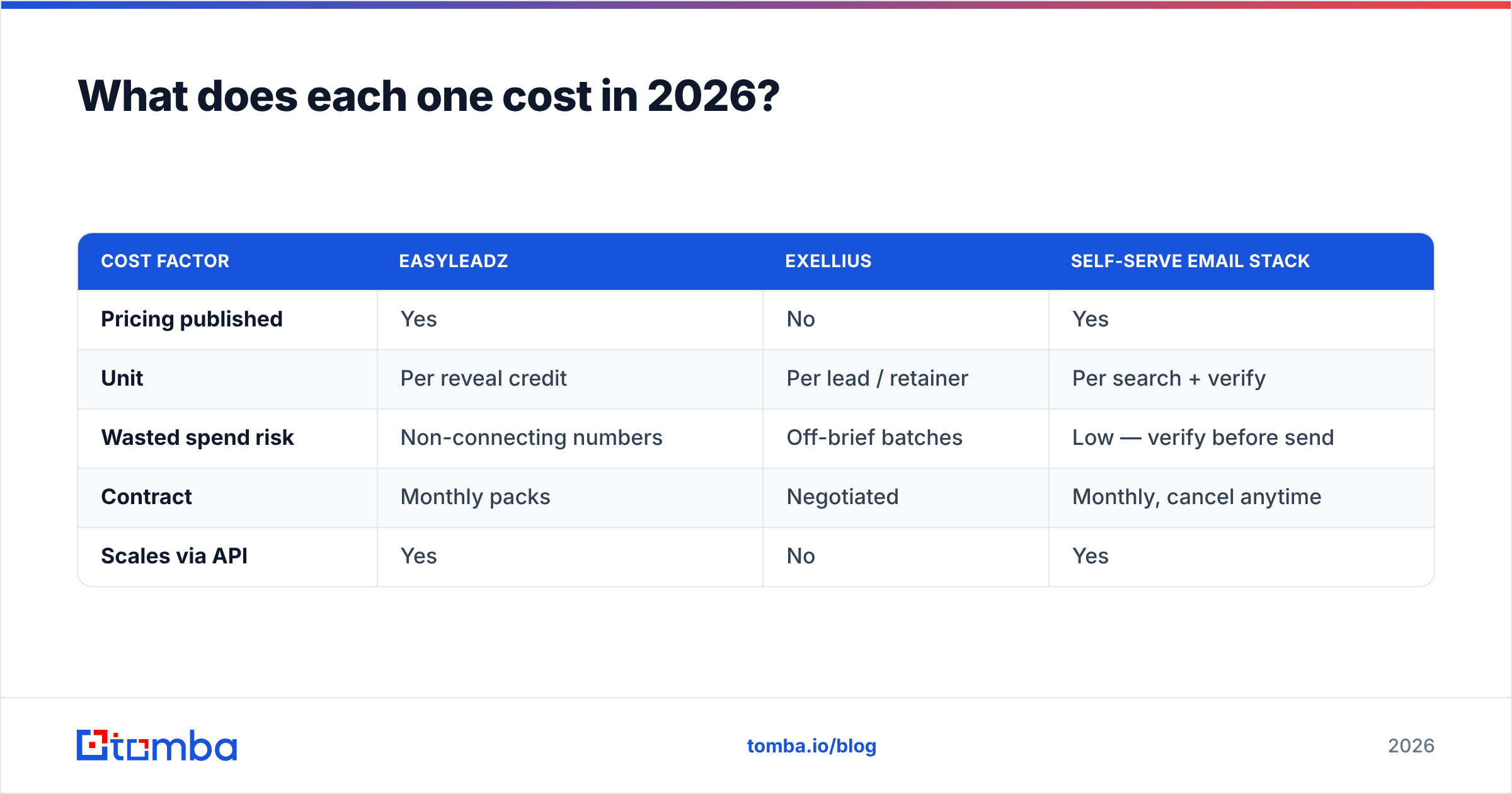
What does each one cost in 2026?#
EasyLeadz publishes credit-pack pricing that starts in the ~$29–$49 range for small monthly bundles and scales into four figures for team plans with API access. Credits are consumed per reveal, and — critically — most phone-data vendors charge whether or not the number connects. Model your cost as cost per connected conversation, not cost per credit. At a 40% connect rate, a $0.30 credit is really a $0.75 conversation.
Exellius doesn't publish pricing. Service-model lead-gen vendors typically land somewhere between a per-lead fee (often $2–$10 depending on ICP difficulty) and a monthly retainer. Neither is unreasonable; both are impossible to benchmark without a quote, which is itself a data point about how you'll experience procurement.
For reference, transparent self-serve pricing looks like this — Tomba's plans run Free (25 searches/mo), Starter $49/mo, Growth $99/mo, Pro $249/mo, and custom Enterprise. You can compute cost-per-verified-contact before you talk to anyone. That's the standard to hold any vendor to.
| Cost factor | EasyLeadz | Exellius | Self-serve email stack |
|---|---|---|---|
| Pricing published | Yes | No | Yes |
| Unit | Per reveal credit | Per lead / retainer | Per search + verify |
| Wasted spend risk | Non-connecting numbers | Off-brief batches | Low — verify before send |
| Contract | Monthly packs | Negotiated | Monthly, cancel anytime |
| Scales via API | Yes | No | Yes |
What are the best alternatives to both?#
If neither model fits, the market splits cleanly into three lanes.
Phone-first alternatives. Cognism, Lusha, and RocketReach all compete on direct dials with stronger Western coverage than EasyLeadz, at meaningfully higher price points.
Done-for-you list alternatives. BookYourData is worth a serious look here — it sells pay-as-you-go, pre-verified B2B lists with a published bounce guarantee, which gives you the "hand me a list" convenience of a service model without the quote-only opacity. For teams that liked the Exellius premise but want transparent pricing, it's the closest thing to a drop-in.
Email-first alternatives. This is where most B2B teams actually spend, and where per-record economics matter most. A dedicated finder plus verifier — Tomba, Hunter, Findymail — will beat any generalist database on email hit rate and bounce rate, because that's the only thing the product is optimized for. If you're currently paying for a broad platform mostly to get emails out of it, an Apollo alternative comparison is a useful next read.
The hybrid most teams land on: a phone tool for the dialing motion, a verified email layer for the sequencing motion, and a CRM that both write into. Tomba's HubSpot integration and Tomba API exist for exactly that plumbing job — you're not switching workflows, you're fixing the data quality inside the workflow you already have.
Which should you choose?#
Answer three questions and the choice makes itself.
- What's your primary channel? Phone → EasyLeadz. Neither → keep reading.
- Do you have someone to operate a tool? No → a service model like Exellius earns its premium. Yes → self-serve is cheaper per record, every time.
- Where are your buyers? India/APAC → EasyLeadz's coverage advantage is real. US/EU → test hard before committing, and price in a Western-coverage alternative.
And the question neither vendor's marketing will ask you: what's your current bounce rate? If it's above 3%, your problem isn't which contact database to buy — it's that you're sending to unverified records and quietly degrading your sender reputation with every campaign. Fix verification first. A perfect list sent from a burned domain still lands in spam.
Get verified emails before your next send#
If your outbound is email-led — and for most B2B teams in 2026 it is — the fastest fix isn't swapping databases. It's adding a verification-grade email layer on top of whatever sourcing you already do.
The Tomba Email Finder finds professional addresses by domain, name, or company, resolves catch-all domains properly instead of shrugging at them, and returns a confidence score you can actually filter on. Start free with 25 searches a month, no card — run your existing EasyLeadz or Exellius records through it and see what your real deliverable rate looks like. If the numbers hold up, Starter is $49/mo and the API scales with you from there.
Related guides#
Ready to find emails that actually work?
Join 150,000+ professionals who stopped guessing and started sending. Free credits on signup — no credit card required.
Get the Tomba newsletter
Practical outbound tactics and product updates — once every two weeks.
About the author