EasyLeadz vs GetProspect (2026): Which Tool Actually Wins?
EasyLeadz sells phone numbers. GetProspect sells email lists. We compared pricing, data accuracy, coverage, and export limits to show which one fits your outbound motion — and when neither is the right call.
TL;DR
- EasyLeadz is a phone-number tool first. Its Mr. E product is built around direct dials for Indian and APAC markets, with email as a secondary field. If you cold call, it earns its spot.
- GetProspect is an email-list builder first. LinkedIn extension, bulk domain search, basic CRM-lite lists. If you run cold email at volume in Europe or North America, it fits better.
- They barely overlap. Comparing them head-to-head only makes sense if your real question is "which one replaces my missing contact data?" — and the honest answer is usually neither alone.
- Pricing traps differ. EasyLeadz charges per credit with steep per-unit costs at low volume; GetProspect's cheap entry tier hides a hard export and validation ceiling.
- If email accuracy is the bottleneck, a dedicated finder plus verifier stack (Tomba, Findymail, Hunter) beats bolting verification onto a list tool.
What are EasyLeadz and GetProspect, exactly?#
Start with what each company actually sells, because the marketing pages blur it.
EasyLeadz is an Indian B2B contact-data company. Its flagship is Mr. E, a Chrome extension that sits on LinkedIn profiles and returns a direct dial mobile number — plus, secondarily, a work email. The pitch is phone-first: get the mobile, skip the gatekeeper. Its density is strongest in India, Southeast Asia, and the Middle East, thinner in the US and Western Europe.
GetProspect is a Ukraine-founded email finder and list builder. It also ships a LinkedIn Chrome extension, but the output is an email address plus firmographic fields, saved into lists inside GetProspect's own lightweight CRM. It layers on bulk domain search, CSV enrichment, and — on higher tiers — a basic email sending sequence.
So the honest framing: EasyLeadz answers "what's their mobile?" and GetProspect answers "what's their work email, at scale?" Anyone comparing them is really deciding which channel they're betting outbound on this quarter.
How do EasyLeadz and GetProspect compare on features and pricing?#
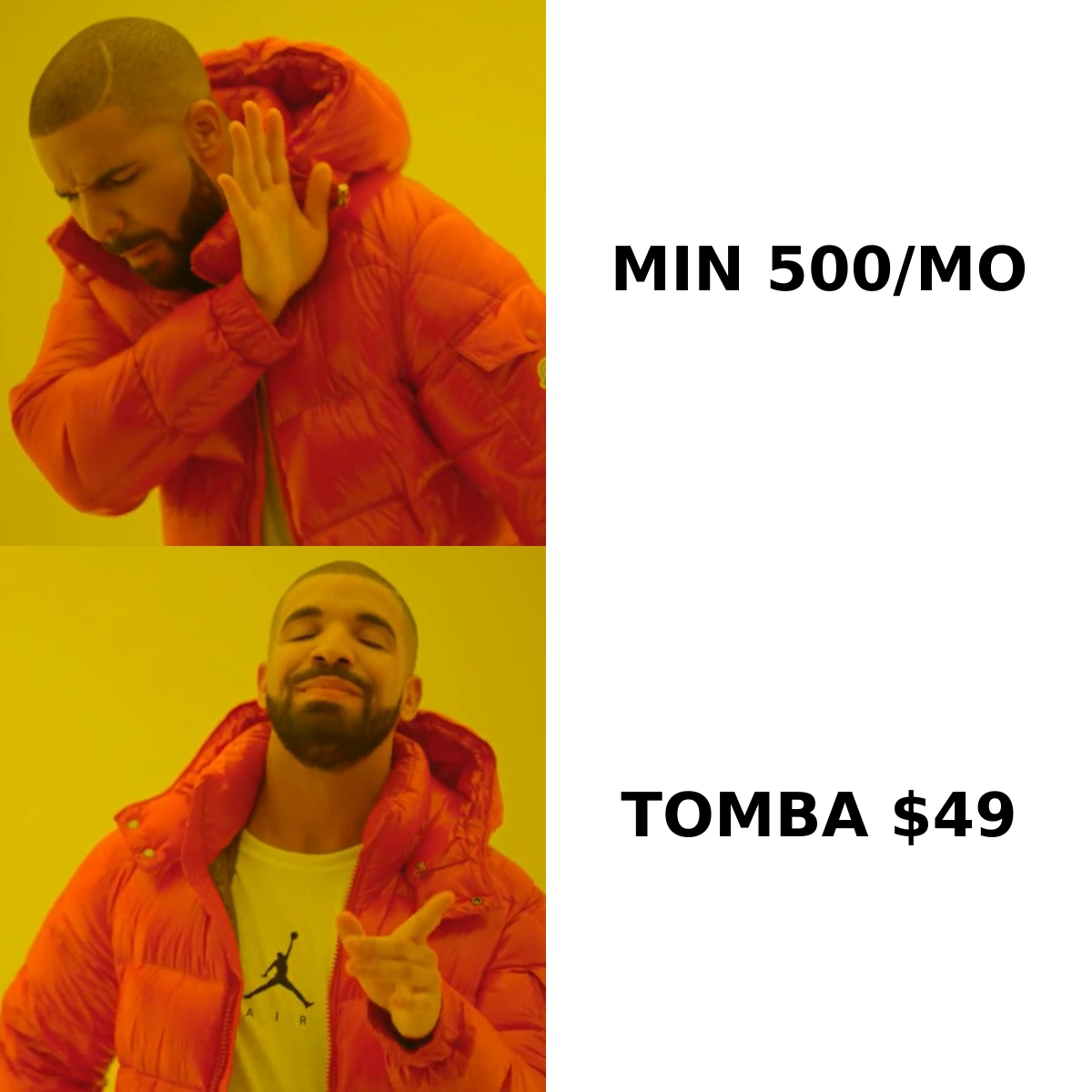
Here's the side-by-side on the dimensions that actually change your workflow. Prices are list prices as of mid-2026 and move often — check both vendors before committing.
| Dimension | EasyLeadz (Mr. E) | GetProspect | Tomba |
|---|---|---|---|
| Primary data type | Direct dial mobile numbers | Work email addresses | Work email addresses |
| Free tier | 5 credits on signup | 50 valid emails/mo | 25 searches/mo |
| Entry paid plan | ~$59/mo (500 credits) | ~$49/mo (1,000 emails) | $49/mo Starter |
| Mid tier | ~$199/mo (2,500 credits) | ~$99/mo (5,000 emails) | $99/mo Growth |
| Geographic strength | India, APAC, MENA | Europe, North America | Global, 190+ countries |
| LinkedIn extension | Yes (core product) | Yes | Yes |
| Bulk domain search | Limited | Yes | Yes |
| Built-in email verification | No | Yes (basic) | Yes (dedicated verifier) |
| Catch-all handling | Not addressed | Marked "risky", no resolution | Dedicated catch-all verifier |
| Public API | Yes | Yes | Yes, plus CLI and MCP |
| Credit rollover | No | No | No |
| Email sequences | No | Yes, on higher tiers | No (integrates instead) |
Two things jump out.
First, the credit economics are not comparable. EasyLeadz counts one credit per successful phone reveal. GetProspect counts one credit per valid email. A 500-credit EasyLeadz plan and a 1,000-email GetProspect plan are not the same purchase — one is 500 phone calls' worth of raw material, the other is a 1,000-name email campaign. Divide by your channel's expected conversion before you compare dollar figures.
Second, verification is where GetProspect quietly wins and both quietly lose. GetProspect at least validates before it charges you a credit. EasyLeadz makes email a side dish and doesn't seriously verify it. But neither resolves catch-all domains, which is where 20-30% of B2B corporate mailboxes now sit. If a large share of your ICP is on Microsoft 365 with catch-all enabled, both tools will hand you addresses labeled "unknown" and let you eat the bounce.
Which one has better data accuracy?#
Different question for each tool, so answer it separately.
EasyLeadz phone accuracy is genuinely strong in its core geography. Reps working Indian SaaS, APAC manufacturing, or Gulf enterprise regularly report connect rates that justify the per-credit price. Outside that footprint, coverage falls off — you'll burn credits on "no number found" misses (which EasyLeadz doesn't charge for, to its credit) and the fill rate drops enough that you start doubting the tool rather than the market.
GetProspect email accuracy sits in the industry-normal band for pattern-based finders: solid on domains with a discoverable, consistent format; weaker on small companies, agencies with mixed formats, and anything behind a catch-all. Its own validity guarantee covers hard bounces on "valid" results, which is meaningful — but the guarantee only pays back credits, not your sender reputation.
That last point matters more than most comparison posts admit. A bounce is not a refunded credit problem; it's an email deliverability problem. Google and Microsoft both tightened bulk-sender rules in 2024-2025, and sustained bounce rates above roughly 2% start throttling your inbox placement across every campaign, not just the bad list. Getting a credit back after your domain gets flagged is a poor trade.

If your accuracy bar is high, the practical answer is to decouple finding from verifying. Use whichever tool has the best coverage for your segment to find, then run the output through a dedicated email verifier before it touches a sending domain. That's a two-tool stack, and it's cheaper than a burned domain.
What does the decision actually come down to?#
Five questions, in order. Answer them honestly and the choice makes itself.
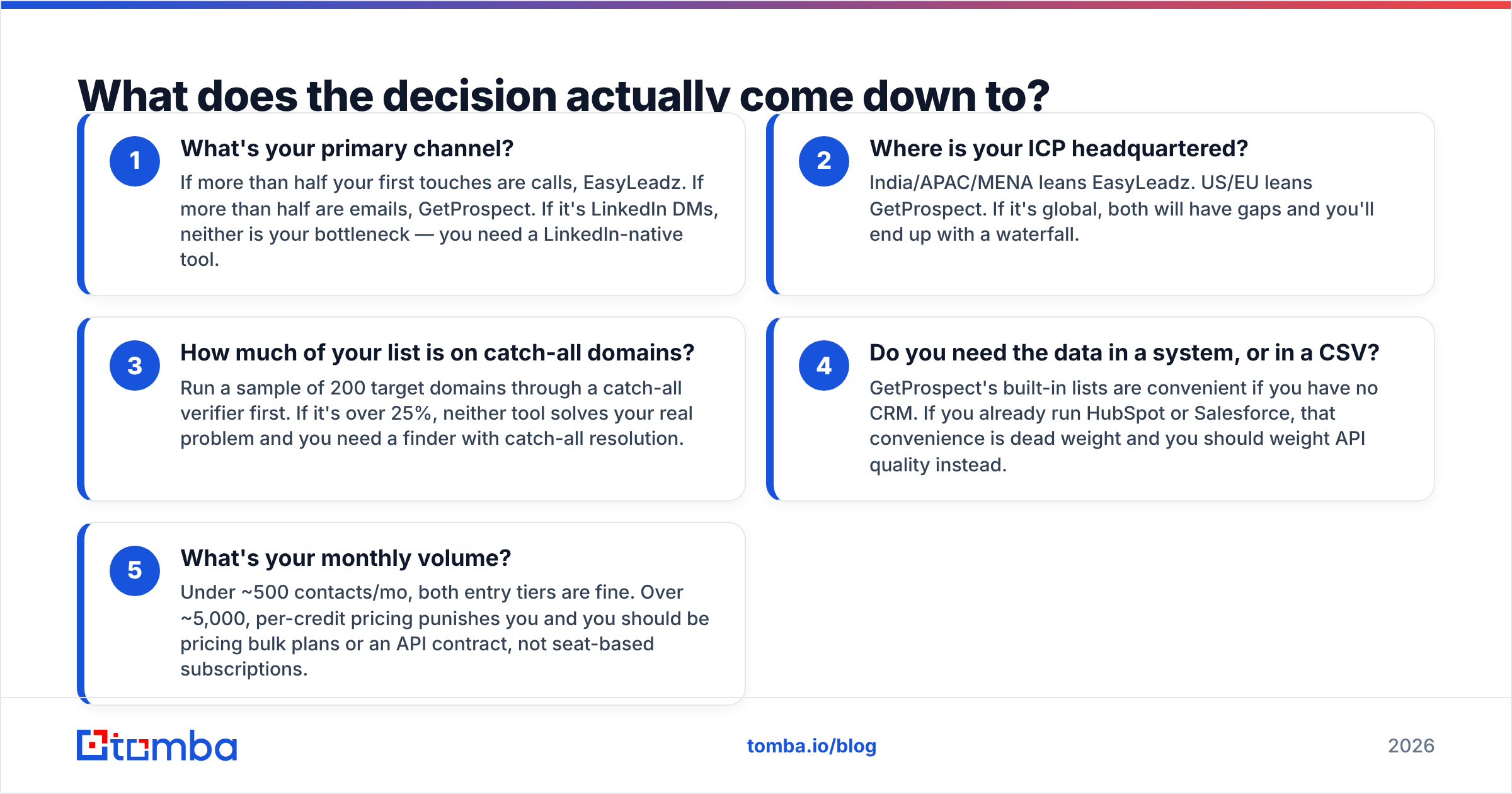
- What's your primary channel? If more than half your first touches are calls, EasyLeadz. If more than half are emails, GetProspect. If it's LinkedIn DMs, neither is your bottleneck — you need a LinkedIn-native tool.
- Where is your ICP headquartered? India/APAC/MENA leans EasyLeadz. US/EU leans GetProspect. If it's global, both will have gaps and you'll end up with a waterfall.
- How much of your list is on catch-all domains? Run a sample of 200 target domains through a catch-all verifier first. If it's over 25%, neither tool solves your real problem and you need a finder with catch-all resolution.
- Do you need the data in a system, or in a CSV? GetProspect's built-in lists are convenient if you have no CRM. If you already run HubSpot or Salesforce, that convenience is dead weight and you should weight API quality instead.
- What's your monthly volume? Under ~500 contacts/mo, both entry tiers are fine. Over ~5,000, per-credit pricing punishes you and you should be pricing bulk plans or an API contract, not seat-based subscriptions.
That third question is the one people skip and then regret. Catch-all domains accept every address at SMTP time, so a naive verifier returns "unknown" and a naive finder returns a plausible-looking guess. You find out at send time.
Is there a better alternative to both?#
Depends on what "better" means for your motion — but if your bottleneck is email coverage and accuracy rather than phone numbers, a specialist finder usually beats a list-builder with verification bolted on.
Here's the honest field, with the trade-offs stated:
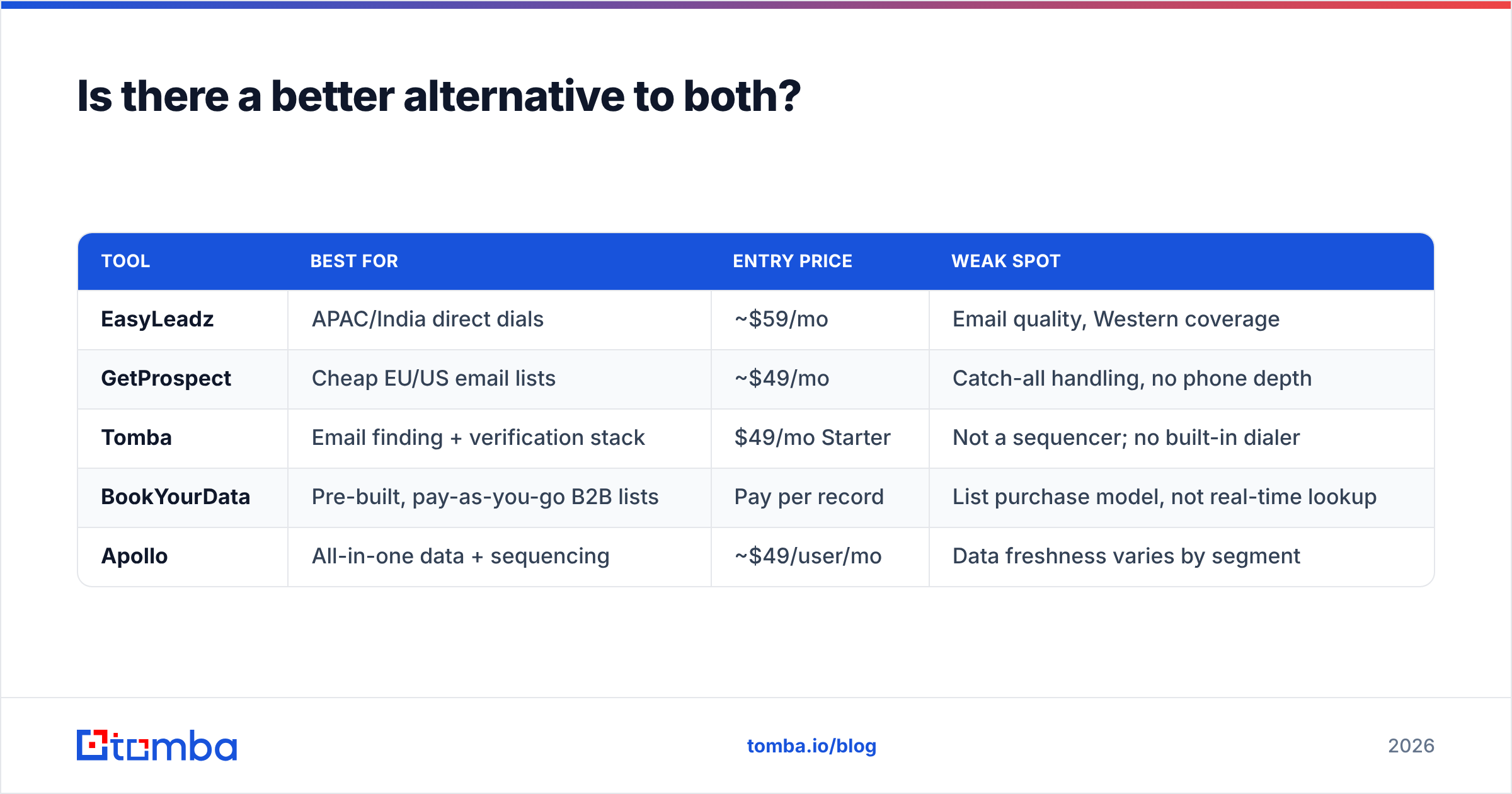
| Tool | Best for | Entry price | Weak spot |
|---|---|---|---|
| EasyLeadz | APAC/India direct dials | ~$59/mo | Email quality, Western coverage |
| GetProspect | Cheap EU/US email lists | ~$49/mo | Catch-all handling, no phone depth |
| Tomba | Email finding + verification stack | $49/mo Starter | Not a sequencer; no built-in dialer |
| BookYourData | Pre-built, pay-as-you-go B2B lists | Pay per record | List purchase model, not real-time lookup |
| Apollo | All-in-one data + sequencing | ~$49/user/mo | Data freshness varies by segment |
A few notes so this reads honestly rather than as a pitch:
- BookYourData is a genuinely different model — you buy verified records outright rather than renting a lookup tool, and its accuracy guarantee is one of the stronger ones in the category. If you want a clean list handed to you rather than a workflow, it's a legitimate choice and often cheaper per usable record than a subscription you underuse.
- Apollo wins if you want data and sequencing in one seat. You pay for that with variable data quality outside tech and mid-market, which is why so many teams search for an Apollo alternative after six months.
- Tomba is narrower on purpose. It does email finder, verification, domain search, and enrichment, with a dedicated catch-all path — the piece both EasyLeadz and GetProspect leave unsolved. It doesn't send email and doesn't dial phones, so you'll pair it with a sequencer.

For reference on how buyers actually rate these categories rather than how vendors describe themselves, G2's lead intelligence grid is worth twenty minutes — filter by company size, because enterprise and SMB reviewers disagree sharply on every tool in this list.
How do you build a stack instead of picking one tool?#
Most teams that stop churning through data vendors end up with three layers, not one product.
Layer 1 — Sourcing. Where do names come from? LinkedIn Sales Navigator, a B2B database, event lists, website visitors, or inbound. This layer decides your TAM, and no email tool fixes a bad ICP definition.
Layer 2 — Contact resolution. Turning a name and company into a reachable email or phone. This is the layer EasyLeadz and GetProspect compete in. Run a waterfall: primary provider first, secondary for misses, and only pay for what fills. A bulk email finder with API access makes this automatable instead of a weekly CSV ritual.
Layer 3 — Validation and hygiene. Verify before send, re-verify anything older than 90 days, suppress role accounts, and check catch-alls explicitly. B2B contact data decays at roughly 25-30% annually — HubSpot's research on database decay has been the standard citation for years and still holds. Whatever you buy today is a quarter of the way to garbage in twelve months.
Teams that skip layer 3 blame layer 2. They switch from EasyLeadz to GetProspect, or the reverse, see the same bounce rate, and conclude "all data vendors lie." Usually the vendor was fine and the hygiene process didn't exist.
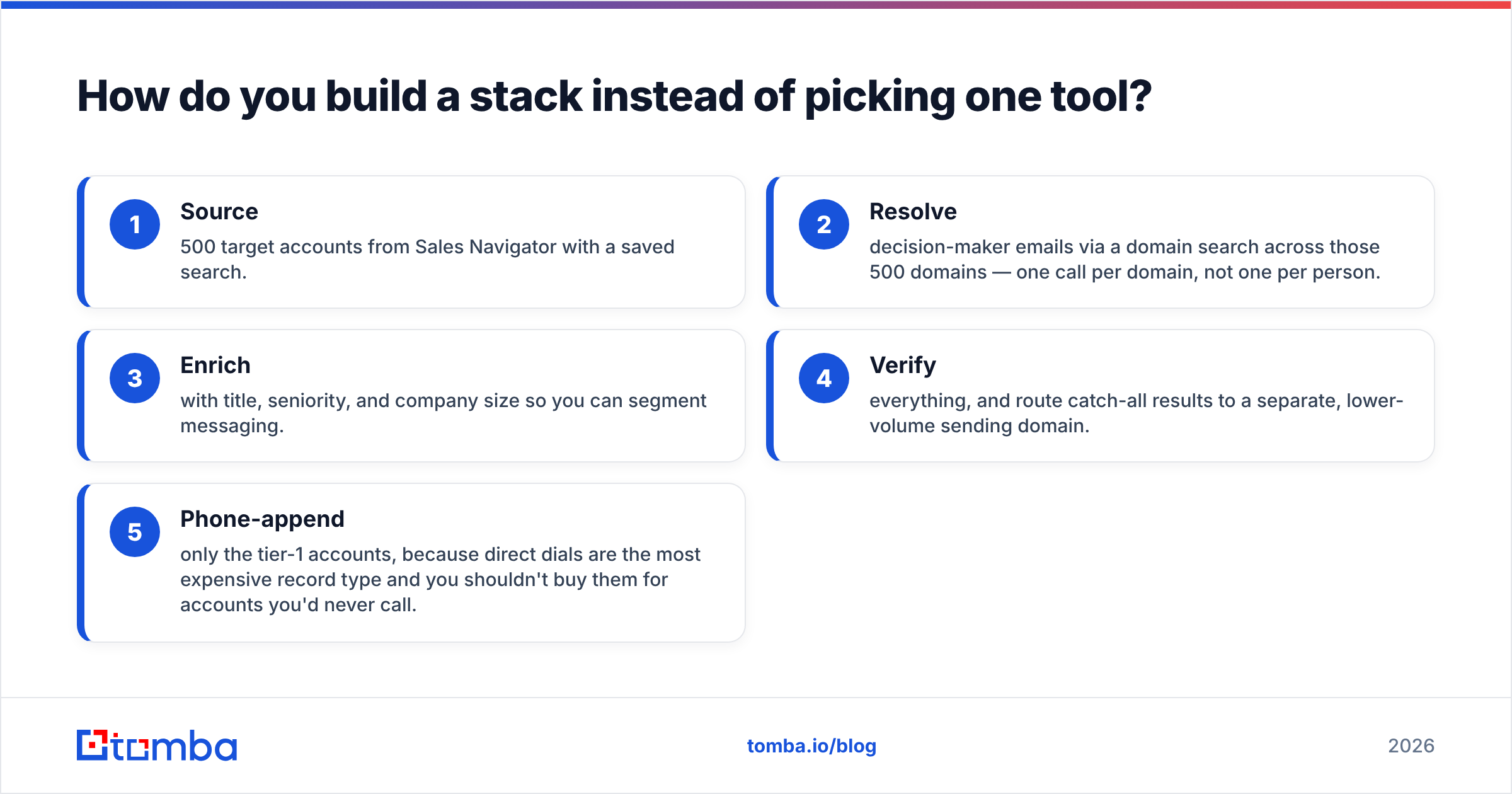
A concrete workflow that works:
- Source 500 target accounts from Sales Navigator with a saved search.
- Resolve decision-maker emails via a domain search across those 500 domains — one call per domain, not one per person.
- Enrich with title, seniority, and company size so you can segment messaging.
- Verify everything, and route catch-all results to a separate, lower-volume sending domain.
- Phone-append only the tier-1 accounts, because direct dials are the most expensive record type and you shouldn't buy them for accounts you'd never call.
Step 5 is where EasyLeadz earns its keep even if it isn't your primary tool. Buy phones surgically, not in bulk.
What's the verdict?#
Pick EasyLeadz if you cold call APAC. Nothing in the Western tool market matches its Indian mobile coverage, and the per-credit price is defensible when a connect is worth more than an email open.
Pick GetProspect if you need cheap email volume in EU/US and have no CRM. The bundled list management and light sequencing genuinely save a small team from buying two more tools.
Pick neither as your only tool. Both are single-layer products sold as complete solutions. The teams with the best-performing outbound run a resolver plus a verifier plus a sequencer, and treat the data layer as infrastructure rather than a subscription they renew out of habit.
If your honest bottleneck is that too many of your emails bounce, are catch-alls you can't resolve, or simply don't exist for the accounts that matter, start there. The Tomba Email Finder handles domain-level discovery, per-contact lookup, catch-all resolution, and verification in one place, with an API and Chrome extension so it fits whatever sourcing layer you already run. The free tier gives you 25 searches to test it against your own account list before you spend anything, and Tomba pricing starts at $49/mo when you're ready to scale. Test it on 50 domains from your current list and compare fill rate and bounce rate directly — that's the only benchmark that matters.
Related guides#
Ready to find emails that actually work?
Join 150,000+ professionals who stopped guessing and started sending. Free credits on signup — no credit card required.
Get the Tomba newsletter
Practical outbound tactics and product updates — once every two weeks.
About the author