EasyLeadz vs Kipplo (2026): Which B2B Contact Tool Wins?
EasyLeadz sells direct dials. Kipplo sells AI-assisted lead lists. They overlap less than the search volume suggests — and the right pick depends on whether you dial or email. Here's the honest breakdown.
TL;DR
- EasyLeadz is a phone-first tool. Its Mr. E product is built around direct dials for India and APAC-heavy territories, with email as a secondary field. If your team dials, that's the pitch.
- Kipplo is an email-first, AI-assisted list builder. It leans on prompt-style search ("find me SaaS marketing directors in Berlin") and bundles enrichment plus basic sending workflow.
- They're not really substitutes. Comparing them head-to-head only makes sense if your real question is "which one fills my CRM cheapest," and even then the answer is usually "neither alone."
- Both charge in credits, and both burn credits on misses. That's the line item nobody quotes you upfront — budget for a 20–40% waste factor unless you verify before you export.
- If email is your primary channel, a dedicated finder-plus-verifier stack (Tomba, or a similar accuracy-first vendor) will beat both on cost-per-valid-contact. If you need mobile numbers in India, EasyLeadz is genuinely hard to replace.
You searched a matchup that most vendors' comparison pages get wrong: they line up feature checkboxes and declare a winner. The actual decision here is about channel, not features. Let's do it properly.
What is EasyLeadz and who actually uses it?#
EasyLeadz (the company behind Mr. E) is an India-headquartered B2B contact data provider best known for one thing: mobile numbers. Its Chrome extension sits on a LinkedIn profile and returns a direct dial, often a personal mobile, for contacts that US-centric databases either miss or return as a generic switchboard line.
That regional strength is the whole story. If your ICP is Indian SaaS, Indian manufacturing, APAC mid-market, or global companies with large India-based engineering and ops teams, EasyLeadz's phone coverage is materially better than what you'd get from a Western-first vendor. Its email data exists but is thinner, and users routinely report needing a separate verification step before sending.
Typical EasyLeadz buyer profile:
- Inside sales teams that dial. Cold calling is still the primary channel, and a wrong number costs more than a bounced email.
- Recruiters sourcing in APAC. Mobile-first outreach beats InMail for candidate response rates in several of these markets.
- Teams with LinkedIn-driven workflows. The extension is the product for most users; the dashboard and bulk exports are secondary.
- Budget-conscious SMBs. Entry pricing sits well below the enterprise data platforms, which is a big part of the appeal.
What is Kipplo and how does it differ?#
Kipplo is a newer, AI-forward B2B prospecting tool. Instead of filter-stacking (industry → headcount → title → geo), you describe the audience in plain language and it assembles a list. It layers enrichment on top — email, company firmographics, sometimes social profiles — and includes light outreach features so you can go from list to first-touch without exporting to a separate sender.
The value proposition is speed and consolidation. The trade-off is depth. Newer data vendors typically license or aggregate from a smaller set of upstream sources, which shows up as gaps in mid-market and non-US coverage, and as inconsistent accuracy on senior titles at large enterprises. Kipplo's AI search layer is genuinely convenient; the data underneath it is where you need to run your own test.

Where Kipplo tends to fit:
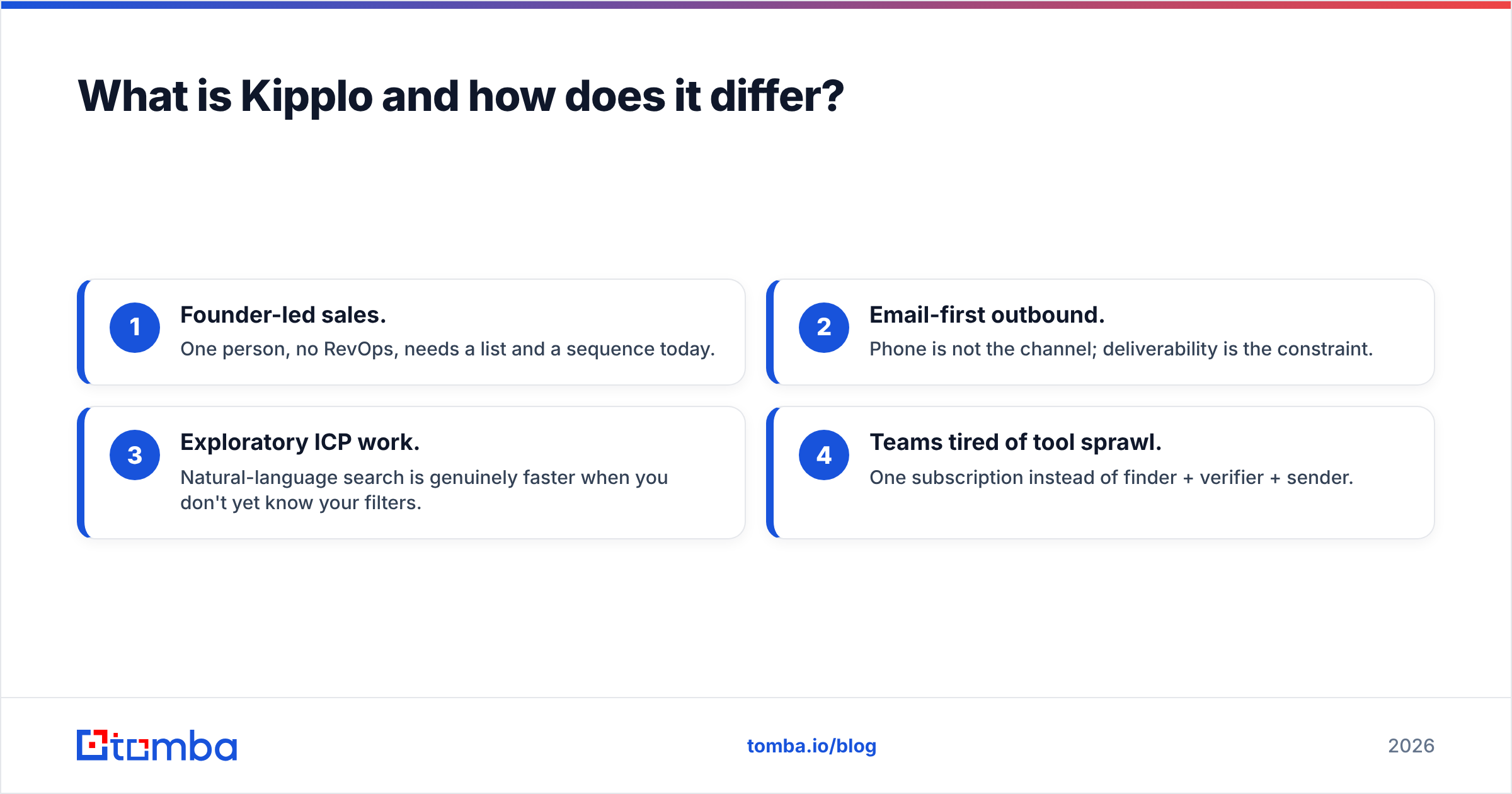
- Founder-led sales. One person, no RevOps, needs a list and a sequence today.
- Email-first outbound. Phone is not the channel; deliverability is the constraint.
- Exploratory ICP work. Natural-language search is genuinely faster when you don't yet know your filters.
- Teams tired of tool sprawl. One subscription instead of finder + verifier + sender.

How do EasyLeadz and Kipplo compare directly?#
Here's the honest side-by-side. Pricing on both platforms moves; treat these as directional and confirm on their own pages before you buy.
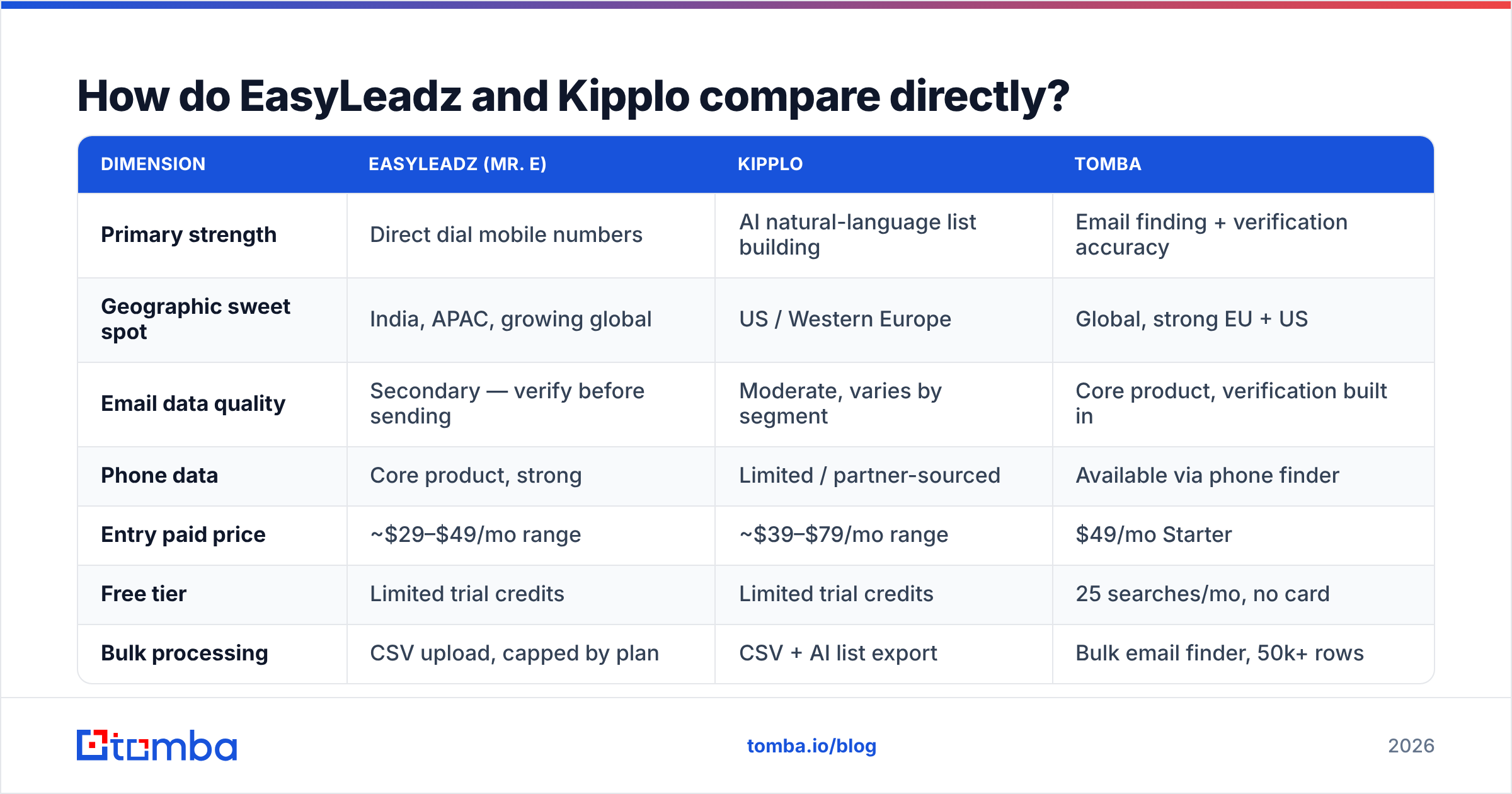
| Dimension | EasyLeadz (Mr. E) | Kipplo | Tomba |
|---|---|---|---|
| Primary strength | Direct dial mobile numbers | AI natural-language list building | Email finding + verification accuracy |
| Geographic sweet spot | India, APAC, growing global | US / Western Europe | Global, strong EU + US |
| Email data quality | Secondary — verify before sending | Moderate, varies by segment | Core product, verification built in |
| Phone data | Core product, strong | Limited / partner-sourced | Available via phone finder |
| Entry paid price | ~$29–$49/mo range | ~$39–$79/mo range | $49/mo Starter |
| Free tier | Limited trial credits | Limited trial credits | 25 searches/mo, no card |
| Bulk processing | CSV upload, capped by plan | CSV + AI list export | Bulk email finder, 50k+ rows |
| API | Yes, credit-metered | Yes, newer | Tomba API, CLI, MCP server |
| Verification included | No — separate step | Basic | Full email verifier + catch-all handling |
| Best for | Phone-first outbound in APAC | Solo founders, fast list building | Email-first outbound at scale |
The table makes the real answer obvious: these tools don't compete for the same job. EasyLeadz wins the "I need a mobile number for this specific person in Bangalore" job. Kipplo wins the "I need 500 plausible prospects and a sequence by Friday" job. Neither wins "I need 10,000 verified email addresses with a bounce rate under 3%."
Which one is more accurate?#
Accuracy is the wrong single number to chase — you need to split it by field.
For phone numbers, EasyLeadz is the stronger of the two by a wide margin in its home markets. Independent user reviews on G2 consistently cite mobile-number hit rates in the 60–75% range for Indian contacts, which is high for that data type. Outside APAC the number drops, sometimes sharply.
For email addresses, neither tool is built to be an accuracy-first email provider, and it shows. Both return plausible-looking addresses from pattern inference without a hard SMTP-level confirmation on every record. Pattern inference is fine as a first pass — it's how most finders start — but shipping unverified pattern guesses straight into a sequence is how you end up with a 12% bounce rate and a scorched sending domain.
The practical fix is a verification layer between export and send. Run the list through an email verifier that distinguishes valid, invalid, catch-all, and risky, then suppress everything that isn't clean. A catch-all verifier matters more than people expect: catch-all domains accept everything at the SMTP handshake, so a naive checker marks them "valid" and you learn the truth from your bounce report a week later.
If you want the deeper mechanics of why bounce rate destroys inbox placement, the email deliverability primer covers the reputation math. Short version: mailbox providers treat repeated hard bounces as a spam signal, and recovery takes weeks.
How does pricing really work on each?#
Both platforms sell credits. Credits are where the marketing price and the real price diverge.
What the pricing page says: X credits for $Y per month.
What you actually pay per usable contact:
- Failed lookups. Some vendors charge for a search that returns nothing; some don't. Read the terms, then test with 100 records before committing annually.
- Multi-field charges. Pulling an email and a phone for the same person often costs two credits, not one.
- Unverified records you discard. If 25% of returned emails fail verification, your effective cost-per-valid-contact is 33% higher than the sticker.
- Rollover rules. Most credit systems expire monthly. Seasonal outbound teams overpay for months they don't use.
- Annual lock-in discounts. Attractive, but they're a bet that the data quality holds up in month seven.
Do the arithmetic on cost-per-valid-contact, not cost-per-credit. A $39/mo plan returning 60% usable data is more expensive than a $49/mo plan returning 95% usable data, and it's not close.
For reference, Tomba pricing runs Free (25 searches/mo), Starter at $49/mo, Growth at $99/mo, and Pro at $249/mo, with Enterprise custom. Verification is part of the platform rather than a separate line item, which is the main reason the effective cost-per-valid-contact lands lower than the headline suggests.
When should you choose EasyLeadz?#
Choose EasyLeadz when the phone is your primary channel and your territory is India or APAC. That's a narrow recommendation, and it's meant to be — it's the scenario where EasyLeadz is genuinely difficult to replace.
Concrete signals it's the right pick:
- Your reps' calendars are built around call blocks, not send volume.
- More than 40% of your ICP sits in India, Southeast Asia, or the Middle East.
- You already work primarily inside LinkedIn and want a one-click extension.
- You have an existing verification step for emails, so EasyLeadz's thinner email data doesn't hurt you.
Signals it's the wrong pick: your ICP is US or EU enterprise, your channel is email, or you need reliable bulk exports of thousands of records with consistent field coverage.
When should you choose Kipplo?#
Choose Kipplo when you're a small team that values speed of setup over depth of data. The AI search removes a real friction point, and having sending built in means one fewer integration to maintain.
Concrete signals it's the right pick:
- You're pre-RevOps: no ops person, no CRM hygiene process, no data contract.
- You're still testing ICPs and need to build five different lists this month.
- Your volumes are modest — a few hundred sends a week, not tens of thousands.
- Consolidation matters more to you than best-in-class in any single layer.
Signals it's the wrong pick: you already own a sending platform you like, you need API-level reliability for programmatic enrichment, or your deliverability is already fragile and you can't absorb a bad list.
What about the alternatives neither of them talks about?#
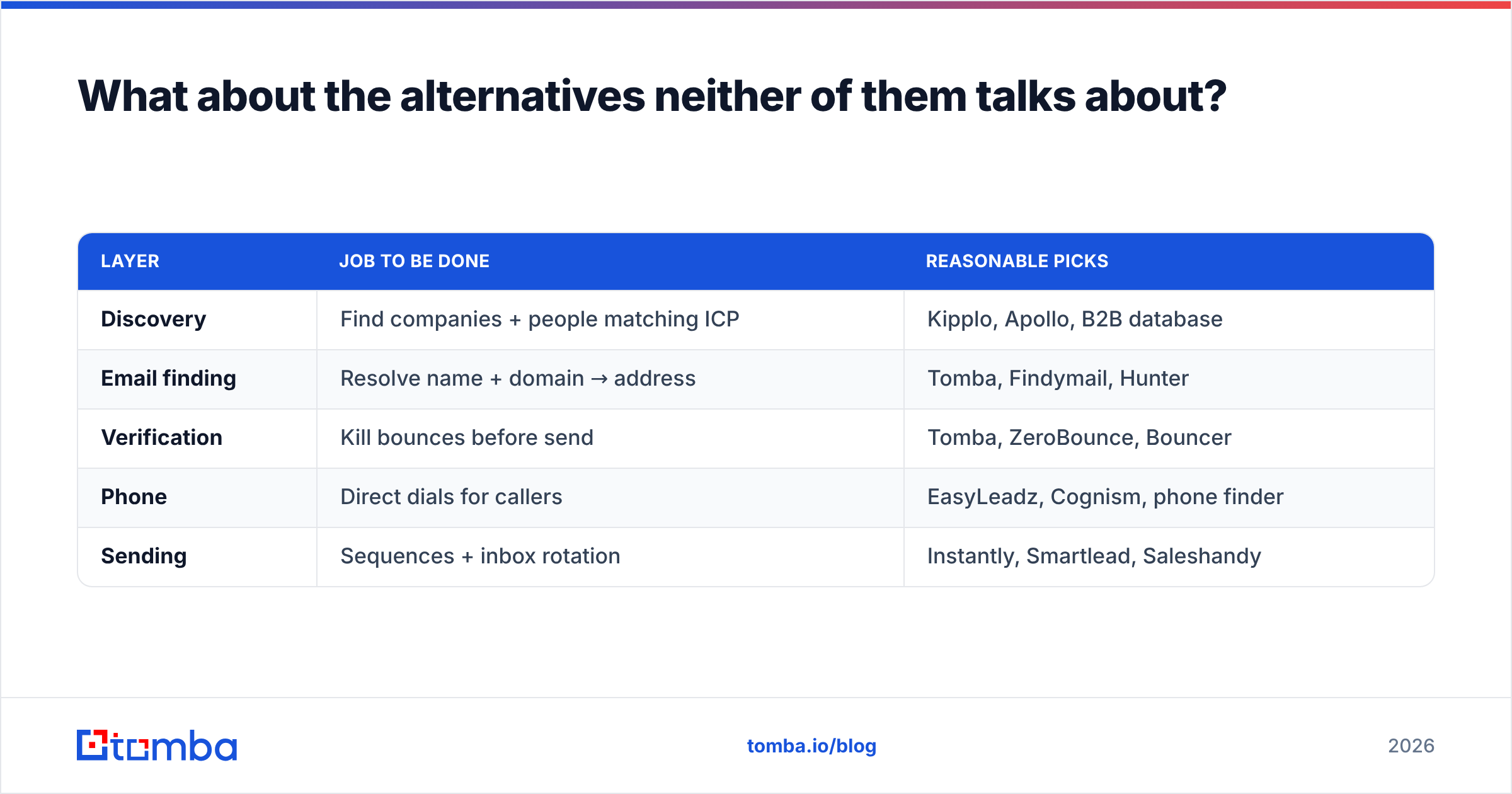
The honest framing is that "EasyLeadz vs Kipplo" is often a false binary. Most teams end up with a stack, and the stack usually looks like this:
| Layer | Job to be done | Reasonable picks |
|---|---|---|
| Discovery | Find companies + people matching ICP | Kipplo, Apollo, B2B database |
| Email finding | Resolve name + domain → address | Tomba, Findymail, Hunter |
| Verification | Kill bounces before send | Tomba, ZeroBounce, Bouncer |
| Phone | Direct dials for callers | EasyLeadz, Cognism, phone finder |
| Sending | Sequences + inbox rotation | Instantly, Smartlead, Saleshandy |
Worth naming in the same breath: BookYourData is a solid option if you'd rather buy a pre-built, pay-as-you-go list than run lookups yourself — it's a genuinely different purchasing model, with no subscription and an accuracy guarantee, and for some teams that's a cleaner fit than either tool here.
If you want to compress that stack, the finder-plus-verifier combination is the highest-leverage merge. Discovery and sending are commoditized; the accuracy layer between them is where money leaks. Tools like domain search handle the "give me everyone at this company" motion, and a Chrome extension covers the one-off LinkedIn lookup that made EasyLeadz's extension popular in the first place.
How do you test both before committing?#
Don't take anyone's word for coverage, including this post. Run a controlled bake-off:
- Build a 100-row ground-truth list. Real people you can independently confirm — customers, past contacts, people whose emails you already know. Strip the known values into a separate column.
- Run the same 100 rows through each tool. Same day, same fields requested.
- Score three metrics: coverage (% of rows with any result), accuracy (% of results matching ground truth), and cost (credits consumed, including misses).
- Verify everything independently. Push all returned emails through a neutral verifier so you're not grading a tool with its own homework.
- Repeat by segment. Split your 100 rows by geography and company size. Aggregate accuracy hides the fact that a tool is 90% in one segment and 40% in another — and your ICP only lives in one of them.
This takes an afternoon and saves an annual contract's worth of regret. Vendors that resist a trial of this shape are telling you something.
The verdict#
If you dial and you sell into India or APAC: EasyLeadz. Its mobile coverage in those markets is the strongest argument either tool makes, and no amount of AI search compensates for a missing phone number.
If you email, and you're a small team optimizing for speed: Kipplo, with the caveat that you must add a verification step before sending anything at volume. Its AI list building is real convenience; its data depth is not yet at the level of the established providers.
If email is your primary channel and volume is going up: neither tool is the center of your stack. You need an accuracy-first finder with verification built in, and you'll spend less per valid contact than either of these options delivers.
That's the case for building your outbound on the Tomba Email Finder. Start on the free tier — 25 searches a month, no card — and run the 100-row bake-off described above against whatever you're using now. If Tomba doesn't return more valid, verified addresses per dollar, you'll have data proving it, which is worth the afternoon either way. When you're ready to scale, Starter is $49/mo and the same verification, bulk processing, and API come with it rather than as add-ons.
Related guides#
Ready to find emails that actually work?
Join 150,000+ professionals who stopped guessing and started sending. Free credits on signup — no credit card required.
Get the Tomba newsletter
Practical outbound tactics and product updates — once every two weeks.
About the author