EasyLeadz vs LetsExtract: Which B2B Data Tool Wins in 2026?
One is a cloud contact database built around direct dials. The other is a Windows desktop scraper you buy once and run forever. Here's how EasyLeadz and LetsExtract actually compare on data, pricing, deliverability risk, and fit.
EasyLeadz vs LetsExtract is not a fair fight — it's a choice between two different kinds of tool. One is a cloud contact database. The other is a Windows scraper you install and run yourself. Here's how they compare on data, price, and risk.
TL;DR
- These are not the same category of tool. EasyLeadz is a cloud contact database with a LinkedIn extension. It is best known for direct-dial phone numbers. LetsExtract is Windows software that scrapes email addresses from search engines, websites, and files.
- EasyLeadz wins on phone data and India/APAC coverage. If your team calls, it is the stronger of the two by a wide margin.
- LetsExtract wins on raw cost per record. You pay once and scrape as much as you like. That beats per-credit pricing when you only need volume.
- Both carry real risk. Scraped emails skew toward
info@and other role addresses, which hurt deliverability. EasyLeadz credits burn fast on searches that miss. - Neither is a clean fit for verified B2B email outbound. If email is your main channel, a verification-first email finder is the safer spine.
What are EasyLeadz and LetsExtract?#
EasyLeadz is an India-founded B2B contact intelligence platform. Its best-known surface is "Mr. E," a Chrome extension that sits on LinkedIn profiles and reveals a contact's direct dial and work email. You buy credits and spend one per revealed contact. The data comes from a hosted database plus partner sources. Nothing runs on your machine, everything syncs to a web app, and there's an API and CRM push.
LetsExtract is something else entirely. It's a Windows desktop suite (Email Studio and its lighter siblings) that you install and license, usually forever. You point it at search engines, a list of URLs, local files, or mail accounts. It then harvests every email address that matches your filters. It also bundles a verifier and a bulk sender, so one machine can go from keyword to sent campaign without a cloud account.
That difference — hosted database versus local harvesting engine — drives every other difference here. One sells you curated records. The other sells you a machine that finds strings that look like emails.
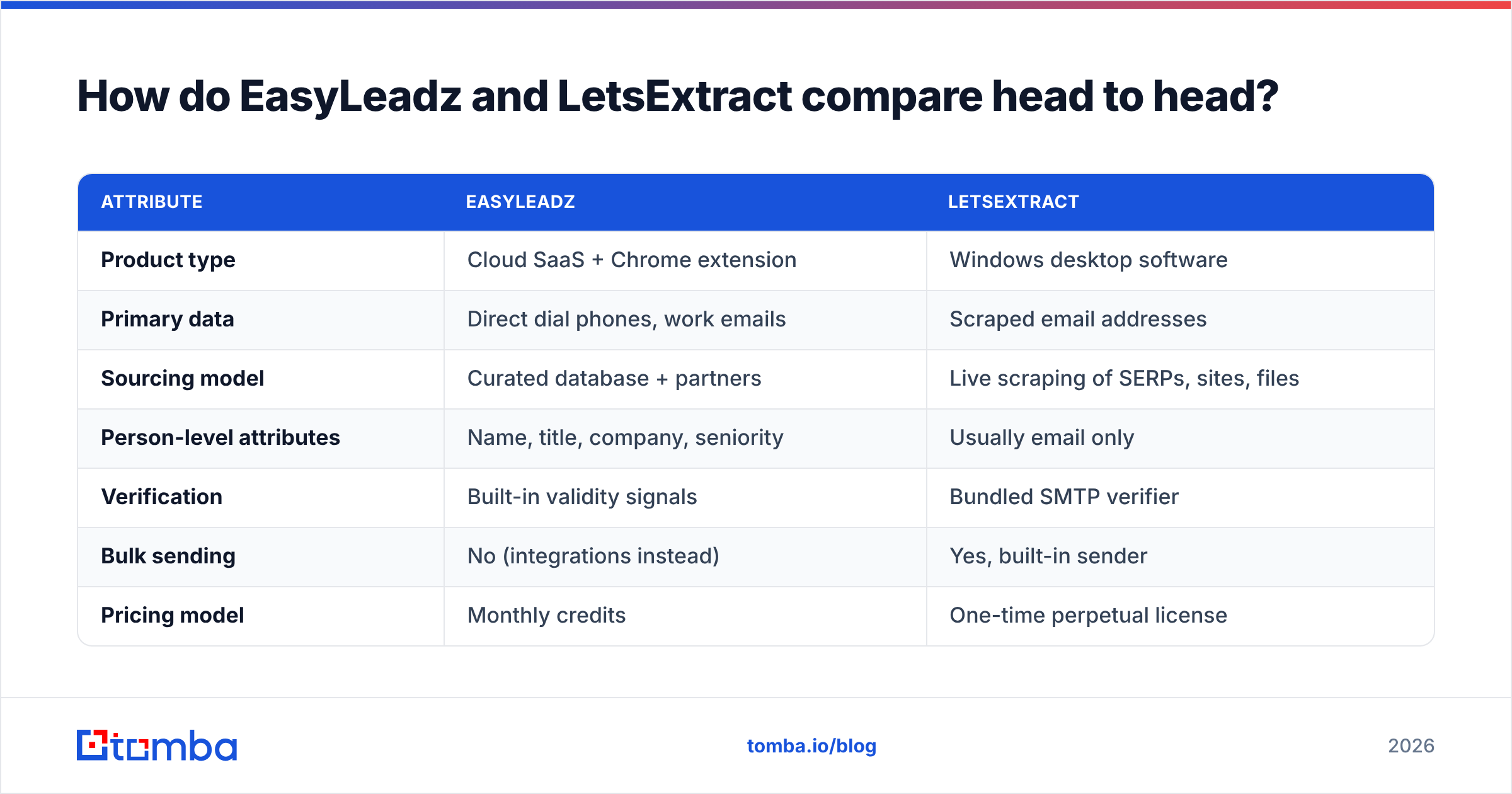
EasyLeadz vs LetsExtract: how do they compare head to head?#
| Attribute | EasyLeadz | LetsExtract |
|---|---|---|
| Product type | Cloud SaaS + Chrome extension | Windows desktop software |
| Primary data | Direct dial phones, work emails | Scraped email addresses |
| Sourcing model | Curated database + partners | Live scraping of SERPs, sites, files |
| Person-level attributes | Name, title, company, seniority | Usually email only |
| Verification | Built-in validity signals | Bundled SMTP verifier |
| Bulk sending | No (integrations instead) | Yes, built-in sender |
| Pricing model | Monthly credits | One-time perpetual license |
| Geographic sweet spot | India, APAC, some EMEA | Anywhere with an indexable page |
| Runs on Mac/Linux | Yes (browser-based) | No (Windows only) |
| API access | Yes | Limited / desktop-bound |
Read that table twice before you shortlist. If you need job titles, seniority filters, or CRM-ready records, LetsExtract simply doesn't produce them. And if you need 50,000 raw addresses for a low-touch newsletter play, EasyLeadz credits will bankrupt you long before you get there.
How does each tool actually find contact data?#
The mechanics matter more than the marketing pages. They predict exactly what your bounce rate will look like.
EasyLeadz: identity-first lookup. You start with a person — a LinkedIn profile, or a name plus a company. The platform matches that identity against its stored records and returns a phone number, an email, or both. Coverage is binary: the person is in the database, or they aren't. Hit rate is the metric that matters, and it varies a lot by region.
LetsExtract: pattern-first harvesting. You start with a query — a keyword, a domain, a folder of PDFs. The engine crawls, pulls out anything shaped like an email, dedupes, and dumps the result. It has no idea who owns the address or what they do. It can't tell you whether the company is still trading.
Verification timing. EasyLeadz validates before delivery, so a returned email is usually syntactically and MX-valid. LetsExtract verifies after harvest, as a separate step you have to remember to run. SMTP checks from a home IP also get throttled or blocked by the big providers fast.
Catch-all handling. Neither tool is strong here. Catch-all domains accept every address at the SMTP layer, so a "valid" result means little on its own. A dedicated catch-all verifier is the only reliable answer. This is the single biggest source of silent list rot in scraped data.
Refresh cadence. Cloud databases re-crawl and decay-score records all the time. A desktop scrape is a snapshot. The file you exported in March is already 8–12% wrong by September, because B2B contact data decays about 2% a month as people change jobs.
Whose data is more accurate?#
Accuracy splits cleanly by data type. The honest answer: neither is best-in-class for email.
EasyLeadz's phone accuracy in India and the wider APAC region is genuinely strong. That's why the product has a loyal base among SDR teams selling into those markets. Its email accuracy is respectable but not category-leading. Coverage also thins out for North American and Western European mid-market contacts.
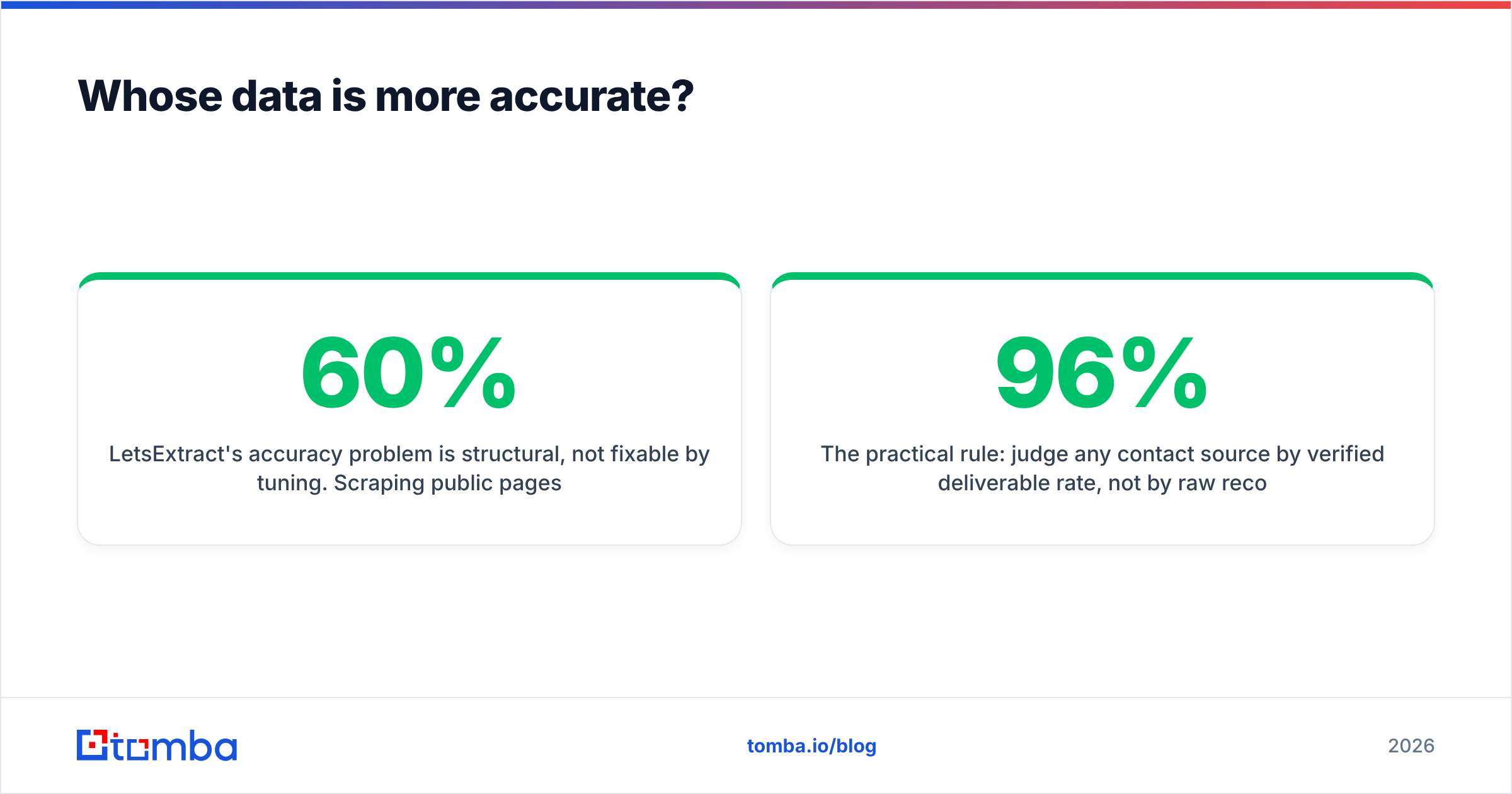
LetsExtract's accuracy problem is structural, not something you can tune away. Scraping public pages surfaces the addresses companies publish: info@, sales@, support@, contact@, plus a long tail of stale addresses buried in old PDFs and cached pages. Role accounts are the worst possible targets for cold email. Shared inboxes monitor them, abandoned ones often turn into spam traps, and mailbox providers weigh them heavily in reputation scoring. A list that's 60% role accounts will damage your sender reputation faster than any subject line can save it.

The practical rule: judge any contact source by verified deliverable rate, not by raw record count. A 2,000-record list at 96% deliverability beats a 40,000-record scrape at 55% every time. The big scrape gets your domain filtered before you finish sending it. Run any imported list through an independent email verifier before it touches your sending domain, whoever produced it.
What do EasyLeadz and LetsExtract cost in 2026?#
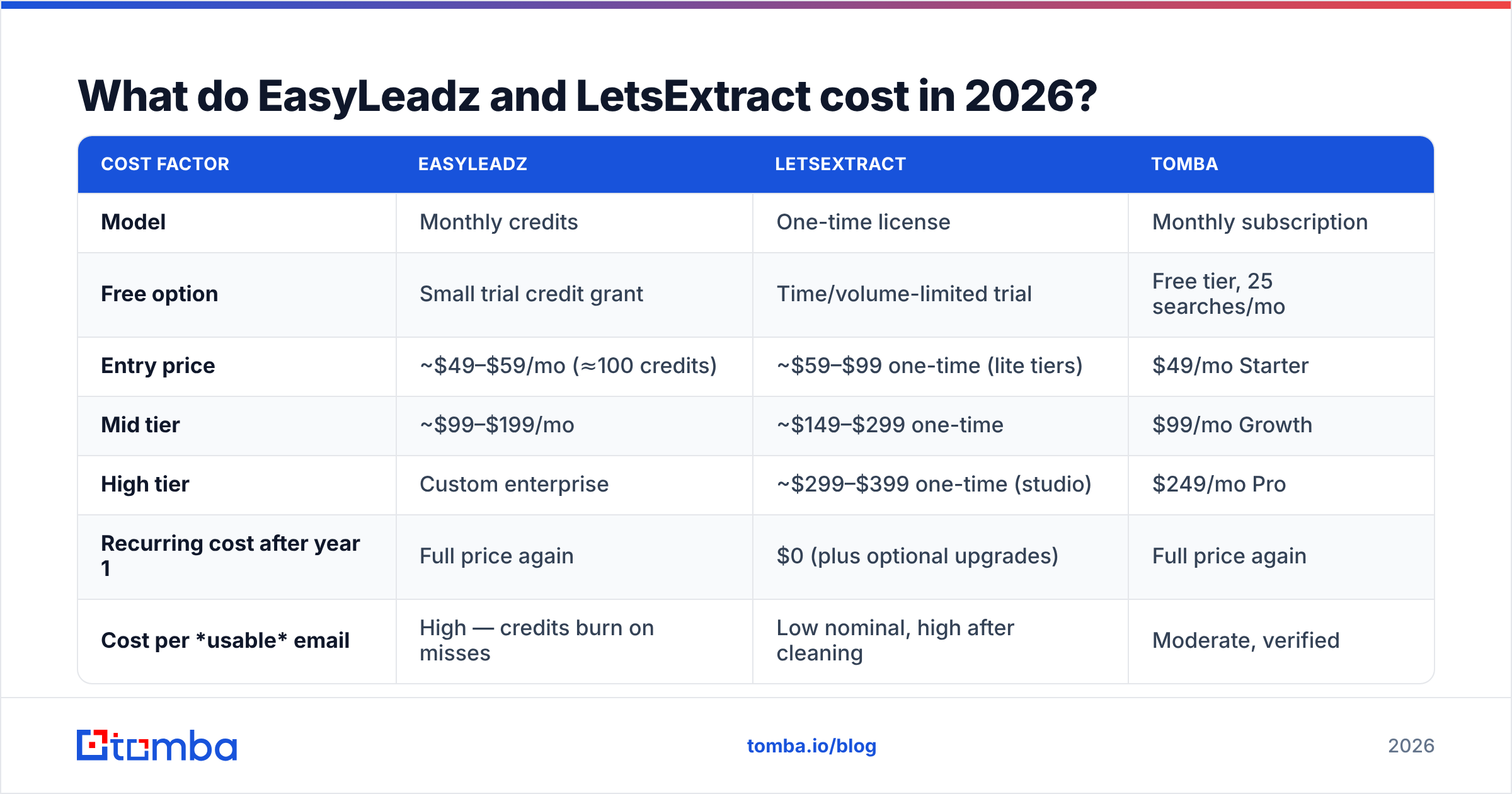
Pricing here is directional. Both vendors adjust tiers, and LetsExtract runs frequent license promotions. Confirm current numbers on their own pages before you commit budget.
| Cost factor | EasyLeadz | LetsExtract | Tomba |
|---|---|---|---|
| Model | Monthly credits | One-time license | Monthly subscription |
| Free option | Small trial credit grant | Time/volume-limited trial | Free tier, 25 searches/mo |
| Entry price | ~$49–$59/mo (≈100 credits) | ~$59–$99 one-time (lite tiers) | $49/mo Starter |
| Mid tier | ~$99–$199/mo | ~$149–$299 one-time | $99/mo Growth |
| High tier | Custom enterprise | ~$299–$399 one-time (studio) | $249/mo Pro |
| Recurring cost after year 1 | Full price again | $0 (plus optional upgrades) | Full price again |
| Cost per usable email | High — credits burn on misses | Low nominal, high after cleaning | Moderate, verified |
| Included verification | Partial | Bundled SMTP checker | Yes |
The perpetual license looks unbeatable until you price the cleanup. Say you scrape 30,000 addresses and 55% survive verification. Then you strip the role accounts and still bounce at 8%. The "free after year one" math now includes a replacement sending domain and several weeks of warmup. That's not a hypothetical cost. It's the most common failure mode for teams that buy scraping software instead of contact data. Compare it with transparent Tomba pricing, where the per-record price already includes verification.
Is EasyLeadz better than LetsExtract for cold outreach?#
For cold outreach, yes — EasyLeadz is the safer of the two, with one caveat.
EasyLeadz gives you a person, a title, and a channel. That's enough to write a relevant first line and route the lead correctly. Its phone data also unlocks a multichannel sequence: connect on LinkedIn, call, then email. Teams selling into India, Southeast Asia, and the Gulf get much better coverage here than from most US-centric databases.
LetsExtract gives you an address and nothing else. You cannot personalize what you cannot segment. Add a bundled bulk sender that ships from your own SMTP, and you've built the exact profile mailbox providers are trained to filter: an unsegmented list, no engagement history, a high role-account ratio, and sudden volume. Google and Microsoft's 2024 bulk-sender rules made that pattern actively dangerous rather than merely wasteful. They require authenticated domains, one-click unsubscribe, and spam complaint rates under 0.3%.
The caveat: EasyLeadz credits are spent on lookups, not on successes. A low-hit-rate ICP quietly inflates your true cost per contact. Test 100 credits against a sample of your target accounts before you buy a year.

Where do both tools fall short?#
Three gaps show up in almost every evaluation:
- Compliance posture. GDPR and similar rules care about lawful basis and source transparency. A curated database can show where a record came from. A desktop scrape usually cannot. If you sell into the EU, ask each vendor where its records originate — Tomba publishes its data sources for that reason.
- Workflow integration. LetsExtract is an island: CSV in, CSV out, on one Windows machine. EasyLeadz integrates better, but still expects you to live in its extension. Neither offers the kind of Tomba API, CLI, and spreadsheet coverage that lets enrichment run inside the systems your team already uses.
- Deliverability tooling. Finding an address is half the job. Neither product gives you SPF/DKIM diagnostics, blacklist monitoring, or warmup guidance. You'll bolt on a separate stack anyway. Start with an SPF checker and a blacklist test before your first send.
What are the best alternatives to EasyLeadz and LetsExtract?#
| Tool | Best for | Data model | Entry price | Watch out for |
|---|---|---|---|---|
| Tomba | Verified B2B email at scale | Domain + person search, verified | $49/mo (free tier) | Lighter phone coverage than dial specialists |
| EasyLeadz | Direct dials in India/APAC | Curated contact DB | ~$49–$59/mo | Credits burn on misses |
| LetsExtract | One-off bulk harvesting | Local scraping | ~$59+ one-time | Role accounts, Windows-only |
| BookYourData | Prebuilt, filterable list purchase | Licensed database | Pay-as-you-go | Best when you want lists, not lookups |
| Apollo | All-in-one prospect + sequence | Contributory network | Freemium | Data quality varies by segment |
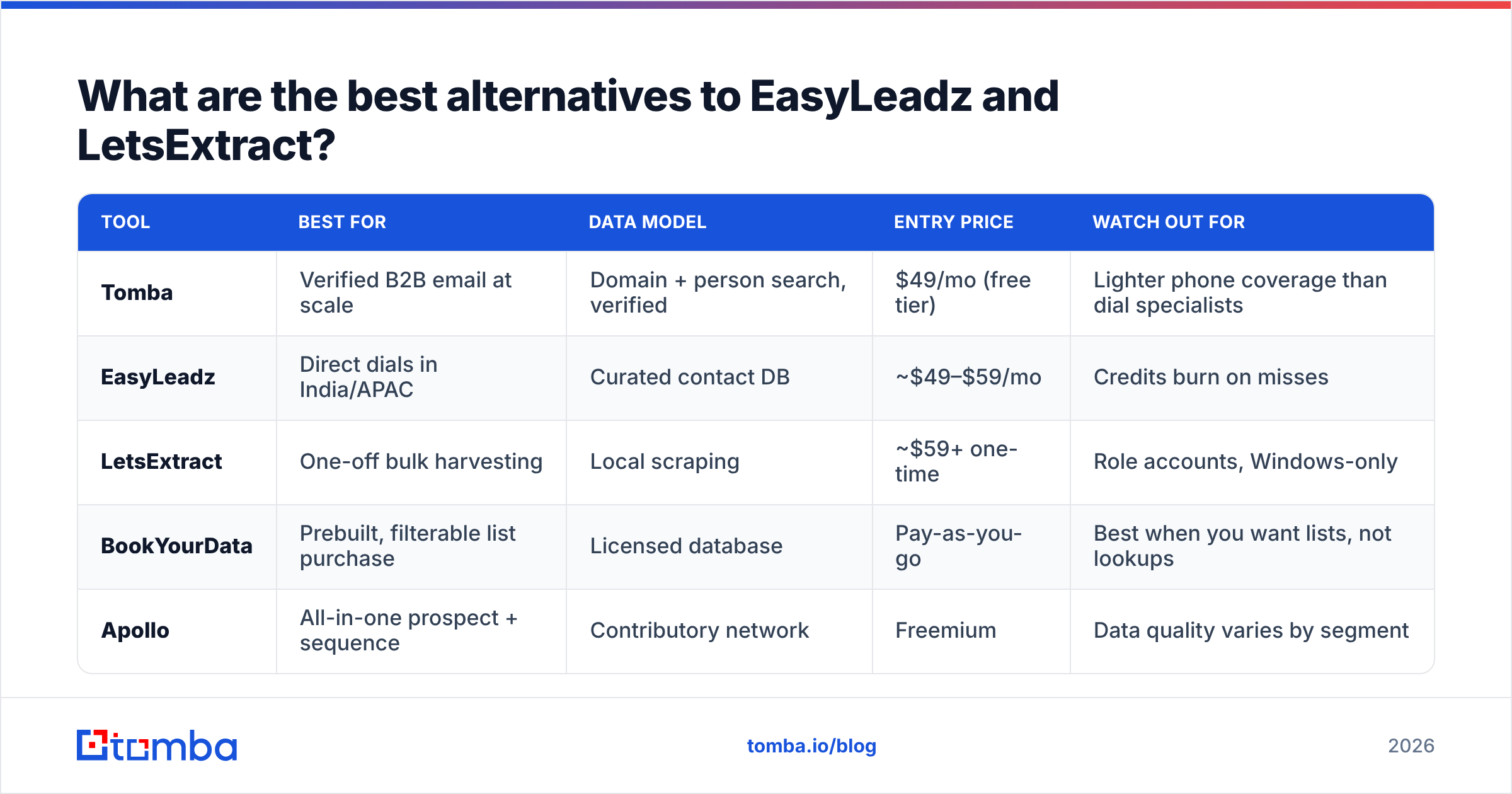
If your motion is phone-led into APAC, EasyLeadz earns its keep. If you want a clean, pre-filtered list you can buy outright without running software, BookYourData is a solid option with clear per-record pricing. And if you're harvesting for a one-time research project on Windows, LetsExtract does what it says.
But if your main channel is email, the job is different. You need a source that finds addresses by person or domain, verifies them before they reach your sequencer, and flags catch-all domains instead of pretending they're valid. That's a verification-first workflow: domain search to map a company's contacts, pattern detection to build candidates, then verification to cut the list down to what will land.

How should you decide between them?#
The EasyLeadz vs LetsExtract call comes down to four questions. Answer them honestly:
- What's your primary channel? Phone → EasyLeadz. Email → neither; use a verification-first finder.
- Do you need more than an address? Titles, seniority, company size → EasyLeadz or a database tool. LetsExtract can't help.
- What OS does your team run? Any Mac or Linux in the mix rules LetsExtract out on day one.
- What's your tolerance for domain risk? If you have one sending domain and no spare, scraped lists are a bad trade at any price.
Run a 100-record bake-off before you commit. Pull the same 100 target contacts from each tool, verify every output through a neutral third-party checker, and compare verified-deliverable records per dollar. That one number settles most of these debates faster than any feature matrix — including this one.
Ready to build a list that actually lands?#
If you've read this far, your real problem probably isn't "EasyLeadz or LetsExtract." It's getting accurate, verified work emails without gambling your sending domain on a scrape. Start with the Tomba Email Finder: search by domain, name, or company, and get verification built into every result. The free tier gives you 25 searches a month before you spend anything. When you're ready to scale, Starter runs $49/mo, and the API drops the same verified data straight into your CRM, sequencer, or spreadsheet — no Windows box required.
Related guides#
Ready to find emails that actually work?
Join 150,000+ professionals who stopped guessing and started sending. Free credits on signup — no credit card required.
Get the Tomba newsletter
Practical outbound tactics and product updates — once every two weeks.
About the author