EasyLeadz vs Mattermark: Which B2B Data Tool Wins in 2026?
EasyLeadz sells direct dials. Mattermark sells company signals. They barely overlap — and picking the wrong one costs you a quarter of pipeline. Here's the honest breakdown, plus what to use instead.
TL;DR
- EasyLeadz and Mattermark are not really competitors. EasyLeadz is a contact-data tool (direct dials and mobile numbers, India-heavy coverage). Mattermark is a company-intelligence tool (funding, growth signals, firmographics) that has changed hands more than once since its 2017 peak.
- If your reps need a phone number to dial today, EasyLeadz is the closer fit. If you need a list of companies that just raised a Series A, Mattermark's lineage is the closer fit — but the data freshness question is real.
- Neither one gives you a complete outbound stack. EasyLeadz is thin on verified work email at scale; Mattermark gives you accounts but not people.
- Pricing: EasyLeadz starts around $59/mo for a small credit bundle; Mattermark historically sat in the $500+/mo enterprise-ish band and no longer publishes transparent self-serve tiers.
- Most teams end up pairing a signal source with a dedicated email finder. That's where a tool like Tomba (free tier, $49/mo Starter) fills the gap both of these leave open.
What are EasyLeadz and Mattermark, actually?#
Short answer: they solve different halves of the same problem, and the "vs" framing hides that.
EasyLeadz is a contact-discovery platform best known for its Chrome extension, Mr. E. You open a LinkedIn profile, click the extension, and it attempts to return a direct dial or mobile number for that person. Its reputation was built on Indian and APAC mobile-number coverage — a genuinely hard dataset that most US-centric vendors handle badly. Work email is offered, but it's the secondary product, not the flagship.
Mattermark is a company-intelligence database. Founded in 2013, it made its name scoring startups on "Mattermark Growth Score" and tracking funding events, headcount trends, and web traffic momentum. It was one of the original signal-based prospecting tools before that category had a name. The company was acquired by FullContact in 2017 and later spun out again; the product still exists but no longer sits at the center of the B2B data conversation the way it did a decade ago.
So when you're evaluating EasyLeadz vs Mattermark, you're really asking: do I need people, or do I need accounts?
How do EasyLeadz and Mattermark compare head to head?#
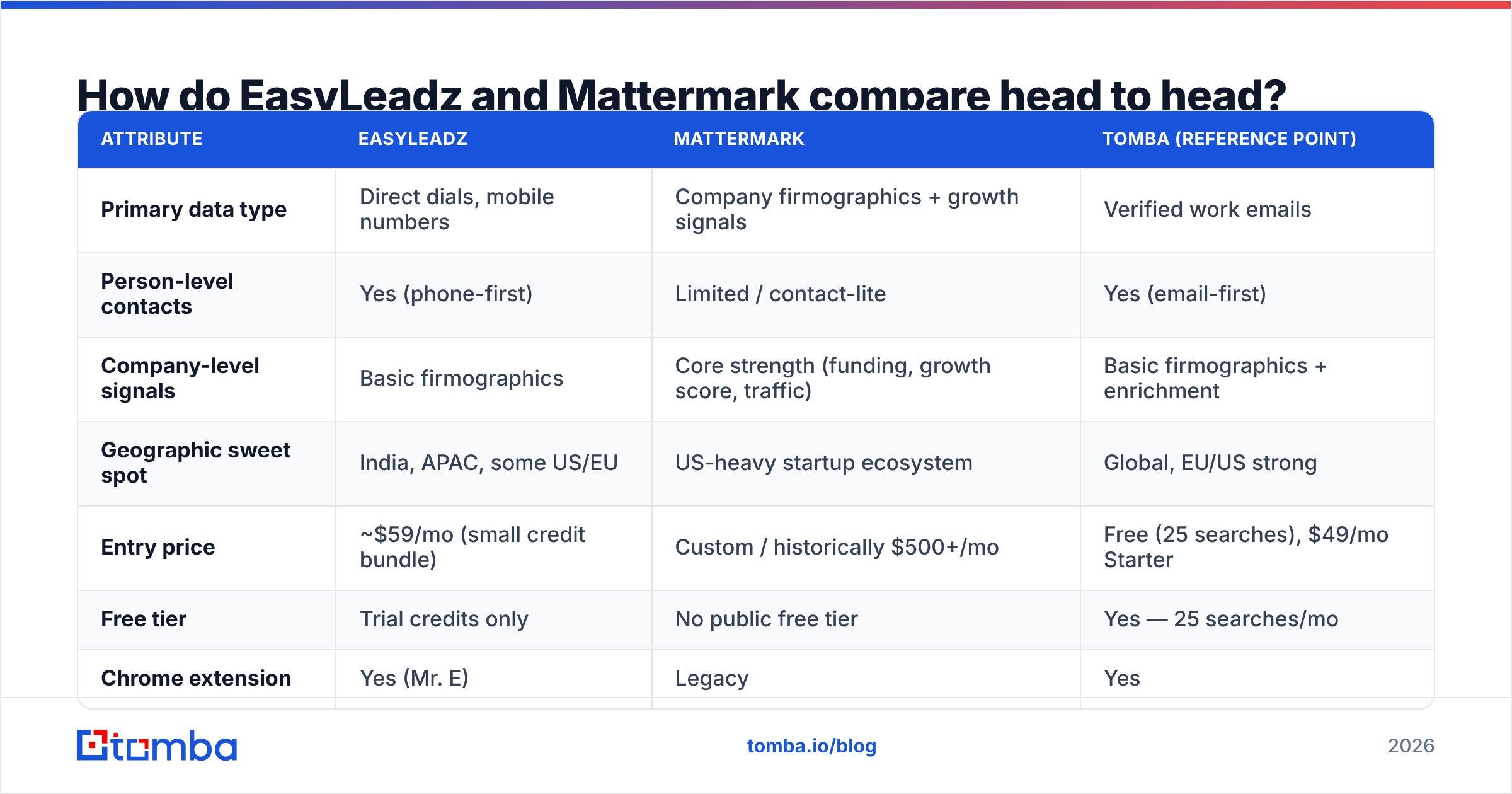
Here's the honest side-by-side. Pricing moves; verify current numbers on each vendor's own site before you sign anything.
| Attribute | EasyLeadz | Mattermark | Tomba (reference point) |
|---|---|---|---|
| Primary data type | Direct dials, mobile numbers | Company firmographics + growth signals | Verified work emails |
| Person-level contacts | Yes (phone-first) | Limited / contact-lite | Yes (email-first) |
| Company-level signals | Basic firmographics | Core strength (funding, growth score, traffic) | Basic firmographics + enrichment |
| Geographic sweet spot | India, APAC, some US/EU | US-heavy startup ecosystem | Global, EU/US strong |
| Entry price | ~$59/mo (small credit bundle) | Custom / historically $500+/mo | Free (25 searches), $49/mo Starter |
| Free tier | Trial credits only | No public free tier | Yes — 25 searches/mo |
| Chrome extension | Yes (Mr. E) | Legacy | Yes |
| API access | Yes, on paid plans | Yes, enterprise | Yes, all paid plans |
| Bulk processing | Yes | Export-based | Yes, bulk finder + verifier |
| Verification layer | Phone validation | None (company data) | SMTP + catch-all verification |
| Best for | Cold callers in APAC | Startup/VC/ecosystem research | Cold email at volume |
The table makes the split obvious. EasyLeadz gets a rep to a ringing phone. Mattermark gets a marketer to a target account list. Only one of them is on the critical path for a cold email motion, and it's neither.
Which one has better data accuracy?#
Depends entirely on which field you're measuring — and both vendors quietly benefit from that ambiguity.
EasyLeadz publishes accuracy claims in the 90%+ range for mobile numbers. In practice, buyers report a real split: coverage and accuracy in India and Southeast Asia are strong, sometimes the best available; US and Western European mobile coverage drops noticeably. That's not a knock — it's a specialization. If your ICP is Bangalore SaaS or Singapore fintech, that specialization is worth paying for. If your ICP is Series B companies in Austin, you'll hit gaps.
Mattermark's accuracy problem is different: it's a recency problem, not a correctness problem. Funding data, headcount, and growth scores are only useful if they reflect this quarter. After the 2017 acquisition and subsequent ownership changes, refresh cadence became a legitimate diligence question. Before you buy, pull 20 companies you know well and check whether their last funding round, headcount, and stage are current. If more than three are stale, the signal layer is decorative.
Four checks to run on either tool during a trial:
- Pull 50 records from your actual ICP — not a demo list the vendor prepared. Vendor demos are curated.
- Cross-verify against a second source. Run the emails through an email verifier and spot-dial 10 phone numbers manually.
- Check the timestamp. Ask what date each record was last refreshed. "We refresh continuously" is not an answer.
- Measure usable-record rate, not match rate. A 70% match rate where half the matches are wrong is a 35% tool.
Independent buyer reviews on G2 are useful directional reading here, but weight recent reviews heavily — B2B data quality changes faster than review scores do.
What does each one actually cost in 2026?#
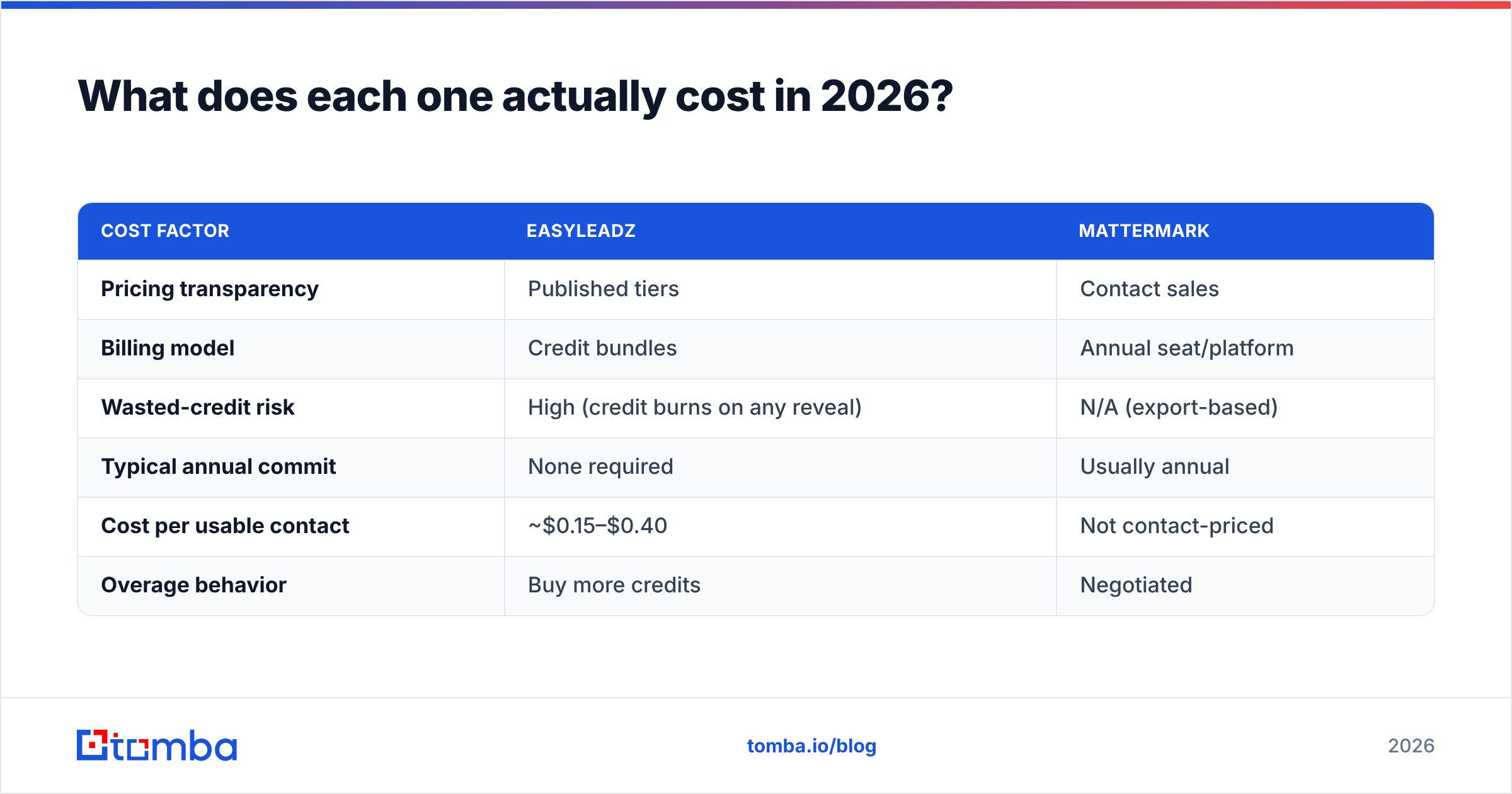
EasyLeadz is the transparent one. Self-serve credit bundles start in the ~$59/mo range for a few hundred credits and scale up per-credit as you buy more. Each revealed contact burns a credit whether or not the number is good — that's the important detail. If your usable-record rate is 60%, your effective cost per usable contact is 1.67x the sticker price.
Mattermark no longer publishes clean self-serve pricing. Historically it sat in the $500–$1,500/mo range for team plans, with enterprise agreements above that. Today you're going through a sales conversation, which means the price is a function of your perceived budget rather than your usage.
| Cost factor | EasyLeadz | Mattermark |
|---|---|---|
| Pricing transparency | Published tiers | Contact sales |
| Billing model | Credit bundles | Annual seat/platform |
| Wasted-credit risk | High (credit burns on any reveal) | N/A (export-based) |
| Typical annual commit | None required | Usually annual |
| Cost per usable contact | ~$0.15–$0.40 | Not contact-priced |
| Overage behavior | Buy more credits | Negotiated |
Compare that to a straightforward per-lookup model. Tomba pricing runs a free tier at 25 searches/mo, Starter at $49/mo, Growth at $99/mo, and Pro at $249/mo — with verification bundled rather than sold as a separate line item. The reason that matters isn't the headline number; it's that you can model your cost per verified contact before you commit, which you cannot do with a "contact sales" vendor.
Is EasyLeadz better than Mattermark for outbound?#
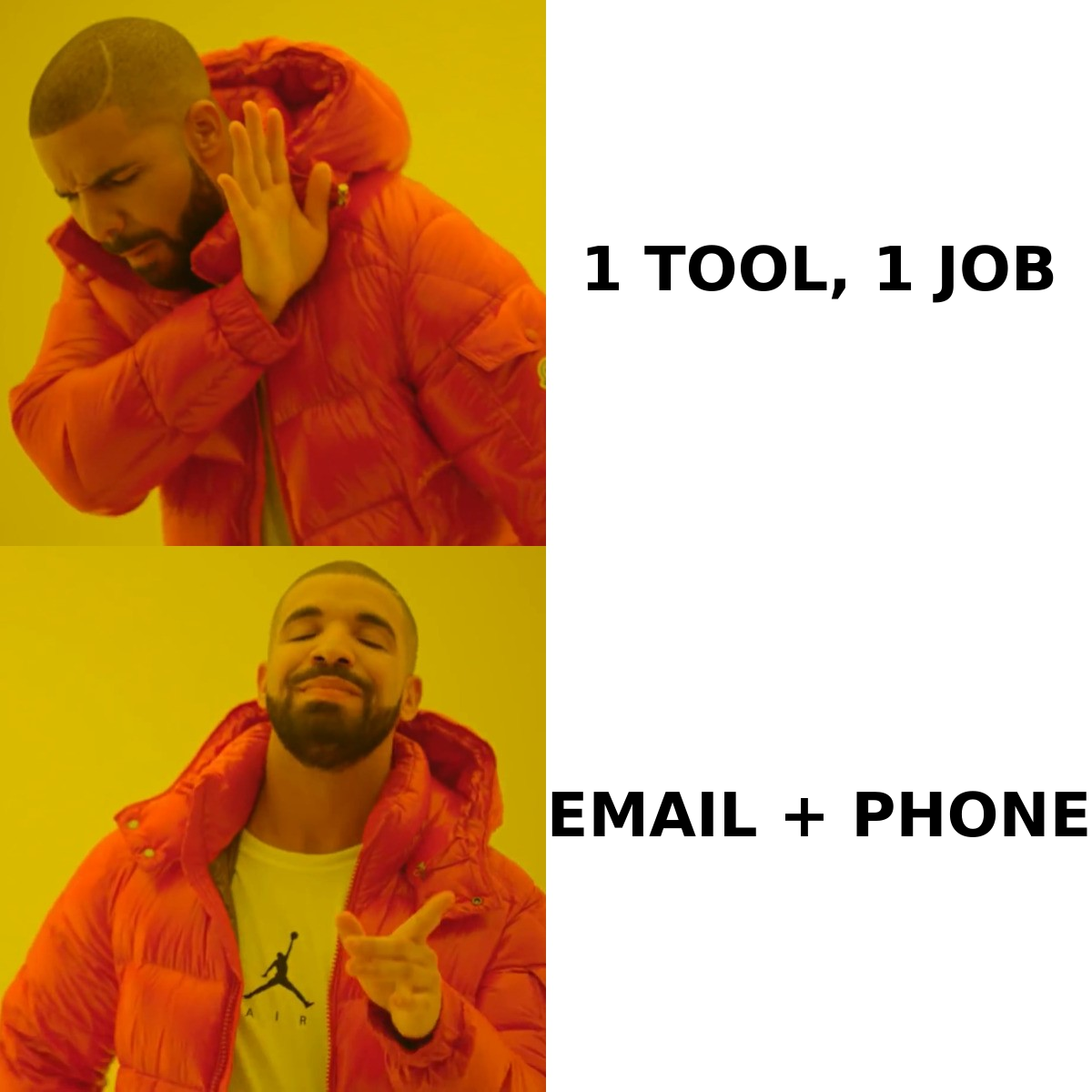
For a phone-led outbound motion, yes — clearly. For an email-led motion, neither is sufficient on its own.
Here's the practical breakdown by motion:
- Cold calling, APAC-focused ICP → EasyLeadz wins. Mobile coverage in that region is its whole reason to exist, and no US-first vendor matches it.
- Cold calling, US/EU ICP → EasyLeadz is competitive but not dominant. Test coverage against your exact territory before committing.
- Cold email at volume → Neither. You need a dedicated email finder with SMTP verification, because bounce rate is what determines whether your domain survives the quarter.
- Account-based marketing / target list building → Mattermark's signal data is the right shape, assuming freshness checks pass. Pair it with a contact source.
- VC, ecosystem, or market research → Mattermark wins outright. That was always its native use case, and competitor tracking is not a job EasyLeadz was built for.
- Full-funnel outbound (email + phone + enrichment) → You need a stack, not a single tool. Typically: a signal source, a contact finder, a verifier, and a sequencer.
That last point is where most evaluations go wrong. Teams try to make one vendor do four jobs, then blame the vendor when reply rates disappoint.
What should you use instead of either one?#
Best answer: split the job by data type and buy the specialist for each layer.
For company signals — if Mattermark's freshness doesn't clear your bar, the modern equivalents are Crunchbase for funding data, Clearbit alternatives for firmographic enrichment, or intent platforms if you have budget. Signal data has commoditized substantially since 2017; you have more options than you did.
For phone numbers — EasyLeadz remains legitimately good in its region. Outside it, look at a dedicated phone finder with a phone validator layer so you're not burning rep hours on disconnected lines. Validation before dialing is the single highest-ROI step in a calling motion, and almost nobody does it.
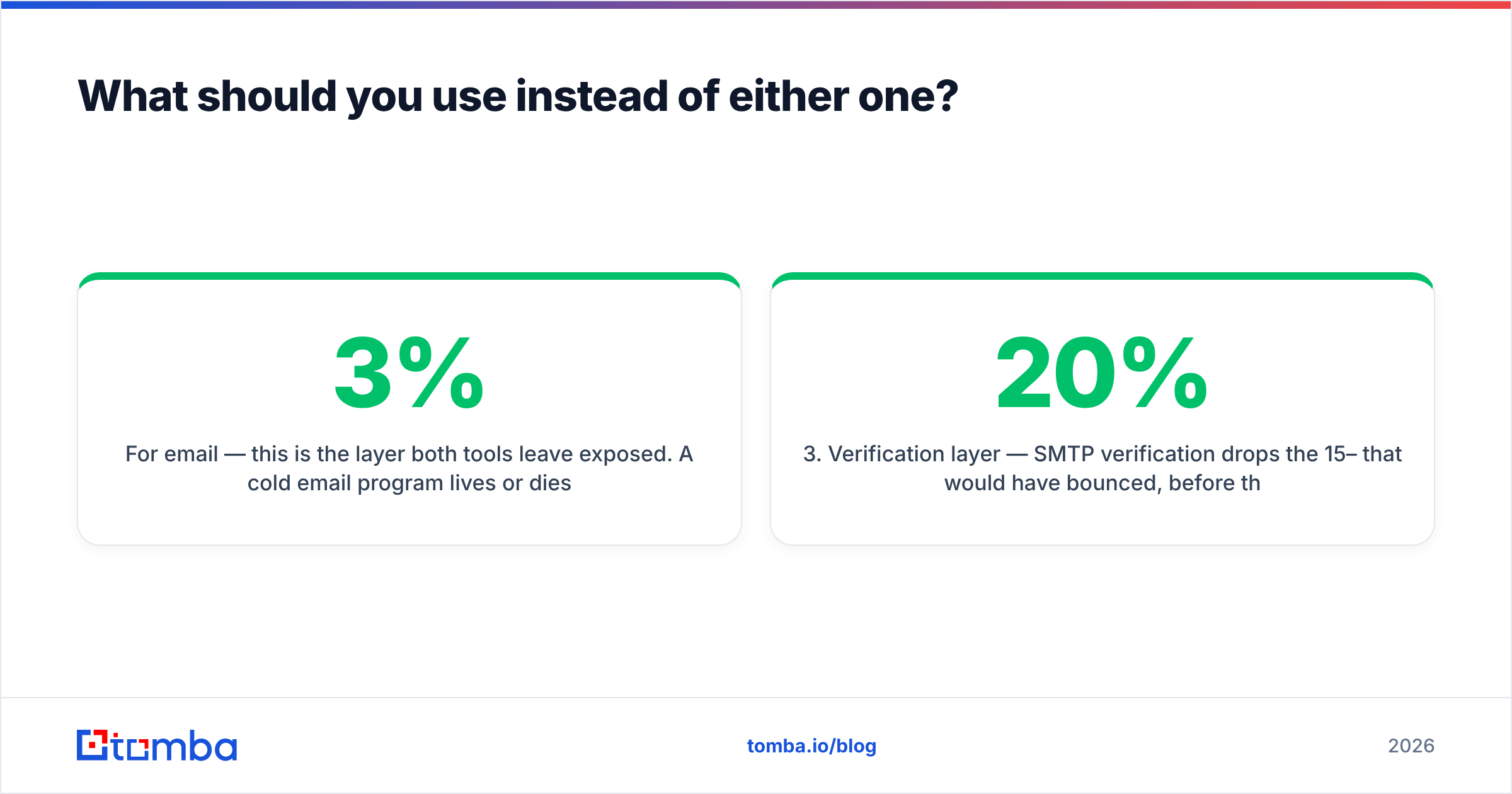
For email — this is the layer both tools leave exposed. A cold email program lives or dies on bounce rate. Above roughly 3%, your sender reputation degrades; above 5%, mailbox providers start throttling you and recovery takes weeks. So the email layer needs finding and verification in the same pipeline, including catch-all verification for the domains that accept everything and tell you nothing.
For contact enrichment — data enrichment fills in the fields your CRM is missing after the initial find. This is what turns a name and a domain into a routable, scorable, assignable record.
A worked example of a sane 2026 stack:
- Signal layer — Crunchbase or a funding-alert feed identifies 200 accounts that raised in the last 90 days.
- Contact layer — domain search returns the decision-makers at each account, with role and seniority.
- Verification layer — SMTP verification drops the 15–20% that would have bounced, before they ever enter your sequencer.
- Phone layer — validated mobile numbers for the top 50 accounts only. Don't buy phone data for accounts you're not going to call.
- Sequencer — your outreach tool of choice, receiving only clean records.
Each layer costs less than a do-everything platform, and you can swap any one of them without renegotiating a contract. That modularity is worth more than the discount a bundled vendor will offer you.
What are the real trade-offs of each tool?#
Direct, without the hedging:
EasyLeadz strengths: APAC mobile coverage that genuinely outperforms bigger names; transparent entry pricing; a Chrome extension that fits the existing LinkedIn workflow with no retraining; low commitment risk since there's no forced annual contract.
EasyLeadz weaknesses: credit burn on failed reveals is a real hidden cost; email coverage is thin relative to phone; US/EU coverage doesn't match its home-market strength; limited native integration depth compared with platform vendors.
Mattermark strengths: signal data in a genuinely useful shape for account targeting; growth-score methodology that still holds up conceptually; strong for research, competitive tracking, and market mapping.
Mattermark weaknesses: freshness is an open question after multiple ownership changes; opaque pricing; no meaningful contact layer, so it can never be your only tool; the category has moved on and the product hasn't obviously moved with it.
The shared weakness: neither vendor gives you verified email at scale with a verification layer attached. That's not a criticism of either product — it's outside both of their design centers. It just means the "vs" question has a false premise. You're not choosing between them. You're choosing what to pair with your email infrastructure.
How do you run a fair 30-day evaluation?#
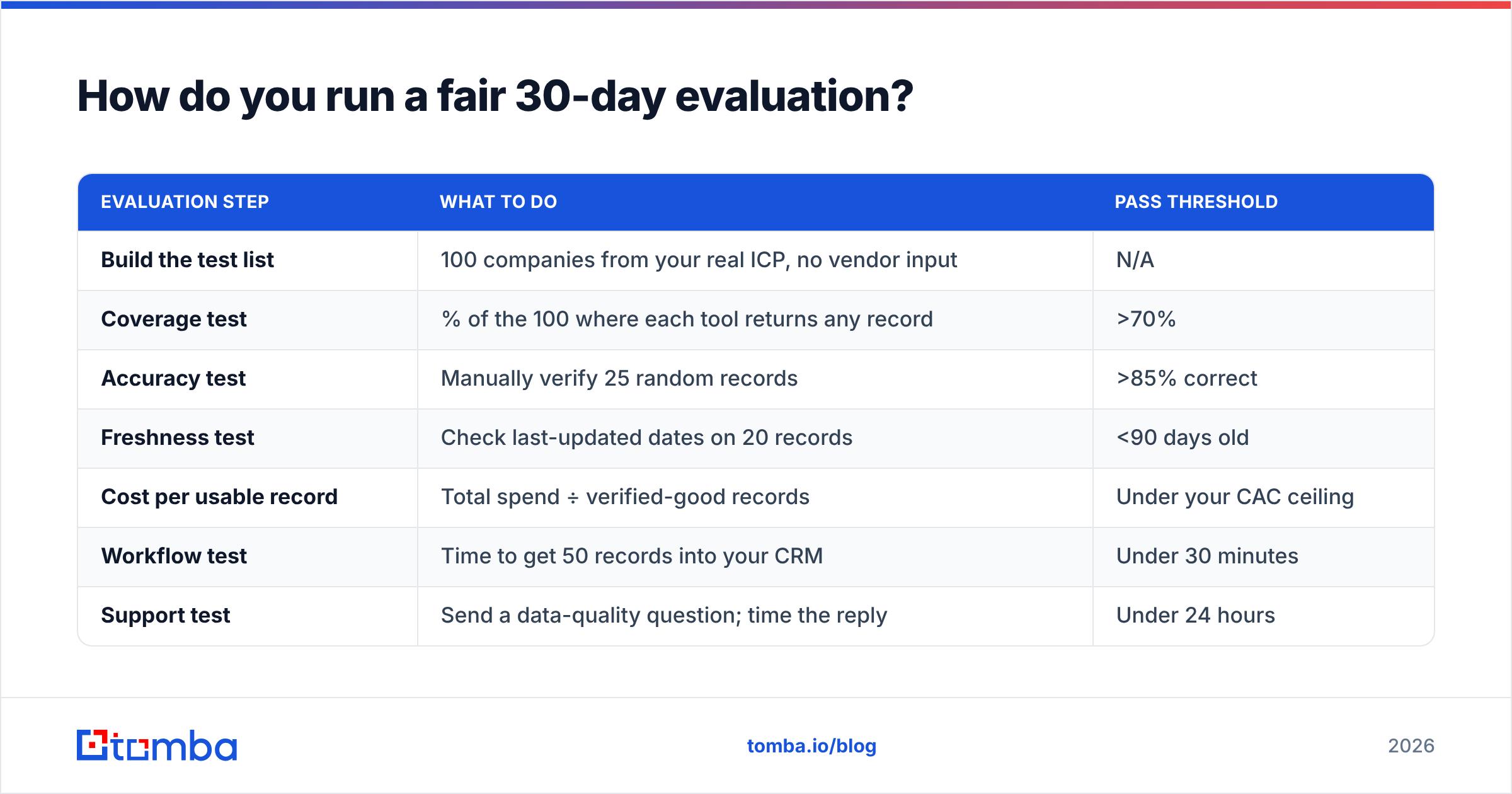
Give both tools the same test and let the data decide. Vendors will steer you toward their strengths; a controlled test is the only defense.
| Evaluation step | What to do | Pass threshold |
|---|---|---|
| Build the test list | 100 companies from your real ICP, no vendor input | N/A |
| Coverage test | % of the 100 where each tool returns any record | >70% |
| Accuracy test | Manually verify 25 random records | >85% correct |
| Freshness test | Check last-updated dates on 20 records | <90 days old |
| Cost per usable record | Total spend ÷ verified-good records | Under your CAC ceiling |
| Workflow test | Time to get 50 records into your CRM | Under 30 minutes |
| Support test | Send a data-quality question; time the reply | Under 24 hours |
Run this before the trial expires, not after. And record the numbers in a shared doc — six months from now, when someone asks why you picked one over the other, "it felt better" won't survive a budget review.
One more thing worth checking: export rights. Some contracts restrict what you can do with exported data after cancellation. Read that clause. It's the one that bites teams at renewal, when the vendor knows you have three years of records living inside their platform.
Which should you pick?#
If you're calling APAC prospects, buy EasyLeadz and stop reading. If you're building target-account lists and doing ecosystem research, evaluate Mattermark with a hard freshness test up front. If you're running cold email — which is most B2B teams most of the time — neither tool is the answer, and the honest recommendation is to solve the email layer properly first.
That means finding the right person at the right company, verifying the address before it enters a sequence, and enriching the record so your CRM stays useful. Tomba's Email Finder does exactly that: search by domain, name, or company, get verified work emails with confidence scores, and process in bulk or through the API when the volume grows. The free tier gives you 25 searches a month to test coverage against your own ICP before spending anything, and Starter is $49/mo when you're ready to scale. Run it against the same 100-company list you use to test EasyLeadz and Mattermark — that's the only comparison that tells you anything about your pipeline.
Related guides#
Ready to find emails that actually work?
Join 150,000+ professionals who stopped guessing and started sending. Free credits on signup — no credit card required.
Get the Tomba newsletter
Practical outbound tactics and product updates — once every two weeks.
About the author