EasyLeadz vs Reachfast: Which B2B Contact Tool Wins in 2026?
EasyLeadz owns India-first mobile numbers. Reachfast leans on LinkedIn-triggered lookups. We compare coverage, pricing, accuracy, and API depth so you can pick the right one — or skip both.
TL;DR
- EasyLeadz is a mobile-number-first contact tool with unusually strong India and APAC coverage, sold through its Mr. E extension and a credit-based API.
- Reachfast is a lighter LinkedIn-triggered lookup tool — you land on a profile, it returns an email and sometimes a phone. Cheaper entry, thinner enterprise plumbing.
- Neither is a full prospecting stack. Both assume you already know who you want; they only tell you how to reach them.
- If your motion is India/SEA phone outreach, EasyLeadz wins. If it's ad-hoc LinkedIn sourcing on a small budget, Reachfast is fine.
- If you need domain-wide email discovery, verification, and an API you can build on, a dedicated email finder covers more ground per dollar than either.
What are EasyLeadz and Reachfast, exactly?#
Both tools solve the same narrow problem — you have a name and a company, you need a working phone number or email — but they approach it from opposite ends.
EasyLeadz is an India-headquartered contact-data provider best known for Mr. E, its Chrome extension. You open a LinkedIn profile, click the extension, and it returns a direct mobile number. That mobile-first positioning is the whole pitch: most Western providers are strong on corporate emails and weak on cell numbers, especially outside North America and Western Europe. EasyLeadz inverted that. It sells credits, exposes a REST API, and pushes into CRMs.
Reachfast is a smaller, newer player in the same LinkedIn-triggered lookup category. Install, browse, click, get a contact. The product surface is deliberately thin — there's no serious database browser, no intent layer, no sequencing. It competes on price and simplicity rather than depth.
The distinction that matters for your buying decision is where the data comes from and how it's priced. EasyLeadz leans on a proprietary phone graph with a heavy regional bias. Reachfast leans on aggregated and enriched sources with broader-but-shallower reach. That single difference drives almost every trade-off below.
How do EasyLeadz and Reachfast compare feature by feature?#
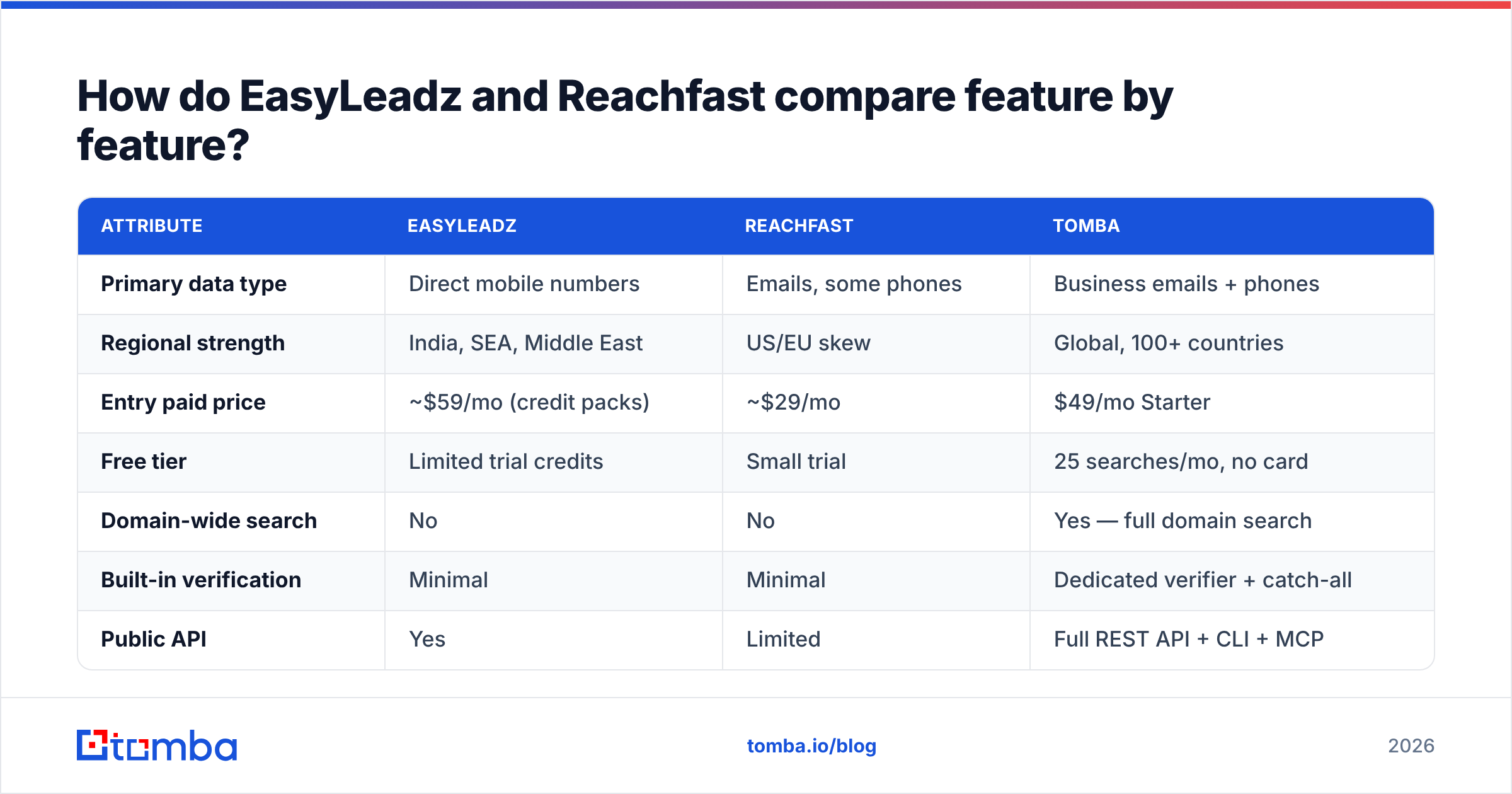
Here's the head-to-head on the attributes that actually change your workflow. Prices reflect publicly listed entry tiers as of 2026 — always confirm current rates directly, since credit-based vendors reprice often.
| Attribute | EasyLeadz | Reachfast | Tomba |
|---|---|---|---|
| Primary data type | Direct mobile numbers | Emails, some phones | Business emails + phones |
| Regional strength | India, SEA, Middle East | US/EU skew | Global, 100+ countries |
| Entry paid price | ~$59/mo (credit packs) | ~$29/mo | $49/mo Starter |
| Free tier | Limited trial credits | Small trial | 25 searches/mo, no card |
| Domain-wide search | No | No | Yes — full domain search |
| Built-in verification | Minimal | Minimal | Dedicated verifier + catch-all |
| Public API | Yes | Limited | Full REST API + CLI + MCP |
| Bulk processing | Yes (CSV) | Basic | Bulk finder + verifier |
| Native integrations | HubSpot, Zapier, Salesforce | Zapier-level | HubSpot, Salesforce, Pipedrive, Sheets, Airtable |
| Best for | APAC phone outreach | Solo LinkedIn sourcing | Multi-channel B2B at scale |
Two rows deserve emphasis. Domain-wide search is absent from both — you cannot say "give me every marketing contact at stripe.com." You must supply a person first. That's a structural limitation, not a feature gap, and it caps how much pipeline either tool can generate on its own.
Verification is the second. Both return contacts; neither treats validity as a first-class product. If you push unverified data straight into a sequence, your bounce rate becomes the deliverability problem you spend the next month unwinding.
Which one has better data accuracy?#
Accuracy depends entirely on geography, and anyone quoting a single global percentage is selling you something.
EasyLeadz's mobile coverage in India is genuinely hard to replicate — reviewers on G2 consistently flag it as the reason they stay. Ask it for a direct dial in Munich or Denver and hit rates fall off noticeably. Reachfast is the mirror image: reasonable email coverage on US and European profiles, sparse phone data, and weaker results the further you get from tech and SaaS job titles.
Three practical rules for evaluating either:
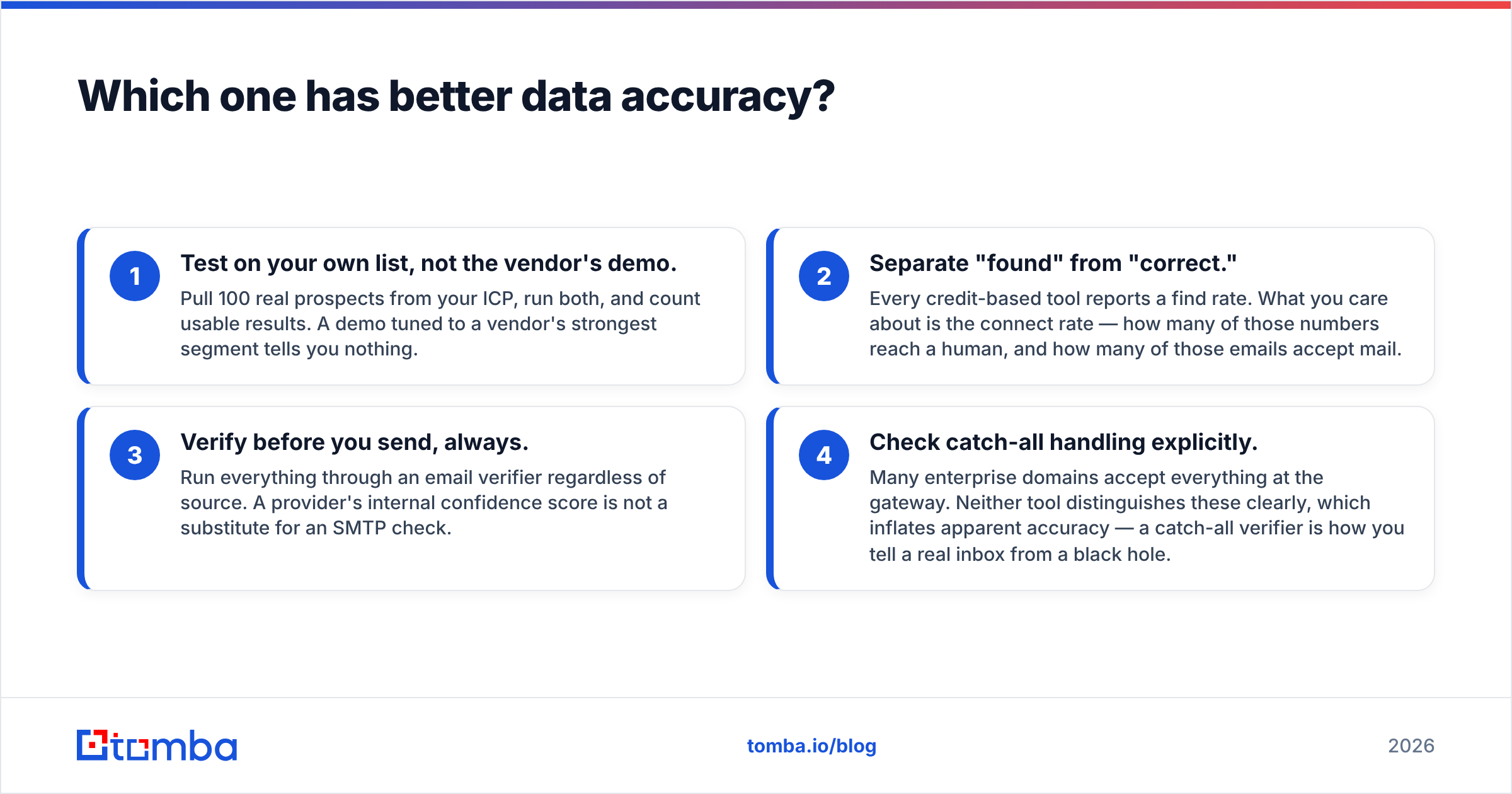
- Test on your own list, not the vendor's demo. Pull 100 real prospects from your ICP, run both, and count usable results. A demo tuned to a vendor's strongest segment tells you nothing.
- Separate "found" from "correct." Every credit-based tool reports a find rate. What you care about is the connect rate — how many of those numbers reach a human, and how many of those emails accept mail.
- Verify before you send, always. Run everything through an email verifier regardless of source. A provider's internal confidence score is not a substitute for an SMTP check.
- Check catch-all handling explicitly. Many enterprise domains accept everything at the gateway. Neither tool distinguishes these clearly, which inflates apparent accuracy — a catch-all verifier is how you tell a real inbox from a black hole.
That third point deserves its own note. Contact data decays roughly 2.5% per month as people change jobs, so any list older than a quarter is meaningfully stale. Verification isn't a one-time gate; it's a recurring hygiene task tied to your sender reputation.
How does pricing actually work on each?#
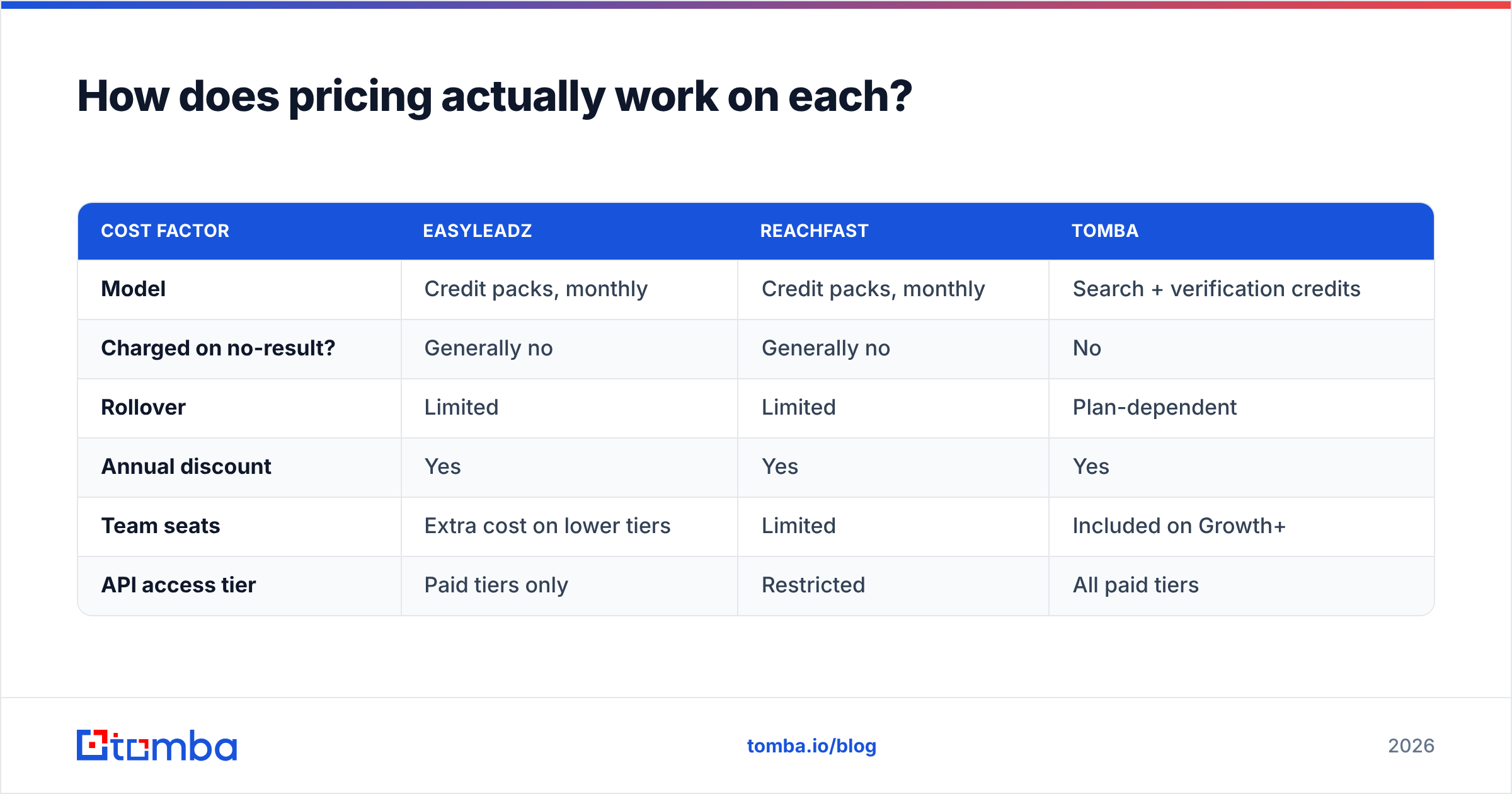
Both sell credits, which makes headline pricing misleading. What matters is the cost per usable contact, not cost per credit.
| Cost factor | EasyLeadz | Reachfast | Tomba |
|---|---|---|---|
| Model | Credit packs, monthly | Credit packs, monthly | Search + verification credits |
| Charged on no-result? | Generally no | Generally no | No |
| Rollover | Limited | Limited | Plan-dependent |
| Annual discount | Yes | Yes | Yes |
| Team seats | Extra cost on lower tiers | Limited | Included on Growth+ |
| API access tier | Paid tiers only | Restricted | All paid tiers |
Run the math this way: take your monthly contact volume, multiply by the realistic find rate for your region (not the marketing number), then divide plan cost by that result. A $29/mo plan with a 35% hit rate on your ICP is more expensive per usable record than a $49/mo plan hitting 70%.
Also account for the hidden line item — API access. EasyLeadz gates its API to paid tiers, and Reachfast's programmatic surface is limited enough that automation-heavy teams end up scripting around the extension. If your workflow is "enrich the CRM nightly," that constraint is disqualifying. Compare that with Tomba pricing, where API access is included on every paid plan and there's a genuine free tier for testing before you commit.
Is EasyLeadz better than Reachfast for cold calling?#
Yes — if you're calling India, Southeast Asia, or the Gulf. That's the clearest verdict in this comparison.
Direct mobile numbers are the scarcest asset in B2B data. Corporate switchboards have effectively stopped forwarding cold calls, and gatekeepers are back in force. A tool that reliably returns a cell number for an APAC decision-maker is doing something structurally difficult, and EasyLeadz does it better than most Western-built alternatives.
The caveat is compliance. Mobile outreach sits under a patchwork of rules — DNC registries in India, TCPA in the US, GDPR legitimate-interest tests in the EU. Having the number does not mean you're clear to dial it. Build the consent and suppression logic before you scale the dial volume, not after.
For US and European calling, neither tool is the strongest option. You'll get better density from a provider that treats phone data as a primary product line rather than a bonus field, which is where a dedicated phone finder with a phone validator in front of it earns its cost — validating line type and reachability before your reps burn an hour on disconnected numbers.

What are the real limitations of both tools?#
Four constraints apply to EasyLeadz and Reachfast alike, and they're worth naming before you sign anything.
- They require a person, not a target. No domain-wide discovery means no "find me the whole revenue team at this account." You're stuck sourcing names manually on LinkedIn first, which caps throughput at human browsing speed.
- Extension-dependent workflows don't scale. Click-per-contact is fine at 20 prospects a week and unbearable at 2,000 a month. Both tools' automation stories are thinner than their extension stories.
- Verification is an afterthought. Neither ships a serious validation layer. You will need a second vendor, which erodes the price advantage that made the cheaper option attractive.
- Enrichment depth is shallow. You get contact coordinates, not firmographics, tech stack, or headcount signals. If your scoring model needs those fields, you're adding a third tool. Proper data enrichment merges those layers in one call instead.
None of these are bugs. They're the natural shape of a focused point tool. The mistake is buying one expecting it to replace a data platform, then discovering three months in that your stack is now four vendors and a Zapier bill.
Who should choose which?#
Match the tool to the motion, not to the feature list.
Choose EasyLeadz if: your buyers are in India, Southeast Asia, or the Middle East; phone is your primary channel; and you're willing to pay a premium for mobile numbers that competitors don't have. It's a specialist, and specialists earn their price inside their specialty.
Choose Reachfast if: you're a solo founder or a small team doing low-volume, high-touch LinkedIn sourcing; your budget is genuinely tight; and you don't need an API. It's the least-commitment entry into this category.
Choose neither if: you need domain-wide discovery, verification built into the same pipeline, an API you can schedule against, or global coverage that doesn't collapse outside one region. That's a different product category, and paying two point tools to approximate it costs more than buying it directly.
Worth noting for teams evaluating this space: providers like BookYourData approach it from the prebuilt-list angle instead — you buy a filtered contact list outright rather than looking people up one at a time. That's a legitimately different purchase shape, and for teams that want volume on day one without building a sourcing workflow, it's worth a look alongside the lookup tools.
How do you build a stack that doesn't need three vendors?#
Start from the workflow, then pick tools that cover contiguous steps rather than overlapping ones.
A functional B2B contact pipeline has five stages: target selection (which accounts), contact discovery (which people, and how to reach them), verification (is this deliverable), enrichment (what else do we know), and activation (into the CRM and sequencer). EasyLeadz and Reachfast both live entirely in stage two. Everything else is your problem.
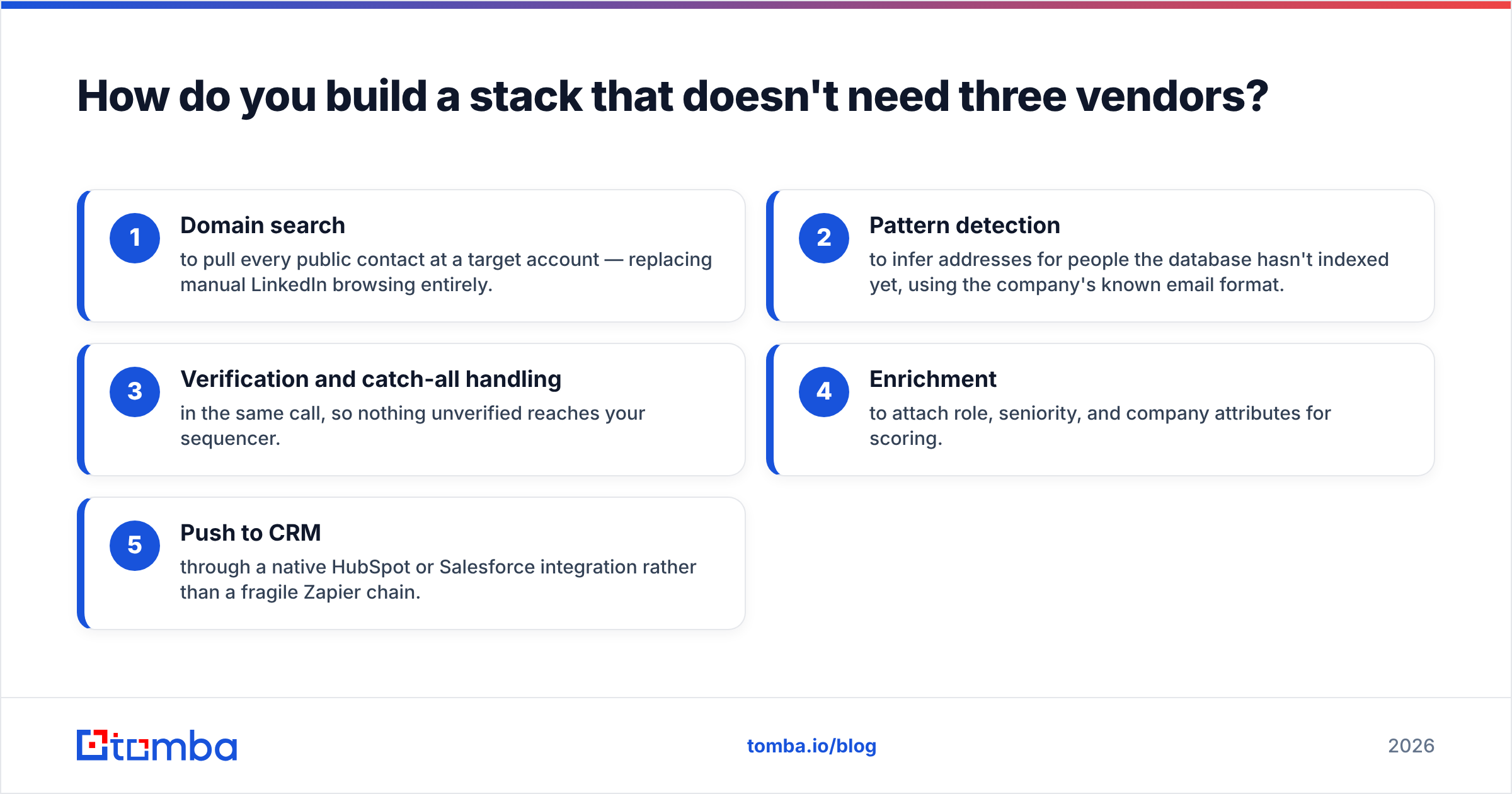
The consolidation play is to cover stages two through four with one provider that exposes them through a single API. That looks like:
- Domain search to pull every public contact at a target account — replacing manual LinkedIn browsing entirely.
- Pattern detection to infer addresses for people the database hasn't indexed yet, using the company's known email format.
- Verification and catch-all handling in the same call, so nothing unverified reaches your sequencer.
- Enrichment to attach role, seniority, and company attributes for scoring.
- Push to CRM through a native HubSpot or Salesforce integration rather than a fragile Zapier chain.
Do that and your per-contact cost drops, your bounce rate stabilizes, and your vendor count goes from four to one. The tools you keep alongside it should be genuine specialists — EasyLeadz for APAC mobile is a defensible reason to keep a second vendor. "Reachfast is cheap" usually isn't, once you've priced the verification you'll bolt on anyway.
One more operational note: whatever you choose, instrument it. Track find rate, connect rate, and bounce rate by data source, monthly. Vendors' coverage shifts as their supply contracts change, and the provider that was best for your ICP last year may not be this year. The teams that get this right treat data vendors like any other supplier — measured, compared, and swapped when the numbers stop justifying the invoice. Reference points from HubSpot's research on outbound benchmarks are a reasonable sanity check for what "normal" looks like in your segment.
Start with coverage you can test before you pay#
The honest summary: EasyLeadz is the better tool if your prospects are in its home regions and you're calling them. Reachfast is the cheaper tool if you're doing low volume and don't need infrastructure. Neither is a platform, and both will require a second vendor for verification the moment you scale past a few hundred sends a month.
If you'd rather not assemble that stack from parts, start with the Tomba Email Finder — domain-wide discovery, built-in verification, catch-all handling, and a full REST API on every paid plan, starting at $49/mo with 25 free searches to test against your own list first. Run your actual ICP through it before you commit to anything. That's the only benchmark that matters.
Related guides#
Ready to find emails that actually work?
Join 150,000+ professionals who stopped guessing and started sending. Free credits on signup — no credit card required.
Get the Tomba newsletter
Practical outbound tactics and product updates — once every two weeks.
About the author