EasyLeadz vs Saleshandy: Full 2026 Comparison and Verdict
EasyLeadz sells direct dials. Saleshandy sends sequences. They're rarely a true either/or — but most teams still buy one and regret it. Here's the honest 2026 breakdown of data quality, pricing, and where each one actually breaks.
TL;DR
- EasyLeadz and Saleshandy are not competitors in the way search results suggest. EasyLeadz is a contact-data provider built around direct-dial phone numbers; Saleshandy is a cold email sending platform that bolted a lead database on top.
- If your motion is phone-first, EasyLeadz (via its "Mr. E" extension) is the more focused buy — its India and APAC mobile coverage is genuinely strong.
- If your motion is email-first, Saleshandy wins on sending infrastructure: unlimited email accounts, rotation, warmup, and sequence logic that EasyLeadz simply doesn't have.
- Neither is a great standalone email-data source. Saleshandy's Lead Finder is a resold database, and EasyLeadz's email accuracy trails its phone accuracy by a wide margin.
- The cheapest working stack for most teams is a dedicated finder/verifier for data plus a sender for delivery — often under $100/month combined, which is less than either vendor's mid tier.
Most "EasyLeadz vs Saleshandy" comparisons treat these two like they're the same product. They aren't. You can buy both and have zero feature overlap, or buy one and discover six weeks in that half your workflow is missing. This post is about figuring out which half you actually need.
What are EasyLeadz and Saleshandy, exactly?#
EasyLeadz (easyleadz.com) is an India-headquartered B2B contact intelligence company. Its flagship is Mr. E, a Chrome extension that surfaces direct-dial mobile numbers and work emails from LinkedIn profiles and company pages. The business is credit-based: you buy a bucket of credits, and each revealed contact burns one. It has an API, a bulk enrichment flow, and a company database, but the reason people buy it is phone numbers — specifically mobile numbers in markets where US-centric vendors go dark.
Saleshandy (saleshandy.com) started as an email tracking tool and became a cold email sequencer. Its core is sending: connect unlimited mailboxes, rotate between them, warm them up, run multi-step sequences with conditional logic, and track replies in a unified inbox. In 2023 it added Lead Finder, a B2B contact database licensed and layered into the platform so you can build a list and sequence it without leaving the app.
So the honest framing:
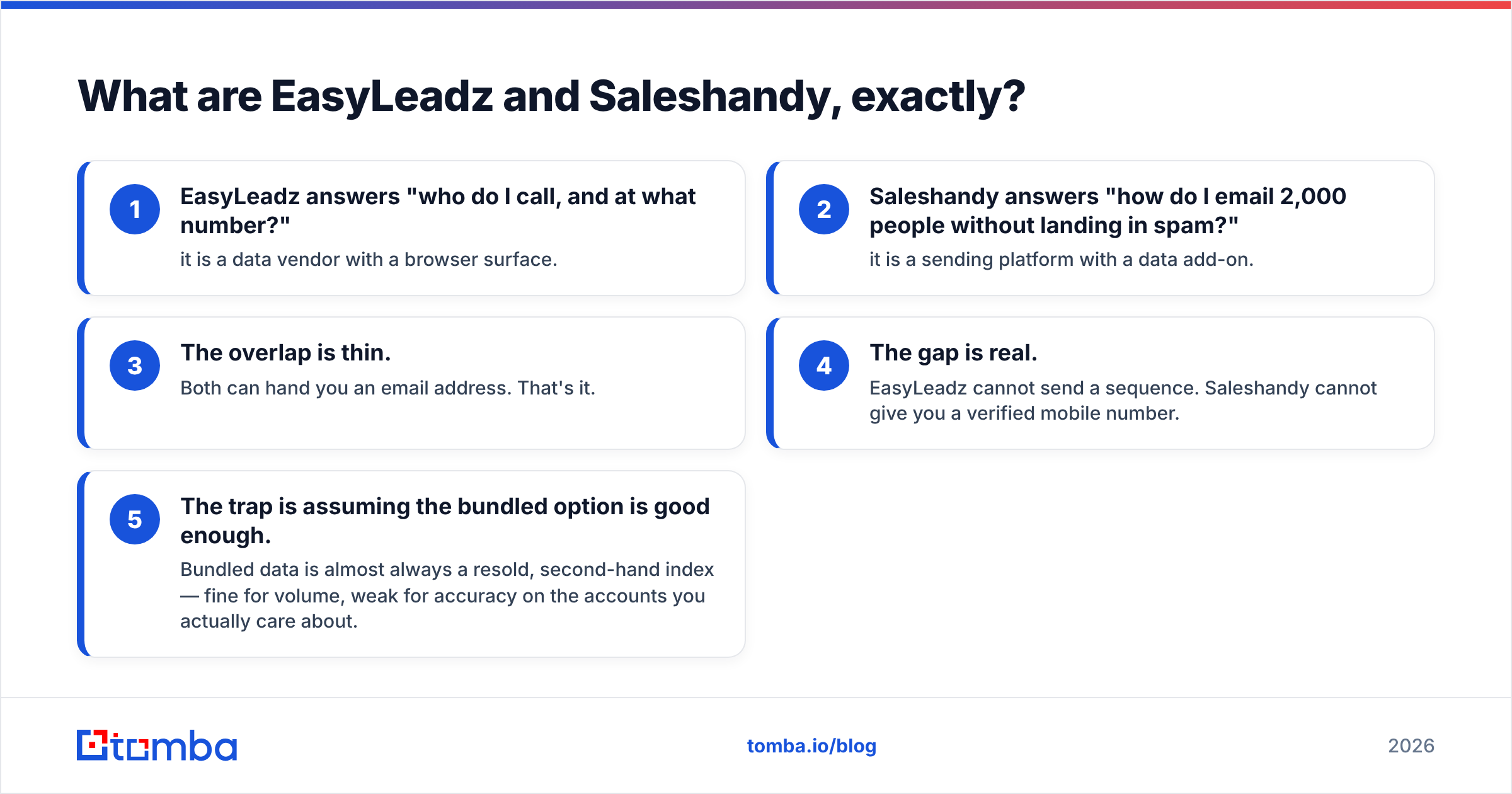
- EasyLeadz answers "who do I call, and at what number?" — it is a data vendor with a browser surface.
- Saleshandy answers "how do I email 2,000 people without landing in spam?" — it is a sending platform with a data add-on.
- The overlap is thin. Both can hand you an email address. That's it.
- The gap is real. EasyLeadz cannot send a sequence. Saleshandy cannot give you a verified mobile number.
- The trap is assuming the bundled option is good enough. Bundled data is almost always a resold, second-hand index — fine for volume, weak for accuracy on the accounts you actually care about.
How do EasyLeadz and Saleshandy compare head-to-head?#
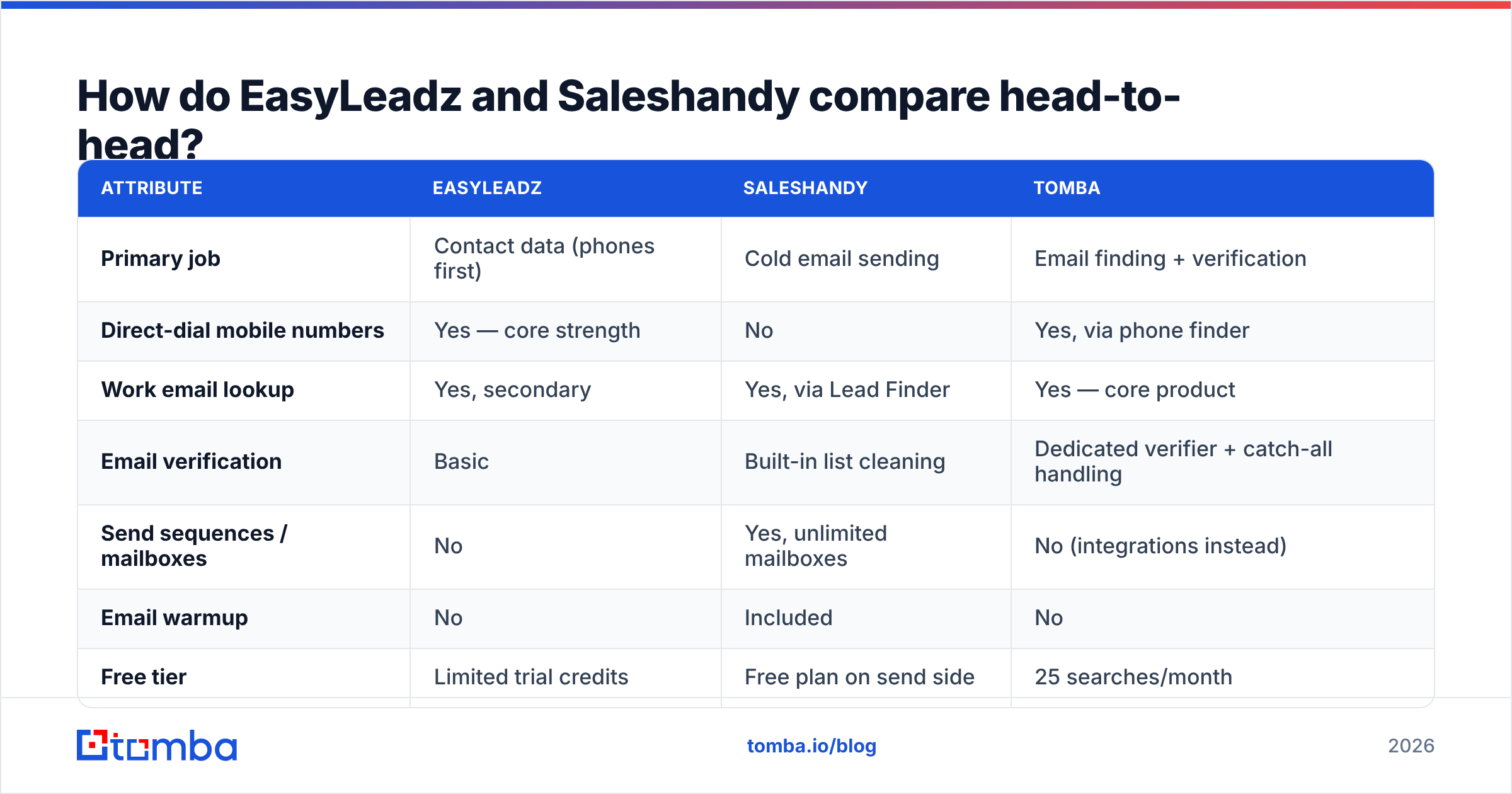
Here's the side-by-side on the attributes that decide the purchase. Pricing is indicative of published list rates at the time of writing — both vendors change tiers frequently, so confirm on their own pages before you commit.
| Attribute | EasyLeadz | Saleshandy | Tomba |
|---|---|---|---|
| Primary job | Contact data (phones first) | Cold email sending | Email finding + verification |
| Direct-dial mobile numbers | Yes — core strength | No | Yes, via phone finder |
| Work email lookup | Yes, secondary | Yes, via Lead Finder | Yes — core product |
| Email verification | Basic | Built-in list cleaning | Dedicated verifier + catch-all handling |
| Send sequences / mailboxes | No | Yes, unlimited mailboxes | No (integrations instead) |
| Email warmup | No | Included | No |
| Free tier | Limited trial credits | Free plan on send side | 25 searches/month |
| Entry paid price | ~$59/mo (credit packs) | ~$36–$49/mo (annual, send-only) | $49/mo Starter |
| Mid tier | ~$99–$199/mo | ~$99/mo + Lead Finder credits | $99/mo Growth |
| API access | Yes | Limited | Full REST API, CLI, MCP |
| Best geography | India, SEA, MENA, UK | Global (send-agnostic) | Global, strong EU/US |
| Worst fit | Teams who need to send | Teams who need phones | Teams who need a dialer |
Two things fall out of that table immediately.
First, the "vs" is mostly false. A phone-heavy SDR team in Bangalore and an email-heavy founder in Berlin are not choosing between the same two products. They're choosing between two different categories that happen to rank against each other.
Second, both vendors are weakest at the thing the other is strongest at. Saleshandy's Lead Finder is not a serious phone-data product. EasyLeadz's email side is competent but not best-in-class, and it has no sending layer at all.
Which one has better data quality?#
Split the question, because the answer flips depending on the field.
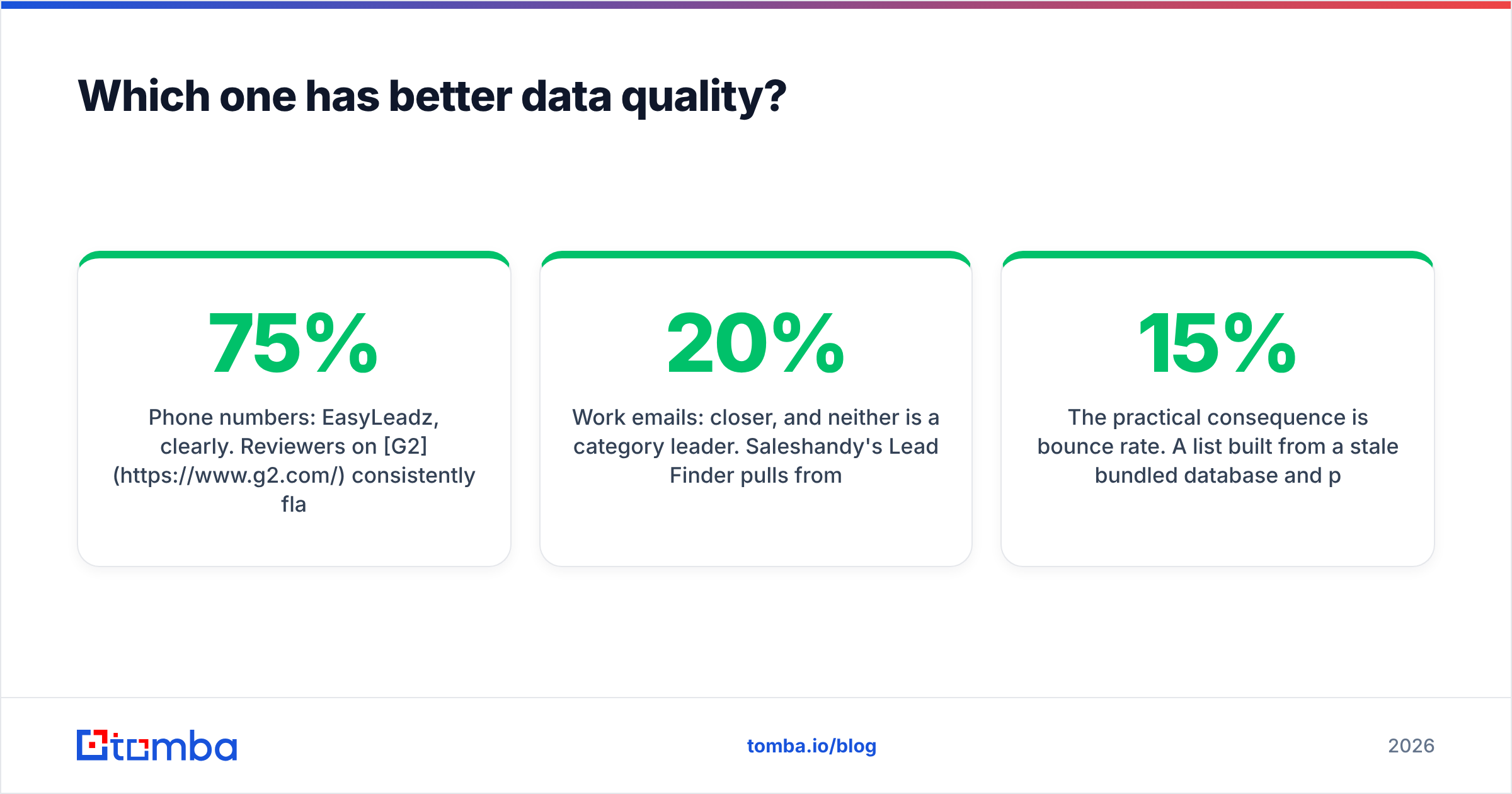
Phone numbers: EasyLeadz, clearly. Reviewers on G2 consistently flag EasyLeadz mobile coverage in India and adjacent markets as better than what Apollo, Lusha, or ZoomInfo return for the same profiles. If half your ICP sits outside North America and your reps dial, this is the differentiator you're paying for. Expect 60–75% usable direct dials on well-covered geographies and a sharp drop-off outside them.
Work emails: closer, and neither is a category leader. Saleshandy's Lead Finder pulls from a licensed database — meaning the index is refreshed on the provider's schedule, not Saleshandy's, and staleness is the usual complaint. EasyLeadz emails are more often pattern-inferred than SMTP-confirmed, which is fine for common formats and bad for the 20% of companies that use something unusual.
The practical consequence is bounce rate. A list built from a stale bundled database and pushed straight into a sequence will routinely bounce 8–15%. Anything above 3% puts your domain reputation at risk, and Google and Microsoft both tightened bulk-sender enforcement in ways that make that threshold non-negotiable. A separate email verifier pass before sending is not optional hygiene — it's the difference between a working domain and a burned one.

Catch-all domains are the silent killer. Roughly a fifth of B2B domains accept everything at the SMTP layer, so a naive verifier marks them "unknown" and you either send blind or discard real contacts. Neither EasyLeadz nor Saleshandy resolves this well. A dedicated catch-all verifier is the only thing that recovers those addresses without gambling your sender reputation on them.
How does pricing actually work for each one?#
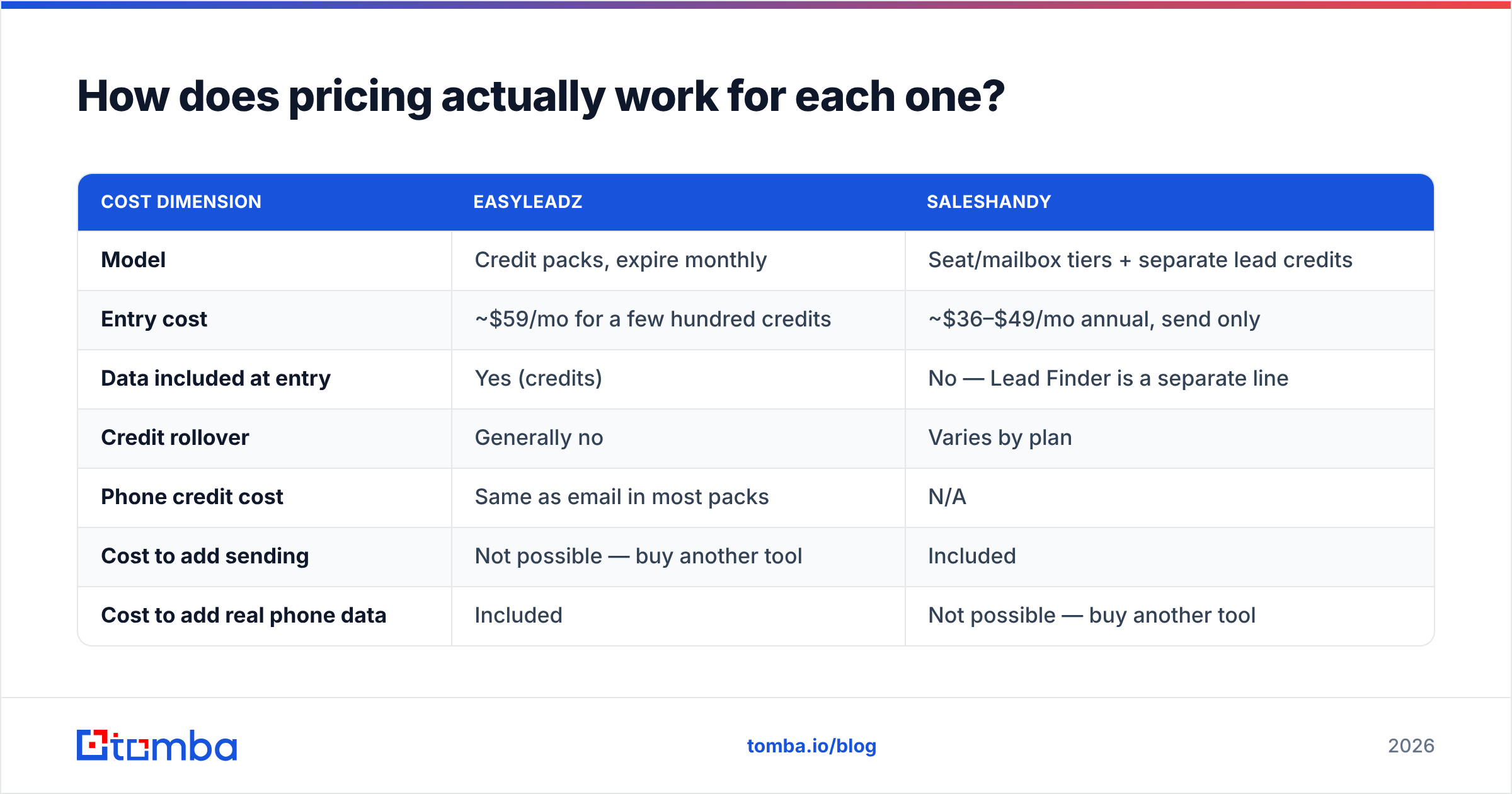
This is where teams get surprised, so read the credit mechanics before the sticker price.
| Cost dimension | EasyLeadz | Saleshandy |
|---|---|---|
| Model | Credit packs, expire monthly | Seat/mailbox tiers + separate lead credits |
| Entry cost | ~$59/mo for a few hundred credits | ~$36–$49/mo annual, send only |
| Data included at entry | Yes (credits) | No — Lead Finder is a separate line |
| Credit rollover | Generally no | Varies by plan |
| Phone credit cost | Same as email in most packs | N/A |
| Cost to add sending | Not possible — buy another tool | Included |
| Cost to add real phone data | Included | Not possible — buy another tool |
| Annual discount | Yes | Yes, significant |
| Realistic all-in for a 3-rep team | $200–$400/mo | $150–$350/mo + data |
The pattern: whichever one you buy, you will end up paying a second vendor. EasyLeadz buyers add a sequencer. Saleshandy buyers add a data source once Lead Finder bounces start hurting. Budget for the pair from day one instead of discovering it in month two.
For reference, Tomba pricing runs Free (25 searches/month), Starter at $49/mo, Growth at $99/mo, and Pro at $249/mo, with the finder, verifier, domain search, and enrichment in the same account rather than metered as separate SKUs. That matters more than the headline number when your workflow needs three lookups per contact — find, verify, enrich — and a per-action credit model charges you three times.
Is Saleshandy's Lead Finder good enough to replace a data vendor?#
For low-stakes volume outbound: yes, with a verification step bolted on. For named-account or ABM work: no.
Bundled databases optimize for breadth. They're built to make the platform feel complete during a trial, not to win an accuracy benchmark. The failure mode is predictable — the contact exists, the title is 14 months out of date, and the person left in Q3. You don't find out until the bounce or the "no longer with the company" auto-reply.
Three tests before you rely on it:
- Pull 100 contacts you already know. Score title accuracy and email validity against your CRM. Under 80% on either, treat Lead Finder as a top-of-funnel toy, not a source of truth.
- Check refresh dates. If the platform can't tell you when a record was last confirmed, assume the worst.
- Verify externally before sending. Even a good database benefits from a fresh SMTP check the day you send, not the day the record was indexed.
If those tests fail, the fix isn't to switch platforms — it's to decouple. Keep Saleshandy for sending, get your addresses from a dedicated email finder with a documented method, and push clean lists in. That's a $49/mo change, not a migration.
Which tool fits which team?#
- Inside sales teams that dial, in APAC/MENA/India — EasyLeadz. Nothing in the Saleshandy stack replaces those mobile numbers, and the phone coverage is the whole reason the product exists.
- Founder-led outbound, email only, small volume — Saleshandy. The free-to-cheap send tier plus warmup gets you sequencing fast, and you can add data later.
- Agencies running cold email for clients — Saleshandy for infrastructure (unlimited mailboxes and rotation are genuinely useful at agency scale), plus a per-client data source. Do not run five clients off one bundled database.
- RevOps building an enriched CRM — Neither, alone. You want an API-first provider you can call from a workflow. Look at data enrichment and a Tomba API style integration rather than a UI-first tool with an API afterthought.
- Multi-channel teams (email + phone + LinkedIn) — A composed stack: verified emails from a finder, mobile numbers from a phone finder, sequencing from Saleshandy or an alternative. Compare the pieces individually; look at a Saleshandy alternative if the send layer is your bottleneck rather than the data.
What about deliverability — does either one protect you?#
Saleshandy does more here, and it's the strongest argument for the platform. Mailbox rotation spreads volume so no single domain gets hammered, built-in warmup ramps new domains gradually, and sending-window controls keep you from firing 500 emails in a minute. Those are real protections and EasyLeadz offers none of them because it isn't a sender.
But deliverability tooling can't fix a dirty list. The order of operations matters:
- Authenticate first. SPF, DKIM, and DMARC on every sending domain. Run an SPF checker before your first send, not after your first spam complaint.
- Verify second. Every address, every send, including ones that came from a paid database.
- Warm third. New domains need weeks, not days. Warmup inside Saleshandy is convenient but it's not instant credibility.
- Volume last. Ramp slowly. Bounce rate above 3% or spam complaints above 0.3% and you throttle immediately, whatever the tool dashboard says.
Skip step two and steps one, three, and four are decoration. The single highest-ROI change most teams make isn't switching sequencers — it's verifying the list they already have. Free tools like a free email checker let you spot-check before you commit budget.
So which one should you buy in 2026?#
Buy EasyLeadz if dialing is a primary channel and your ICP sits in geographies where US-centric vendors have thin coverage. It's a focused product that does one hard thing well. Pair it with any sequencer.
Buy Saleshandy if email is your channel and your bottleneck is sending infrastructure — deliverability, mailbox management, sequence logic, reply handling. Treat Lead Finder as a bonus, verify everything it gives you, and don't make it your system of record.
Buy neither as a complete solution. That's the actual verdict. The comparison people search for assumes one of these two replaces the other, and it doesn't. What replaces the awkward middle is a clean split: a dedicated data layer you trust, and a dedicated send layer you control.
If you're rebuilding that data layer, start with the part everything else depends on. Tomba's Email Finder covers domain search, pattern detection, SMTP verification, and catch-all handling in one account — Free gets you 25 searches a month to test against contacts you can already validate, and Starter is $49/mo when you're ready to run volume. Run your own accuracy test on 100 known contacts, compare the bounce rate against whatever your current database gives you, and let the numbers pick the stack.
Related guides#
Ready to find emails that actually work?
Join 150,000+ professionals who stopped guessing and started sending. Free credits on signup — no credit card required.
Get the Tomba newsletter
Practical outbound tactics and product updates — once every two weeks.
About the author