EasyLeadz vs Salutary Data: Which B2B Data Tool Wins in 2026?
EasyLeadz sells mobile numbers by the credit. Salutary Data sells verified B2B files by the record. They solve different problems — here's which one fits your motion, and where a cheaper email-first stack beats both.
EasyLeadz vs Salutary Data is a common shortlist, but the two tools rarely compete for the same job. One sells mobile numbers by the credit. The other sells verified B2B data files by contract. Here is how they differ — and when a cheaper email-first stack beats both.
TL;DR
- EasyLeadz is a credit-based contact lookup tool built around direct mobile numbers. It is strongest in India and APAC, and it sells self-serve from roughly $29/month. Its Chrome extension ("Mr. E") is the main interface.
- Salutary Data is a US-focused B2B contact and company data provider. It sells verified, compiled data files and API access. Expect bigger minimum commitments, no true self-serve tier, and deeper firmographic and intent layers.
- They are not really competitors. One is a per-lookup tool for reps. The other is a data supply contract for RevOps and data teams.
- Neither is built for high-volume email outbound. If email is your primary channel, an email-finder-first stack (Tomba at $49/mo, or a specialist verifier) usually costs less per usable contact.
- Pick EasyLeadz for phone-led prospecting in India and SEA. Pick Salutary Data for US TAM building and CRM enrichment at scale. Pick neither if your bottleneck is deliverable email addresses.
What are EasyLeadz and Salutary Data?#
Think of it like buying groceries. EasyLeadz is the corner shop — you walk in, grab the three things you need, pay per item, and walk out. Salutary Data is the wholesale supplier. You sign a contract and they deliver pallets. The per-unit price only makes sense if you are feeding a restaurant.
EasyLeadz (easyleadz.com) is an Indian-founded contact intelligence platform. Its core product is a browser extension. It reveals direct dial and mobile numbers while you view a LinkedIn profile or a company website. You buy credits; each revealed contact burns one. It is built for individual SDRs and small teams. They prospect one profile at a time and want a phone number they can dial today.
Salutary Data (salutarydata.com) is a US B2B data compiler. Instead of a click-to-reveal extension, it sells access to a maintained contact and company database. You get it as files, via API, or pushed into your CRM. The pitch is data hygiene: multi-source verification, regular refresh cycles, and clear records of where each contact came from. Buyers are usually RevOps, marketing ops, or data engineering rather than individual reps.
The distinction matters more than any feature checklist. One is priced for a person. The other is priced for a pipeline.
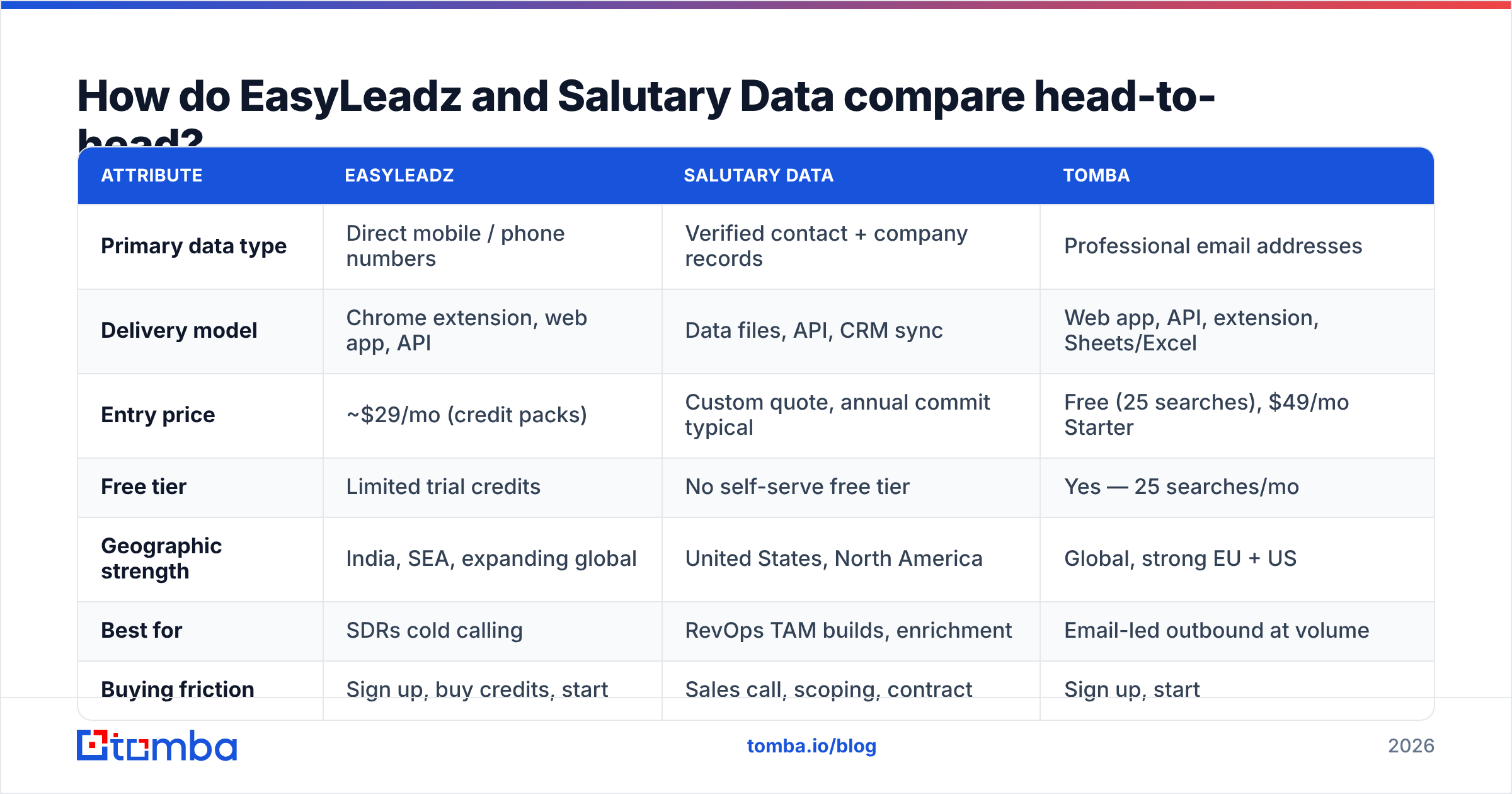
EasyLeadz vs Salutary Data: how do they compare head-to-head?#
| Attribute | EasyLeadz | Salutary Data | Tomba |
|---|---|---|---|
| Primary data type | Direct mobile / phone numbers | Verified contact + company records | Professional email addresses |
| Delivery model | Chrome extension, web app, API | Data files, API, CRM sync | Web app, API, extension, Sheets/Excel |
| Entry price | ~$29/mo (credit packs) | Custom quote, annual commit typical | Free (25 searches), $49/mo Starter |
| Free tier | Limited trial credits | No self-serve free tier | Yes — 25 searches/mo |
| Geographic strength | India, SEA, expanding global | United States, North America | Global, strong EU + US |
| Best for | SDRs cold calling | RevOps TAM builds, enrichment | Email-led outbound at volume |
| Buying friction | Sign up, buy credits, start | Sales call, scoping, contract | Sign up, start |
| Bulk workflow | Limited, credit-throttled | Native — files are the product | Bulk finder + verifier included |
| Verification of emails | Secondary feature | Included in record hygiene | Core product |
The table exposes the real fork in the road. If you cannot get a purchase order signed this quarter, Salutary Data is out of reach. If you need 40,000 rows enriched by Friday, the EasyLeadz credit model makes that slow and expensive.
Which one has better data accuracy?#
Accuracy is the wrong single question. Ask instead: accurate at what, and where?
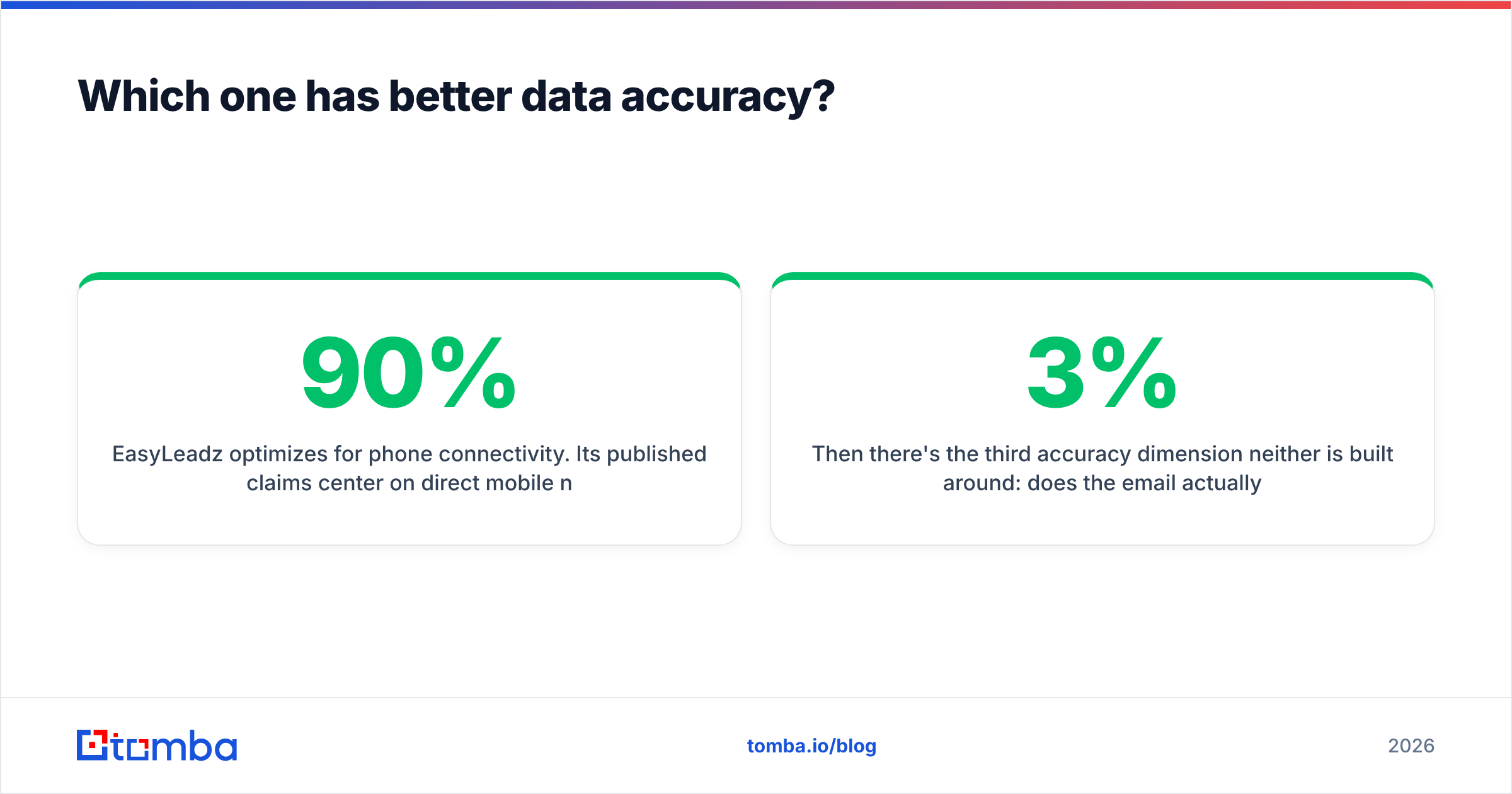
EasyLeadz optimizes for phone connectivity. Its published claims center on direct mobile numbers. In India and Southeast Asia the coverage is genuinely strong. It beats the US-first incumbents that treat APAC as an afterthought. Move the same query to a mid-market German or Brazilian company and hit rates fall off. Vendor marketing puts phone accuracy above 90%. Independent G2 reviews tell a more mixed story. Reviewers praise the India coverage and flag gaps elsewhere.
Salutary Data optimizes for record-level hygiene. Its differentiator is the verification pipeline. Multiple sources are cross-checked and records are refreshed on a schedule. Every record carries a documented history, which matters when your legal team asks where a contact came from. For US datasets, that beats scraped-and-resold lists. The trade-off: a compiled database is a snapshot. Freshness depends on the refresh schedule, not on a live lookup at the moment you need the contact.
Then there is the third accuracy question neither is built around: does the email actually deliver? A record can be "correct" — right person, right company, right title — and still bounce. The mailbox may have been shut down last month, or the domain may be catch-all. That is a separate verification step. It is why teams running email-heavy outbound run an email verifier over every purchased or enriched list, whatever the vendor promised. Let your bounce rate creep past 3% and mailbox providers start treating your domain as suspect. No amount of "97% accurate" marketing copy fixes that.
One more note for catch-all-heavy industries such as agencies, consultancies, and .io startups. A plain verifier returns "unknown" on catch-all domains and leaves you guessing. A dedicated catch-all verifier resolves a real slice of those. That shifts your usable-contact math far more than a 2-point gap in vendor-claimed accuracy ever will.
How does pricing actually work for each?#
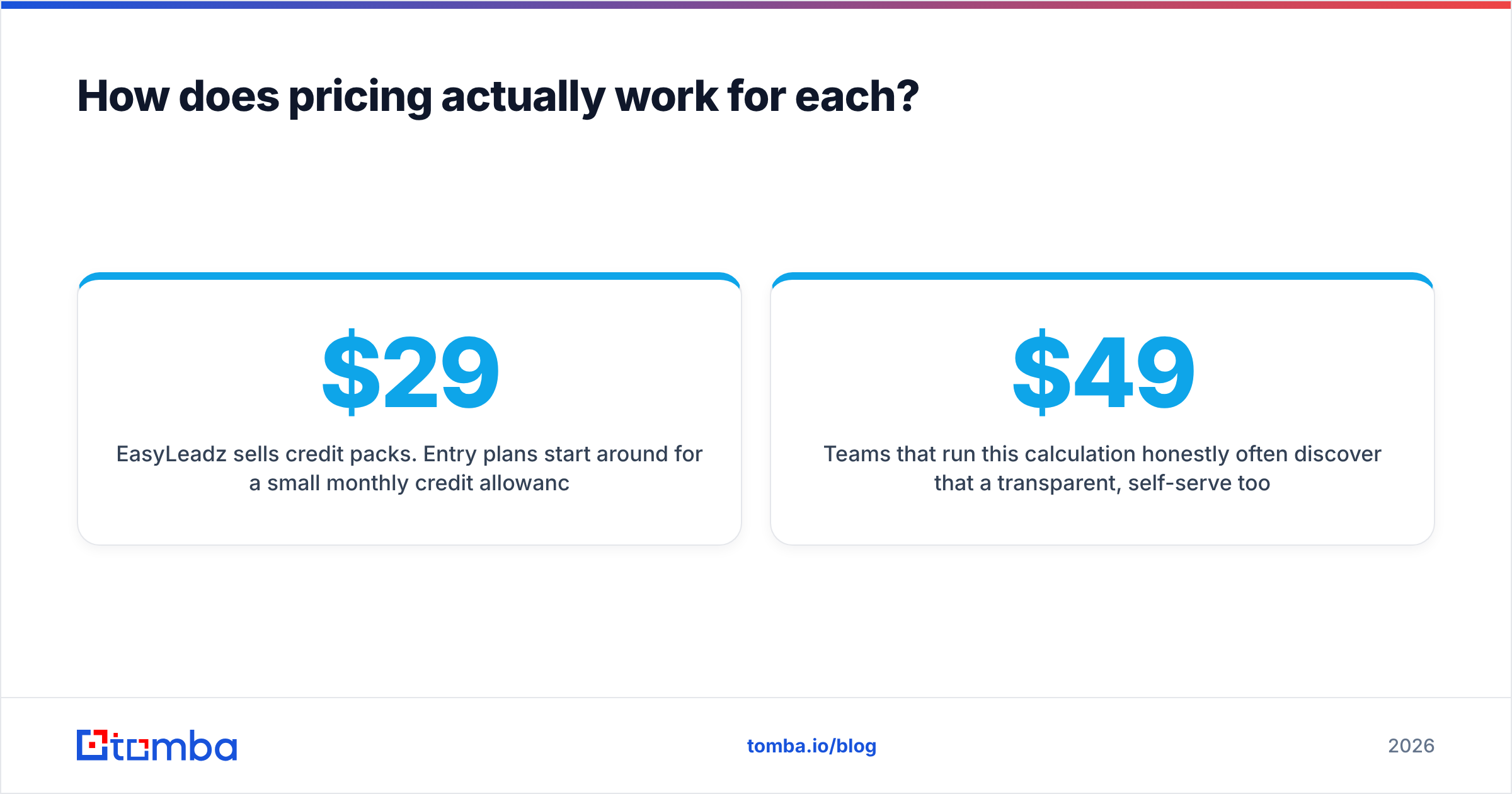
EasyLeadz sells credit packs. Entry plans start around $29/month for a small monthly credit allowance and scale up from there. The mental model is simple: one reveal, one credit. But credits burn whether or not the number turns out to be useful. Unused credits also expire in most plans. For a rep doing 100–300 targeted lookups a month, the math is fine. For anyone doing 5,000, it stops being fine fast.
Salutary Data does not publish list pricing. Deals are quoted against record volume, field depth, refresh frequency, and license terms (internal use vs. resale, one-time vs. ongoing). Expect a discovery call, a sample file, and an annual commitment. That is normal for the data-supply category. Gartner's coverage of B2B data providers frames these as procurement decisions, not tool purchases. The catch is that you cannot pilot it over a weekend.
The cost dimension both hide: per usable contact, not per record. Run the numbers this way instead:
- Start with records delivered. Whatever the vendor invoices you for.
- Subtract records missing the field you need. A row without a phone number is worthless to a caller. A row without an email is worthless to an emailer.
- Subtract records that fail verification. Run them through a verifier before they touch your sequencer.
- Subtract records outside your actual ICP. Filters are never as tight as the demo suggested.
- Divide the invoice by what's left. That is your real cost per contact. It is routinely 2–4× the headline rate.
Teams that run this calculation honestly often reach the same conclusion. A transparent, self-serve tool with published Tomba pricing — Free at 25 searches, Starter $49/mo, Growth $99/mo, Pro $249/mo — beats an opaque enterprise contract on cost per deliverable contact. There is no minimum commit soaking up the waste.
When should you choose EasyLeadz?#
Choose EasyLeadz when all of these are true:
- Phone is your primary channel. You are dialing, not sequencing. Mobile numbers are the deliverable.
- Your ICP skews India, Southeast Asia, or APAC. This is where EasyLeadz coverage beats the US-first alternatives.
- You prospect profile-by-profile. The extension workflow is a strength when you research accounts one at a time. It is a bottleneck when you do not.
- You need to start today. Self-serve signup, no procurement cycle.
- Volume is modest. Under a few thousand lookups a month, credits are economical.
Where it strains: bulk enrichment of an existing CRM, European coverage, and any workflow where email is the channel. If you are buying credits to reveal a phone number just to guess the email format, you picked the wrong tool. A domain search returns the whole company's email pattern in one query.
When should you choose Salutary Data?#
Choose Salutary Data when:
- You're building or refreshing a TAM. You need tens or hundreds of thousands of records with consistent firmographics, not one-off lookups.
- Your market is North America. US coverage is the core strength.
- Compliance asks where the data came from. A documented data trail beats an anonymous list broker. It matters under GDPR-adjacent scrutiny even for US-focused teams.
- You have RevOps capacity. Someone must own the ingest, the dedupe, the field mapping, and the refresh schedule. Files do not enrich themselves.
- Budget is annual, not monthly. You can absorb a commitment before proving ROI.
Where it strains: solo founders, agencies with variable client volume, anyone who needs a contact in the next ten minutes, and teams without a data owner. A pallet of groceries is a liability if you do not have a kitchen.

Is there a better option for email-first outbound?#
Yes — and this is the honest part of the comparison that most versus posts skip.
If your outbound motion is email-led, neither tool belongs at the center of your stack. EasyLeadz economics are built around phone reveals. Salutary Data economics are built around record volume with an annual floor. Both will sell you email addresses, but email is a side line item for each.
An email-finder-first stack flips that order. You start with the addresses. You verify them before they enter a sequence. You add phone or firmographic layers only where they change the play.
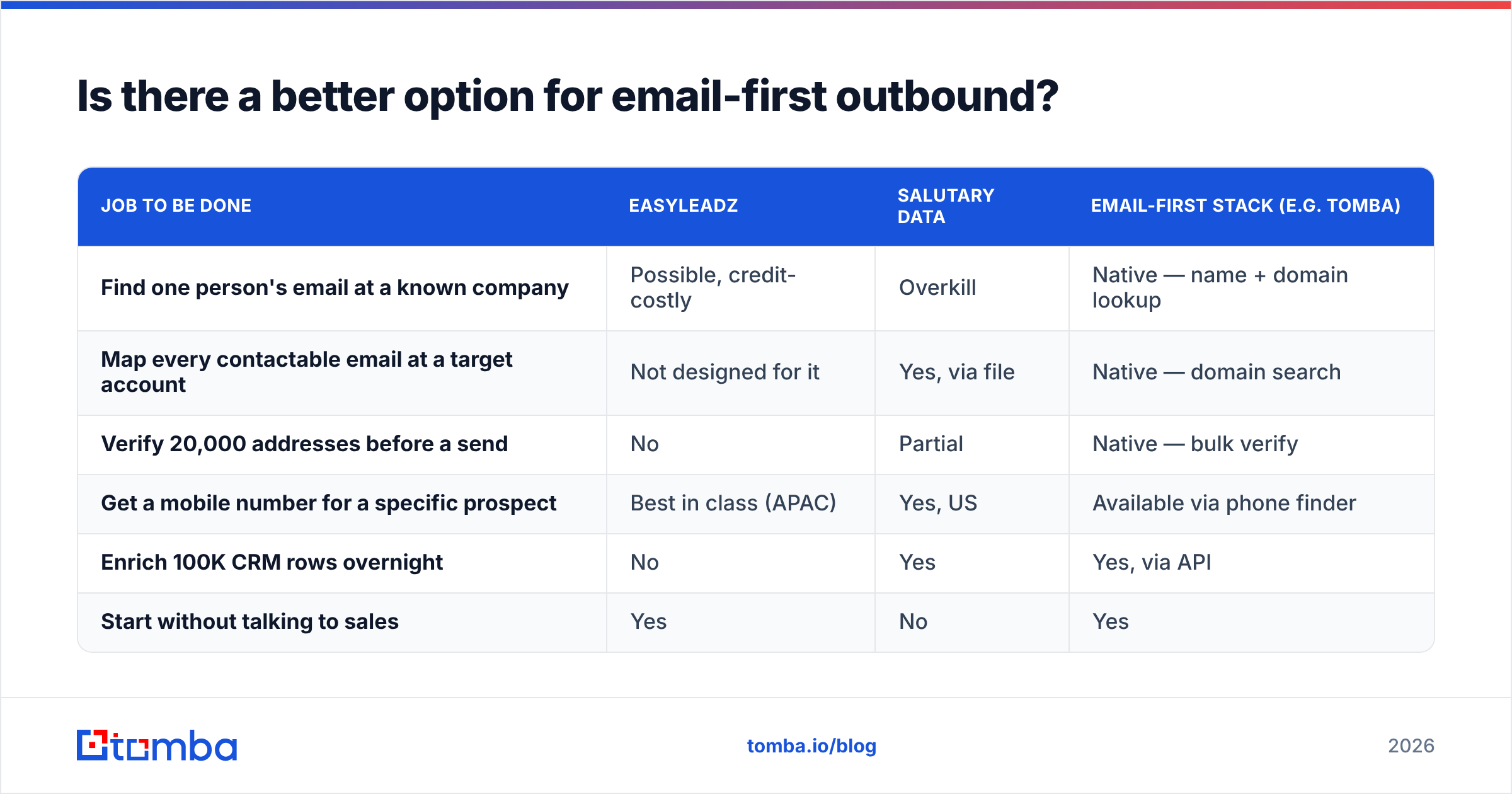
| Job to be done | EasyLeadz | Salutary Data | Email-first stack (e.g. Tomba) |
|---|---|---|---|
| Find one person's email at a known company | Possible, credit-costly | Overkill | Native — name + domain lookup |
| Map every contactable email at a target account | Not designed for it | Yes, via file | Native — domain search |
| Verify 20,000 addresses before a send | No | Partial | Native — bulk verify |
| Get a mobile number for a specific prospect | Best in class (APAC) | Yes, US | Available via phone finder |
| Enrich 100K CRM rows overnight | No | Yes | Yes, via API |
| Start without talking to sales | Yes | No | Yes |
In practice, that stack looks like this. First, find email addresses by name and domain, or sweep a whole company with domain search. Next, run the output through verification and catch-all resolution. Then push clean records into your sequencer via the Tomba API or a Sheets/CRM integration. Phone numbers get layered in only for the accounts worth calling. For most teams that is the top 10–20% of the list, not all of it.
This is not a claim that Tomba does everything Salutary Data does. It does not sell compiled data files with custom licensing, and it is not trying to. It is a claim about order of operations. Solve the email layer first with a tool priced for it. Then buy specialist data for the gaps that remain. Teams that work in the other order buy a large, expensive dataset first. Then they discover they still need a verifier.
For wider context, HubSpot's research on sales data quality points the same way. Decaying contact data, not thin contact volume, is the main drag on outbound performance. That argues for verification first, not volume first.
What about the other alternatives worth knowing?#
A few names come up in the same evaluations. Here is where each one fits:
- Apollo — a huge database plus a built-in sequencer. Strong if you want one vendor for data and sending. Weaker if you care about email accuracy per record. See the Apollo alternative breakdown for the trade-offs.
- BookYourData — pay-as-you-go verified B2B lists with a strong accuracy guarantee and no annual commit. It sits neatly between the EasyLeadz per-credit model and the Salutary Data contract model. Good for teams that want a clean file without procurement.
- RocketReach — broad person-level coverage with both email and phone, priced per user. A solid generalist, rarely the best at any single field. The RocketReach alternative comparison covers the specifics.
- ZeroBounce / specialist verifiers — not contact finders at all. Still essential if you buy lists from anyone. Verification is a separate job from discovery.
- Clearbit-style enrichment — firmographic depth on records you already have, rather than net-new discovery.
Most working stacks end up with two or three of these, not one. The mistake is expecting a single vendor to lead on discovery, verification, phone data, and firmographics at once. No one does.
How should you actually run the evaluation?#
Do not compare feature pages. Run the same test against both:
- Build a 100-row sample from your real ICP. Not the vendor's demo accounts — yours. Same companies, same titles, same geography.
- Ask each vendor to fill it. You can test EasyLeadz yourself with trial credits. Salutary Data will send a sample file if you are a credible buyer.
- Verify everything independently. Run emails through a verifier you control. Spot-dial 20 phone numbers.
- Score fill rate and accuracy separately. A 95% accuracy rate on a 40% fill rate is a 38% usable rate. Vendors quote the first number.
- Divide cost by usable rows. This is the only number that should drive the decision.
Run that way, the EasyLeadz vs Salutary Data question settles in a day instead of a quarter.
The verdict#
EasyLeadz wins if you are a rep or small team dialing prospects in India and APAC, buying month to month, working profile by profile. It is fast, self-serve, and genuinely good at the one thing it does.
Salutary Data wins if you are RevOps at a US company. It fits TAM builds, CRM refreshes, and data warehouse feeds. You need the budget, the annual cycle, and someone in-house to put the data file to work.
Neither wins if your bottleneck is deliverable email addresses at volume. For most B2B outbound teams in 2026, it is. That job belongs to a tool built and priced for it.
If email is your channel, start with the Tomba Email Finder. Find addresses by name and domain. Sweep entire companies with domain search. Verify in bulk before anything reaches your sequencer. Layer phone or firmographic data on top only where it changes the outcome. The free tier gives you 25 searches a month, so you can test against your own list before you spend anything. That is exactly the discipline this comparison argues for.
Related guides#
Ready to find emails that actually work?
Join 150,000+ professionals who stopped guessing and started sending. Free credits on signup — no credit card required.
Get the Tomba newsletter
Practical outbound tactics and product updates — once every two weeks.
About the author