EasyLeadz vs Soleadify: Which B2B Data Tool Wins in 2026?
EasyLeadz sells direct dials and India-heavy contact data. Soleadify sells local-business firmographics at scale. They barely overlap — here is how to pick, and when neither one is the right buy.
EasyLeadz vs Soleadify is a comparison most buyers run for the wrong reason. One tool sells phone numbers. The other sells records on small businesses. Below is what each one does well, what it costs, and when the right answer is neither.
TL;DR
- These two tools are not real competitors. EasyLeadz is a phone-first contact finder with unusually deep India and APAC coverage. Soleadify is a firmographic database of small and local businesses across ~200M+ companies. Buying one instead of the other is usually an ICP mistake, not a vendor mistake.
- Pick EasyLeadz if your motion is cold calling and your buyers sit in India, Southeast Asia, or the Middle East. Its Chrome extension pulls direct dials from LinkedIn profiles faster than most Western-built tools manage in those regions.
The rest of the short version:
- Pick Soleadify if you sell to dentists, gyms, restaurants, contractors, or any long-tail SMB category that Apollo and ZoomInfo do not index. Its category and tech-stack filtering is the product.
- Neither is a great general-purpose email finder. EasyLeadz treats email as a secondary field. Soleadify gives you company-level contacts, not verified person-level inboxes.
- Budget reality: both start in the $50–$200 per month range for one seat, and both meter credits hard. Check the current numbers on each vendor's pricing page before you commit.
What is EasyLeadz and who actually uses it?#
EasyLeadz is an Indian B2B contact data company. It is best known for Mr. E, its Chrome extension. You open a LinkedIn profile and click the extension. It returns a direct dial — often a mobile — plus any email and company data it holds.
The positioning is narrow on purpose. EasyLeadz built its name on phone numbers in markets where Western vendors are thin. India first. Then UAE, Singapore, Indonesia, and parts of Europe. Run an Apollo or Lusha search for a SaaS buyer in Bengaluru and you often get a switchboard number three levels away from your target. That is the gap EasyLeadz filled.
Typical users:
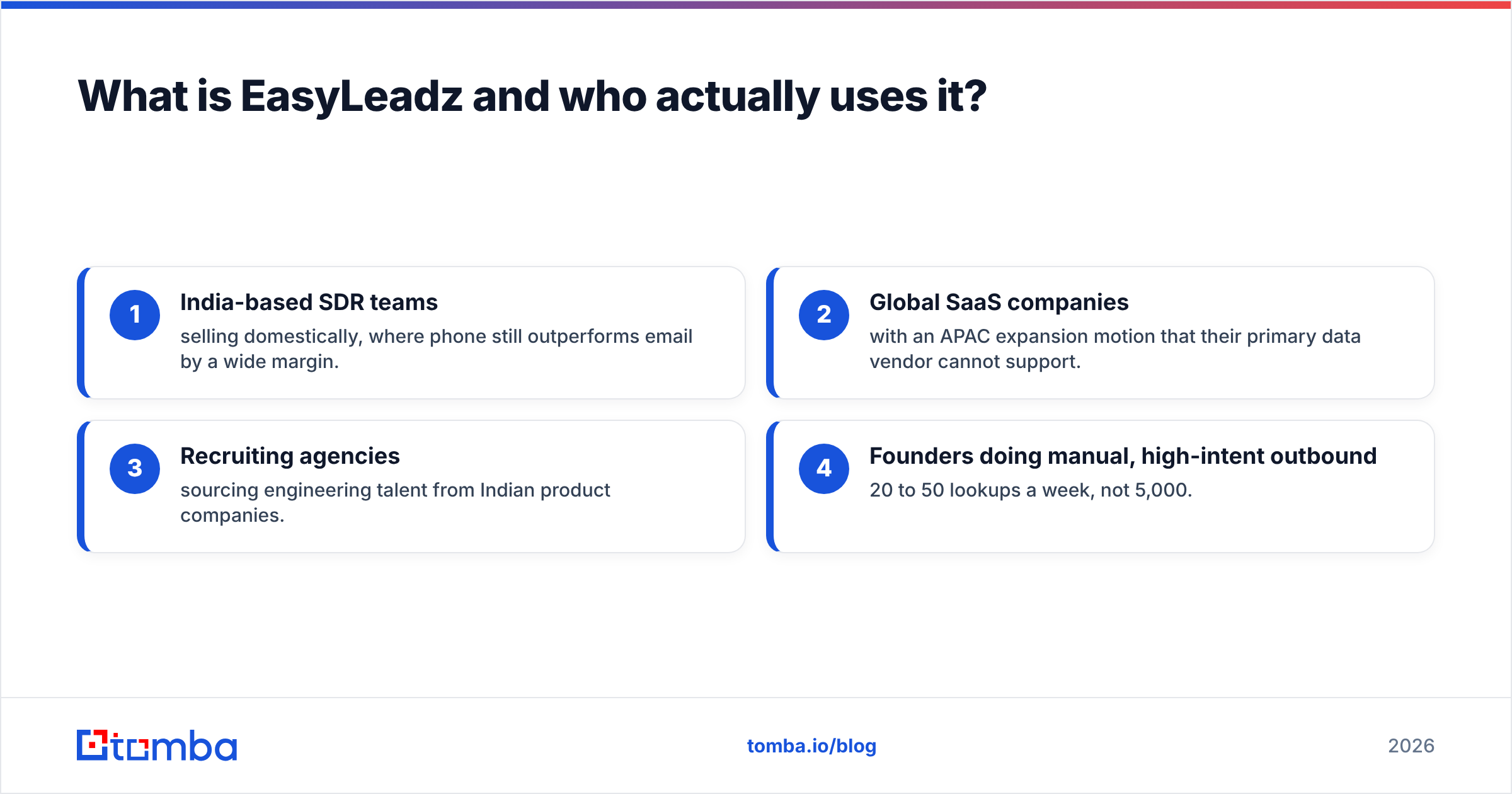
- India-based SDR teams selling at home, where phone still beats email by a wide margin.
- Global SaaS companies with an APAC push their main data vendor cannot support.
- Recruiting agencies sourcing engineers from Indian product companies.
- Founders doing manual, high-intent outbound — 20 to 50 lookups a week, not 5,000.
The workflow is manual by default, one profile at a time. There is an API and bulk enrichment too. But the heart of the product is simple: one person, one browser tab, one click.
What is Soleadify and what problem does it solve?#
Soleadify is a different animal. It is a company database built by crawling the open web at scale. It reads business websites, listings, review platforms, and social profiles. The output is firmographic data on small and local firms that the big B2B vendors ignore.
The core insight is simple. ZoomInfo, Apollo, and Clearbit are strong on the 5–10 million companies that act like tech firms. Those firms have funding rounds, LinkedIn pages, and clean employee counts. They are weak on the other 200 million: a plumbing company in Ohio, a dental clinic in Lyon, a three-location gym chain in Manchester.
Soleadify indexes those. Its filters are the differentiator:
- Business category — down to granular verticals like "orthodontist" or "commercial HVAC contractor," not just SIC/NAIC buckets.
- Technology detected on site — Shopify, WooCommerce, Squarespace, booking software, POS systems.
- Local signals — number of physical locations, service areas, review counts and ratings.
- Web presence maturity — does the business have a site at all, is it mobile-friendly, does it run ads.
Do you sell software or services to local businesses? A booking platform, a payments product, a marketing agency? Then this filtering is the whole value. You can build a list of Shopify stores in Germany that sell supplements and have under 20 staff. No conventional B2B database does that.
EasyLeadz vs Soleadify: how do they compare head-to-head?#
Here is the honest side-by-side. Few rows are a fair fight. That is the point.
First, the data itself:
| Dimension | EasyLeadz | Soleadify |
|---|---|---|
| Primary data type | Person-level direct dials + phone numbers | Company-level firmographics + local business data |
| Database scale | ~200M+ contact profiles (vendor claim) | ~200M+ business records across 190+ countries |
| Geographic strength | India, UAE, SEA, growing EU coverage | US, EU, and broad international local-business coverage |
| Email coverage | Secondary — inconsistent, often company-level | Company emails and generic inboxes; limited person-level |
| Phone coverage | Core strength — mobile/direct dial focus | Business landlines from listings, not direct dials |
| Verification layer | Limited public detail on validation method | Crawl-based freshness, not SMTP-level email verification |
Then, fit and access:
| Dimension | EasyLeadz | Soleadify |
|---|---|---|
| Standout filter | LinkedIn profile → phone in one click | Business category, tech stack, review data, locations |
| Best-fit ICP | Enterprise/mid-market buyers in APAC | SMB and local service businesses anywhere |
| Interface | Chrome extension first, dashboard second | Search platform first, bulk export second |
| API | Yes, credit-metered | Yes, on higher tiers |
| Free option | Limited free credits on signup | Free trial or limited plan, sales-gated for volume |
Read those tables twice before you shortlist. Only one row is a true head-to-head: database scale. Even there, the records describe different worlds. EasyLeadz counts people. Soleadify counts businesses.
Which one is better for cold calling?#
EasyLeadz, without much debate — inside its geography.
Cold calling lives on connect rate. Connect rate lives on one thing: does the number ring a mobile in your buyer's pocket? EasyLeadz is built for that. Reviews on G2 praise its phone accuracy for Indian contacts. They get much more mixed on North American and Western European records.
Soleadify's phone data is a different asset. It is the number the business publishes on its own site or in a listing. That helps when you call a dental practice. The front desk is the gatekeeper you need to pass. There is no direct dial to a decision maker, because the owner answers the phone between patients. It does not help when you need a VP of Engineering at a 2,000-person company.
Do not trust a single vendor's record either way. Validate numbers before you dial. A phone validator strips out dead and malformed numbers, so reps stop wasting dials on them.
Which one is better for cold email?#
Neither, and this is the most important finding in this comparison.
EasyLeadz does return emails. But email is not what the product is built around, and the hit rate shows it. Soleadify returns the business inbox — info@, hello@, contact@. Those are role accounts. They have a place in local outreach, since they are often the only address that exists. At scale they behave badly: weak engagement, more complaints, and many ESPs treat them as a deliverability red flag.
If email is your main channel, use a tool built for the job. You want pattern detection per domain, SMTP-level checks, catch-all handling, and a bulk pipeline. That is a different product category. A dedicated email finder turns a name and a domain into a person-level address. An email verifier then confirms it will land. Skip that step and you end up debugging a sender reputation problem three weeks into a campaign.
Many teams land on a hybrid. Use Soleadify to find the businesses. Then run domain-level discovery to find the humans inside them. Soleadify tells you a company exists and fits your filters. It does not reliably tell you the owner's inbox.
How does pricing compare in 2026?#
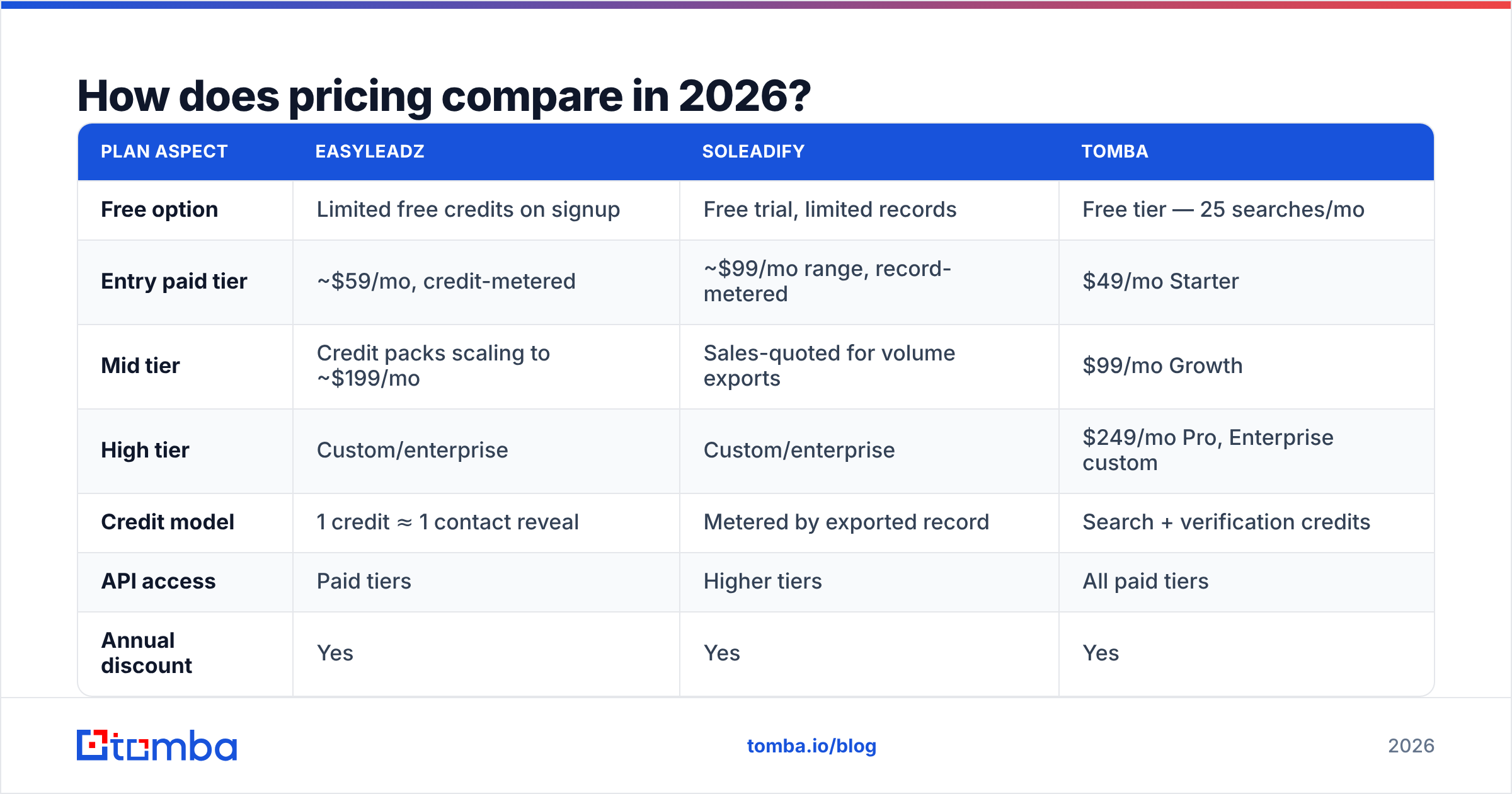
Pricing is where the EasyLeadz vs Soleadify choice gets muddy. Both vendors hide details behind signup or a sales call at higher volumes. Treat the figures below as directional. Confirm them on each pricing page before you buy.
| Plan aspect | EasyLeadz | Soleadify | Tomba |
|---|---|---|---|
| Free option | Limited free credits on signup | Free trial, limited records | Free tier — 25 searches/mo |
| Entry paid tier | ~$59/mo, credit-metered | ~$99/mo range, record-metered | $49/mo Starter |
| Mid tier | Credit packs scaling to ~$199/mo | Sales-quoted for volume exports | $99/mo Growth |
| High tier | Custom/enterprise | Custom/enterprise | $249/mo Pro, Enterprise custom |
| Credit model | 1 credit ≈ 1 contact reveal | Metered by exported record | Search + verification credits |
| API access | Paid tiers | Higher tiers | All paid tiers |
| Annual discount | Yes | Yes | Yes |
Two things to watch on both platforms:
- Credits can burn on failed lookups. Ask whether a reveal that returns nothing still costs a credit. That one answer can move your true cost per usable contact by 30–50%.
- Export limits are separate from credit limits. Teams often find mid-quarter that they still have credits but have hit an export ceiling. Check both numbers.
For reference, Tomba pricing starts at $49/mo for Starter. The free tier gives you 25 searches a month. That is enough to test accuracy on your own domain list before you spend anything.
Where do both tools fall short?#
Be clear-eyed about the gaps before you sign anything.
- Neither is a complete GTM data stack. You will still need verification. Most teams also need a sequencer and a CRM sync. Budget for the whole chain, not one line item.
- Compliance takes real diligence. Scraped local-business data and phone databases both carry GDPR and telemarketing duties. Ask each vendor for their lawful basis, opt-out handling, and DPA. Do not assume it is handled.
- Coverage claims are averages. A "200M records" number says nothing about coverage in your segment. Test on 50 accounts from your real pipeline, not their demo list.
Two more to raise on the sales call:
- Refresh cadence is opaque on both. Crawled firmographics decay fast for SMBs, because businesses close, move, and rebrand. Phone data decays fast for people, because they change jobs. Ask when records were last touched.
- Integration depth is thin. Both offer CSV and API paths. Neither matches the native CRM depth of the larger platforms. If Salesforce or HubSpot must stay clean on its own, plan the middleware.
What are the alternatives to EasyLeadz and Soleadify?#
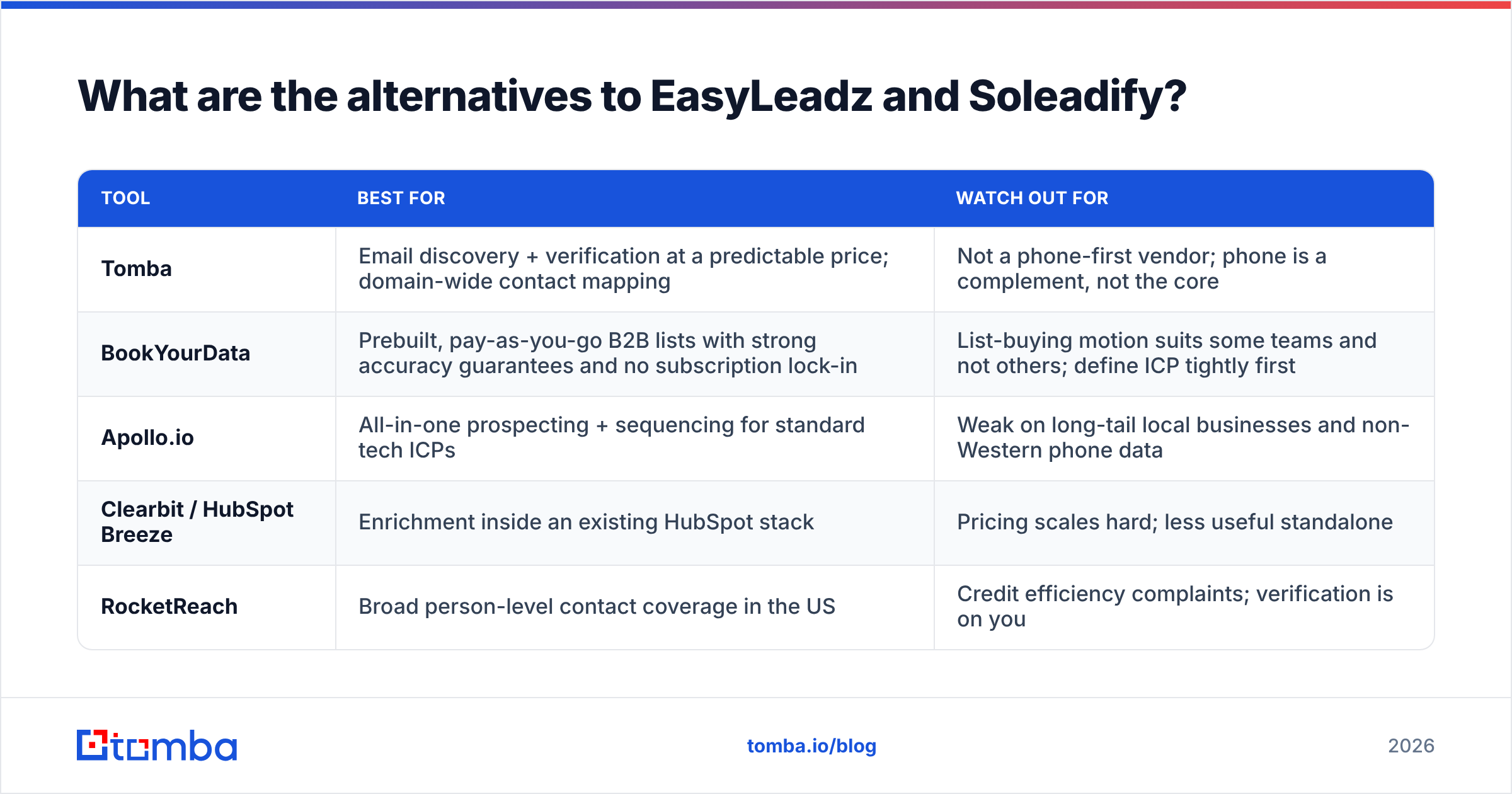
If the head-to-head left you unconvinced by both, here is how the nearby options stack up:
| Tool | Best for | Watch out for |
|---|---|---|
| Tomba | Email discovery + verification at a predictable price; domain-wide contact mapping | Not a phone-first vendor; phone is a complement, not the core |
| BookYourData | Prebuilt, pay-as-you-go B2B lists with accuracy guarantees and no lock-in | List-buying suits some teams and not others; define ICP tightly first |
| Apollo.io | All-in-one prospecting + sequencing for standard tech ICPs | Weak on long-tail local businesses and non-Western phone data |
| Clearbit / HubSpot Breeze | Enrichment inside an existing HubSpot stack | Pricing scales hard; less useful standalone |
| RocketReach | Broad person-level contact coverage in the US | Credit efficiency complaints; verification is on you |
Two of these deserve a note. BookYourData works differently from everything else here. You filter, preview, and buy the list outright. That suits teams who need one clean dataset rather than an ongoing seat. Tomba sits on the email side of the problem. Its domain search returns every discoverable address at a company, with the pattern and a confidence score attached. That is the layer both EasyLeadz and Soleadify leave thin. If you are replacing a broader platform, the Apollo alternative breakdown covers that comparison in detail.
So which should you buy?#
The EasyLeadz vs Soleadify call comes down to your ICP, not to feature counts:
- You dial individuals at mid-market or enterprise firms in India, UAE, or Southeast Asia. → EasyLeadz. Nothing else in this price band matches its regional phone coverage.
- You sell to small local businesses and filter by category, tech stack, or footprint. → Soleadify. No conventional B2B database copies those filters.
- Your buyers are anywhere and email is your primary channel. → Neither. Buy an email finding and verification stack first. Add a phone vendor only if calling is a real motion.
- You need two of the three. → Run a 30-day paid pilot on the same 200 accounts. Measure usable contacts per dollar, not raw match rate. Let the number decide.
The costly mistake here is rarely the wrong vendor. It is buying a regional phone tool for a global email campaign. Or a local-business database for an enterprise SaaS motion. Then blaming the data when reply rates stay flat.
Start with the layer that touches every campaign. Before you fund a specialized phone or firmographic database, make sure your core contact discovery is solid. Tomba's Email Finder resolves person-level addresses from a name and a domain. It scores confidence on every result and pairs with built-in verification, so you are not sending to addresses that bounce. The free tier gives you 25 searches a month. That is enough to test accuracy against your own account list before spending a dollar. Paid plans start at $49/mo with API access included.
Related guides#
Ready to find emails that actually work?
Join 150,000+ professionals who stopped guessing and started sending. Free credits on signup — no credit card required.
Get the Tomba newsletter
Practical outbound tactics and product updates — once every two weeks.
About the author