EasyLeadz vs UpLead 2026: Which B2B Data Tool Wins?
EasyLeadz sells verified mobile numbers. UpLead sells verified emails with a 95% accuracy guarantee. We compare pricing, coverage, and data quality to show which one actually fits your outbound motion.
TL;DR
- EasyLeadz is a phone-number tool first. Its Mr. E product is built around direct-dial and mobile numbers, strongest in India and APAC, and priced per credit rather than per seat.
- UpLead is an email-and-firmographics tool first. It sells a 95% data accuracy guarantee, real-time email verification at export, and 50+ search filters against a ~160M-contact database.
- They rarely compete head-to-head. If your motion is cold calling in India/SEA, EasyLeadz wins. If your motion is cold email into US/EU mid-market, UpLead wins.
- Both charge you for records you may not use. UpLead credits are consumed on reveal; EasyLeadz credits are consumed per lookup, and neither refunds a bad number automatically in every tier.
- The cheaper stack is often a splitter: a dedicated email finder for email discovery plus a phone tool only where dials actually matter.
You are probably reading this because a rep asked for "better data" and two very different tools ended up on the same shortlist. That happens a lot with EasyLeadz and UpLead, because both get bucketed as "B2B contact databases" in G2 categories even though they solve different halves of the problem.
This comparison sorts out which half you actually need.
What is EasyLeadz and who is it for?#
EasyLeadz is an Indian B2B data company best known for Mr. E, its Chrome extension that pulls direct phone numbers from LinkedIn profiles. You install the extension, open a prospect's profile, click, and it returns a mobile number (and sometimes an email).
The positioning is deliberately narrow. EasyLeadz does not try to be your CRM, your sequencer, or your intent-data layer. It tries to be the tool that gets a mobile number that actually rings.
Where it's strong:
- APAC and India coverage. This is the honest differentiator. For Indian companies, EasyLeadz consistently returns mobile numbers that US-centric databases simply do not hold.
- Credit-based pricing with no seat tax. Plans start low and scale by lookups, which suits small SDR teams and founders doing their own prospecting.
- Speed of the extension. One click on LinkedIn, number in the panel. There's very little to learn.
- Company-level data too. EasyLeadz layers in funding, headcount, and tech signals for account research, though it's thinner than a dedicated intelligence platform.
Where it's weak: email coverage outside India is inconsistent, the UI is dated compared to newer tools, and bulk enrichment workflows feel bolted on rather than native. If you need 10,000 verified US emails this quarter, this is the wrong starting point.
What is UpLead and who is it for?#
UpLead is a US-based B2B prospecting database with roughly 160 million contacts and 16 million companies. Its headline claim is a 95% data accuracy guarantee backed by real-time email verification — UpLead pings the mail server at the moment you export, and credits for bounced addresses are refunded.
That guarantee is the whole product thesis. UpLead is not the biggest database; ZoomInfo and Apollo both hold more records. It competes on the promise that the records you pull will not bounce.
Where it's strong:
- 50+ search filters. Industry, technology used, revenue, headcount, funding, job title, location, SIC/NAIC codes. You can build genuinely narrow ICP lists.
- Real-time verification on export. Not "verified 90 days ago" — verified now.
- Technographics. Filter accounts by the software they run, which is the single most useful filter for anyone selling into a specific stack.
- Clean CRM sync. Native pushes to Salesforce, HubSpot, Pipedrive, and Outreach without a Zapier detour.
Where it's weak: pricing gets steep fast, credits are consumed per contact revealed regardless of whether you contact them, and international coverage outside North America and Western Europe drops off noticeably. Mobile numbers exist but are not the strength.
EasyLeadz vs UpLead: how do they compare on price and data?#
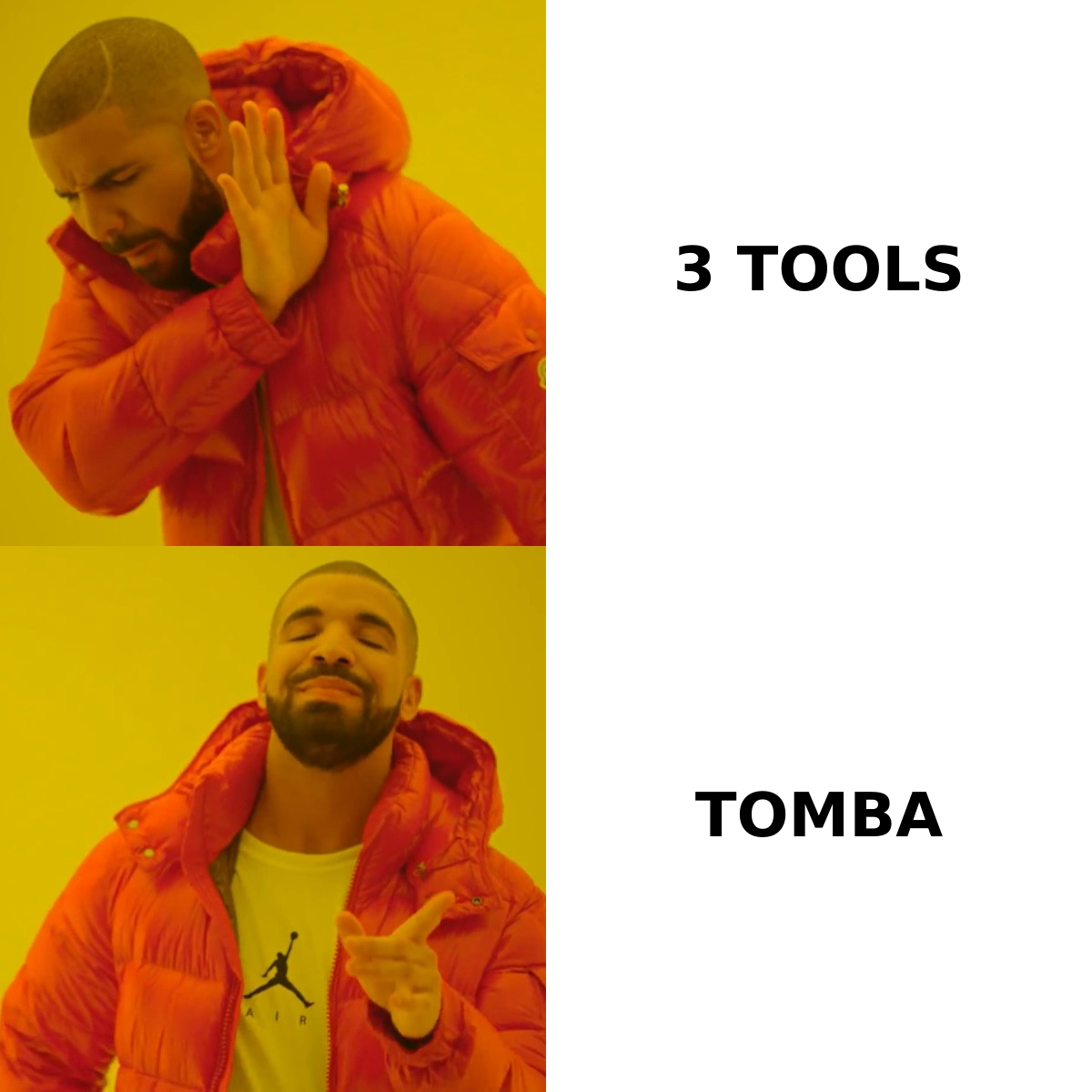
Here is the practical side-by-side. Prices reflect publicly listed 2026 plans and move with annual commitments, so treat them as directional rather than quotes.
| Attribute | EasyLeadz (Mr. E) | UpLead | Tomba |
|---|---|---|---|
| Primary data type | Mobile & direct-dial numbers | Verified business emails | Verified business emails |
| Entry paid plan | ~$29/mo (Starter, ~150 credits) | $99/mo (Essentials, 170 credits) | $49/mo (Starter) |
| Free tier | 5 credits trial | 5 credits trial | 25 searches/mo, no card |
| Database size | ~90M+ contacts, APAC-heavy | ~160M contacts, US/EU-heavy | 400M+ emails, global |
| Accuracy promise | No formal guarantee | 95% guarantee, bounce credits refunded | Verifier with confidence score + SMTP check |
| Real-time verification | Limited | Yes, at export | Yes, plus catch-all handling |
| Technographic filters | Basic | Extensive (16k+ technologies) | Via enrichment |
| Phone numbers | Core strength | Available, secondary | Available via phone finder |
| API access | Yes, on higher plans | Yes, on Professional+ | Yes, all paid plans |
| Best geography | India, SEA, MENA | US, Canada, UK, DACH | Global, strongest EU/US |
| Bulk enrichment | Basic CSV | Yes | Yes, native bulk |
| Credit rollover | No | No | No |
Two things jump out of that table.
First, the entry price gap is misleading. EasyLeadz looks cheaper at ~$29 but gives you fewer usable records for an email-led campaign, because most of its value is locked in phone data. UpLead's $99 entry gives you 170 credits — that is roughly $0.58 per verified contact, which is not cheap when a typical cold email test list is 2,000 people.
Second, neither tool rolls credits over. That is the quiet cost of both platforms. If your team prospects in bursts — heavy in January, dead in August — you are paying a monthly fee for capacity you burn or lose.
Is UpLead's 95% accuracy guarantee actually worth it?#
Mostly yes, with a caveat about how "accuracy" is measured.
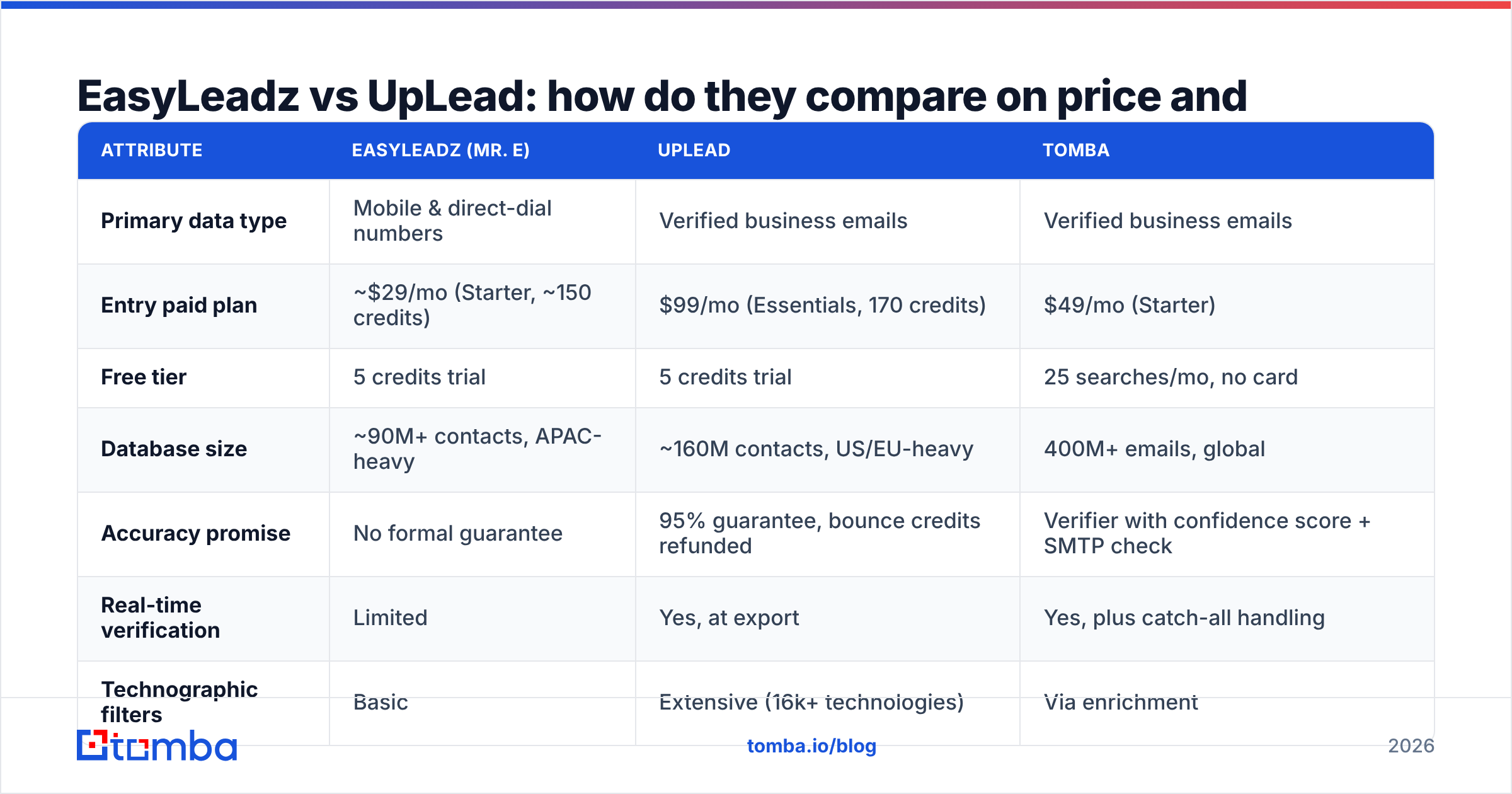
UpLead's guarantee covers deliverability, not correctness. A verified email means the mailbox exists and accepts mail. It does not guarantee that the person still works there, still owns that title, or is the right buyer. Job-change decay in B2B runs roughly 25–30% annually according to widely cited industry benchmarks, and no SMTP check catches a stale title.
That distinction matters when you compare bounce rates. A 2% bounce rate on stale titles still produces a terrible reply rate. Deliverability is a floor, not a ceiling.
The practical read: UpLead's verification is genuinely good and the refund policy is real. But it solves the mailbox-exists problem, which is the cheapest problem to solve. Standalone email verification tools do the same check at a fraction of per-contact cost, which is why many teams pull raw records from a cheaper source and verify separately.
If you go that route, the piece most tools get wrong is catch-all domains — servers that accept everything and reveal nothing. A proper catch-all verifier is what separates a 1% bounce list from a 6% one, because catch-alls typically make up 15–25% of enterprise domains.

Which one fits your outbound motion?#
Forget feature lists for a second. Pick based on the channel that actually books your meetings.
Choose EasyLeadz if:
- Your primary channel is the phone. Cold calling with a bad number is worse than no call at all, and EasyLeadz's mobile hit rate in its core geographies is the best argument for the product.
- You sell into India, Southeast Asia, or the Middle East. Western databases have thin coverage here. This is not close.
- You're a small team without procurement. Credit packs, low entry price, no annual lock-in.
- You prospect from LinkedIn manually. The extension is built for exactly this loop.
Choose UpLead if:
- Your primary channel is cold email into North America or Western Europe. Coverage and verification are both aligned to that use case.
- Your ICP is defined by technology. Technographic filtering is the strongest single feature either tool offers.
- You need clean CRM hygiene. Native sync plus verification-on-export keeps junk out of Salesforce.
- You're building lists in the low thousands, not tens of thousands. Above that, per-credit cost becomes the dominant line item.
Choose neither if: you need high-volume email discovery at a predictable cost. That is a different product category, and it's where dedicated finders compete on unit economics rather than database size. Running a domain search across 500 target accounts costs a fraction of revealing 500 individual contacts in a seat-based database.
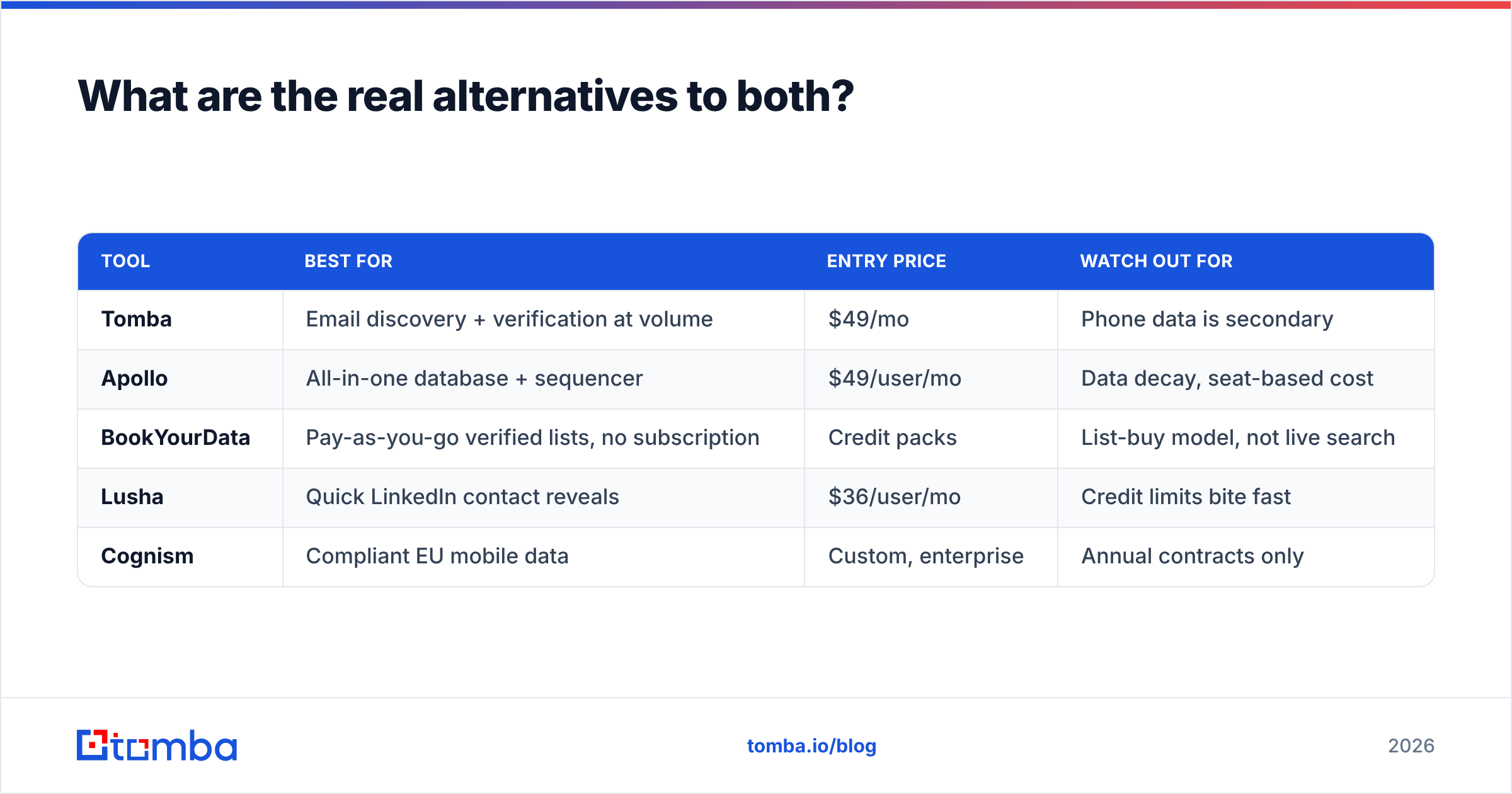
What are the real alternatives to both?#
The EasyLeadz-vs-UpLead framing assumes you need one database. Most teams that get outbound working run a splitter stack instead: a cheap, high-coverage finder for volume, plus a specialist tool for the one data type that's hard.
| Tool | Best for | Entry price | Watch out for |
|---|---|---|---|
| Tomba | Email discovery + verification at volume | $49/mo | Phone data is secondary |
| Apollo | All-in-one database + sequencer | $49/user/mo | Data decay, seat-based cost |
| BookYourData | Pay-as-you-go verified lists, no subscription | Credit packs | List-buy model, not live search |
| Lusha | Quick LinkedIn contact reveals | $36/user/mo | Credit limits bite fast |
| Cognism | Compliant EU mobile data | Custom, enterprise | Annual contracts only |
BookYourData is worth a specific mention here because it solves the credit-rollover complaint that hits both EasyLeadz and UpLead: you buy a pack, you own it, there's no monthly burn. For teams that prospect in bursts, that pricing model is structurally better than a subscription, and its 97% deliverability guarantee is in the same class as UpLead's.
Apollo is the volume play, but be honest about what you're getting — the database is enormous and the decay is proportional. Plenty of teams end up looking for an Apollo alternative once they've measured bounce rates on records older than six months.

How do you test either tool before committing?#
Do not evaluate on database size. Every vendor's number is inflated by dead records and duplicated entities. Run this instead:
- Build a 100-contact golden list from accounts you already closed or know well. You know the right answers.
- Run the same list through each tool during the free trial. Record hit rate (did it return anything?) and accuracy (was it right?).
- Send a verification pass through a neutral third party. Never trust a vendor to grade its own data. A free email checker run on the exports gives you an unbiased bounce estimate.
- Calculate cost per usable contact, not cost per credit. If a tool returns 60 valid records from 100 credits at $0.58 each, your real cost is $0.97 per contact.
- Test one non-core geography. Every vendor is good in its home market. The tail is where you find out what you actually bought.
- Check the API before you need it. If you plan to automate, hit the endpoint during the trial. A clean email finder API is worth more than 20M extra database records you'll never query.
That fifth step kills more deals than anything else. Teams buy on a US demo, then discover their APAC expansion has 30% coverage. Test the market you're growing into, not the one you already serve.
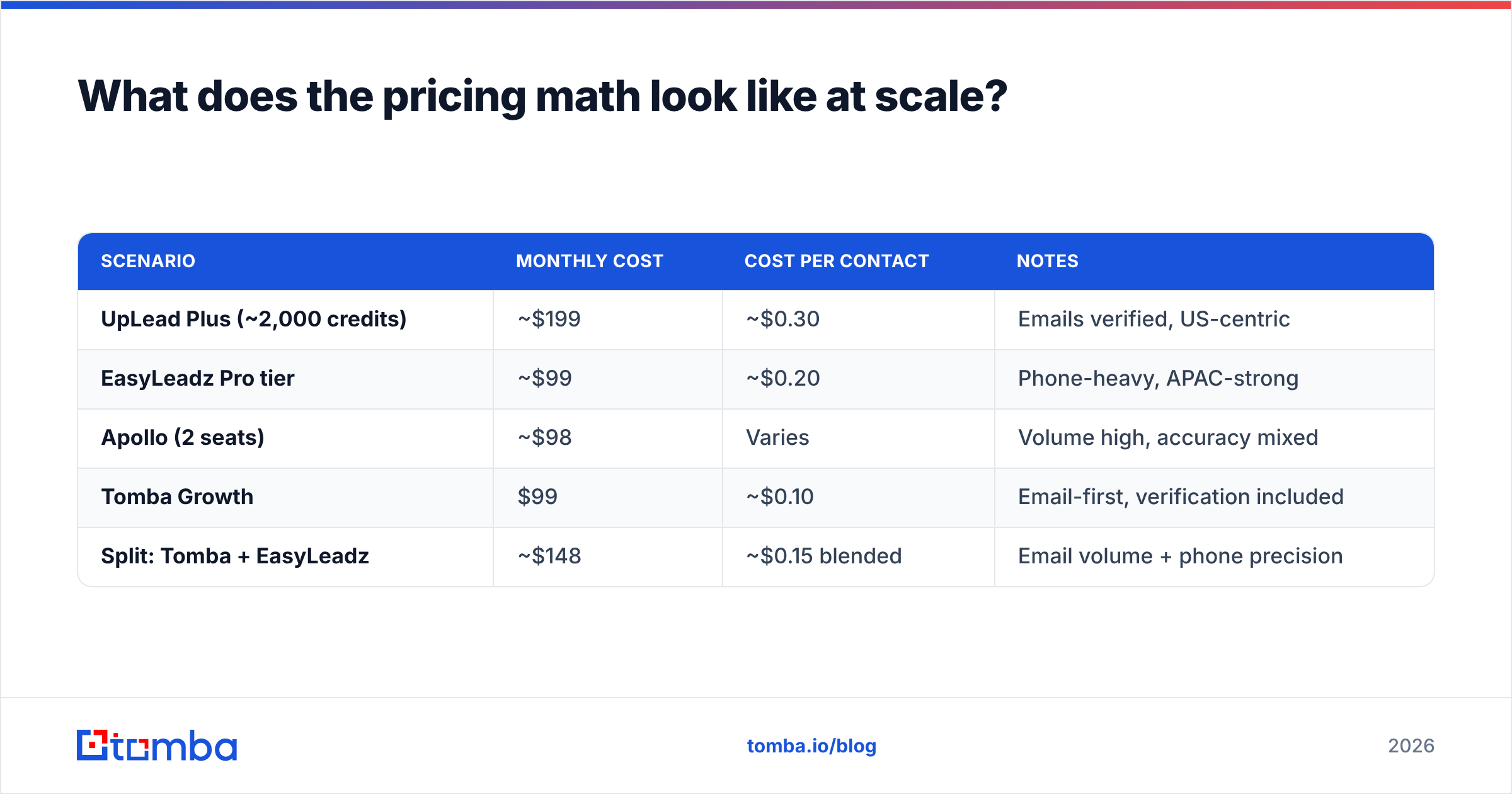
What does the pricing math look like at scale?#
Assume a two-SDR team building 3,000 new contacts per quarter.
| Scenario | Monthly cost | Cost per contact | Notes |
|---|---|---|---|
| UpLead Plus (~2,000 credits) | ~$199 | ~$0.30 | Emails verified, US-centric |
| EasyLeadz Pro tier | ~$99 | ~$0.20 | Phone-heavy, APAC-strong |
| Apollo (2 seats) | ~$98 | Varies | Volume high, accuracy mixed |
| Tomba Growth | $99 | ~$0.10 | Email-first, verification included |
| Split: Tomba + EasyLeadz | ~$148 | ~$0.15 blended | Email volume + phone precision |
The last row is the one most teams land on after a year of trial and error. You do not need one vendor to be excellent at everything — you need email discovery at low unit cost and phone data only for the accounts that justify a dial.
Full Tomba pricing runs Free (25 searches/mo), Starter $49/mo, Growth $99/mo, Pro $249/mo, and Enterprise custom, and every paid tier includes API access rather than gating it behind a Professional upgrade.
What's the verdict?#
UpLead wins on email quality and filtering. EasyLeadz wins on phone data in APAC. Neither wins on cost per contact at volume.
If someone forced a single pick: UpLead, because email is still the channel most B2B teams can actually scale, and the verification guarantee removes a real operational headache. But that recommendation flips completely if you're selling in Mumbai or Jakarta, where EasyLeadz's numbers are simply the ones that connect.
The more useful takeaway is that this is a false binary. Both tools price like databases — you pay for access to records — while your actual constraint is cost per booked meeting. Once you measure that, the stack that wins is usually a lean email finder plus a targeted phone source, not a single subscription trying to be both.
Start by fixing the expensive half. Email discovery is where volume lives, and where per-contact pricing hurts most at scale. Run your next target account list through the Tomba Email Finder — 25 free searches, no card required — and compare the hit rate and cost per valid contact against whatever quote is sitting in your inbox. Then decide whether you need a second tool at all, or just a better first one.
Related guides#
Ready to find emails that actually work?
Join 150,000+ professionals who stopped guessing and started sending. Free credits on signup — no credit card required.
Get the Tomba newsletter
Practical outbound tactics and product updates — once every two weeks.
About the author