EasyLeadz vs Warpleads (2026): Which Lead Data Tool Wins?
EasyLeadz sells direct dials. Warpleads sells volume exports. They solve different problems, and picking the wrong one burns a quarter of pipeline. Here is the honest breakdown, plus what each costs in practice.
TL;DR
- EasyLeadz is a phone-number tool first. Its value is direct dials and mobile numbers pulled one contact at a time from LinkedIn, with unusually strong India and APAC coverage.
- Warpleads is a volume tool first. Its pitch is large exportable lead lists for cold email, not surgical single-contact lookups.
- They are not really competitors. If you compare them feature-for-feature you will pick wrong. Compare them against the motion you actually run: dialing, or emailing at scale.
- Both leave a gap on email accuracy. Bulk exports and scraped dials still need independent verification before they touch a sending domain.
- Cheapest sane stack for most teams: a dedicated email finder and verifier ($49/mo tier territory) plus one of these two for the specific data type they're good at — not both.
What are EasyLeadz and Warpleads?#
Two tools that both call themselves "lead generation," and that is where the similarity ends.
EasyLeadz — usually seen as its browser product, Mr. E — is a contact-intelligence tool built around one core action: you open a LinkedIn profile, click the extension, and it returns a direct dial or mobile number for that person. It has been around since 2017, is headquartered in India, and its data density reflects that. If your ICP includes Indian SaaS founders, APAC operations leaders, or mid-market decision makers in Southeast Asia, EasyLeadz will return numbers where US-centric providers return nothing.
Warpleads sits at the opposite end. It is a newer outbound-focused platform whose headline feature is exportable lead lists — build a filter, export the rows, load them into your sequencer. The marketing emphasises unlimited or high-ceiling exports on upper tiers, plus an "on-demand" leads service where you brief a list and receive it. It is designed for agencies and outbound teams who need thousands of contacts a month, not five perfect ones.
So the real question in EasyLeadz vs Warpleads is not "which has better data." It's: are you dialing or emailing?
How do EasyLeadz and Warpleads actually differ?#
Here is the practical split, in the order it usually matters when you're evaluating:
- Primary data type. EasyLeadz leads with mobile/direct-dial numbers; email is secondary. Warpleads leads with work emails and company firmographics; phone data is thinner.
- Workflow shape. EasyLeadz is per-contact and human-in-the-loop (extension, LinkedIn tab open). Warpleads is list-first and batch (filter, export, upload).
- Geographic strength. EasyLeadz is strongest in India and broader APAC. Warpleads skews toward the US and Western Europe, like most bulk databases.
- Cost per contact. Warpleads' unit economics get better as volume rises. EasyLeadz's credits are priced like phone data — fewer, more expensive lookups.
- Verification burden. Neither replaces a dedicated verifier. Export volume amplifies the risk: a 5,000-row list with a 12% invalid rate is 600 bounces, which is enough to damage a sending domain.
- Who it's for. EasyLeadz suits SDRs who call. Warpleads suits agencies and founders running cold email at volume.

EasyLeadz vs Warpleads: full comparison table#
Pricing below reflects publicly listed plans at the time of writing. Both vendors adjust tiers and credit bundles regularly — verify on their own pricing pages before you commit to an annual contract.
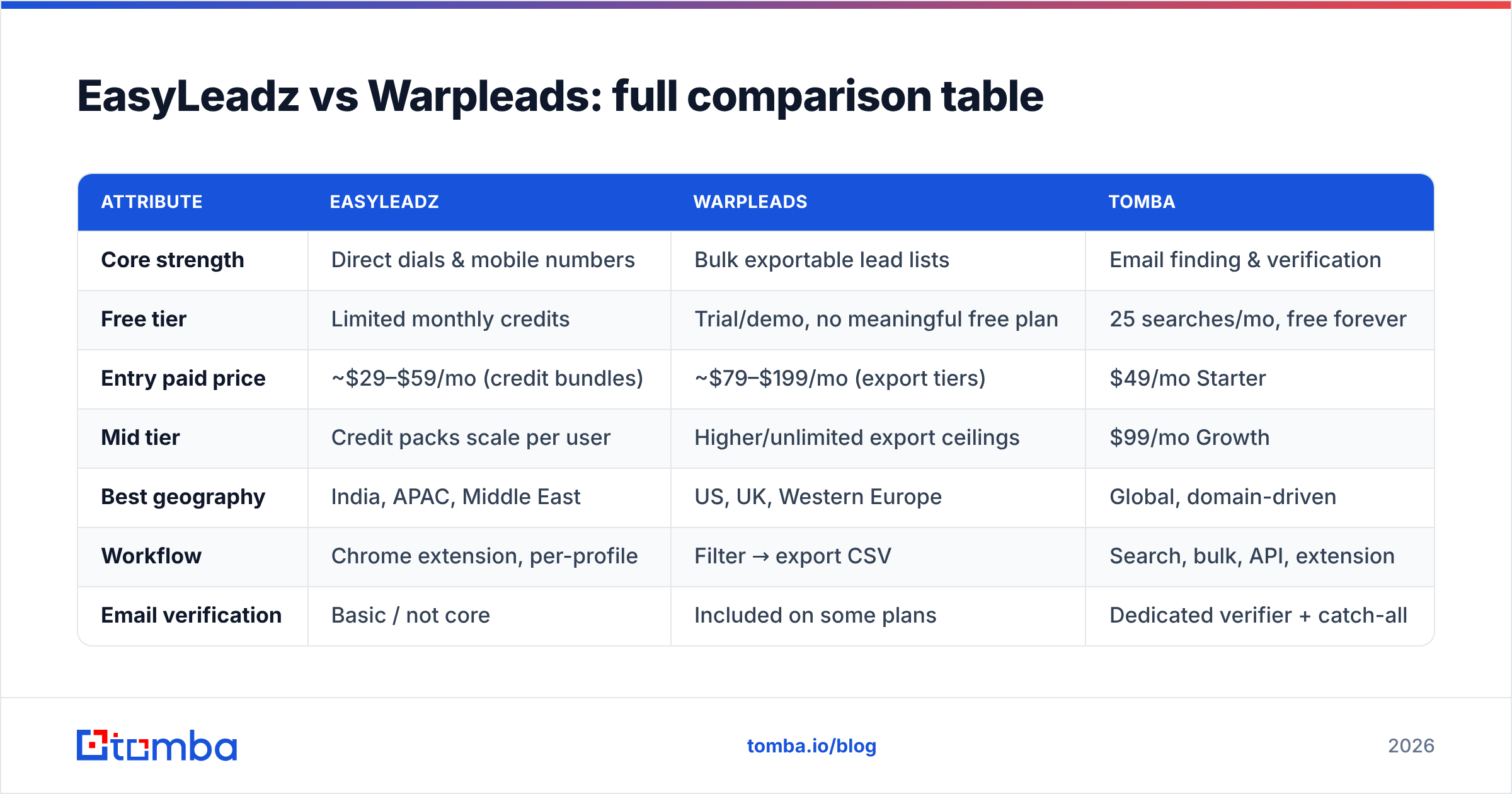
| Attribute | EasyLeadz | Warpleads | Tomba |
|---|---|---|---|
| Core strength | Direct dials & mobile numbers | Bulk exportable lead lists | Email finding & verification |
| Free tier | Limited monthly credits | Trial/demo, no meaningful free plan | 25 searches/mo, free forever |
| Entry paid price | ~$29–$59/mo (credit bundles) | ~$79–$199/mo (export tiers) | $49/mo Starter |
| Mid tier | Credit packs scale per user | Higher/unlimited export ceilings | $99/mo Growth |
| Best geography | India, APAC, Middle East | US, UK, Western Europe | Global, domain-driven |
| Workflow | Chrome extension, per-profile | Filter → export CSV | Search, bulk, API, extension |
| Email verification | Basic / not core | Included on some plans | Dedicated verifier + catch-all |
| API access | Yes, credit-metered | Limited on lower tiers | Yes, on all paid plans |
| Phone data | Primary product | Secondary, patchy | Available via phone finder |
| Best for | Cold callers, APAC ICPs | High-volume cold email | Precision email at any volume |
The row that decides most evaluations is best geography. If your target accounts are Indian or APAC-headquartered, no amount of export volume from a US-centric database makes up for the coverage gap — and vice versa.

Which one has better data accuracy?#
Different questions, different answers.
For phone numbers, EasyLeadz wins outright in its home regions. Direct dials are expensive data because they decay fast and are rarely scrapeable at scale; EasyLeadz has invested in exactly that. Independent user reviews on G2 consistently praise its India coverage and flag weaker results for US mid-market — a pattern you should expect from any regionally-anchored provider.
For email addresses, neither should be your final word. This is the part evaluation posts routinely skip. Bulk databases report "verified" status based on the last time a record was checked, which may be months ago. Phone-first tools treat email as a bonus field with correspondingly less QA.
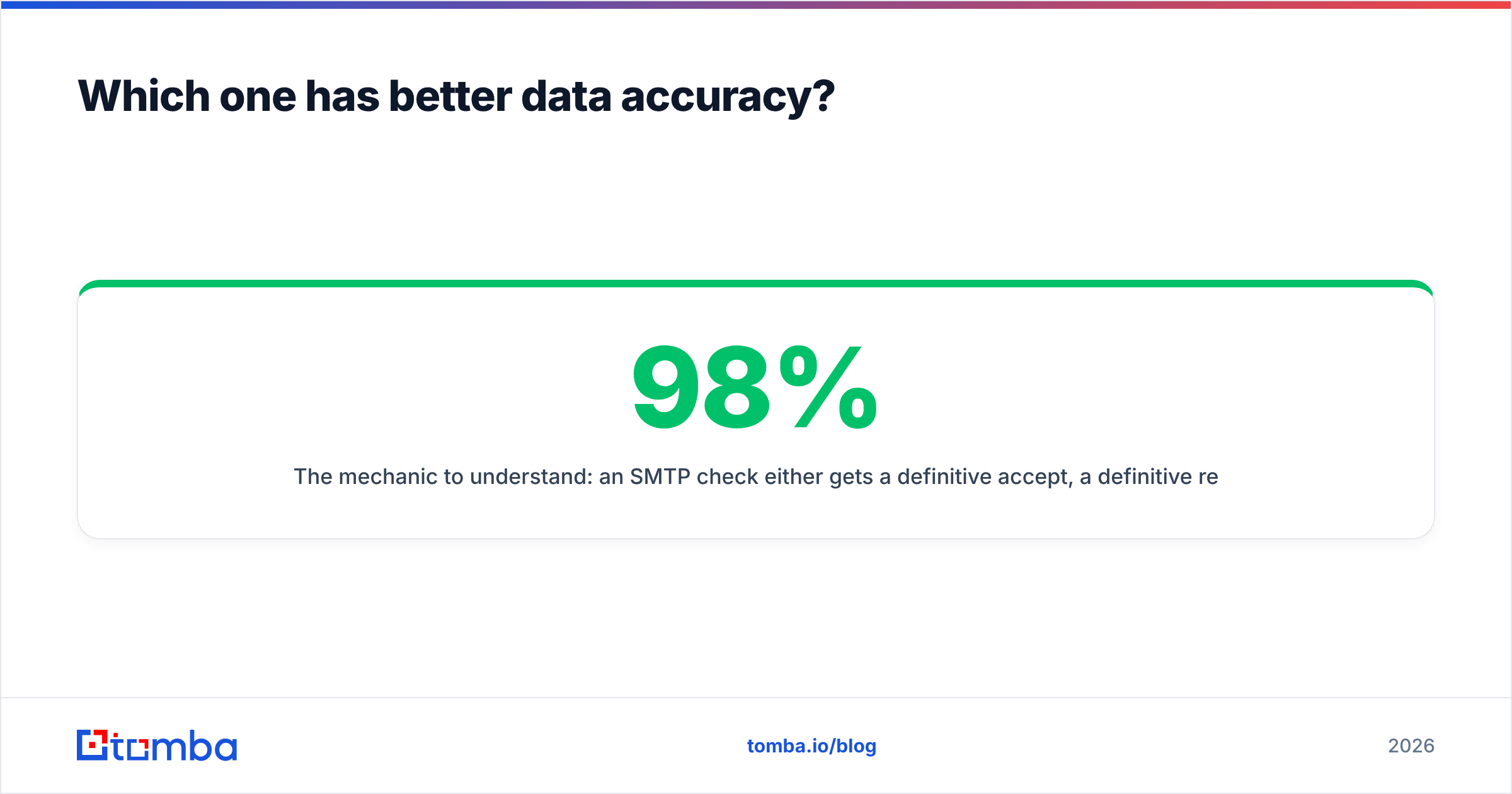
The mechanic to understand: an SMTP check either gets a definitive accept, a definitive reject, or nothing useful — and roughly a third of B2B domains are catch-all, meaning the server accepts everything and tells you nothing. Any provider that reports 98%+ accuracy without disclosing how it handles catch-all domains is quietly counting "accepted by a catch-all" as "valid." That's how a list with a 97% claimed accuracy delivers a 9% bounce rate.
Practical fix, regardless of which vendor you pick: run every exported list through an independent email verifier before it enters your sequencer, and route catch-all domains through a dedicated catch-all verifier rather than guessing. It costs a fraction of a cent per record and protects the one asset you cannot buy back — your domain reputation.
How do the pricing models compare in practice?#
Look past the sticker price at the unit you're buying.
EasyLeadz sells credits, and one credit typically equals one contact reveal. Phone reveals are the expensive item. A solo SDR doing 200 dials a month lands in the cheap tier comfortably; a five-person team doing the same lands in per-seat territory where the monthly figure roughly quintuples. Credit rollover rules matter here — ask directly whether unused credits expire monthly, because most credit-based vendors reset them.
Warpleads sells export ceilings. The economics invert: the first 1,000 leads are expensive, the 20,000th is nearly free. That's excellent if you genuinely send 20,000 emails a month with infrastructure to match — dozens of warmed inboxes, rotating domains, real deliverability discipline. It's terrible value if you export 20,000 rows and send to 2,000 of them, which is what happens in practice at most companies.

Three cost traps to price in before signing:
- Annual-only discounting. Both vendors push annual terms. If your outbound motion is under six months old, monthly is worth the premium.
- Seat multiplication. Extension-based tools price per user. A tool that looks cheap for one rep is not cheap for a team of six.
- Wasted export volume. Paying for unlimited exports you don't send is the most common overspend in outbound. Count your actual monthly send capacity first.
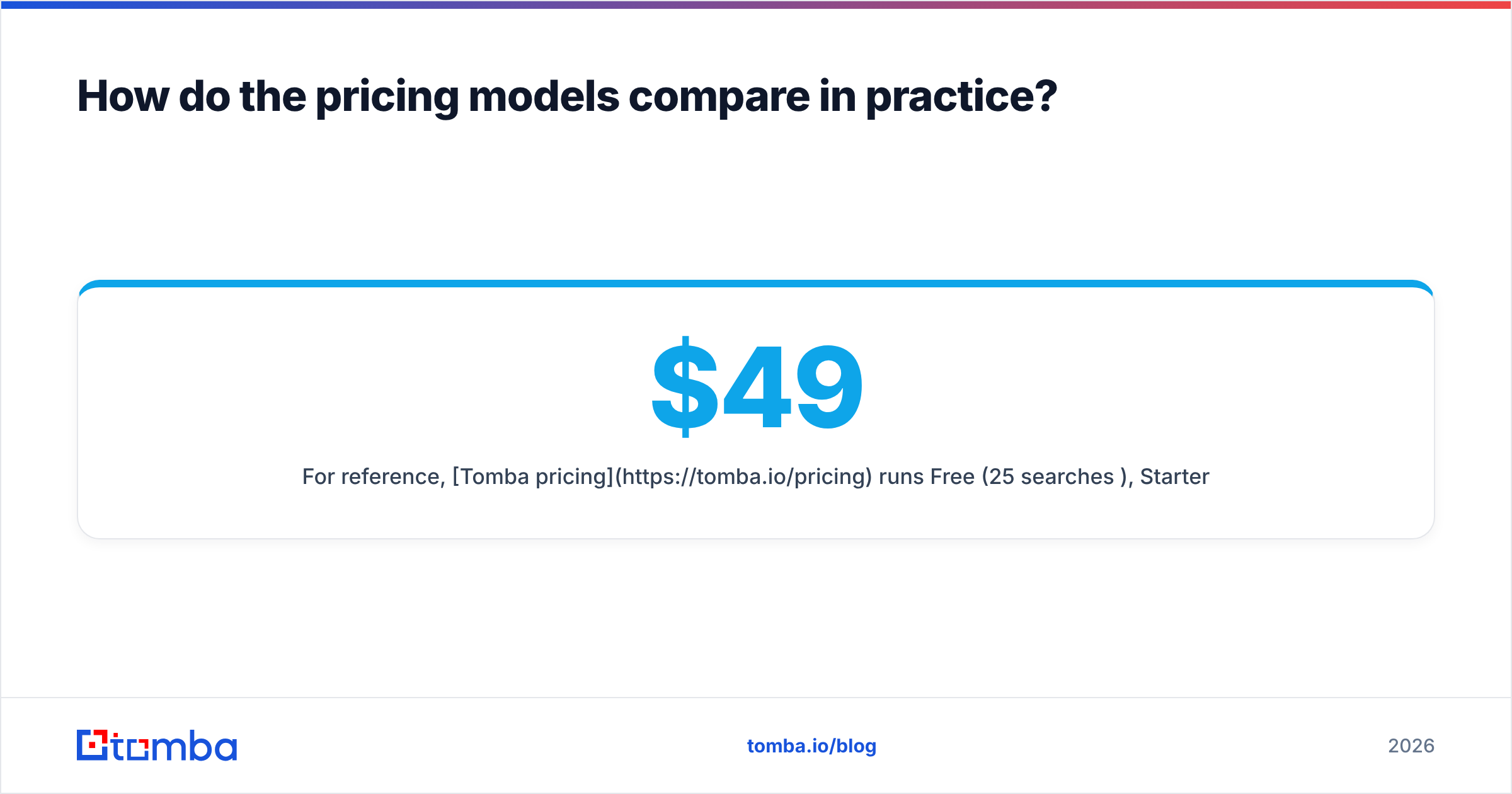
For reference, Tomba pricing runs Free (25 searches/mo), Starter $49/mo, Growth $99/mo, Pro $249/mo, and custom Enterprise — with API access on every paid tier rather than gated to the top plan, which matters if you plan to enrich inside your CRM instead of exporting CSVs.

Is EasyLeadz better than Warpleads for cold email?#
No — and it isn't trying to be.
If cold email is your primary channel, the EasyLeadz workflow fights you. Reveals happen one LinkedIn profile at a time, which caps you at maybe 60–100 contacts an hour of manual work. That's fine for a 40-account named-account list. It's untenable for a 3,000-prospect quarterly campaign.
Warpleads is built for that campaign shape. Filter, export, verify, load, send. The tradeoff is precision: filter-built lists are inherently looser than hand-picked ones, so your personalisation has to carry more weight, and your first-line research has to come from somewhere else.
The third option most teams overlook: skip the pre-built list entirely and generate contacts from the accounts you already qualified. If you have a list of 400 target companies from your CRM, a domain search returns the people and email patterns at each one, and a bulk email finder processes the whole file in one pass. You get list-building speed without inheriting someone else's stale database — and you only pay for the accounts you actually care about.
Is Warpleads better than EasyLeadz for calling?#
Also no. Warpleads' phone coverage exists but is thin compared with a provider whose entire business is direct dials. If your motion is call-first — recruiting, real estate, financial services, anything in India or the Gulf — EasyLeadz is the more defensible purchase.
If you need phone data alongside a primarily email-driven motion, a standalone phone finder plus a phone validator pass is usually cheaper than adding an entire second platform and its seat fees.
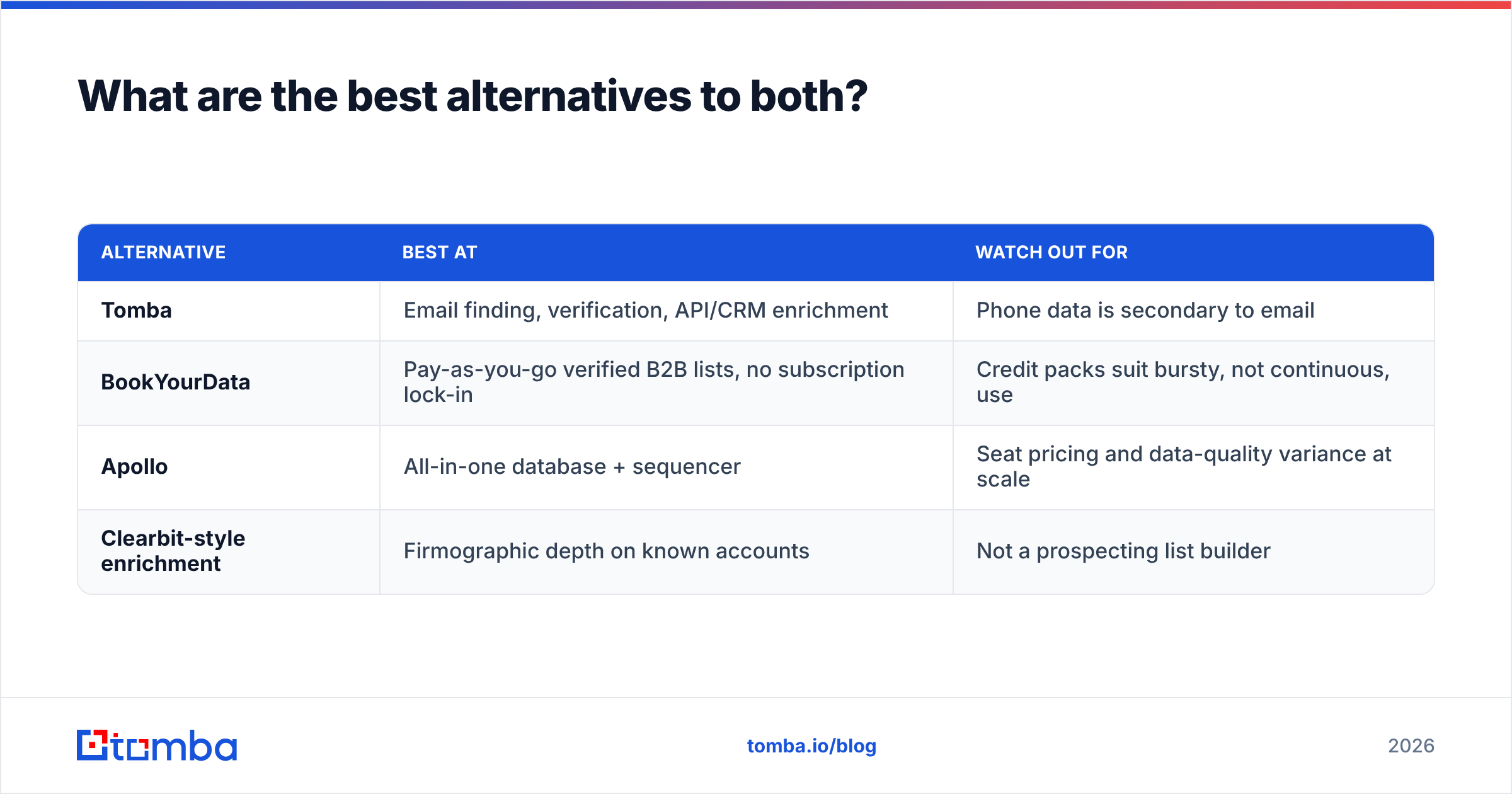
What are the best alternatives to both?#
Neither tool is the obvious default for a general-purpose B2B outbound stack. Worth evaluating alongside them:
| Alternative | Best at | Watch out for |
|---|---|---|
| Tomba | Email finding, verification, API/CRM enrichment | Phone data is secondary to email |
| BookYourData | Pay-as-you-go verified B2B lists, no subscription lock-in | Credit packs suit bursty, not continuous, use |
| Apollo | All-in-one database + sequencer | Seat pricing and data-quality variance at scale |
| Clearbit-style enrichment | Firmographic depth on known accounts | Not a prospecting list builder |
If you want a deeper teardown of the all-in-one category, our Apollo alternative breakdown covers where bundled platforms lose to focused tools — mainly on per-record cost and on how "verified" gets defined.
Which should you pick?#
Decide by motion, not by feature count:
- You call, and your ICP is India/APAC: EasyLeadz. Nothing else in this price band matches its dial coverage there.
- You send high-volume cold email and already have inbox infrastructure: Warpleads, with a mandatory verification pass on every export.
- You send targeted email to accounts you've already qualified: neither — a dedicated email finder against your own account list will be cheaper and more accurate.
- You need both dials and email at moderate volume: one email-first tool plus per-lookup phone credits, rather than two full subscriptions.
The failure mode to avoid is buying volume you can't send and calling it a data problem. Most outbound teams don't need more rows. They need the rows they already have to be correct, verified, and matched to accounts that fit.
Start with clean email data#
If your bottleneck is finding and verifying the right work emails — not scraping more phone numbers or exporting bigger CSVs — start with the Tomba Email Finder. Search by domain, name, or company, verify before you send, and connect it to your CRM through the API on any paid plan. The free tier gives you 25 searches a month to test accuracy against your own known-good contacts before you spend anything.
Run that test against whichever vendor you're currently considering. Take 50 contacts you already have verified emails for, run them through each tool blind, and count the matches. It takes an afternoon, and it beats every comparison table on the internet — including this one.
Related guides#
Ready to find emails that actually work?
Join 150,000+ professionals who stopped guessing and started sending. Free credits on signup — no credit card required.
Get the Tomba newsletter
Practical outbound tactics and product updates — once every two weeks.
About the author