EasyLeadz vs Zintlr 2026: Which B2B Data Tool Wins?
EasyLeadz sells direct dials. Zintlr sells personality-enriched B2B profiles. We compare coverage, accuracy, pricing, and API depth — and name the cheaper pick for email-first outbound teams.
TL;DR
- EasyLeadz is a direct-dial phone number tool first, email tool second. Its "Mr. E" Chrome extension pulls mobile numbers off LinkedIn profiles, and its coverage is strongest in India and APAC.
- Zintlr is a broader B2B database play — company + contact records, intent signals, and a personality-profiling layer ("Zintlr Personality") that most competitors don't ship.
- Neither is a specialist email finder. If your outbound motion is email-led, both will cost you bounces and credits you didn't plan for.
- Pricing on both is credit-metered and changes often. Budget for the effective cost per usable contact, not the sticker price.
- Best fit: EasyLeadz for phone-heavy APAC teams, Zintlr for research-heavy ABM, a dedicated email finder for volume email prospecting.
What are EasyLeadz and Zintlr, actually?#
They get compared because they both sell "B2B contact data." They're solving different problems.
EasyLeadz is built around one job: get you a mobile number for a person you found on LinkedIn. The product most people actually use is the Mr. E browser extension — open a profile, click, get a direct dial. The company is India-headquartered and that shows in the data: coverage of Indian and broader APAC contacts is noticeably deeper than what US-centric vendors return for the same region.
Zintlr is a database-and-intelligence platform. You search a contact and company index, filter by firmographics, layer on intent signals, and — the differentiator — get a psychographic read on the prospect. Zintlr's personality module classifies people into behavioral archetypes and suggests how to pitch them. Whether you believe that inference is another question, but nobody else in this price bracket ships it.
So the honest framing of easyleadz vs zintlr isn't "which is better." It's: do you need a phone number for one person right now, or do you need a researched list of accounts to work over the next quarter?

How do EasyLeadz and Zintlr compare on features and price?#
Both vendors meter by credits and both revise their plans regularly, so treat the figures below as directional — check the live pricing page before you commit to an annual contract.
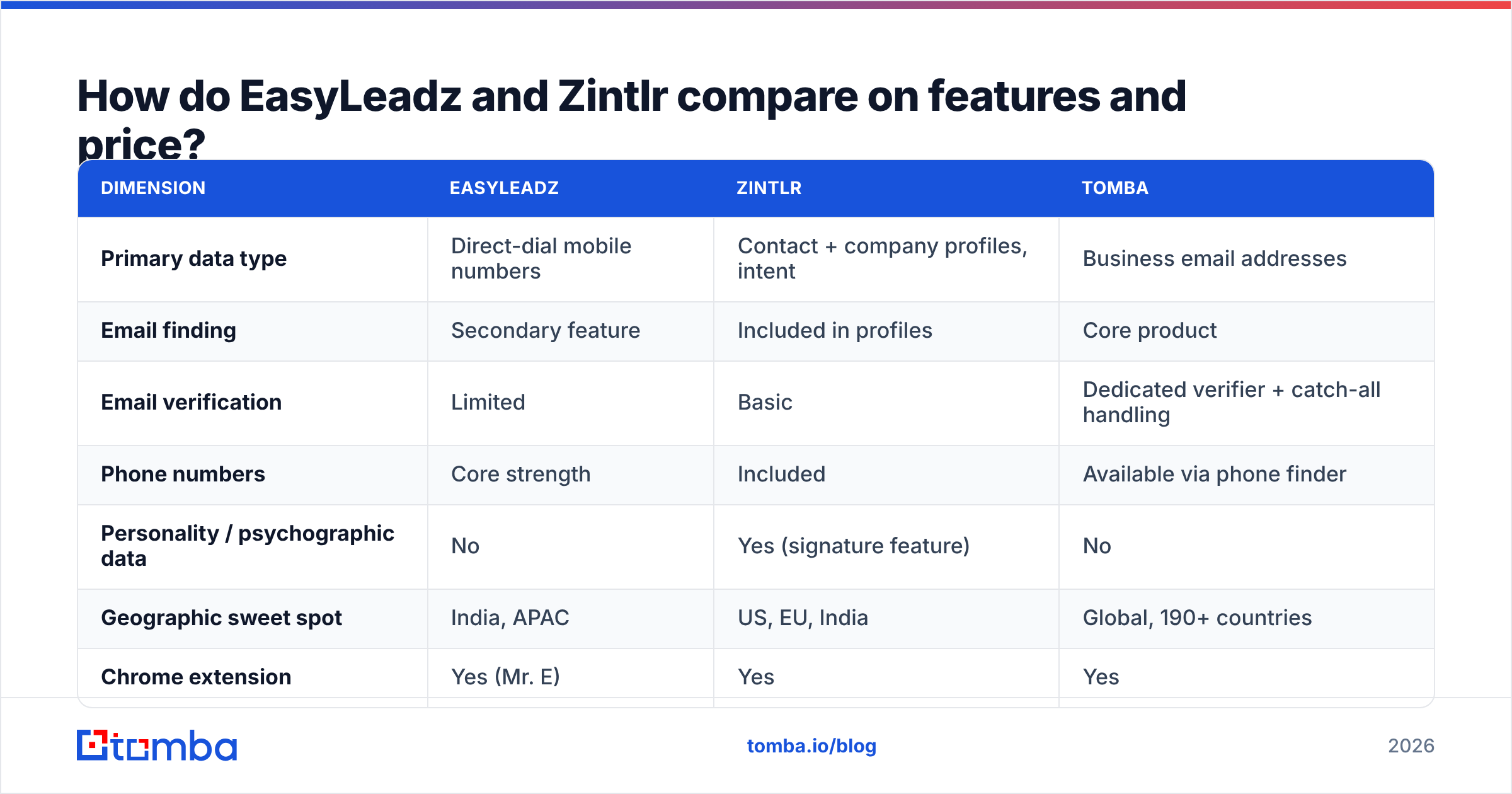
| Dimension | EasyLeadz | Zintlr | Tomba |
|---|---|---|---|
| Primary data type | Direct-dial mobile numbers | Contact + company profiles, intent | Business email addresses |
| Email finding | Secondary feature | Included in profiles | Core product |
| Email verification | Limited | Basic | Dedicated verifier + catch-all handling |
| Phone numbers | Core strength | Included | Available via phone finder |
| Personality / psychographic data | No | Yes (signature feature) | No |
| Geographic sweet spot | India, APAC | US, EU, India | Global, 190+ countries |
| Chrome extension | Yes (Mr. E) | Yes | Yes |
| Public API | Yes | Yes | Yes, documented, with CLI + MCP |
| Free tier | Trial credits | Limited free plan | 25 searches/month, no card |
| Entry paid plan | ~$59/mo range, credit-metered | ~$50–85/mo range, credit-metered | $49/mo Starter |
| Bulk enrichment | Yes | Yes | Yes, CSV + API |
| Best for | Phone-first APAC outbound | ABM research + intent | High-volume email prospecting |
Two things jump out of that table.
First, neither tool treats email as the main event. EasyLeadz will return an email, but it's a side product of a phone-finding engine. Zintlr returns emails as one field on a profile record. Neither runs the kind of continuous re-verification pipeline that an email-first vendor has to run to survive.
Second, the price columns aren't comparable the way they look. A $59 plan that returns 100 credits and burns a credit on every attempt — hit or miss — is not cheaper than a $49 plan that only charges on a confirmed result. Ask both vendors the same question before you buy: do I pay for a failed lookup?
Which one has better data accuracy?#
Here's the uncomfortable answer: accuracy claims from every vendor in this category are marketing numbers, measured on the vendor's own sample, and they do not transfer to your ICP.
What is defensible:
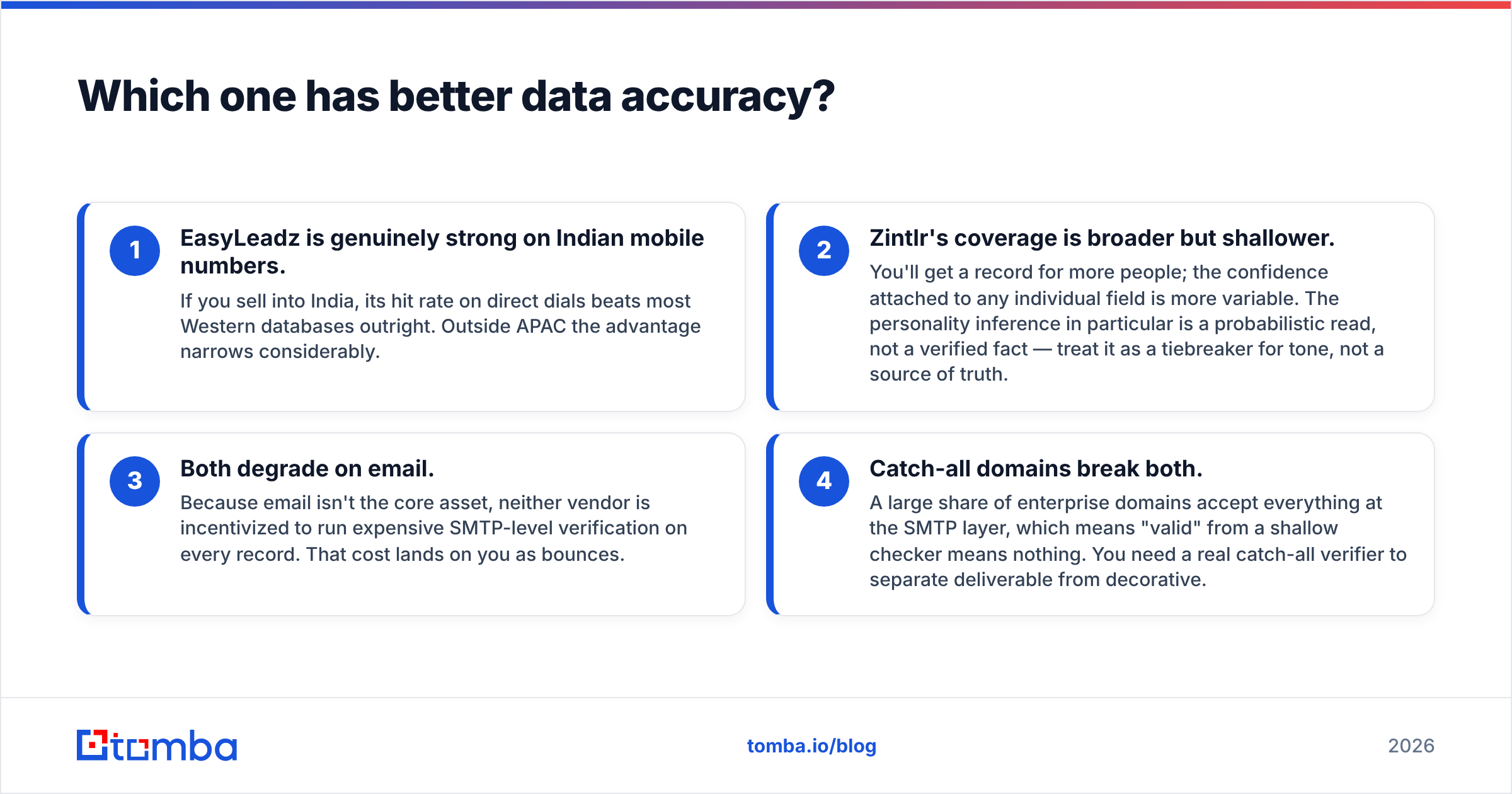
- EasyLeadz is genuinely strong on Indian mobile numbers. If you sell into India, its hit rate on direct dials beats most Western databases outright. Outside APAC the advantage narrows considerably.
- Zintlr's coverage is broader but shallower. You'll get a record for more people; the confidence attached to any individual field is more variable. The personality inference in particular is a probabilistic read, not a verified fact — treat it as a tiebreaker for tone, not a source of truth.
- Both degrade on email. Because email isn't the core asset, neither vendor is incentivized to run expensive SMTP-level verification on every record. That cost lands on you as bounces.
- Catch-all domains break both. A large share of enterprise domains accept everything at the SMTP layer, which means "valid" from a shallow checker means nothing. You need a real catch-all verifier to separate deliverable from decorative.

The practical test — and the only one worth doing — is a 100-contact bake-off. Take 100 real target accounts from your ICP. Run them through each tool's trial. Then push every returned email through an independent email verifier and count how many survive. Not how many were returned. How many were deliverable. In most bake-offs we've seen, the gap between "returned" and "deliverable" is between 15% and 40%, and that gap is your real cost per lead.

Is EasyLeadz better than Zintlr for cold outreach?#
Depends entirely on channel.
Pick EasyLeadz if:
- Your first touch is a phone call, not an email.
- You sell into India, Southeast Asia, or the Middle East.
- Your reps work LinkedIn manually and want a one-click enrich on a profile they're already looking at.
- Volume is modest — dozens of high-value contacts per week, not thousands.
Pick Zintlr if:
- You run account-based motions and need to map an org chart before you touch anyone.
- Intent signals actually change your prioritization (they only do if you have the volume to prioritize).
- You want messaging guidance baked into the record and your reps will genuinely use it.
- Your team values breadth of profile fields over depth on any single one.
Pick neither if:
- You send more than a few hundred cold emails a month. At that volume, deliverability is the strategy, and a general-purpose database will quietly wreck your domain reputation with 20% bounce rates. That's the point where a dedicated finder-plus-verifier stack stops being optional.
A word on the third case, because it's the one people get wrong. Mailbox providers judge you on bounce rate before they judge you on content. Cross 2–3% hard bounces consistently and your sender reputation takes a hit that a better subject line cannot repair. Buying contact data from a tool that doesn't verify at the SMTP layer means outsourcing your domain health to a vendor who isn't measured on it.
What does each tool actually cost per usable contact?#
Sticker price is the wrong metric. Here's the arithmetic that matters, using round numbers you can substitute your own results into.
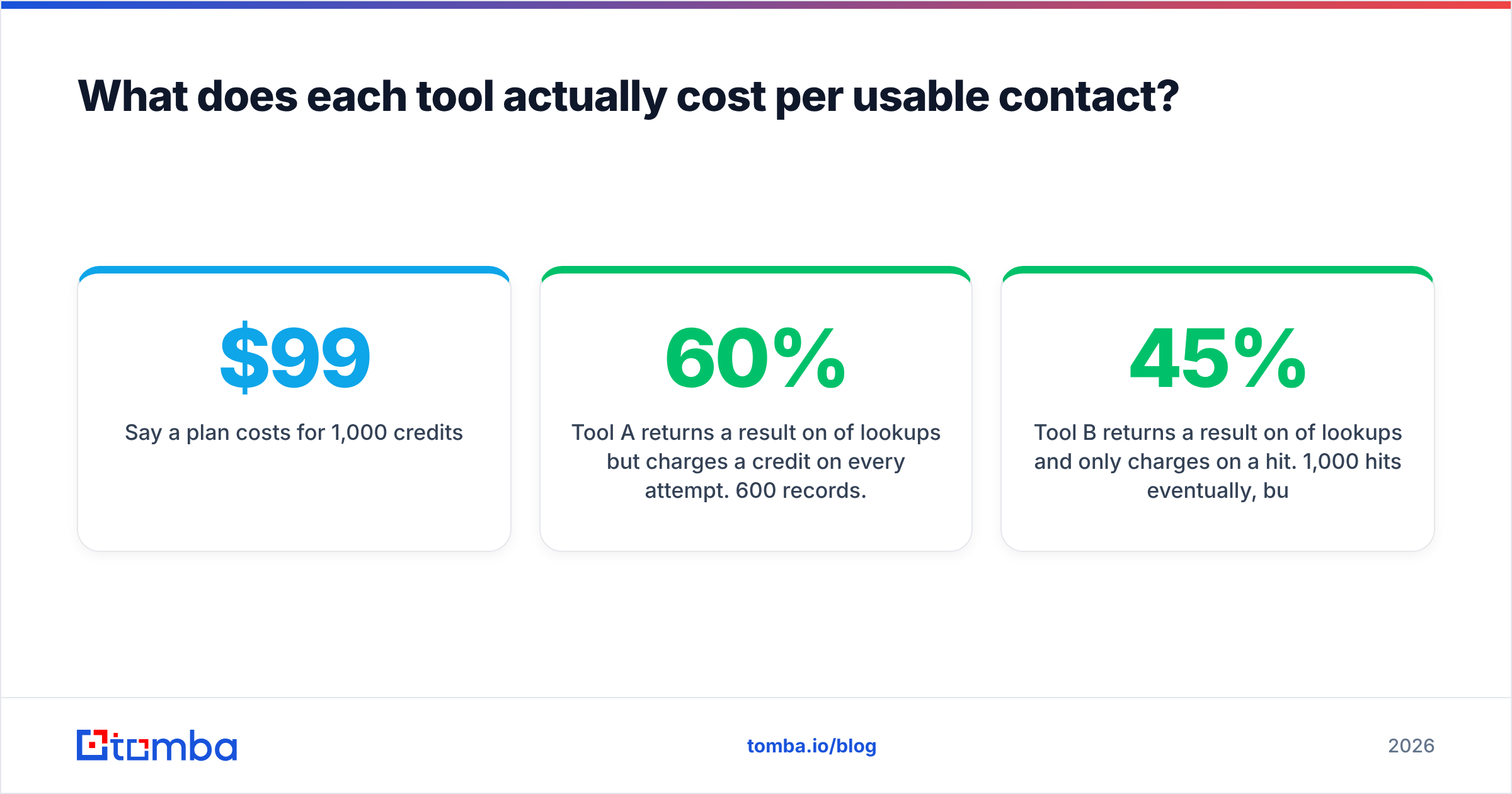
Say a plan costs $99/month for 1,000 credits.
- Tool A returns a result on 60% of lookups but charges a credit on every attempt. 600 records. Of those, 70% are deliverable after independent verification → 420 usable contacts. Effective cost: $0.24 each.
- Tool B returns a result on 45% of lookups and only charges on a hit. 1,000 hits eventually, but of those, 90% are deliverable → 900 usable contacts. Effective cost: $0.11 each.
Tool B looked worse on the hit-rate slide and is less than half the price in reality. This is why the credit-charging policy is the single most important line item in a data contract, and why it is never on the pricing page in plain language.

Run that calculation on your own trial data before you sign anything annual. If a vendor won't tell you their charging policy in writing, that's your answer.
Can you use them together — and where does Tomba fit?#
Yes, and for a lot of teams that's the correct architecture. These tools are not mutually exclusive, and the best stacks we see are layered by job:
- Discovery layer — find the accounts and people. Zintlr, LinkedIn Sales Navigator, or your own ICP list.
- Email layer — resolve and verify work emails at volume. This is where a specialist finder earns its keep, via domain search to map every addressable contact at a target company, then bulk verification before anything enters your sequencer.
- Phone layer — add direct dials for the accounts worth calling. EasyLeadz for APAC, a general provider elsewhere.
- Enrichment layer — fill in firmographics and technographics on records that clear the first three steps. No point enriching a contact you can't reach.
Where Tomba fits in that stack is narrow and specific: step two. Tomba is an email finder first, with the verifier, catch-all handling, and bulk tooling that a finder-first product has to build. Pricing is straightforward — a free tier at 25 searches/month, then Starter at $49/month, Growth at $99/month, and Pro at $249/month, with Enterprise negotiated. Full Tomba pricing is public, no demo call gate.
It is not an intent platform. It doesn't do psychographics. If those are the things you're shopping for, Zintlr is the more complete answer and you should evaluate it on its own terms — check independent reviews on G2 rather than any vendor's own case studies, including ours.
What should you check before you buy either one?#
Six questions, in order of how much money they'll save you:
- Do I get charged for failed lookups? Get it in writing. This changes effective cost by 2x or more.
- What's the coverage rate on my ICP? Not global average. Run 100 real target accounts through the trial.
- What does "verified" mean here? Syntax check, MX record check, or full SMTP handshake? Only the third one predicts deliverability.
- Do credits roll over? Most don't. Unused credits at month-end are a real cost if your volume is spiky.
- Is there a usable API? If you're enriching inside a CRM or workflow, an undocumented or rate-crippled API kills the integration. Compare the Tomba API docs against theirs as a baseline for what "documented" should look like.
- What's the cancellation path? Annual-only contracts with no monthly option are a signal about churn, not about product quality.
The verdict#
EasyLeadz wins on phones in APAC. Zintlr wins on research depth and org mapping. Neither wins on email, and for most outbound teams email is still where the volume lives.
If you're calling into India and your reps live inside LinkedIn, EasyLeadz is the sharper tool and the extension workflow is genuinely fast. If you're running ABM and need to understand an account before you touch it, Zintlr gives you more raw material per record than anything else at its price point — just don't mistake inferred personality data for verified fact.
But if your quarter depends on getting 3,000 clean, deliverable emails into a sequencer without torching your domain, both of these are the wrong primary tool. You'd be paying database prices for email data that a specialist verifies better and cheaper.
Start with a free test rather than a sales call. Tomba's Email Finder gives you 25 searches a month at no cost and no card — enough to run the 100-contact bake-off described above against your own ICP and see the deliverable-versus-returned gap for yourself. Run the same list through EasyLeadz and Zintlr trials, count what survives verification, and let the numbers pick your stack instead of the pricing page.
Related guides#
Ready to find emails that actually work?
Join 150,000+ professionals who stopped guessing and started sending. Free credits on signup — no credit card required.
Get the Tomba newsletter
Practical outbound tactics and product updates — once every two weeks.
About the author