Ecanvasser Pricing Reviews Pros and Cons: 2026 Buyer Guide
An independent breakdown of Ecanvasser pricing, real user reviews, and the pros and cons that matter before you commit budget to field-canvassing software in 2026.
Looking for a straight read on Ecanvasser pricing reviews pros and cons? Start here. Ecanvasser is door-to-door canvassing software. Teams use it to map turf, send walk lists to phones, and log answers. This guide covers what it costs, what users praise, what they gripe about, and when a cheaper stack wins.
TL;DR
- Ecanvasser runs field canvassing: door-to-door maps, walk lists, volunteer coordination, and survey capture. Most real deals are quote-based, so budgets are hard to compare.
- The best reviews come from political campaigns, advocacy groups, and city outreach teams.
- The worst reviews come from B2B sales teams. They wanted a prospecting tool and got a canvassing platform.
Three more points before the detail:
- Top pros: strong offline mobile apps, clean turf mapping, and volunteer tools a non-technical organizer can run.
- Top cons: seat costs climb with volunteer headcount, reporting is thin, and the platform ships no contact data. You bring your own list.
- If your canvassing is digital, a lead-data stack costs a fraction of this. An email finder plus verification and enrichment solves the real bottleneck.
What is Ecanvasser, and who buys it?#
Ecanvasser is field software for teams that knock on doors. The loop is simple. Import a list of addresses. Cut it into turf. Push walk lists to volunteer phones. Capture answers with custom surveys. Sync it all back to one dashboard.
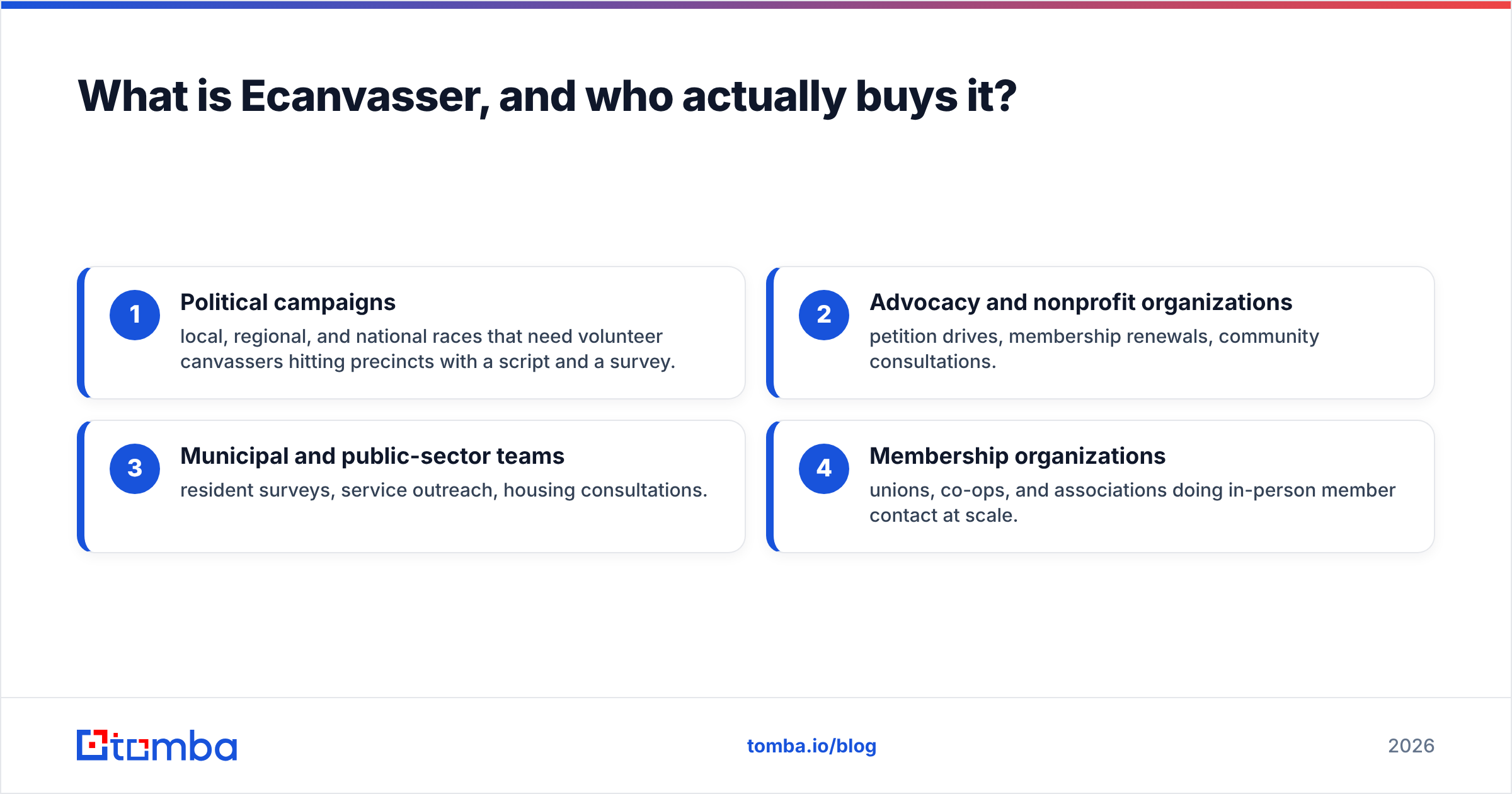
The typical buyer is not a SaaS sales team. It is one of four groups:
- Political campaigns — local and national races that send volunteers into precincts with a script and a survey.
- Advocacy and nonprofit groups — petition drives, membership renewals, and community consultations.
- Public-sector teams — resident surveys, service outreach, and housing consultations.
- Membership bodies — unions, co-ops, and associations doing member contact at scale.
That framing shapes every pricing and review call below. Ecanvasser is priced as a field operations tool, not a lead-generation tool. Reviews on G2 and Capterra split along the same line. Organizers rate it well. Buyers who wanted a B2B database rate it poorly. You can check the official feature set at ecanvasser.com.
How does Ecanvasser pricing work in 2026?#
Short answer: it is tiered, seat-driven, and mostly quote-based. The price you read in a blog post is rarely the price you pay.
Ecanvasser publishes a tier structure, not a full per-seat price list. Five things move your quote:
- User seats — organizers, admins, and canvassers each use a license in most setups. A 12-person campaign and a 300-volunteer campaign are not the same invoice.
- Contract length — an annual deal cuts the monthly rate. Election cycles make demand seasonal, so vendors reward the longer term.
- Data volume — the size of your imported contact list moves you up storage tiers.
- Feature tier — survey logic, API access, integrations, and custom reports sit above the entry plan.
- Support level — onboarding, training, and a named success contact come bundled into higher tiers.
The result is a wide spread. Two teams can describe the same needs and get quotes that differ by several multiples. Get the quote in writing. Pin down seat counts, overage terms, and renewal increases. Then ask one more question. What happens when you add 50 volunteers three weeks before election day? That is where seat pricing bites hardest.
What should you budget?#
Plan for a low four-figure year for a small local operation. Plan for a mid to high five-figure year for a national campaign with hundreds of volunteers. Anyone who quotes you one universal number for Ecanvasser pricing is guessing.
How does Ecanvasser compare to the alternatives?#
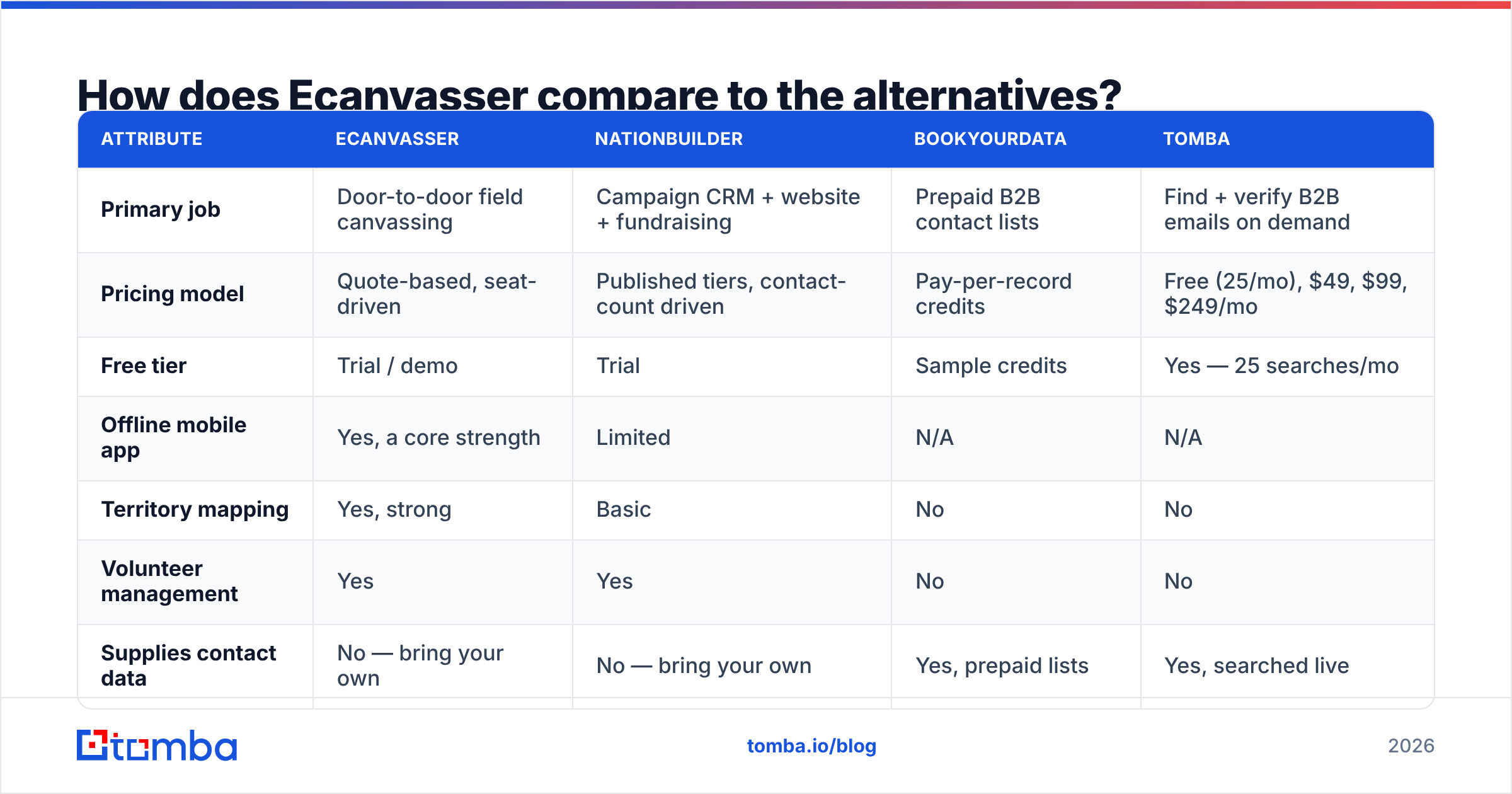
Here is the honest read. These tools overlap in name only. The real question is what job you are hiring the software to do.
| Attribute | Ecanvasser | NationBuilder | BookYourData | Tomba |
|---|---|---|---|---|
| Primary job | Door-to-door field canvassing | Campaign CRM + website + fundraising | Prepaid B2B contact lists | Find + verify B2B emails on demand |
| Pricing model | Quote-based, seat-driven | Published tiers, contact-count driven | Pay-per-record credits | Free (25/mo), $49, $99, $249/mo |
| Free tier | Trial / demo | Trial | Sample credits | Yes — 25 searches/mo |
| Offline mobile app | Yes, a core strength | Limited | N/A | N/A |
| Territory mapping | Yes, strong | Basic | No | No |
| Volunteer management | Yes | Yes | No | No |
| Supplies contact data | No — bring your own | No — bring your own | Yes, prepaid lists | Yes, searched live |
| Email verification | No | No | List-level validation | Yes, dedicated verifier |
| API access | Higher tiers | Yes | Yes | Yes, all paid tiers |
| Best for | Physical canvassing ops | Full campaign infrastructure | Buying a clean list upfront | Building targeted lists continuously |
BookYourData deserves a fair note. If you want a prepaid list you own outright, with no monthly commitment, that credit model fits well. It is a different way to buy. It does not compete with Ecanvasser at all. It competes on data sourcing, and Ecanvasser does not play there.
What do Ecanvasser reviews praise?#
Four themes repeat across review sites and community threads.
- The offline mobile app. Canvassers work in basements, rural roads, and dead zones. The app stores data on the phone and syncs when signal returns. Reviewers who came from clipboards call this the biggest time saver.
- Turf cutting and mapping. Drawing turf on a map and assigning it to a named volunteer takes minutes. Sorting addresses by hand takes an afternoon. Teams running many precincts rate this highly.
- Ease of use. Volunteer coordinators are often unpaid and untrained. Reviews say new canvassers get productive after a short walkthrough, not a formal training program.
- Support in crunch week. Several reviews praise fast help in the final weeks of a race. Downtime in that window cannot be won back.
What do Ecanvasser reviews criticize?#
The critical reviews cluster just as tightly. Three gripes come first:
- Cost scales with volunteers. This is the top complaint. Small teams find the price fair. Teams that surge to hundreds of volunteers watch seat math reshape the budget. Negotiate volunteer-tier pricing before you scale, not after.
- Reporting depth. The dashboards answer "how many doors did we knock" well. They handle turnout analysis by segment far less well. Data-mature teams export to a BI tool.
- Integration gaps. Reviewers with a CRM, customer relationship management stack, or fundraising platform sometimes need custom API work. Budget that engineering time, or confirm a native connector exists first.
Two more issues drive the angriest reviews:
- It is not a data source. Ecanvasser organizes contacts you already hold. If your list is stale or thin, the software cannot fix it. Buyers who expected built-in contact discovery feel misled, and the mismatch starts on the buying side.
- Seasonal value. Campaign tools get hammered for 90 days and sit idle the rest of the year. An annual contract can feel steep in the off-season unless the vendor offers cycle-aware terms.
Is Ecanvasser worth it for B2B sales teams?#
Almost certainly not. A lot of search traffic lands on this page by mistake.
Say you sell B2B and searched for "canvassing software." You probably mean digital canvassing. That means working a defined set of accounts with email and phone outreach. It needs a different toolchain. Paying seat-based field-ops prices for it is a budgeting error.
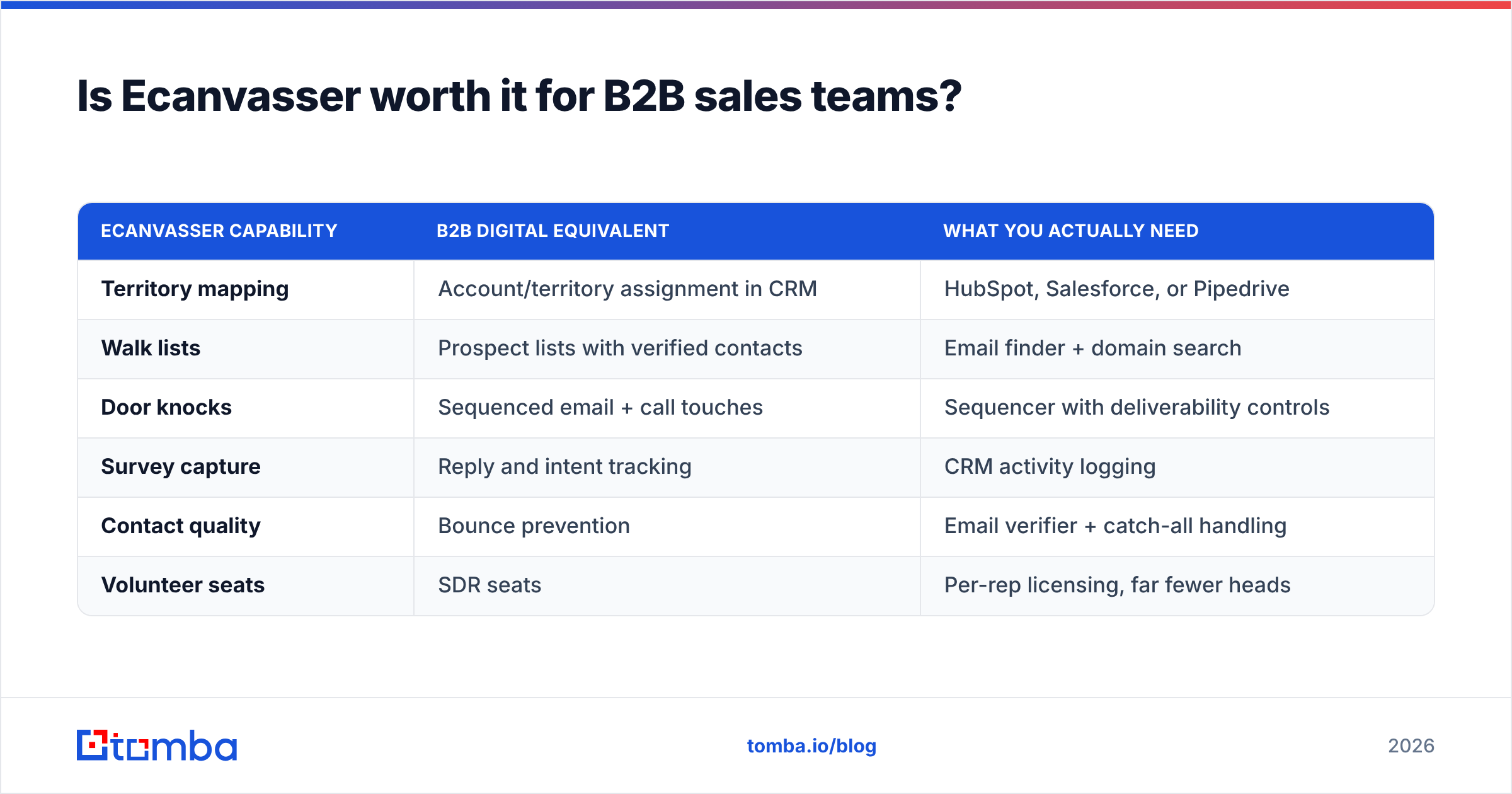
Here is the B2B version of each Ecanvasser job:
| Ecanvasser capability | B2B digital equivalent | What you actually need |
|---|---|---|
| Territory mapping | Account/territory assignment in CRM | HubSpot, Salesforce, or Pipedrive |
| Walk lists | Prospect lists with verified contacts | Email finder + domain search |
| Door knocks | Sequenced email + call touches | Sequencer with deliverability controls |
| Survey capture | Reply and intent tracking | CRM activity logging |
| Contact quality | Bounce prevention | Email verifier + catch-all handling |
| Volunteer seats | SDR seats | Per-rep licensing, far fewer heads |
The economics split sharply. Five reps can run a full outbound motion on a data stack under $250 a month. A campaign with 200 volunteers cannot. The cost driver there is headcount in the field, not records in a database.
What should you ask before you buy?#
Run this checklist with any field-engagement vendor, Ecanvasser included. Start with money:
- What is the exact per-seat price, and what counts as a seat? Price admin, organizer, and canvasser roles apart. Ask if idle volunteers still use a license.
- What are the overage and expansion terms? Campaigns scale fast. Fixed expansion pricing saves you from a renegotiation at the worst moment.
- What happens at renewal? Ask for the escalator cap in writing. A renewal after a winning cycle is a classic price-hike moment.
Then cover the technical side:
- Which integrations are native, and which are custom? Ask for a list of certified connectors. "We have an API" is not an answer. Every custom build is an engineering line item.
- What is the data export path? You should pull your contacts and survey answers out in a standard format at any time, with no support ticket.
- Where does the contact data come from? For Ecanvasser, the answer is you. Budget for sourcing and refreshing that list. Transparent vendors publish their data sources openly, which is a fair benchmark.
Ecanvasser pricing reviews pros and cons: the verdict#
Here is the short version of Ecanvasser pricing reviews pros and cons, in three calls.
Buy it if you knock on real doors at scale. Campaigns, advocacy drives, and city outreach teams earn the price back. Offline reliability, turf management, and volunteer usability are the three things that break first on spreadsheets. Get the quote in writing. Negotiate volunteer-tier economics before you scale. Confirm your integrations are native.
Skip it if your canvassing is digital. If your doors are inboxes, you need contact discovery and verification, not turf maps. The cost structure is wrong for you. The feature set solves a problem you do not have.
Either way, solve the data question on its own. Ecanvasser will not find you a single new contact. Most field-ops platforms will not either. Sourcing and hygiene are a separate budget line. Verify before you contact. Bounces hurt sender reputation fast, and a bad list makes good software look broken. HubSpot offers vendor-neutral guidance if you are building the process from scratch.
Where does Tomba fit?#
Not as an Ecanvasser replacement. The two tools do different jobs. Tomba fits the step before any outreach platform. It turns a list of target companies and people into verified, reachable contacts.
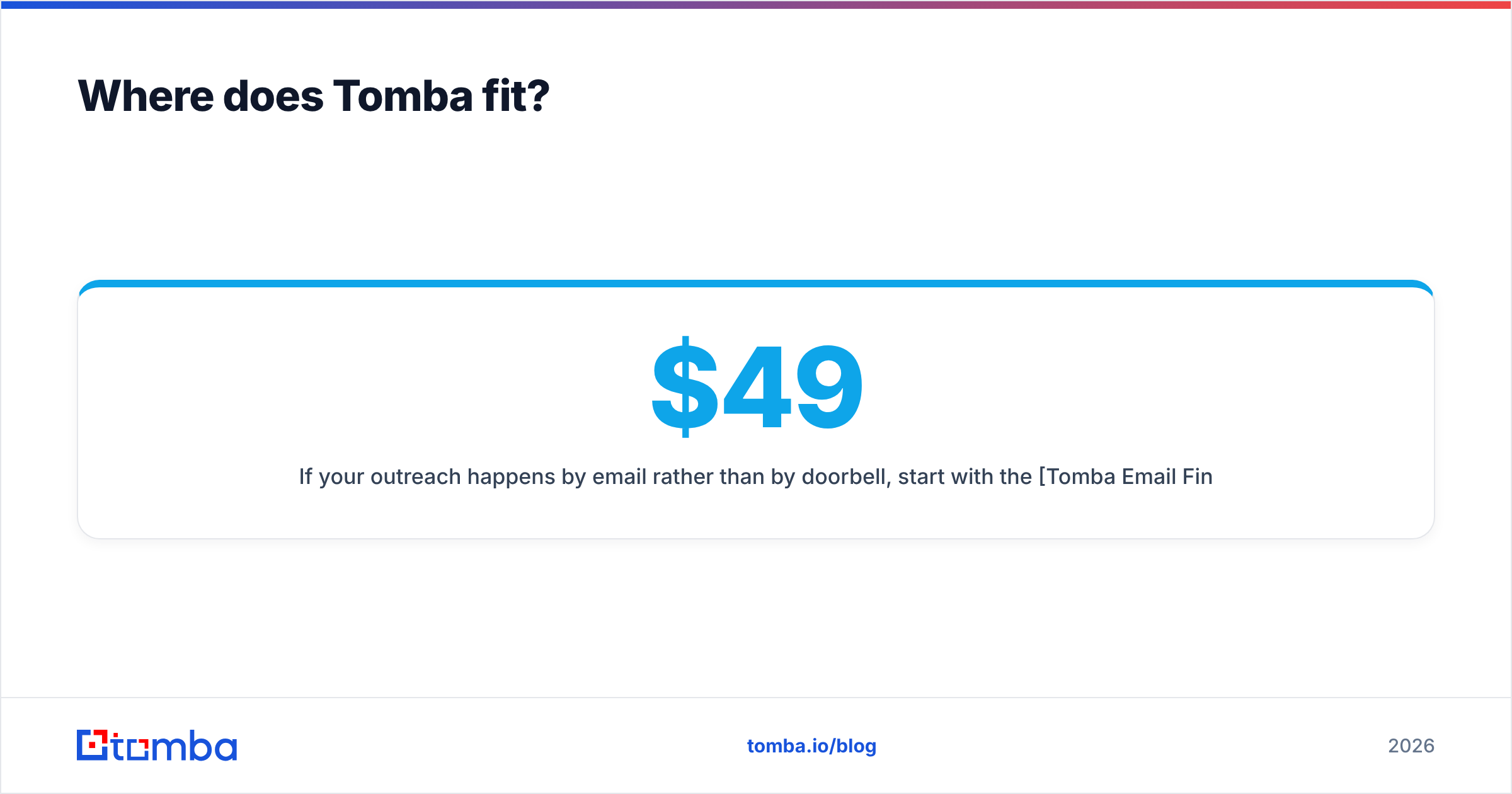
If your outreach goes by email, not by doorbell, start with the Tomba Email Finder. Give it a domain, or a name plus a company. It returns the work email with a confidence score. It then runs verification, so you stop paying for bounces. The free tier gives you 25 searches a month. Test it against contacts you already know are right. That is the only benchmark that counts. Paid plans start at $49 a month, with Growth at $99 and Pro at $249. Full Tomba pricing is published openly, with no quote form.
Build the list once. Verify it properly. Then let your outreach tool do what it does well.
Related guides#
Ready to find emails that actually work?
Join 150,000+ professionals who stopped guessing and started sending. Free credits on signup — no credit card required.
Get the Tomba newsletter
Practical outbound tactics and product updates — once every two weeks.
About the author