Ecommerce Demand Generation: The 2026 Playbook That Works
Most ecommerce demand generation advice is just paid social with extra steps. Here is the channel mix, the payback math, and the 90-day rollout that actually compounds in 2026.
TL;DR
- Ecommerce demand generation is not paid acquisition. Paid search and shopping ads capture demand that already exists; demand generation creates the intent those ads harvest later.
- The channels that compound — organic search, creator partnerships, owned email/SMS, community — take 60 to 180 days to show up in revenue. Budget for the lag or you will kill them at day 45.
- Attribution will lie to you. Track blended CAC, new-customer contribution margin, and branded search volume instead of last-click ROAS on any single channel.
- If you sell to ecommerce brands (apps, 3PLs, agencies, suppliers), your demand gen problem is finding the 40 people at each account who actually control budget — that is a data problem, not a creative problem.
- A realistic starting split for a $50k/month budget: 45% capture, 35% creation, 20% owned and experimental. Rebalance quarterly on payback, not on vibes.
What is ecommerce demand generation, actually?#
Demand generation is the work of making people want a category of product before they type a query into Google. Demand capture is the work of being there when they do.
Think of it like a restaurant on a busy street. Capture is the sign in the window and your ranking on Google Maps — you win customers who already decided they want ramen. Creation is the smell drifting onto the sidewalk, the food critic's write-up, the friend who won't shut up about your broth. One of those is measurable in an afternoon. The other is why you have a line on a Tuesday.
Most ecommerce teams call their paid media budget "demand gen" because that is where the money sits. It isn't. If you turn off Meta and revenue drops 90% within a week, you never had demand generation — you had a rented audience.
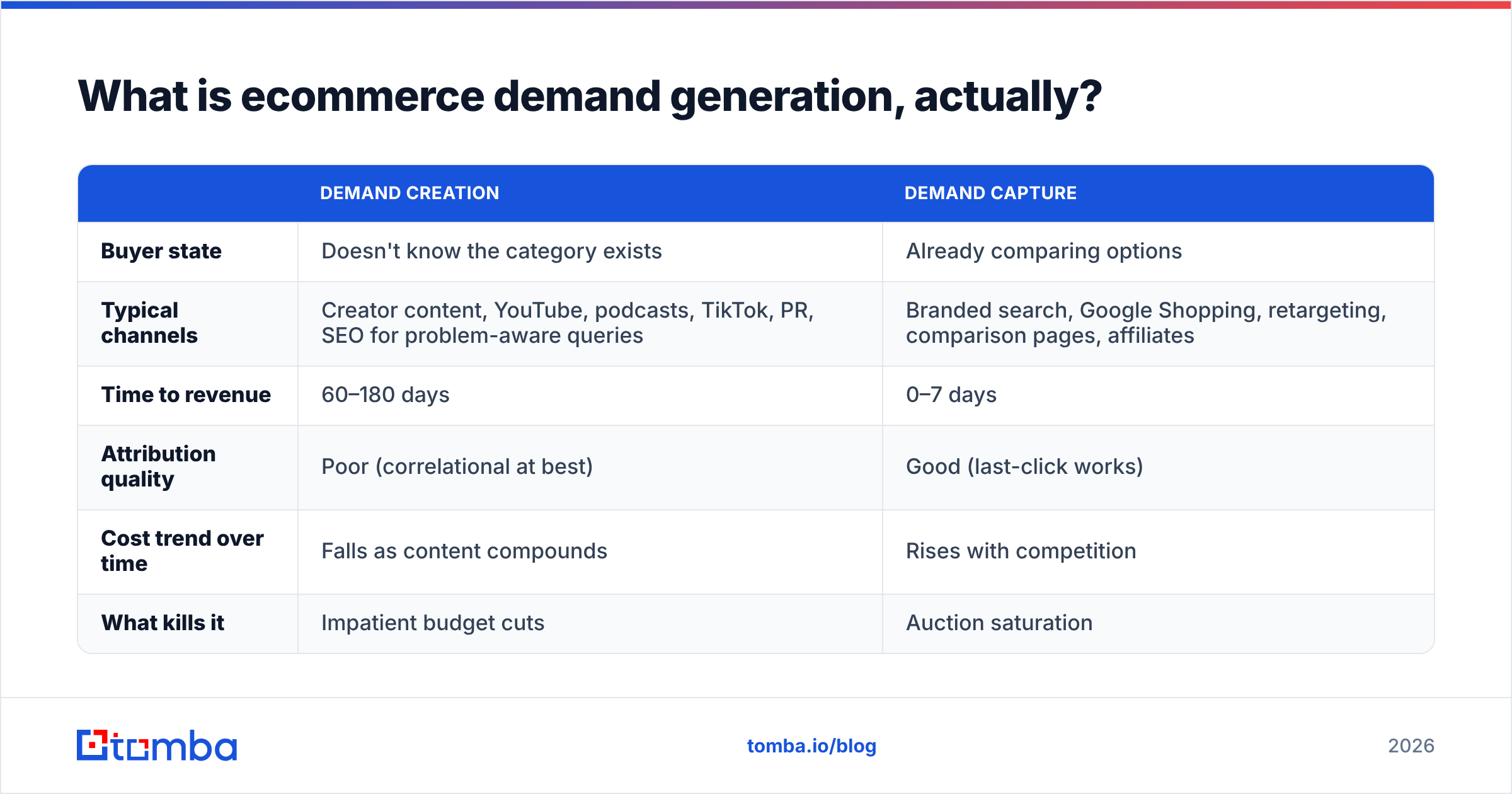
The practical distinction:
| Demand creation | Demand capture | |
|---|---|---|
| Buyer state | Doesn't know the category exists | Already comparing options |
| Typical channels | Creator content, YouTube, podcasts, TikTok, PR, SEO for problem-aware queries | Branded search, Google Shopping, retargeting, comparison pages, affiliates |
| Time to revenue | 60–180 days | 0–7 days |
| Attribution quality | Poor (correlational at best) | Good (last-click works) |
| Cost trend over time | Falls as content compounds | Rises with competition |
| What kills it | Impatient budget cuts | Auction saturation |
Both are necessary. A capture-only program has a hard ceiling: you can only take a share of existing search volume, and once you own it, growth stalls. A creation-only program builds awareness that a competitor's better-optimized shopping feed converts for them.
Why does ecommerce demand generation break so often?#
Four failure modes account for most of it.
- The payback window is set by finance, not by physics. A CFO who wants CAC recovered in 30 days will force you into bottom-funnel spend permanently. Demand creation cannot clear that bar. Negotiate a blended payback target (say, 90 days) with a carve-out for creation channels measured on a 6-month cohort.
- Attribution models get treated as truth. Last-click gives all credit to the branded search click that closed the sale — the same branded search that only happened because of a TikTok the buyer saw three weeks earlier. HubSpot's marketing research and most multi-touch vendors agree on the direction of the error even when they disagree on the fix.
- Creative volume is too low. Paid social is a creative-testing machine, not a targeting machine. Teams shipping four ads a month are not running demand gen; they are running a slideshow. Twenty to forty concepts a month is the working floor for a mid-size brand.
- Nobody owns the middle. Someone owns ads, someone owns email, and the gap between "saw a Reel" and "landed on a PDP" belongs to no one. That gap is where demand generation lives.
Which channels actually work for ecommerce in 2026?#
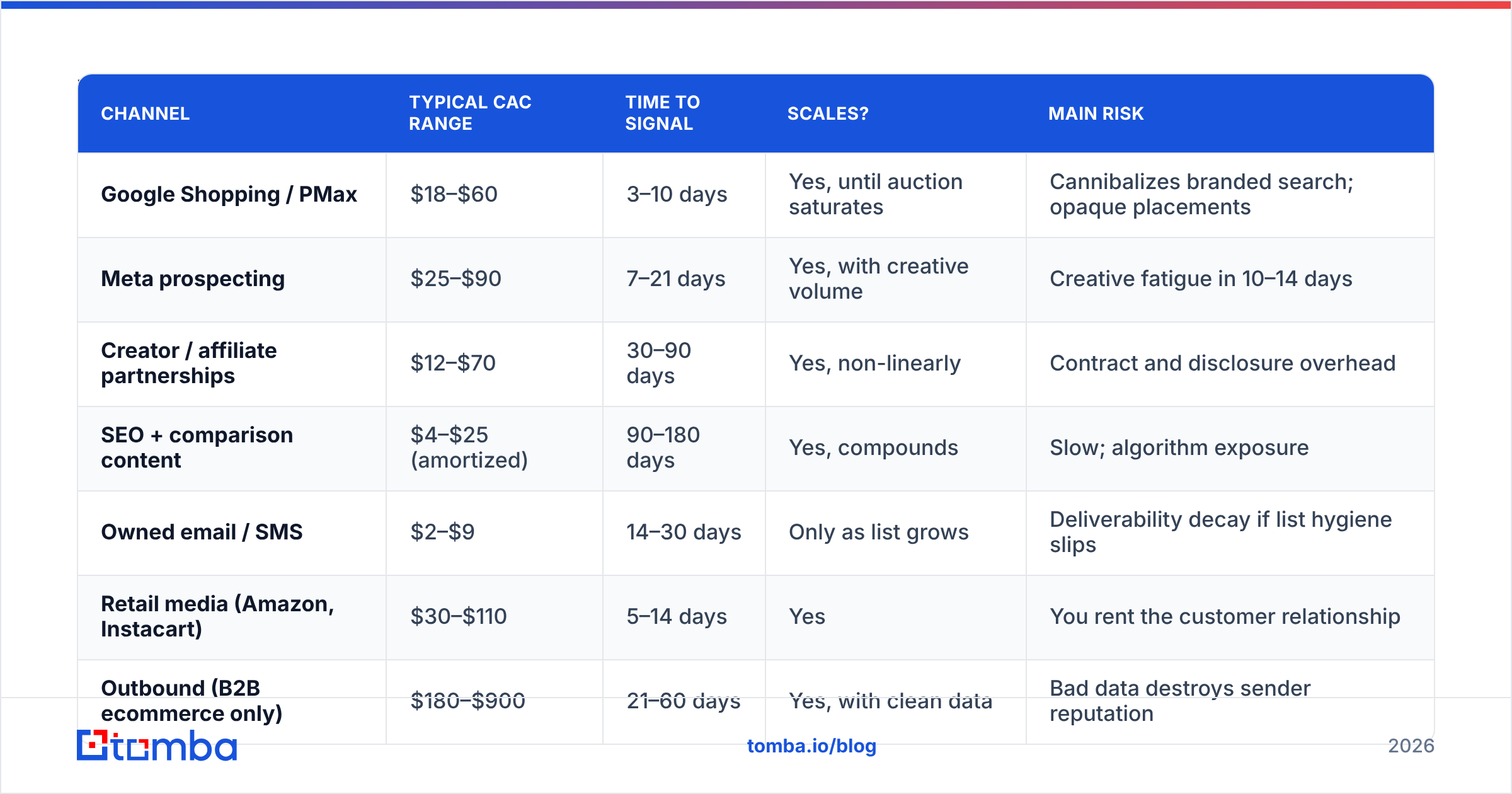
Here is an honest comparison of the main options, with the caveats vendors leave out. Costs are directional ranges for a US-market DTC or B2B ecommerce brand doing $2M–$20M annually.
| Channel | Typical CAC range | Time to signal | Scales? | Main risk |
|---|---|---|---|---|
| Google Shopping / PMax | $18–$60 | 3–10 days | Yes, until auction saturates | Cannibalizes branded search; opaque placements |
| Meta prospecting | $25–$90 | 7–21 days | Yes, with creative volume | Creative fatigue in 10–14 days |
| Creator / affiliate partnerships | $12–$70 | 30–90 days | Yes, non-linearly | Contract and disclosure overhead |
| SEO + comparison content | $4–$25 (amortized) | 90–180 days | Yes, compounds | Slow; algorithm exposure |
| Owned email / SMS | $2–$9 | 14–30 days | Only as list grows | Deliverability decay if list hygiene slips |
| Retail media (Amazon, Instacart) | $30–$110 | 5–14 days | Yes | You rent the customer relationship |
| Outbound (B2B ecommerce only) | $180–$900 | 21–60 days | Yes, with clean data | Bad data destroys sender reputation |
Two things stand out. First, owned channels have CAC an order of magnitude below paid — which is why list growth should be a demand gen KPI, not an email-team KPI. Second, the cheapest scalable channel (SEO) is also the slowest, which is exactly why underfunded teams never get there.
On deliverability: owned email only stays cheap if the list stays clean. Run new signups and any imported list through an email verifier before they hit your sending domain. A 4% hard-bounce rate on a welcome flow is enough to visibly move inbox placement, and recovering sender reputation takes weeks longer than protecting it.
How do you build the engine, step by step?#
Six components, in build order. Skipping any one of them turns the rest into noise.
- Define the category story. One sentence a stranger repeats correctly: what problem you solve, for whom, and why the existing solution is worse. Everything downstream — creator briefs, ad hooks, landing copy — is a compression of this sentence. If five people on your team write five different versions, stop and fix this first.
- Instrument before you spend. Server-side tracking, a consented first-party identifier, and a post-purchase "how did you hear about us" survey. That survey is not scientific, but at a few hundred responses a month it is a better directional check on creation channels than any attribution model you will buy.
- Build the creative factory. A weekly brief, a standing pool of creators or a UGC vendor, and a testing calendar. Target 20–40 new concepts monthly, tested at small budget, with winners graduated to scale. Cut concepts on hook rate (3-second view / impressions), not on final ROAS — you get the signal four days earlier.
- Turn on capture properly. Branded search defense, shopping feed hygiene (titles, GTINs, images), a comparison page per major competitor, and retargeting capped so it stops taking credit for organic buyers. Feed quality alone routinely moves shopping performance more than bid strategy does.
- Convert attention into an owned list. Every creation asset should have a low-friction capture path — quiz, waitlist, early access, back-in-stock. The goal of demand creation is not the immediate sale; it is a permissioned contact you can reach for free next quarter.
- Run a quarterly reallocation review. Not monthly. Monthly reviews punish long-cycle channels for being long-cycle. Each quarter, rank channels by contribution margin per dollar and 90-day payback, then move 10–20% of budget, no more.
What metrics should you actually report?#
Kill channel-level ROAS as the headline number. It is the metric most likely to make a good decision look bad.
Report these instead:
- Blended CAC — total sales and marketing spend divided by new customers. Immune to attribution games.
- New-customer contribution margin — revenue minus COGS, shipping, payment fees, and acquisition cost. If this is negative, you need a repeat-purchase model good enough to justify it, in writing.
- Branded search volume, week over week — the cleanest lagging proxy for demand creation. When creation works, people search your name.
- Direct and organic traffic share — rising share means the brand is doing work the ads used to do.
- Payback period by cohort — the number your CFO should be graded on instead of ROAS.
- List growth rate and engaged-list share — a 200k list with 12% 30-day engagement is worth less than a 60k list at 40%.
Gartner's marketing research has been making the same argument for years: the shift from channel efficiency metrics to portfolio-level profitability metrics is what separates programs that survive a budget cut from ones that don't.
How is demand generation different if you sell to ecommerce brands?#
Completely different, and this is where most B2B teams get it wrong by copying DTC tactics.
If you're a 3PL, a subscription app, a returns platform, a packaging supplier, or an agency, your buyer is not scrolling for a $40 impulse purchase. There are maybe 15,000 accounts in your realistic market, each with a buying committee of three to eight people, and the deal takes 30 to 120 days. Broad-reach creation still matters — it's why your name gets shortlisted — but the capture layer is human, not an ad auction.
That changes the data requirement. You need to know:
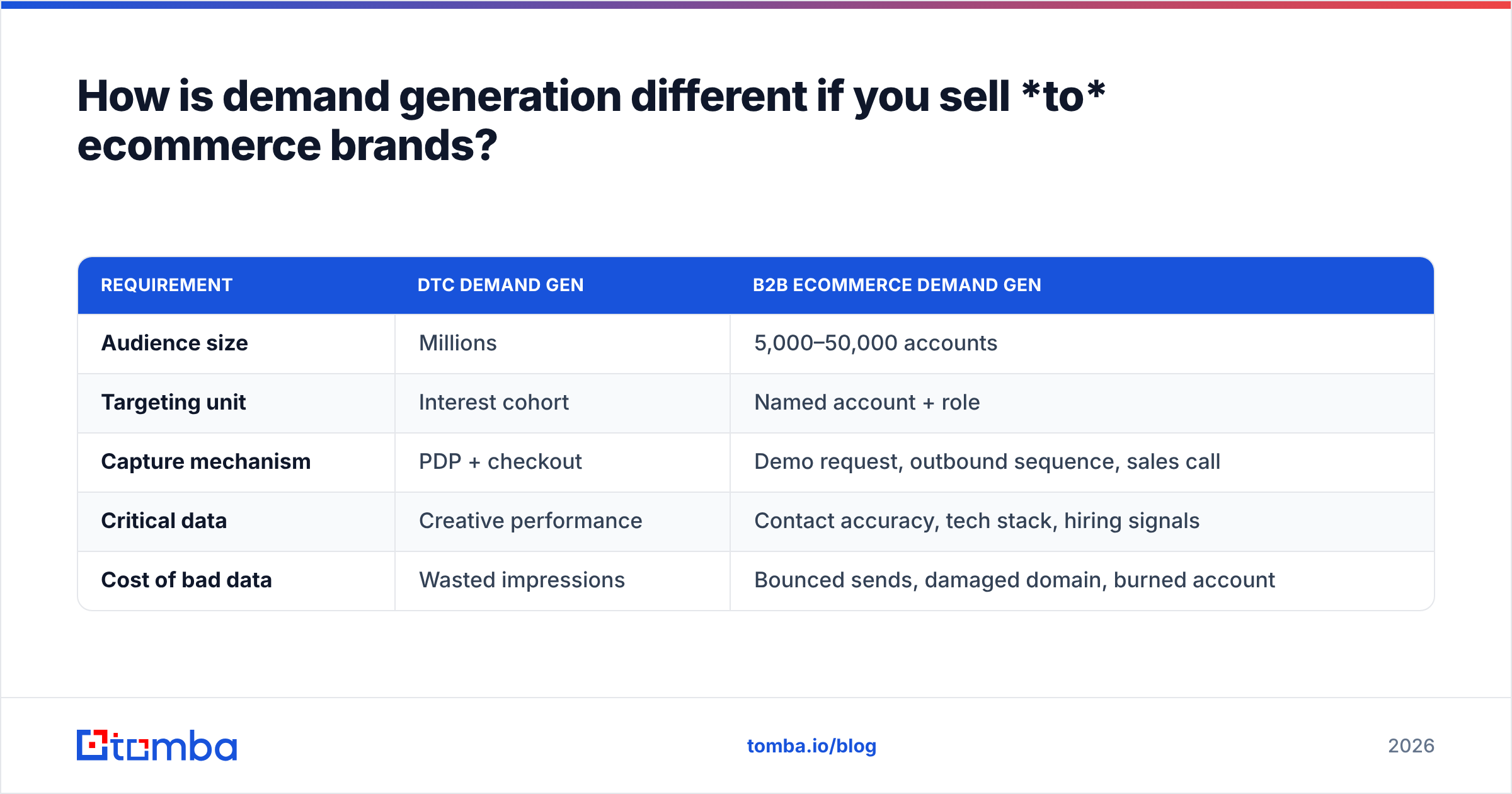
| Requirement | DTC demand gen | B2B ecommerce demand gen |
|---|---|---|
| Audience size | Millions | 5,000–50,000 accounts |
| Targeting unit | Interest cohort | Named account + role |
| Capture mechanism | PDP + checkout | Demo request, outbound sequence, sales call |
| Critical data | Creative performance | Contact accuracy, tech stack, hiring signals |
| Cost of bad data | Wasted impressions | Bounced sends, damaged domain, burned account |
That last row is the one to internalize. In DTC, bad data costs you impressions. In B2B, a 12% bounce rate on an outbound sequence damages the domain you also send marketing email from — so your demand capture failure becomes a demand nurture failure two weeks later.
Practically, a B2B ecommerce demand gen stack needs three data layers:
- Account discovery. Which Shopify Plus or BigCommerce merchants match your ICP, and which just changed platforms, opened a warehouse, or hired a head of retention.
- Contact resolution. Turning "Head of Ecommerce at Brand X" into a verified, reachable address. A domain search across a target account surfaces the full published contact map rather than one guessed pattern, which matters when the actual decision-maker is a director you never had on the list.
- Intent and enrichment. Firmographics, tech stack, and headcount trends layered onto the record so sequencing is relevant. Contact enrichment is what turns a name into a reason to reach out this week rather than next quarter.
There is a fourth layer worth naming: the traffic you already have. Most B2B ecommerce sites convert 1–2% of visitors and lose the rest anonymously. Website visitor reveal closes part of that gap by identifying which companies read your comparison page, which turns a pure creation asset into a capture asset without buying more traffic.
What does a realistic 90-day rollout look like?#
Days 1–30 — instrument and stabilize. Fix tracking. Clean the product feed. Verify and segment the existing email list. Defend branded search. Ship the category story and rewrite the top three landing pages against it. Do not increase spend this month; you're building the measurement floor.
Days 31–60 — build the creative and content engines. Recruit three to eight creators or one UGC vendor. Ship 20+ ad concepts. Publish the first six comparison and problem-aware articles. Launch a capture offer (quiz, waitlist, or early access) on every creation asset. For B2B, build the target account list and enrich it — that build is a week of work if you have good data sources and a month if you don't.
Days 61–90 — scale winners and start the compounding channels. Graduate the top creative concepts to scaled budget. Keep publishing. Start outbound if B2B, at low volume, with verified addresses only. Run the first quarterly reallocation review using blended CAC and cohort payback, not last-click ROAS.
Expect the first 45 days to look worse than doing nothing, because you are paying for channels that haven't returned yet while cleaning up ones that were flattering themselves. That is the trade. Compare vendor claims on G2 if you want to sanity-check any tool in this stack — the reviews are noisy, but the complaint patterns are informative.
What should you cut first?#
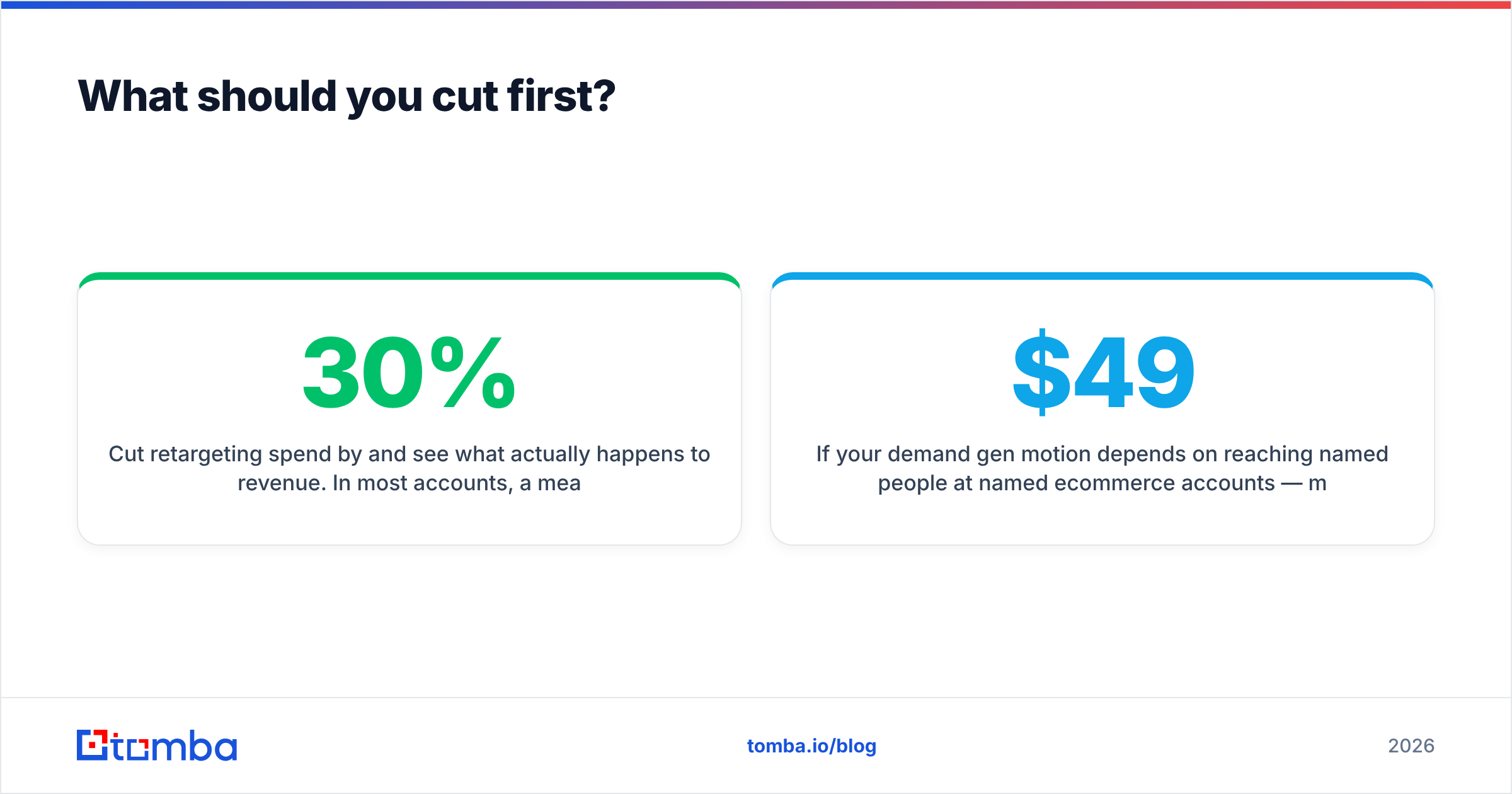
Cut retargeting spend by 30% and see what actually happens to revenue. In most accounts, a meaningful share of retargeting conversions are people who would have bought anyway. It's the single cheapest experiment in the whole playbook, it takes two weeks, and the money it frees is exactly the budget you need for the creation channels you keep saying you can't afford.
Then cut any channel where you cannot state the payback period from memory. If nobody knows, nobody is managing it.
If your demand gen motion depends on reaching named people at named ecommerce accounts — merchandising directors, heads of retention, ops leads at 3PLs — the bottleneck is almost never creative. It's whether the contact record is real. Tomba's Email Finder resolves verified professional addresses by domain, name, or company so your sequences reach the buying committee instead of a catch-all inbox. Start on the free tier at 25 searches a month, or check Tomba pricing — Starter runs $49/mo, Growth $99/mo — and build the target list before you spend the next dollar on ads.
Related guides#
Ready to find emails that actually work?
Join 150,000+ professionals who stopped guessing and started sending. Free credits on signup — no credit card required.
Get the Tomba newsletter
Practical outbound tactics and product updates — once every two weeks.
About the author