Ecommerce Go To Market Strategy: A 2026 Playbook That Works
Most ecommerce launches fail on distribution, not product. Here is the six-stage go-to-market framework, the channel economics behind it, and the metrics that tell you within 90 days whether it is working.
TL;DR
- An ecommerce go-to-market strategy is a distribution plan, not a launch checklist. Product-market fit without a repeatable acquisition motion is a hobby.
- Six stages carry a brand from zero to durable revenue: segment, position, price, pick channels, build the wholesale/partner pipeline, and instrument the metrics.
- Paid social alone is the most expensive GTM you can pick in 2026. Blended CAC payback under 90 days almost always requires two or more channels working together.
- If any part of your plan involves selling to other businesses — wholesale, retail buyers, 3PLs, marketplace category managers, affiliate networks — you need contact data infrastructure, not a spreadsheet of guesses.
- Judge the strategy at day 90 on four numbers: CAC payback, contribution margin after shipping, repeat rate at 60 days, and the percentage of revenue from channels you own.
What is an ecommerce go-to-market strategy?#
An ecommerce go-to-market strategy is the specific, testable plan for how a product reaches a defined buyer, at a defined price, through defined channels, at a cost that leaves margin. That's it. Everything else — the brand deck, the launch calendar, the influencer seeding list — is downstream execution.
The reason this definition matters is that most "GTM strategies" you'll read are actually launch plans. A launch plan answers what happens in week one. A GTM strategy answers why anyone buys the second time, and how you acquire the next 10,000 customers without CAC eating the business.
The distinction shows up in the failure mode. Brands with a launch plan get a spike, a flat line, and a slow bleed. Brands with a GTM strategy get a slope. Shopify's own merchant data has long shown the same pattern across cohorts: early revenue is a poor predictor of survival, while repeat purchase rate and channel diversity are strong ones.
A complete ecommerce GTM strategy has to answer six questions, and they have to be answered in order because each one constrains the next.
What are the six stages of an ecommerce GTM strategy?#
- Segment before you position. Pick one buyer with an urgent, expensive, recurring problem. "Women 25–45 who care about sustainability" is not a segment — it's a census category. "Salon owners who buy color supplies monthly and hate 5-day lead times" is a segment, because it names a purchase trigger.
- Position against the alternative, not the category. Your competitor is rarely the other brand. It's the incumbent behavior — Amazon Prime, the local distributor, doing nothing. Write the positioning as a swap: instead of X, you get Y, which matters because Z.
- Price for the channel you intend to win. A $28 product cannot survive a $42 blended CAC on Meta. A $180 product with a 60% gross margin can. Price is a distribution decision disguised as a finance decision.
- Pick two channels, not seven. One demand-capture channel (search, marketplace, retail shelf) and one demand-creation channel (paid social, creator, outbound). Anything more in the first two quarters means none of them get the budget or the iteration cycles to work.
- Build the B2B pipeline in parallel. Even pure DTC brands sell to businesses: retail buyers, subscription-box curators, corporate gifting managers, affiliate directors. This pipeline is slower to build and far cheaper per dollar of revenue than paid acquisition.
- Instrument before you scale. Contribution margin per order, CAC payback, 60-day repeat rate, and channel concentration. If you can't produce those four numbers weekly, you're not running a strategy — you're running an experiment with no readout.

Why do most ecommerce launches fail on distribution?#
Because paid acquisition is the only channel that feels like progress on day one, and it's the only channel that gets structurally more expensive as you scale.
Here's the arithmetic that kills brands. You launch at a $34 CAC on Meta with a $72 AOV and 55% gross margin. Contribution per order is roughly $39.60 minus $9 shipping and fulfillment, so $30.60 — you're losing $3.40 per first order and betting on repeat. Then auction pressure lifts CAC to $48 by month four because you widened targeting to spend more. Now you lose $17.40 per order and the repeat math has to be twice as good to save you. It rarely is.
The brands that survive this squeeze do one of three things: raise AOV through bundling and subscription, add a channel with structurally lower marginal cost (SEO, email, retail wholesale), or move upmarket into B2B where a single account is worth 40 DTC orders.
That third path is the most underrated, and it's the one that most changes what tooling you need. Selling 200 units to one salon distributor requires finding and reaching one buyer — not winning 200 auctions.
Which GTM motion fits your ecommerce model?#
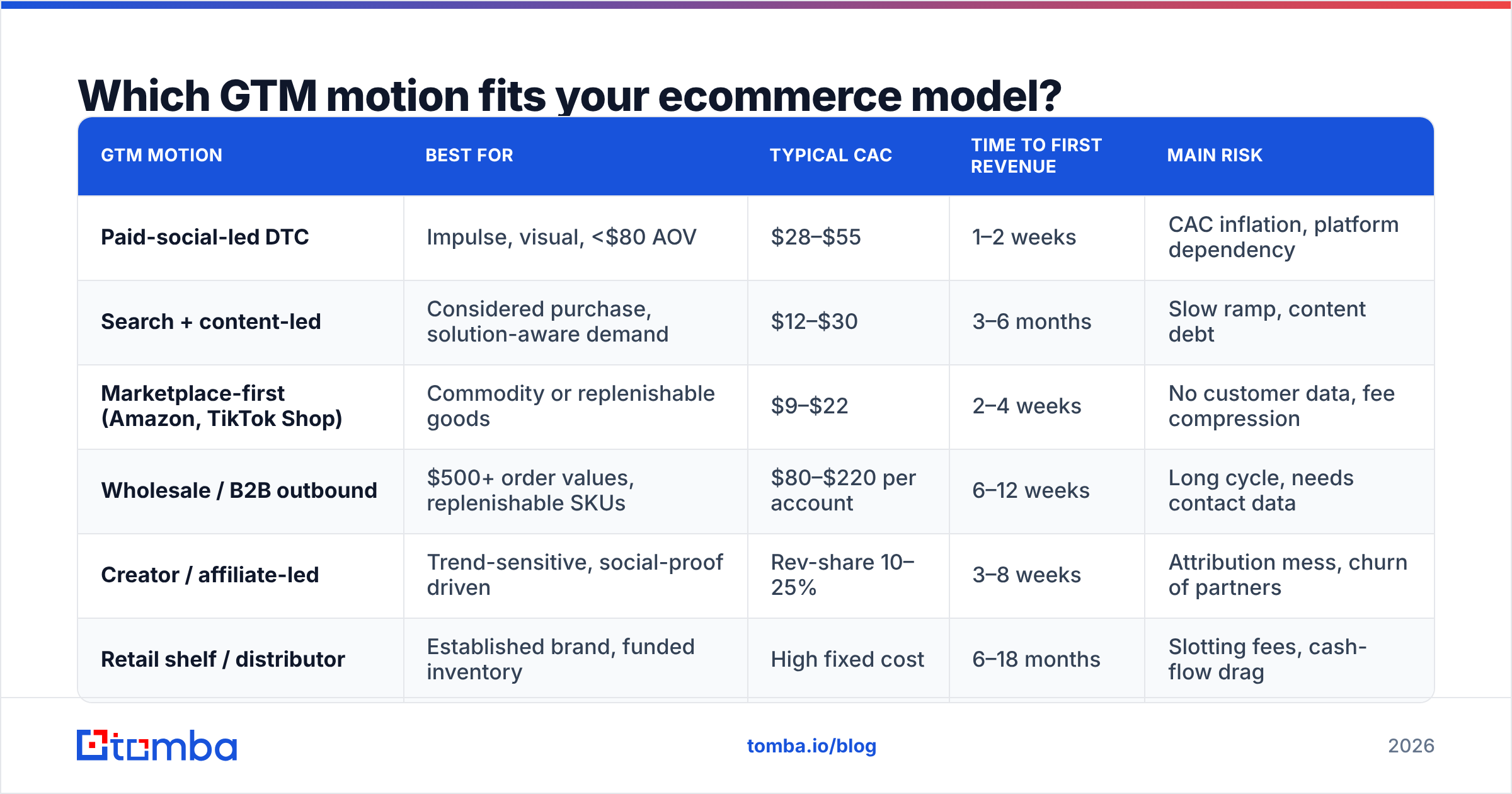
Not every ecommerce business should run the same play. The motion follows the margin structure and the order size.
| GTM motion | Best for | Typical CAC | Time to first revenue | Main risk |
|---|---|---|---|---|
| Paid-social-led DTC | Impulse, visual, <$80 AOV | $28–$55 | 1–2 weeks | CAC inflation, platform dependency |
| Search + content-led | Considered purchase, solution-aware demand | $12–$30 | 3–6 months | Slow ramp, content debt |
| Marketplace-first (Amazon, TikTok Shop) | Commodity or replenishable goods | $9–$22 | 2–4 weeks | No customer data, fee compression |
| Wholesale / B2B outbound | $500+ order values, replenishable SKUs | $80–$220 per account | 6–12 weeks | Long cycle, needs contact data |
| Creator / affiliate-led | Trend-sensitive, social-proof driven | Rev-share 10–25% | 3–8 weeks | Attribution mess, churn of partners |
| Retail shelf / distributor | Established brand, funded inventory | High fixed cost | 6–18 months | Slotting fees, cash-flow drag |
The useful read of this table isn't "pick the cheapest row." It's that CAC and time-to-revenue trade off against each other almost perfectly. Cheap channels are slow; fast channels are expensive. A functioning ecommerce go to market strategy runs one of each simultaneously so the fast channel funds the slow one while the slow one compounds.
How do you size and segment the market before launch?#
Skip the top-down TAM slide. Nobody has ever made a channel decision because of a $47B market number.
Do bottom-up sizing instead, in three passes:
- Count the buyers you can name. For B2B-adjacent ecommerce, this is literal: how many salons, clinics, gyms, indie retailers, or agencies exist in your geography? Use industry association counts, G2 category listings, or public registry data. If the number is under 5,000, outbound is your primary motion. If it's over 500,000, search and paid win.
- Estimate realistic penetration. First-year share of a defined niche is usually 0.5–3% for a new brand with no distribution advantage. Multiply by average annual order value, not one-time AOV.
- Pressure-test with a 50-conversation sample. Talk to 50 buyers before you spend on media. HubSpot's research on buyer behavior has consistently found that purchase triggers cluster around a small number of recurring events — a supplier failing, a price hike, a compliance change. Those triggers become your ad angles and your subject lines.
Segmentation output should be a list, not a persona document. Literally: a spreadsheet of companies or buyer types, ranked by fit, that your team can start contacting. The gap between a persona doc and a contact list is where most GTM plans die.
How do you build the B2B side of the pipeline?#
This is the part of ecommerce GTM that gets hand-waved, so here it is concretely.
Step 1 — build the account list. Start with a defined firmographic filter: industry, employee count, geography, and a technographic signal if it's relevant (running Shopify Plus, using a specific POS, listed on a distributor directory). Purchased list providers like BookYourData are a legitimate fast path for filling in a first-pass account universe, particularly for niche verticals where scraping yields thin coverage.
Step 2 — find the right human. The buyer is a merchandising manager, a purchasing lead, or an owner-operator — not "info@". Run a domain search against each account domain to see who's actually reachable, then use an email finder to resolve the specific first-name/last-name/domain combinations you care about.
Step 3 — verify before you send. Bounce rate is the single fastest way to destroy a new sending domain. Run every address through an email verifier and pull catch-all domains into a separate, lower-volume sequence rather than blasting them. A list at 97%+ deliverability behaves completely differently from one at 88%.
Step 4 — enrich for personalization at scale. Company size, tech stack, and location let you write one sequence with three variables instead of three hundred bespoke emails. Data enrichment turns a flat list into something you can actually segment.
Step 5 — sequence with restraint. Four touches over 12 days, one clear ask, no attachments in touch one. Wholesale buyers respond to margin math and lead times, not brand story.
The cost comparison is stark. Acquiring a $2,400/year wholesale account through outbound typically costs $80–$220 in tooling and rep time. Acquiring $2,400 of DTC revenue at a $42 CAC and $72 AOV costs roughly $1,400 in media. That's not a small difference — it's the difference between a business that funds itself and one that needs another round.

What does the 2026 channel mix actually look like?#
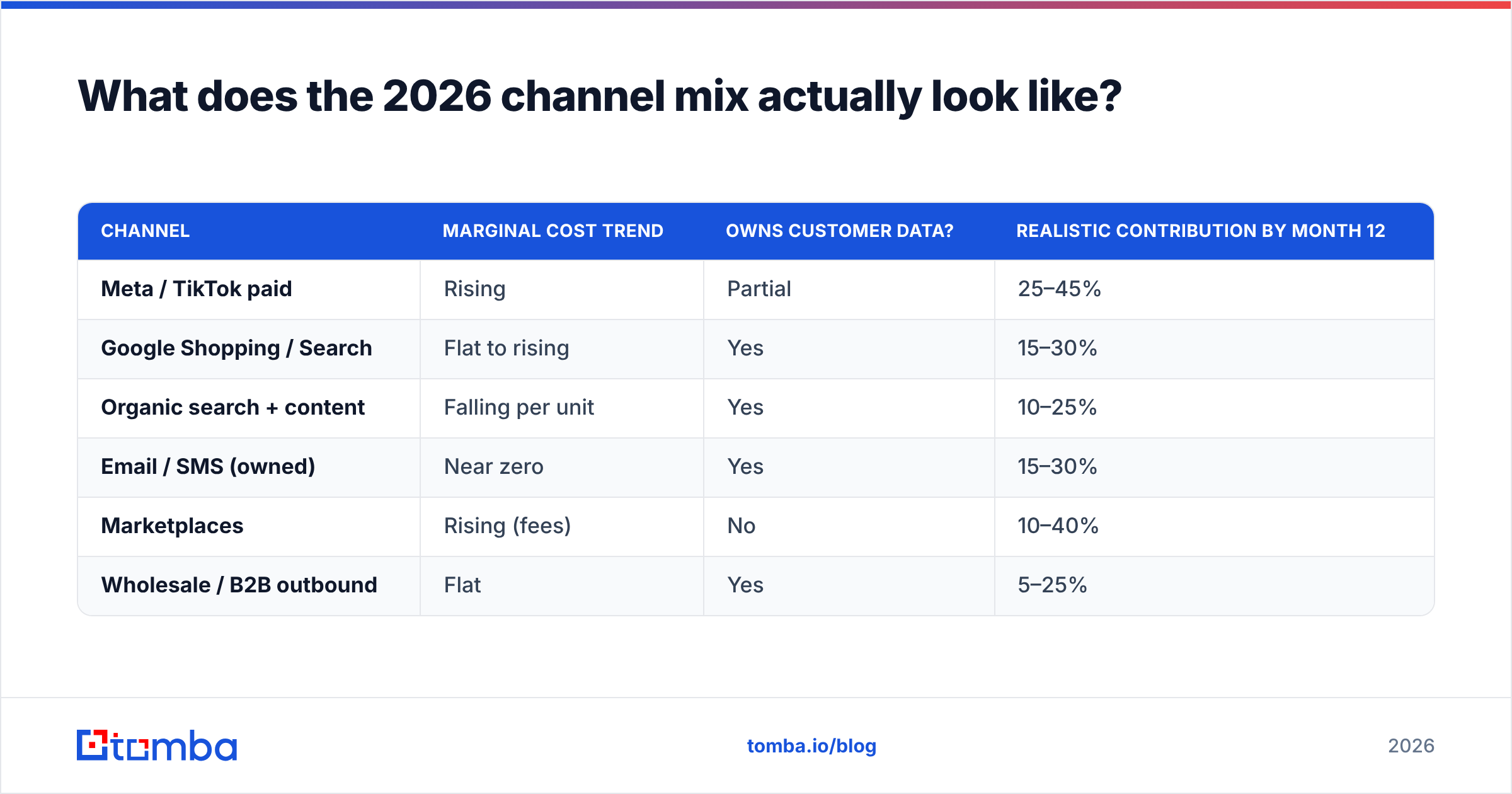
Channel economics have shifted meaningfully. Signal loss from privacy changes made broad prospecting less efficient, marketplace fees crept up, and AI-assisted search compressed the value of thin content while raising the value of genuinely differentiated content.
| Channel | Marginal cost trend | Owns customer data? | Realistic contribution by month 12 |
|---|---|---|---|
| Meta / TikTok paid | Rising | Partial | 25–45% |
| Google Shopping / Search | Flat to rising | Yes | 15–30% |
| Organic search + content | Falling per unit | Yes | 10–25% |
| Email / SMS (owned) | Near zero | Yes | 15–30% |
| Marketplaces | Rising (fees) | No | 10–40% |
| Wholesale / B2B outbound | Flat | Yes | 5–25% |
Two conclusions fall out of this table. First, any channel where you don't own the customer relationship should be capped as a share of revenue — it's rented demand. Second, the two channels with the best long-run unit economics, owned email and B2B outbound, both depend on the same underlying asset: accurate contact data. That's not a coincidence, and it's why data infrastructure belongs in the GTM plan rather than the ops backlog.
For teams already running search and paid, the fastest incremental win is usually the owned-audience layer — a bulk email finder run against a partner or retailer list will typically produce more qualified pipeline in a week than a month of budget reallocation between ad platforms.
What metrics prove the strategy is working?#
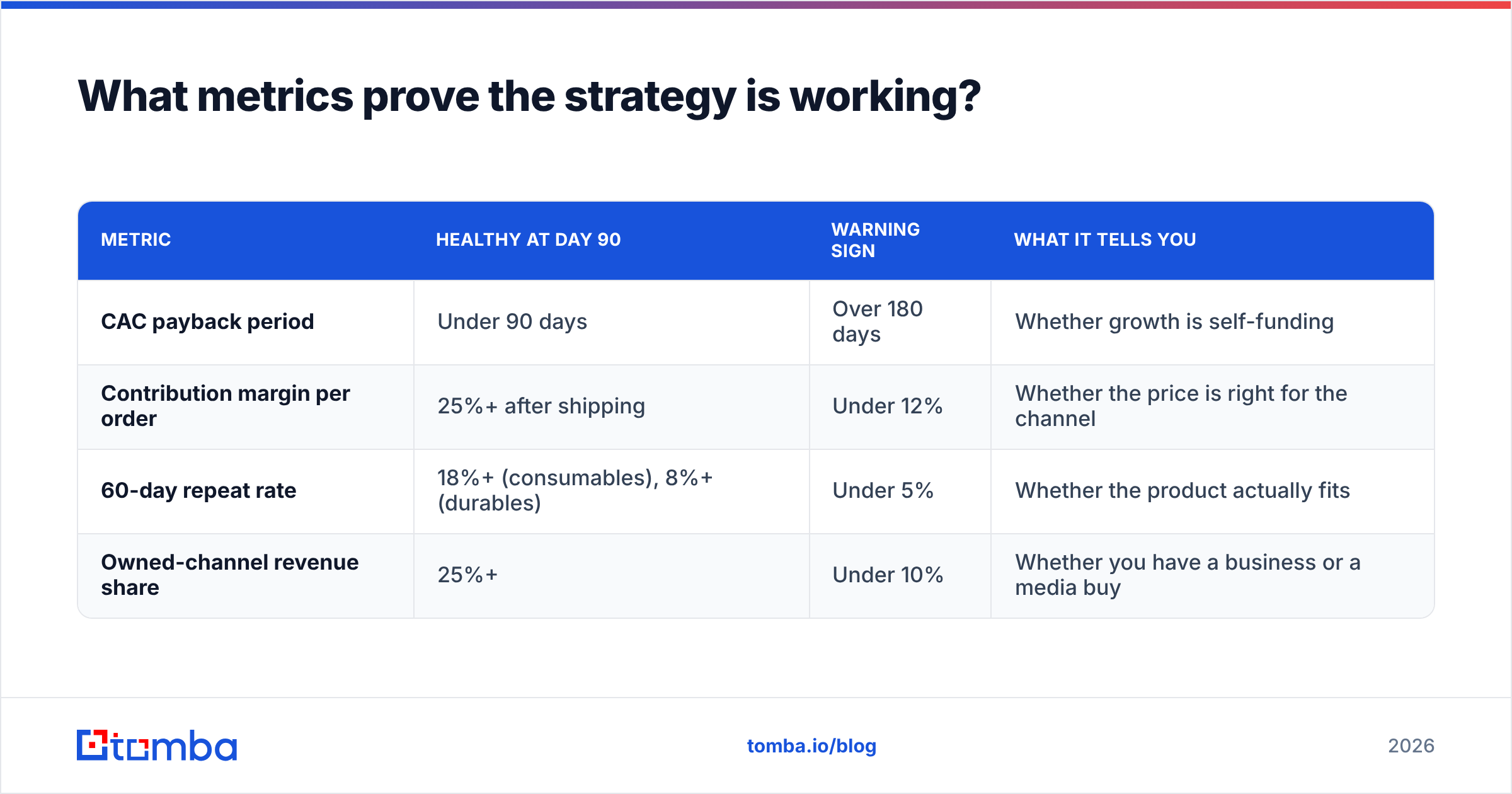
Set the review at day 90 and judge on four numbers. Not revenue — revenue can be bought.
| Metric | Healthy at day 90 | Warning sign | What it tells you |
|---|---|---|---|
| CAC payback period | Under 90 days | Over 180 days | Whether growth is self-funding |
| Contribution margin per order | 25%+ after shipping | Under 12% | Whether the price is right for the channel |
| 60-day repeat rate | 18%+ (consumables), 8%+ (durables) | Under 5% | Whether the product actually fits |
| Owned-channel revenue share | 25%+ | Under 10% | Whether you have a business or a media buy |
If three of four are healthy, scale the winning channel and leave everything else alone. If two or more are failing, the problem is upstream — segment, positioning, or price — and spending more will make it worse faster.
One practical note on measurement: pick a single attribution model at the start and don't change it mid-quarter. Platform-reported ROAS and post-purchase survey attribution will disagree, sometimes by 2x. The absolute number matters less than the consistency of the trend line.
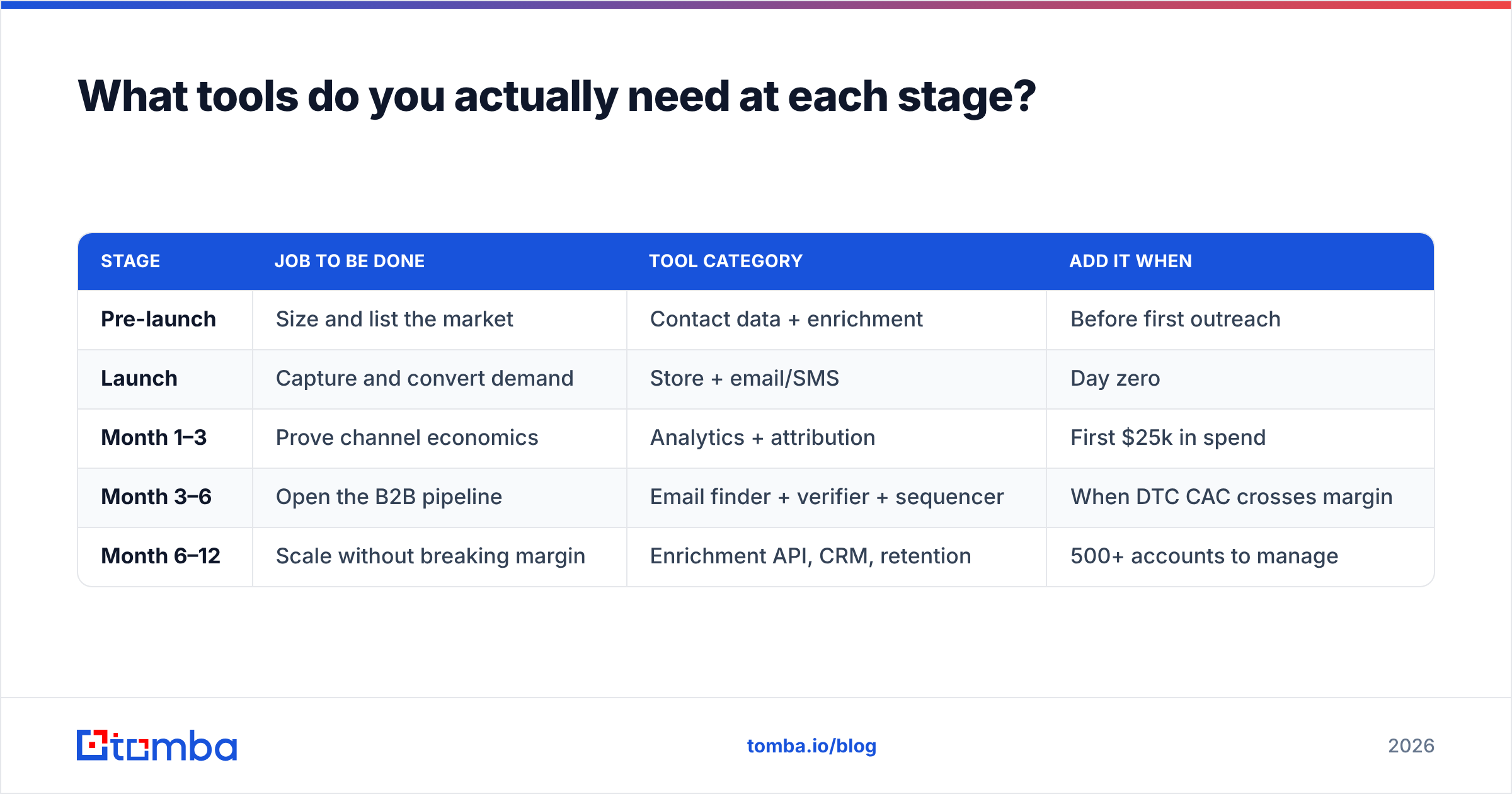
What tools do you actually need at each stage?#
You need far less than the average martech diagram suggests. At launch: a store platform, an email/SMS platform, an analytics layer, and a contact-data source. Everything else can wait until a specific bottleneck justifies it.
| Stage | Job to be done | Tool category | Add it when |
|---|---|---|---|
| Pre-launch | Size and list the market | Contact data + enrichment | Before first outreach |
| Launch | Capture and convert demand | Store + email/SMS | Day zero |
| Month 1–3 | Prove channel economics | Analytics + attribution | First $25k in spend |
| Month 3–6 | Open the B2B pipeline | Email finder + verifier + sequencer | When DTC CAC crosses margin |
| Month 6–12 | Scale without breaking margin | Enrichment API, CRM, retention | 500+ accounts to manage |
If you're wiring this into an existing stack rather than clicking around a dashboard, the Tomba API handles finding and verifying at volume, and current Tomba pricing runs from a free tier at 25 searches per month through Starter at $49/mo, Growth at $99/mo, and Pro at $249/mo — which for most early-stage ecommerce teams is less than two days of ad spend.
Where do most teams get this wrong?#
Three recurring mistakes, in order of how expensive they are:
- Treating GTM as a launch event. The strategy is a standing system for acquiring the next cohort. It gets revised quarterly, not filed.
- Confusing channel diversity with channel dilution. Two channels executed well beats six channels executed at 20% attention. Add a third only when the first two have plateaued at known economics.
- Deferring the data layer. Teams build the ad account, the content calendar, and the influencer list, then discover at month five that they have no way to reach the 400 retailers who would each buy more than 40 consumers combined. Building that list takes days. Wishing you'd built it costs quarters.
Ready to build the pipeline half of your GTM?#
The demand-creation side of an ecommerce go to market strategy is well documented and heavily competed. The pipeline side — knowing exactly which buyers, retailers, and partners to reach and having verified addresses for them — is where the durable advantage sits, because it's the one asset the ad platforms can't reprice out from under you.
Start by building one clean list of 200 target accounts and finding the decision-maker at each. The Tomba Email Finder will resolve names and domains into verified, deliverable addresses, and the free tier is enough to validate whether your segment responds before you commit budget. If the reply rate holds, you've found the channel that will still be working when CAC on paid social is 40% higher than it is today.
Related guides#
Ready to find emails that actually work?
Join 150,000+ professionals who stopped guessing and started sending. Free credits on signup — no credit card required.
Get the Tomba newsletter
Practical outbound tactics and product updates — once every two weeks.
About the author