Economic Buyer in B2B Sales: How to Find and Win Them
Most stalled deals die because nobody ever met the person who controls the budget. Here is how to identify the economic buyer, earn access, and build a business case they will actually sign.
TL;DR
- The economic buyer is the single person who can release funds and say yes when everyone else can only say no. In most B2B deals that is one name, not a committee.
- Champions, users, and technical evaluators are essential, but none of them controls budget. Confusing enthusiasm with authority is the most common reason forecasted deals slip.
- You can usually identify the economic buyer with three signals: who owns the budget line, who owns the metric your product moves, and who signed the last comparable contract.
- Deals with direct economic-buyer access close meaningfully faster and discount less, because pricing conversations happen with the person who sets the number.
- Build the target list before the first call — org mapping, verified contact data, and a business case tied to their metric, not your feature list.
What is an economic buyer?#
The economic buyer is the person with the authority to approve spend and sign the contract. They control the budget line your deal will be paid from, and they can override objections from every other stakeholder.
Think of a house renovation. The contractor talks to whoever is home, the designer talks to whoever cares about tile, but only one person's bank account funds the job. You can spend six weeks delighting everybody in the kitchen and still lose when the account holder says the number is too high. The economic buyer is the account holder.
In enterprise sales frameworks like MEDDIC, the "E" stands for exactly this: identify the economic buyer or accept that your forecast is fiction. The role is not defined by title. A VP of Marketing at a 60-person startup may hold a $400k discretionary budget while a VP at a 6,000-person enterprise cannot approve $15k without finance sign-off.
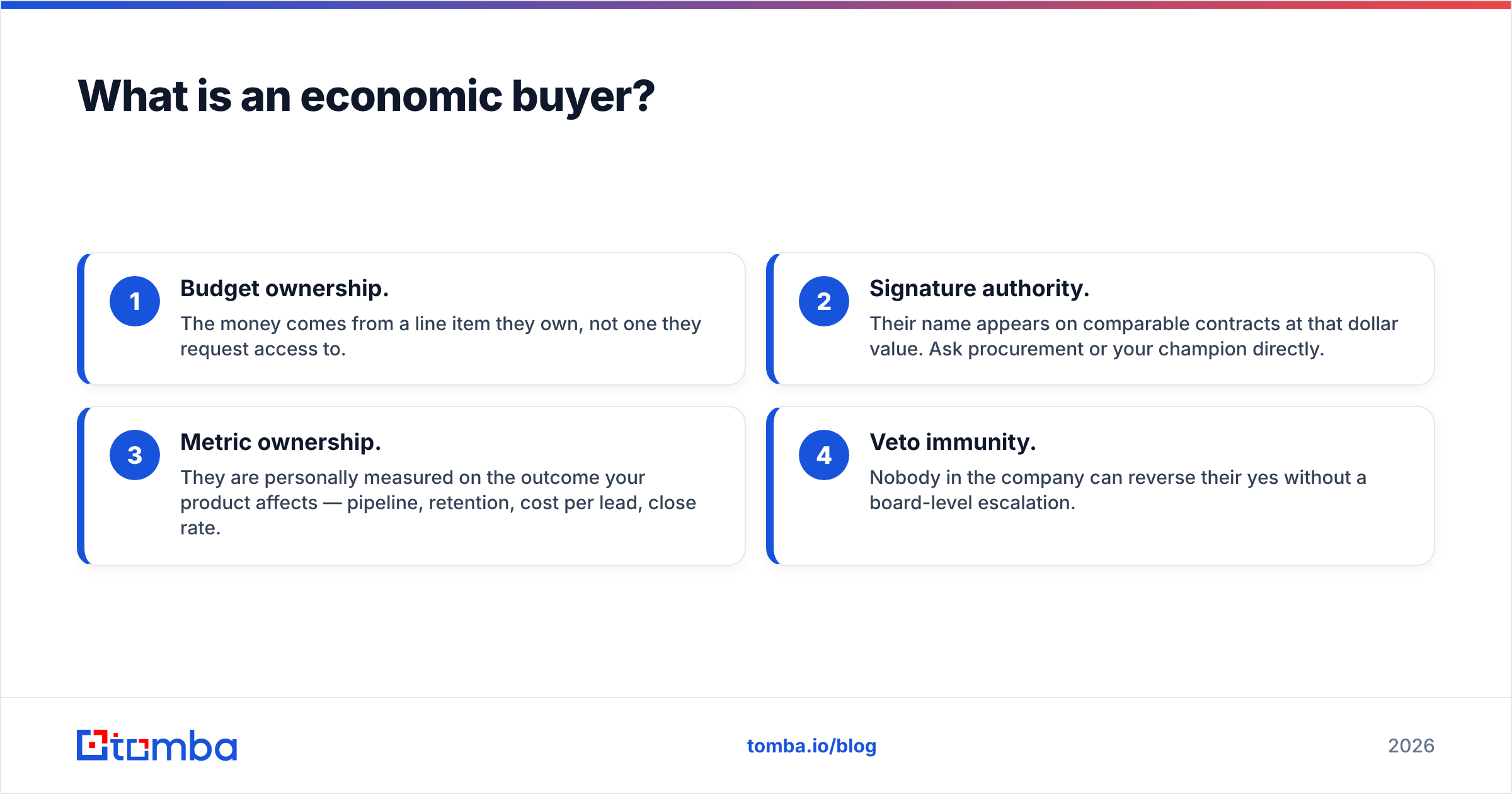
Three practical tests separate the economic buyer from everybody else:
- Budget ownership. The money comes from a line item they own, not one they request access to.
- Signature authority. Their name appears on comparable contracts at that dollar value. Ask procurement or your champion directly.
- Metric ownership. They are personally measured on the outcome your product affects — pipeline, retention, cost per lead, close rate.
- Veto immunity. Nobody in the company can reverse their yes without a board-level escalation.
If a contact fails two or more of those tests, you are talking to an influencer. That is fine — influencers open doors — but do not put a close date on the calendar yet.
Who else is in the buying group?#
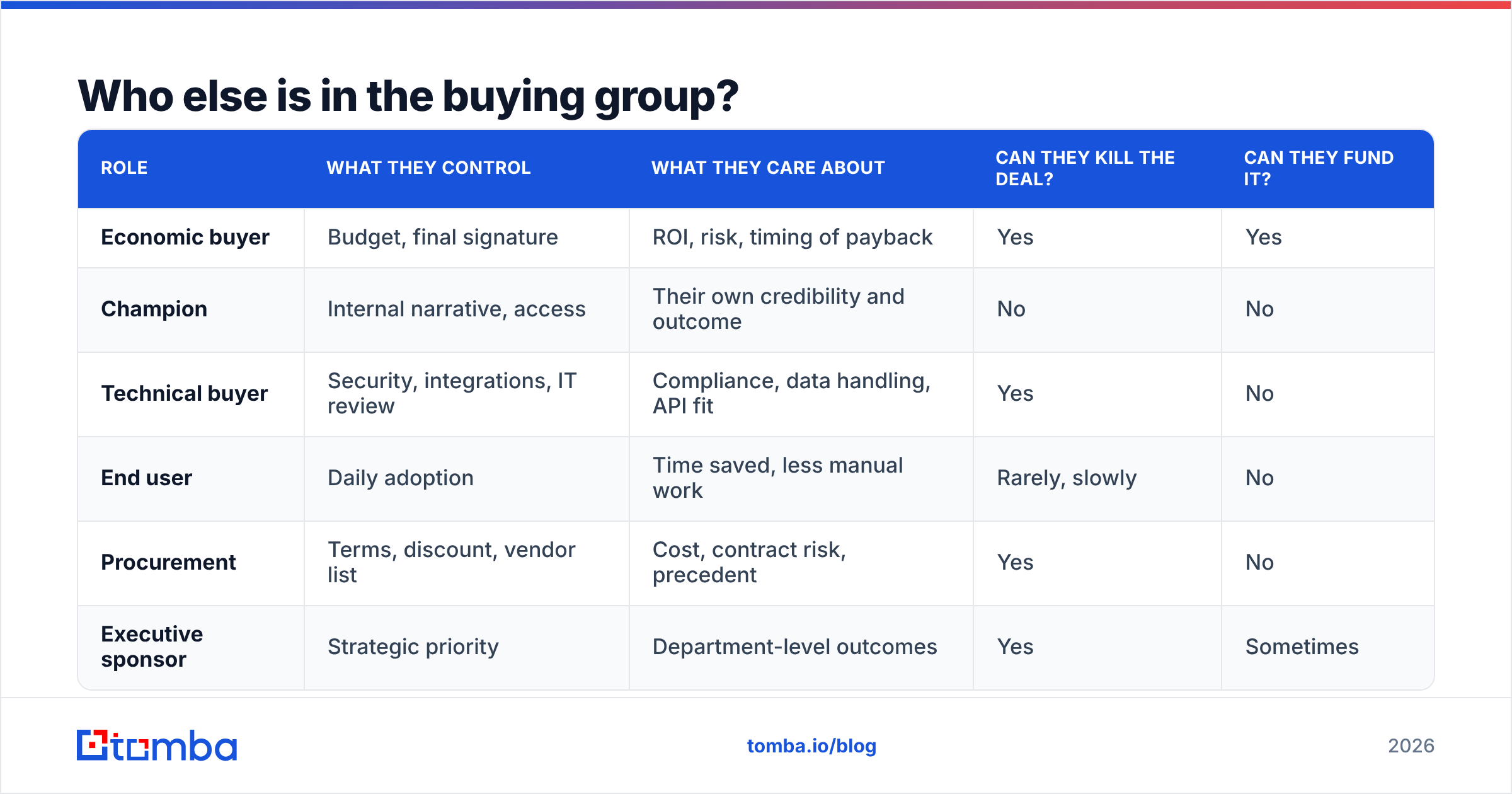
Gartner's research on B2B buying has consistently found that a typical complex purchase involves six to ten decision makers, each arriving with independently sourced information. Your job is not to sell to all of them equally. It is to know which role each person plays and what each one needs before they will stay out of the way.
| Role | What they control | What they care about | Can they kill the deal? | Can they fund it? |
|---|---|---|---|---|
| Economic buyer | Budget, final signature | ROI, risk, timing of payback | Yes | Yes |
| Champion | Internal narrative, access | Their own credibility and outcome | No | No |
| Technical buyer | Security, integrations, IT review | Compliance, data handling, API fit | Yes | No |
| End user | Daily adoption | Time saved, less manual work | Rarely, slowly | No |
| Procurement | Terms, discount, vendor list | Cost, contract risk, precedent | Yes | No |
| Executive sponsor | Strategic priority | Department-level outcomes | Yes | Sometimes |
The trap is that champions and end users are the easiest people to reach and the most fun to talk to. They reply to your emails. They love the demo. They tell you the budget is "basically approved." Then the deal reaches the person who actually signs and you discover the requirement was never on the roadmap.
Why do deals stall without economic-buyer access?#
Because everything you have built collapses into a single 20-minute conversation you are not in the room for.
When your champion carries the business case upstairs alone, four things go wrong:
- The framing changes. Your champion pitches features. The economic buyer thinks in payback periods and headcount equivalents. The translation is usually lost.
- The comparison shifts. Internally, you are no longer compared to a competitor. You are compared to the other three things that department could do with the same money.
- Objections go unanswered. You cannot handle an objection you never hear. The economic buyer asks "what happens if adoption is low?" and your champion improvises.
- Urgency evaporates. Nobody escalates a decision on your behalf. "Next quarter" is the safest answer any executive can give.
There is a diagnostic worth running on your own pipeline this week. Pull every deal that slipped two or more quarters. Count how many had a logged meeting with a confirmed economic buyer. In most teams the answer is under a third, and it explains the forecast accuracy problem better than any methodology change will.
How do you identify the economic buyer before the first call?#
Do the org mapping before outreach, not after discovery. The research is unglamorous, but it is the highest-leverage 15 minutes in the whole cycle.
Start with the metric, not the title. Ask: which number does our product move, and who is publicly accountable for that number? If you sell a pipeline tool, follow the pipeline metric. If you sell a support tool, follow CSAT or cost per ticket. The owner of the metric is almost always the economic buyer or one step from them.
Read the earnings call or the careers page. Public companies name their priorities every quarter. Private companies leak theirs through job postings. A company hiring four SDRs and a RevOps manager has budget attached to outbound, and someone owns that budget.
Look at reporting lines on LinkedIn. Who does the champion report to? Who does that person report to? Two levels up from your champion is usually where signature authority begins for mid-market deals. A LinkedIn finder turns a profile you found into a reachable contact instead of a name you can only message through a connection request that may never be accepted.
Verify the contact before you spend a personalized email on it. Executive email addresses churn fast — reorganizations, title changes, acquisitions. Running the address through an email verifier first means your carefully researched executive email does not bounce and take your sender reputation with it.
Enrich the whole buying group at once. Once you know the champion, pull the two people above them and the likely technical reviewer in the same pass. Contact enrichment at the account level costs a fraction of what a lost quarter costs, and it means multithreading is a decision you already made rather than a scramble in week six.
A practical account map for a mid-market deal looks like this: one economic buyer, one champion, one technical reviewer, two end users. Five names, verified, before the first outbound touch. That is the input. Everything downstream gets easier.
How do you get access without burning your champion?#
Going over your champion's head unannounced is the fastest way to lose both the champion and the deal. Going around them is different from going with them.
The move that works is to make executive access a natural next step in the process rather than a favor you are asking for. Three approaches, in order of how often they work:
- Trade value for access. "I can put together a business case with your numbers in it. To get the assumptions right I need 20 minutes with whoever owns the budget — otherwise we are both guessing." You are offering to do work, not asking for a meeting.
- Use a mutual action plan. Lay out the steps from evaluation to signature, including "executive alignment call" as a dated milestone. When it is on a shared timeline from week one, it stops being a request and becomes a checkbox. HubSpot's sales resources cover mutual action plan templates in depth if you need a starting structure.
- Ask the qualifying question early and plainly. "When we get to a decision, what does the approval process look like — who else signs off?" Asked in the first call, this is routine. Asked in week eight, it sounds like you have been wasting everyone's time.
If your champion resists all three, treat that as data. Either they lack the influence they claimed, or the priority is lower than they let on. Both are worth knowing in week two rather than at quarter end.
What does the economic buyer actually want to hear?#
Not your product. Their problem, in their units, with a number attached.
Executives buying software are underwriting a bet. The pitch that lands answers four questions in under ten minutes:
- What is this costing us today? Quantified. "Your team of eight SDRs each lose roughly six hours a week to manual list building" beats "manual research is inefficient."
- What changes if we fix it? Tied to a metric they already report on, not a metric you invented.
- When does it pay back? A specific month, with the assumptions visible so they can argue with them.
- What is the risk if it fails? Contract length, rollout plan, what happens to the data if they churn. Executives buy from people who name the downside first.
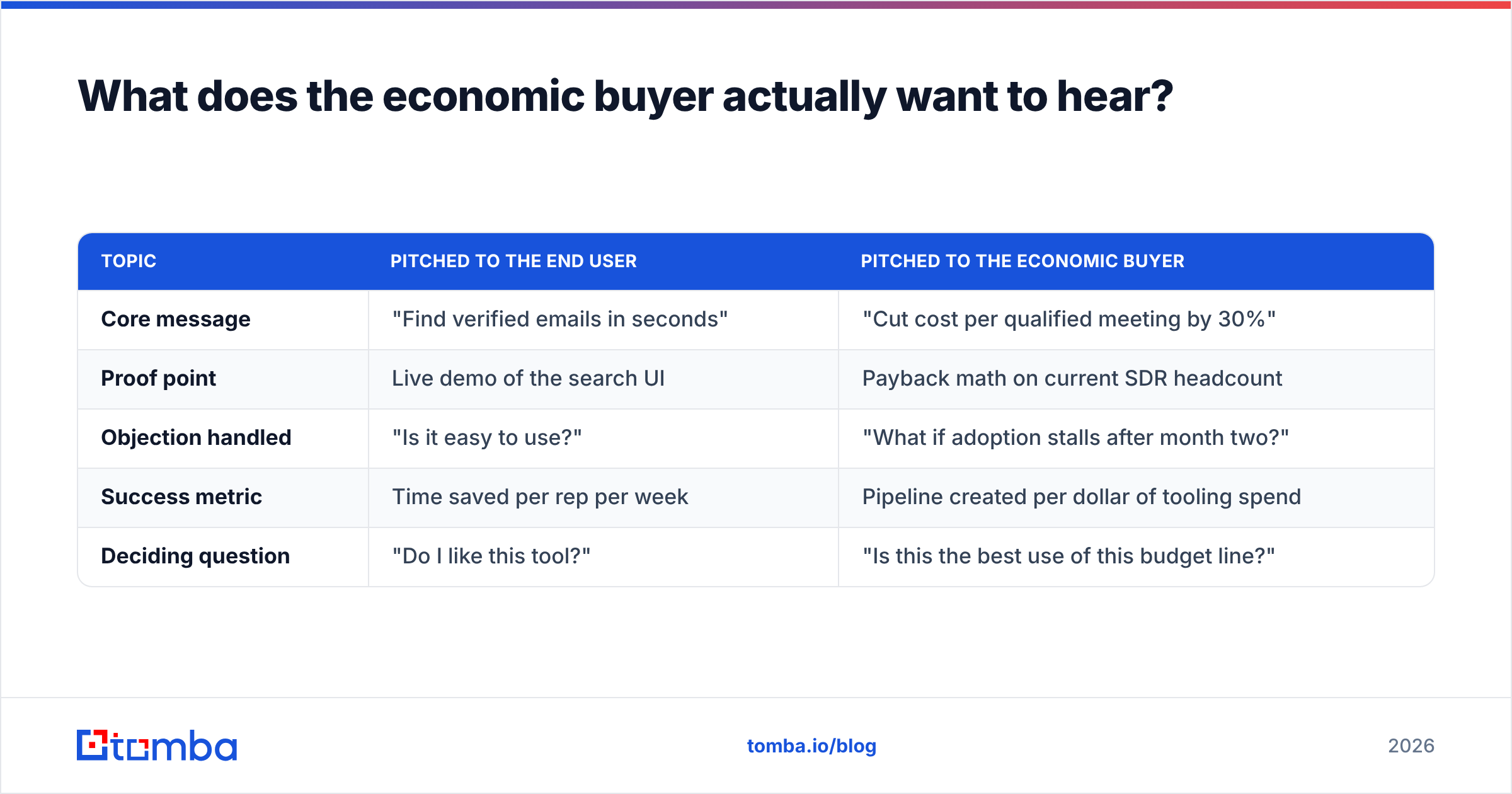
Here is what the same deal sounds like at two altitudes:
| Topic | Pitched to the end user | Pitched to the economic buyer |
|---|---|---|
| Core message | "Find verified emails in seconds" | "Cut cost per qualified meeting by 30%" |
| Proof point | Live demo of the search UI | Payback math on current SDR headcount |
| Objection handled | "Is it easy to use?" | "What if adoption stalls after month two?" |
| Success metric | Time saved per rep per week | Pipeline created per dollar of tooling spend |
| Deciding question | "Do I like this tool?" | "Is this the best use of this budget line?" |
Notice that nothing in the right column is a feature. Features are how the technical buyer and end user evaluate you. The economic buyer evaluates whether the outcome is worth the line item, and they are comparing you against every other thing that money could do.
One more discipline: bring bad news yourself. If your product will not solve one of their three stated problems, say so on the call. Executives hear polished pitches all day. The rep who says "we will not help with X, you would still need to solve that separately" earns disproportionate trust, and trust is what shortens legal review.
How do you track economic-buyer engagement in your pipeline?#
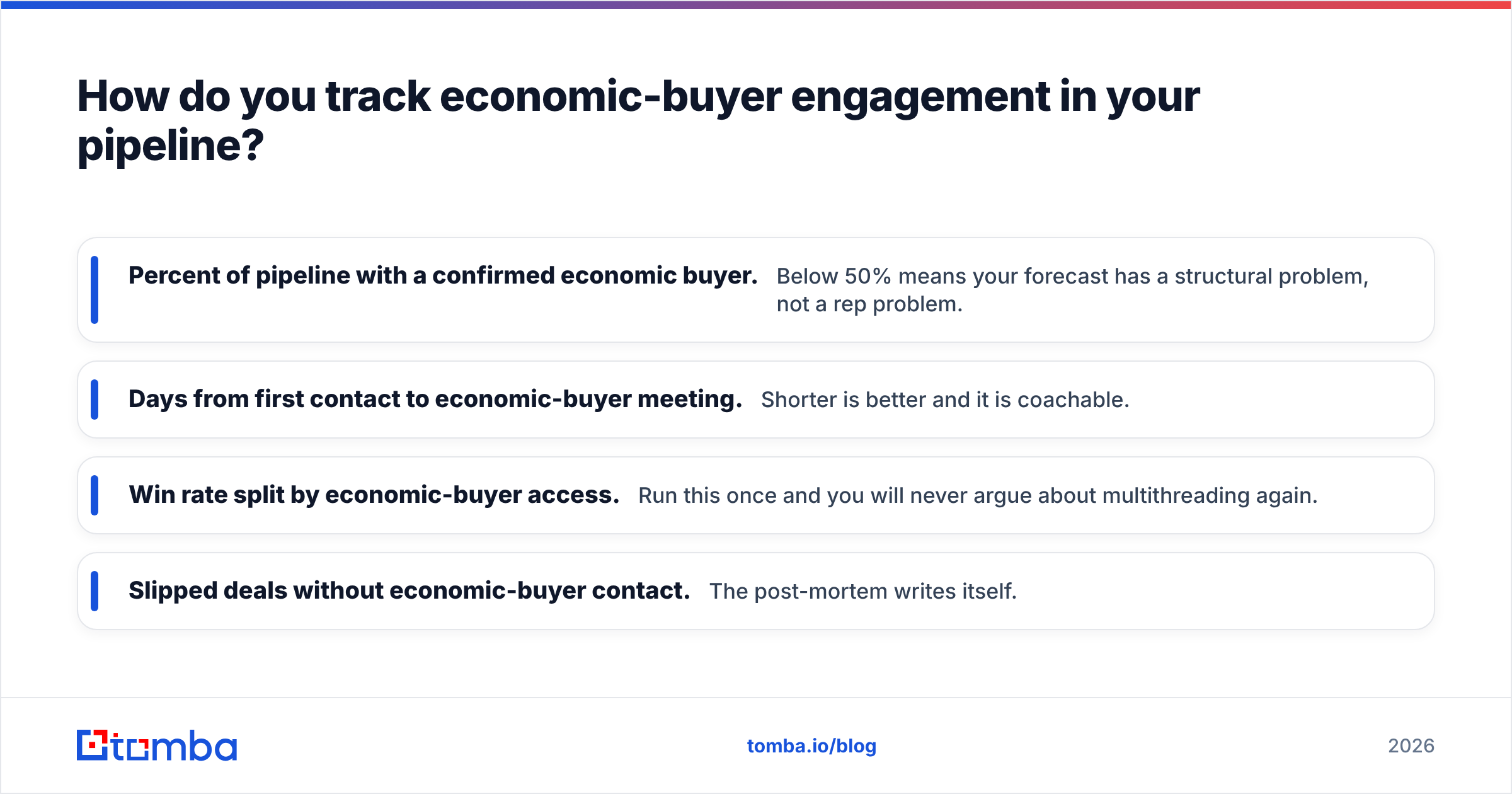
Make it a field, not a vibe. Add a required stage gate in your CRM: a deal cannot advance past evaluation without a named economic buyer and a logged interaction with them. Not an email that got a one-line reply — an actual meeting or a substantive written exchange.
Then report on it weekly:
- Percent of pipeline with a confirmed economic buyer. Below 50% means your forecast has a structural problem, not a rep problem.
- Days from first contact to economic-buyer meeting. Shorter is better and it is coachable.
- Win rate split by economic-buyer access. Run this once and you will never argue about multithreading again.
- Slipped deals without economic-buyer contact. The post-mortem writes itself.
Two caveats worth holding. First, seniority is not authority — a C-level title on a deal does not count if that person delegated the decision. Log the person who signs, not the most impressive name you spoke to. Second, the economic buyer can change mid-cycle. Reorganizations, budget freezes, and new hires reset the map. Re-verify quarterly on long cycles; a stale org map is worse than no org map because it feels like certainty.
Where should you start?#
Pick your ten largest open deals. For each one, write down the name of the person who will sign. If you cannot write a name, you do not have a deal — you have a conversation. Then spend a morning mapping those ten accounts properly: the signer, the champion, the technical reviewer, and verified contact details for each.
That research step is where most teams lose the thread, because manual org mapping across ten accounts eats a full day. Tomba's Email Finder takes a name and a company domain and returns a verified professional address with a confidence score, so you can build the full buying-group map in an afternoon instead of a week. The free tier covers 25 searches a month if you want to test it against accounts you already know, and paid plans start at $49/mo — see Tomba pricing for the full breakdown. Map the signer first, and the rest of the deal gets a lot less mysterious.
Related guides#
Ready to find emails that actually work?
Join 150,000+ professionals who stopped guessing and started sending. Free credits on signup — no credit card required.
Get the Tomba newsletter
Practical outbound tactics and product updates — once every two weeks.
About the author