Ecosystem Led Growth in 2026: The No-Fluff Playbook
Ecosystem-led growth turns partner account overlap into warm pipeline. Here's how ELG compares to PLG, ABM and outbound, what it actually costs to run, and the metrics that prove it works.
TL;DR
- Ecosystem-led growth (ELG) uses overlapping customer and prospect data between you and your technology or channel partners to find warmer accounts, shorten cycles, and reduce churn.
- It is not a replacement for outbound or product-led growth. It is a targeting layer that makes both of them cheaper.
- The typical ELG stack is three parts: an account-mapping tool, a CRM of record, and a contact data layer that turns a matched account into a reachable human.
- Reported wins are real but narrow: partner-sourced and partner-influenced deals usually close faster and at higher win rates, but they cap out at a fraction of total pipeline for most companies.
- ELG fails when nobody owns it. If partnerships reports to marketing as a "brand" function with no pipeline target, the data sits in a dashboard and nothing happens.
What is ecosystem-led growth?#
Ecosystem-led growth is a go-to-market motion where your partners' customer data tells you which accounts to work, when to work them, and who to talk to.
Think of it like asking a friend before a blind date. You could cold-message a stranger and hope. Or you could ask three mutual friends what they think first. Same person, wildly different odds. ELG is the second approach applied to B2B accounts: before you spend a sequence on Acme Corp, you check whether two of your integration partners already sell to Acme, whether Acme just churned off a competitor, and who at Acme owns the budget.
Technically, ELG rests on account mapping — a privacy-safe data exchange where you and a partner each upload account lists and only see the overlap. Neither side exposes its full customer base. The output is a set of segments:
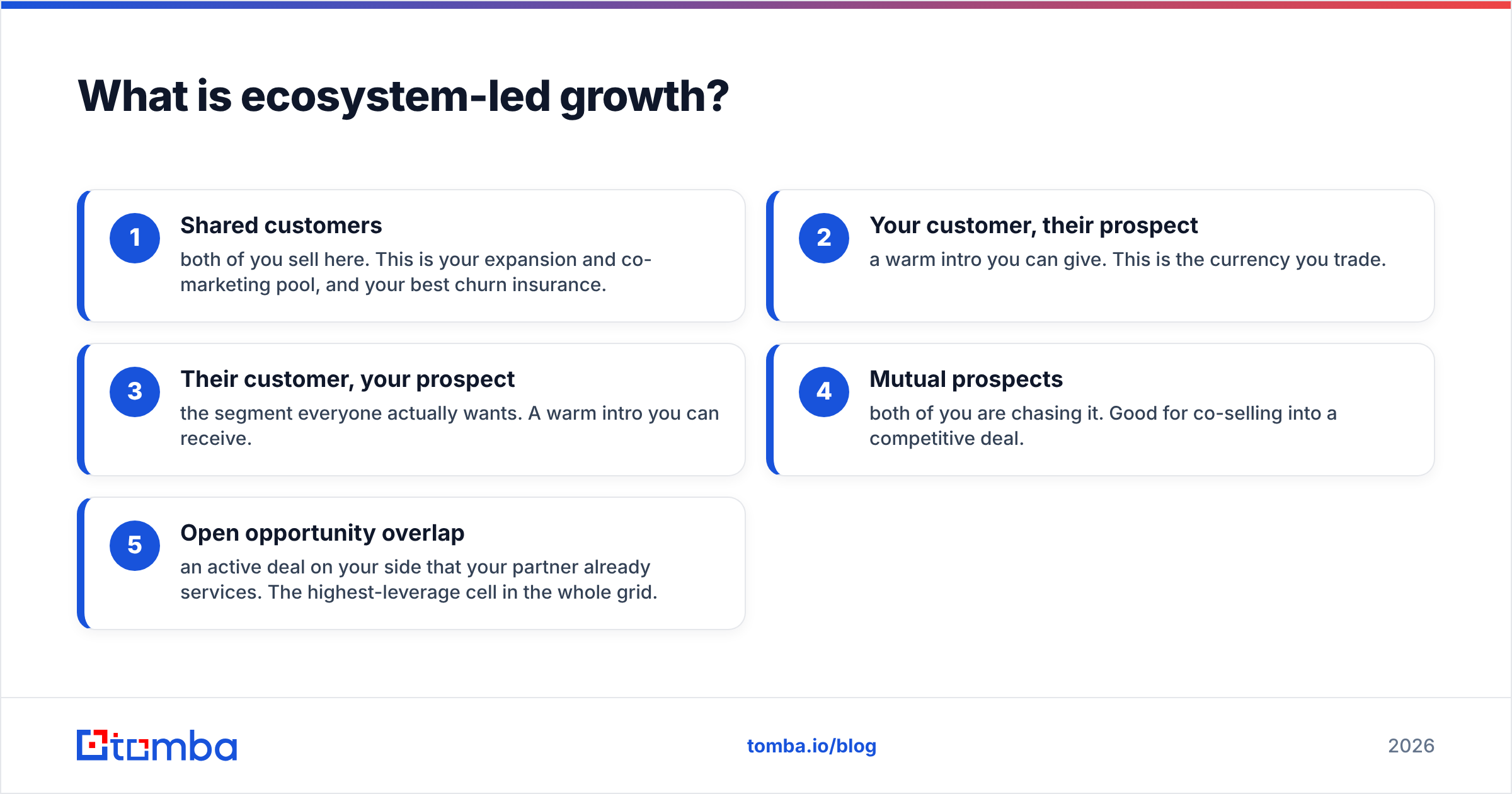
- Shared customers — both of you sell here. This is your expansion and co-marketing pool, and your best churn insurance.
- Your customer, their prospect — a warm intro you can give. This is the currency you trade.
- Their customer, your prospect — the segment everyone actually wants. A warm intro you can receive.
- Mutual prospects — both of you are chasing it. Good for co-selling into a competitive deal.
- Open opportunity overlap — an active deal on your side that your partner already services. The highest-leverage cell in the whole grid.
That five-cell grid is the entire concept. Everything else — the tooling, the metrics, the org charts — is plumbing around it.
The term got popular because Crossbeam and similar networks made account mapping cheap enough that mid-market companies could run it without a data engineering team. Before that, partner overlap analysis meant two RevOps leads emailing spreadsheets and a legal review.
Why is ecosystem-led growth showing up in 2026 budgets?#
Because the cheap channels got expensive.
Three things happened at once. Cold email deliverability got significantly harder after the bulk-sender enforcement waves — Google and Yahoo's requirements pushed complaint-rate thresholds and authentication from "nice to have" to "you don't send at all." Paid acquisition costs kept climbing while conversion held flat. And buying committees expanded; Gartner has documented that typical B2B purchases now involve large groups of stakeholders, which mechanically slows everything down.
Meanwhile the average company runs a stack of dozens of SaaS tools. Every one of those vendors is a potential data partner who already knows something about your prospects that you don't.
So ELG is less a new idea than an arbitrage: the channels everyone shares are crowded, and partner data is a signal your competitors mostly aren't using yet. That arbitrage will close. Right now it's open.

How does ecosystem-led growth compare to PLG, ABM, and outbound?#
Straight answer: ELG is a targeting and warming layer, not a standalone channel. It makes the other three better. Here's the honest comparison.
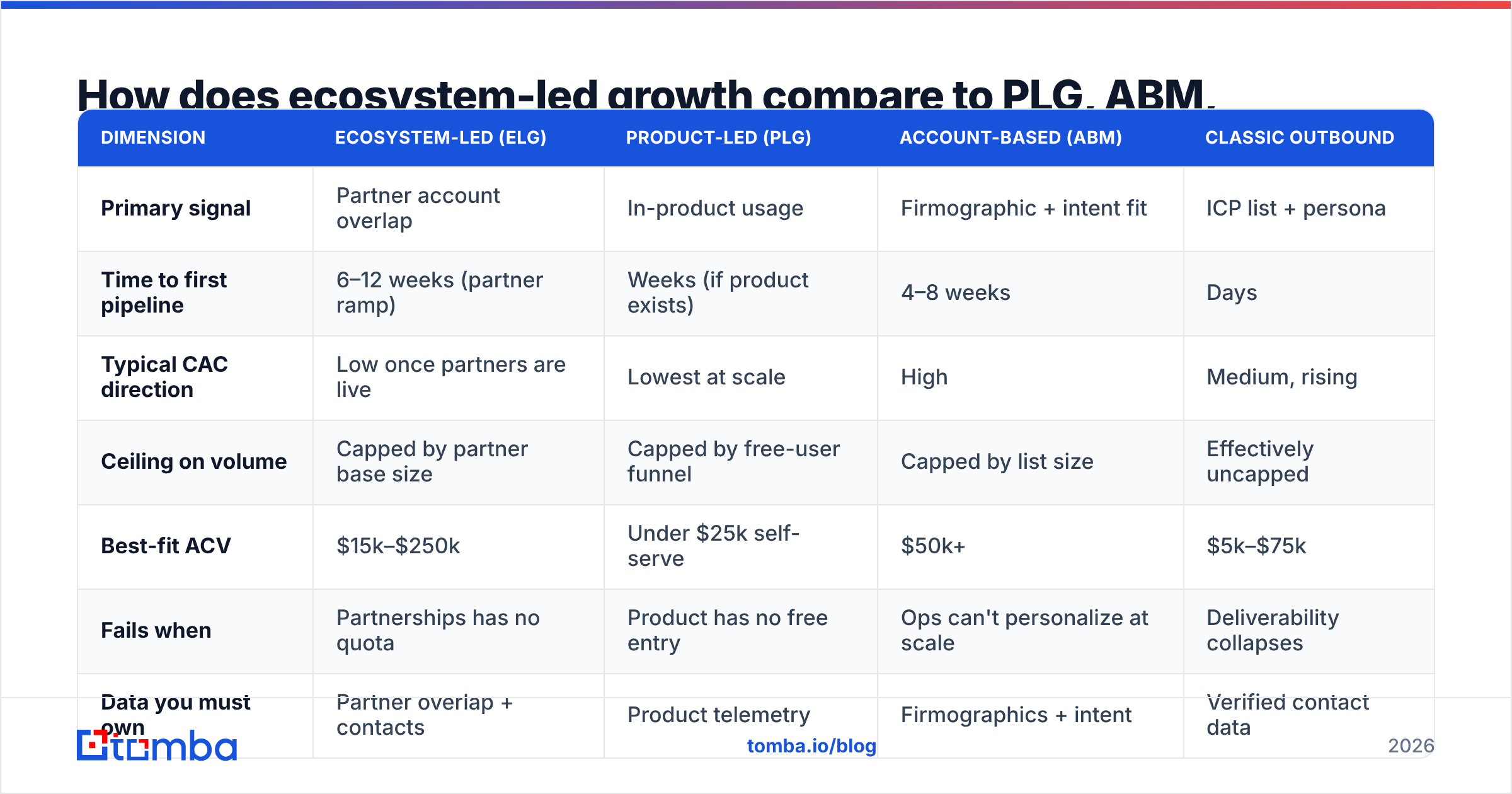
| Dimension | Ecosystem-led (ELG) | Product-led (PLG) | Account-based (ABM) | Classic outbound |
|---|---|---|---|---|
| Primary signal | Partner account overlap | In-product usage | Firmographic + intent fit | ICP list + persona |
| Time to first pipeline | 6–12 weeks (partner ramp) | Weeks (if product exists) | 4–8 weeks | Days |
| Typical CAC direction | Low once partners are live | Lowest at scale | High | Medium, rising |
| Ceiling on volume | Capped by partner base size | Capped by free-user funnel | Capped by list size | Effectively uncapped |
| Best-fit ACV | $15k–$250k | Under $25k self-serve | $50k+ | $5k–$75k |
| Fails when | Partnerships has no quota | Product has no free entry | Ops can't personalize at scale | Deliverability collapses |
| Data you must own | Partner overlap + contacts | Product telemetry | Firmographics + intent | Verified contact data |
| Who runs it | Partnerships + RevOps | Growth + product | Marketing + SDR | SDR leadership |
Two things fall out of that table.
First, ELG has a hard volume ceiling. If your five partners collectively touch 8,000 accounts and your overlap is 22%, you have roughly 1,760 warm accounts. That's a great quarter, not a permanent growth engine. Companies that go all-in on ELG and shut down outbound tend to discover this in month seven.
Second, ELG and outbound are complements, not substitutes. The overlap list is your tier-one segment. Everything outside it is still outbound — you just work it with lower expectations and a cheaper cadence.
What does an ecosystem-led motion actually look like week to week?#
Here's the operational loop, stripped of vendor language.
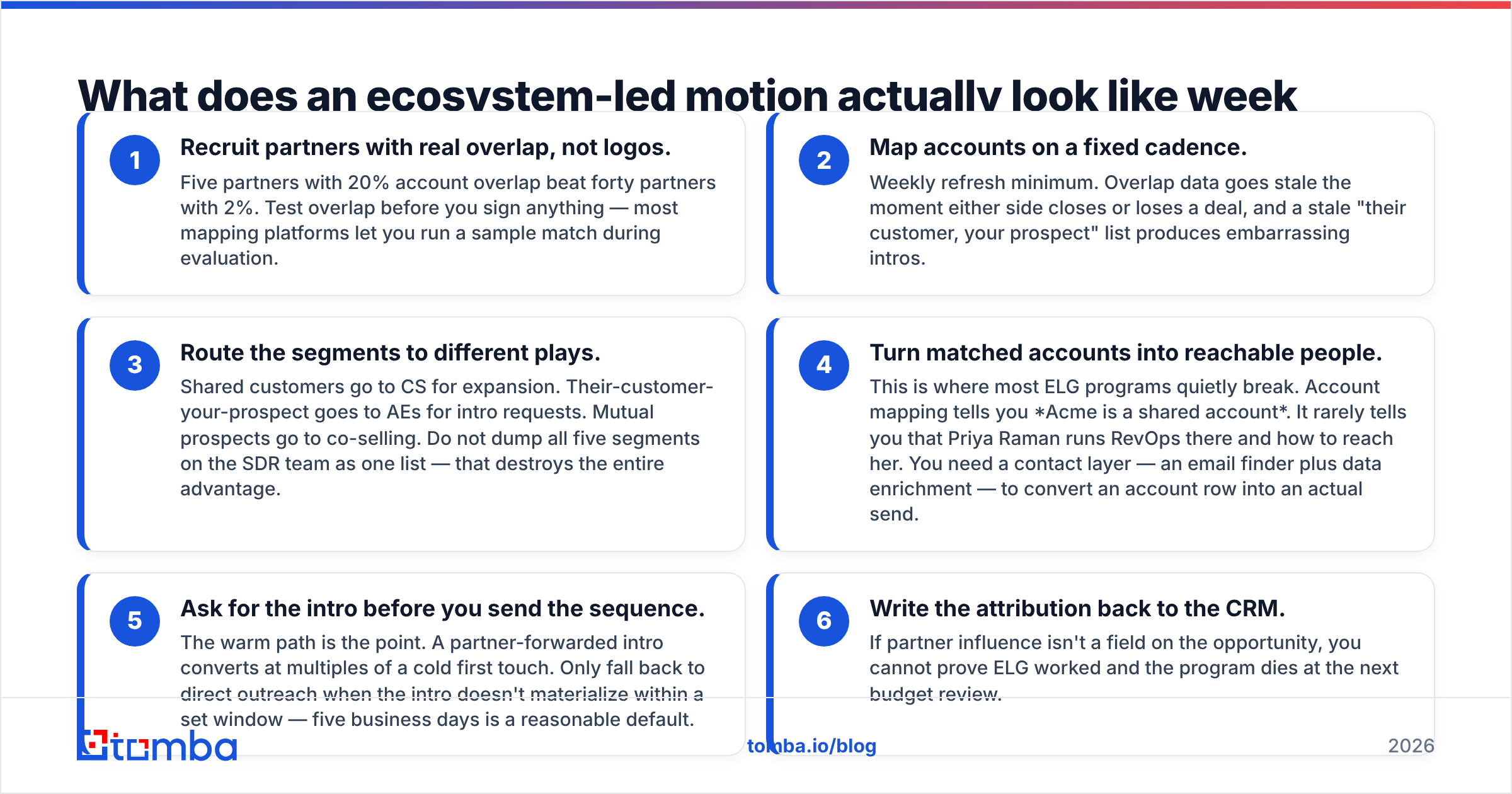
- Recruit partners with real overlap, not logos. Five partners with 20% account overlap beat forty partners with 2%. Test overlap before you sign anything — most mapping platforms let you run a sample match during evaluation.
- Map accounts on a fixed cadence. Weekly refresh minimum. Overlap data goes stale the moment either side closes or loses a deal, and a stale "their customer, your prospect" list produces embarrassing intros.
- Route the segments to different plays. Shared customers go to CS for expansion. Their-customer-your-prospect goes to AEs for intro requests. Mutual prospects go to co-selling. Do not dump all five segments on the SDR team as one list — that destroys the entire advantage.
- Turn matched accounts into reachable people. This is where most ELG programs quietly break. Account mapping tells you Acme is a shared account. It rarely tells you that Priya Raman runs RevOps there and how to reach her. You need a contact layer — an email finder plus data enrichment — to convert an account row into an actual send.
- Ask for the intro before you send the sequence. The warm path is the point. A partner-forwarded intro converts at multiples of a cold first touch. Only fall back to direct outreach when the intro doesn't materialize within a set window — five business days is a reasonable default.
- Write the attribution back to the CRM. If partner influence isn't a field on the opportunity, you cannot prove ELG worked and the program dies at the next budget review.
Step 6 is the one that gets skipped, and it's the one that kills programs.
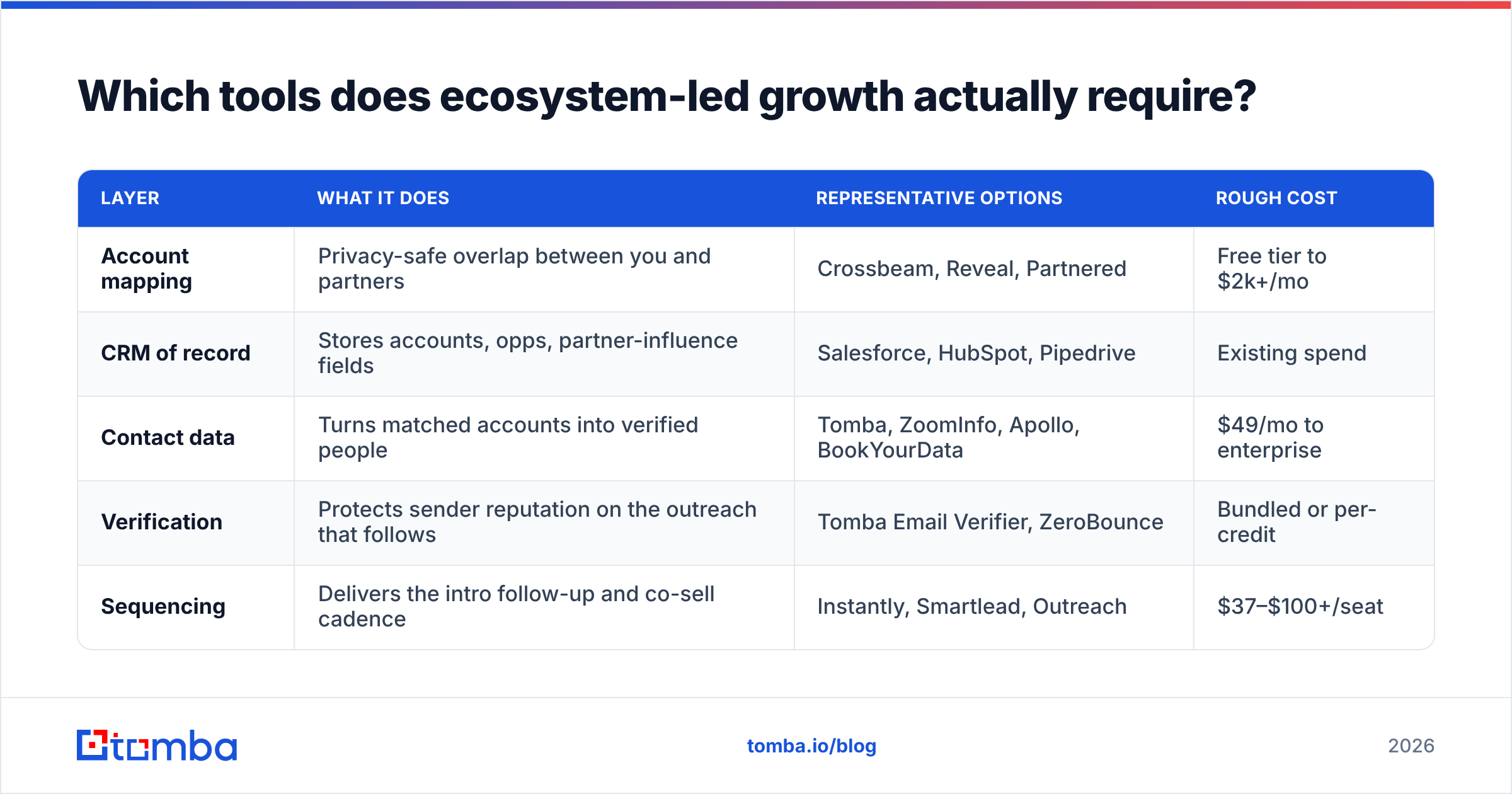
Which tools does ecosystem-led growth actually require?#
Fewer than the category marketing suggests. Three layers, and you probably already own two of them.
| Layer | What it does | Representative options | Rough cost |
|---|---|---|---|
| Account mapping | Privacy-safe overlap between you and partners | Crossbeam, Reveal, Partnered | Free tier to $2k+/mo |
| CRM of record | Stores accounts, opps, partner-influence fields | Salesforce, HubSpot, Pipedrive | Existing spend |
| Contact data | Turns matched accounts into verified people | Tomba, ZoomInfo, Apollo, BookYourData | $49/mo to enterprise |
| Verification | Protects sender reputation on the outreach that follows | Tomba Email Verifier, ZeroBounce | Bundled or per-credit |
| Sequencing | Delivers the intro follow-up and co-sell cadence | Instantly, Smartlead, Outreach | $37–$100+/seat |
On the contact layer specifically: the mapping platform hands you a domain and a company name. You still need the human. Tools differ mostly on coverage-versus-price. Tomba pricing starts with a free tier at 25 searches/month, then $49/mo Starter, $99/mo Growth, and $249/mo Pro — which is the range where ELG programs at a few hundred matched accounts per month actually live. BookYourData is a solid pick if you prefer pay-as-you-go credits over a subscription and want a prebuilt database to pull from. Enterprise data vendors make sense once you're matching tens of thousands of accounts and need firmographic depth alongside contacts.
The practical workflow: export the overlap segment as domains, run bulk email finder against it, verify before send, push back to CRM. If your partner list refreshes weekly, automate that loop through the Tomba API rather than doing it by hand — the manual version survives about three weeks before someone stops doing it.
How do you measure ecosystem-led growth without fooling yourself?#
Partner attribution is the most gameable metric in go-to-market. Every partner-adjacent deal will get claimed by someone. Set definitions before you set targets.
Use two clean buckets and one diagnostic:
- Partner-sourced — the opportunity did not exist in your CRM before the partner introduced it. Strict definition, small number, most credible.
- Partner-influenced — the opportunity existed, and a documented partner action (intro, co-sell call, reference) occurred before close. Larger number, softer claim. Report it separately, never combined.
- Overlap coverage — what percentage of your target account list appears in at least one partner's customer base. This is the leading indicator. If coverage isn't growing, sourced pipeline won't grow either.
Then track the deltas that justify the program: win rate on partner-touched deals versus baseline, sales cycle length delta, average contract value delta, and net revenue retention for shared customers versus non-shared. If those four don't separate from your baseline after two quarters, your partners aren't the right partners.
HubSpot's research on sales benchmarks is a reasonable external sanity check when you're arguing about whether your baselines are normal. Just don't import someone else's numbers as your target.
One warning on dashboards: a partner-influenced number that includes every deal where a partner logo appeared anywhere in the account history is not a metric, it's a mood. Require a timestamped action.
Where does ecosystem-led growth actually break down?#
Four failure modes, in rough order of frequency.
No owner with a number. Partnerships sits under marketing, has a "relationships" goal, and never gets held to sourced pipeline. Nothing forces the loop to close. Fix: give partnerships a sourced-pipeline quota and give AEs a partner-intro activity target.
Overlap without relevance. Two companies share 40% of accounts and zero buying-committee overlap — your partner sells to IT, you sell to finance. The match looks great and converts at nothing. Fix: check persona overlap, not just account overlap, before investing.
The last-mile contact gap. You have 900 matched accounts and no contacts. This sounds trivial and consumes entire quarters. Fix: budget the contact layer as part of the ELG program, not as a separate line item someone forgets.
Intro fatigue. You ask your partner's AE for 60 intros in a month. They do four and stop answering. Fix: cap intro requests per partner rep per week, and reciprocate first. Partner ecosystems run on ledger balance — give before you take, visibly.
There's a fifth, subtler one: partner data can make you lazy about sender reputation. A warm account is not a warm inbox. If the intro stalls and you fall back to direct email, you're doing outbound again, with all the same email deliverability rules applying. Verify addresses, keep bounce rates under 2%, and don't blast the overlap list because it "feels warm."
Is ecosystem-led growth right for your team in 2026?#
Run this filter honestly.
ELG is worth building if: your ACV is above roughly $15k, your product integrates with other software, your buyers use a recognizable stack, and you have at least three partners whose customers plausibly need you. Under those conditions it's the highest-leverage program most RevOps teams aren't running.
ELG is not worth it yet if: you're pre-product-market-fit, your ACV is under $5k with a self-serve motion, you have no integrations, or your partnerships headcount is zero and nobody will own the loop. In those cases, spend the same effort on your outbound fundamentals — better targeting, cleaner data, tighter messaging. ELG amplifies a working motion; it doesn't create one.
The middle case is most companies: run ELG as a segment, not a strategy. Carve out the overlap accounts as your tier-one list, work them with intros and co-sell plays, and keep outbound running for everything else. Measure the two side by side for two quarters. Let the numbers decide how much you shift.
What's the fastest way to start this quarter?#
Pick three partners. Run an overlap map. Take the "their customer, your prospect" segment — usually a few hundred accounts. Then close the last mile: pull decision-maker contacts, verify them, and get them into a play within a week, while the data is fresh.
That last step is where programs stall, and it's the cheapest one to fix. Tomba Email Finder turns a matched domain into verified, deliverable contacts — by domain, name, or company — with a free tier to test the workflow on your first overlap batch and API access when you're ready to run it weekly on autopilot. Map the accounts, find the humans, ask for the intro. That's the whole motion.
Related guides#
Ready to find emails that actually work?
Join 150,000+ professionals who stopped guessing and started sending. Free credits on signup — no credit card required.
Get the Tomba newsletter
Practical outbound tactics and product updates — once every two weeks.
About the author