Education Lead Generation: A Practical 2026 Playbook
Education lead generation fails for one boring reason: the contact data expires faster than the sales cycle. Here's the channel mix, the CPL benchmarks, and the list-hygiene process that actually fill a pipeline in 2026.
TL;DR
- Education lead generation breaks on data decay, not creativity. School staff turn over every summer,
.edualiases get recycled, and a list bought in March is measurably worse by September. - The two buyer motions are completely different: selling to institutions (EdTech, curriculum, facilities) and recruiting students for institutions. Same channel names, opposite playbooks.
- Cost per lead in education ranges from roughly $15 for organic content to $200+ for paid search on degree-program keywords. Blended CPL is a vanity number — segment it by motion.
- Verify before you send. A district IT director list with a 30% bounce rate will torch your sending domain before it produces a single demo.
- Time outreach to the academic calendar. Budget cycles, not your quarter, decide when a school can say yes.
What is education lead generation?#
Education lead generation is the process of identifying and capturing contact information from people who can buy — or enroll in — an educational product or service. That definition sounds broad because the category genuinely is. It covers a K-12 SaaS vendor chasing curriculum directors, a coding bootcamp chasing career-changers, a university chasing transfer applicants, and a facilities contractor chasing a district's operations lead.
Think of it like fishing in a lake with a strict seasonal calendar. The fish are there year-round, but they only feed during specific windows tied to budget approvals and enrollment deadlines. Cast at the wrong time with the right bait and you catch nothing. Technically: education buying cycles are calendar-locked and committee-driven, so lead timing carries more weight here than in most B2B categories.
The practical consequence is that education lead generation has two failure modes that other verticals don't share as acutely:
- Stale contacts. Teachers, principals, deans, and district administrators move roles at high rates each summer. A contact record that was accurate in April may be dead in August.
- Committee purchasing. The person who requests your product is rarely the person who signs. You need three to six contacts per institution, not one.
- Public procurement rules. Public districts and state universities often require RFPs above a spending threshold, which means your "lead" is really a request to be on a bid list.
- Seasonal blackout windows. Nobody in a school building is evaluating software the first two weeks of term or the last two weeks before finals.
- Deliverability sensitivity. Many institutions run aggressive spam filtering and shared blocklists, so one bad send can affect an entire domain's future reachability.
Who are you actually selling to in education?#
Before you pick a channel, pick a segment. These five buy in genuinely different ways:
- K-12 districts (public). Buyer committee: superintendent, curriculum director, IT director, business manager. Long cycles, procurement rules, grant and Title funding. Highest contract value, slowest close.
- Private and independent K-12 schools. Head of school and business manager decide fast. Smaller budgets, far shorter cycles, and email works better than phone.
- Higher education. Departmental autonomy means your buyer is a dean, program chair, or a director of student success — not "the university." Highly fragmented; account mapping matters more than volume.
- Bootcamps, test prep, and online course providers. These are functionally B2C or B2B2C. Paid social and search dominate; the "lead" is a student, and speed-to-lead is measured in minutes.
- Corporate L&D and workforce training. Closest to standard B2B SaaS motion. HR and L&D leaders, annual budget cycles, straightforward outbound.
If your CRM has one segment called "Education," your reporting is lying to you. Split it at minimum into institutional buyer and student/learner before you compare any CPL numbers.
Which channels produce the best education leads?#
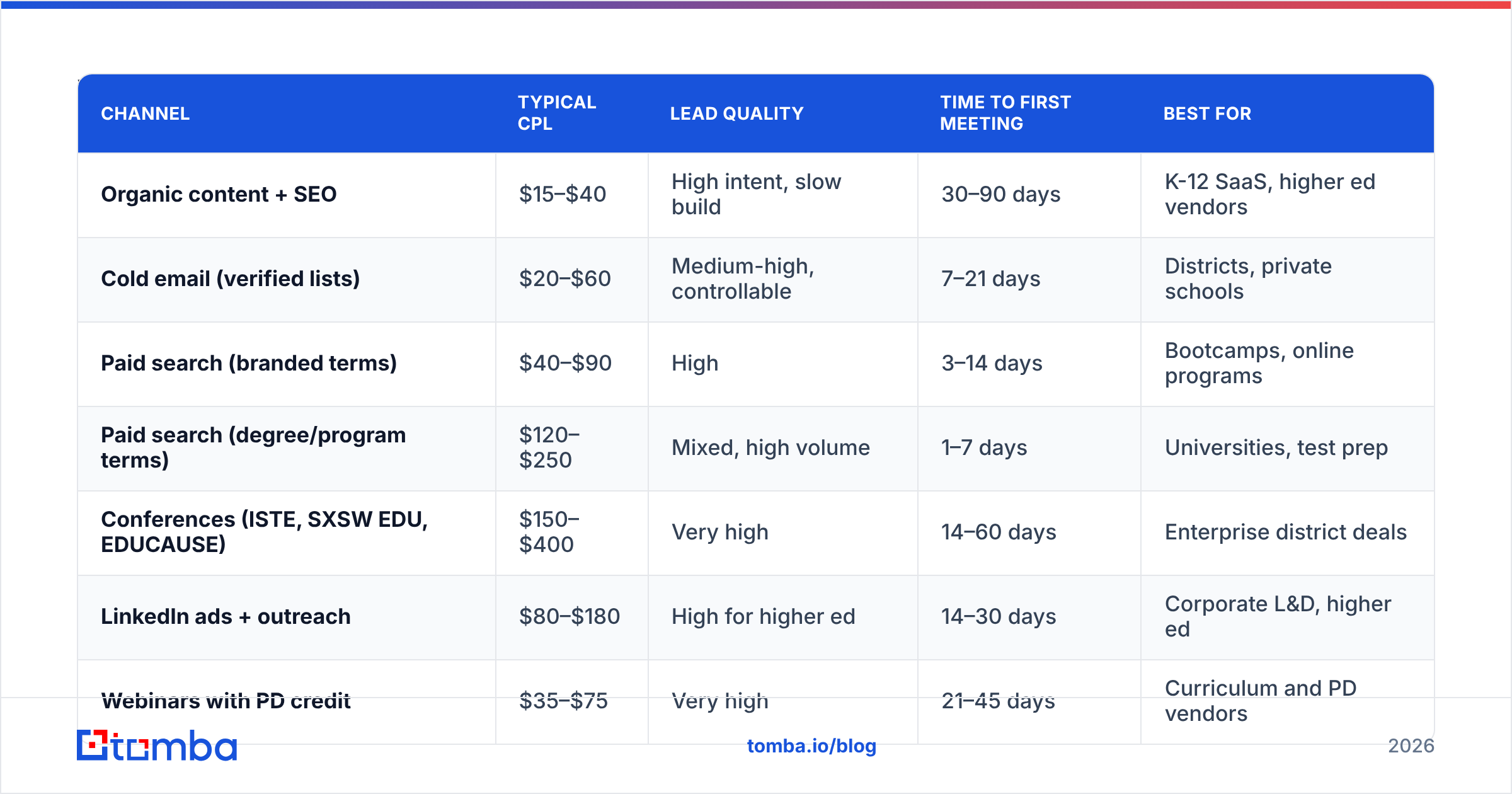
Here is a realistic channel comparison for institutional education selling in 2026. Figures are directional ranges pulled from mid-market vendor reporting, not universal truths — instrument your own numbers before making budget decisions.
| Channel | Typical CPL | Lead quality | Time to first meeting | Best for |
|---|---|---|---|---|
| Organic content + SEO | $15–$40 | High intent, slow build | 30–90 days | K-12 SaaS, higher ed vendors |
| Cold email (verified lists) | $20–$60 | Medium-high, controllable | 7–21 days | Districts, private schools |
| Paid search (branded terms) | $40–$90 | High | 3–14 days | Bootcamps, online programs |
| Paid search (degree/program terms) | $120–$250 | Mixed, high volume | 1–7 days | Universities, test prep |
| Conferences (ISTE, SXSW EDU, EDUCAUSE) | $150–$400 | Very high | 14–60 days | Enterprise district deals |
| LinkedIn ads + outreach | $80–$180 | High for higher ed | 14–30 days | Corporate L&D, higher ed |
| Webinars with PD credit | $35–$75 | Very high | 21–45 days | Curriculum and PD vendors |
| Referral / consortium partnerships | $10–$30 | Highest | 30–120 days | Anyone with existing districts |
Two things stand out. First, conferences look expensive per lead but produce the shortest path to a signed district contract, because you meet the whole committee in one room. Second, cold email is the only channel where you control both cost and targeting precisely — provided your data is clean. That "provided" is doing enormous work.
Why do education contact lists decay so fast?#
Because the sector reshuffles itself every twelve months on a fixed schedule.
Staff turnover in US K-12 has run materially above pre-2020 levels, and administrative roles churn alongside teaching roles. When a curriculum director leaves in June, three things happen to your data: the mailbox is often deactivated, the replacement's address may follow a different pattern (some districts use first.last@, others flast@, others a legacy initial+employee-ID scheme), and the department may be reorganized entirely.
Higher ed adds its own decay. Adjunct and contract staff rotate, program chairs rotate on two- or three-year terms, and many institutions maintain both a departmental alias and a personal address for the same human. Send to the alias and your message lands in a shared inbox nobody owns.
The measurable outcome: education lists that aren't re-verified within 90 days routinely bounce at 15–35%. Mailbox providers treat sustained bounce rates above roughly 2% as a spam signal, so a single unverified 5,000-contact blast can damage email deliverability for months.
The fix is unglamorous and mandatory: re-verify before every campaign, not once at acquisition. Run the list through an email verifier as a pre-send step in your workflow, and treat any list older than 60 days as unverified by default.
How do you build an education contact list that doesn't bounce?#
A repeatable process beats any single tool. This is the sequence that holds up:
- Define the institution universe first, not the people. Pull a list of districts, schools, or institutions that match your ICP by size, region, funding profile, and existing tech stack. Public data sources like NCES for US K-12 and IPEDS for higher ed give you enrollment counts and locations for free.
- Map domains to institutions. Every school has a website; that domain is your join key. Run each domain through a domain search to see which addresses and email patterns exist at that institution before you guess anything.
- Identify the committee, not the contact. For each institution, target three to six roles: the functional buyer, the IT gatekeeper, the budget holder, and an end-user champion. Single-threaded education deals stall almost universally.
- Find addresses by name and role. With the pattern known, use an email finder to resolve specific people. Role-based guesses (
info@,admin@) belong in a separate, lower-priority segment — they're gatekeeper inboxes, not buyer inboxes. - Verify, then segment by confidence. Split into valid, catch-all, and risky. Many
.edudomains are catch-all, which means standard SMTP verification returns "accept" for everything. Run those through a catch-all verifier before you assume the address is real. - Enrich for personalization hooks. Grant awards, new superintendent hires, 1:1 device rollouts, and accreditation cycles are all public and all better openers than "I wanted to reach out."
Steps 2 through 5 are the ones teams skip, and they're the ones that determine whether the campaign works. Buying a pre-built list and sending on day one is the education equivalent of mailing 5,000 postcards to addresses you copied off a 2019 phone book.
What does an education lead gen data stack cost?#
You're generally choosing between three approaches: build the list yourself from public institution data, buy a pre-built vertical list, or run a hybrid where you source institutions in bulk and resolve contacts on demand.
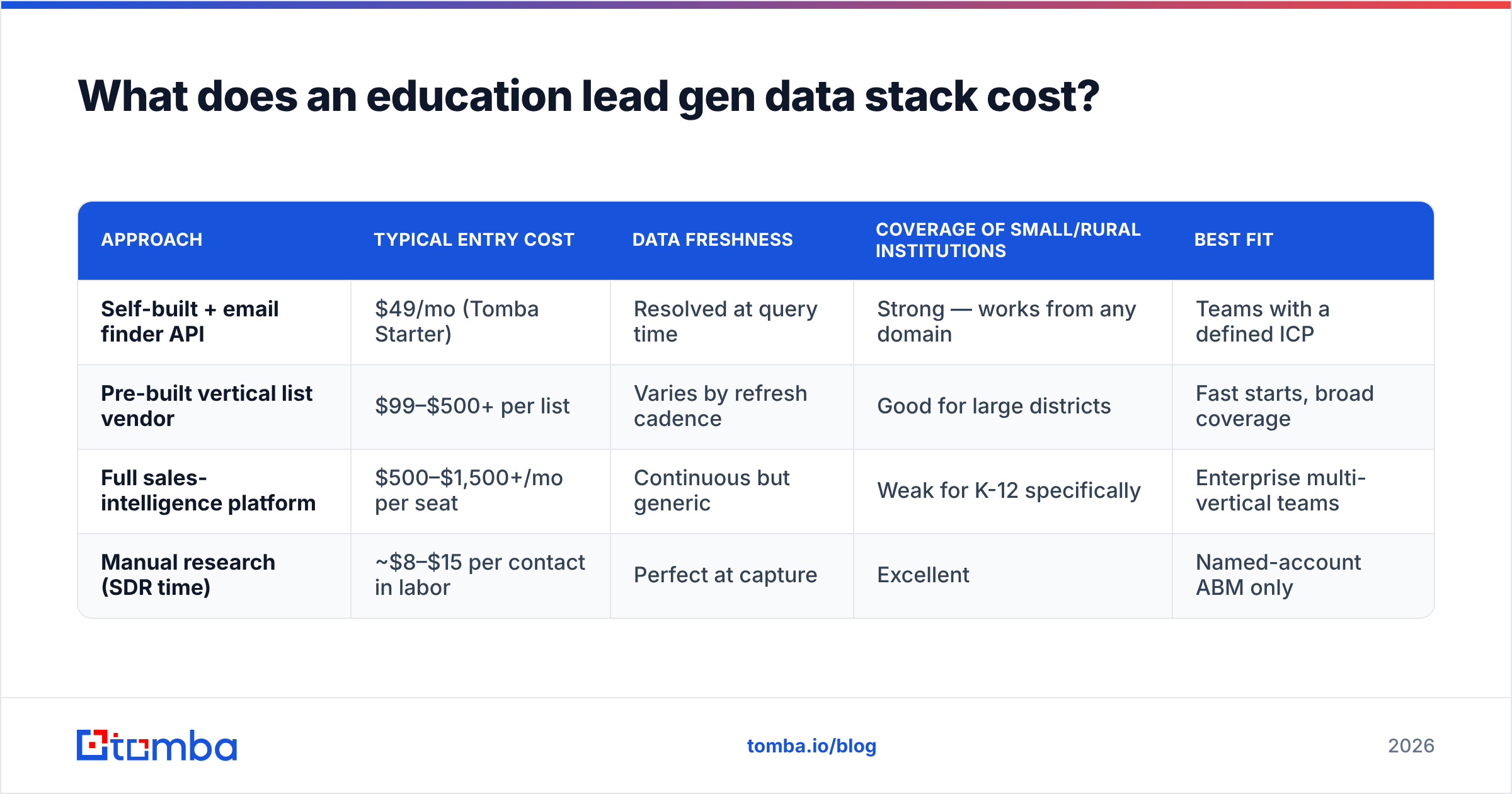
| Approach | Typical entry cost | Data freshness | Coverage of small/rural institutions | Best fit |
|---|---|---|---|---|
| Self-built + email finder API | $49/mo (Tomba Starter) | Resolved at query time | Strong — works from any domain | Teams with a defined ICP |
| Pre-built vertical list vendor | $99–$500+ per list | Varies by refresh cadence | Good for large districts | Fast starts, broad coverage |
| Full sales-intelligence platform | $500–$1,500+/mo per seat | Continuous but generic | Weak for K-12 specifically | Enterprise multi-vertical teams |
| Manual research (SDR time) | ~$8–$15 per contact in labor | Perfect at capture | Excellent | Named-account ABM only |
Tomba pricing starts with a free tier at 25 searches per month, then Starter at $49/mo, Growth at $99/mo, and Pro at $249/mo — which is why the self-built path tends to win for teams that already know which 500 districts they want. If you'd rather start from a pre-assembled vertical list, providers like BookYourData sell education-segment lists with pay-as-you-go credits, which is a reasonable on-ramp before you build your own sourcing process.
The hybrid is what most successful education teams settle on: pull the institution universe from public data, resolve and verify contacts programmatically through an email finder API, and reserve human research for your top 50 named accounts.
How should you time outreach around the academic calendar?#
Budget calendars decide your win rate more than your copy does. A rough US-centric map:
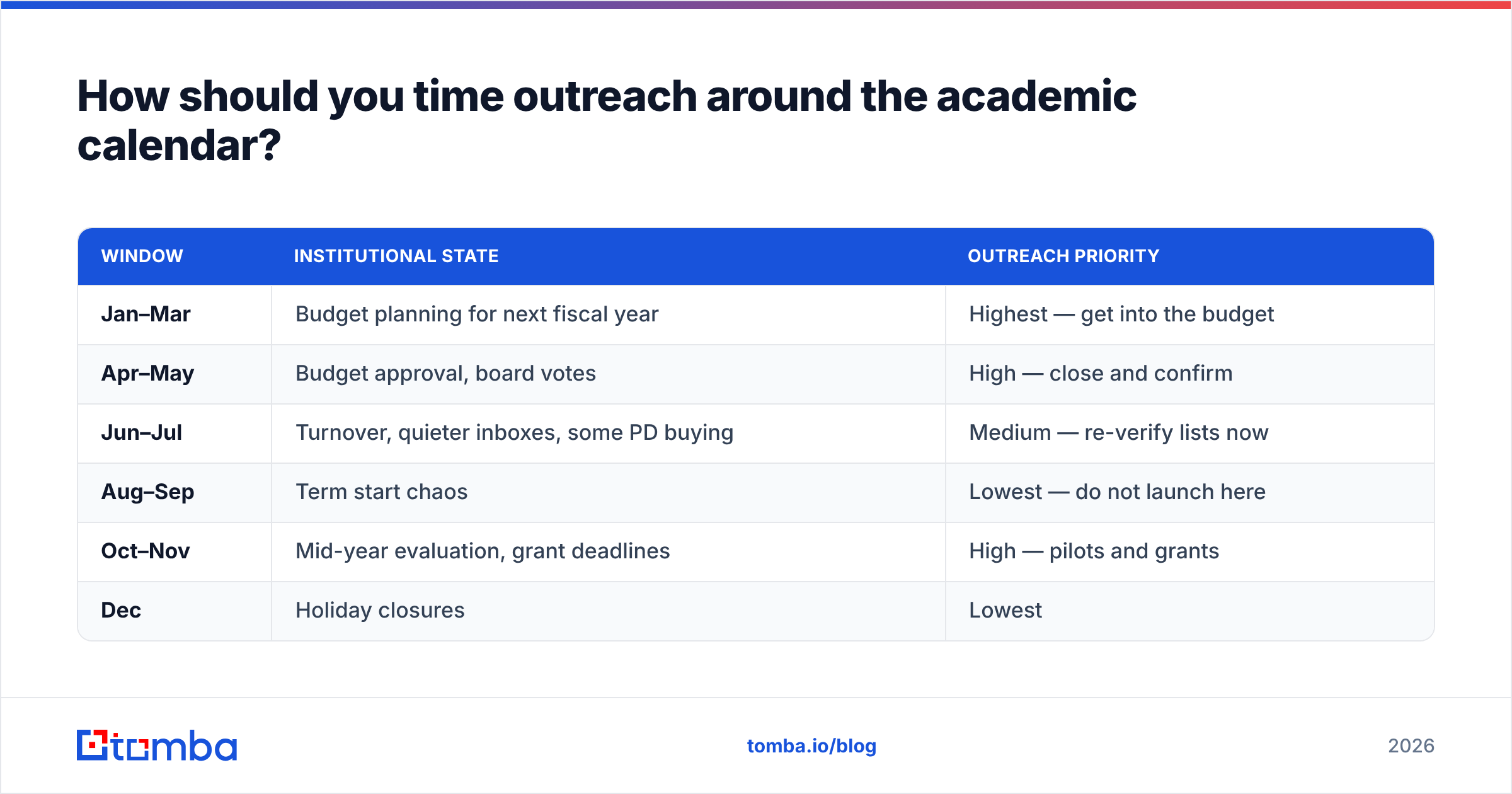
| Window | Institutional state | Outreach priority |
|---|---|---|
| Jan–Mar | Budget planning for next fiscal year | Highest — get into the budget |
| Apr–May | Budget approval, board votes | High — close and confirm |
| Jun–Jul | Turnover, quieter inboxes, some PD buying | Medium — re-verify lists now |
| Aug–Sep | Term start chaos | Lowest — do not launch here |
| Oct–Nov | Mid-year evaluation, grant deadlines | High — pilots and grants |
| Dec | Holiday closures | Lowest |
The single highest-leverage scheduling decision: run your full list re-verification in July, right after summer turnover, so your fall campaigns hit real mailboxes. For student recruitment the calendar inverts — application deadlines drive demand spikes, so paid search budgets should peak six to eight weeks before each deadline, not evenly across the year.
What metrics should you track?#
Drop blended CPL. Track these instead, split by segment:
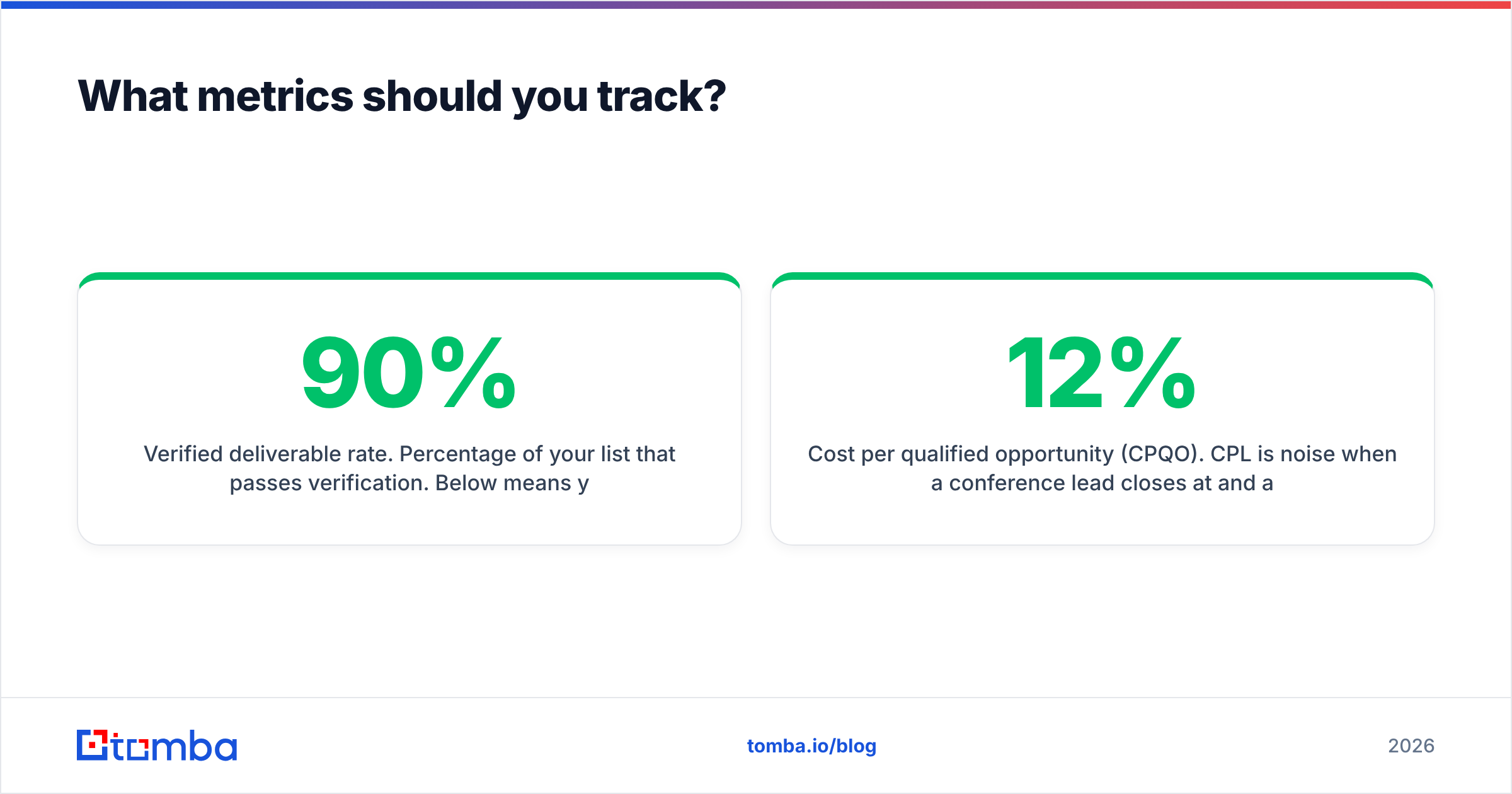
- Verified deliverable rate. Percentage of your list that passes verification. Below 90% means your sourcing is broken, not your copy.
- Institution coverage. How many of your target institutions have at least three mapped contacts. This is the real leading indicator for committee-driven deals.
- Reply-to-meeting rate. Education generates a high volume of polite non-buyer replies. Measure meetings, not replies.
- Cost per qualified opportunity (CPQO). CPL is noise when a conference lead closes at 12% and a paid-search lead closes at 0.8%.
- Time-to-first-touch on inbound. For learner-facing programs, contact within five minutes materially outperforms contact within an hour, a finding HubSpot and others have documented repeatedly across lead-response research.
- Domain reputation trend. Watch your sender reputation weekly, not after something breaks.
For definitions and benchmarks on the pipeline side of these metrics, Gartner publishes ongoing research on B2B buying-group behavior that maps closely to education committee dynamics, and the education technology category overview is a useful primer if you're new to the sector's structure.
What are the most common education lead gen mistakes?#
Treating a district like a company. A district of 40 schools has 40 potential champions and one budget. Sell to the building, then escalate to the district.
Sending to info@ and calling it outreach. Those inboxes are staffed by people whose job is to filter you out.
Ignoring catch-all domains. A huge share of .edu and district domains accept everything. If your verification tool marks these "valid," you're flying blind — you need explicit catch-all handling.
Personalizing with the wrong signal. "I saw your school won a state championship" reads as scraped. "I saw your board approved a 1:1 Chromebook rollout in March" reads as researched.
Re-buying the same stale list every quarter. Refresh the contacts against live sources instead. Running an existing CSV through a bulk email finder and re-resolving current addresses is cheaper than buying the same names twice.
Launching in late August. See the calendar table. Every vendor emails in late August. Nobody reads it.
Where should you start this quarter?#
Pick one segment. Build a list of 200 institutions inside it. Map three roles per institution, resolve the addresses, verify every one, and send a sequence timed to the next budget window. That's 600 verified contacts — enough to produce statistically meaningful data about whether your offer lands, and small enough that you can do it in a week.
If you're starting that build now, the Tomba Email Finder is the fastest way to go from a list of school and district domains to verified, committee-mapped contacts. Start on the free tier at 25 searches per month to test your pattern coverage on a handful of target districts, then scale to Starter at $49/mo when the sourcing process is proven. Your list will still decay — but if you re-verify before every send, it will decay on your schedule instead of the school calendar's.
Related guides#
Ready to find emails that actually work?
Join 150,000+ professionals who stopped guessing and started sending. Free credits on signup — no credit card required.
Get the Tomba newsletter
Practical outbound tactics and product updates — once every two weeks.
About the author