Education Sales Pitch: How to Sell to Schools in 2026
Most education sales pitches die because they target the wrong person in a committee of seven. Here's the structure, timing, and data that actually books meetings with schools and districts.

TL;DR
- An education sales pitch fails at the org-chart level, not the copy level: K-12 and higher-ed purchases run through 5-9 stakeholders, and pitching the wrong one wastes the whole cycle.
- Budget timing beats persuasion. Most districts lock spend between February and May for the following fiscal year — a great pitch in October lands in a dead zone.
- Lead with a compliance-and-outcomes frame (student data privacy, measurable learning gains, procurement fit), not features.
- Superintendents, curriculum directors, and CTOs need three different pitches from the same product.
- Contact data is the silent killer: school staff directories churn ~25% every summer, so verify before you send.
Why do most education sales pitches fail before the first meeting?#
Because they're written for a single buyer, and education doesn't have one.
When you sell to a SaaS company, you can often find one VP who can say yes. When you sell to a school district, the person who wants your product usually can't buy it, the person who can buy it has never heard of you, and a third person — the technology director or data privacy officer — can veto the whole thing over a single clause in your terms of service.
That structural difference is why most reps' education sales pitch reads like a B2B SaaS deck with the word "students" swapped in. It gets polite interest from a teacher, a "let me check with the district" from a principal, and then silence.
The second reason is timing. Education budgets are legally scheduled. A district doesn't buy when it's convinced; it buys when the line item exists. If your pitch arrives in November, the money for that fiscal year was allocated in April. You are not selling — you are, at best, applying for next year's budget.
The third reason is credibility framing. Educators are pitched constantly, and they've been burned by tools that promised engagement lifts and delivered another login. Vendor claims without a named district, a measurable outcome, or a third-party study get filtered out fast.

Who actually needs to hear your education sales pitch?#
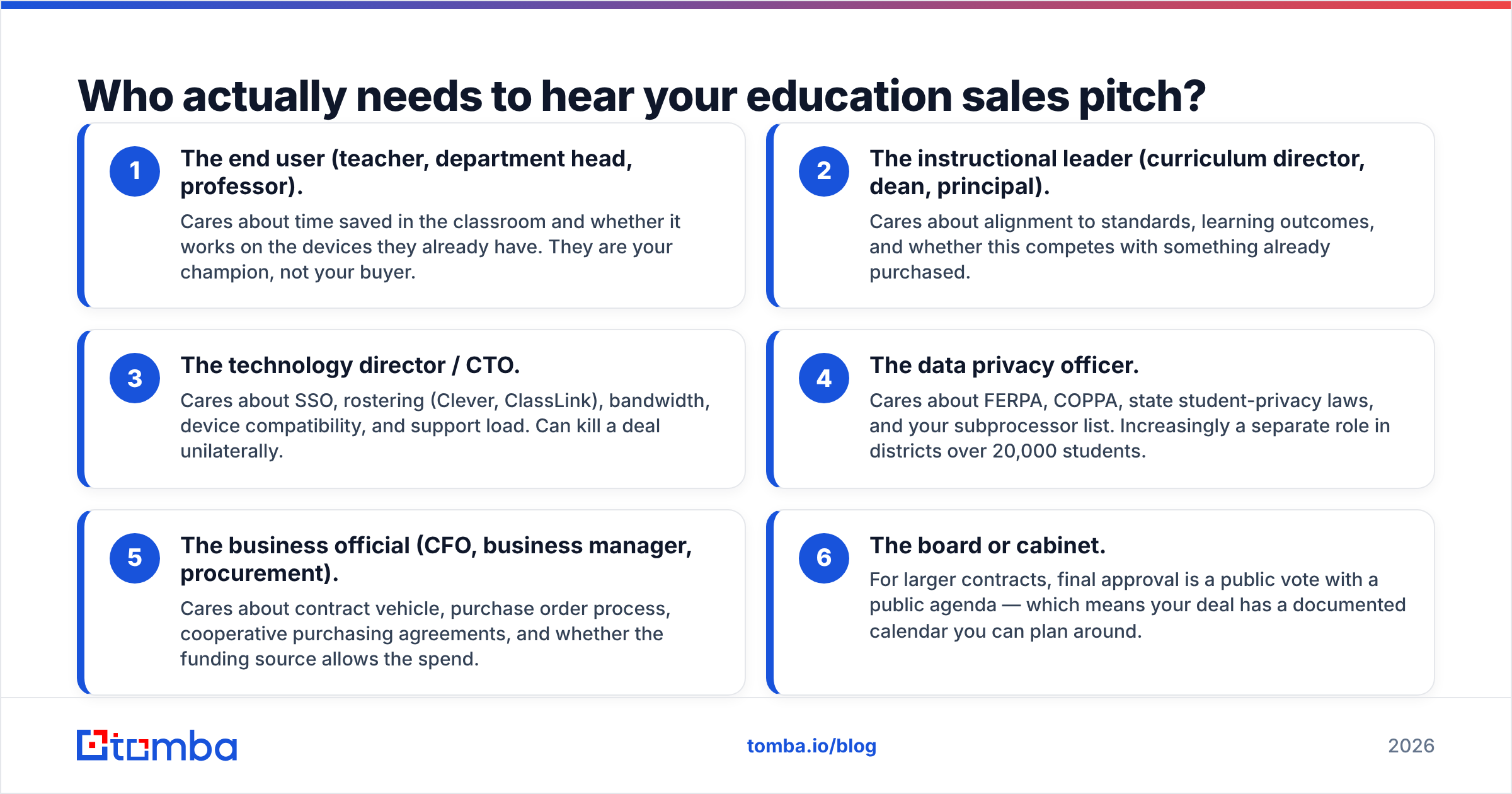
Map the committee before you write a word. In K-12, a typical purchase over $10,000 touches these roles:
- The end user (teacher, department head, professor). Cares about time saved in the classroom and whether it works on the devices they already have. They are your champion, not your buyer.
- The instructional leader (curriculum director, dean, principal). Cares about alignment to standards, learning outcomes, and whether this competes with something already purchased.
- The technology director / CTO. Cares about SSO, rostering (Clever, ClassLink), bandwidth, device compatibility, and support load. Can kill a deal unilaterally.
- The data privacy officer. Cares about FERPA, COPPA, state student-privacy laws, and your subprocessor list. Increasingly a separate role in districts over 20,000 students.
- The business official (CFO, business manager, procurement). Cares about contract vehicle, purchase order process, cooperative purchasing agreements, and whether the funding source allows the spend.
- The board or cabinet. For larger contracts, final approval is a public vote with a public agenda — which means your deal has a documented calendar you can plan around.
Higher education compresses this slightly but adds faculty governance, which can be slower than any school board.
The practical takeaway: your pitch is not one message. It's a coordinated set of three to four messages that say the same thing in different currencies — time for the teacher, outcomes for the instructional lead, risk reduction for the CTO, and total cost of ownership for the business official.
What does the buying committee care about, role by role?#
| Stakeholder | Primary question | What lands | What kills the pitch |
|---|---|---|---|
| Teacher / faculty | "Does this save me time this week?" | 5-minute setup, works on existing devices | Another separate login |
| Curriculum director | "Does it move a metric we report on?" | Outcome data from a comparable district | Vague "engagement" claims |
| Technology director | "What breaks and who supports it?" | SSO, Clever/ClassLink rostering, uptime SLA | No integration docs |
| Data privacy officer | "Where does student data go?" | Signed state DPA, named subprocessors | "We're SOC 2, don't worry" |
| Business official | "Which funding source pays for this?" | Cooperative contract, clean PO terms | Annual price increases buried in T&Cs |
| Superintendent / provost | "Does this match our strategic plan?" | Language lifted from their own board goals | Generic industry stats |
That last row is the highest-leverage move in the entire process. Districts publish strategic plans, board minutes, and technology plans as public documents. Quoting a district's own stated priority back to them — "your 2026-2029 plan names chronic absenteeism as priority two" — converts a cold email into an obviously researched one.
How should you structure the pitch itself?#
Use a four-part structure and keep the first touch under 120 words.
1. Named, specific trigger. Not "I saw you're in education." Instead: a new curriculum adoption, a bond measure passing, a grant award, a new CTO hire, an ESSER-replacement funding gap. These are all public.
2. A peer proof point with a number. "Kent County Schools cut their rostering setup from 3 weeks to 2 days" beats "trusted by 500+ districts." Peer means similar enrollment, similar funding profile, ideally same state — state matters enormously in education because procurement rules and privacy laws are state-level.
3. The role-specific value line. One sentence, in that stakeholder's currency. Do not list six benefits.
4. A low-friction ask. For education, the highest-converting ask is rarely "book a demo." It's "want the one-page privacy and integration summary?" or "should I send the DPA we've already signed with three districts in your state?" You're offering to remove work from their plate, which is exactly what a procurement-heavy buyer wants.
Here's what that looks like in practice for a technology director:
Subject: rostering for the ClassLink migration
Hi Dana — saw the board approved the ClassLink move at the June 12 meeting. When Kent County did the same migration, the piece that ate their summer was re-provisioning third-party apps.
We ship a ClassLink-certified connector, so that step takes about two days instead of three weeks. Signed DPA already on file with two districts in your state.
Want the integration doc? Happy to send it with no call attached.
No adjectives. No "revolutionary." A specific public event, a specific peer, a specific time saving, and an ask that costs the recipient thirty seconds.
When should you send an education sales pitch?#
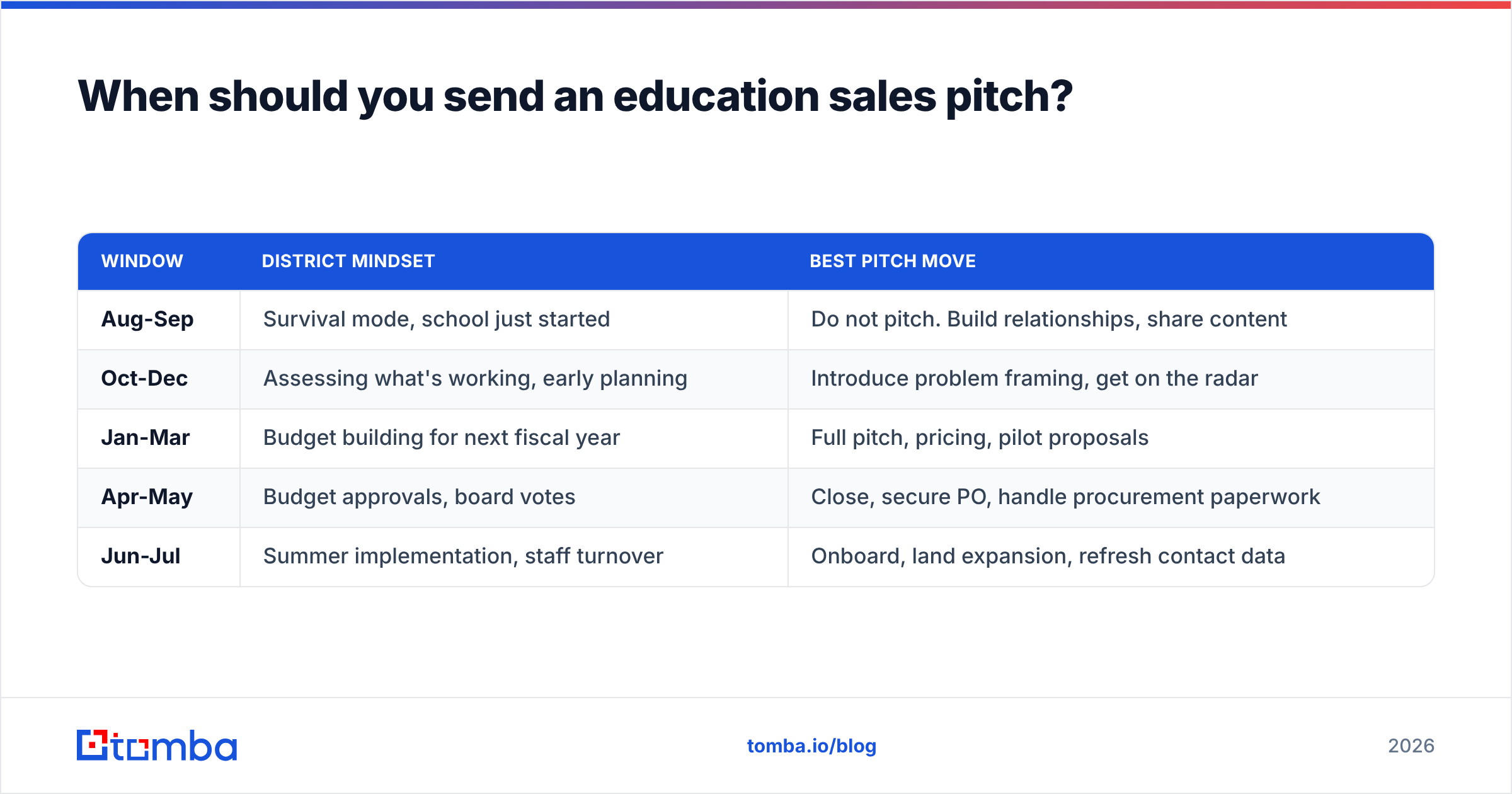
Calendar strategy matters more in education than in almost any other vertical. Here's the pattern that holds for most U.S. districts on a July-June fiscal year:
| Window | District mindset | Best pitch move |
|---|---|---|
| Aug-Sep | Survival mode, school just started | Do not pitch. Build relationships, share content |
| Oct-Dec | Assessing what's working, early planning | Introduce problem framing, get on the radar |
| Jan-Mar | Budget building for next fiscal year | Full pitch, pricing, pilot proposals |
| Apr-May | Budget approvals, board votes | Close, secure PO, handle procurement paperwork |
| Jun-Jul | Summer implementation, staff turnover | Onboard, land expansion, refresh contact data |
Higher ed runs on a similar rhythm with more variation — many institutions build budgets in the Jan-March window for a July 1 start, but grant-funded and departmental purchases can happen any time.
Two practical rules follow from this table. First, a cold outbound push in late August is close to a waste of send volume. Second, if you're not in conversation by January, you're selling into next year's budget regardless of how good the pitch is — so pace your quota expectations accordingly.
How do you find the right contacts at schools and districts?#
This is where most education outbound quietly falls apart. School and district staff directories are public, which lulls reps into thinking the data problem is solved. It isn't.
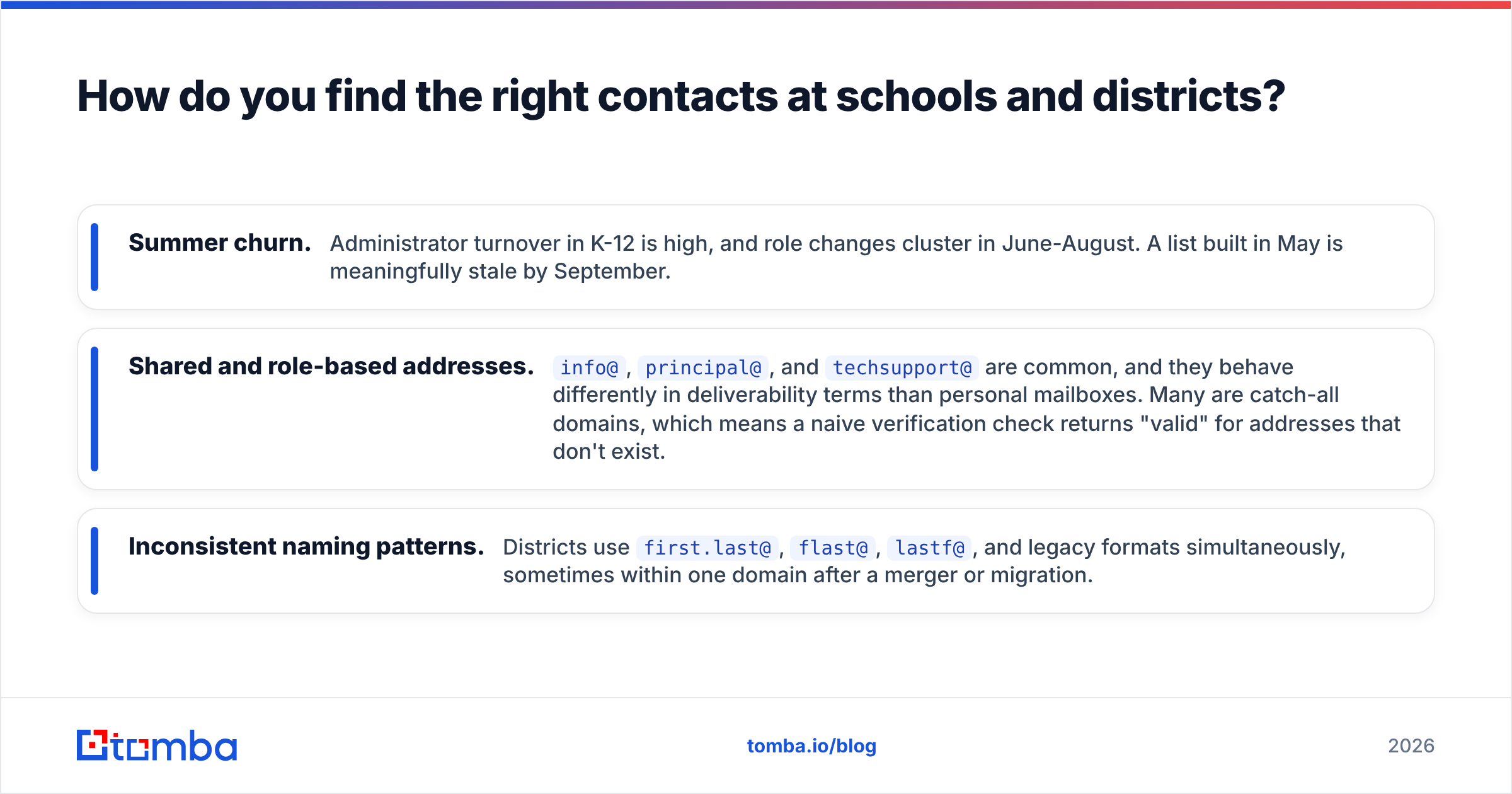
Three specific issues:
- Summer churn. Administrator turnover in K-12 is high, and role changes cluster in June-August. A list built in May is meaningfully stale by September.
- Shared and role-based addresses.
info@,principal@, andtechsupport@are common, and they behave differently in deliverability terms than personal mailboxes. Many are catch-all domains, which means a naive verification check returns "valid" for addresses that don't exist. - Inconsistent naming patterns. Districts use
first.last@,flast@,lastf@, and legacy formats simultaneously, sometimes within one domain after a merger or migration.
The workflow that survives contact with reality: identify the district domain, run a domain search to pull the naming pattern and known contacts, resolve individual decision-makers with an email finder, then run everything through an email verifier before it touches your sending tool. For the .edu and .k12.xx.us domains that come back as catch-all — and a lot of them will — a catch-all verifier is the difference between a usable list and a bounce-driven domain reputation problem.
If you're building lists at volume across a state, bulk verify the whole file rather than sampling. Education domains are frequently hosted on shared infrastructure, and one bad send pattern can affect your reach into an entire region.
How do you handle the procurement conversation?#
Assume procurement is a sale of its own, and start it early rather than treating it as paperwork after the yes.
Ask which contract vehicle applies. Many districts prefer to buy through cooperative purchasing agreements (E&I, Sourcewell, state contracts) because it bypasses a competitive bid. If you're on one of these, say so in the first substantive conversation — it can remove weeks.
Know the bid threshold. Districts have a dollar amount above which they must issue an RFP. Ask for it directly. Sometimes the right move is a smaller pilot below the threshold, which then produces the internal data that justifies the larger purchase next cycle.
Have the DPA ready. Student data privacy agreements are the single most common cause of stalled education deals. Districts in many states use standardized forms (the Student Data Privacy Consortium's NDPA is widely adopted). If you've already signed the standard agreement for that state, lead with it. If you haven't, get your legal team to review it before you're in a live deal, not during.
Get the PO process in writing. Who issues purchase orders, what the approval chain is, and how long it takes. This is unglamorous and it's the difference between a forecast that lands in Q2 and one that slips to Q4.
For broader context on how procurement committees evaluate vendors, Gartner and Forrester both publish public research on B2B buying-group dynamics that maps well onto education. Peer review signals matter too — buyers in this space check G2 and Capterra listings before they'll take a second call.
What should the follow-up sequence look like?#
Education buyers are slow, not uninterested. Silence usually means the person is teaching, in a board meeting, or waiting on someone else. Your follow-up should reflect that.
- Touch 2 (day 4): Send the artifact you offered. Nothing else. No "just checking in."
- Touch 3 (day 10): Forward a peer district's outcome — one paragraph, one number.
- Touch 4 (day 18): Loop in the second stakeholder. Cc the tech director on a message to the curriculum lead, or vice versa. Multi-threading is not rude in education; it's how their process works.
- Touch 5 (day 30): Calendar-anchored. "Budget building usually starts for you in January — want me to send pricing so it's in the draft?"
- Touch 6 (day 45): Clean close. Offer to check back next cycle and mean it.
Aim for a response rate you can actually measure. If you're consistently under 3% on a well-verified education list, the problem is almost always the peer proof point — you're using logos from a district that looks nothing like theirs. Track response rate by district size band and you'll see it immediately.
What separates a good education sales pitch from a great one?#
Three things, in order of impact:
Specificity of the trigger. The rep who reads the board minutes wins against the rep who read the website. Board agendas, bond measures, grant announcements, and technology plans are all public and almost nobody in outbound reads them.
Peer match precision. A 1,200-student rural district does not care what a 90,000-student urban district did. Segment your proof points by enrollment band and funding profile, and use the closest match every time.
Removing work. Every education buyer is understaffed. The pitch that says "here's the signed DPA, here's the integration doc, here's the cooperative contract number" converts better than the one that says "let's find 30 minutes." You're not asking for their time — you're giving some back.
One thing that is not on the list: pricing aggression. Education buyers rarely choose on price alone, because the switching cost of a failed rollout — retraining staff mid-year — dwarfs a few thousand dollars in license fees. Compete on implementation certainty and support instead.
Start with contacts that actually exist#
Every one of the tactics above assumes your message reaches a real inbox belonging to a person who currently holds that role. In education, that assumption breaks more often than in any other vertical — summer turnover, catch-all district domains, and inconsistent naming conventions all conspire against your list.
Fix the input before you optimize the pitch. Use the Tomba Email Finder to resolve superintendents, curriculum directors, and technology leads by name and district domain, then verify at bulk before your sequence starts. The free tier covers 25 searches a month if you want to test the accuracy on a handful of districts you already know; paid plans start at $49/mo on Starter, with full Tomba pricing available if you're building lists across a whole state. Get the contact data right, and the pitch structure above finally has something to work with.
Related guides#
Ready to find emails that actually work?
Join 150,000+ professionals who stopped guessing and started sending. Free credits on signup — no credit card required.
Get the Tomba newsletter
Practical outbound tactics and product updates — once every two weeks.
About the author