The Educational Selling Approach: A Practical 2026 Guide
Teaching outperforms pitching when buyers already did 70% of the research without you. Here is how the educational selling approach works, where it fails, and how to build one in 90 days.
TL;DR
- The educational selling approach means you lead with a teachable insight that changes how a buyer sees their problem, then position your product as the natural consequence — not the opening line.
- It works because buyers now complete most of their evaluation before they talk to you. If your first touch adds nothing they couldn't Google, you get ignored.
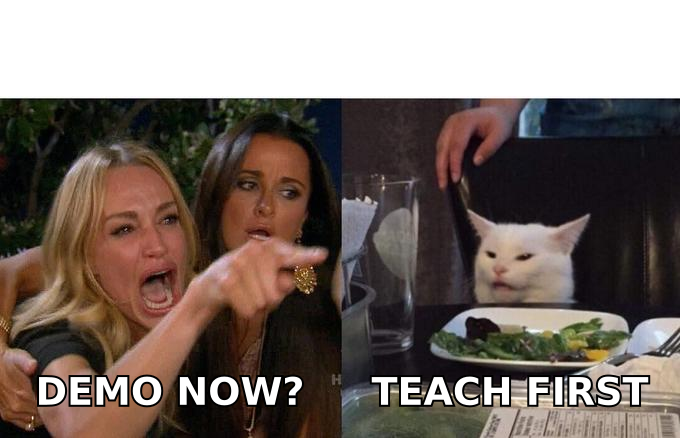
- It is not content marketing with a sales badge. Educational selling happens one-to-one, inside the deal, with a specific person's numbers on the table.
- It fails in three predictable ways: teaching things buyers already know, teaching for too long without asking for a decision, and teaching the wrong person.
- The unlock is contact-level accuracy. A brilliant teaching sequence sent to a stale, unverified list still lands in spam.
What is the educational selling approach?#
The educational selling approach is a sales method where your primary unit of value in every interaction is a piece of knowledge the buyer did not have, framed against their specific situation — and the ask comes only after the frame has shifted.
Think of a good mechanic. A bad one says "you need new brakes, $600." A good one shows you the worn pad next to a new one, explains that you have maybe 2,000 miles left, and tells you what happens to the rotor if you wait. You buy the brakes either way. But in the second case you understood the purchase, and you come back next year.
That is the whole idea. Educational selling shifts the seller's job from persuasion to comprehension. You are not arguing that your product is better. You are making the buyer's decision criteria sharper, and accepting the risk that sharper criteria might disqualify you.
Three things separate it from adjacent ideas:
- It is one-to-one, not one-to-many. A blog post is content marketing. A 6-minute Loom walking through this prospect's checkout funnel and flagging three leaks is educational selling.
- It carries commercial intent openly. You are not pretending to be a disinterested academic. You teach, then you ask. Hiding the ask is what makes "value-add" outreach feel manipulative.
- It survives disqualification. If the lesson leads the buyer to conclude they don't need you this quarter, you say so. That is the price of credibility, and it is why the method compounds.
Why does educational selling work better in 2026?#
Because the buyer's information advantage flipped, and most sales playbooks never updated.
Gartner's research on the B2B buying journey has documented for years that buyers spend the majority of their purchase process in independent research and internal group discussion — with only a small slice of total time spent with any single supplier's rep. By the time a rep gets a meeting, the buyer has read the G2 category grid, watched three teardown videos, and asked their peer Slack group who they use.
So the classic discovery script — "tell me about your current process" — now costs the buyer time and returns them nothing. They already told the internet. They want to know what you know that the internet doesn't.
Two other forces pushed the same direction:
- Inbox saturation. Volume-based outbound got cheap, then got filtered. Google and Yahoo's bulk-sender requirements made sloppy sending expensive, and the differentiator moved from "how many can you send" to "does anyone want to open it."
- AI-generated sameness. Everyone now has access to a competent writing assistant. Generic personalization ("Loved your post about scaling!") is now free, therefore worthless. Actual proprietary insight — from your product data, your customer base, your category experience — is the only thing that can't be cheaply replicated.

How does educational selling compare to other sales methodologies?#
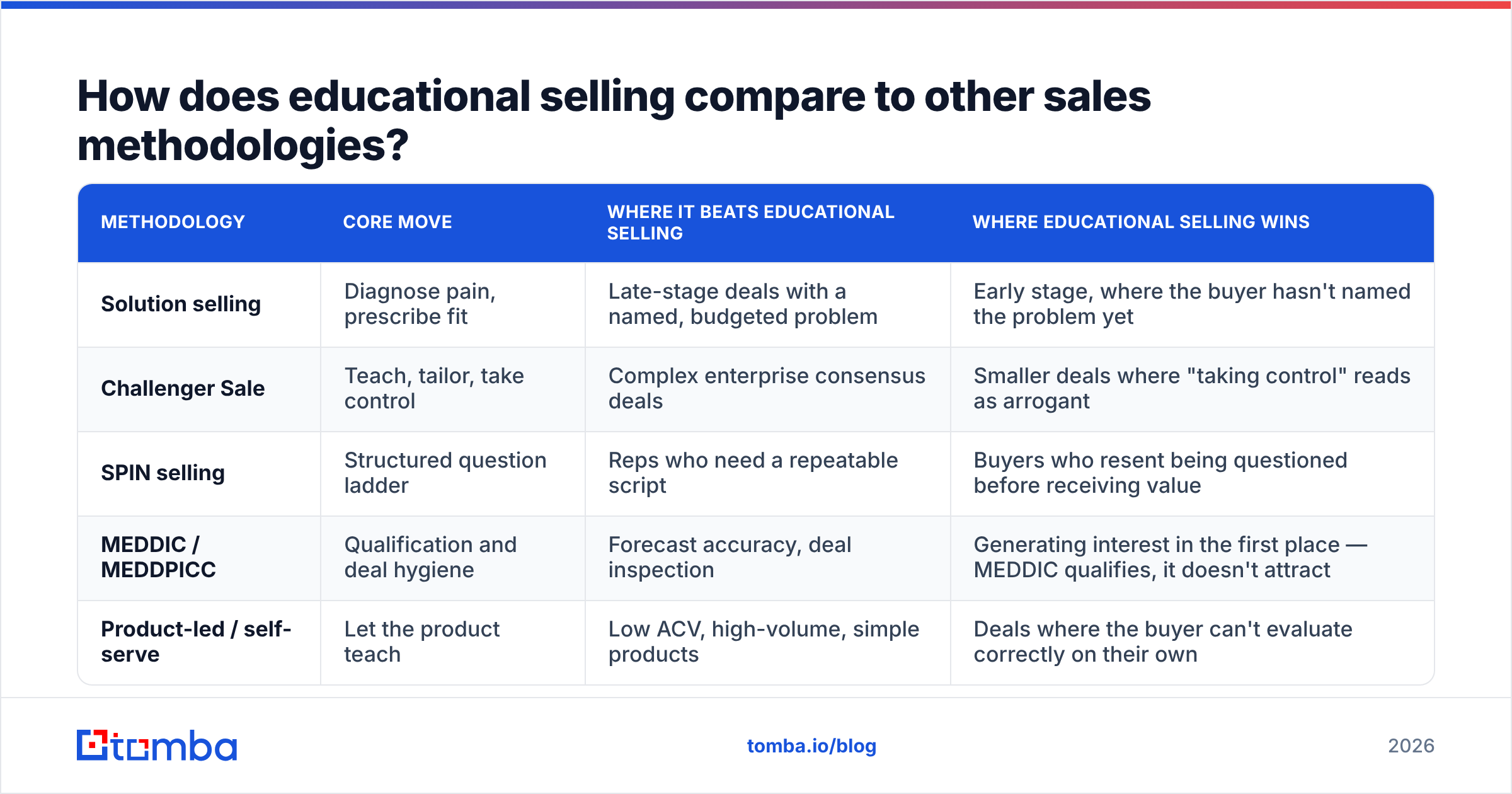
It borrows from several and conflicts with none of them badly. The honest comparison:
| Methodology | Core move | Where it beats educational selling | Where educational selling wins |
|---|---|---|---|
| Solution selling | Diagnose pain, prescribe fit | Late-stage deals with a named, budgeted problem | Early stage, where the buyer hasn't named the problem yet |
| Challenger Sale | Teach, tailor, take control | Complex enterprise consensus deals | Smaller deals where "taking control" reads as arrogant |
| SPIN selling | Structured question ladder | Reps who need a repeatable script | Buyers who resent being questioned before receiving value |
| MEDDIC / MEDDPICC | Qualification and deal hygiene | Forecast accuracy, deal inspection | Generating interest in the first place — MEDDIC qualifies, it doesn't attract |
| Product-led / self-serve | Let the product teach | Low ACV, high-volume, simple products | Deals where the buyer can't evaluate correctly on their own |
Educational selling is closest to the Challenger Sale, and the two are often confused. The difference is temperature. Challenger prescribes constructive tension — you tell the buyer they're wrong. Educational selling prescribes clarity — you show the buyer something and let them conclude they were wrong. Same destination, less friction, and it works for reps who aren't naturally confrontational (which is most of them).
Layer it on top of MEDDIC rather than replacing it. Teaching creates the opportunity; qualification decides whether you should spend 40 hours on it.
What does an educational selling motion actually look like?#
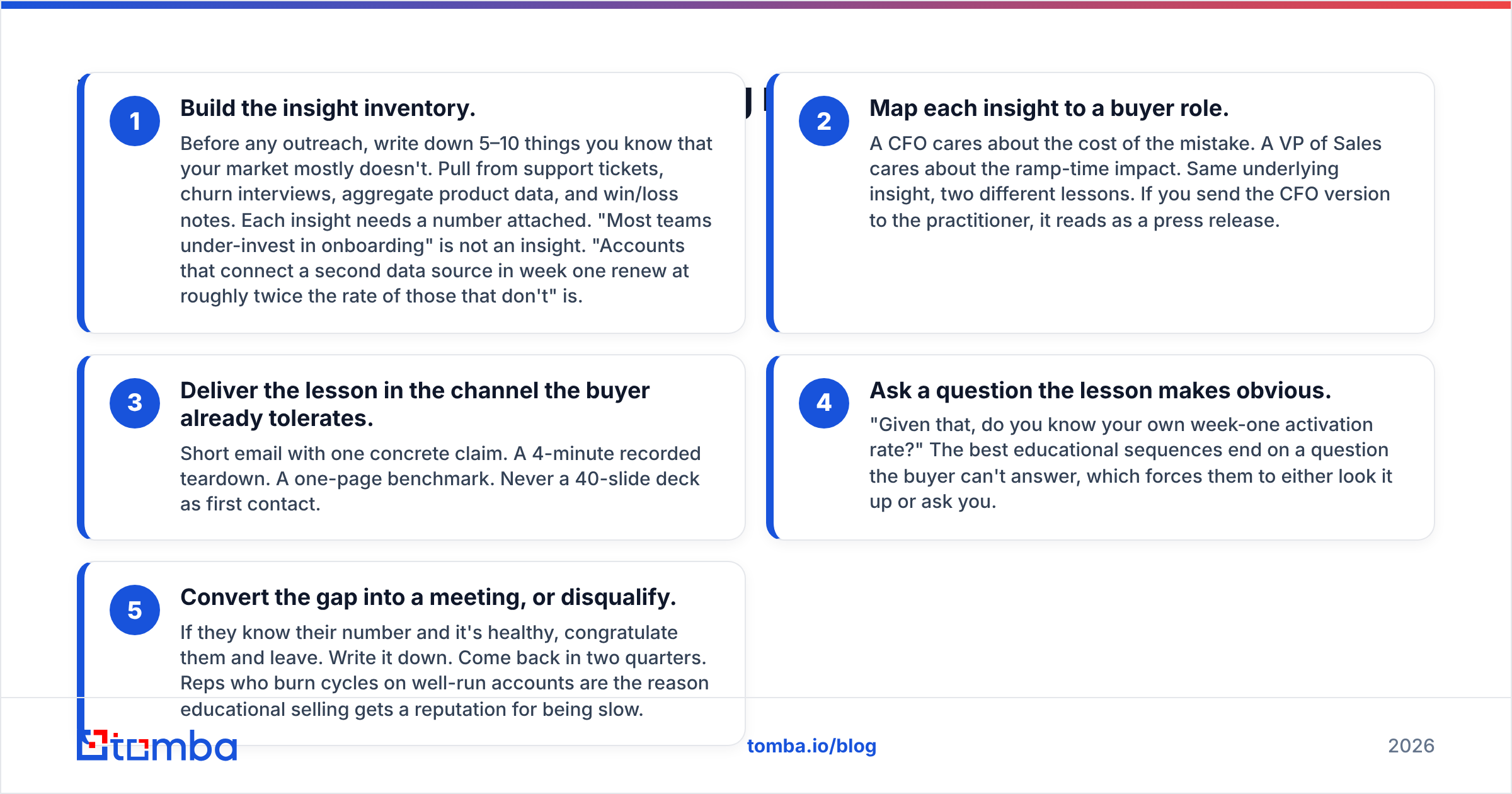
Five steps, in order. Skipping step one is why most attempts fail.
- Build the insight inventory. Before any outreach, write down 5–10 things you know that your market mostly doesn't. Pull from support tickets, churn interviews, aggregate product data, and win/loss notes. Each insight needs a number attached. "Most teams under-invest in onboarding" is not an insight. "Accounts that connect a second data source in week one renew at roughly twice the rate of those that don't" is.
- Map each insight to a buyer role. A CFO cares about the cost of the mistake. A VP of Sales cares about the ramp-time impact. Same underlying insight, two different lessons. If you send the CFO version to the practitioner, it reads as a press release.
- Deliver the lesson in the channel the buyer already tolerates. Short email with one concrete claim. A 4-minute recorded teardown. A one-page benchmark. Never a 40-slide deck as first contact.
- Ask a question the lesson makes obvious. "Given that, do you know your own week-one activation rate?" The best educational sequences end on a question the buyer can't answer, which forces them to either look it up or ask you.
- Convert the gap into a meeting, or disqualify. If they know their number and it's healthy, congratulate them and leave. Write it down. Come back in two quarters. Reps who burn cycles on well-run accounts are the reason educational selling gets a reputation for being slow.
Which assets do you need before you launch?#
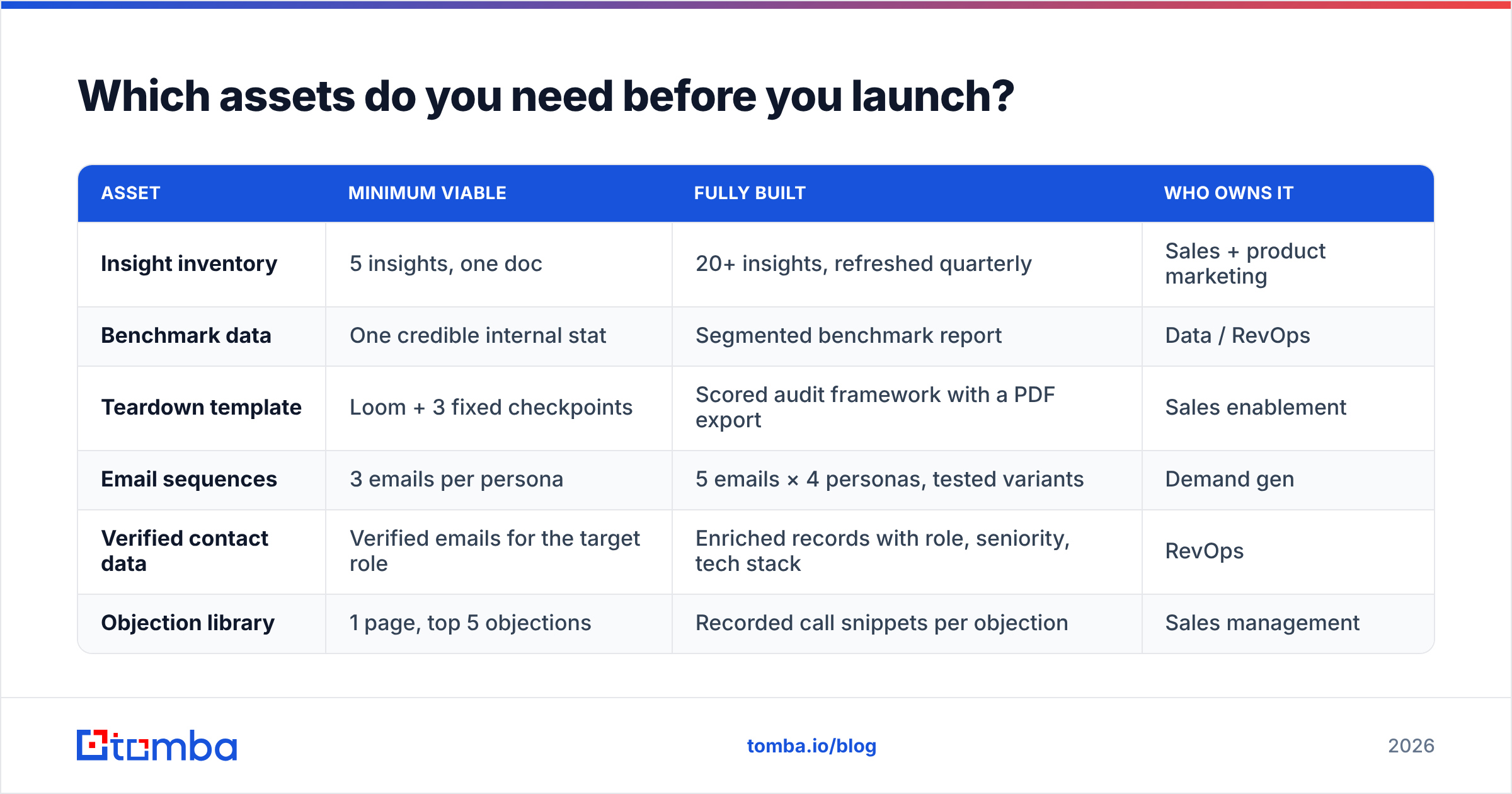
You need less than most enablement teams claim. Here is a realistic minimum kit versus the gold-plated version:
| Asset | Minimum viable | Fully built | Who owns it |
|---|---|---|---|
| Insight inventory | 5 insights, one doc | 20+ insights, refreshed quarterly | Sales + product marketing |
| Benchmark data | One credible internal stat | Segmented benchmark report | Data / RevOps |
| Teardown template | Loom + 3 fixed checkpoints | Scored audit framework with a PDF export | Sales enablement |
| Email sequences | 3 emails per persona | 5 emails × 4 personas, tested variants | Demand gen |
| Verified contact data | Verified emails for the target role | Enriched records with role, seniority, tech stack | RevOps |
| Objection library | 1 page, top 5 objections | Recorded call snippets per objection | Sales management |
The row people underestimate is contact data. An educational sequence takes real effort per persona, so wasting it on a bounced address or the wrong job title is expensive in a way that spray-and-pray outbound never was. Get the target's address right with an email finder, confirm deliverability with an email verifier, and use data enrichment to confirm the role actually matches the version of the lesson you're about to send.
How do you write a teaching-first cold email?#
Four constraints. Break any of them and it reverts to a pitch.
- Open with the claim, not with yourself. No "I'm reaching out because." First sentence is the fact.
- Attach a number. Vague teaching is indistinguishable from flattery.
- Make the relevance explicit in one clause. "Because you're running self-serve and sales-assisted side by side, this hits you harder than most."
- Close with a question, not a calendar link. The link goes in reply two, once they've engaged with the idea.
A working shape:
Teams running self-serve and sales-assisted motions on the same pricing page convert about a third worse on the assisted path, because the self-serve price anchors the deal before the rep ever quotes.
Saw you're doing both on /pricing. Do you know your assisted-path close rate versus self-serve conversion? Most teams don't split the reporting, so the leak stays invisible.
Happy to send the two-line query we use to separate them.
Note what's absent: no company boilerplate, no "quick call," no three paragraphs about your Series B. If you want a starting library to adapt, the cold email templates collection is a reasonable base — but the insight must be yours, or the whole method collapses.
How do you measure whether educational selling is working?#
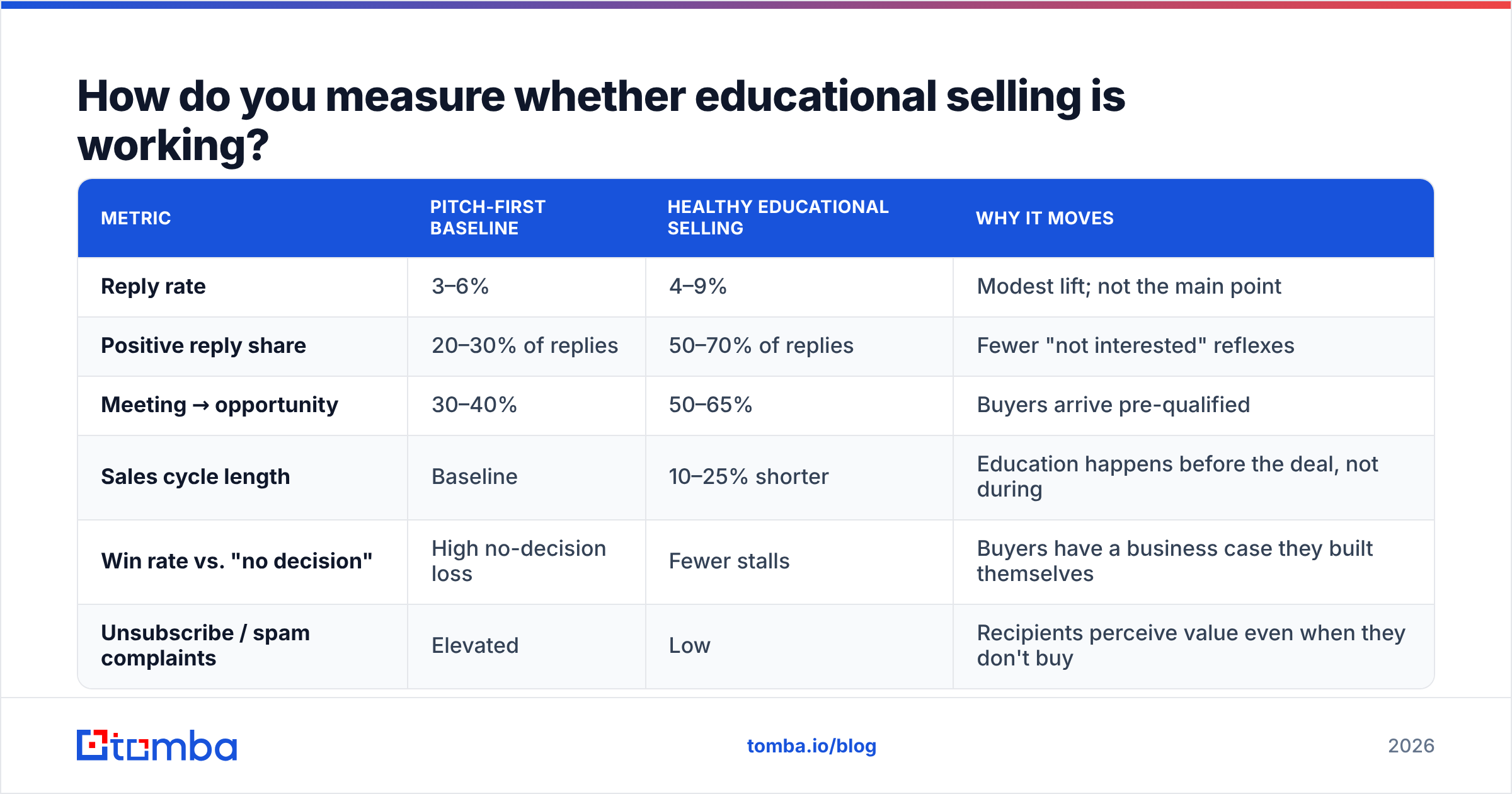
The trap is judging it on reply rate alone. Educational sequences often produce fewer replies than aggressive ones, but far better ones. Track the funnel, not the top.
| Metric | Pitch-first baseline | Healthy educational selling | Why it moves |
|---|---|---|---|
| Reply rate | 3–6% | 4–9% | Modest lift; not the main point |
| Positive reply share | 20–30% of replies | 50–70% of replies | Fewer "not interested" reflexes |
| Meeting → opportunity | 30–40% | 50–65% | Buyers arrive pre-qualified |
| Sales cycle length | Baseline | 10–25% shorter | Education happens before the deal, not during |
| Win rate vs. "no decision" | High no-decision loss | Fewer stalls | Buyers have a business case they built themselves |
| Unsubscribe / spam complaints | Elevated | Low | Recipients perceive value even when they don't buy |
Two measurement rules. First, hold volume constant when you test — halving send volume and improving response rate proves nothing. Second, wait a full sales cycle before judging. Educational selling front-loads effort and back-loads results, which is exactly the shape that gets programs killed at week six.

Where does the educational selling approach fail?#
Four failure modes, all of them common:
- Teaching what the buyer already knows. If your insight appears in the first page of search results, it isn't an insight. This is the single biggest killer, and it usually happens when marketing hands sales a "thought leadership" one-pager built from public sources.
- Endless teaching, no ask. Some reps get comfortable being helpful and never convert. Set a rule: by the third value touch, there is an explicit ask. Helpfulness without commercial clarity trains buyers to consume you for free.
- Wrong altitude. Teaching a Director-level buyer about board-level strategy is condescending; teaching a CRO about API rate limits is irrelevant. Match the lesson to the role's actual decision.
- Bad data underneath it. You can write the best teardown of your career and still hit a role that changed jobs eight months ago. Educational selling has a higher cost per touch, which raises the penalty for stale records. HubSpot's research on sales and marketing performance has repeatedly flagged data quality as a top constraint on outbound results, and that constraint gets sharper as per-touch effort rises.
Who should not use this approach?#
Be honest about fit. Educational selling is a poor choice when:
- The purchase is genuinely simple. Nobody needs a teardown to buy a $12/month utility. Let the product sell itself.
- You have no proprietary knowledge. If you're reselling a commodity with no unique data or category view, you'll end up recycling competitor blog posts. Build the knowledge first, or compete on price and service instead.
- The buyer is in active RFP mode. Once procurement is running a formal process, teaching reads as an attempt to reshape criteria mid-flight. Some vendors pull it off; most look like they're stalling.
- Your quota horizon is 30 days. This method pays out over a quarter or two. If you need pipeline by Friday, run a direct offer, then build the educational program in parallel.
For everyone else — considered purchases, multiple stakeholders, a real chance the buyer misdiagnoses their own problem — it is the highest-leverage change most B2B teams can make to their outbound.
How do you build a 90-day educational selling program?#
Days 1–15 — Mine the insights. Interview your five best customers and your three most recent churns. Pull three aggregate stats from your own product data that no competitor can see. Write the insight inventory. Kill anything without a number.
Days 16–30 — Build the contact layer. Define two target personas precisely, including seniority and function. Build the list, verify every address, and enrich with the fields your lesson depends on. Do not start sending against an unverified list; the effort-to-bounce ratio makes it the most expensive mistake in the program.
Days 31–60 — Run one persona, one insight. Resist the urge to launch four sequences. One persona, one insight, 150 contacts, five touches. Record every reply verbatim in a shared doc — those objections become your next round of insights.
Days 61–90 — Read the funnel and expand. Compare positive-reply share and meeting-to-opportunity rate against your pitch-first control. If positive-reply share hasn't roughly doubled, the insight is the problem, not the copy. Rewrite the insight before you rewrite the subject line.
Then repeat with persona two. A mature program runs four to six insight-persona pairs simultaneously, retired and refreshed every couple of quarters as the market catches up to what you know.
Ready to build the list your teaching deserves?#
Educational selling only pays off when the lesson reaches the right inbox. Start with Tomba Email Finder to get verified, role-accurate contacts for the exact personas your insights are written for — the free tier gives you 25 searches a month to test the motion, with Starter at $49/mo and Growth at $99/mo when you're ready to scale it. Full details are on the Tomba pricing page. Write the insight once, send it to people who actually exist, and let the teaching do the selling.
Related guides#
Ready to find emails that actually work?
Join 150,000+ professionals who stopped guessing and started sending. Free credits on signup — no credit card required.
Get the Tomba newsletter
Practical outbound tactics and product updates — once every two weeks.
About the author