eGrabber vs SeamlessAI (2026): Which B2B Data Tool Wins?
eGrabber sells desktop-licensed list building. Seamless.AI sells an AI-powered contact database with unlimited-sounding credits. We tested how both actually behave on pricing, accuracy, and workflow — and where a cheaper API beats both.
eGrabber vs SeamlessAI is a choice between two business models. eGrabber sells a desktop licence, one seat at a time. SeamlessAI sells cloud credits, one user at a time. Below: what each costs, how clean the data is, and where a plain API beats both.
TL;DR
- eGrabber (LeadGrabber Pro, eMail-Prospector) is desktop software. You buy it per seat, per year, and list price for LeadGrabber Pro starts near $3,500. It scrapes and appends from public sources on your own machine. Windows only, and no real API.
- Seamless.AI is a cloud contact database with an AI "real-time search" pitch and credit packs. Pricing is quote-driven. Public reports put teams at $147–$300 per user per month once you leave the free 50-credit tier.
- Accuracy is the real differentiator. eGrabber guesses patterns, then verifies them. Seamless.AI returns more volume with less consistent precision. Both need an independent verify step before you send.
The rest of the buying case comes down to fit:
- Neither is API-first. If your workflow lives in a CRM, a script, or a spreadsheet, a metered email-finding API (Tomba at $49/mo Starter) costs a fraction. It drops into the pipeline you already have.
- Pick eGrabber if you build lists by hand from LinkedIn or Sales Navigator on Windows. Pick Seamless.AI if you want a big searchable database with phone coverage. Pick an API if you want per-record pricing and automation.
eGrabber vs SeamlessAI: what each tool actually is#
They solve the same job — get contact data for people you want to sell to — with opposite architectures.
eGrabber has been around since the 1990s. Its flagship, LeadGrabber Pro, is a Windows desktop application. You browse a LinkedIn search, a conference attendee page, or a directory, and LeadGrabber captures names, titles, and companies into a grid. It then appends business email and phone by combining pattern inference with live verification. eMail-Prospector is the lighter, append-only sibling. The licence is annual and per seat, and the credits for append are bundled in tiers.
Seamless.AI launched in 2015 and sells the opposite model: a hosted database plus a Chrome extension, with an "AI search engine for B2B leads" positioning. You search by title, industry, revenue, tech stack, or geography, and it returns contacts with emails and mobile numbers you unlock with credits. There's a free tier (50 credits) and paid tiers that are quote-gated.
The practical difference: eGrabber puts the work on your desktop and your list; Seamless.AI puts the work on their index and your credit balance.
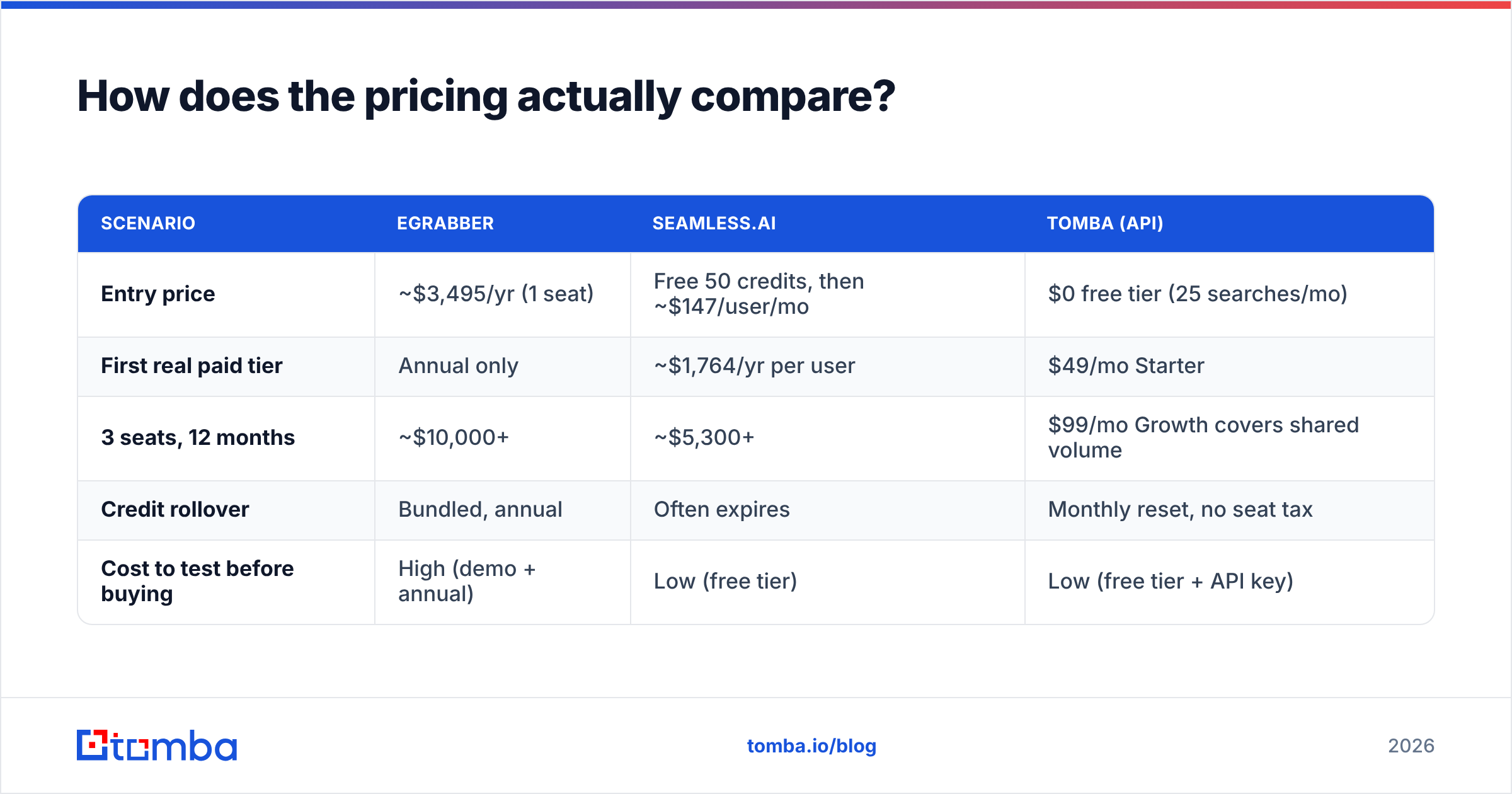
| Dimension | eGrabber (LeadGrabber Pro) | Seamless.AI |
|---|---|---|
| Delivery model | Windows desktop app, per-seat licence | Cloud app + Chrome extension |
| Pricing shape | ~$3,495–$5,000/yr per seat (list) | Free 50 credits; paid ~$147–$300/user/mo, quote-based |
| Core motion | Capture a list you found, then append | Search their database, then unlock |
| Phone data | Yes, bundled append credits | Yes, mobile numbers are a strength |
| Email verification | Built-in verify pass | Basic; independent verify recommended |
| API access | Minimal / not the product | Available on higher tiers |
| Team collaboration | Weak (local files per seat) | Native (shared lists, seats) |
| Contract | Annual, upfront | Annual push, monthly possible |
| Best for | Solo researcher on Windows | SDR teams needing volume + dials |

How does the pricing actually compare?#
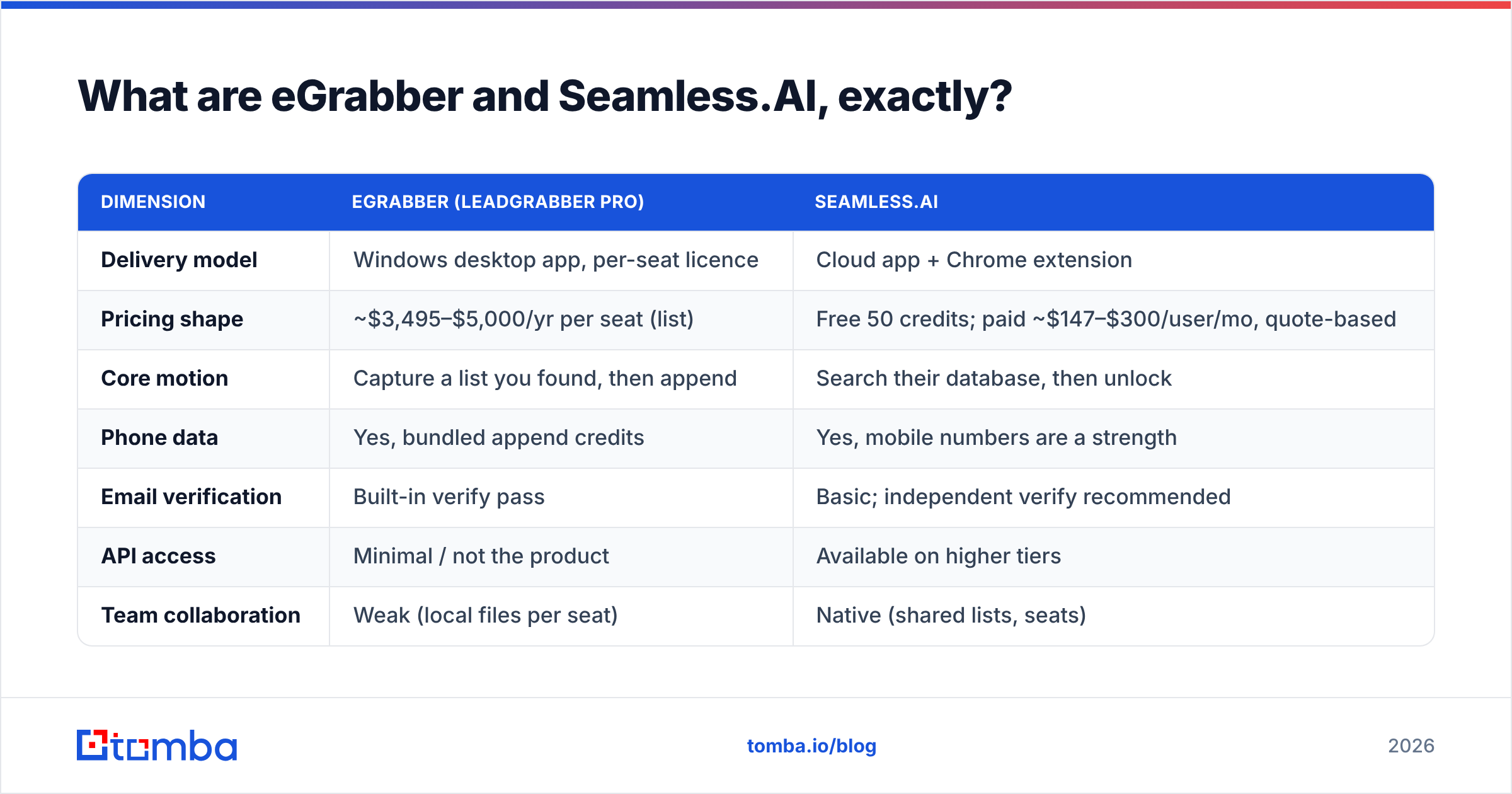
On price, eGrabber vs SeamlessAI is hard to compare head to head. Both vendors hide the number, for different reasons.
eGrabber publishes list prices and then discounts hard on calls. LeadGrabber Pro's list price sits in the mid-thousands per year per seat. Tiers are defined by how many append credits are bundled. That is a big up-front bet: you pay before you know whether the data fits your ICP. There's no monthly escape hatch either — you buy a year.
Seamless.AI doesn't publish tiers at all beyond the free 50-credit account. Reported deal sizes on G2 and Capterra cluster around $147/user/month for Basic, and materially more for Pro with higher credit allocations. The common complaint in reviews is not the headline price. It is renewal, cancellation, and credits that expire.
Here's the comparison people actually need — cost per usable contact:
| Scenario | eGrabber | Seamless.AI | Tomba (API) |
|---|---|---|---|
| Entry price | ~$3,495/yr (1 seat) | Free 50 credits, then ~$147/user/mo | $0 free tier (25 searches/mo) |
| First real paid tier | Annual only | ~$1,764/yr per user | $49/mo Starter |
| 3 seats, 12 months | ~$10,000+ | ~$5,300+ | $99/mo Growth covers shared volume |
| Credit rollover | Bundled, annual | Often expires | Monthly reset, no seat tax |
| Cost to test before buying | High (demo + annual) | Low (free tier) | Low (free tier + API key) |
Two things fall out of that table. First, Seamless.AI is cheaper to start, but it scales by seat, so it punishes you as the team grows. Second, eGrabber's per-seat annual model is brutal for teams. It is still reasonable for one dedicated researcher who builds lists all day. Neither vendor charges by the thing you actually consume: a verified email. That is why Tomba pricing tends to undercut both when you model it per record.
Which one has better email accuracy?#
Honest answer: neither publishes an audited number you should trust, and both degrade on the same segments.
eGrabber's approach is inference-plus-verification. It knows the common company email pattern shapes (first.last@, flast@, first@) and tests candidates against the mail server. That works well on mid-market and enterprise domains with standard MX setups. It falls apart on catch-all domains, where SMTP always answers yes. Every tool in this category shares that gap. Use a dedicated catch-all verifier rather than trusting a green checkmark.
Seamless.AI's approach is index-plus-AI-scoring. Coverage is genuinely broad, especially for US mid-market and for mobile numbers. The tradeoff shows up in review threads. Users report contacts no other tool surfaced, alongside batches with stale titles and dead mailboxes. Volume and precision trade against each other, and Seamless.AI leans volume.
What both mean for you operationally:
- Never send off a single tool's output. Run every list through an independent email verifier before it touches your sequencer. A 4% bounce rate is enough to damage sender reputation.
- Treat catch-all domains as a separate bucket. Route them to LinkedIn or phone rather than cold email, or verify them with a tool built for the case.
- Check title freshness, not just deliverability. An email can land and still reach someone who changed roles nine months ago. That wastes the same slot in your sequence.
Two habits that pay off at renewal time:
- Sample before you commit. Pull 100 contacts from your exact ICP on both free tiers, verify externally, and compare. Vendor accuracy claims are marketing; your ICP sample is data.
- Log bounce reasons by source. Once you can attribute bounces to a vendor, renewal negotiations get easy.
Suggested visual: side-by-side of LeadGrabber Pro's append grid and Seamless.AI's search results panel, both showing the same 10-company sample.
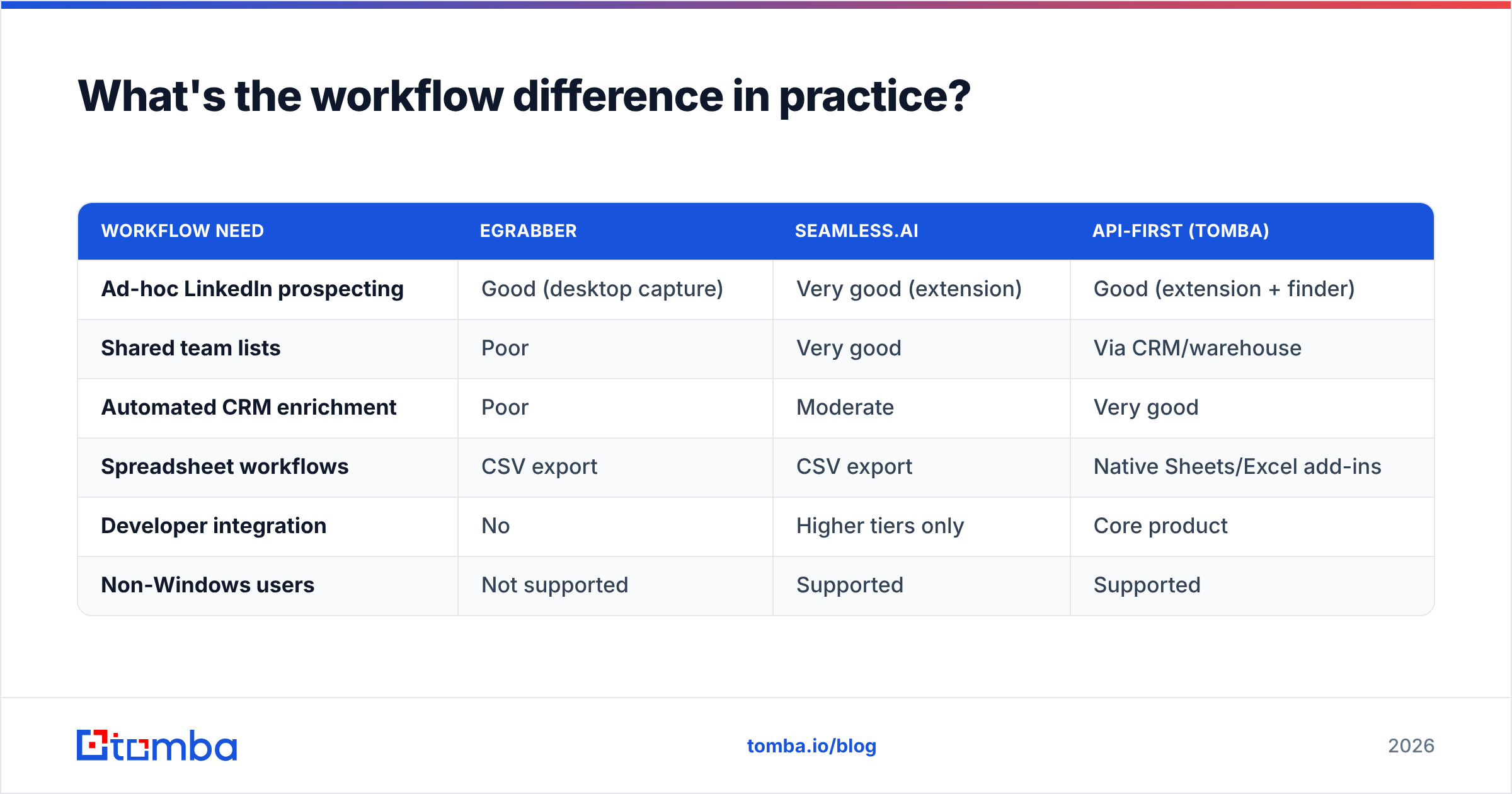
What's the workflow difference in practice?#
This is where the two tools stop being comparable.
eGrabber's loop is manual and local. You find a list somewhere — a Sales Navigator search, an association member directory, a webinar attendee page. You capture it. LeadGrabber appends. You export CSV. You import to your CRM. Every step happens on one Windows machine, and the output lives in files. If your researcher is out, the pipeline stops. If you want the same enrichment inside HubSpot automatically, you're writing a Zap around a CSV, not calling an endpoint.
Seamless.AI's loop is cloud-native but seat-bound. Reps search, unlock, push to CRM via the native HubSpot or Salesforce integration, and work the list in their sequencer. That is better for teams, and the Chrome extension makes LinkedIn prospecting fast. The friction is credits. Reps burn them exploring, and exploring is how you find good segments. Managers end up rationing search, which is exactly backwards.
The API loop is neither. You define the trigger — new account in CRM, new signup domain, new list row — and enrichment happens without a human. This is what most teams want by year two, and it's the axis where both eGrabber and Seamless.AI are weakest. A domain search call returns every public email pattern at a company. A bulk email finder run handles the 5,000-row backlog overnight.
| Workflow need | eGrabber | Seamless.AI | API-first (Tomba) |
|---|---|---|---|
| Ad-hoc LinkedIn prospecting | Good (desktop capture) | Very good (extension) | Good (extension + finder) |
| Shared team lists | Poor | Very good | Via CRM/warehouse |
| Automated CRM enrichment | Poor | Moderate | Very good |
| Spreadsheet workflows | CSV export | CSV export | Native Sheets/Excel add-ins |
| Developer integration | No | Higher tiers only | Core product |
| Non-Windows users | Not supported | Supported | Supported |
Is Seamless.AI better than eGrabber for outbound teams?#
For most SDR teams in 2026, yes — with caveats.
Seamless.AI wins on the things a team cares about: shared access, browser-based work, phone coverage, and CRM push. eGrabber's per-seat desktop model was built for an era when one person owned list building. If you have four SDRs who each need to prospect, four eGrabber licences is a five-figure line item for software that cannot share a list.
eGrabber wins in two specific situations. First, when your source lists are weird — obscure directories, PDF attendee lists, association rosters — its capture engine handles messy HTML better than a database that simply lacks those people. Second, when you have one dedicated researcher and compliance rules that make cloud contact databases a problem. Local processing is an easier conversation with legal.
If you're evaluating Seamless.AI specifically, read the renewal terms carefully. The most consistent negative theme in third-party reviews is contract friction, not data quality. Ask for month-to-month in writing. Ask what happens to unused credits. Ask for a written accuracy guarantee on a sample.
What are the honest alternatives to both?#
The category has more shape than a two-way fight suggests.
- Apollo.io — database plus sequencer plus dialer. Broad, cheap per seat, accuracy varies by segment. If you want one tool for data and sending, start here. See our Apollo alternative breakdown for the tradeoffs.
- BookYourData — pay-as-you-go prebuilt lists with a stated accuracy guarantee and no subscription. A strong fit when you want a clean one-off list for a defined segment, and the credit model is refreshingly simple.
- RocketReach — solid coverage, simple pricing, weaker automation. A reasonable Seamless.AI substitute for individual reps. Compare on the RocketReach alternative page.
Two more worth naming:
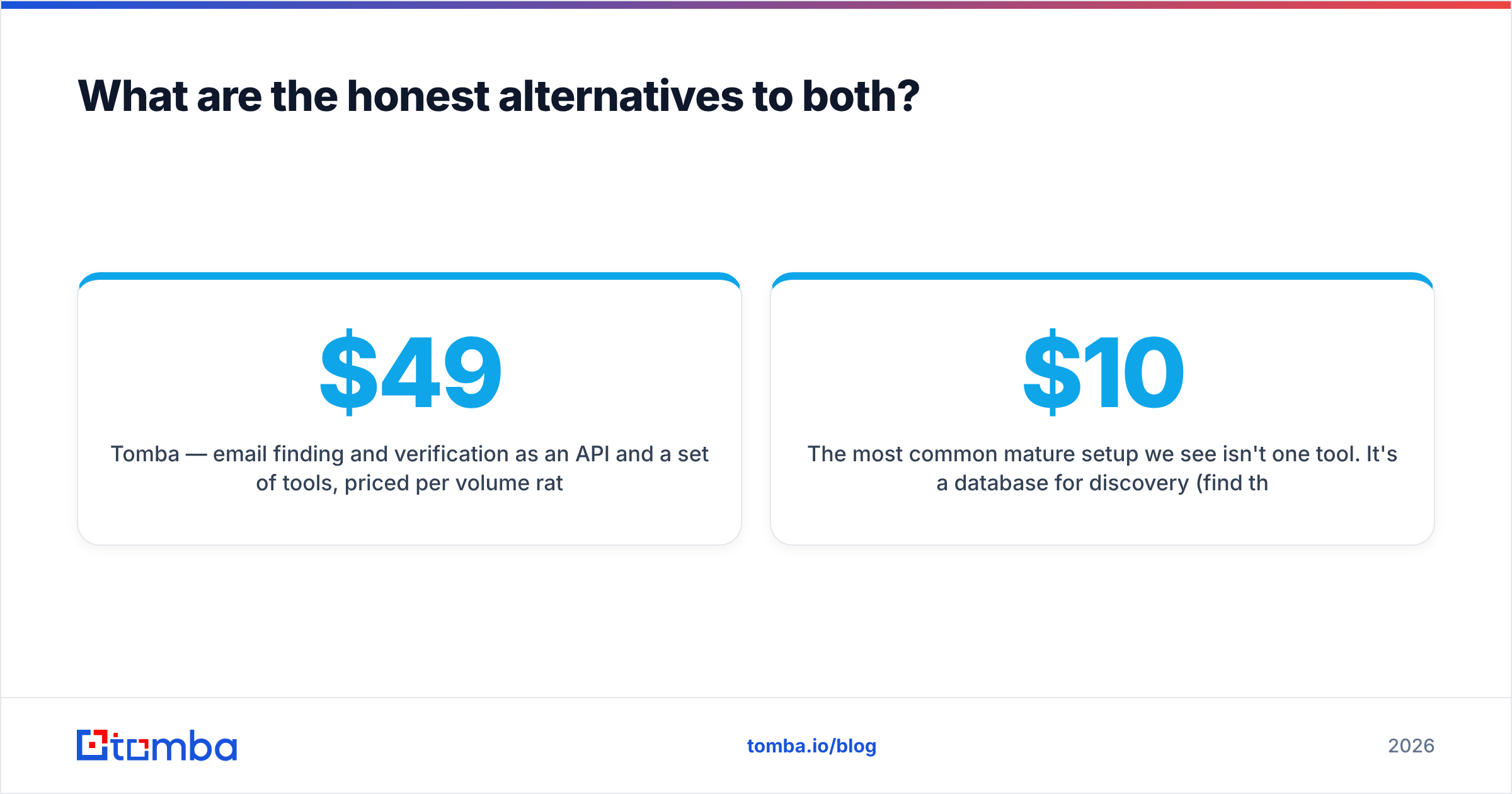
- Tomba — email finding and verification as an API and a set of tools, priced per volume rather than per seat: Free (25 searches/mo), Starter $49/mo, Growth $99/mo, Pro $249/mo. No database seat tax, no annual lock, and a real email finder API with a CLI and MCP server for agent workflows.
- Seamless.AI alternatives generally — if your objection is credit anxiety rather than data quality, a metered API removes the anxiety. You can see exactly what a lookup costs.
The most common mature setup we see isn't one tool. It is a database for discovery, plus an API for verification and enrichment. The database finds the accounts and people. The API keeps the addresses real and the CRM current. Buying one product to do both is what leads to $10,000 annual contracts that get half-used.
How should you decide?#
Run a 100-contact bake-off before you sign anything. It takes an afternoon.
- Define one narrow ICP. Not "SaaS companies" — "Head of RevOps at US SaaS companies, 50–200 employees." Narrow segments expose coverage gaps that broad ones hide.
- Pull the same 100 targets from each tool. Use eGrabber's demo, Seamless.AI's free 50 credits, and a Tomba free tier key.
- Verify all three outputs with a fourth, independent tool. Never let a vendor grade its own homework. Note catch-all rate separately from invalid rate.
Then model the money:
- Score cost per verified, correct-title contact. Not cost per credit. Not cost per seat. This is the only number that survives a renewal conversation.
- Model 12 months at your real headcount. eGrabber multiplies by seats and locks annually. Seamless.AI multiplies by seats monthly. An API multiplies by volume, which usually grows slower than headcount.
- Check the automation path. Ask each vendor how enrichment fires without a human clicking. If the answer is "export a CSV," price that human's time into the total.
Most teams that run this exercise end up buying less software than they planned. That's the point.
The verdict#
The short version of eGrabber vs SeamlessAI: neither one wins outright.
eGrabber is a specialist tool. It still earns its place with one dedicated researcher working messy sources on Windows, or where local processing simplifies compliance. The annual per-seat price makes it hard to justify for a team.
Seamless.AI is the better default for a growing SDR org that needs shared access, phone numbers, and CRM push. Negotiate the contract terms up front, and budget for independent verification.
Neither is the right answer if what you actually need is enrichment that runs without a human. That's an API problem, and it's priced an order of magnitude lower.
If your real bottleneck is getting accurate, verified business emails into the systems you already run — CRM, sequencer, spreadsheet, or your own code — start with the Tomba Email Finder. The free tier gives you 25 searches a month to test against your own ICP, Starter is $49/mo, and every lookup runs through the same verification layer rather than a separate credit pool. Test it against whatever eGrabber or Seamless.AI quotes you, on your list, and let the bounce rate decide.
Related guides#
Ready to find emails that actually work?
Join 150,000+ professionals who stopped guessing and started sending. Free credits on signup — no credit card required.
Get the Tomba newsletter
Practical outbound tactics and product updates — once every two weeks.
About the author