Elevator Speech for Sales Representative: 2026 Templates
A sales elevator speech is not a resume read aloud. Here is the 30-second structure that earns a second question, seven scripts by scenario, and the lines to delete today.
TL;DR
- A working elevator speech for a sales representative is 30 seconds or less, names one specific problem, and ends with a question — not a pitch, not a feature list, not your job title.
- The single biggest failure mode is starting with "I'm a sales rep at [Company] and we do [category]." Nobody buys a category. They react to a problem they recognize.
- Use one of four frameworks (Problem-First, Before-After-Bridge, Social Proof, Question-Led) depending on channel and how warm the listener is. They are not interchangeable.
- Write three versions of the same speech: 10 seconds, 30 seconds, 60 seconds. You will need all three within the same week.
- Delivery beats wording. Record yourself, time it, and track the reply rate — a pitch you cannot measure is a pitch you cannot fix.
What is an elevator speech for a sales representative?#
An elevator speech is a 20-to-30-second explanation of who you help, what problem you remove, and what proof you have — delivered fast enough to survive a hallway, a conference badge scan, or the first eight seconds of a cold call. The name comes from the idea of pitching someone between floors; the origin of the elevator pitch is Hollywood, not enterprise software, and it shows in how many reps still deliver it like a movie trailer.
For a sales representative specifically, the speech has a different job than a founder's pitch. A founder pitches the company. You pitch the conversation. Your goal is not to close, describe your product roadmap, or win agreement. Your goal is one thing: get permission for the next 90 seconds.
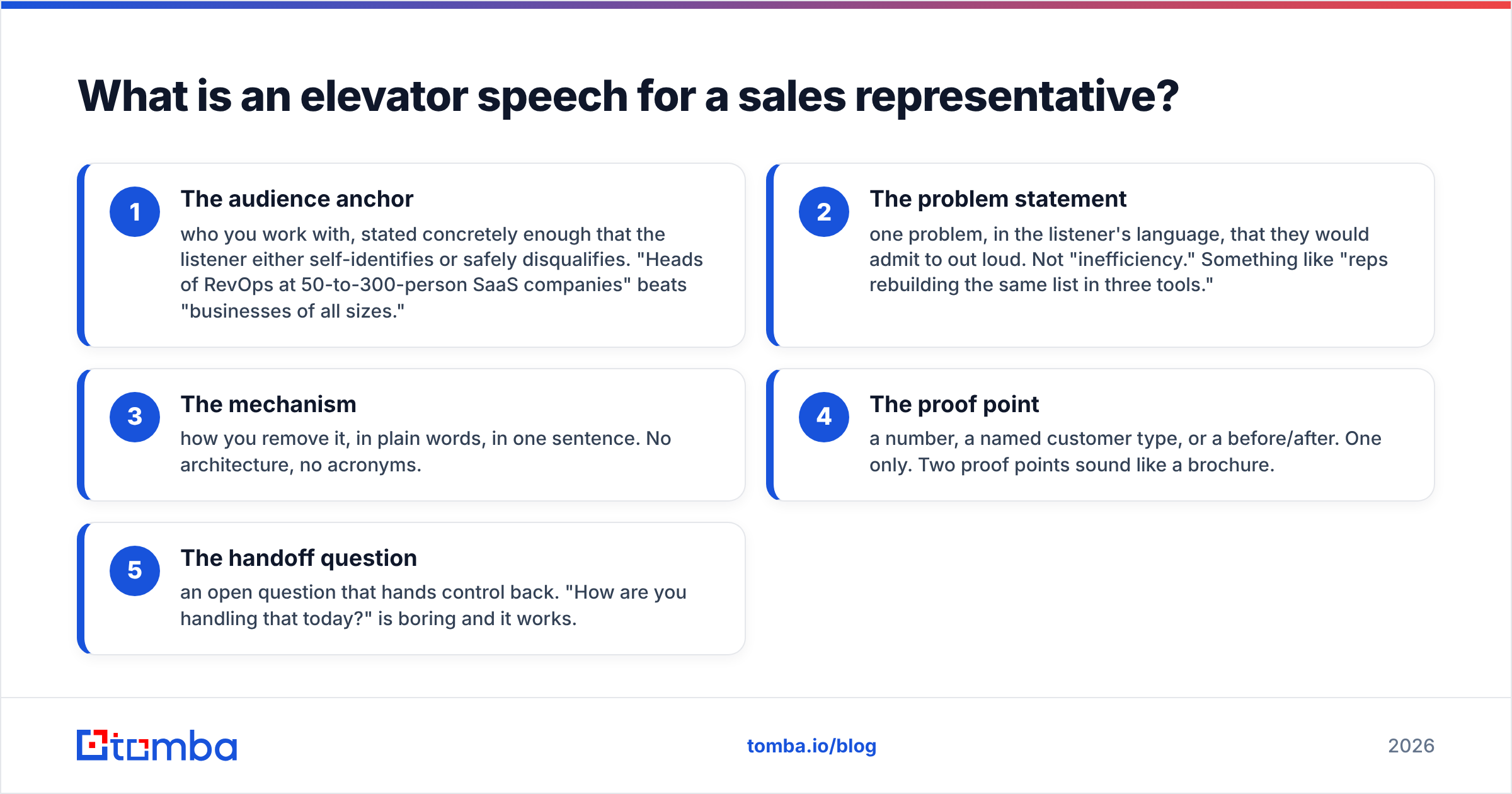
Here is what a rep-grade elevator speech contains:
- The audience anchor — who you work with, stated concretely enough that the listener either self-identifies or safely disqualifies. "Heads of RevOps at 50-to-300-person SaaS companies" beats "businesses of all sizes."
- The problem statement — one problem, in the listener's language, that they would admit to out loud. Not "inefficiency." Something like "reps rebuilding the same list in three tools."
- The mechanism — how you remove it, in plain words, in one sentence. No architecture, no acronyms.
- The proof point — a number, a named customer type, or a before/after. One only. Two proof points sound like a brochure.
- The handoff question — an open question that hands control back. "How are you handling that today?" is boring and it works.
That is it. Five parts, roughly 65 to 85 words spoken at a normal pace. Anything longer is a presentation you did not get invited to give.
Why do most sales elevator pitches fail in the first ten seconds?#
Because they are structured around the seller. The rep leads with name, company, title, and category — four facts that cost the listener attention and return nothing. By the time you reach the part that might matter, the listener has already filed you under "vendor" and started planning their exit.
The four most expensive habits, in order of damage:
- Category-first openings. "We're a sales engagement platform." The listener now has to translate a category into a problem. They won't do that work for you.
- Feature stacking. Three capabilities in one breath signals that you do not know which one they need. Pick the one that maps to the problem you just named.
- Superlatives instead of specifics. "Leading," "best-in-class," and "revolutionary" are noise. A number is not. "Cut list-building from four hours to twenty minutes" is a claim someone can argue with, which is exactly why it lands.
- No exit ramp. If your speech ends with a statement, the listener has to invent the next move. End with a question and they simply answer it.
There is also a length problem. Research summaries on buyer attention consistently point the same direction: the first sentence decides whether the rest gets heard. HubSpot's sales blog and conversation-intelligence teams like Gong have published repeatedly on how early talk-track choices predict call outcomes. The pattern is not subtle — front-load relevance or lose the floor.
What does the four-part structure look like in practice?#
Take a rep selling a data and outreach tool to mid-market sales teams. Here is the same speech at three lengths.
10 seconds (badge-scan, hallway, intro at a table): "I help mid-market sales teams stop losing half their prospecting day to bad contact data. What's your team using now?"
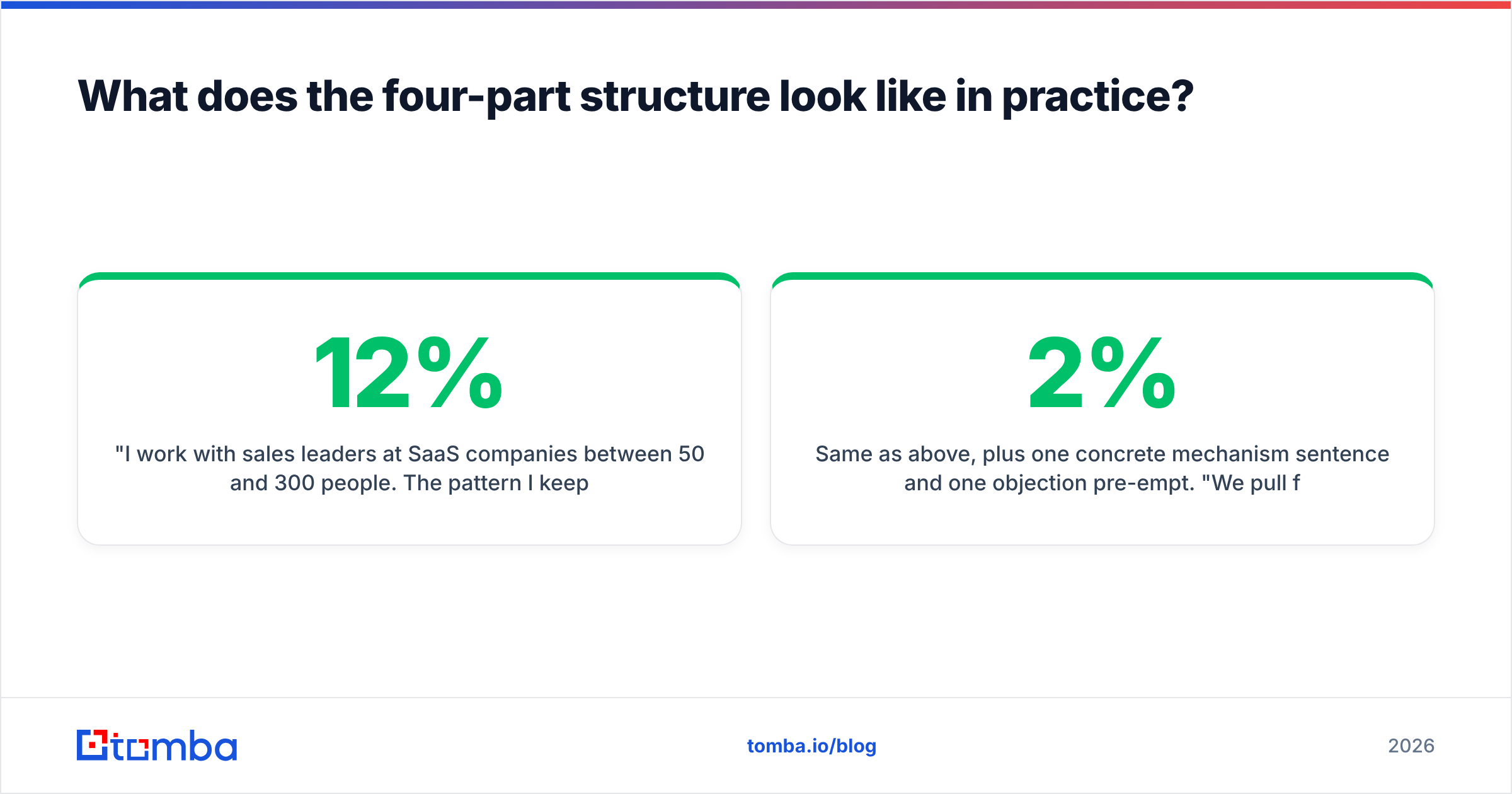
30 seconds (cold call opener, event conversation, warm intro): "I work with sales leaders at SaaS companies between 50 and 300 people. The pattern I keep hearing is that reps spend the first two hours of the day hunting for emails and phone numbers, then half of what they find bounces. We find and verify contacts before they ever hit the sequence — one team went from a 12% bounce rate to under 2% in a month. How are you handling verification today?"
60 seconds (scheduled intro call, panel question, recruiter conversation): Same as above, plus one concrete mechanism sentence and one objection pre-empt. "We pull from public sources and verify at the SMTP layer, so catch-all domains get flagged instead of guessed. Most teams I talk to already have a data vendor — the reason they still add verification is that vendor freshness decays about 2% a month, so a list that was clean in January isn't in June."
Notice what is missing: the product name, the pricing, the integrations, and the word "solution." Those belong in the conversation you just earned, not the pitch that earns it.
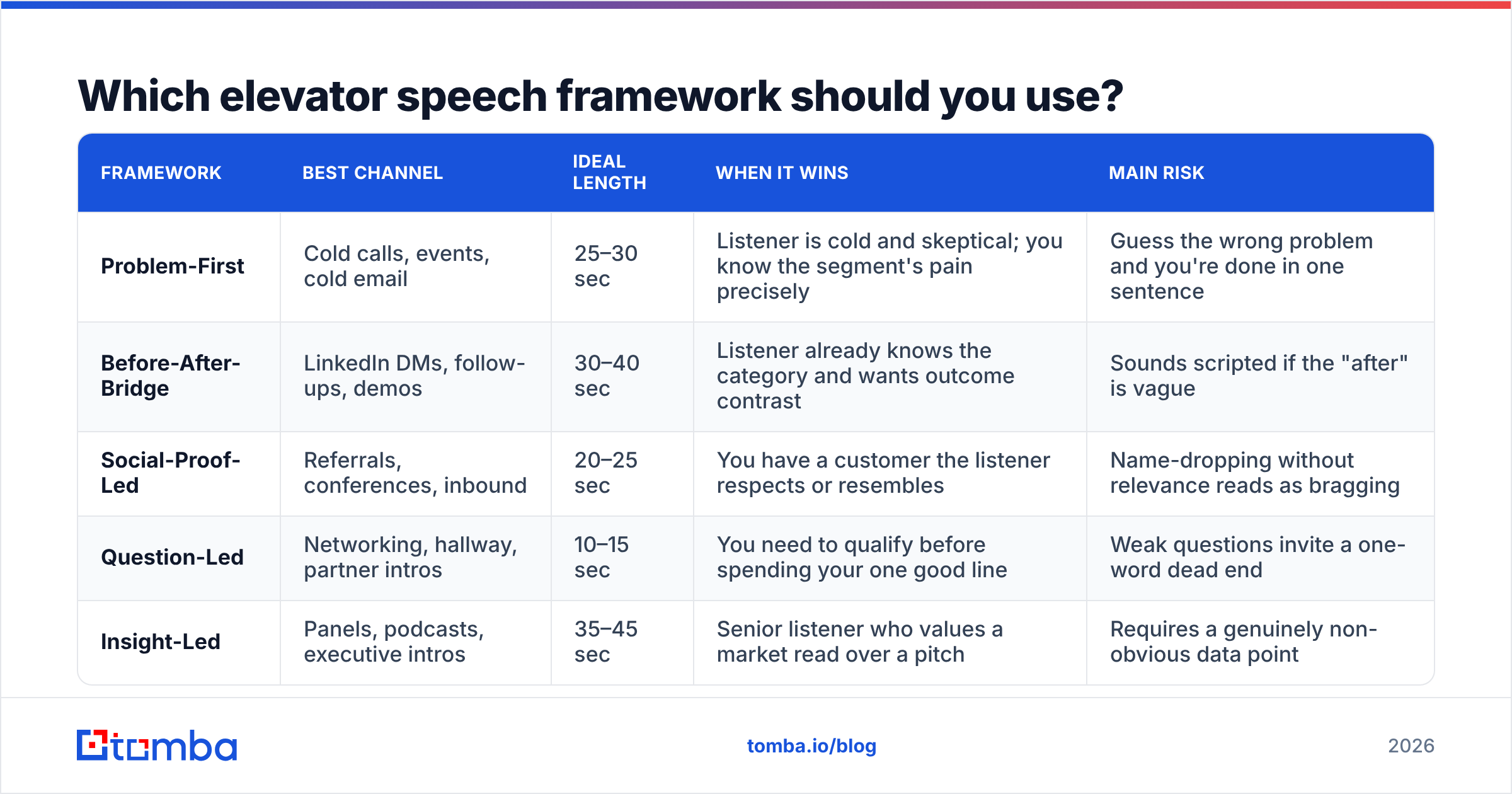
Which elevator speech framework should you use?#
Four frameworks cover almost every situation a sales rep encounters. Match the framework to the channel and the listener's temperature — a cold call and a warm referral do not deserve the same opener.
| Framework | Best channel | Ideal length | When it wins | Main risk |
|---|---|---|---|---|
| Problem-First | Cold calls, events, cold email | 25–30 sec | Listener is cold and skeptical; you know the segment's pain precisely | Guess the wrong problem and you're done in one sentence |
| Before-After-Bridge | LinkedIn DMs, follow-ups, demos | 30–40 sec | Listener already knows the category and wants outcome contrast | Sounds scripted if the "after" is vague |
| Social-Proof-Led | Referrals, conferences, inbound | 20–25 sec | You have a customer the listener respects or resembles | Name-dropping without relevance reads as bragging |
| Question-Led | Networking, hallway, partner intros | 10–15 sec | You need to qualify before spending your one good line | Weak questions invite a one-word dead end |
| Insight-Led | Panels, podcasts, executive intros | 35–45 sec | Senior listener who values a market read over a pitch | Requires a genuinely non-obvious data point |
A practical rule: if you do not know the listener's role yet, start Question-Led and switch to Problem-First the moment they tell you. If you already know the role, skip straight to Problem-First. Save Insight-Led for rooms where you are being evaluated as a thinker, not a vendor.
What are proven elevator speech examples by scenario?#
Copy the structure, replace the specifics. Do not copy the words — a script that sounds borrowed dies on delivery.
1. SDR, cold call, mid-market SaaS "Quick reason for the call — I work with SDR managers at Series B SaaS companies, and the complaint I hear most is that half the sequence volume goes to addresses that bounce or belong to someone who left. We fix the data before it enters the sequence. Is deliverability something your team is watching right now?"
2. Account executive, industry conference "I'm on the sales side at [Company]. We work with RevOps teams who've bought three tools that all claim to enrich the same record and still can't agree on a phone number. Usually we replace two of them. What does your stack look like?"
3. Agency rep, referral introduction "Ravi mentioned you're scaling outbound. The teams we work with usually come to us after a channel plateaus — good copy, decent list, replies falling anyway. Nine times out of ten it's list hygiene, not messaging. Where are you seeing the drop-off?"
4. Sales rep at a job interview or internal promotion panel "I sell into finance teams at companies where the buyer is skeptical by default. My approach is problem-first — I lead with the specific reconciliation pain, not the platform, and I've held a 34% meeting-to-opportunity rate for six quarters doing it. Want me to walk through the last deal end to end?"
5. Field rep, walk-in or trade-show booth "Thirty seconds and then I'll let you go — we help distributors who still quote from spreadsheets get pricing out same-day instead of next-week. If that's not you, ignore me. If it is, what's your current turnaround?"
6. Rep selling to non-technical SMB owners "I work with owner-operators doing between two and ten million. The thing that costs them most isn't marketing spend, it's leads sitting unanswered for two days. We close that gap. How fast does your team get back to a new inquiry?"
7. Rep re-engaging a closed-lost account "Last time we spoke, the blocker was that our coverage in EMEA was thin. That changed in March. Not asking for a meeting — just wanted to know whether EMEA data is still on your list of problems."
Number seven is the most underused speech in B2B. Reopening a closed-lost with a single changed fact converts better than most first-touch attempts, and it takes twelve seconds.
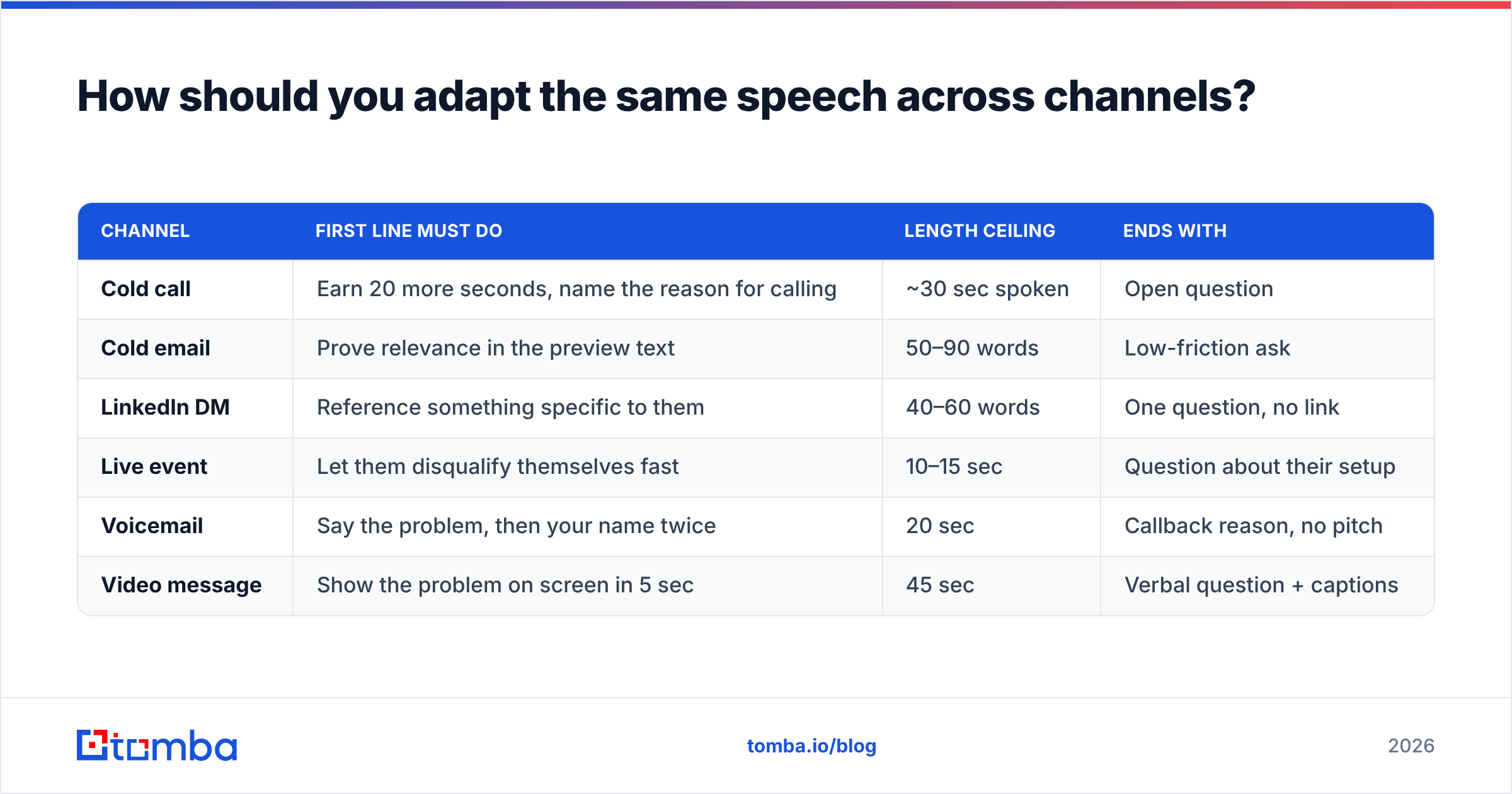
How should you adapt the same speech across channels?#
The words change less than the sequencing. Spoken channels tolerate a slower build; written channels punish it brutally.
| Channel | First line must do | Length ceiling | Ends with |
|---|---|---|---|
| Cold call | Earn 20 more seconds, name the reason for calling | ~30 sec spoken | Open question |
| Cold email | Prove relevance in the preview text | 50–90 words | Low-friction ask |
| LinkedIn DM | Reference something specific to them | 40–60 words | One question, no link |
| Live event | Let them disqualify themselves fast | 10–15 sec | Question about their setup |
| Voicemail | Say the problem, then your name twice | 20 sec | Callback reason, no pitch |
| Video message | Show the problem on screen in 5 sec | 45 sec | Verbal question + captions |
Written versions collapse the proof point and the mechanism into one clause because reading is faster than listening. If you are building the email variant, our cold email templates show the same structure compressed for inbox scanning, and the subject line generator handles the part of the pitch that decides whether the rest gets opened at all.
For phone work, the speech only matters if the number connects. Verified B2B phone numbers are the unglamorous prerequisite — a perfect 30-second opener delivered to a dead line converts at zero.
How do you practice and measure an elevator speech?#
Treat it like copy, not like personality. Copy gets tested.
- Record and time it. Phone voice memo, three takes. If take one runs 55 seconds and you intended 30, the problem is almost always two proof points instead of one.
- Read it as text. Anything you would not write in an email, cut. Spoken filler hides behind confidence and dies on transcript.
- Run the disqualify test. Would a wrong-fit listener know within eight seconds that they are wrong-fit? If not, your audience anchor is too broad and you are burning goodwill on people who cannot buy.
- Track one number per variant. For calls, it is "conversations that reach 90 seconds." For email, it is response rate. Change one element per week — the problem statement, then the proof point, then the question — and keep the winner.
- Get a peer to repeat it back. If a colleague cannot restate your problem statement after hearing it twice, no prospect will.
Reps who improve fastest do one boring thing: they keep a running list of the exact words prospects use to describe the problem, and they steal those words. Your best pitch is usually a sentence a customer already said to you on a call.
What mistakes should you cut today?#
- Saying your job title before the problem. Nobody has ever bought because someone was an "Enterprise Account Executive."
- Using your product's internal vocabulary. If the phrase only exists inside your company wiki, it does not belong in the first 30 seconds.
- Asking "do you have a few minutes to talk about..." — it invites a no and signals a script.
- Two questions at the end. One question, then silence. Silence does the work.
- Rehearsing until it is airless. The speech should sound like the fourth time you have said it today, not the four-hundredth.
- Pitching to an unqualified list. The best elevator speech in your company still fails if 40% of the contacts are stale. Data quality sets the ceiling on delivery quality — that is why email verification sits upstream of any talk-track work.
Where does data fit into a pitch conversation?#
It fits at the front, invisibly. A pitch is a function of relevance, and relevance is a function of knowing who you are talking to before you open your mouth. Reps who research one specific detail — a recent hire, a tool in the stack, a market they just entered — get to skip the generic audience anchor entirely and lead with the problem. That is a 30% shorter speech with a much higher hit rate.
Before you rehearse another opener, make sure the contacts receiving it are real and current. The Tomba Email Finder locates verified professional addresses by name, company, or domain so your best 30 seconds reaches an actual inbox instead of a bounce log. Start on the free tier with 25 searches a month, or move to Starter at $49/mo when your outbound volume outgrows it — see Tomba pricing for the full breakdown. Get the list right, and the speech has something to land on.
Related guides#
Ready to find emails that actually work?
Join 150,000+ professionals who stopped guessing and started sending. Free credits on signup — no credit card required.
Get the Tomba newsletter
Practical outbound tactics and product updates — once every two weeks.
About the author