Email A B Testing Best Practices: The 2026 Playbook
Most email A/B tests never had enough volume to prove anything. Here is how to pick variables, size your sample, run the test long enough, and call a winner you can actually trust.
TL;DR — the email A B testing best practices that survive contact with real traffic:
- Most tests fail on math, not creativity. A 200-send test cannot detect a 2-point reply-rate lift, no matter how clever the copy is.
- Test one variable at a time. Start with the variables that move money — offer, audience, and first line — before you touch button colors.
- At a 5% baseline reply rate, a +2 point lift needs roughly 1,900 sends per variant. Below that, you are reading noise.
- Deliverability and list quality contaminate results faster than copy does. Verify your list and stabilize sending before you test anything.
- Log every test, including the losers. A written test log is the only asset that compounds; individual winners decay within two quarters.
Which email A B testing best practices matter, and why do most tests fail?#
Email A/B testing splits one audience into two statistically comparable groups. Each group gets a version that differs in exactly one element. You then measure which version produces more of the outcome you care about. That sounds obvious. But almost every step gets broken in practice, which is why email A B testing best practices exist at all.
Three failures come from the setup:
- The sample is far too small. Teams call winners on 150 sends per arm. At typical B2B reply rates, that sample cannot tell a better email from a coin flip.
- Two things changed at once. Variant B has a new subject line and a new opening line and a shorter CTA. When B wins, you have learned nothing you can reuse.
- The metric is wrong. Open rate has been unreliable since Apple Mail Privacy Protection began pre-fetching images in 2021. Optimizing opens now optimizes a partly synthetic number.
Three more come from how the test is run:
- The split is not random. Sorting a list alphabetically or by import date and cutting it in half assigns different company sizes, industries, and seniority levels to each arm.
- The test ran across a confound. One variant went out Tuesday morning, the other Friday afternoon. Day-of-week beat copy, and nobody noticed.
- Nobody wrote it down. Six weeks later the team re-tests the same hypothesis, because the result lives in someone's Slack DMs.
Fix those six and you are ahead of most outbound teams, before you write a single new sentence of copy.
What should you actually test, and in what order?#
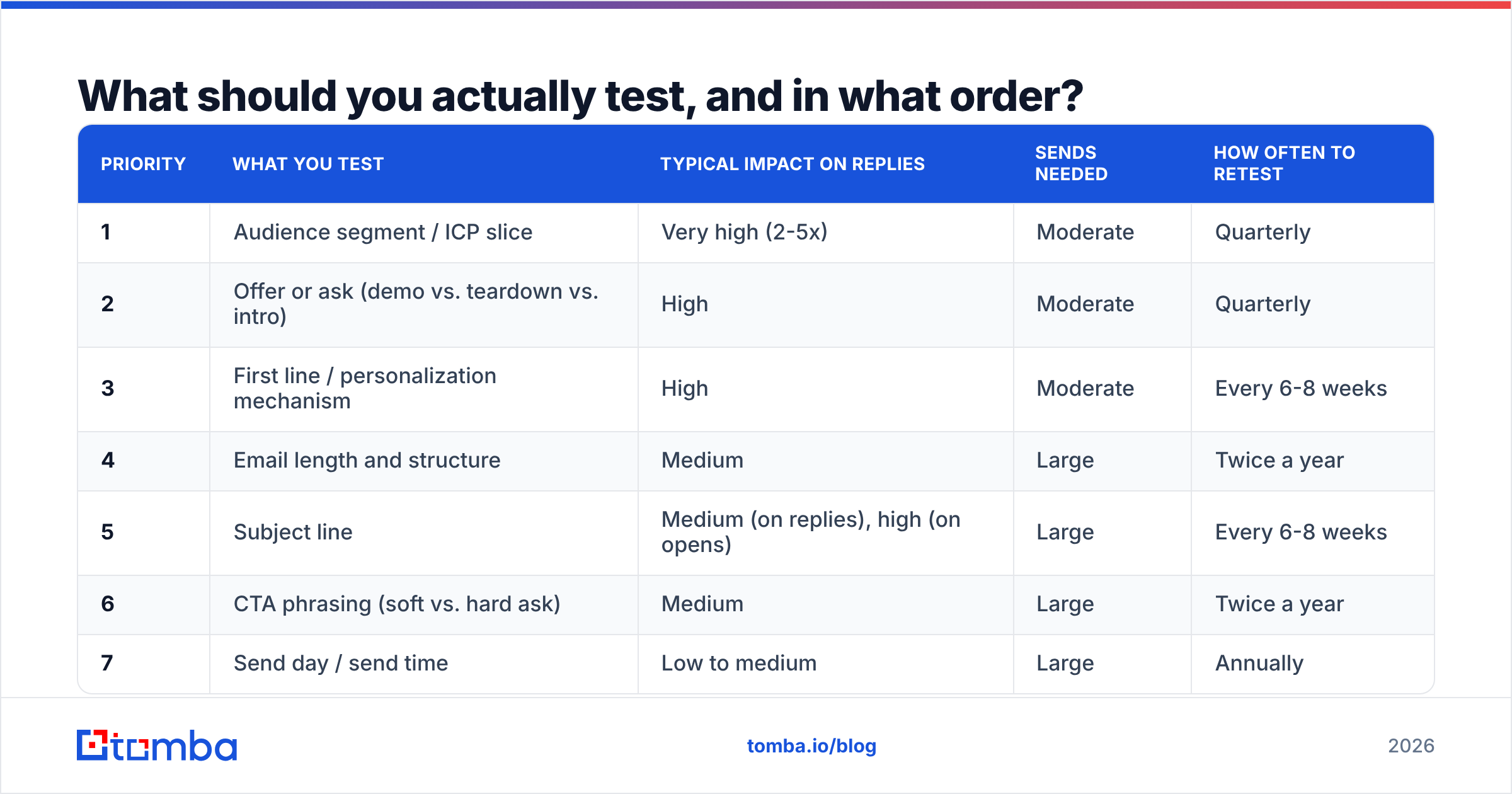
Test in descending order of leverage. The elements that change who receives the email and what you are offering them dominate the elements that change how the email is worded.
| Priority | What you test | Typical impact on replies | Sends needed | How often to retest |
|---|---|---|---|---|
| 1 | Audience segment / ICP slice | Very high (2-5x) | Moderate | Quarterly |
| 2 | Offer or ask (demo vs. teardown vs. intro) | High | Moderate | Quarterly |
| 3 | First line / personalization mechanism | High | Moderate | Every 6-8 weeks |
| 4 | Email length and structure | Medium | Large | Twice a year |
| 5 | Subject line | Medium (on replies), high (on opens) | Large | Every 6-8 weeks |
| 6 | CTA phrasing (soft vs. hard ask) | Medium | Large | Twice a year |
| 7 | Send day / send time | Low to medium | Large | Annually |
| 8 | Signature, formatting, images | Low | Very large | Rarely |
Two notes on this ordering. First, audience is technically not an A/B test of copy — it is a segment comparison. But it is the single highest-leverage split you can run, so run it first. Second, subject lines sit lower than most people expect. They strongly affect opens and only weakly affect replies, because a reply requires the body to do the work. If your reply rate is the number tied to revenue, treat subject-line tests as a secondary track.
How large does your sample need to be?#
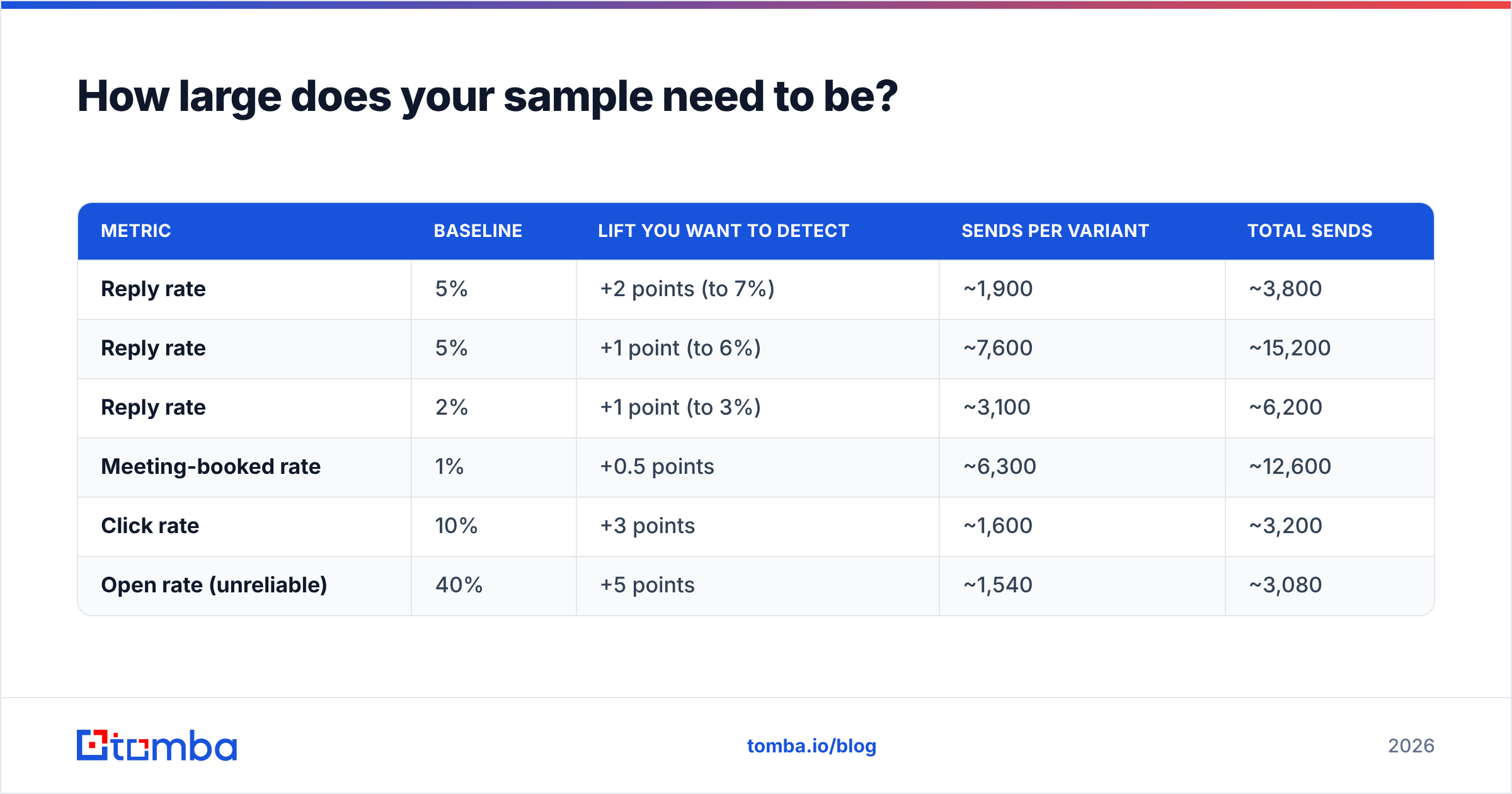
Big enough that the difference you are hoping to find is larger than the noise. The practical rule of thumb for comparing two rates: you need roughly 16 × p × (1 − p) / δ² contacts per variant, where p is your current rate and δ is the absolute lift you want to detect.
That formula produces uncomfortable numbers:
| Metric | Baseline | Lift you want to detect | Sends per variant | Total sends |
|---|---|---|---|---|
| Reply rate | 5% | +2 points (to 7%) | ~1,900 | ~3,800 |
| Reply rate | 5% | +1 point (to 6%) | ~7,600 | ~15,200 |
| Reply rate | 2% | +1 point (to 3%) | ~3,100 | ~6,200 |
| Meeting-booked rate | 1% | +0.5 points | ~6,300 | ~12,600 |
| Click rate | 10% | +3 points | ~1,600 | ~3,200 |
| Open rate (unreliable) | 40% | +5 points | ~1,540 | ~3,080 |
Read the second row carefully. Detecting a one-point reply-rate gain on a 5% baseline takes about 15,000 sends. Most outbound teams do not have 15,000 relevant, verified contacts in a single segment. That is not a reason to stop testing. It is a reason to be honest about what you can conclude, and to stop chasing small lifts. Look for changes that plausibly move the needle by 50% or more in relative terms. Those are detectable. A 4% relative gain is not, and pretending otherwise is how teams ship the losing variant.
Want the formal version of this reasoning? The statistical significance primer covers why a p-value below 0.05 on a tiny sample still tells you almost nothing about the true effect size. HubSpot's walkthrough of how to run an A/B test is a solid non-technical companion.
How long should a test run?#
Long enough to capture a full behavioral cycle, and never longer than the environment stays stable.
- Minimum: one full business week. Monday-morning behavior differs sharply from Thursday-afternoon behavior. A test that spans two days measures the calendar, not the copy.
- Preferred: two weeks, or until sample size is met — whichever comes later. Both conditions, not either.
- Hard stop: four to six weeks. Beyond that, seasonality, mailbox provider filtering changes, and your own list drift start acting as invisible third variables.
- Reply attribution window: at least 7 days after the last send. Roughly a third of B2B replies arrive more than 72 hours after send. Calling a winner at day three favors whichever variant happened to reach faster responders.
- Never peek and stop early. Checking daily and stopping the moment one arm looks ahead inflates your false-positive rate badly. Set the end condition before you launch, then honor it.
One practical exception: kill a variant immediately if it triggers a deliverability problem — spam complaints, a bounce spike, or a blocklist hit. Statistical purity is not worth a burned domain.
How do you A/B test cold email when your volume is low?#
Most B2B teams testing cold outreach hit the sample-size wall immediately. Four workarounds, in descending order of rigor:
Pool across cohorts. Instead of testing inside a single 400-contact campaign, run the same two variants across every campaign in a quarter and aggregate. You lose some cleanliness, because different segments mix. You gain the volume that makes the comparison meaningful.
Test bigger swings. If you can only detect large effects, only test large differences. Compare a two-sentence email against a nine-sentence email, not "Quick question" against "A quick question." Compare a case-study offer against a free-audit offer. Large deltas need smaller samples.
Move up the funnel metric. Clicks and replies are rarer than opens, so they need more volume. If you are volume-constrained, use a leading indicator with a higher base rate as a directional signal. Just remember it is a proxy, not the outcome.
Run sequential tests, not parallel ones. With very small lists, run version A for two weeks, then version B for two weeks, holding everything else steady. It is weaker than a randomized split, because time is confounded. It still beats calling winners on 60 sends per arm.
What none of these fix is bad data. If 18% of your list bounces, your reply-rate denominators are wrong in both arms and unevenly so. Run your list through an email verifier before any test, and use bulk verify as a standing step in list prep rather than a one-time cleanup. Testing copy on an unverified list is like tuning an engine while the fuel line leaks.
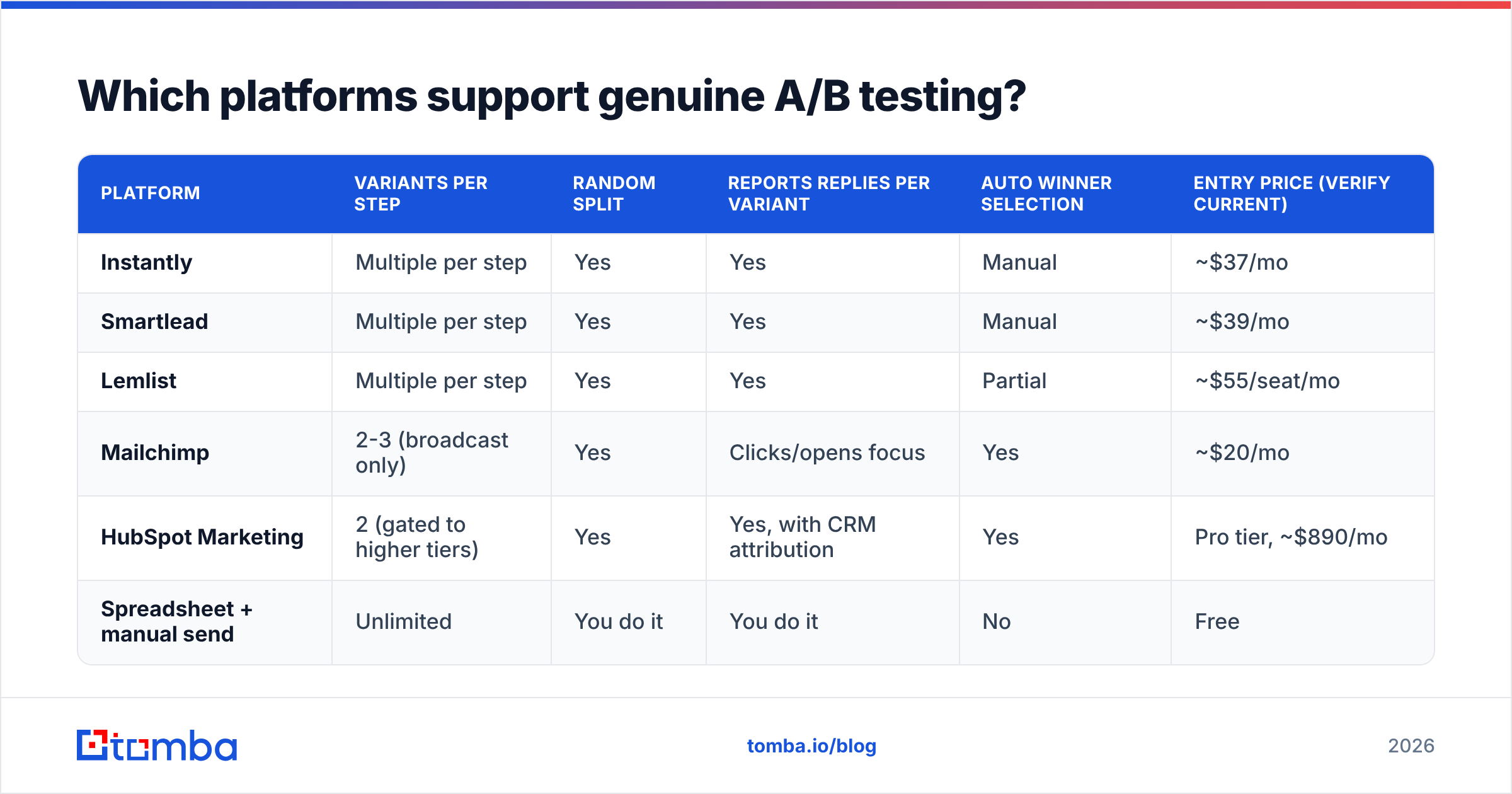
Which platforms support genuine A/B testing?#
Support varies more than the marketing pages suggest. The distinction that matters: does the tool split randomly and report per-variant outcome data, or does it merely rotate templates?
| Platform | Variants per step | Random split | Reports replies per variant | Auto winner selection | Entry price (verify current) |
|---|---|---|---|---|---|
| Instantly | Multiple per step | Yes | Yes | Manual | ~$37/mo |
| Smartlead | Multiple per step | Yes | Yes | Manual | ~$39/mo |
| Lemlist | Multiple per step | Yes | Yes | Partial | ~$55/seat/mo |
| Mailchimp | 2-3 (broadcast only) | Yes | Clicks/opens focus | Yes | ~$20/mo |
| HubSpot Marketing | 2 (gated to higher tiers) | Yes | Yes, with CRM attribution | Yes | Pro tier, ~$890/mo |
| Spreadsheet + manual send | Unlimited | You do it | You do it | No | Free |
Pricing on this category moves constantly, so treat those figures as orientation and confirm on each vendor's own page; the email marketing category on G2 is a reasonable place to sanity-check feature claims against recent reviews.
Two caveats. First, "auto winner selection" is often a trap: several tools declare winners on whatever sample has accumulated, using thresholds they do not disclose. Check the underlying counts before you accept a verdict. Second, no sending tool can fix an upstream data problem. If variant A happened to draw more catch-all domains than variant B, its apparent performance gap may be pure deliverability. A catch-all verifier run before the split keeps that particular confound out of your results.

What mistakes quietly invalidate results?#
These are the failure modes that survive even a well-designed test.
Unequal deliverability across arms. If variant B's subject line trips more spam filters, fewer of its emails land. Its reply rate then drops for reasons unrelated to persuasiveness. Check per-variant bounce and spam-complaint rates before interpreting anything. A spam checker pass on both variants pre-launch catches the obvious cases.
Mid-test edits. Fixing a typo in variant A on day four means you now have three variants and no clean comparison. Freeze copy at launch.
Overlapping campaigns. If half your test population is also getting a different sequence from a teammate, your control is not a control.
Survivorship in the denominator. Some platforms compute reply rate over delivered, others over sent, others over opened. Compare like with like, and state which denominator you used in your log.
Winner's curse. The variant that wins a marginally-powered test usually shows a smaller effect when you rerun it. Expect regression toward the mean, and re-validate anything you plan to build a playbook on.
Testing into a dead segment. If the audience does not have the problem you are describing, no subject line rescues it. When a whole series of tests comes back flat, the constraint is targeting, not copy. That is why segment tests belong first in the priority list above, and why improving your response rate usually starts with who you contact.
What does a disciplined testing cadence look like?#
A workable quarterly rhythm for a team sending 5,000-20,000 emails per quarter:
- Week 0 — Prep. Rebuild the segment and verify every address. Define the primary metric and the minimum detectable effect, then calculate the required sample per arm. Write the hypothesis in one sentence: "Changing X will improve Y because Z."
- Weeks 1-2 — Run test one. One variable. No edits. No peeking.
- Week 3 — Analyze and log. Record variant text, sample sizes, both denominators, the result, and your interpretation — including "inconclusive," which is the most common honest answer.
- Weeks 4-5 — Run test two. Carry the winner forward as the new control, or keep the old control if the result was inconclusive.
- Week 6 — Retest one prior winner. This is the step everyone skips, and the only one that protects you from building a playbook on noise.
- Weeks 7-12 — Repeat, then review the log. At quarter end, ask which findings replicated. Those become standards. The rest stay hypotheses.
Two supporting habits make this cheaper. Keep a library of proven variants so you are not writing from scratch each cycle — a cold email templates collection plus a subject line tester shortens prep considerably. And build segments large enough to be testable in the first place. A 300-contact list is not a testing program; it is a single send.
What should you take away?#
The core email A B testing best practices reduce to five sentences. Change one thing at a time. Compute the sample you need before you launch, and accept that small lifts are undetectable at your volume. Measure replies and meetings, not opens. Run for full weeks with a fixed end condition, and never stop on a peek. Write down every result, especially the boring ones.
Everything above assumes one thing you cannot test your way out of: a clean, correctly targeted list. Two variants sent to the wrong 2,000 people will both fail. The test will tell you nothing, except that you wasted a fortnight. That is the real bottleneck for most outbound teams — not copy, and not tooling.
Build the list first. Tomba's Email Finder locates professional addresses by name, domain, or company, with verification built into the same workflow. Your test arms then start from comparable data quality instead of comparable guesswork. The free tier includes 25 searches per month, so you can check accuracy on your own segment before committing. Paid plans start at $49/mo on Starter, $99/mo on Growth, and $249/mo on Pro — full details on Tomba pricing. Get the denominator right, then let the copy tests actually mean something.
Related guides#
Ready to find emails that actually work?
Join 150,000+ professionals who stopped guessing and started sending. Free credits on signup — no credit card required.
Get the Tomba newsletter
Practical outbound tactics and product updates — once every two weeks.
About the author