Email After Introduction: Templates and Timing Guide 2026
A warm intro is the highest-converting lead source you have — and most reps waste it with a slow, vague follow-up. Here is how to write the email after an introduction so it actually books a meeting.
TL;DR
- Send your email after an introduction within 24 hours. Warm-intro reply rates decay fast — by day four the referrer's endorsement has gone stale and you are effectively cold again.
- Move the introducer to BCC on your first reply, thank them in one line, and never make them read a second message.
- Lead with why the intro happened, not who you are. The recipient already has social proof; what they lack is a reason to spend 25 minutes.
- Ask for one specific, low-friction next step — a 20-minute call with two proposed times beats "let me know if you'd like to chat."
- If the intro was made to a shared inbox or a name-only handoff, verify the address before you send. A bounced warm intro burns the referral and your sender reputation.
What is an email after an introduction?#
An email after an introduction is the message you send once a mutual contact has connected you to someone new — usually over email, sometimes on LinkedIn, occasionally after a live handoff at an event. It is the moment where a referral converts into a real conversation, or quietly dies.
Think of it like being walked into a dinner party by the host. The host's job is done: everyone knows you belong there. But if you stand there saying "so, tell me about yourself," the moment evaporates. The intro buys you attention; the email has to buy you time.
That distinction matters because warm-intro emails follow completely different rules than cold outreach:
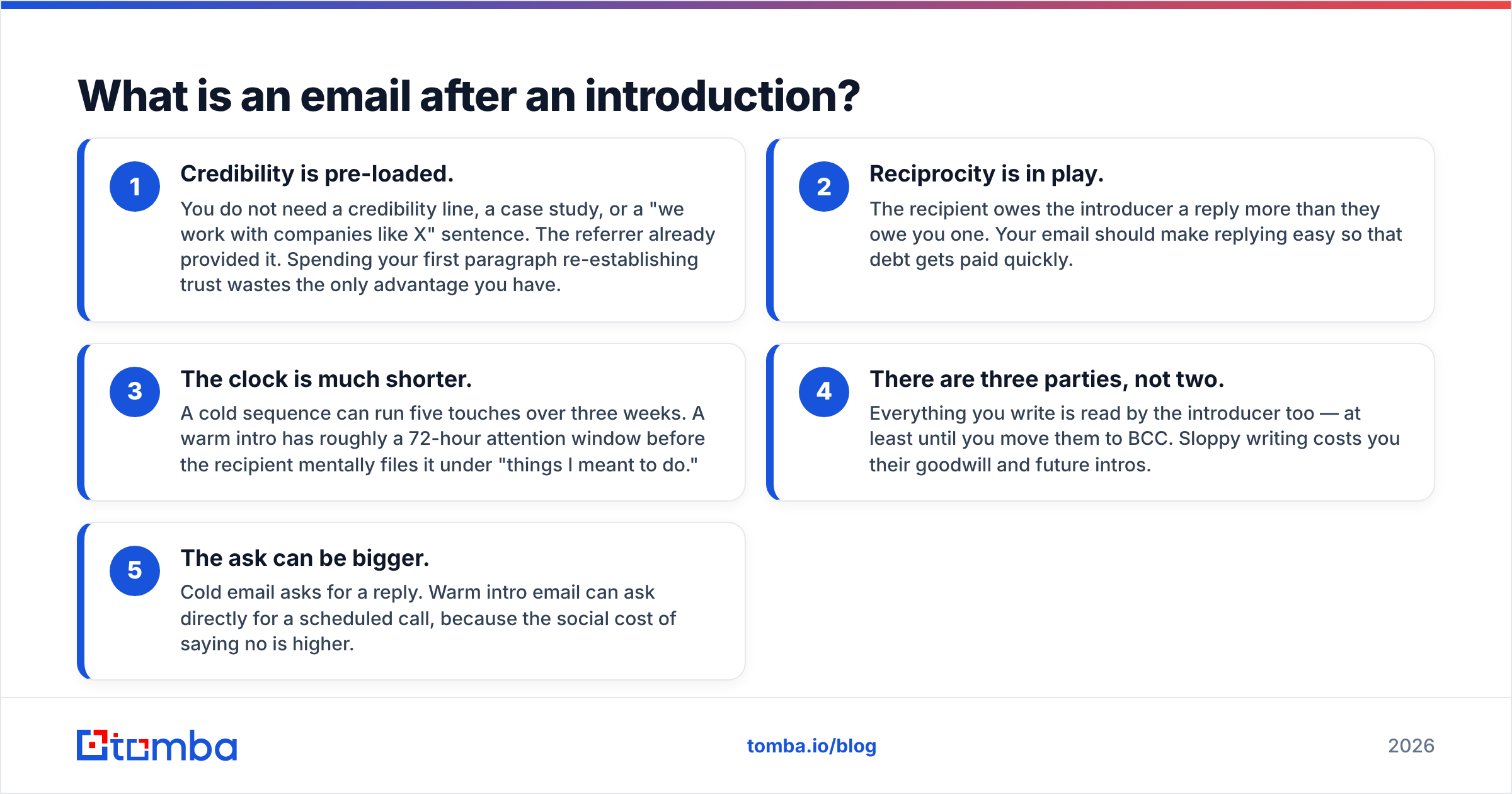
- Credibility is pre-loaded. You do not need a credibility line, a case study, or a "we work with companies like X" sentence. The referrer already provided it. Spending your first paragraph re-establishing trust wastes the only advantage you have.
- Reciprocity is in play. The recipient owes the introducer a reply more than they owe you one. Your email should make replying easy so that debt gets paid quickly.
- The clock is much shorter. A cold sequence can run five touches over three weeks. A warm intro has roughly a 72-hour attention window before the recipient mentally files it under "things I meant to do."
- There are three parties, not two. Everything you write is read by the introducer too — at least until you move them to BCC. Sloppy writing costs you their goodwill and future intros.
- The ask can be bigger. Cold email asks for a reply. Warm intro email can ask directly for a scheduled call, because the social cost of saying no is higher.
Why do most emails after an introduction fail?#
Three failure modes account for nearly all of it, and none of them are about writing talent.
You were too slow. Response rate on referral follow-ups drops steeply after the first day. The introducer's message is still near the top of the inbox on day one; on day five it is buried under 200 other threads and the recipient has to reconstruct context from scratch. Speed is not a nice-to-have — it is most of the strategy.
You wrote a cold email with a warm greeting. The tell is a first paragraph about your company. If the second sentence of your email is "Tomba is a B2B data platform that helps teams..." you have thrown away the referral and started from zero. The recipient does not need your pitch; they need to know why their friend thought this was worth their time.
You made the introducer keep working. Leaving them on Reply-All for six messages of scheduling logistics is a small, real tax on a person who just did you a favor. Do it twice and the intros stop.

There is a fourth, less obvious failure: the introduction never actually reached a working inbox. Live handoffs at conferences, LinkedIn intros that produce a name but no address, and "I'll connect you with our VP of Ops" promises all end with you guessing at an email format. Guess wrong and you get a bounce — which the recipient never sees, the introducer never hears about, and you interpret as disinterest. Running the name and domain through an email finder before you send removes that whole failure class.
How fast should you send the email after an introduction?#
Fast, and the definition of fast depends on how the intro arrived.
| Intro type | Send within | Why this window | Common mistake |
|---|---|---|---|
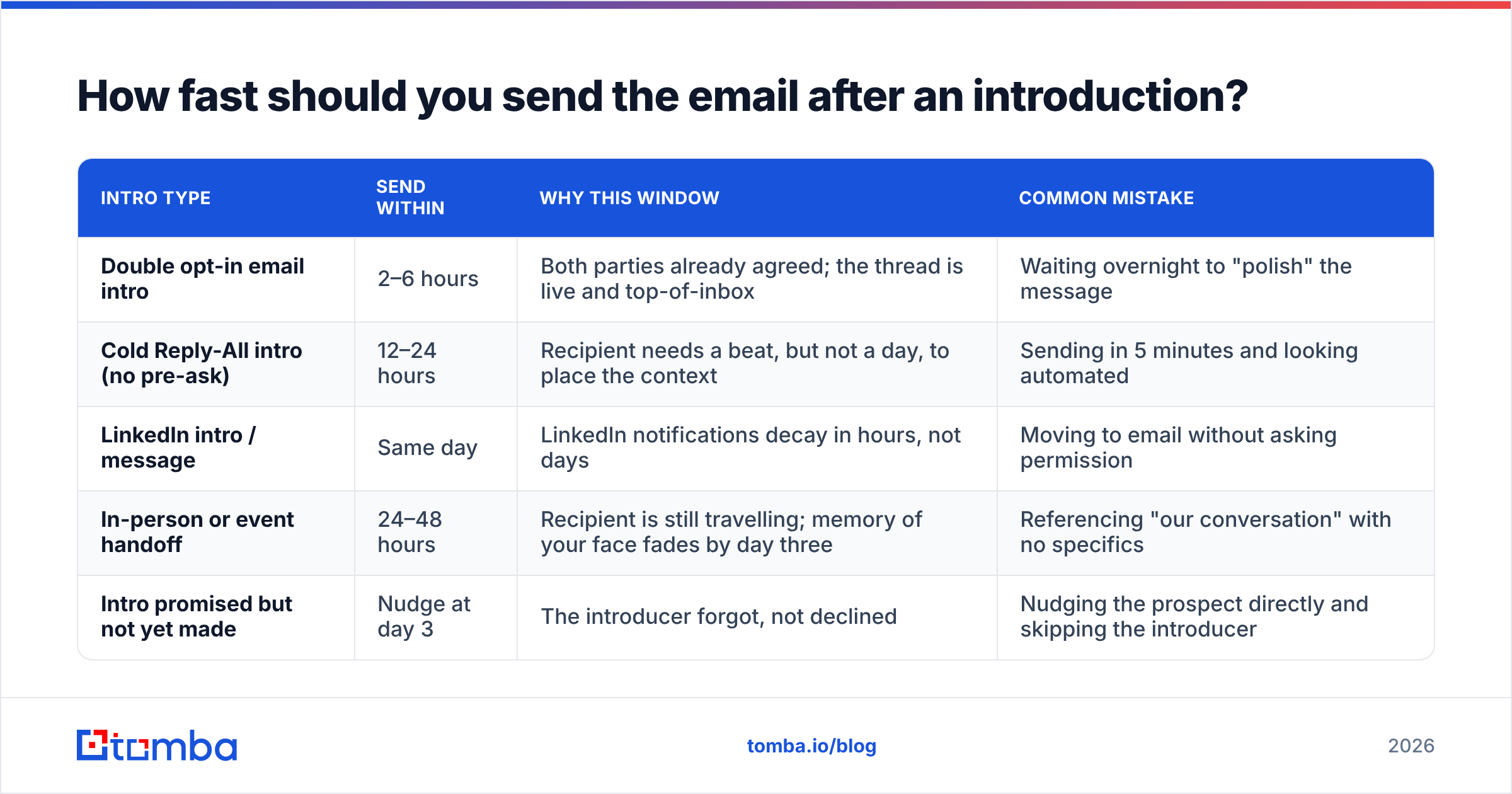
| Double opt-in email intro | 2–6 hours | Both parties already agreed; the thread is live and top-of-inbox | Waiting overnight to "polish" the message |
| Cold Reply-All intro (no pre-ask) | 12–24 hours | Recipient needs a beat, but not a day, to place the context | Sending in 5 minutes and looking automated |
| LinkedIn intro / message | Same day | LinkedIn notifications decay in hours, not days | Moving to email without asking permission |
| In-person or event handoff | 24–48 hours | Recipient is still travelling; memory of your face fades by day three | Referencing "our conversation" with no specifics |
| Intro promised but not yet made | Nudge at day 3 | The introducer forgot, not declined | Nudging the prospect directly and skipping the introducer |
Two practical notes on that table. First, if the intro lands at 4:45pm on a Friday, send Monday morning rather than into the weekend void — Monday 8am beats Friday 5pm on open rate in every dataset I have seen. Second, "fast" does not mean "instant." A reply that arrives 90 seconds after the intro reads as a bot or as someone who was hovering. Between two and six hours is the sweet spot for email intros.
What should the email after an introduction actually say?#
Five components, in this order. Total length: under 120 words.
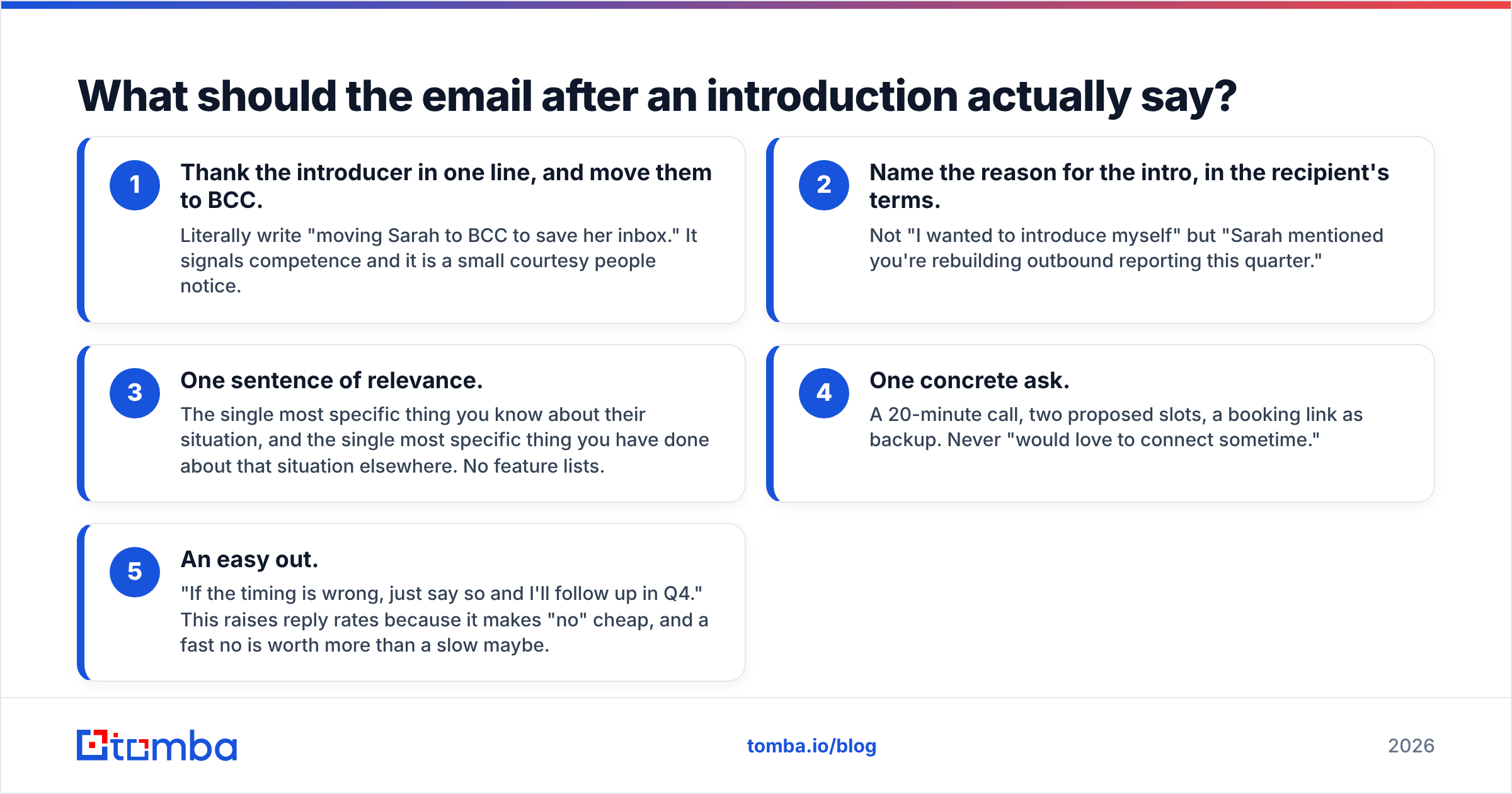
- Thank the introducer in one line, and move them to BCC. Literally write "moving Sarah to BCC to save her inbox." It signals competence and it is a small courtesy people notice.
- Name the reason for the intro, in the recipient's terms. Not "I wanted to introduce myself" but "Sarah mentioned you're rebuilding outbound reporting this quarter."
- One sentence of relevance. The single most specific thing you know about their situation, and the single most specific thing you have done about that situation elsewhere. No feature lists.
- One concrete ask. A 20-minute call, two proposed slots, a booking link as backup. Never "would love to connect sometime."
- An easy out. "If the timing is wrong, just say so and I'll follow up in Q4." This raises reply rates because it makes "no" cheap, and a fast no is worth more than a slow maybe.
What to cut: your title, your funding round, a "hope you're doing well," any sentence containing "synergy" or "circle back," and attachments. Attachments on a first warm-intro reply feel like a proposal you already wrote before understanding the problem.
Template 1 — Standard double opt-in intro#
Subject: (keep the existing thread subject)
Thanks for the intro, Sarah — moving you to BCC.
Priya, Sarah mentioned you're consolidating three prospecting tools into one stack before the fiscal year closes. We ran that exact migration with a 40-rep team last quarter; the surprise was how much of the mess was duplicate records, not tooling.
Worth 20 minutes to compare notes? Thursday 10am or Friday 2pm ET both work — or grab any slot here.
If the timing's off, say the word and I'll check back in October.
Template 2 — Event handoff, no pre-existing thread#
Subject: Following up from the RevOps panel — pipeline hygiene
Priya — good to meet you after the panel Wednesday. You mentioned your team throws out about a third of enriched records because the emails bounce.
That's the problem I spend most of my week on. Two things worked for a team your size: verifying at import instead of at send, and separating catch-all domains into their own workflow.
Happy to walk through both on a call — 20 minutes, Tuesday or Wednesday next week?
Template 3 — Intro promised but never sent (nudge the introducer, not the prospect)#
Subject: No rush — the Priya intro
Sarah, no urgency at all on this. If the intro to Priya still makes sense, here's a two-line blurb you can forward as-is:
"Ben's team fixed our bounce problem when we consolidated tools — worth 20 minutes if you're still cleaning up the prospecting stack."
And if it's not a fit anymore, genuinely no problem — just say pass.
The blurb matters more than the nudge. You are removing the writing work that made them procrastinate in the first place.
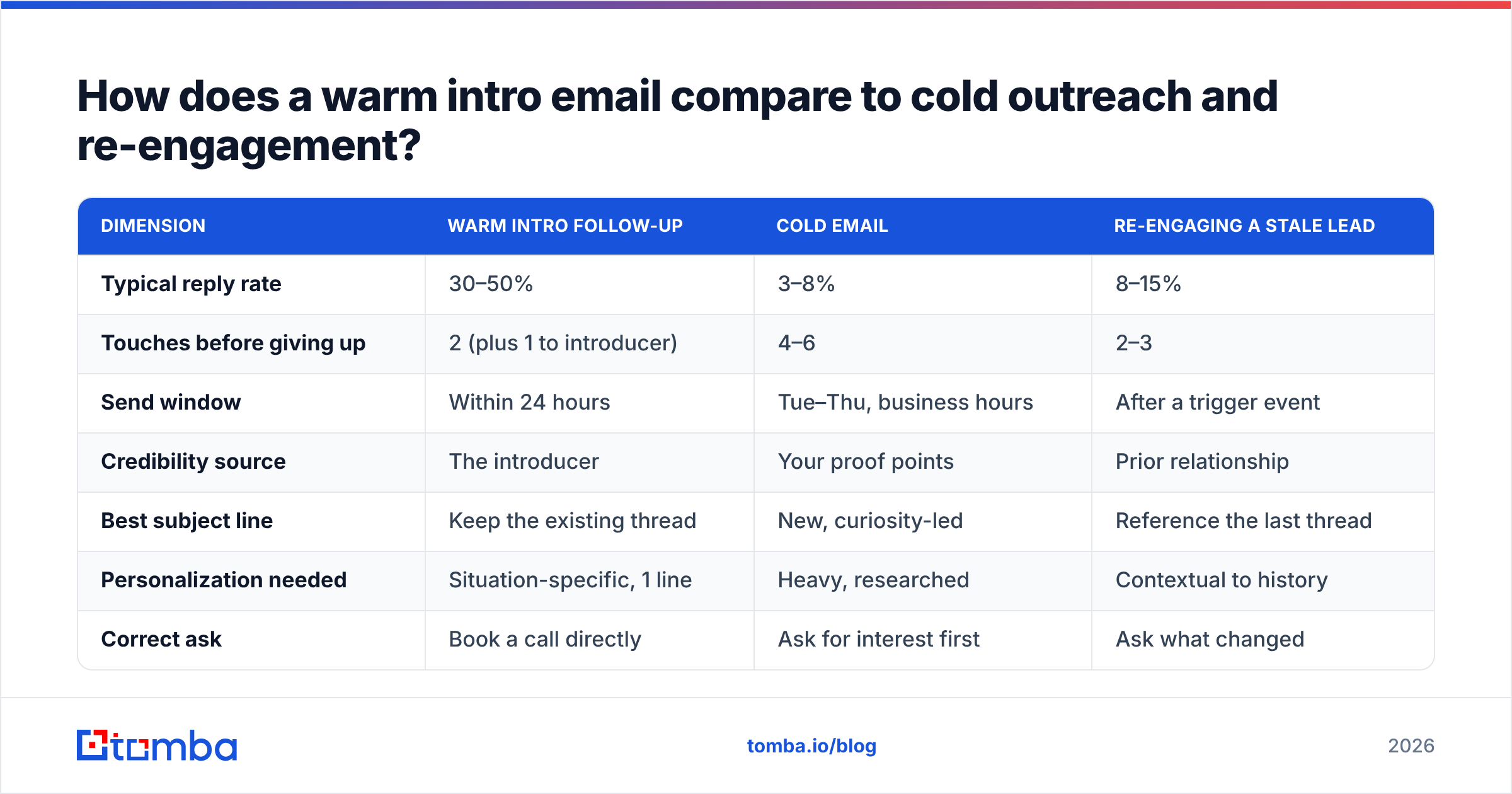
How does a warm intro email compare to cold outreach and re-engagement?#
Different mechanics, different benchmarks. Treating them the same is why teams under-invest in referrals.
| Dimension | Warm intro follow-up | Cold email | Re-engaging a stale lead |
|---|---|---|---|
| Typical reply rate | 30–50% | 3–8% | 8–15% |
| Touches before giving up | 2 (plus 1 to introducer) | 4–6 | 2–3 |
| Send window | Within 24 hours | Tue–Thu, business hours | After a trigger event |
| Credibility source | The introducer | Your proof points | Prior relationship |
| Best subject line | Keep the existing thread | New, curiosity-led | Reference the last thread |
| Personalization needed | Situation-specific, 1 line | Heavy, researched | Contextual to history |
| Correct ask | Book a call directly | Ask for interest first | Ask what changed |
| Data hygiene needed | Verify the one address | Verify the whole list | Re-verify — 25%/yr decay |
The row that surprises people is "touches before giving up." Two. A warm intro that gets no response after one follow-up is not a persistence problem; it is a signal that the recipient's priorities differ from what the introducer assumed. Sending touch five on a referral thread costs you the referrer's credibility, not just your own.

How do you follow up when the email after an introduction gets no reply?#
One follow-up, four to five business days later, on the same thread. Then stop emailing and change channels.
The follow-up should add something, not repeat something. "Just bumping this up" is the weakest sentence in B2B sales; it asks for effort and offers nothing. Instead, send one of these:
- A relevant artifact. A benchmark, a teardown of their competitor's approach, a one-paragraph observation about their careers page. Something they would forward.
- A narrower ask. If a 20-minute call got nothing, ask a single question they can answer in one line: "Is bounce rate even on your list this quarter, or is it further down?"
- A graceful close. "I'll assume this isn't a priority right now and stop nudging — happy to reconnect if that changes." This gets replies from people who intended to answer and forgot, and it protects the introducer's relationship.
If two emails produce nothing, switch to LinkedIn or the phone. A short LinkedIn note referencing the intro ("Sarah connected us over email — no pressure, just closing the loop") often works because it arrives in a channel with far less volume. For accounts worth real revenue, a call is legitimate here too; you have an introducer's name to open with, which is most of what makes a cold call uncomfortable. And if you are working the referral into a broader account plan, the response rate benchmarks for each channel are worth checking against your own numbers rather than industry averages.
What you should not do: forward the thread to a second person at the company without telling the introducer, add the recipient to an automated sequence, or email their assistant. All three convert a warm relationship into a cold one and can put you on the wrong side of the recipient's spam filter, which affects every future send from your domain.
What operational habits make warm intros scale?#
Referrals feel un-systematizable. They are not. The pieces that scale are the boring ones.
Ask for intros with a forwardable blurb attached. Every intro request should include two sentences the introducer can paste without editing. This roughly doubles the follow-through rate because you removed the work.
Keep a running intro ledger. Who introduced whom, on what date, and what happened. Introducers deserve an outcome update — "Priya and I are talking next Tuesday, thank you again" — and that single message is the cheapest way to earn a second intro. A simple CRM field or a shared sheet is enough; treating it as part of your sales pipeline rather than a side channel is what keeps it from being forgotten.
Verify before you send, always. This applies even to warm intros — arguably especially to them. When someone says "email her at priya@," you are guessing at the rest. A single bounce on a referral thread reads to the recipient as carelessness if they ever see it, and to you as silence if they do not. Bulk-checking a batch of intro targets through an email verifier takes seconds and removes the ambiguity from your reply-rate data.
Instrument the channel separately. If warm intros sit in the same reporting bucket as cold outbound, their 40% reply rate gets averaged into invisibility and nobody argues for more of them. Tag them. Report them separately. Referral pipeline is usually the highest-win-rate source a B2B team has — HubSpot's sales research and G2's buyer-behavior data both put peer and referral input near the top of what buyers actually trust — and it is chronically under-resourced because it is under-measured.
Give intros before you ask for them. The strongest referral networks are reciprocal. Two useful connections made per month, with no ask attached, changes how people respond when you eventually need one. HubSpot's guidance on referral programs is blunt about this: the ask converts in proportion to what you have already given.
What are the most common mistakes to avoid?#
- Changing the subject line on a live intro thread. It breaks threading, drops the introducer's context, and often lands the message in a different tab.
- Writing to the introducer instead of the prospect. After your first line of thanks, every word should be addressed to the recipient. Emails that keep performing for the referrer read as insecure.
- Pitching product in message one. The goal is a conversation, not a demo. Product details belong on the call.
- Asking an open-ended question when you want a meeting. "What does your current process look like?" invites a long answer nobody has time to write. Ask for the call.
- Sending from a domain with no authentication. If your SPF, DKIM, and DMARC are not configured, even a warm reply can land in spam. Check your SPF record before you blame the prospect for ghosting.
- Never closing the loop. Tell the introducer what happened, win or lose. It costs one line and it is the entire mechanism by which one intro becomes five.
Where should you start?#
Pick the three warmest relationships in your network this week, ask each for one specific introduction, and hand them a two-sentence forwardable blurb. Then, when the intro lands, reply within six hours using Template 1: thank, BCC, reason, relevance, one ask, easy out. Under 120 words. Two touches maximum.
The one place this process breaks silently is the address itself — a name-only handoff, an address typed from memory at a conference, a "reach out to our VP of Ops." Before you send, run the name and company domain through the Tomba Email Finder and confirm you have a deliverable inbox. The free tier covers 25 searches a month, which is more than most people's monthly intro volume; Tomba pricing starts at $49/mo on Starter if you are working referrals at team scale. A warm introduction is the most valuable lead you will get all quarter. Do not lose it to a typo.
Related guides#
Ready to find emails that actually work?
Join 150,000+ professionals who stopped guessing and started sending. Free credits on signup — no credit card required.
Get the Tomba newsletter
Practical outbound tactics and product updates — once every two weeks.
About the author