Email Call To Action: How to Write CTAs That Get Replies
Most cold emails die at the last line. Here's how to write an email call to action that earns a reply — with tested formats, a CTA comparison table, and the mistakes that quietly kill your reply rate.
TL;DR
- Your email call to action is the single line that converts attention into a reply — and it's usually the weakest sentence in the whole email.
- Low-friction CTAs (interest-based questions) outperform high-friction CTAs (calendar links, 30-minute demos) in cold outreach, because you're asking for a decision the reader can make in two seconds.
- One CTA per email. Two CTAs is a choice; a choice is work; work gets ignored.
- The CTA is downstream of data quality. A perfect ask sent to a stale or unverified address is a zero regardless of copy.
- Match CTA aggressiveness to sequence position: soft on email 1, specific by email 3, breakup-style on the last touch.
What is an email call to action?#
An email call to action is the explicit request you make of the reader — the sentence that tells them what to do next. In a cold email it's usually the final line before your signature. In a nurture email it might be a button. Either way, it's the only part of the email that produces a measurable outcome.
Think of it like the end of a phone call. Everything before it is context. The CTA is "so — can we talk Thursday?" If you never say it, the call ends politely and nothing happens.
Most sales emails fail here for a boring reason: the writer spends 90% of their effort on the opener and personalization, then closes with a generic "let me know if you're interested" or dumps a Calendly link. Both hand the work back to the reader.
A useful email call to action does three things:
- Names one action. Not "reply, or book time, or check out our site." One.
- Sizes the ask to the relationship. A stranger owes you nothing. A warm reply owes you a bit more.
- Makes the "yes" cheap. The easiest yes in B2B email is a single word typed on a phone.
Which email CTA types actually exist?#
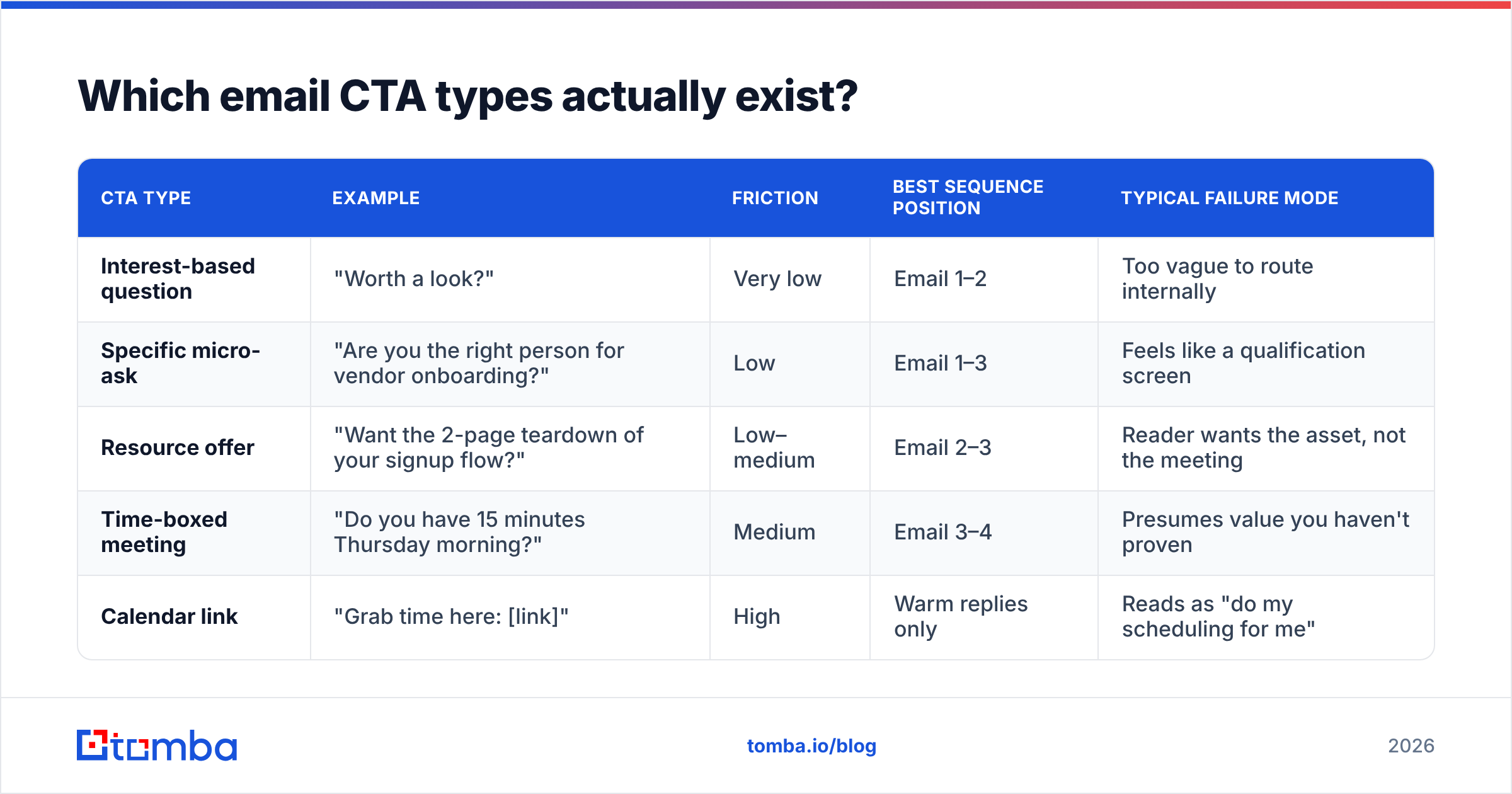
There's no shortage of CTA advice, but almost all of it collapses into five recognizable formats. Here's how they compare in cold outreach, where the reader has no prior relationship with you.
| CTA type | Example | Friction | Best sequence position | Typical failure mode |
|---|---|---|---|---|
| Interest-based question | "Worth a look?" | Very low | Email 1–2 | Too vague to route internally |
| Specific micro-ask | "Are you the right person for vendor onboarding?" | Low | Email 1–3 | Feels like a qualification screen |
| Resource offer | "Want the 2-page teardown of your signup flow?" | Low–medium | Email 2–3 | Reader wants the asset, not the meeting |
| Time-boxed meeting | "Do you have 15 minutes Thursday morning?" | Medium | Email 3–4 | Presumes value you haven't proven |
| Calendar link | "Grab time here: [link]" | High | Warm replies only | Reads as "do my scheduling for me" |
The pattern is straightforward: friction rises as you move down the table, and so does the amount of trust the CTA presumes. Cold email that opens with a calendar link is asking a stranger to schedule labor on your behalf. That's why it underperforms even when the rest of the email is excellent.
The counterintuitive part is that the softest CTA is often the most effective in absolute reply terms, but the hardest CTA produces higher-quality meetings from the replies you do get. If your team is measured on meetings booked rather than replies, this trade-off is worth an explicit decision rather than a default.
Why do low-friction CTAs outperform hard asks?#
Because the recipient is making a cost-benefit calculation in under three seconds, and every element of your CTA sits on the cost side.
Consider what "Do you have 30 minutes Tuesday to walk through our platform?" actually asks for:
- Read and understand the pitch
- Judge whether it applies to them
- Check a calendar
- Commit a half hour of a workday
- Accept the risk of a bad meeting
Now consider "Is reducing onboarding drop-off on your roadmap this quarter?" That asks for one thing: a yes or no they already know the answer to. No calendar, no commitment, no risk.
This is why "worth a conversation?" and its cousins keep showing up in high-performing sequences. They convert the email from a transaction request into a conversation opener. Once someone replies "yes, but we're looking at Q4," you have a thread — and threads convert far better than cold sends.
The same principle appears in classic conversion research on friction and choice architecture. HubSpot's research on email marketing consistently shows that clarity and single-focus asks beat multi-option emails, and the same holds in one-to-one outbound.
How do you write an email call to action step by step?#
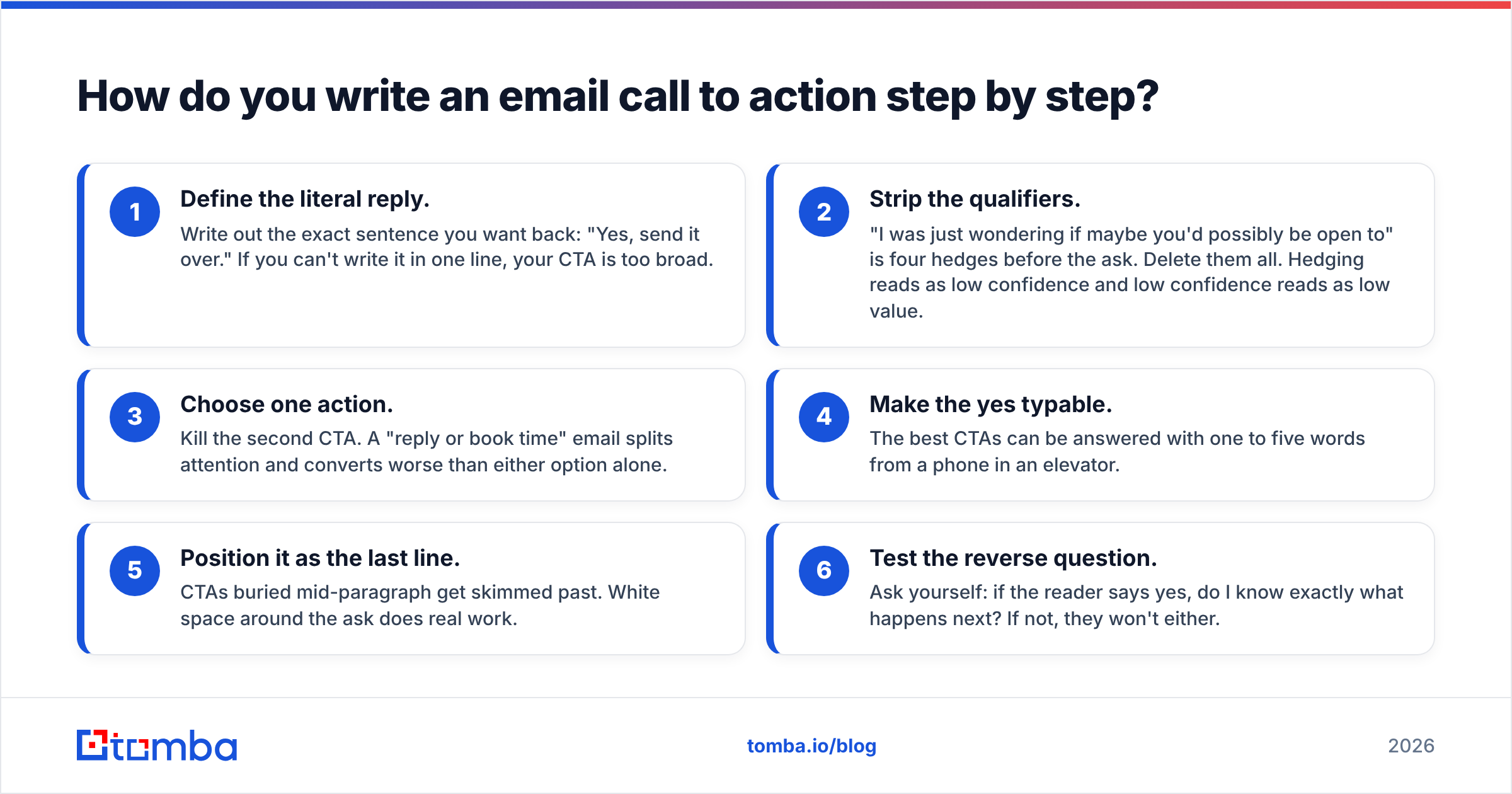
Work backwards from the reply you want to receive.
- Define the literal reply. Write out the exact sentence you want back: "Yes, send it over." If you can't write it in one line, your CTA is too broad.
- Strip the qualifiers. "I was just wondering if maybe you'd possibly be open to" is four hedges before the ask. Delete them all. Hedging reads as low confidence and low confidence reads as low value.
- Choose one action. Kill the second CTA. A "reply or book time" email splits attention and converts worse than either option alone.
- Make the yes typable. The best CTAs can be answered with one to five words from a phone in an elevator.
- Position it as the last line. CTAs buried mid-paragraph get skimmed past. White space around the ask does real work.
- Test the reverse question. Ask yourself: if the reader says yes, do I know exactly what happens next? If not, they won't either.
A quick before/after:
Before: "Let me know if you'd like to learn more about how we help companies like yours improve their outbound performance, or feel free to book a time on my calendar here."
After: "Is outbound reply rate something you're actively working on this quarter?"
The second is shorter, asks one thing, and can be answered with "yes" or "not right now" — and "not right now" is still a usable data point.
What are the most common email CTA mistakes?#
- Stacking asks. Reply and download and book. Each additional option reduces the odds of any single action.
- The naked calendar link. Sending a scheduling link before earning interest reverses the order of trust. Save it for after the "yes."
- Fake urgency. "This offer expires Friday" on a cold email to someone who has never heard of you creates skepticism, not action.
- Asking for a decision-maker's time on email one. You haven't established that the meeting is worth having.
- Vague enthusiasm. "Excited to connect!" is not an ask. It's a feeling.
- CTA-personality mismatch. A playful "worth a peek? 👀" lands very differently with a compliance officer than with a growth marketer.
There's also a structural mistake that has nothing to do with copy: sending a great CTA into a dead inbox. If a meaningful percentage of your list bounces, your sender reputation degrades, your deliverability drops, and even your best-performing CTA never gets read. Running your list through an email verifier before a send is unglamorous and it protects everything downstream. For a deeper background on the mechanics, see email deliverability.
Should your CTA change across the sequence?#
Yes — and this is where most sequences leak. Sending the same ask five times reads as a script, not a conversation.
A workable escalation pattern across a five-touch sequence:
- Email 1 — Interest check. "Is X something your team is thinking about this quarter?" Zero commitment. You're testing relevance.
- Email 2 — Value drop plus soft ask. Share a concrete insight or benchmark, then: "Want the full breakdown?" You're trading information for permission.
- Email 3 — Specific micro-ask. "Are you the right person for this, or should I be talking to someone in RevOps?" This one converts unusually well because it's easy to answer even when the answer is no.
- Email 4 — Time-boxed meeting. Now you've earned the right to ask for 15 minutes. Name a day, not a link.
- Email 5 — Permission to close. "Sounds like this isn't a priority right now — should I close the loop?" The classic breakup email works because it's the only email in the sequence where "no" is the easy answer, which paradoxically makes "actually, yes" easier to say.
Notice that the ask gets heavier as the thread gets warmer, never the reverse. If you open with a demo request and de-escalate to "just checking in," you've inverted the ladder and taught the reader that your emails carry no weight.
How does data quality affect CTA performance?#
More than copy does, in most accounts. This is the part CTA guides skip.
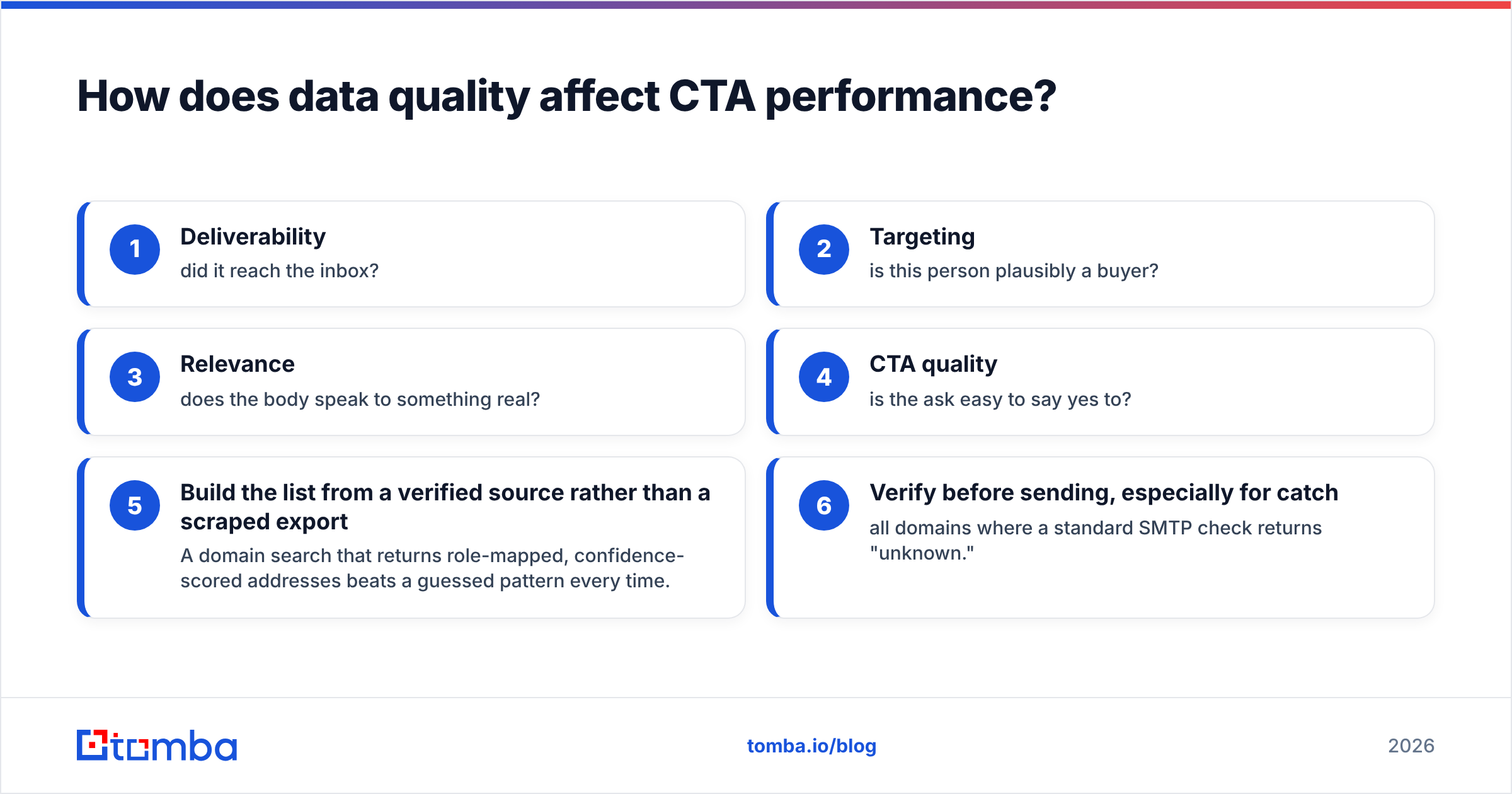
Your reply rate is the product of four multiplied factors:
- Deliverability — did it reach the inbox?
- Targeting — is this person plausibly a buyer?
- Relevance — does the body speak to something real?
- CTA quality — is the ask easy to say yes to?
Because they multiply, a zero anywhere zeroes the outcome. A 40% improvement in CTA copy on a list where half the addresses are wrong produces a rounding error. Teams routinely spend weeks A/B testing closing lines while their contact data quietly decays at roughly 2–3% per month through job changes alone.
Practical order of operations:
- Build the list from a verified source rather than a scraped export. A domain search that returns role-mapped, confidence-scored addresses beats a guessed pattern every time.
- Verify before sending, especially for catch-all domains where a standard SMTP check returns "unknown."
- Enrich with role and seniority so your CTA can actually match the reader's authority — you shouldn't ask an IC for budget approval.
- Only then optimize the closing line.
For a broader view of vendor options and how data providers compare, G2's sales intelligence category is a reasonable neutral starting point, and it's worth reading reviews with an eye on coverage by region rather than headline accuracy claims.
What does a good email call to action look like in practice?#
Here are CTA lines you can adapt, grouped by the outcome you want. Swap the specifics — the structure is the reusable part.
When you want a yes/no on relevance
- "Is [problem] on your radar for this half?"
- "Worth exploring, or is this handled?"
- "Does this land, or am I off base?"
When you want to be routed to the right person
- "Are you the right person for [function], or should I reach out to someone else?"
- "Who owns [process] on your side these days?"
When you want to deliver a resource
- "Want me to send the two-page version?"
- "I put together a short teardown of your [page] — want it?"
When you want a meeting
- "Do you have 15 minutes Thursday or Friday morning?"
- "Open to a short call next week? I'll keep it to 15."
When you want to close the loop
- "If this isn't a fit, just say 'no thanks' and I'll stop following up."
- "Should I close this out on my end?"
Two structural notes. First, questions outperform statements as CTAs because a question creates an open loop that feels rude to leave unanswered. Second, offering two named times beats offering an open calendar, because you've converted an open-ended scheduling problem into a binary choice. If you want more full-email structures to slot these into, the cold email templates library is a decent place to pull from.
How should you measure CTA performance?#
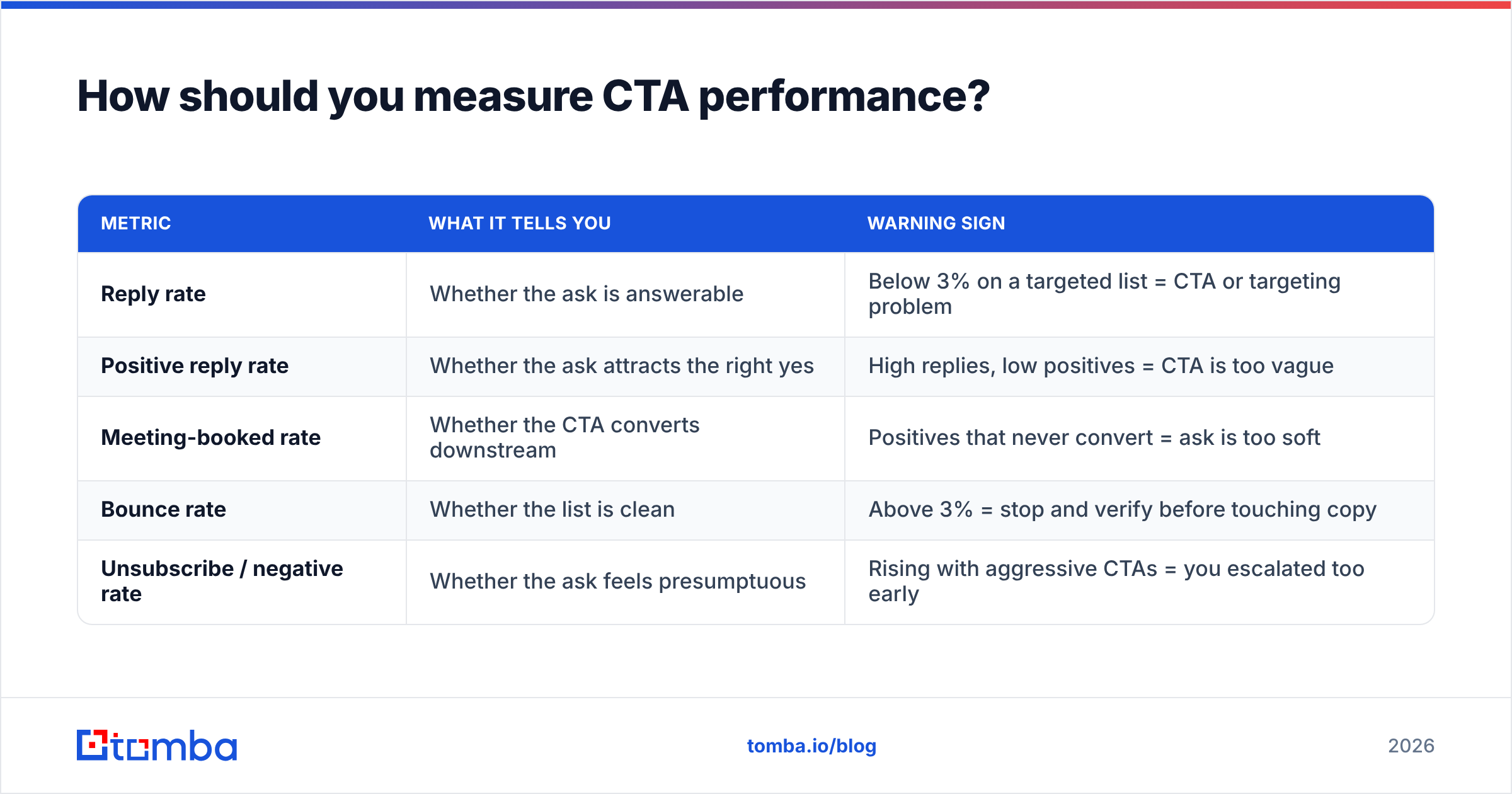
Reply rate is the headline metric, but it's not sufficient on its own. Track these together:
| Metric | What it tells you | Warning sign |
|---|---|---|
| Reply rate | Whether the ask is answerable | Below 3% on a targeted list = CTA or targeting problem |
| Positive reply rate | Whether the ask attracts the right yes | High replies, low positives = CTA is too vague |
| Meeting-booked rate | Whether the CTA converts downstream | Positives that never convert = ask is too soft |
| Bounce rate | Whether the list is clean | Above 3% = stop and verify before touching copy |
| Unsubscribe / negative rate | Whether the ask feels presumptuous | Rising with aggressive CTAs = you escalated too early |
Test one variable at a time. Changing the subject line, opener, and CTA in the same experiment gives you a result you cannot attribute. And give each variant enough volume to mean something — a 200-send test showing "8% vs 6%" is noise, not a finding. You want a few thousand sends per arm before you rewrite your playbook. Track response rate as your primary readout and treat everything else as a diagnostic.
Do CTAs work differently in newsletters and nurture emails?#
They do, in one important way: in marketing email you're optimizing for a click, not a typed reply, so buttons and links are appropriate and multiple CTAs are sometimes defensible.
Even so, the same hierarchy applies. One primary action, visually dominant, above the fold if the email is long. Secondary links go at the bottom in smaller text. Button copy should describe the outcome ("See the pricing breakdown") rather than the mechanic ("Click here"). And test button copy separately from placement — they interact more than people expect.
The one rule that transfers cleanly from cold email to marketing email: if a reader has to reread the CTA to understand what happens after they act, the CTA has failed, regardless of how it's styled.
Start with data your CTA can actually reach#
The best closing line in your sequence is worth nothing if it lands on an address that bounced, a person who left in March, or a catch-all domain you never checked. Fix the input before you polish the output.
Tomba's Email Finder gives you verified, confidence-scored business email addresses by name, domain, or company — so the CTAs you spend hours refining actually reach a human who can say yes. The free tier includes 25 searches a month, and paid plans start at $49/mo with bulk lookup, verification, and API access. Check Tomba pricing to see which tier matches your send volume, then get back to the part that's actually fun: writing an ask people want to answer.
Related guides#
Ready to find emails that actually work?
Join 150,000+ professionals who stopped guessing and started sending. Free credits on signup — no credit card required.
Get the Tomba newsletter
Practical outbound tactics and product updates — once every two weeks.
About the author