Email Check vs Apolloio: Which Wins for B2B Data in 2026
A dedicated email check tool and Apollo.io solve different problems, and paying for the wrong one burns budget fast. Here is the honest breakdown of accuracy, pricing, and fit.
Email check vs Apolloio is really a question about jobs, not brands. One tool tells you whether an address is real. The other tells you who to contact and how to sequence them. Here is how the two compare on accuracy, price, and fit.
TL;DR
- An "email check" tool (a dedicated verifier/finder like Tomba) and Apollo.io answer different questions: is this address real? versus who should I contact and how do I sequence them?
- Apollo.io wins on breadth — 275M+ contacts, sequencing, dialer, and a CRM layer in one login. It loses on verification depth: exports still carry stale and catch-all addresses you have to clean elsewhere.
- A dedicated email check stack wins on accuracy per dollar. Tomba starts at $49/mo with a free tier of 25 searches, and every result ships with a confidence score and sources.
- Most teams under 20 reps end up running both: Apollo (or a database) for discovery, a verifier for the last-mile check before send.
- If your bounce rate is above 3%, the problem is almost never your sequencer. It is that nobody verified the list.
What does "email check" actually mean in 2026?#
"Email check" is a loose phrase that covers three distinct jobs, and conflating them is why people buy the wrong tool.
- Syntax and domain validation — does the address parse, does the domain resolve, does it have MX records? This is free and instant. Any free email checker does it.
- Mailbox verification — does the specific inbox exist on that server? This requires an SMTP handshake and, increasingly, provider-specific probing because Google and Microsoft have both hardened their responses.
- Discovery + verification — you don't have the address at all. You have a name and a company, and you need a tool to find the address and confirm it lands. This is what an email finder does.
Apollo.io does a version of #3 as a byproduct of being a database. It stores an email against a contact record, labels it "verified," and hands it to you. What it does not do is re-verify that address at the moment you export it, which is where the gap opens up.
Is Apollo.io an email verification tool or a sales platform?#
Apollo.io is a sales engagement platform that happens to include contact data. That framing matters more than any feature bullet.
The product is built around a workflow: search a B2B database, build a list, push contacts into a multi-step sequence, dial them, log activity, and report on it. Verification is one small step inside that pipeline, not the product's reason for existing. Apollo's own platform documentation leads with prospecting, engagement, and go-to-market intelligence — data quality is a supporting claim, not the headline.
That has consequences you feel in month three:
- Database recency varies by segment. Tech companies in North America are well covered. Mid-market European manufacturers, agencies under 20 people, and anything in a regulated niche degrade noticeably.
- "Verified" is a stored label, not a live check. A contact marked verified nine months ago may have left. Apollo does re-verify on a cadence, but you have no control over when.
- Credit consumption is workflow-shaped. Export credits, email credits, and mobile credits are separate pools with separate limits. Teams routinely burn export credits on records they never contact.

What does a dedicated email check tool do differently?#
It optimises for one number: the percentage of addresses you send to that actually accept mail.
A verification-first stack runs the check at send time, not at database-build time. Push a name through Tomba's email verifier and the tool runs a live syntax check, MX lookup, disposable-domain check, role-account flag, and SMTP probe. It then returns a status and a confidence score. Some domains are catch-all, which means the server accepts everything and tells you nothing. In that case a catch-all verifier applies pattern analysis and historical signal instead of pretending the SMTP result was meaningful.
The other structural difference is sourcing transparency. Tomba returns the public sources where an address pattern was observed, so you can audit a result rather than trust a badge. Apollo does not expose this; you get a contact record and a confidence label.
Here is the practical split of responsibilities:
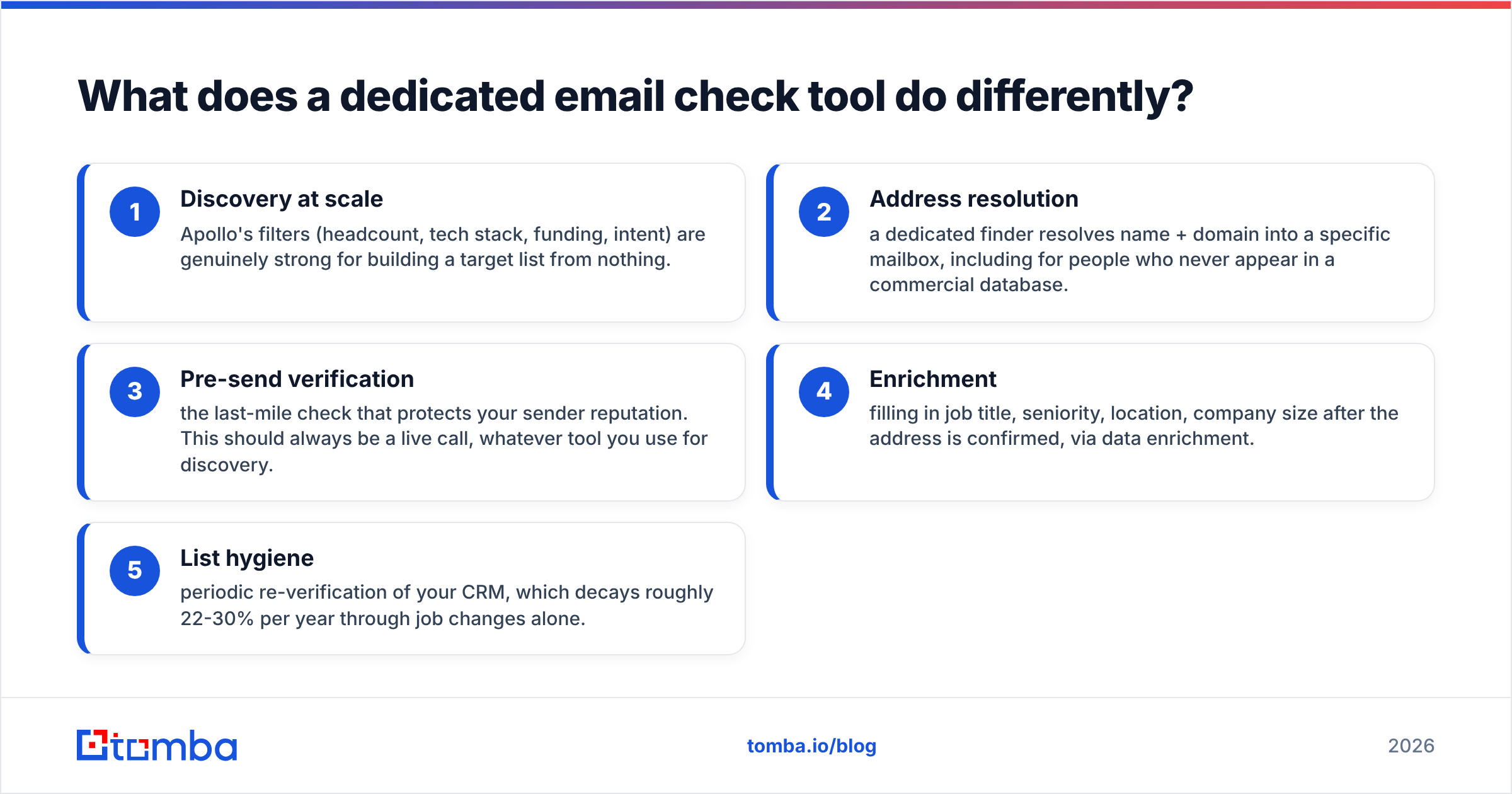
- Discovery at scale — Apollo's filters (headcount, tech stack, funding, intent) are genuinely strong for building a target list from nothing.
- Address resolution — a dedicated finder resolves name + domain into a specific mailbox, including for people who never appear in a commercial database.
- Pre-send verification — the last-mile check that protects your sender reputation. This should always be a live call, whatever tool you use for discovery.
- Enrichment — filling in job title, seniority, location, company size after the address is confirmed, via data enrichment.
- List hygiene — periodic re-verification of your CRM, which decays roughly 22-30% per year through job changes alone.

Email check vs Apolloio: how do the prices and features compare?#
The honest comparison is not "which is better" but "what do you get per dollar for the job you actually have."
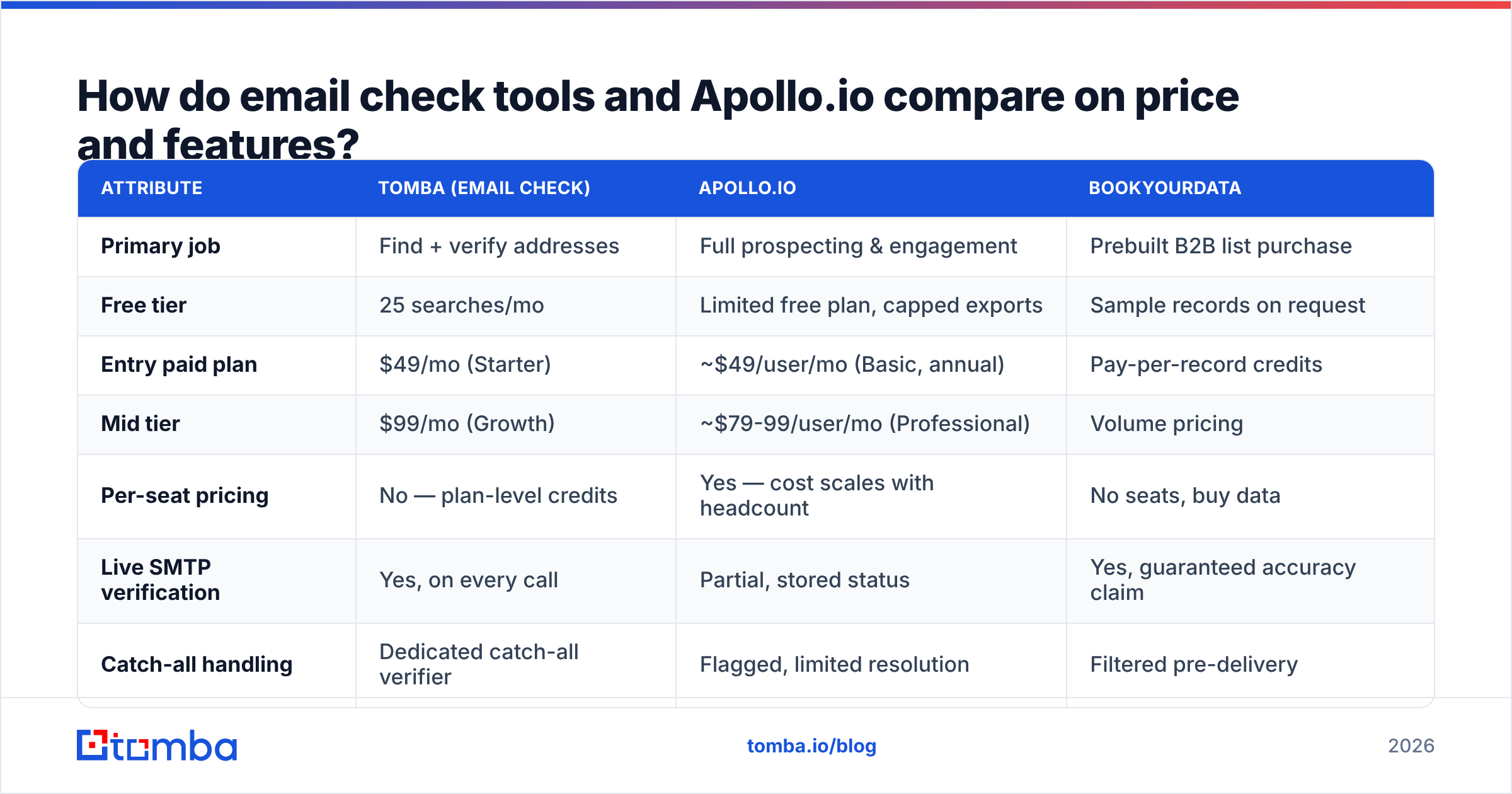
| Attribute | Tomba (email check) | Apollo.io | BookYourData |
|---|---|---|---|
| Primary job | Find + verify addresses | Full prospecting & engagement | Prebuilt B2B list purchase |
| Free tier | 25 searches/mo | Limited free plan, capped exports | Sample records on request |
| Entry paid plan | $49/mo (Starter) | ~$49/user/mo (Basic, annual) | Pay-per-record credits |
| Mid tier | $99/mo (Growth) | ~$79-99/user/mo (Professional) | Volume pricing |
| Per-seat pricing | No — plan-level credits | Yes — cost scales with headcount | No seats, buy data |
| Live SMTP verification | Yes, on every call | Partial, stored status | Yes, guaranteed accuracy claim |
| Catch-all handling | Dedicated catch-all verifier | Flagged, limited resolution | Filtered pre-delivery |
| Source transparency | Public sources returned | Not exposed | Compliance documentation |
| Sequencing / dialer | No | Yes, built in | No |
| CRM sync | HubSpot, Salesforce, Pipedrive | Native, bidirectional | Export to CSV/CRM |
| API access | All paid plans | Higher tiers | Available |
| Best for | Accuracy-first outbound, dev teams | Full-cycle SDR teams | One-time targeted list buys |

Two things stand out in that table.
Per-seat pricing is the hidden multiplier. Apollo at $79/user/month across six reps is $474/month before add-ons. Tomba's pricing is plan-level: Starter $49, Growth $99, Pro $249, with credits shared across the team. If your bottleneck is data volume rather than seat count, per-seat billing is the wrong shape.
BookYourData occupies a real third position. If you need a clean, targeted list of 5,000 contacts in a specific vertical and you don't want to run discovery yourself, buying a verified list is a legitimate move — and it sidesteps both the seat costs and the credit math. It's a different purchase pattern, not a worse one.
Which one produces fewer bounces?#
Dedicated verification wins, and the mechanism is simple: freshness of the check.
Consider two identical lists of 1,000 contacts.
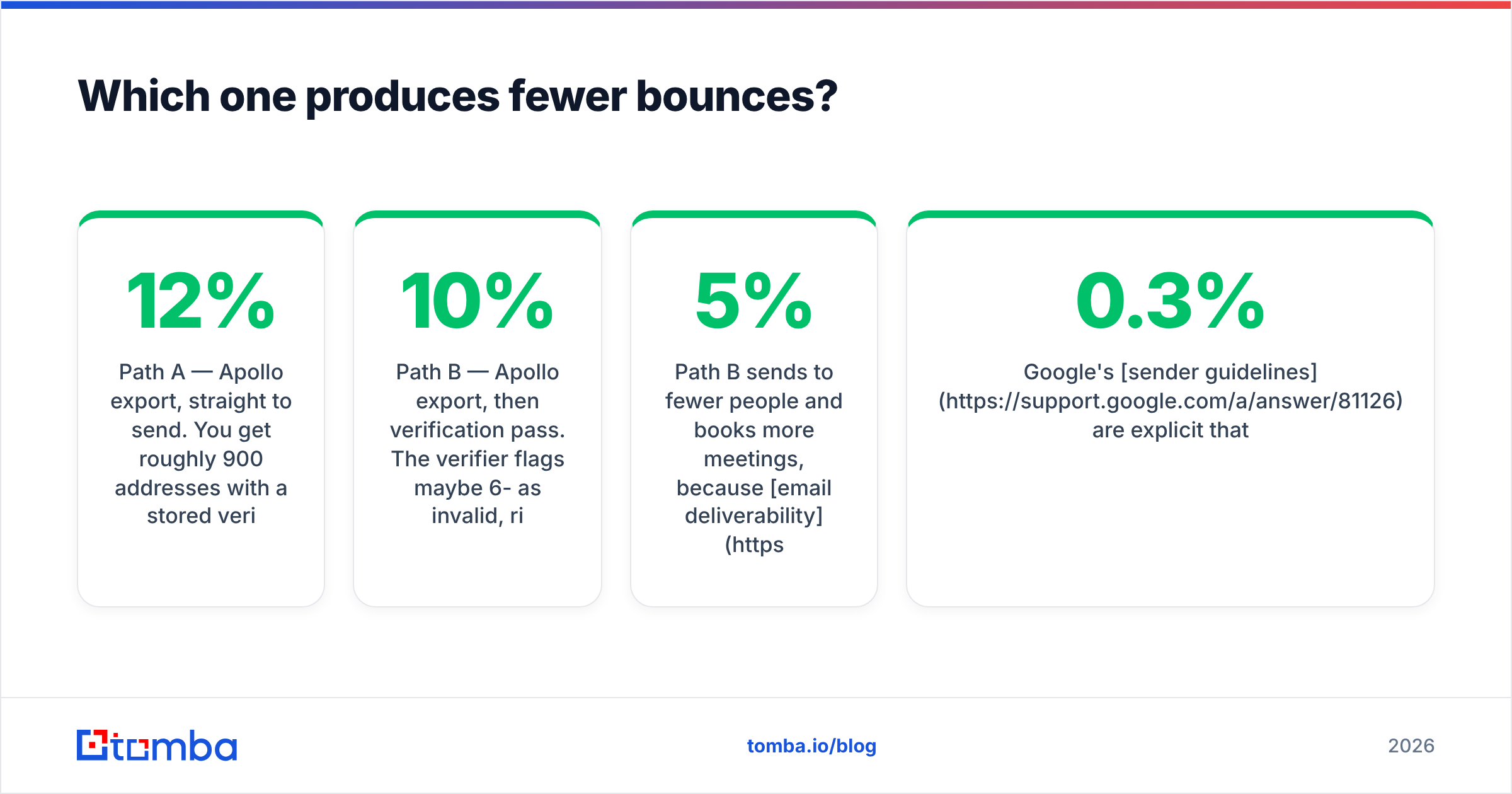
- Path A — Apollo export, straight to send. You get roughly 900 addresses with a stored verified label. Real-world bounce rates on unrefreshed exports commonly land in the 5-12% range depending on segment age. At 8%, that's 72 hard bounces.
- Path B — Apollo export, then verification pass. The verifier flags maybe 6-10% as invalid, risky, or catch-all-unknown before you send. You drop them, send to 830, and bounce at roughly 1-2%.
Path B sends to fewer people and books more meetings. That is because email deliverability is a compounding system. Google and Microsoft both treat bounce rate as a domain-level reputation signal. Cross 5% and your good addresses start landing in spam. The 72 bounces in Path A don't cost you 72 prospects — they cost you the inbox placement of the other 828.
This is the part most teams learn the expensive way, usually about six weeks into a new domain.

Google's sender guidelines are explicit that bulk senders must keep spam complaint rates under 0.3% and maintain valid authentication. Nothing in a sequencer protects you from a dirty list. The check has to happen upstream.
When should you actually pick Apollo.io?#
Apollo is the right call in specific, identifiable situations. Don't let a verification argument talk you out of it when these are true:
- You have 5+ SDRs who need one system. Consolidating discovery, sequencing, dialing, and reporting into one login has real operational value that a point tool cannot match.
- You're selling to North American tech. Apollo's coverage is strongest exactly here, and the intent/technographic filters are genuinely useful for building segments you couldn't build manually.
- You need call + email in one cadence. The built-in dialer and task queue matter if your motion is multi-channel.
- Your budget is per-seat anyway. If you're already paying per-rep for a sequencer, folding data into the same line item can be cheaper than two vendors.
The counter-case: you're a founder, a two-person team, an agency running outbound for clients, or a developer wiring lead capture into your own product. In all four, per-seat pricing and a bundled sequencer you won't use are pure overhead. You want an API, accurate results, and credits you control.
When is a dedicated email check the better buy?#
Pick verification-first when any of these describe you:
- Your bounce rate is above 3%. Fix the input before you touch anything else. Run your existing list through a bulk verify pass and measure the delta.
- You prospect outside Apollo's strong coverage. Think non-US markets, SMB, agencies, trades, education, and healthcare. Database coverage thins out there. You need a tool that can resolve an address from a name and a website rather than look one up.
- You're building on an API. Tomba's email finder API is a first-class product, not a tier-gated add-on. So are the Tomba CLI and MCP server if you're wiring this into an agent workflow.
- You need catch-all resolution. Roughly 20% of B2B domains are catch-all. A tool that just labels them "unknown" hands the risk back to you.
- You want source auditability. For regulated industries or GDPR-sensitive outreach, "where did this address come from" is a question you need answered.
Can you use both together?#
Yes, and for most teams past 10 people this is the correct architecture, not a compromise.
The clean pattern:
- Discover in Apollo. Use the filters to build your target account and contact list. This is what it's best at.
- Export without over-spending credits. Export names, companies, domains, and titles. You do not need Apollo's email credits for every record.
- Resolve and verify in Tomba. Push the name + domain pairs through the finder and verifier. You get a fresh, live-checked address with a confidence score.
- Sync back. Use the HubSpot integration or Zapier to write clean records into your CRM.
- Sequence wherever you like. Apollo, Instantly, Smartlead — the sequencer stops mattering once the list is clean.
Reviews on G2 show the same split again and again. Platform users praise workflow consolidation and complain about data decay. Point-tool users praise accuracy and wish for more built-in automation. Both complaints are accurate. Running both resolves both.
What does this cost in practice?#
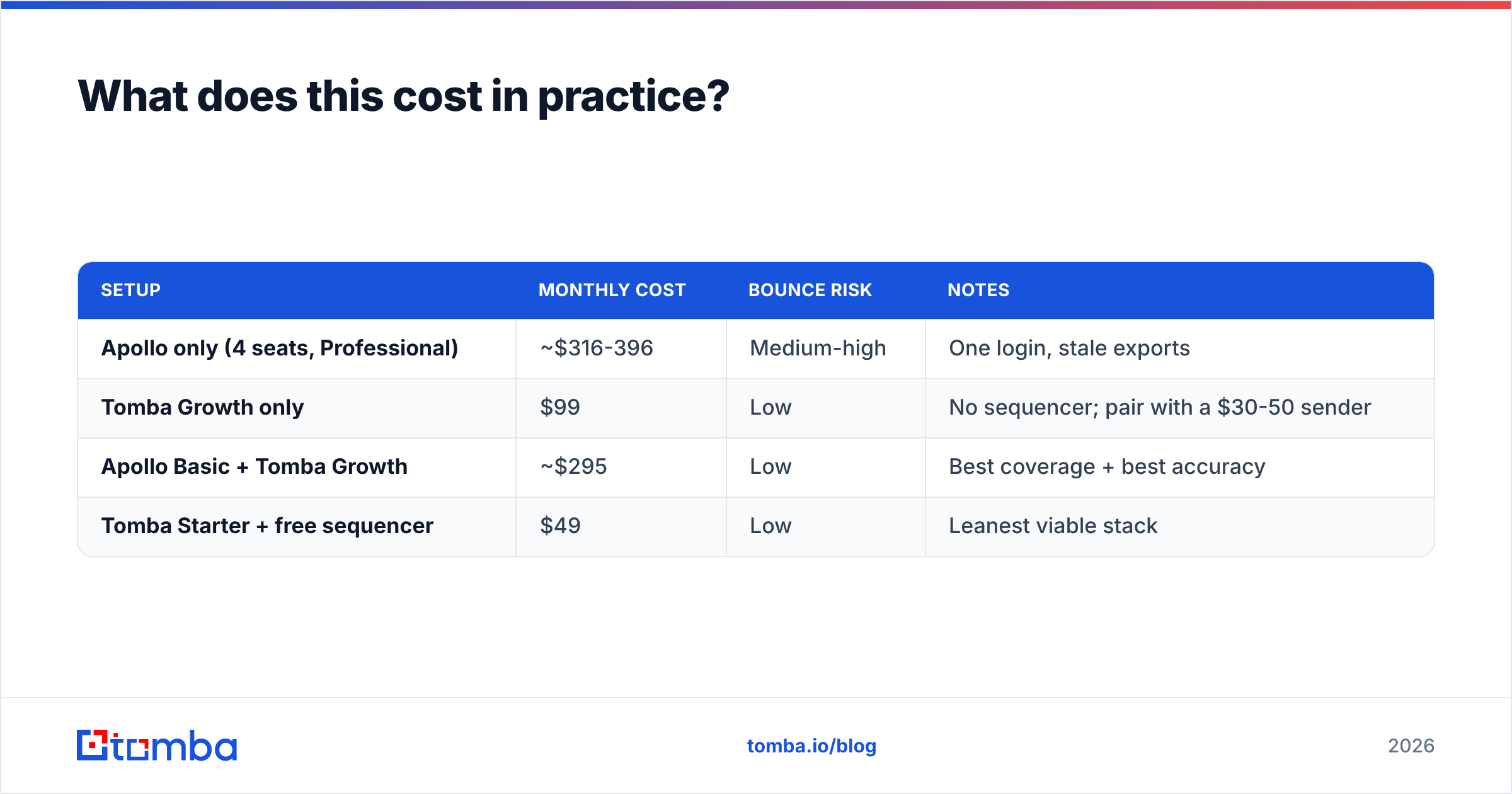
For a four-person outbound team sending 4,000 emails a month:
| Setup | Monthly cost | Bounce risk | Notes |
|---|---|---|---|
| Apollo only (4 seats, Professional) | ~$316-396 | Medium-high | One login, stale exports |
| Tomba Growth only | $99 | Low | No sequencer; pair with a $30-50 sender |
| Apollo Basic + Tomba Growth | ~$295 | Low | Best coverage + best accuracy |
| Tomba Starter + free sequencer | $49 | Low | Leanest viable stack |
The stack that most consistently outperforms is row three. It often costs less than Apollo alone at a higher tier, because you stop paying for email credits you're going to re-verify anyway.
The bottom line#
Email check vs Apolloio comes down to how many problems you are solving. If you only have one — are these addresses real? — buy the verifier. If you have five and one of them is data, buy the platform. If you have both, run discovery in the platform and the last-mile check in the verifier, and stop paying twice for the same email credit.
Start with the free tier and test it against a list you already know the answer to. Take 100 contacts you've emailed in the last quarter, run them through Tomba Email Finder, and compare the results against your actual send log. Twenty-five free searches a month is enough to prove the accuracy claim before you spend $49. If the numbers hold up on your own data, you'll know exactly which side of this comparison your team belongs on.
Related guides#
Ready to find emails that actually work?
Join 150,000+ professionals who stopped guessing and started sending. Free credits on signup — no credit card required.
Get the Tomba newsletter
Practical outbound tactics and product updates — once every two weeks.
About the author