EmailChecker.net vs Apollo.io: Which Tool Wins in 2026?
One tool cleans lists. The other builds them. Here is an honest breakdown of EmailChecker.net vs Apollo.io — pricing, accuracy, data depth, and which one actually belongs in your 2026 outbound stack.
EmailChecker.net vs Apollo.io is not a fair fight, and that is the point. One tool cleans the list you already own. The other builds a list you do not have yet. This guide shows which gap each one fills, what each really costs, and when neither is the right buy.
TL;DR
- They are not the same category. EmailChecker.net is a list-hygiene tool. You feed it addresses you already have. Apollo.io is a database and sequencing platform. It hands you contacts you did not have.
- If your problem is bounces, buy a verifier. If your problem is "I have nobody to email," a verifier will not help.
- Apollo's cost scales with seats. Verification cost scales with volume. Mixing the two on one bill is where budgets get ugly.
- Apollo's built-in verification is directional, not final. Most teams still run an outside check before a cold send. So you pay twice.
- A middle path exists. A finder plus verifier that bills per credit, not per seat. A two-person team is then not funding enterprise pricing.
EmailChecker.net vs Apollo.io: what does each tool do?#
Think of it like a restaurant. Apollo.io is the supplier truck that pulls up with crates of produce. EmailChecker.net is the prep cook who throws out the bruised tomatoes. You need both jobs done. You will not get both from one vendor here.
Concretely:
- EmailChecker.net is a validation service. Upload a CSV or call the API. It returns a status per address: valid, invalid, disposable, role-based, or unknown. It does not source new contacts.
- Apollo.io is a go-to-market platform. It bundles a contact database, filters, a Chrome extension, email sequencing, a dialer, and light CRM features.
- The pricing models differ. Verification is credit-based and pay-as-you-go. Apollo is seat-based, with credit allowances on top. Adding a junior SDR costs a full license.
The failure modes differ too.
- A verifier fails quietly. It marks a good address "unknown," and you never send.
- A database fails loudly. It hands you a job title that changed 14 months ago.
- Only one of them is optional. You can run outbound without Apollo. You cannot run it without verification, unless you enjoy explaining a 15% bounce rate to whoever owns the domain.
So the real question behind EmailChecker.net vs Apollo.io is rarely which tool is better. It is simpler. Which gap in my stack am I closing, and am I paying a platform price for a utility job?
EmailChecker.net vs Apollo.io: the head-to-head comparison#
Here is the honest side-by-side. Pricing reflects publicly listed tiers at the time of writing. Always confirm on the vendor's own page, because both change tiers often.
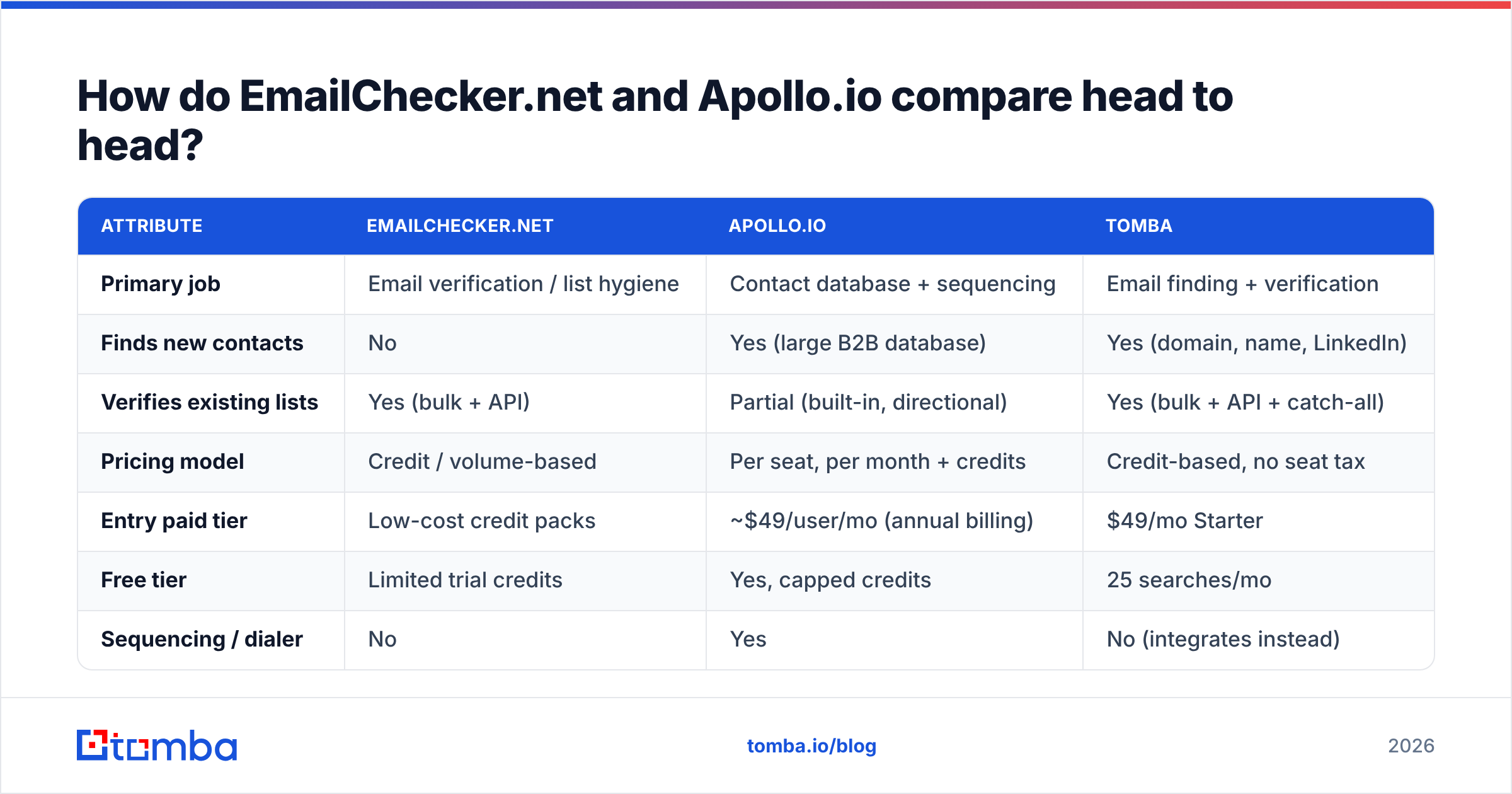
| Attribute | EmailChecker.net | Apollo.io | Tomba |
|---|---|---|---|
| Primary job | Email verification / list hygiene | Contact database + sequencing | Email finding + verification |
| Finds new contacts | No | Yes (large B2B database) | Yes (domain, name, LinkedIn) |
| Verifies existing lists | Yes (bulk + API) | Partial (built-in, directional) | Yes (bulk + API + catch-all) |
| Pricing model | Credit / volume-based | Per seat, per month + credits | Credit-based, no seat tax |
| Entry paid tier | Low-cost credit packs | ~$49/user/mo (annual billing) | $49/mo Starter |
| Free tier | Limited trial credits | Yes, capped credits | 25 searches/mo |
| Sequencing / dialer | No | Yes | No (integrates instead) |
| Catch-all handling | Flags as unknown | Flags as unverified | Dedicated catch-all verifier |
| Best for | Cleaning a list you own | Full-funnel outbound teams | Accurate sourcing + hygiene at low cost |
Two things jump out of that table.
First, the two tools overlap on one row only: "verifies existing lists." Even there, Apollo's check is a convenience feature inside a much larger product. It is not a specialist engine.
Second, the pricing rows are not the same unit. Apollo's ~$49/user/month becomes ~$245/month once you have five reps. A credit-based verifier at the same list volume often costs a fraction of that. So normalize on cost per usable contact, not cost per month.

EmailChecker.net vs Apollo.io: which one is more accurate?#
Accuracy means two different things here. It depends on which tool you are grading.
For Apollo, accuracy is data freshness. Is this person still in this role, at this company, with this address? Reviews on G2 praise Apollo's coverage. They also flag stale records in smaller markets, outside the US, and at fast-moving startups. That is the usual trade-off for a large scraped database. Breadth comes at the cost of decay.
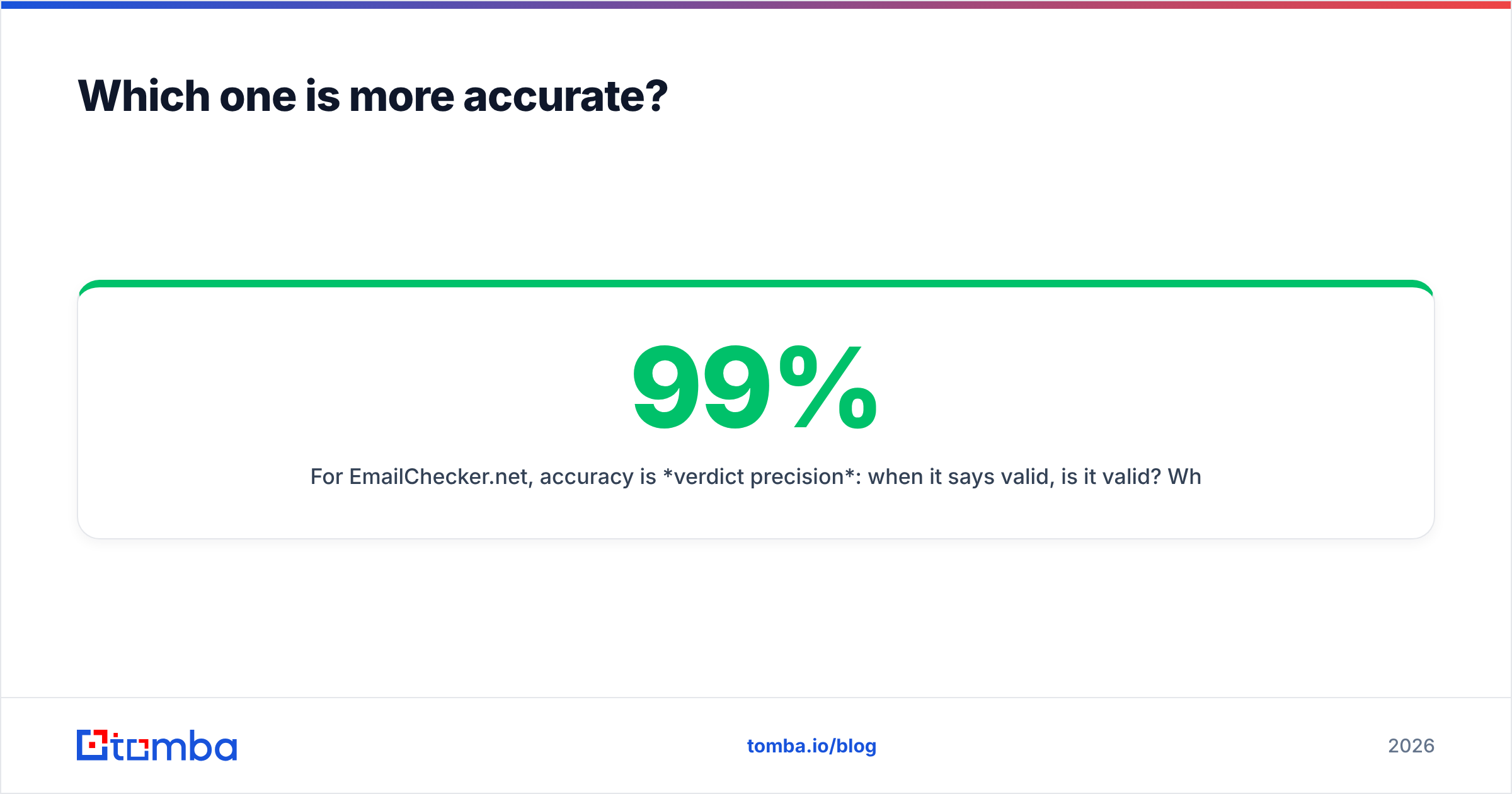
For EmailChecker.net, accuracy is verdict precision. When it says valid, is it valid? When it says invalid, was it really? The real test is not the headline claim, since everyone claims 97-99%. The real test is the unknown rate: how many addresses the tool refuses to judge.
A verifier that returns 30% "unknown" has been 99% accurate on the 70% it judged. You are still guessing on a third of your pipeline.

The catch-all problem is where most comparisons fall apart. Roughly a fifth of B2B domains accept mail for every address. So an SMTP check returns "accept" for nonsense@company.com just as readily as for the CEO.
Standard verifiers dump those into "unknown." A dedicated catch-all verifier adds more signal: pattern confidence, past deliverability on the domain, and source corroboration. That turns part of the unknown bucket into a usable verdict.
Practical rule: run a 500-address control test on contacts you already know. Measure the unknown rate and the false-valid rate. Vendor accuracy pages are marketing. Your control test is data.
EmailChecker.net vs Apollo.io: what does each one really cost?#
The sticker price is almost never the real price. Three costs stay hidden.
- The seat tax. Apollo charges per user. Verifiers charge per address. A five-person team on Apollo's mid tier pays roughly $4,700-$7,100 a year before overage credits. Put that number next to any "it's only $79/month" claim.
- The double-pay problem. Teams export Apollo contacts, then re-verify them elsewhere before sending. Sender reputation is not worth the risk. You have now paid for the contact and paid again to trust it.
- Annual lock-in. Apollo's headline seat prices assume an annual contract. Month to month costs more. Verification credits usually do not expire the same way. Still, check first, because some vendors reset them monthly.

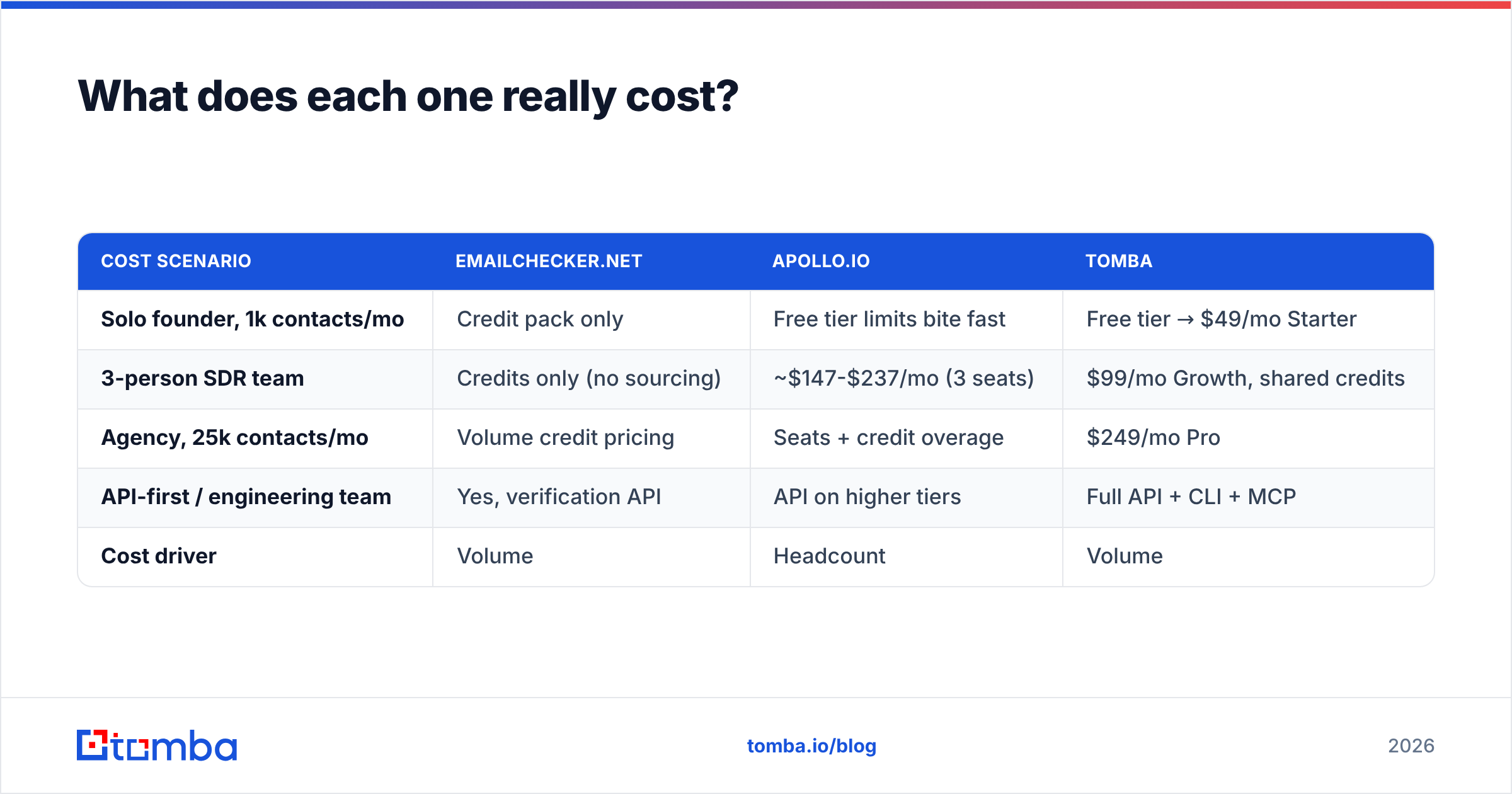
| Cost scenario | EmailChecker.net | Apollo.io | Tomba |
|---|---|---|---|
| Solo founder, 1k contacts/mo | Credit pack only | Free tier limits bite fast | Free tier → $49/mo Starter |
| 3-person SDR team | Credits only (no sourcing) | ~$147-$237/mo (3 seats) | $99/mo Growth, shared credits |
| Agency, 25k contacts/mo | Volume credit pricing | Seats + credit overage | $249/mo Pro |
| API-first / engineering team | Yes, verification API | API on higher tiers | Full API + CLI + MCP |
| Cost driver | Volume | Headcount | Volume |
Full Tomba pricing is credit-based on every tier. That matters most on the agency row. You are not billed for the account manager who logs in twice a month.
Which tool fits which team?#
Pick EmailChecker.net if you already own your list. Maybe it came from an event, a webinar export, an old CRM, or a partner. You do not need new contacts. You need to know which of the 40,000 rows will bounce. Buying a full GTM platform for that is like buying a car to charge your phone.
Pick Apollo.io if you have budget, headcount, and a real need for sequencing, dialing, and pipeline tracking in one login. Apollo's value is consolidation: one tool instead of four, one vendor, one onboarding.
Teams of 10 or more with a dedicated ops person get the most from it. Teams of two mostly pay for features they never open. If consolidation is not your goal, an Apollo alternative billed by usage is usually cheaper.
Pick a dedicated finder plus verifier if your bottleneck sounds like this: "I know the 500 companies I want. I just need the right person's address, verified." This is the most common real-world case. It is also the one EmailChecker.net vs Apollo.io handles worst. One cannot source it. The other makes you buy a whole platform to get it.
Pick a prebuilt list provider if you want contacts delivered rather than discovered. Vendors like BookYourData sell verified B2B lists by filter. That suits teams who would rather buy a finished dataset than run a sourcing workflow. Different philosophy, valid outcome.

How does Tomba fit between them?#
Full disclosure: this is the Tomba blog. Read this section with the right amount of skepticism, then go test the free tier instead of taking our word for it.
Tomba sits in the gap that EmailChecker.net vs Apollo.io leaves open. It sources addresses like a database tool and verifies them like a hygiene tool, with no per-seat bill:
- Email finder — first name, last name, domain in; verified address out. This is the atomic operation most outbound runs on.
- Domain search — pull every discoverable address at a company, plus the detected email pattern. You can then build addresses for people no database lists yet.
- Email verifier — SMTP, syntax, MX, disposable, and role-based checks, with a real catch-all path instead of a shrug.
- Bulk processing — upload a list and get it enriched and verified in one pass, with no export step between two vendors.
- Tomba API, CLI, and MCP server — for teams who want this inside their own tooling.
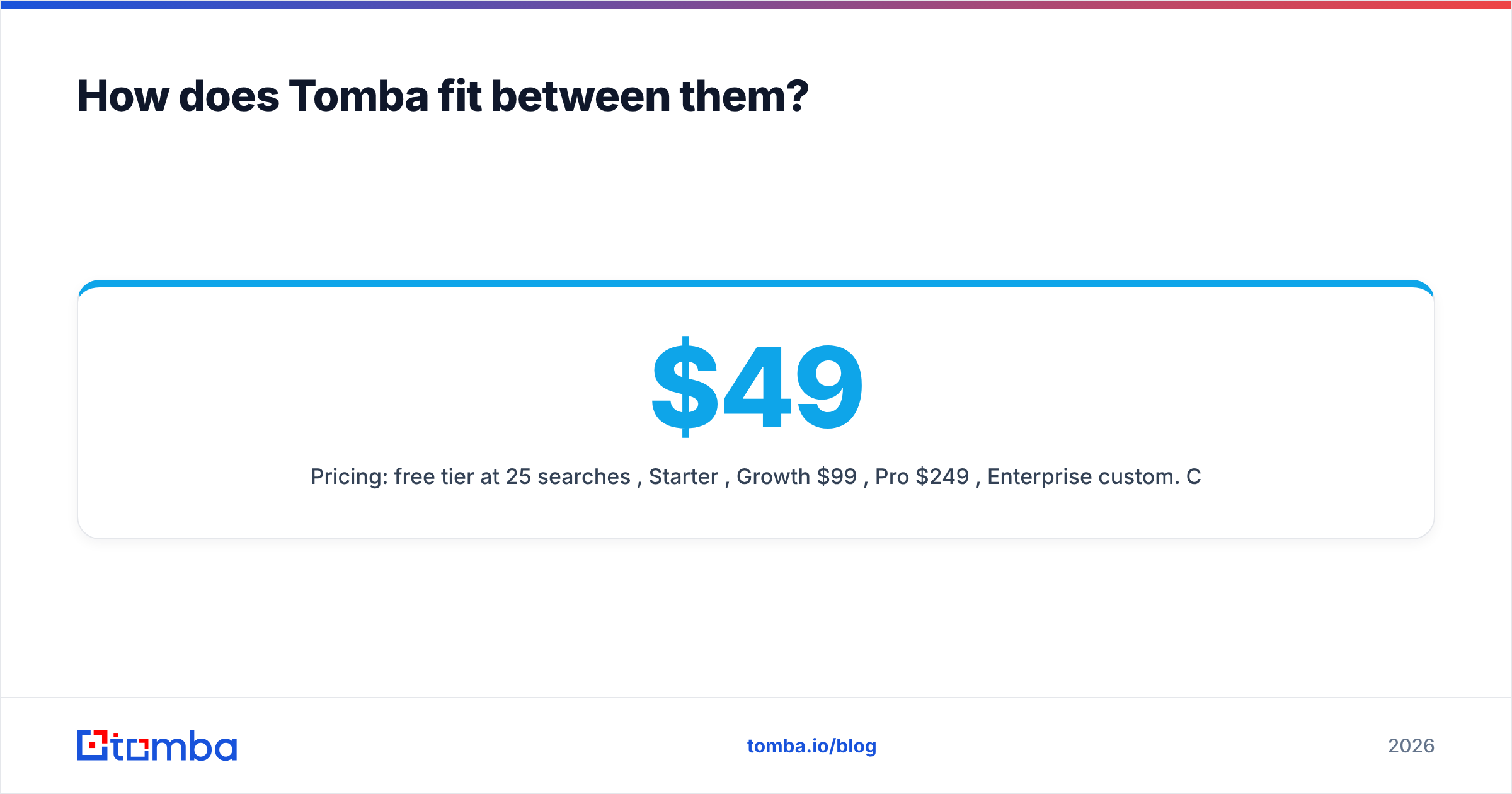
Pricing: free tier at 25 searches a month, Starter $49/mo, Growth $99/mo, Pro $249/mo, Enterprise custom. Credits are shared across the account, so adding teammates does not multiply the bill.
Where Tomba is not the answer: a native dialer, multichannel sequencing, conversation intelligence, or a full CRM replacement. Apollo does more on all four. Tomba plugs into sending tools rather than replacing them — see integrations for HubSpot, Salesforce, Pipedrive, and Zapier. Buying Tomba and expecting a sequencer will disappoint you.
What should you test before you commit?#
Do not buy on a comparison table. Not even this one. Run this in an afternoon.
- Build a 100-row control set. Use contacts you can confirm yourself: customers, colleagues at partner firms, people who have replied to you.
- Run it through every free tier. All three tools here have some free entry point.
- Score three numbers. Hit rate, unknown rate, and false-valid rate. The third one is the expensive one.
Then widen the test.
- Check coverage in your real ICP. US enterprise data is easy, and every vendor looks good on it. Test the segment you actually sell into.
- Model 12 months of cost at your real headcount. Include seats you plan to add. Per-seat models punish growth. Per-credit models punish spikes. Know which pattern is yours.
- Send a small warm-up batch first. Even a clean list into a cold domain hurts email deliverability. Verification protects reputation; it does not create it. HubSpot's deliverability guidance is a solid primer.
Teams get burned here for one reason. They treat verification as a box Apollo already ticked. Then the sending domain gets throttled in week three.
EmailChecker.net vs Apollo.io: so which one wins?#
Neither. They were never in the same race, and that is the honest answer a vendor page will not give you.
- List hygiene only: EmailChecker.net does the job. Buying a GTM platform for it is overpaying by an order of magnitude.
- Full-funnel platform for a funded team of 10+: Apollo.io earns its price through consolidation. The seat model is what that convenience costs.
- Accurate sourcing without a per-seat bill: this is the underserved middle. A dedicated finder plus verifier wins on cost per usable contact.
So the EmailChecker.net vs Apollo.io decision comes down to your bottleneck, not the feature list.
If that bottleneck is finding the right person's address and knowing it will land, start with the Tomba Email Finder. The free tier gives you 25 searches a month. That is enough to run the control test above and decide with your own numbers instead of ours.
If it does not beat what you use today, you lost an afternoon and learned something concrete about your data. If it does, you just removed a per-seat line item from next year's budget.
Related guides#
Ready to find emails that actually work?
Join 150,000+ professionals who stopped guessing and started sending. Free credits on signup — no credit card required.
Get the Tomba newsletter
Practical outbound tactics and product updates — once every two weeks.
About the author