Email Checkernet vs UpLead: Which B2B Email Tool Wins in 2026?
One cleans lists you already have. The other sells you contacts you don't. Email Checkernet vs UpLead, compared honestly on pricing, accuracy, workflow fit, and where a combined tool beats both.
Email Checkernet vs UpLead comes down to one question: do you need to clean a list you already have, or buy contacts you don't? Email Checker.net verifies addresses. UpLead sells contacts. Here is how the two compare on price, accuracy, and workflow fit.
TL;DR
- Email Checker.net and UpLead solve different problems. One verifies emails you already have. The other sells you contacts you don't.
- Pick Email Checker.net if you have a large, aging list and just need to cut the bounce rate before a send.
- Pick UpLead if you have no list, sell into US mid-market, and want firmographic filters plus contacts in one subscription. Entry pricing is about $99/mo.
- Neither is cheap per usable contact. Verifiers leave you sourcing elsewhere. Databases leave you paying for records you never work.
- Want find, verify, and enrich in one place? Tomba does both jobs from $49/mo, with a free tier to test accuracy first.
What is Email Checker.net and what does it actually do?#
Email Checker.net is a single-purpose email verification service. You paste an address or upload a list. It then runs the standard validation chain: syntax check, domain and MX record lookup, disposable-domain detection, and role-account flagging (info@, sales@, support@). It also runs an SMTP handshake, which asks the receiving mail server whether a mailbox exists without sending a real message.
Its output is a status per address — valid, invalid, unknown, catch-all, or disposable — plus a bulk CSV you can re-import into your sending tool. There's an API for developers who want to validate at form-submit time, and pay-as-you-go credit packs for teams that don't want a monthly subscription.
What it does not do is find anyone. Email Checker.net has no contact database, no company search, no job-title filter. If your list is empty, this tool has nothing to give you. That single fact settles most of the "email checkernet vs uplead" debate before you look at a single price.
Think of it like a metal detector at an airport. It's excellent at telling you which bags are a problem. It cannot tell you who should be on the flight.
What is UpLead and who is it built for?#
UpLead sits on the other side of the pipeline. It's a B2B contact database — a searchable index of company and people records with filters for industry, headcount, revenue, technology stack, location, job title, and seniority. You build a list inside the platform, reveal contacts, and export to CSV or push straight into your CRM.
UpLead's main pitch is its 95% data accuracy guarantee. Records are verified in real time when you reveal a contact, not months earlier when they were scraped. That is a real difference from providers that hand you a stale database dump and let you eat the bounces. UpLead also credits you back for bad addresses, which is a fair policy and one reason its G2 reviews skew positive on data quality.
The trade-off is credit economics. Each revealed contact spends a credit from a monthly allowance. Entry pricing lands around $99/mo for a few hundred credits. That sounds fine until you model a real quarter: three SDRs working 400 new accounts a month will burn an Essentials plan in about a week.

Is Email Checker.net better than UpLead?#
Wrong question, but here's the honest answer to the question underneath it: they're not substitutes, and if you buy one expecting the other's job to get done, you'll be disappointed.
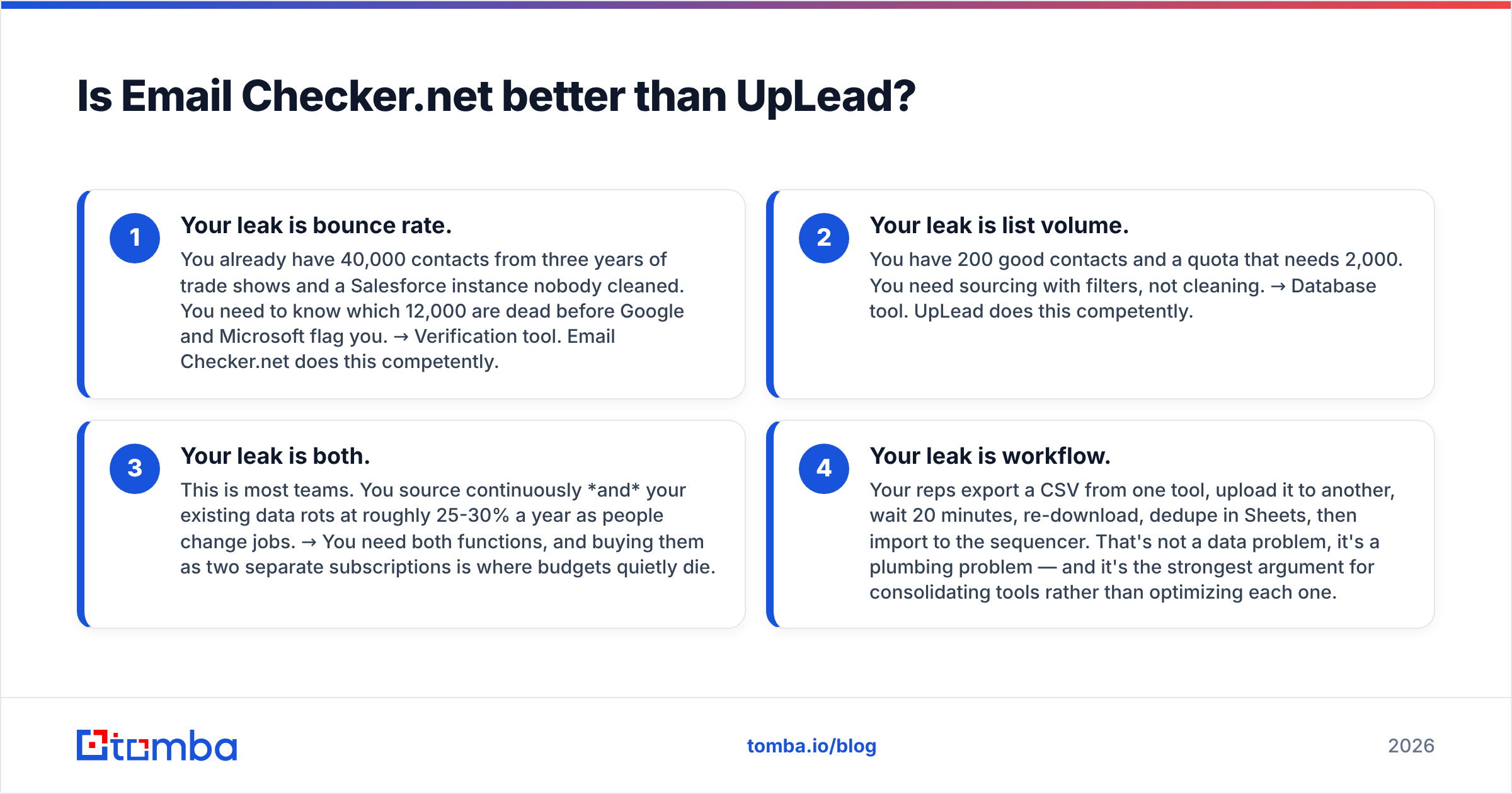
The Email Checkernet vs UpLead choice is really about where your pipeline leaks.
- Your leak is bounce rate. You have 40,000 contacts from three years of trade shows and a CRM nobody cleaned. You need to know which 12,000 are dead before Google and Microsoft flag you. → Verification tool. Email Checker.net does this well.
- Your leak is list volume. You have 200 good contacts and a quota that needs 2,000. You need sourcing with filters, not cleaning. → Database tool. UpLead does this well.
The other two cases are where most teams actually sit.
- Your leak is both. You source every week and your old data rots about 25-30% a year as people change jobs. You need both functions, and paying two separate subscriptions is where budgets quietly die.
- Your leak is workflow. Reps export a CSV from one tool, upload it to another, wait, re-download, dedupe in Sheets, then import to the sequencer. That is a plumbing problem, not a data problem.
How do Email Checker.net, UpLead, and Tomba compare on features and price?#
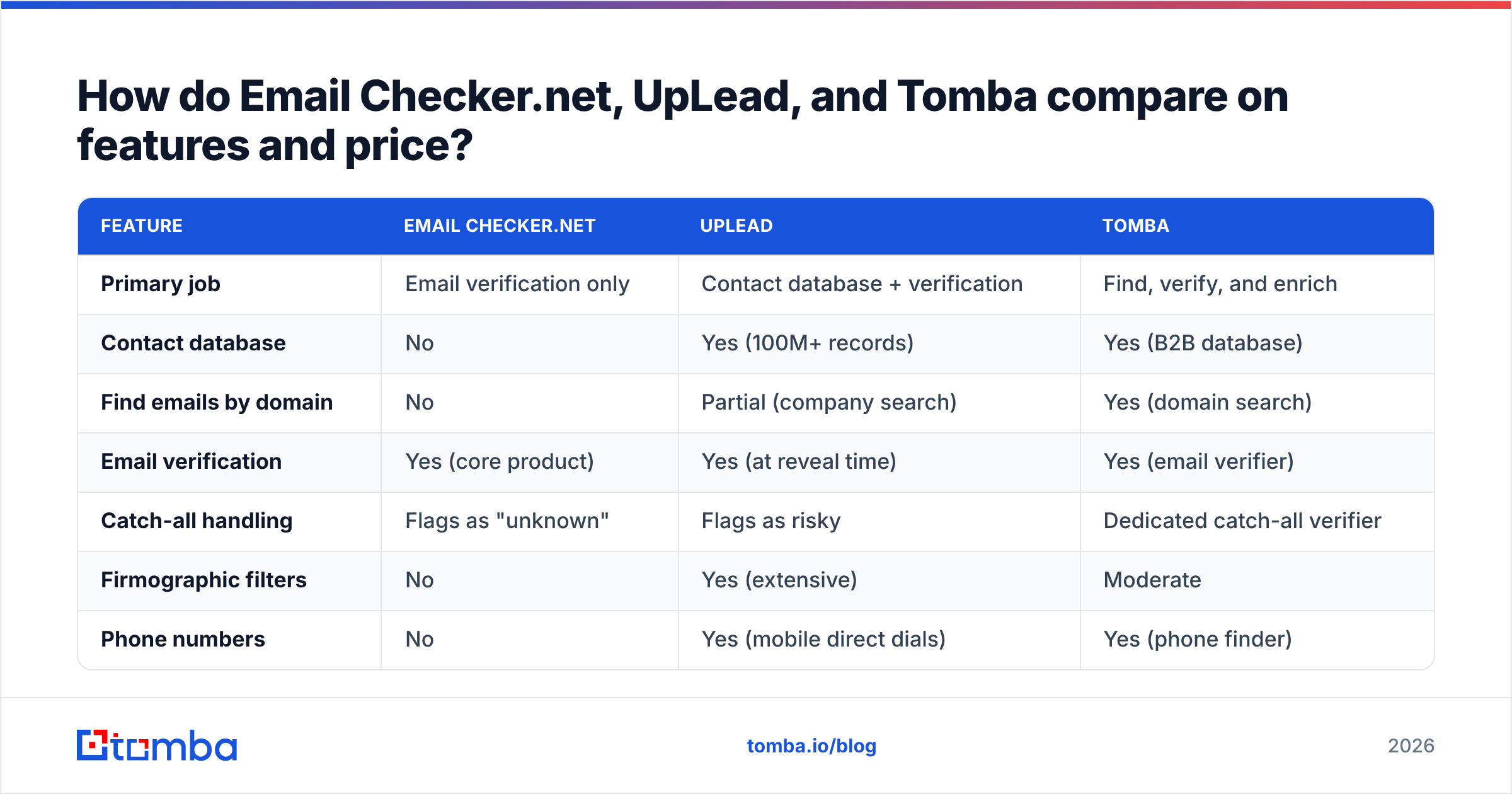
Here's the side-by-side. Pricing moves, so treat these as directional and confirm on each vendor's page before you buy.
| Feature | Email Checker.net | UpLead | Tomba |
|---|---|---|---|
| Primary job | Email verification only | Contact database + verification | Find, verify, and enrich |
| Contact database | No | Yes (100M+ records) | Yes (B2B database) |
| Find emails by domain | No | Partial (company search) | Yes (domain search) |
| Email verification | Yes (core product) | Yes (at reveal time) | Yes (email verifier) |
| Catch-all handling | Flags as "unknown" | Flags as risky | Dedicated catch-all verifier |
| Firmographic filters | No | Yes (extensive) | Moderate |
| Phone numbers | No | Yes (mobile direct dials) | Yes (phone finder) |
| Free tier | Limited trial credits | 5 free credits | 25 searches/mo |
| Entry paid plan | Pay-as-you-go credits | ~$99/mo | $49/mo Starter |
| API access | Yes | Yes (higher tiers) | Yes, all paid plans |
| Bulk processing | Yes | Yes | Yes (bulk email finder) |
| Chrome extension | No | Yes | Yes |
| Best for | Cleaning owned lists | Net-new US mid-market lists | Teams doing both |
Two things jump out of that table.
First, UpLead and Email Checker.net barely overlap. UpLead's verification is a feature that protects its own data. It is not built to process a 200,000-row list you brought from somewhere else. Email Checker.net's whole product is that job.
Second, the credit math differs structurally. Verification credits are cheap per unit, because the work is a DNS lookup and an SMTP conversation. Database credits cost more, because you pay for finding, matching, and refreshing a record. Comparing "$X per credit" across the two is meaningless.
How accurate are these tools in practice?#
Accuracy claims in this category are hard to check unless you test them yourself. So run this before you sign anything.
Take 200 addresses you know the truth about — colleagues, customers, contacts who've replied in the last 90 days. Mix in 50 you know are dead. Run that seed list through each tool's free tier. Count false positives (dead marked valid) and false negatives (live marked invalid). False positives cost you deliverability. False negatives cost you pipeline. Most teams only measure the first.

Three things distort every published accuracy number:
- Catch-all domains. A growing share of B2B domains accept mail for every address at the SMTP layer, so a handshake can't prove anything. Some tools quietly count catch-alls as "valid" and inflate their score. Better tools mark them separately and let you decide — which is why a dedicated catch-all verifier matters more each year.
- Greylisting and rate limits. Big providers throttle verification traffic. A tool that gets throttled returns "unknown" and may still bill you.
- Sample bias. Accuracy on Fortune 500 domains is much easier than accuracy on 20-person agencies with Google Workspace and no MX oddities. Vendors benchmark on the easy half.
The practical rule: a verifier that returns a confident valid/invalid split on more than about 92-95% of a real B2B list is either very good or lying. Only your own seed test tells you which.
What does this cost per usable contact?#
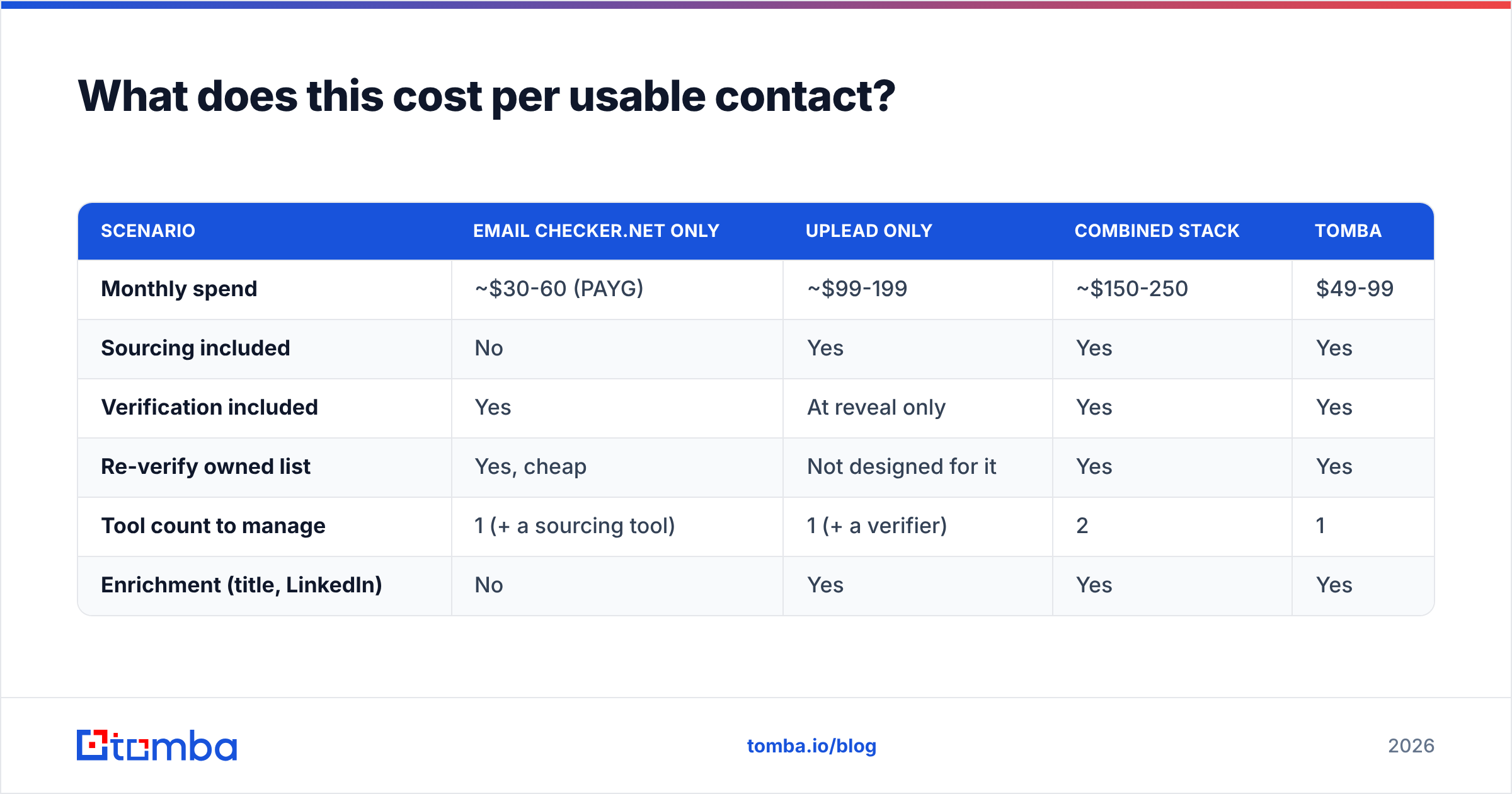
Cost per credit is the wrong metric. Cost per contact you actually email is the one that maps to pipeline.
| Scenario | Email Checker.net only | UpLead only | Combined stack | Tomba |
|---|---|---|---|---|
| Monthly spend | ~$30-60 (PAYG) | ~$99-199 | ~$150-250 | $49-99 |
| Sourcing included | No | Yes | Yes | Yes |
| Verification included | Yes | At reveal only | Yes | Yes |
| Re-verify owned list | Yes, cheap | Not designed for it | Yes | Yes |
| Tool count to manage | 1 (+ a sourcing tool) | 1 (+ a verifier) | 2 | 1 |
| Enrichment (title, LinkedIn) | No | Yes | Yes | Yes |
The two-tool stack is defensible at real volume, because dedicated verifiers process millions of rows more cheaply than bundled ones. Below roughly 20,000 verifications a month, consolidation usually wins. You are paying two platform fees plus the hours your team spends shuffling CSVs between them.

Email Checkernet vs UpLead: which one should you actually buy?#
Buy Email Checker.net if: you have an existing list problem and a separate, working source of new contacts. Its pay-as-you-go model is friendly for one-off cleanups — an annual hygiene project, a pre-migration CRM scrub, a list you inherited from an acquisition. Don't buy it expecting prospecting.
Buy UpLead if: you sell into US mid-market, your ICP is defined by firmographics you can filter on, and you value the accuracy guarantee and credit-back policy. Budget for the credit ceiling honestly. Most complaints in reviews trace back to teams underestimating burn rate, not to data quality.
Look at a combined platform if: your team does both jobs weekly, you want API access without jumping to an enterprise tier, or you're tired of the export-import loop. Tomba runs $49/mo Starter, $99/mo Growth, and $249/mo Pro, with a free tier at 25 searches a month. That is enough to run the seed test above before you spend anything. See Tomba pricing for the current breakdown.
Consider a purchased-list provider if: you want to own the data outright rather than rent access. BookYourData, for example, sells verified B2B lists per record with a bounce guarantee. That suits teams who prefer a one-time purchase over a seat and credit model.
What should your workflow look like either way?#
Regardless of which tool you pick, the sequence that protects your domain looks like this:
- Source narrowly. 200 well-targeted contacts beat 2,000 loose ones. Filter to companies where the pain you solve shows in public signals.
- Verify before every send, not once. A list verified in January is roughly 8-10% wrong by April. Re-verify anything older than 60 days.
- Segment catch-alls into their own track. Send them at lower volume from a secondary domain until you see engagement. Don't mix them into your main send.
- Watch bounce rate. Sustained bounce above 3% degrades sender reputation, and reputation recovers far slower than it drops.
- Enrich after verification, not before. Paying to enrich dead addresses is the quietest waste in outbound budgets.
- Log which source produced which reply. After a quarter you'll have real per-tool ROI instead of vendor claims.

Are there other options worth checking?#
Yes — the category is crowded, and the right answer often isn't either of these two.
- ZeroBounce, NeverBounce, Bouncer — dedicated verifiers in the same lane as Email Checker.net, usually with better UIs at slightly higher prices.
- Apollo, Cognism, Lusha — database plays in UpLead's lane, with heavier sequencing features and heavier price tags. See our Apollo alternative breakdown if you're comparing at that tier.
- Hunter, Findymail, Tomba — find-and-verify hybrids that sit between the two categories.
If you're evaluating more than two vendors, standardize the test. Same seed list, same 200 rows, same week. Vendor-published accuracy figures are not comparable, because none of them use the same denominator.
The bottom line#
Email Checkernet vs UpLead is not really a head-to-head. Email Checker.net is a clean, focused verifier that does one job well. UpLead is a solid US-focused contact database with an accuracy guarantee it honors. Neither is the wrong choice. They answer different questions, and the mistake is buying one to solve the other's problem.
If your honest answer is "I need both," stop paying two platform fees and shuttling CSVs between them. Start with the Tomba Email Finder — find verified professional emails by domain, name, or company, verify them in the same workspace, and push them to your CRM without an export step. The free tier gives you 25 searches a month. That is enough to run the seed-list accuracy test on your own data before you spend a dollar.
Related guides#
Ready to find emails that actually work?
Join 150,000+ professionals who stopped guessing and started sending. Free credits on signup — no credit card required.
Get the Tomba newsletter
Practical outbound tactics and product updates — once every two weeks.
About the author