Email Closing Templates: 25 Sign-Offs That Get Replies
Your last two sentences decide whether a prospect replies or archives. Here are 25 tested email closing templates, ranked by reply rate, plus the closers that quietly kill deals.
TL;DR
- The closing line does more work than the subject line in mid-thread emails. It's the only part that tells the reader what to physically do next.
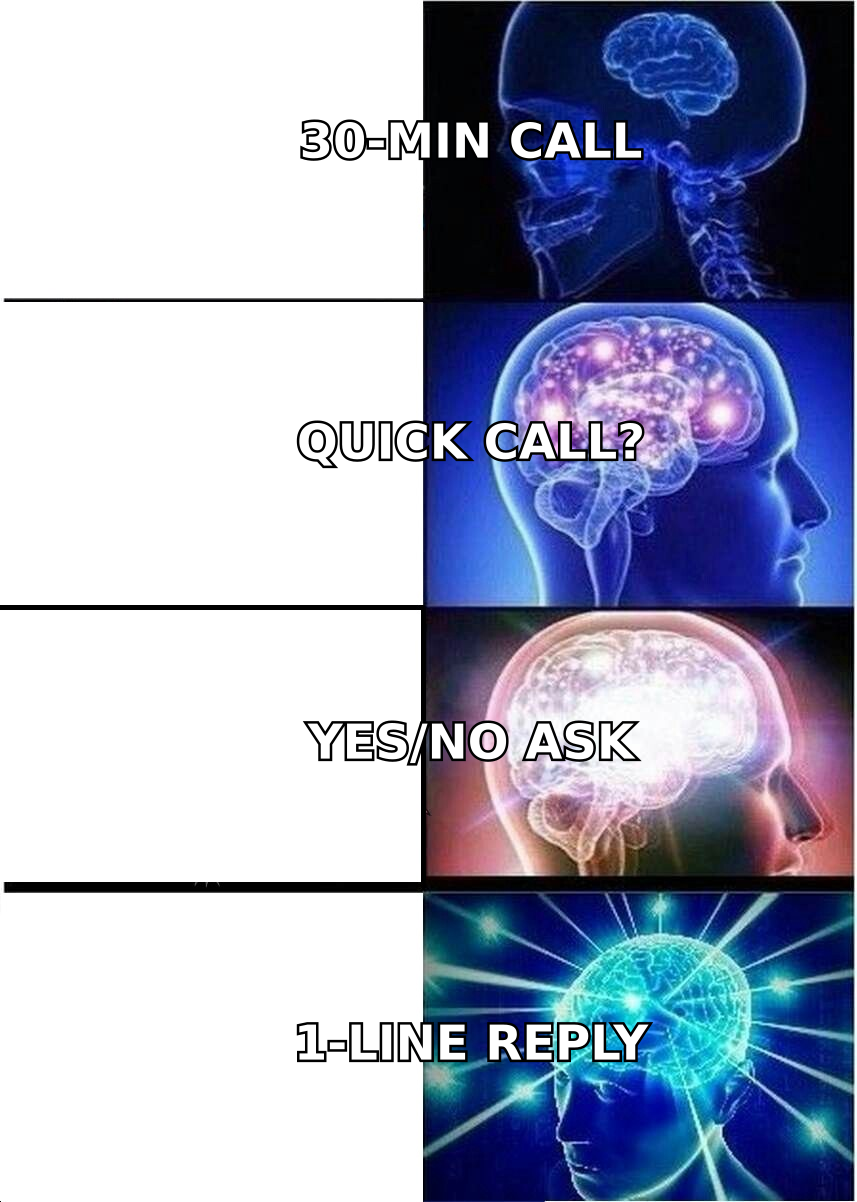
- The highest-replying closers ask for a decision, not a calendar slot. "Worth a look, or wrong timing?" beats "Do you have 30 minutes Thursday?" almost every time.
- Sign-offs ("Best," "Cheers," "Thanks") barely move reply rates on their own — but "Thanks in advance" and "Regards" both test measurably worse in most B2B sample sets.
- Match the ask to thread stage: cold email → low-friction question; follow-up → binary choice; post-demo → explicit next step with a date.
- Templates only work if the message lands. Bad data kills more replies than bad copy — clean the list first, then optimize the last line.
What Is an Email Closing, and Why Does It Decide the Reply?#
An email closing is the last 1-3 lines of your message: the call to action, the sign-off, and anything between them. It's the handoff point — the moment where the reader either does something or closes the tab.
Think of it like the end of a phone call. You can have a great conversation, but if you hang up without saying "I'll send the contract Tuesday," nothing happens. The closing is where you name the next move.
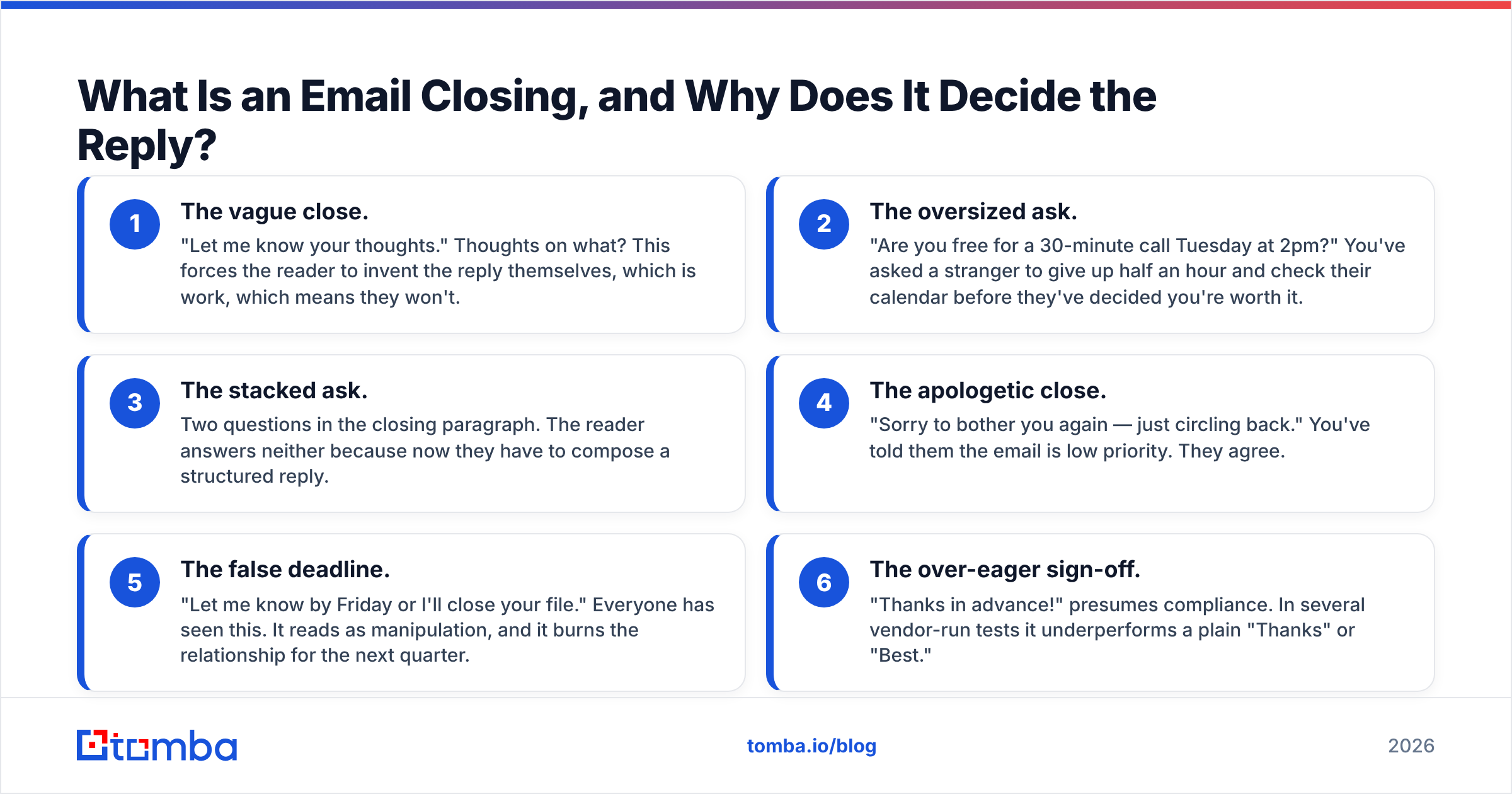
Most reps get the middle of the email right and then fumble the last two lines. The typical failure modes:
- The vague close. "Let me know your thoughts." Thoughts on what? This forces the reader to invent the reply themselves, which is work, which means they won't.
- The oversized ask. "Are you free for a 30-minute call Tuesday at 2pm?" You've asked a stranger to give up half an hour and check their calendar before they've decided you're worth it.
- The stacked ask. Two questions in the closing paragraph. The reader answers neither because now they have to compose a structured reply.
- The apologetic close. "Sorry to bother you again — just circling back." You've told them the email is low priority. They agree.
- The false deadline. "Let me know by Friday or I'll close your file." Everyone has seen this. It reads as manipulation, and it burns the relationship for the next quarter.
- The over-eager sign-off. "Thanks in advance!" presumes compliance. In several vendor-run tests it underperforms a plain "Thanks" or "Best."
The fix is structural, not cosmetic. Swap the closing type, not the adjective.
What Are the Main Types of Email Closings?#
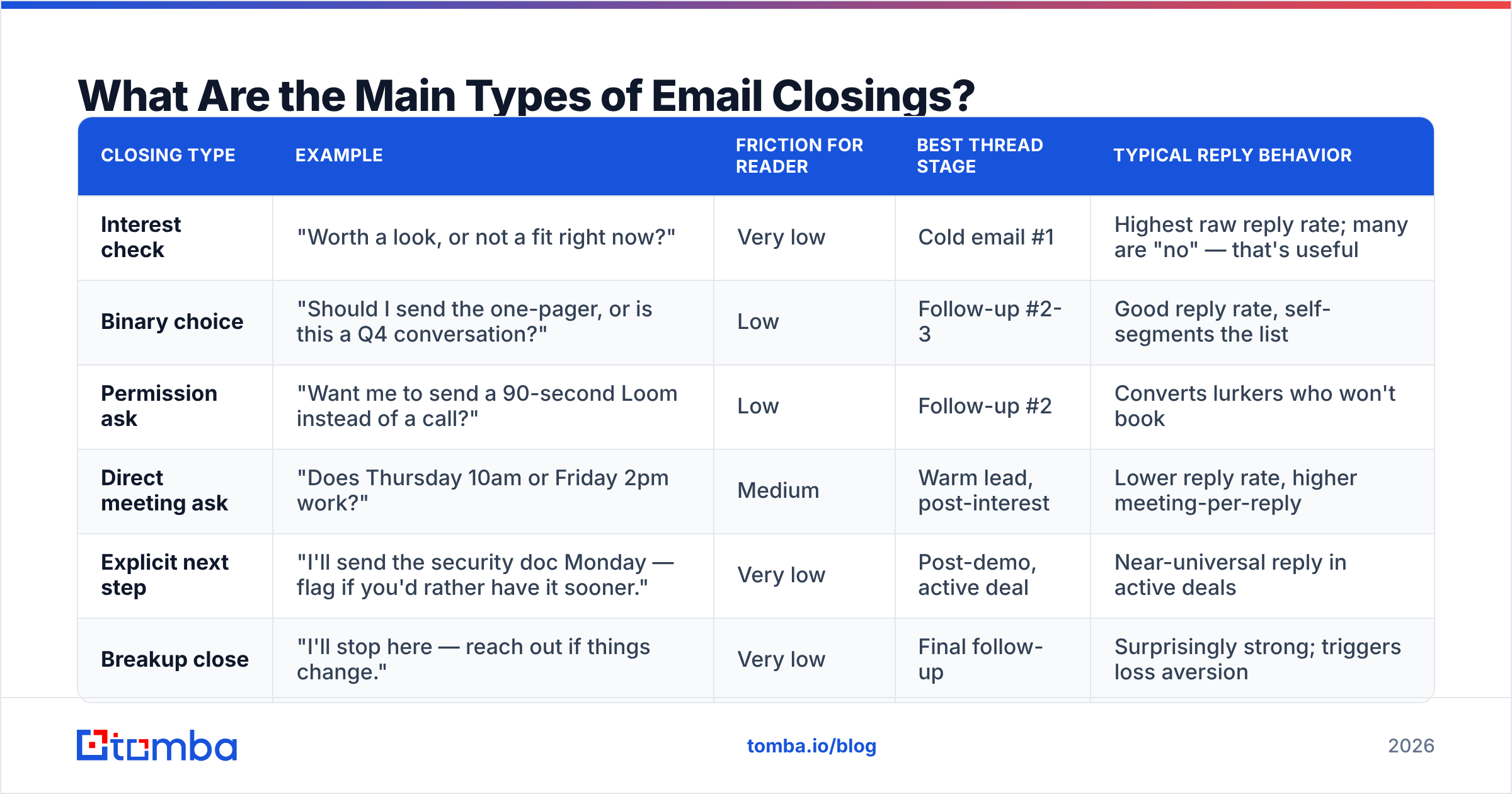
There are five closing patterns that cover roughly every B2B situation. Each has a different friction cost and a different job.
| Closing type | Example | Friction for reader | Best thread stage | Typical reply behavior |
|---|---|---|---|---|
| Interest check | "Worth a look, or not a fit right now?" | Very low | Cold email #1 | Highest raw reply rate; many are "no" — that's useful |
| Binary choice | "Should I send the one-pager, or is this a Q4 conversation?" | Low | Follow-up #2-3 | Good reply rate, self-segments the list |
| Permission ask | "Want me to send a 90-second Loom instead of a call?" | Low | Follow-up #2 | Converts lurkers who won't book |
| Direct meeting ask | "Does Thursday 10am or Friday 2pm work?" | Medium | Warm lead, post-interest | Lower reply rate, higher meeting-per-reply |
| Explicit next step | "I'll send the security doc Monday — flag if you'd rather have it sooner." | Very low | Post-demo, active deal | Near-universal reply in active deals |
| Breakup close | "I'll stop here — reach out if things change." | Very low | Final follow-up | Surprisingly strong; triggers loss aversion |
The pattern is consistent: the less you ask for, the more people answer. That sounds obvious, and almost nobody writes emails that way.
Which Email Closing Templates Work for Cold Outreach?#
Cold email closings should ask for a reaction, not a commitment. Copy these and swap the bracketed parts.
Interest checks (use in email #1):
- "Worth a quick look, or is this the wrong quarter for it?"
- "Is [problem] something your team owns, or should I be talking to someone else?"
- "Open to me sending over how [similar company] handled this?"
- "Reasonable to explore, or off-base?"
- "Are you the right person for [topic], or can you point me somewhere better?"
Template #5 does double duty — it either gets you a yes or gets you a referral, and referrals inside a company convert far better than cold entries. Route those to the right inbox with a domain search rather than guessing at name.surname patterns.
Value-forward closings (use when you have a real asset):
- "I put together a 6-line teardown of your [signup flow / pricing page]. Want it?"
- "Happy to send the benchmark data for [industry] — say the word."
- "I can share the exact sequence that got [company] from 2% to 7% reply. Interested?"
Low-friction alternatives to a call:
- "Rather than a call — want me to answer your top two questions by email?"
- "Would a 4-minute Loom be easier than finding a slot?"
Notice none of these say "let me know your thoughts." Every one can be answered with a single word.
Which Closings Work for Follow-Ups and Stalled Threads?#
Follow-ups fail because they repeat the original ask with more urgency. Change the ask instead.
Follow-up #2 (3-4 days after first email):
- "Bumping this in case it got buried. Yes, no, or not now — all useful."
- "Should I keep this on your radar, or park it?"
- "Quick one: is [problem] a priority this half, or later?"
Follow-up #3 (context shift, ~7 days later):
- "Different angle — [new proof point]. Still worth a conversation?"
- "If [competitor] is already handling this, just say so and I'll stop."
The breakup close (final email):
- "I'll assume timing's off and close this out. Ping me if that changes."
- "Last one from me. If [problem] comes up in Q4, you know where I am."
- "Closing the loop — I'd rather not clutter your inbox. Door's open."
The breakup email routinely outperforms follow-ups #2 and #3 on reply rate. It removes obligation, which paradoxically makes people respond. Just don't fake it — if you send a breakup and then email again two weeks later, you've taught them your closings mean nothing.
Stalled deal closings (after a demo went quiet):
- "Has this dropped down the priority list? Totally fine — just want to stop guessing."
- "Should I send the proposal to [procurement contact], or is that premature?"
Which Closings Work for Active Deals and Post-Demo Emails?#
Once someone is engaged, your closing's job flips from asking to directing. Ambiguity here is what turns a warm deal into a stalled one.
- "Next step on my side: security questionnaire back to you by Wednesday. Anything you need from me before then?"
- "I'll draft the pilot scope today. Can you confirm who signs off — you or [name]?"
- "Two things to close this out: [item A] from you, [item B] from me. Fair?"
- "Sending the redlines Thursday. If legal needs longer, tell me now and I'll adjust the timeline."
- "Recapping so nothing slips: [decision], [owner], [date]. Correct me if I've got it wrong."
Each one names an owner and a date. That's the whole trick. A closing without an owner is a wish.
Do Sign-Offs Like "Best" and "Cheers" Actually Matter?#
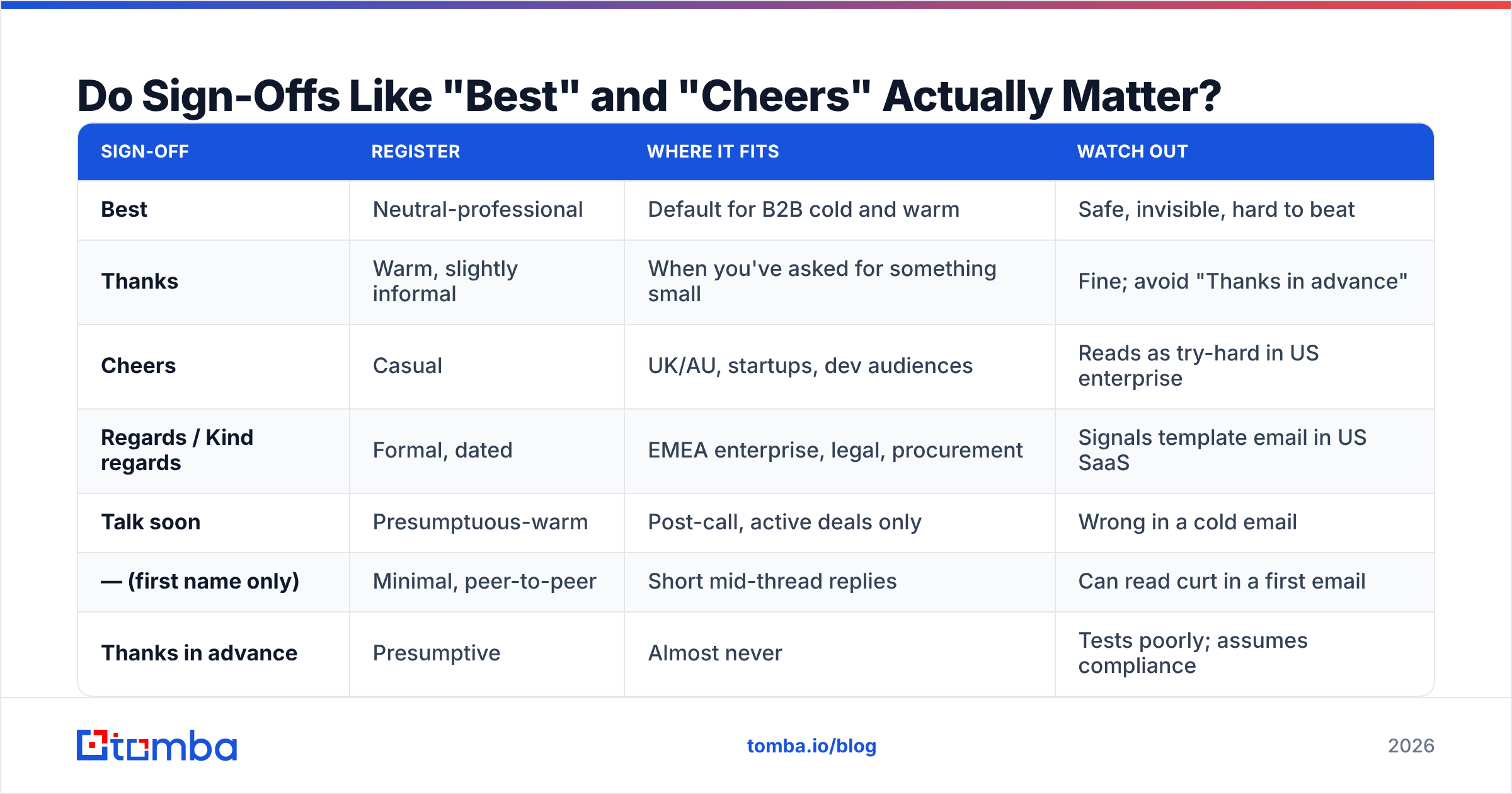
Less than people think — but not zero. The sign-off signals register more than it drives clicks.
| Sign-off | Register | Where it fits | Watch out |
|---|---|---|---|
| Best | Neutral-professional | Default for B2B cold and warm | Safe, invisible, hard to beat |
| Thanks | Warm, slightly informal | When you've asked for something small | Fine; avoid "Thanks in advance" |
| Cheers | Casual | UK/AU, startups, dev audiences | Reads as try-hard in US enterprise |
| Regards / Kind regards | Formal, dated | EMEA enterprise, legal, procurement | Signals template email in US SaaS |
| Talk soon | Presumptuous-warm | Post-call, active deals only | Wrong in a cold email |
| — (first name only) | Minimal, peer-to-peer | Short mid-thread replies | Can read curt in a first email |
| Thanks in advance | Presumptive | Almost never | Tests poorly; assumes compliance |
The practical rule: pick one neutral sign-off, use it consistently, and spend your optimization energy on the CTA line above it. If you want to test something with real upside, test the ask.
How Do You Structure the Last Three Lines?#
Use this skeleton for every email and you'll never write a dead closing again:
- Bridge line — one sentence connecting your body copy to the ask. ("If that's roughly how it works at [company]...")
- The ask — one question, answerable in under five words. Never two questions.
- Sign-off + name — two lines, no title stack, no legal disclaimer wall.
Add a signature that doesn't fight the CTA. A four-line signature with a phone number, three social icons, a banner image, and a legal footer buries the ask you just wrote. Keep it to name, role, company, one link. Build a clean one with a email signature generator if yours has grown a tail.
Before:
Let me know your thoughts on the above and if you'd like to set up some time to discuss further, I'm generally available most afternoons this week and next, happy to work around your schedule.
Thanks in advance!
After:
If lead routing is still manual over there, this is a 15-minute fix.
Worth a look, or wrong timing?
Best,
Sam
Second version: 24 words versus 41, one clear question, no presumption. This is the single highest-leverage edit in most sequences.
Why Do Great Closings Still Get Zero Replies?#
Because the email never arrived, or it arrived at the wrong person. Copy optimization has a ceiling, and list quality sets it.
Three failure points sit upstream of your closing line:
- Invalid addresses. Every bounce chips away at sender reputation, and once reputation slips, even your good sends start landing in Promotions or spam. Run the list through an email verifier before the send, not after the bounces.
- Wrong persona. A perfect closing aimed at an office manager when the buyer is the VP of RevOps produces exactly zero pipeline. Title-level targeting beats copy tweaks by an order of magnitude.
- Authentication gaps. Missing SPF/DKIM alignment sends otherwise-good mail to the junk folder. Google and Yahoo tightened bulk-sender requirements in 2024, and enforcement has only gotten stricter since — Google's sender guidelines spell out the current baseline.
If you're seeing under 2% replies across a whole sequence, the problem is almost never the sign-off. Check bounce rate first. Anything above 3% means your data layer is the bottleneck, and no template in this post will fix it.
How Should You Test Email Closing Templates?#
Keep it boring and statistically honest:
- One variable at a time. Change the CTA or the sign-off, never both. Otherwise you learn nothing.
- Minimum 200 sends per variant before you draw a conclusion. Under that, you're reading noise. Reply rates on small samples swing wildly.
- Measure replies, not opens. Apple Mail Privacy Protection made open rates functionally decorative years ago. Positive-reply rate and meetings-booked are the metrics that survive.
- Segment by stage. A closing that wins on email #1 can lose badly on email #3. Track them separately.
- Re-test quarterly. Closings decay. "Worth a look?" was fresh in 2022 and is now common enough that some buyers pattern-match it instantly.
For benchmarks on what "good" looks like by industry, HubSpot's sales email research and G2's outreach category reviews are reasonable neutral references — though treat any published reply-rate figure as a directional signal, not a target. Your list quality and category maturity swamp the industry average.
One more thing worth tracking: which closing types produce fast replies versus good replies. Interest checks generate volume, including a lot of polite nos. Explicit-next-step closings generate fewer replies but nearly all of them move a deal. Optimizing purely for response rate can quietly push you toward closings that fill your inbox and empty your pipeline.
What's the Fastest Way to Roll These Out?#
Pick three templates — one interest check, one binary choice, one breakup — and load them as snippets in whatever sending tool you use. Don't try to deploy all 25. You'll dilute the test and never learn which one earns its slot.
Then audit your last 50 sent emails. Count how many ended in "let me know your thoughts" or a 30-minute meeting request. If it's more than half, rewriting just those closings will likely do more for your numbers this quarter than any new tool.
Start With the Data, Then Fix the Closing#
The best closing line in the world can't rescue an email sent to a guessed address at a company that already churned. Before you A/B test sign-offs, make sure the contacts are real and current.
Tomba's Email Finder pulls verified professional addresses by domain, name, or company, so your sequence lands with the person who can actually say yes. The free tier gives you 25 searches a month to test it against your current list; paid plans start at $49/mo on Starter, with Growth at $99/mo and Pro at $249/mo — full Tomba pricing is public. Clean the data first, then go win the last two lines.
Related guides#
Ready to find emails that actually work?
Join 150,000+ professionals who stopped guessing and started sending. Free credits on signup — no credit card required.
Get the Tomba newsletter
Practical outbound tactics and product updates — once every two weeks.
About the author