Email Copy in 2026: How to Write Cold Emails That Get Replies
Most cold emails die in the first two lines. Here's the framework, word counts, subject-line rules, and teardown examples that separate email copy that books meetings from copy that gets archived.
TL;DR
- Email copy is judged in about three seconds: sender name, subject line, and the first visible line of preview text. Everything else is optional reading.
- The highest-leverage edit is deletion. Cold emails between 50 and 125 words consistently outperform 250-word pitches.
- Pick one framework (PAS, AIDA, or BAB) per campaign and hold it constant so your A/B tests actually mean something.
- Personalization that works is observable and specific — a hiring post, a pricing-page change, a podcast quote — not "I loved your website."
- Great copy sent to unverified addresses still fails. Bounces above 3% drag your domain reputation down and your best-written email lands in spam.
What is email copy, and why does most of it fail?#
Email copy is every word a recipient can see: the sender name, the subject line, the preview snippet, the body, the call to action, and the signature. It is not "the paragraph in the middle." Treat it as one continuous unit and your metrics move; treat it as body text alone and you optimize the part almost nobody reaches.
Most cold email copy fails for three unglamorous reasons.
It talks about the sender. Count the first-person pronouns in your last outbound email. If "I," "we," and "our" outnumber "you" and "your," you wrote a brochure.
It asks for too much, too early. "Do you have 30 minutes Thursday?" is a large ask from a stranger. A smaller ask — "Is this on your roadmap this quarter, or should I check back?" — converts better because replying costs one word.
It was sent to a list that shouldn't have received it. No amount of clever writing fixes a message aimed at the wrong role at the wrong company. Copy is a multiplier on targeting, not a substitute for it.
There's a fourth reason nobody likes to talk about: volume masks quality. If you send 5,000 emails and get 12 replies, the campaign "works" in the sense that a slot machine works. Cut to 400 well-targeted contacts with copy written for that specific segment and most teams see the same reply count with a fraction of the domain risk.
What are the five parts of an email that actually get read?#
Write these five in order, and edit each one independently. Most reps write the body first and bolt on a subject line at the end — which is backwards, because the subject is doing more work than the body.
- Sender name. "Sarah Kim" beats "Sarah Kim | Acme Revenue Team." Human names get opened; department names get filtered. Use a real inbox on a real domain that has been warmed.
- Subject line. Three to five words, lowercase or sentence case, no brackets, no emoji. It should read like an internal note, not a campaign: "quick question on onboarding," "Q3 headcount," "your Series B."
- Preview text (the first 8–12 words of the body). This is the second subject line, and it's the most-neglected asset in outbound. If your first line is "Hi {{first_name}}, I hope this finds you well," you've spent your preview real estate on nothing.
- The proof line. One sentence that shows you know something specific and true about their business. This is the entire trust budget of a cold email.
- The ask. One question, ending in a question mark, answerable in under ten words. Never stack two asks. Never end with "Let me know your thoughts!" — that's an ask disguised as a courtesy.
Everything else — the case study, the feature list, the calendar link — is optional and usually subtractive. If a sentence doesn't earn its line, cut it. The single most reliable copy edit is deleting your second paragraph entirely and seeing whether reply rate moves. It usually goes up.
Which copy framework should you use — AIDA, PAS, or BAB?#
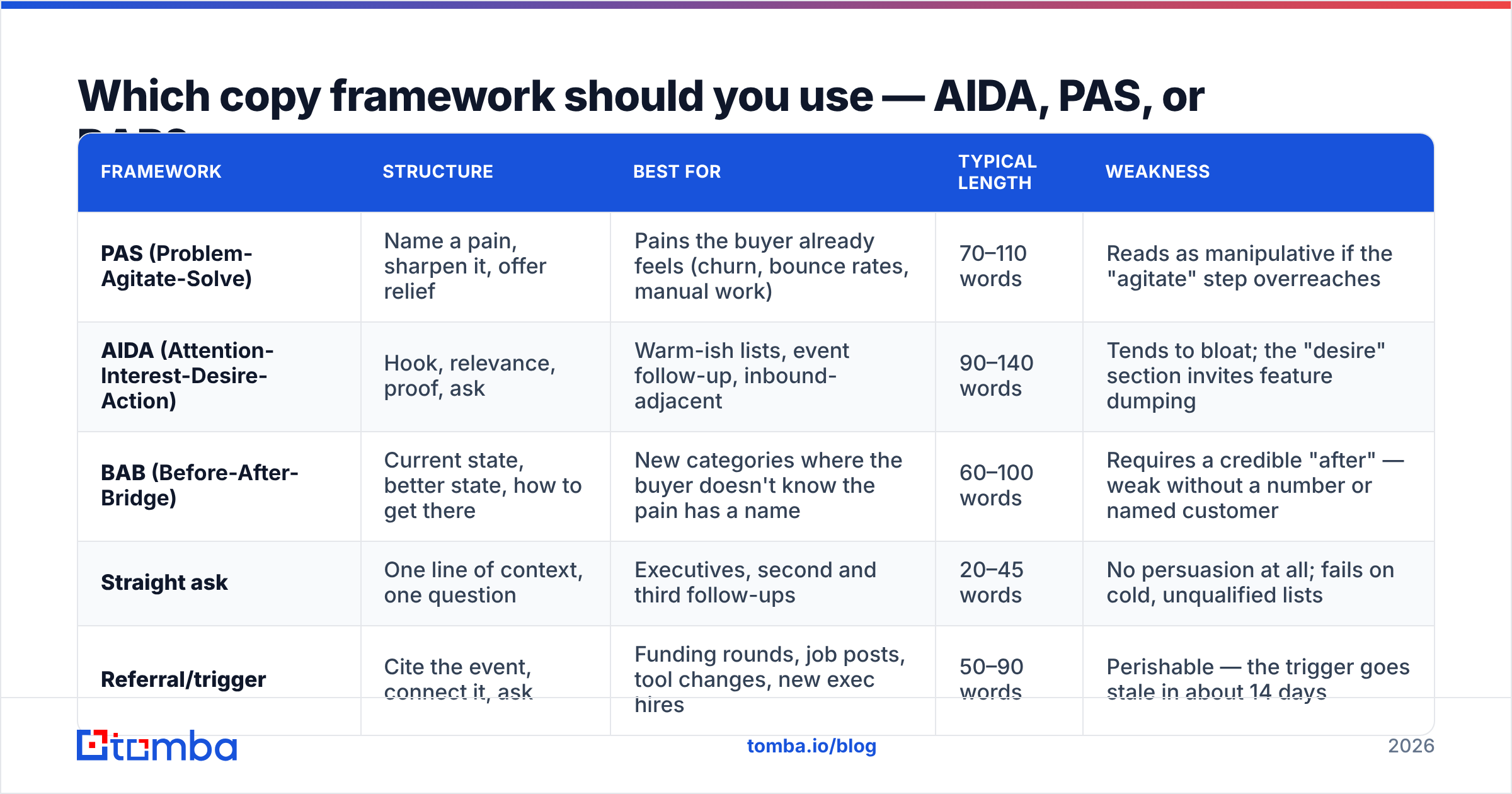
All three work. What kills campaigns is switching frameworks mid-test, so you can't tell whether the new angle or the new structure caused the change. Pick one per sequence and hold it.
| Framework | Structure | Best for | Typical length | Weakness |
|---|---|---|---|---|
| PAS (Problem-Agitate-Solve) | Name a pain, sharpen it, offer relief | Pains the buyer already feels (churn, bounce rates, manual work) | 70–110 words | Reads as manipulative if the "agitate" step overreaches |
| AIDA (Attention-Interest-Desire-Action) | Hook, relevance, proof, ask | Warm-ish lists, event follow-up, inbound-adjacent | 90–140 words | Tends to bloat; the "desire" section invites feature dumping |
| BAB (Before-After-Bridge) | Current state, better state, how to get there | New categories where the buyer doesn't know the pain has a name | 60–100 words | Requires a credible "after" — weak without a number or named customer |
| Straight ask | One line of context, one question | Executives, second and third follow-ups | 20–45 words | No persuasion at all; fails on cold, unqualified lists |
| Referral/trigger | Cite the event, connect it, ask | Funding rounds, job posts, tool changes, new exec hires | 50–90 words | Perishable — the trigger goes stale in about 14 days |
A practical default: PAS for the first touch, straight ask for touches two and four, trigger-based for anything you can time to a real event. HubSpot's sales email research lands in a similar place — structure matters less than relevance and brevity, but consistent structure is what makes relevance measurable.
How long should a cold email be?#
Between 50 and 125 words for a first touch. Under 50 for a follow-up.
The reason isn't reader attention span alone — it's mobile rendering. Roughly six in ten B2B emails are first opened on a phone. On a standard iPhone display, a recipient sees about 40 words before scrolling. If your ask is in word 180, you're relying on a stranger to scroll for you.
Length discipline also forces prioritization. When you have 90 words, you cannot include the company boilerplate, three feature bullets, a case study, and an ask. You have to choose. That choice is the copywriting.
A quick self-audit you can run on any draft:
- Read only the first line. Does it say something only you could say to only this person? If it works for any prospect, rewrite it.
- Delete every adjective. "Powerful," "seamless," "innovative," "cutting-edge," "best-in-class." If the sentence still makes sense, they were padding.
- Count question marks. Exactly one, at the end.
- Read it aloud. If you wouldn't say it to someone at a conference, don't send it.
- Check the ask cost. How many words must they type to answer? Over ten, and you've built friction into your conversion step.
What makes a subject line get opened in 2026?#
Specificity and lowercase. That's most of it.
Subject lines that mimic internal email — short, unpolished, referencing a concrete noun from the recipient's world — outperform marketing-styled subjects by a wide margin. "quick q re: your Snowflake migration" beats "Transform Your Data Stack Today" every time, because the second one announces itself as a broadcast.
Rules that hold up across industries:
- Three to five words. Longer truncates on mobile.
- No title case. Title Case Signals Marketing Department.
- No brackets, no emoji, no "Re:" fakery. Faking a reply thread is a trust bomb that also runs afoul of deceptive-header rules under the CAN-SPAM Act.
- Avoid the word "free," urgency stacking, and all caps. These correlate with spam filtering, not conversion.
- Name a specific thing. A product, a city, a metric, a competitor, a job title from their careers page.
Before you launch, run drafts through a subject line tester and a spam checker so you're not discovering filter problems from a silent campaign three days later.
How do you personalize without spending an hour per email?#
Tier it. Not every contact deserves the same research budget.
Tier 1 (top 50 accounts): manual research, 5–10 minutes each. Read a recent post, a funding announcement, a job description. Write one bespoke proof line. Everything else is templated.
Tier 2 (next 300): segment-level personalization. Same email, but the proof line references something true of the whole segment — "most Series B fintechs we talk to are still verifying lists manually before compliance review."
Tier 3 (long tail): role-level relevance only. No fake personalization. A generic-but-honest email outperforms a badly-merged one, and nothing torches credibility faster than "I loved your recent post about {{topic}}."
The trap is the merge tag. Every extra tag is a failure point. If your enrichment data is 80% complete, one tag means 20% of your sends look broken. Two tags means 36%. Pull firmographics and role data from a source you trust — contact enrichment that fills company, title, and domain reliably is worth more to your copy than any new adjective.
Does your copy matter if your data is bad?#
No. And this is the part teams keep learning the expensive way.
Deliverability is a gate that sits in front of copy. If 8% of your list bounces, mailbox providers read that as list-buying behavior and start routing your domain to spam — including the emails to valid addresses. At that point your reply rate isn't measuring your writing, it's measuring your sender reputation.
Keep hard bounces under 2%, ideally under 1%. That means running your list through an email verifier before every campaign, not once at import. B2B contact data decays roughly 2–3% per month as people change jobs, so a list you verified in January is materially worse by April.
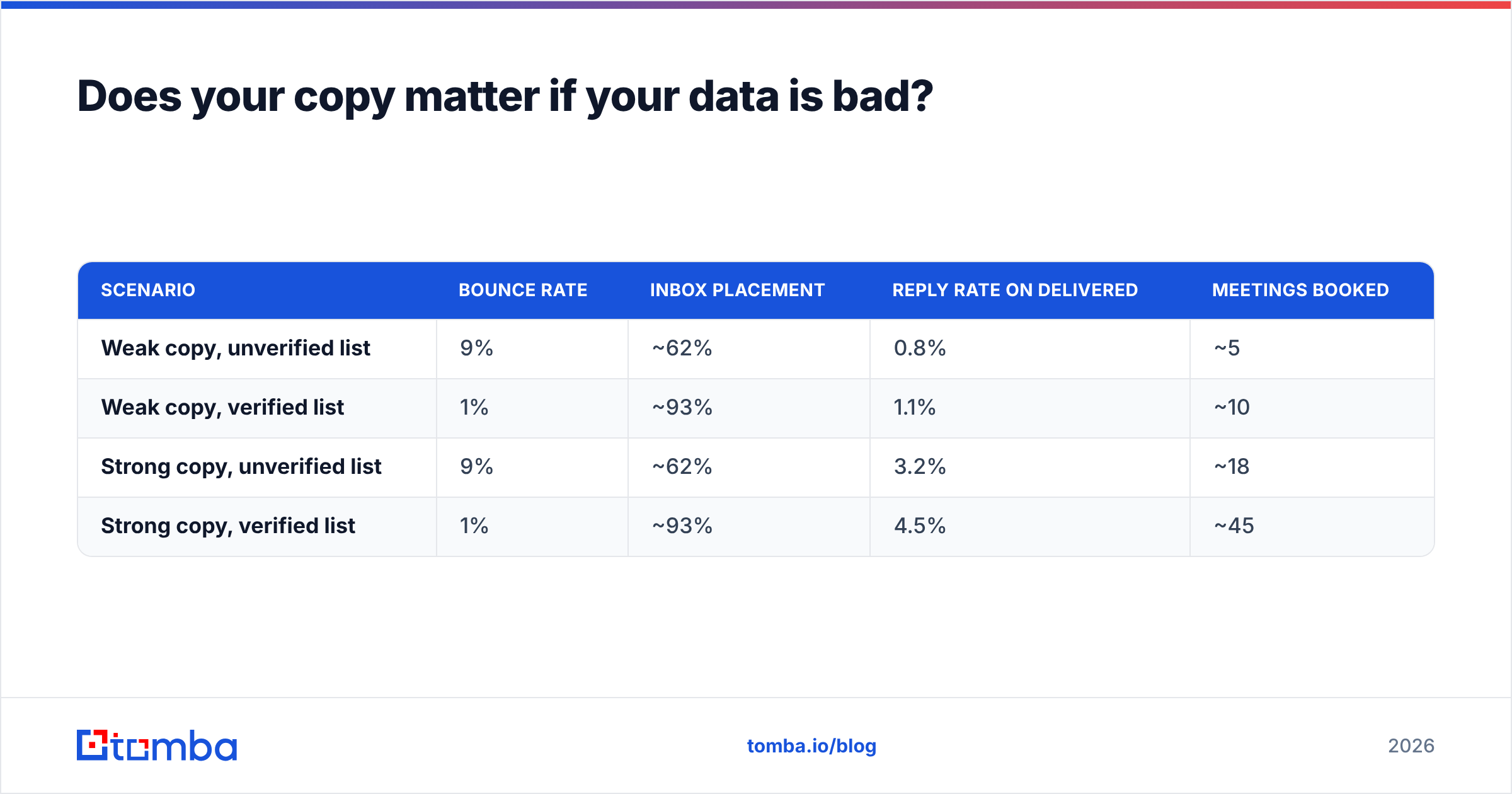
Here's how the two levers interact on a 1,000-contact send:
| Scenario | Bounce rate | Inbox placement | Reply rate on delivered | Meetings booked |
|---|---|---|---|---|
| Weak copy, unverified list | 9% | ~62% | 0.8% | ~5 |
| Weak copy, verified list | 1% | ~93% | 1.1% | ~10 |
| Strong copy, unverified list | 9% | ~62% | 3.2% | ~18 |
| Strong copy, verified list | 1% | ~93% | 4.5% | ~45 |
The numbers are directional, but the shape is consistent across teams: copy and data multiply. Fixing one while ignoring the other caps your ceiling.
What should you test, and how do you know it worked?#
Test one variable at a time, on at least 400 sends per arm, over at least five business days. Anything smaller is noise you'll mistake for insight.
Test in this order of impact:
- List/segment — biggest lever, and technically not copy at all
- Subject line — affects open rate, which gates everything downstream
- First line / preview text — affects whether the body gets read
- The ask — affects reply rate directly
- Length — usually confirms "shorter wins," but confirm it for your market
- CTA phrasing — smallest lever; test last
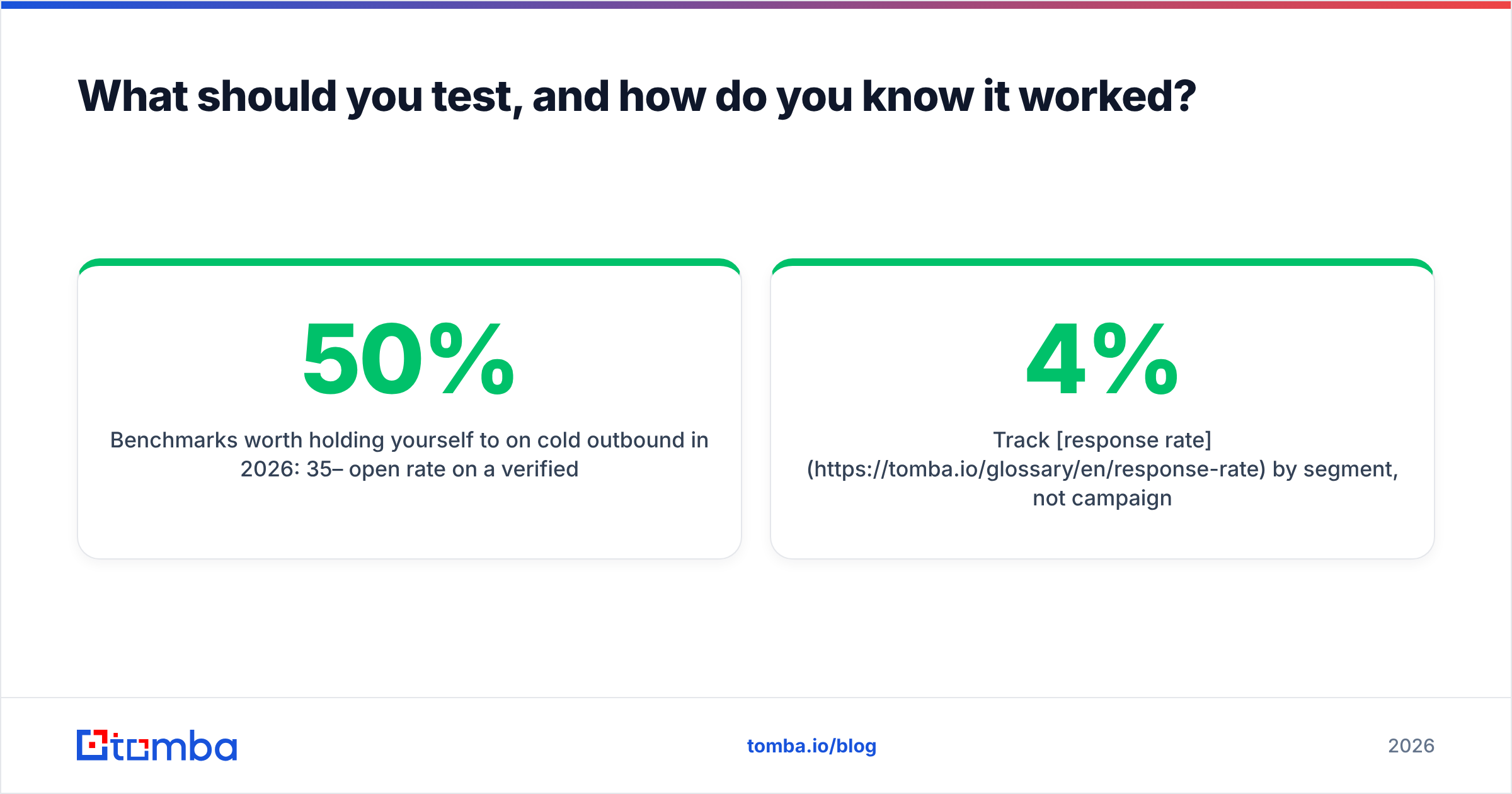
Benchmarks worth holding yourself to on cold outbound in 2026: 35–50% open rate on a verified list, 3–8% reply rate, and 1–2% positive reply rate. Below that, the problem is almost never the closing line. Vendor-reported benchmarks vary widely, so cross-check against independent sources like G2's sales engagement category rather than a single tool's marketing page.
Track response rate by segment, not campaign-wide. A 4% blended rate can hide a 9% segment and a 0.5% segment — and the fix for those two is completely different.
What does good email copy actually look like?#
Three short teardowns.
Trigger-based, 61 words:
Subject: your Denver posting
Saw you're hiring two SDRs in Denver. Teams doing that usually hit a data problem before the reps ramp — new hires burn their first month on lists that bounce.
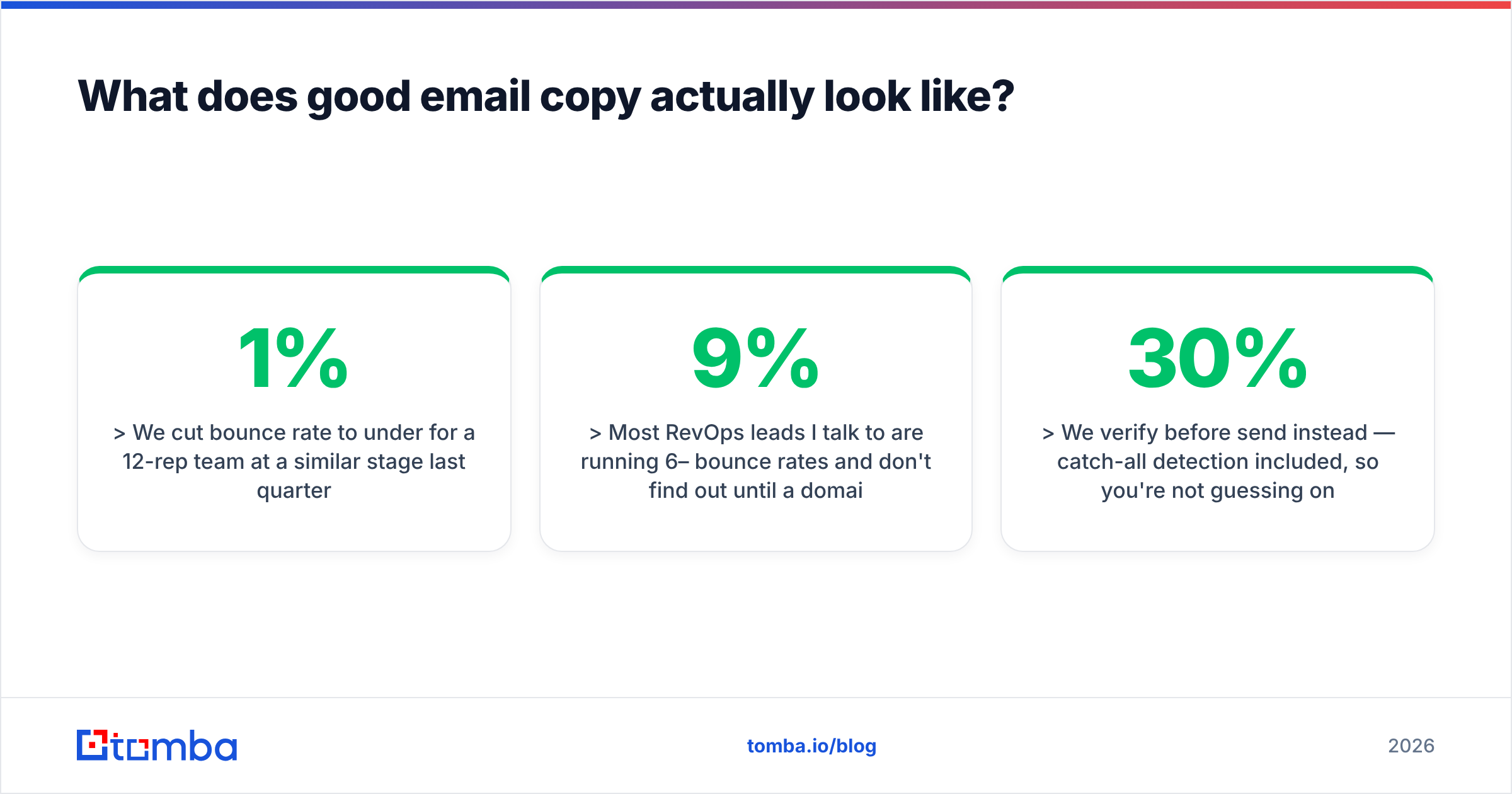
We cut bounce rate to under 1% for a 12-rep team at a similar stage last quarter.
Worth a look before the new hires start, or is data already handled?
Why it works: the proof line is verifiable in ten seconds, the pain is timed to a real event, and the ask offers an easy exit ("or is data already handled?"), which paradoxically raises reply rate.
PAS, 78 words:
Subject: bounce rate question
Most RevOps leads I talk to are running 6–9% bounce rates and don't find out until a domain gets throttled.
By then the fix is a 4-week warmup, not a list scrub.
We verify before send instead — catch-all detection included, so you're not guessing on the 30% of B2B domains that accept everything.
Is bounce rate something you're tracking weekly, or only when something breaks?
Follow-up, 24 words:
Subject: re: bounce rate question
Closing the loop on this — should I stop following up, or is this a Q4 thing?
The permission-to-close follow-up gets replies from people who'd otherwise ghost, because it's easier to say "Q4" than to feel rude.
Where should you start this week?#
Rewrite one sequence, not all of them. Pull your worst-performing campaign, cut every email to under 110 words, replace the opening line with something observable and specific, and reduce every ask to one question. Then verify the list before you resend. If you want a starting structure, the cold email templates library gives you skeletons you can adapt rather than blank pages.
And before any of that copy goes out, make sure it's reaching real people. Tomba Email Finder finds verified professional addresses by name, domain, or company, with catch-all detection built in — so the copy you just spent an afternoon sharpening actually lands in an inbox instead of a bounce log. The free tier covers 25 searches a month, and paid plans start at $49/mo on Tomba pricing if you're running real volume.
Good copy on a bad list is a well-written letter mailed to a demolished building. Fix the address first, then sharpen the sentence.
Related guides#
Ready to find emails that actually work?
Join 150,000+ professionals who stopped guessing and started sending. Free credits on signup — no credit card required.
Get the Tomba newsletter
Practical outbound tactics and product updates — once every two weeks.
About the author