Email Copywriting in 2026: Frameworks That Get Replies
Most cold emails fail on the first line, not the offer. Here are the copywriting frameworks, subject-line rules, and rewrite examples that actually move reply rates in 2026.
TL;DR
- Reply rate is decided in the first 12 words. Subject line and opening sentence do 80% of the work; your offer does the rest.
- Short beats clever. Emails between 50 and 125 words consistently outperform 200+ word pitches in every public benchmark set.
- Pick one framework (PAS, BAB, or the 3-sentence "observation → consequence → ask") and run it for 500 sends before you judge it.
- Personalization that references a decision the prospect made beats personalization that references their city, job title, or last funding round.
- Great copy sent to bad data still fails. Bounces poison your domain reputation before anyone reads your clever hook.
What is email copywriting, really?#
Email copywriting is the craft of writing a message that earns a reply from someone who did not ask to hear from you. That is the whole job. It is not brand writing, it is not newsletter writing, and it is definitely not the polished paragraph your marketing team approved for the website.
Think of it like knocking on a stranger's door. You have about four seconds before they decide whether to open it or pretend they are not home. The subject line is the knock. The preview text is your face through the peephole. The first sentence is whether you sound like a neighbor or a salesman.
The mistake most teams make: they optimize the middle. They rewrite the value prop for the fifth time while the subject line stays "Quick question" and the opener stays "I hope this email finds you well." The middle is the part almost nobody reads.
Here is what actually determines whether a cold email works, ranked by leverage:
- The list. Right person, right company, verifiable email. No copy survives a wrong-fit list.
- The subject line. Decides open. Everything downstream is gated on it.
- The first sentence. Decides whether they keep reading or archive.
- The relevance signal. One specific thing that proves you did not blast 4,000 people.
- The ask. Small, single, and easy to answer with one word.
- The rest of the body. Genuinely the least important part, and the part teams spend the most time on.
Which email copywriting framework should you use?#
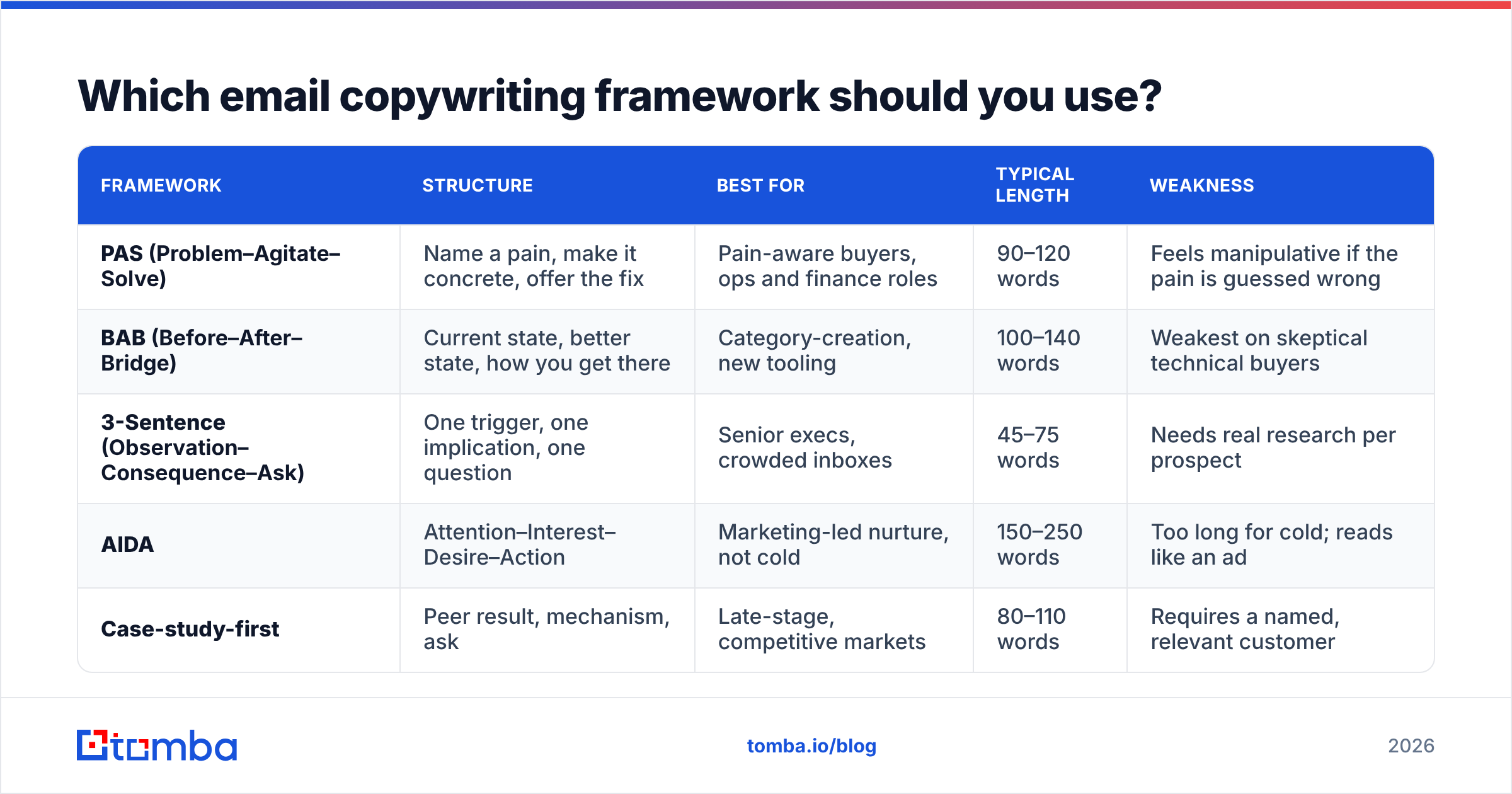
You do not need twelve frameworks. You need one you can execute consistently across a whole sequence. Below are the three that hold up in B2B outbound, compared on the dimensions that matter when you are writing at volume.
| Framework | Structure | Best for | Typical length | Weakness |
|---|---|---|---|---|
| PAS (Problem–Agitate–Solve) | Name a pain, make it concrete, offer the fix | Pain-aware buyers, ops and finance roles | 90–120 words | Feels manipulative if the pain is guessed wrong |
| BAB (Before–After–Bridge) | Current state, better state, how you get there | Category-creation, new tooling | 100–140 words | Weakest on skeptical technical buyers |
| 3-Sentence (Observation–Consequence–Ask) | One trigger, one implication, one question | Senior execs, crowded inboxes | 45–75 words | Needs real research per prospect |
| AIDA | Attention–Interest–Desire–Action | Marketing-led nurture, not cold | 150–250 words | Too long for cold; reads like an ad |
| Case-study-first | Peer result, mechanism, ask | Late-stage, competitive markets | 80–110 words | Requires a named, relevant customer |
If you are starting from zero, run the 3-Sentence framework. It is the hardest to write badly, because there is nowhere to hide filler. Here it is applied:
Subject: your Q3 SOC 2 posting
Saw you opened a second compliance analyst req in eight weeks — usually means the audit evidence collection is eating the team.
We cut that collection time from ~30 hours a cycle to under 4 for [Peer Company], without adding headcount.
Worth a 12-minute look?
Three sentences. One observation grounded in a public signal, one consequence they can verify against their own experience, one ask small enough to say yes to. No "I hope this finds you well," no company boilerplate, no five bullet points of features.
How long should a cold email be?#
Between 50 and 125 words for the first touch. This is one of the few places where the public data is not ambiguous.
The reason is not that people love brevity in the abstract. It is that mobile reading killed long cold email. Roughly 60% of B2B email opens now happen on a phone, where 125 words is already two full scrolls. If your ask sits below the fold, you are relying on a stranger to work for it.
A practical rule: write the email you want to send, then delete the first paragraph. In about eight cases out of ten, the first paragraph is throat-clearing — context you needed to write yourself into the message, not context the reader needs.
The delete list. These phrases add words and subtract credibility:
- "I hope this email finds you well" — signals template immediately.
- "I wanted to reach out because…" — you are reaching out; that is self-evident.
- "We're a leading provider of…" — nobody has ever booked a meeting off this clause.
- "Just circling back" — the single most-ignored opener in follow-up.
- "Let me know if this resonates" — vague ask, vague response.
- "Does this sound interesting?" — yes/no question with an easy no.
What makes a subject line get opened?#
Specificity plus low commercial temperature. A subject line's job is to look like it came from a human who knows something about the recipient, not from a campaign.
Four patterns that consistently earn opens in B2B:
- The reference line — "your Postgres migration post" — names something the person made or did. Highest open rate, lowest scale.
- The internal-shorthand line — "Q3 evidence collection" — reads like an internal thread, not a pitch.
- The two-word noun phrase — "audit prep" — short enough to read fully in mobile preview.
- The question-with-a-premise — "still handling SOC 2 in spreadsheets?" — only works if you have evidence for the premise; a wrong guess kills trust instantly.
What to avoid: capital letters mid-sentence, exclamation marks, the words "free," "guarantee," and "opportunity," and anything with a number-plus-percent pattern ("Cut costs 40%!"). Those trip spam-filter heuristics and, more importantly, read as marketing. You can pressure-test a line in seconds with a subject line tester or generate variants with a subject line generator before you commit a sequence to it.
Preview text is the underrated half of this. Most email clients show 35–90 characters after the subject. If your first line is "Hi {{FirstName}}," you have wasted your entire preview slot on a greeting. Lead with the substance and put the greeting nowhere, or on line two.
Does personalization still work in 2026?#
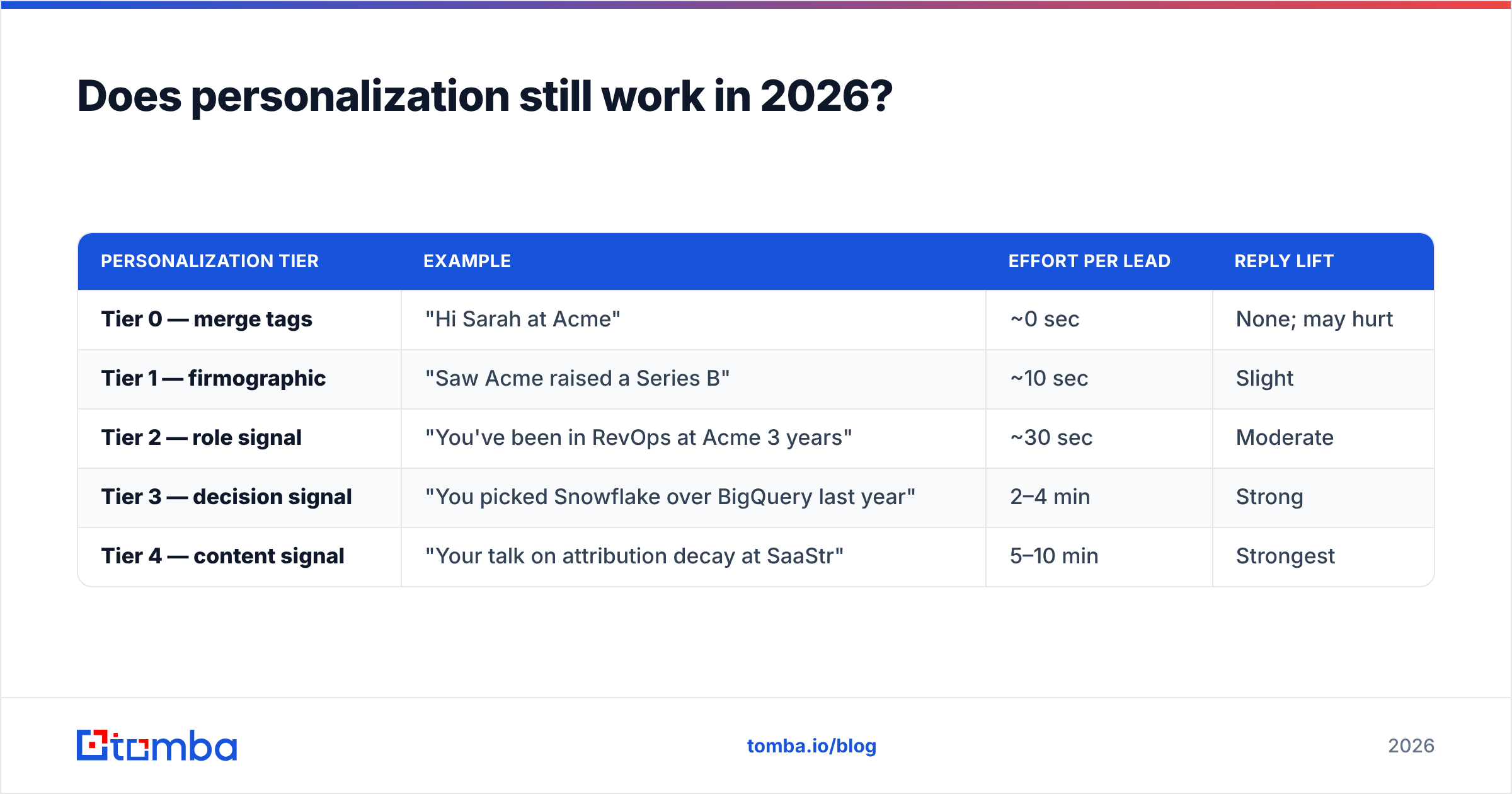
Yes — but the bar moved. Merge-tag personalization ("I noticed you work at Acme in Boston") is now a negative signal, because everyone can do it and buyers have learned to spot it. What still works is what you might call decision personalization: referencing a choice the prospect made, and showing you understand the tradeoff behind it.
| Personalization tier | Example | Effort per lead | Reply lift |
|---|---|---|---|
| Tier 0 — merge tags | "Hi Sarah at Acme" | ~0 sec | None; may hurt |
| Tier 1 — firmographic | "Saw Acme raised a Series B" | ~10 sec | Slight |
| Tier 2 — role signal | "You've been in RevOps at Acme 3 years" | ~30 sec | Moderate |
| Tier 3 — decision signal | "You picked Snowflake over BigQuery last year" | 2–4 min | Strong |
| Tier 4 — content signal | "Your talk on attribution decay at SaaStr" | 5–10 min | Strongest |
Tier 3 and Tier 4 do not scale to 5,000 sends a month with a two-person team, and pretending otherwise is how teams end up with AI-generated "personalization" that is worse than none. The honest answer is a split: 200–300 hand-written Tier 3/4 emails a month to your top accounts, and a tighter, more generic-but-honest template for the mid-market tail. Do not fake Tier 4 at scale. Buyers notice.
One shortcut that does scale: when your target published something, the author finder pulls the writer's email straight from the article byline, so your Tier 4 reference and your contact record come from the same source.
How do you write follow-ups that don't annoy people?#
Change the angle, not the volume. The classic failure is a four-email sequence where emails 2, 3, and 4 are all "just bumping this to the top of your inbox." That teaches the reader you have nothing new to say.
A sequence that respects the reader looks like this:
- Email 1 — the observation. Trigger + consequence + soft ask. 50–75 words.
- Email 2 (day 3) — the proof. One peer result with a real number, no restating email 1. 60 words.
- Email 3 (day 7) — the objection. Name the reason they probably ignored you ("if you already built this in-house, this is genuinely not for you"). 40 words.
- Email 4 (day 14) — the resource. Give something with standalone value — a benchmark, a teardown — with no ask attached. 50 words.
- Email 5 (day 21) — the close. "I'll stop here. Want me to check back in Q4?" 25 words.
Notice that reply rates on emails 3 and 5 are often the highest in the sequence. The permission-to-say-no email works because it hands control back to the reader.
Also: kill the breakup email that guilt-trips. "I guess you're not interested" is a mild insult delivered to someone who owes you nothing.
Why does great copy still land in spam?#
Because deliverability is upstream of copy, and no amount of craft outruns a burned domain. If your emails are not reaching the inbox, your framework debate is academic.
Three things sink otherwise-good campaigns:
Bad list hygiene. Every hard bounce is a signal to mailbox providers that you are sending to addresses you did not verify. Keep bounce rate under 2%, ideally under 1%. Run every list through an email verifier before the first send, and re-verify anything older than 90 days — B2B data decays at roughly 2–2.5% per month as people change jobs.
Missing authentication. SPF, DKIM, and DMARC are table stakes since Google and Yahoo tightened bulk-sender requirements. Google's own sender guidelines spell out the thresholds, including keeping spam complaints below 0.3%. If you cannot explain your DMARC policy, fix that before you rewrite another subject line.
Volume ramp errors. A new domain sending 300 emails on day one is a textbook spam pattern. Ramp from 20/day over 4–6 weeks.
For a deeper treatment of the sending side, email deliverability covers the mechanics; the short version is that copy quality and inbox placement are separate problems and you need both solved.
How do you measure whether your copy is working?#
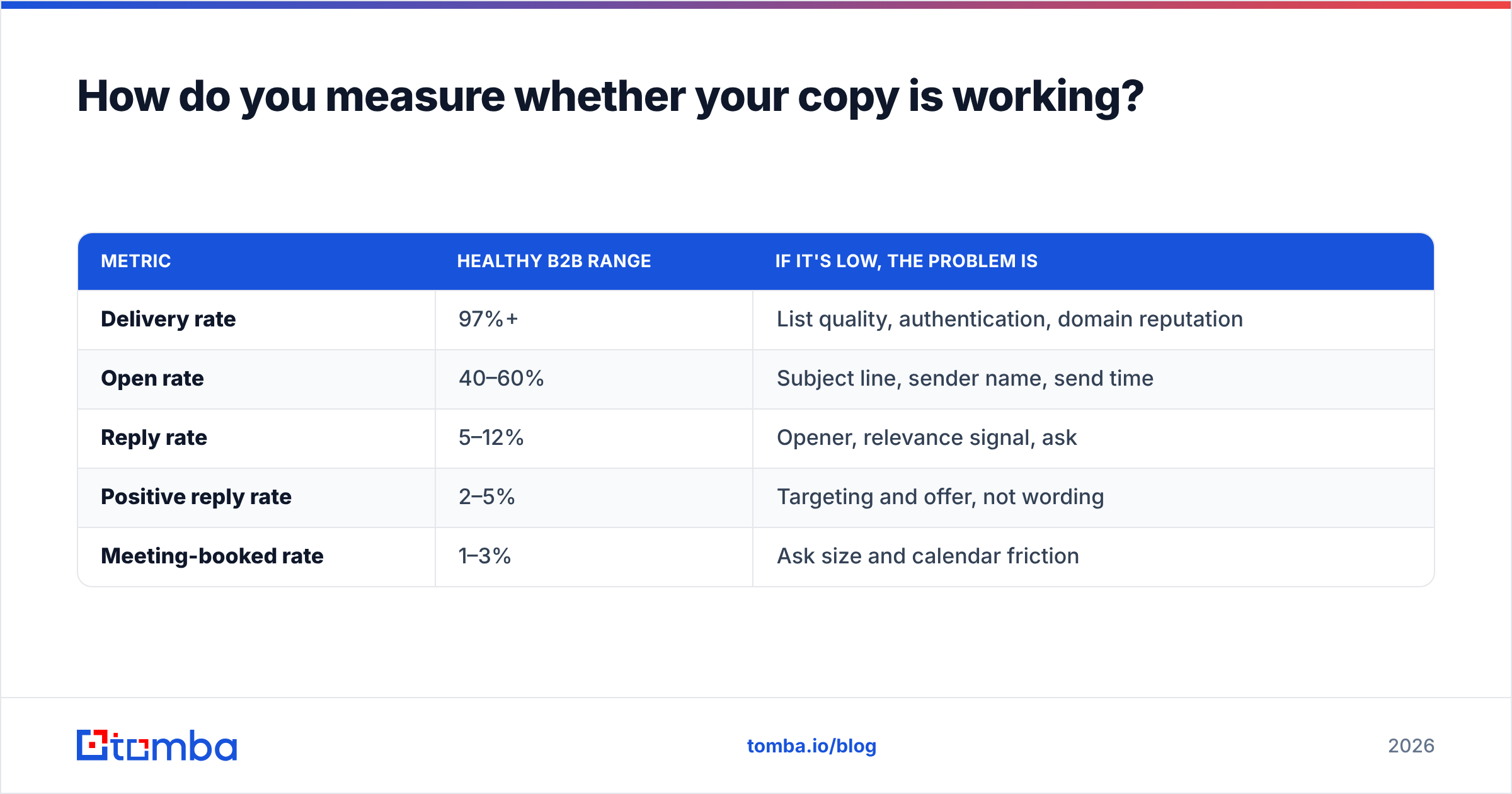
Track four numbers, in this order, and diagnose top-down. A reply-rate problem is rarely a reply-rate problem.
| Metric | Healthy B2B range | If it's low, the problem is |
|---|---|---|
| Delivery rate | 97%+ | List quality, authentication, domain reputation |
| Open rate | 40–60% | Subject line, sender name, send time |
| Reply rate | 5–12% | Opener, relevance signal, ask |
| Positive reply rate | 2–5% | Targeting and offer, not wording |
| Meeting-booked rate | 1–3% | Ask size and calendar friction |
Open rate is now a soft metric — Apple Mail Privacy Protection inflates it and iOS pre-fetching fires pixels nobody looked at. Treat it directionally, not absolutely. Reply rate is the number that survives contact with reality.
Test one variable at a time and give it volume. A/B testing two subject lines across 40 sends tells you nothing; the confidence interval swallows the difference. You need roughly 300–500 sends per variant before a 2-point reply-rate gap means anything. Most teams declare a winner at 60 sends and then build a quarter of strategy on noise.
For benchmarking outside your own account, G2's sales engagement category and vendor-published reports give you a sanity range — though treat any vendor's own "average reply rate" number as marketing until you can see the sample size.
What does a good rewrite actually look like?#
Here is a real-shaped before and after.
Before (183 words, 0 replies across 220 sends):
Hi Sarah,
I hope this email finds you well! My name is Alex and I'm a Senior Account Executive at DataFlow, a leading provider of end-to-end data observability solutions for modern enterprises.
I wanted to reach out because I noticed that Acme Corp is a fast-growing company in the fintech space, and I thought you might be interested in learning more about how we help companies like yours improve their data quality, reduce downtime, and increase trust in analytics across the organization.
We work with companies like [Big Logo], [Big Logo], and [Big Logo] to deliver best-in-class outcomes. Some of our key features include automated anomaly detection, column-level lineage, and integrations with all major warehouses.
Would you be open to a 30-minute call next week to discuss how we might be able to help? Let me know what works for your schedule and I'd be happy to send over an invite.
Best regards, Alex
After (78 words, 9 replies across 220 sends):
Subject: your dbt test coverage
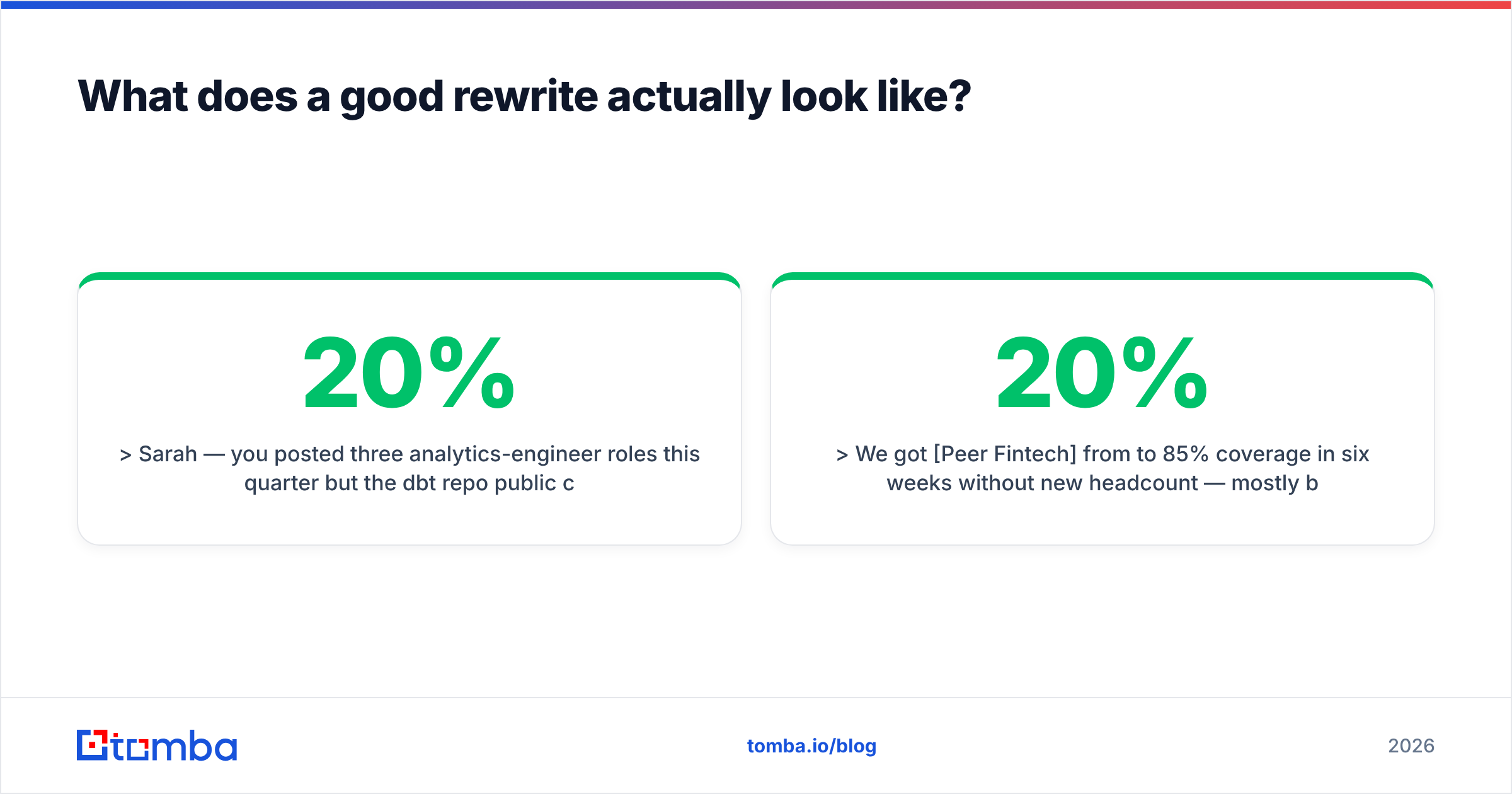
Sarah — you posted three analytics-engineer roles this quarter but the dbt repo public commits still show tests on ~20% of models. That gap usually shows up as a Monday morning "why is this dashboard wrong" fire drill.
We got [Peer Fintech] from 20% to 85% coverage in six weeks without new headcount — mostly by auto-generating the boring tests.
Want the 6-week breakdown? Happy to just send the doc, no call needed.
What changed: the greeting-plus-introduction paragraph is gone, the company description is gone, the logo list is gone, and the 30-minute call became a document. The ask dropped from "give me half an hour" to "should I email you a thing." Every deletion increased the reply rate.
Where does your list come from?#
Copy is downstream of contacts, and contacts are downstream of data. If you are writing Tier 3 personalization, you need a workflow that gets you a verified address for a specific named person at a specific company — not a bulk list you rented.
That means a stack that looks roughly like: identify the account, identify the human, find and verify the address, then write. Tools like Apollo, Clearbit, and BookYourData each solve slices of this well; BookYourData in particular is strong when you want a pre-built, pay-as-you-go list rather than a per-lookup workflow, and it is a reasonable pick if your motion is volume-first.
Where a dedicated finder earns its place is the per-prospect path: you have a name and a company domain, and you need the address in seconds without a seat-based contract. Tomba's email finder does that from a name plus domain, domain search pulls the addressable people at a company, and the Tomba API drops the same lookup into whatever sequencing tool you already run. Plans start free at 25 searches a month, with Starter at $49/mo and Growth at $99/mo — check Tomba pricing for the full breakdown.
Start with the list, then fix the copy#
The fastest reply-rate improvement available to most teams is not a better framework. It is sending the same email to fifty correct people instead of five hundred wrong ones. Copy amplifies targeting; it does not replace it.
So do this, in order: verify your list, cut your first paragraph, shrink your ask, and pick one framework to run for a month. Then measure reply rate, not opens.
When you are ready to build that list properly, start with the Tomba Email Finder — find verified professional addresses by name, company, or domain, test it on 25 free searches, and put your rewritten copy in front of people who actually exist.
Related guides#
Ready to find emails that actually work?
Join 150,000+ professionals who stopped guessing and started sending. Free credits on signup — no credit card required.
Get the Tomba newsletter
Practical outbound tactics and product updates — once every two weeks.
About the author