Email Enrichment Tools in 2026: What Actually Works
Most email enrichment tools claim 95%+ accuracy. Real-world match rates land closer to 40-70%. Here's how to test coverage, price, and compliance before you sign anything.
TL;DR
- Email enrichment tools fill missing contact fields — work email, title, company, phone — on records you already have. They are not the same as an email finder, though the best platforms do both.
- Vendor-published match rates (90-98%) are measured on their own sample sets. Expect 40-70% on your actual CRM data, and much lower outside North America and English-speaking Europe.
- Pricing models split three ways: credits per enriched record, credits per attempt, or flat per-seat. Per-attempt billing is where budgets die.
- The single highest-leverage test is a 500-record blind bake-off against a list you already know the answers for. Never buy on a demo.
- Tomba starts at $49/mo with a free 25-search tier, and bundles finding, verification, and enrichment in one API — which matters more than any single accuracy number.
What are email enrichment tools?#
Email enrichment tools take a partial record and complete it. You give them an anchor — a domain, a full name, a LinkedIn URL, or an existing email — and they return the missing fields: verified work email, job title, seniority, company size, industry, technographics, sometimes a direct dial.
Think of it like a passport office. You show up with a birth certificate and a utility bill; they cross-reference three databases and hand you a document that proves who you are. Enrichment does the same thing for a half-filled CRM row: it takes what you have, checks it against multiple sources, and returns something usable.
Technically, enrichment happens in one of three modes:
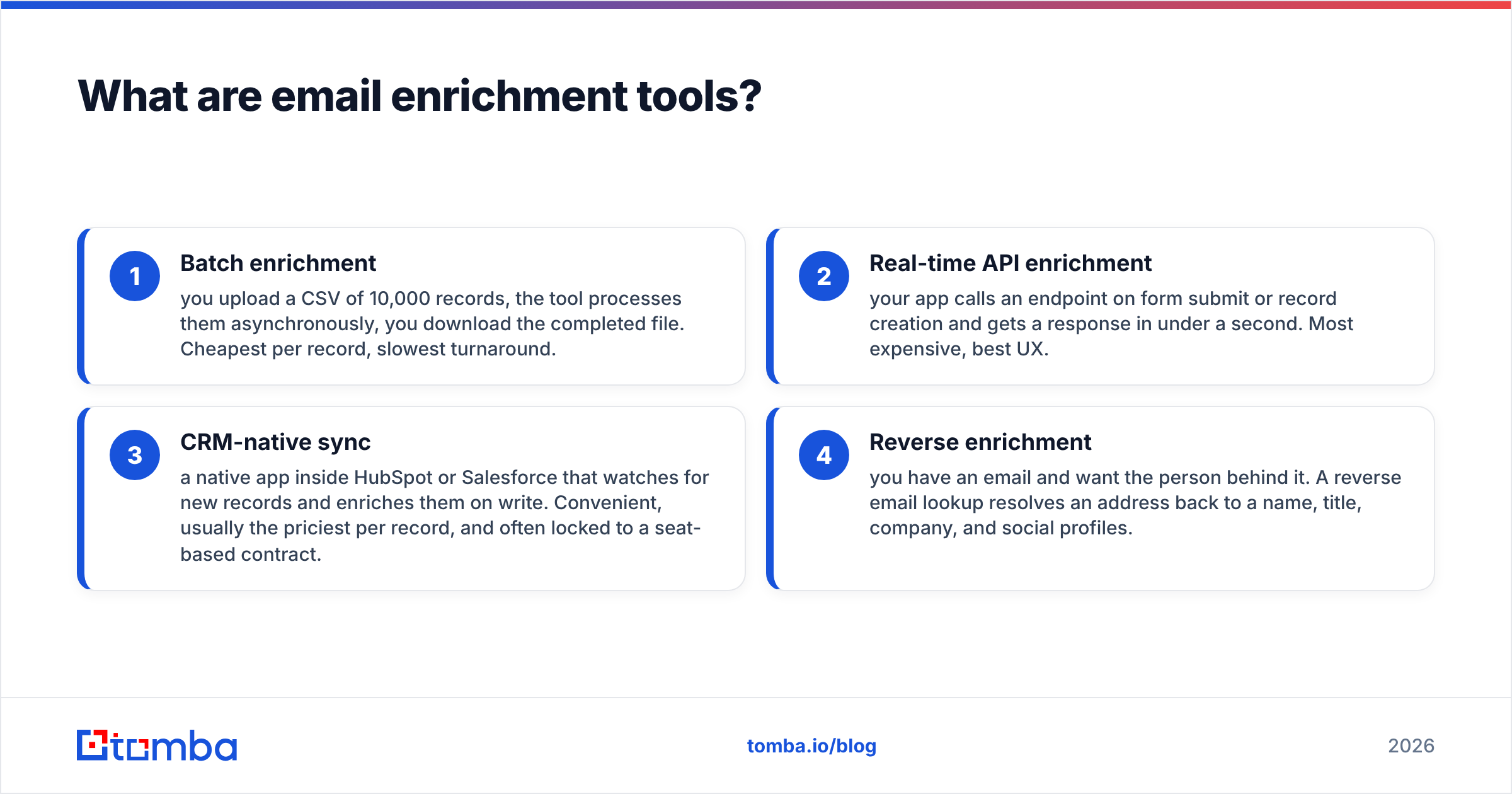
- Batch enrichment — you upload a CSV of 10,000 records, the tool processes them asynchronously, you download the completed file. Cheapest per record, slowest turnaround.
- Real-time API enrichment — your app calls an endpoint on form submit or record creation and gets a response in under a second. Most expensive, best UX.
- CRM-native sync — a native app inside HubSpot or Salesforce that watches for new records and enriches them on write. Convenient, usually the priciest per record, and often locked to a seat-based contract.
- Reverse enrichment — you have an email and want the person behind it. A reverse email lookup resolves an address back to a name, title, company, and social profiles.
The distinction that trips people up: finding discovers an address that didn't exist in your system; enrichment completes a record that already does; verification confirms an address is deliverable. You almost always need all three, and buying them from three vendors triples your integration surface for no accuracy gain.
Why do vendor accuracy claims fall apart on your data?#
Because the benchmark and your CRM are different populations.
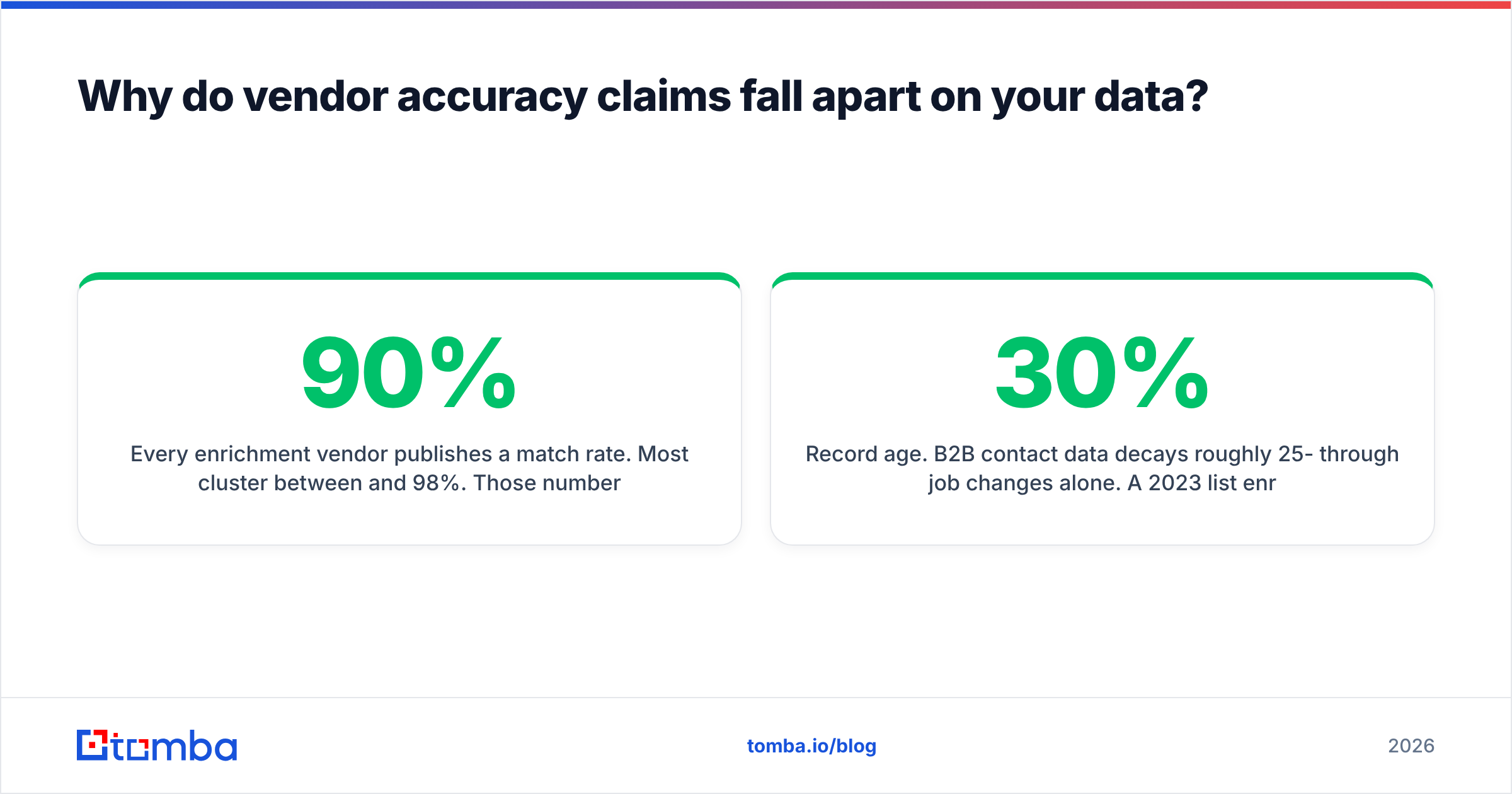
Every enrichment vendor publishes a match rate. Most cluster between 90% and 98%. Those numbers are honest in a narrow sense — they're measured against a sample the vendor selected, usually skewed toward large US tech companies where public data is abundant. Your CRM is not that sample. It's got 2019 trade-show scans, misspelled company names, three variations of "Ltd", and a chunk of contacts in Germany, Brazil, and Japan where scraping-based data collection has thinner coverage and stricter legal limits.
Four things that reliably crater real-world match rates:
- Geography. North American coverage is the best-served market by a wide margin. Coverage in DACH, France, and Japan is typically 20-40 points lower across most vendors, partly because of GDPR-driven data-minimization and partly because fewer employees publish work emails publicly.
- Company size. Sub-50-employee firms have far less public footprint. If your ICP is SMB, discount every published number by a third before you even start.
- Record age. B2B contact data decays roughly 25-30% per year through job changes alone. A 2023 list enriched in 2026 is mostly enriching ghosts.
- Anchor quality. Enriching from a LinkedIn URL beats enriching from "John S., Acme" by a mile. Garbage anchor, garbage output — and you still pay for the attempt at most vendors.

The fix is not to find a vendor with a bigger claim. It's to change how you measure. Take 500 records where you already know the correct email — closed-won accounts, your own newsletter list, contacts who've replied to you. Strip the emails. Run the stripped file through each candidate tool. Score three things separately: coverage (percent returned), accuracy (percent of returned that match the known-good value), and cost per correct record. That third number is the only one that matters, and it's the only one no vendor will quote you.
How do the main email enrichment tools compare?#
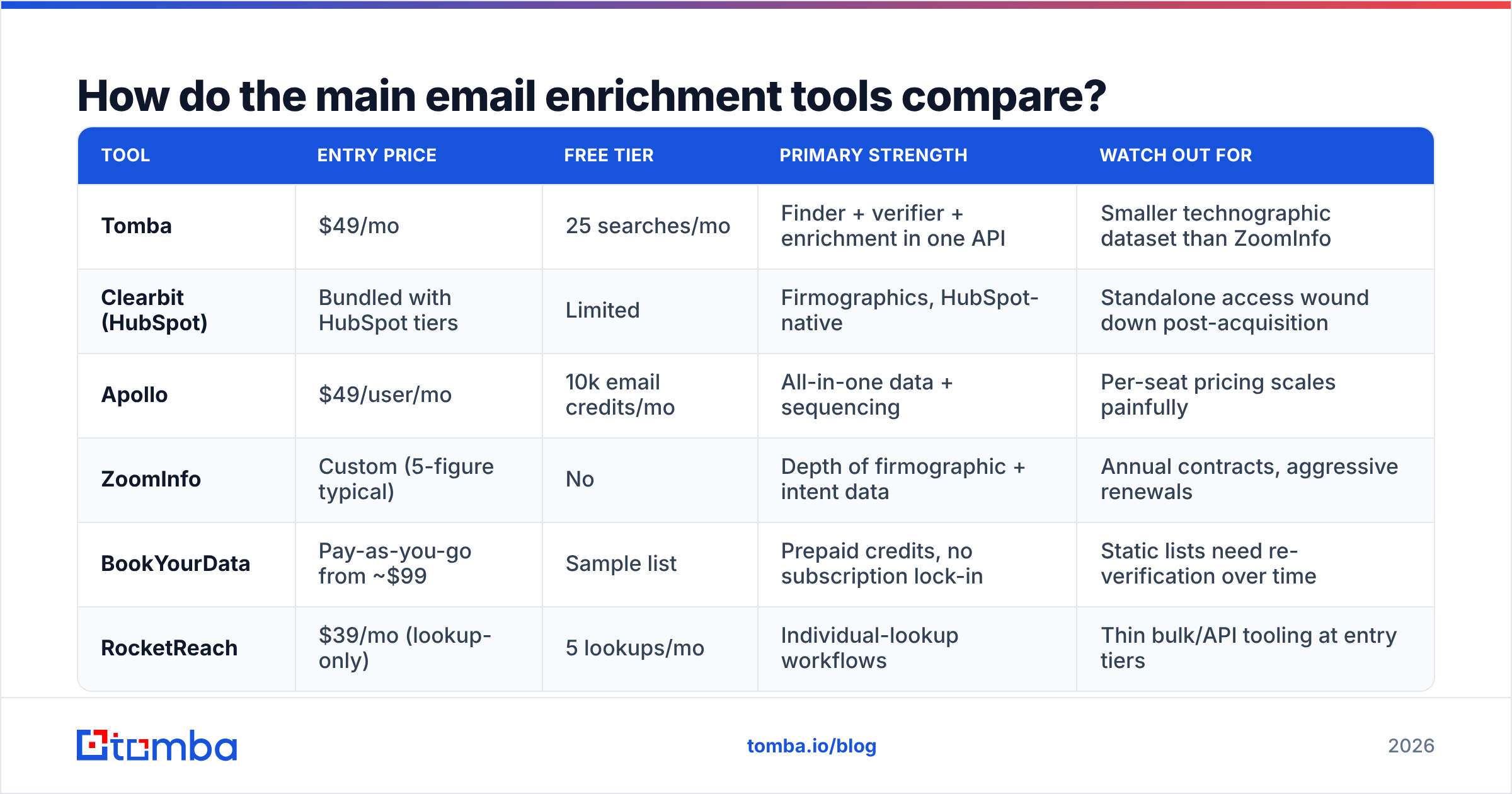
Here's the landscape as it stands in 2026. Prices are entry-level published rates; enterprise contracts vary wildly and most vendors negotiate.
| Tool | Entry price | Free tier | Primary strength | Watch out for |
|---|---|---|---|---|
| Tomba | $49/mo | 25 searches/mo | Finder + verifier + enrichment in one API | Smaller technographic dataset than ZoomInfo |
| Clearbit (HubSpot) | Bundled with HubSpot tiers | Limited | Firmographics, HubSpot-native | Standalone access wound down post-acquisition |
| Apollo | $49/user/mo | 10k email credits/mo | All-in-one data + sequencing | Per-seat pricing scales painfully |
| ZoomInfo | Custom (5-figure typical) | No | Depth of firmographic + intent data | Annual contracts, aggressive renewals |
| BookYourData | Pay-as-you-go from ~$99 | Sample list | Prepaid credits, no subscription lock-in | Static lists need re-verification over time |
| RocketReach | $39/mo (lookup-only) | 5 lookups/mo | Individual-lookup workflows | Thin bulk/API tooling at entry tiers |
A few honest notes on that table.
Apollo is genuinely good value if your team is small and you want prospecting, enrichment, and sequencing in one place. The pain arrives at 15+ seats, where per-user pricing turns a $49 line item into a five-figure annual commitment. If that's where you are, an Apollo alternative built on API credits rather than seats usually cuts the bill substantially.
ZoomInfo remains the deepest B2B dataset for enterprise firmographics and intent. It is also the most expensive, and its contracts are famously hard to exit. If you're a 12-person startup evaluating it, you're not the customer — you're the renewal target.
BookYourData takes a different, refreshing approach: prepaid credits with no monthly subscription and an accuracy guarantee on delivered records. That model suits teams with lumpy, campaign-driven demand rather than steady daily enrichment. It's a solid pick when you don't want a contract at all — just note that any static list, from any vendor, needs re-verification before send.
Clearbit was the developer-favorite enrichment API for a decade. Post-HubSpot acquisition, its value now sits mostly inside the HubSpot ecosystem. If you're not on HubSpot, a standalone Clearbit alternative is the practical path.

What should you actually pay per enriched record?#
Work backwards from cost per correct record, not cost per credit.
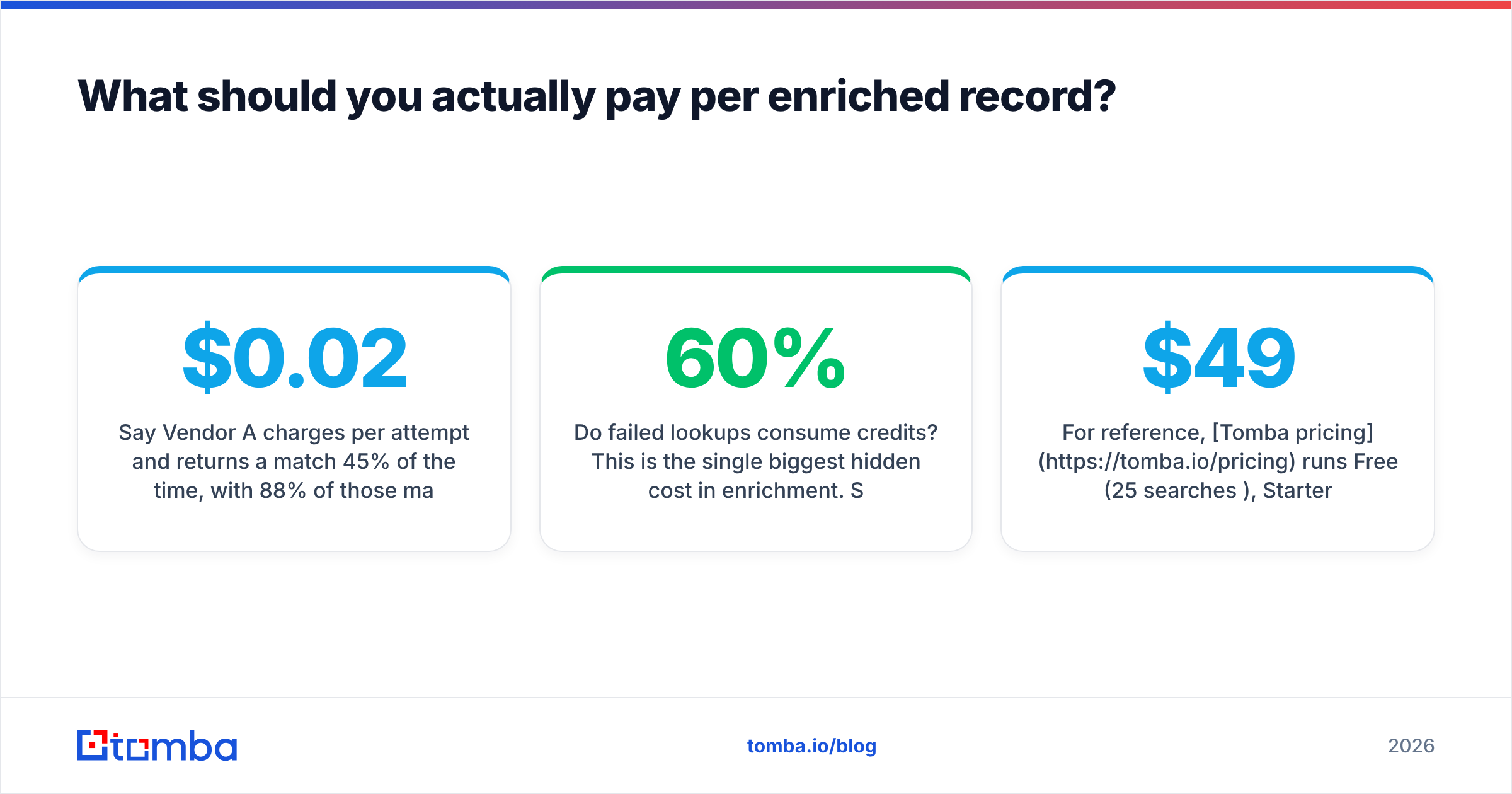
Say Vendor A charges $0.02 per attempt and returns a match 45% of the time, with 88% of those matches correct. Your effective cost per usable record is $0.02 ÷ (0.45 × 0.88) = $0.05. Vendor B charges $0.06 per successful match only, at 92% accuracy — that's $0.065 per usable record. Vendor A looks 3x cheaper on the rate card and is barely cheaper in reality. Flip the match rates and the ranking inverts.
Three pricing mechanics to nail down in writing before signing:
- Do failed lookups consume credits? This is the single biggest hidden cost in enrichment. Some vendors charge for every attempt regardless of outcome. On a low-match segment, you can burn 60% of a credit pack on nothing.
- Do credits roll over, and do they expire? Monthly-expiring credits force you to over-buy for peak months and waste the rest.
- Is verification bundled or billed separately? An enriched email you haven't verified is a guess. If verification is a separate SKU, add it to the true unit cost.
For reference, Tomba pricing runs Free (25 searches/mo), Starter $49/mo, Growth $99/mo, Pro $249/mo, and custom Enterprise — with the email verifier and enrichment on the same credit pool rather than as separate line items. That bundling is what usually makes the per-correct-record math work out, more than any headline accuracy figure.
How do you build an enrichment workflow that doesn't rot?#
Enrichment isn't a purchase, it's a maintenance loop. Data decays whether or not you're looking at it.
1. Enrich at the point of entry, not in bulk. Every new lead — form fill, demo request, trade show scan — gets enriched within seconds of creation via API. Fresh data at the moment of intent beats a quarterly batch job every time.
2. Verify everything before it touches a sequence. Enrichment returns a probable address. Verification confirms it resolves. Skipping this step is how you land on blocklists — bounce rates above 2-3% start damaging sender reputation with the major mailbox providers, and recovery takes weeks.
3. Handle catch-all domains explicitly. A large share of enterprise domains accept all mail at the SMTP layer, so standard verification returns "unknown" rather than valid or invalid. Route those through a catch-all verifier instead of guessing, and tag them separately in your CRM so reps know the confidence level.
4. Re-enrich on a 90-day cycle for active pipeline. Job changes are the main decay driver. Contacts in open opportunities are the ones where a stale title costs you a deal, so prioritize them over your dormant database.
5. Log the source and timestamp on every field. When a rep says "this data is wrong," you need to know which vendor supplied it and when. Without provenance you can't hold anyone accountable — including yourself.
6. Measure downstream, not upstream. Match rate is a vanity metric. Track bounce rate, reply rate, and meetings booked per 1,000 enriched records. That's the number that tells you whether the spend is working.
Is enrichment legal under GDPR and CCPA?#
Short answer: yes, with conditions — and the conditions are where teams get sloppy.
Under GDPR, B2B contact data is still personal data. Most enrichment programs in the EU rely on legitimate interest as the lawful basis, which requires a documented balancing test, a clear opt-out path, and the ability to fulfil deletion requests within a month. The ICO's guidance on legitimate interests sets out the three-part test in plain language, and it's worth reading before your first EU campaign rather than after your first complaint.
Practical requirements that apply regardless of jurisdiction:
- Know your vendor's sourcing. Ask directly where the data comes from and whether they can produce a lawful-basis statement. Vendors publish this — Tomba documents its data sources — and one that won't answer is a liability you're absorbing.
- Honor deletion end-to-end. If someone requests erasure, they need to be gone from your CRM and suppressed from re-enrichment. Otherwise the next batch job resurrects them.
- Include an opt-out in the first message. Under CAN-SPAM and CCPA-adjacent state laws in the US, and as basic hygiene in the EU, cold B2B email needs a working unsubscribe.
- Watch the sensitive-category line. Enrichment fields that imply health, political affiliation, or union membership are a different legal tier. Standard firmographics are not; keep it that way.
None of this makes enrichment risky by default. It makes undocumented enrichment risky. The teams that get burned are the ones who can't say where a record came from.
Which email enrichment tool should you pick?#
It depends on the shape of your motion, and the honest answer is that three different teams should buy three different things.
- Developer-led, API-first, cost-sensitive. You want finding, verification, and enrichment on one endpoint with predictable credit pricing. Tomba, or a comparable API-native vendor.
- Full-cycle SMB sales team that wants one login. Apollo or a similar all-in-one, at least until seat count makes the math hurt.
- Enterprise with intent-data requirements and budget. ZoomInfo, with a hard-negotiated contract and a real exit plan.
- Campaign-driven, no-subscription preference. BookYourData's prepaid model, paired with re-verification before each send.
Whatever you shortlist, run the 500-record bake-off. It takes an afternoon, costs nothing on free tiers, and is the only evidence that survives contact with your actual data. Vendor benchmarks tell you about the vendor's sample; your bake-off tells you about your pipeline.
One more filter worth applying: check whether the tool exposes bulk operations and a real API on the plan you can afford, not just on enterprise. A lot of buyers discover post-purchase that bulk enrichment sits three tiers above where they signed.
Ready to test enrichment on your own data?#
Pull 500 records you already know the answers for, strip the email column, and run them through the Tomba Email Finder — the free tier gives you 25 searches to sanity-check quality before you spend anything, and the $49/mo Starter plan covers a full bake-off with room left over. Finding, verification, catch-all handling, and enrichment run on one credit pool and one API key, so you're measuring data quality rather than integration overhead. Score coverage, accuracy, and cost per correct record, then buy on that number instead of a rate card.
Related guides#
// get started
Find, verify and enrich your first contacts today
Start on the free plan with 25 searches a month, then scale when your team is ready.
Free plan · No credit card required · GDPR & CCPA
Get the Tomba newsletter
Product and data updates
// about the author