Email Etiquette Introduction: How to Introduce Yourself in 2026
An introduction email fails in the first three seconds, not the third paragraph. Here are the etiquette rules, formats, and templates that actually get a reply — plus the ones people still get wrong.
TL;DR
- An introduction email is judged in the first three seconds: sender name, subject line, and first sentence. Everything after that is optional reading.
- The core etiquette rule is reciprocity of effort — your email should cost the reader less time to read than it cost you to write.
- Keep it to 50–125 words, one ask, one link, no attachments on first contact.
- Warm intros, double opt-in intros, cold intros, and internal intros follow different rules. Using the cold format on a referral is the most common mistake.
- Etiquette starts before the writing: sending to a guessed address that bounces is a deliverability problem and a manners problem.
What does "email etiquette introduction" actually mean?#
It means two related things, and people mix them up constantly.
The first is introducing yourself — a first-contact email to someone who does not know you. A cold prospect, a hiring manager, a podcast host, a potential partner.
The second is introducing two other people — the classic "Sara, meet Marcus" email, where you're the connector and your reputation is on the line for both parties.
Both are governed by the same principle: an introduction is a request for someone else's attention, and attention is the scarcest thing in a B2B inbox. Etiquette is just the set of conventions that make that request cheap to grant. The netiquette conventions that formed in early email culture still hold — brevity, clear subject lines, no surprise attachments — because the underlying constraint never changed. There are only so many minutes in a workday.
What has changed by 2026 is volume. A director-level buyer at a mid-market SaaS company now receives somewhere between 100 and 200 emails a day, and a meaningful share of those are AI-generated outreach that reads like it was written by a template that read another template. The etiquette bar has moved: sounding human is now a differentiator, not a baseline.
Why do most introduction emails get ignored?#
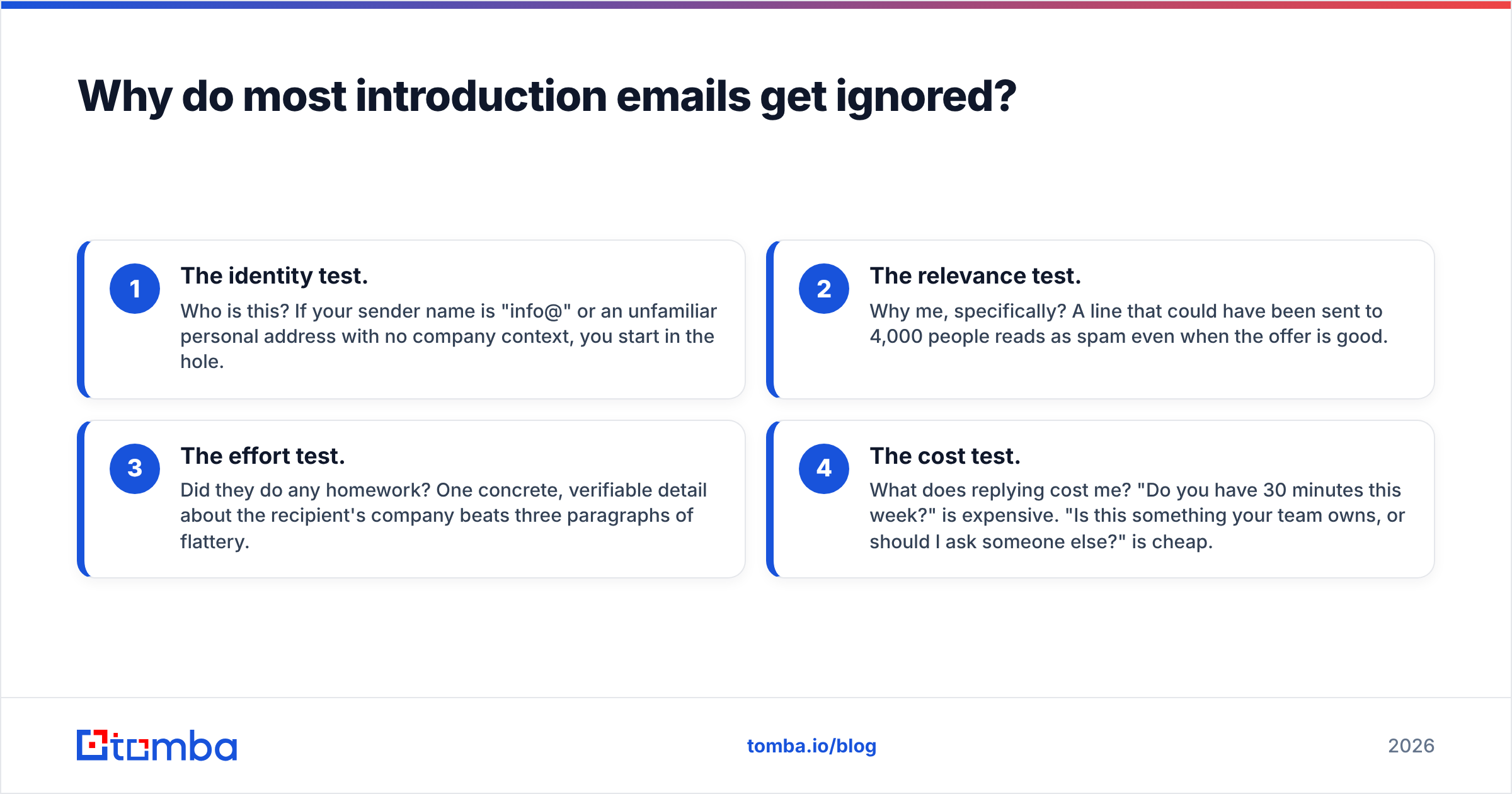
Because they fail one of four tests before the reader gets to your value proposition.
- The identity test. Who is this? If your sender name is "info@" or an unfamiliar personal address with no company context, you start in the hole.
- The relevance test. Why me, specifically? A line that could have been sent to 4,000 people reads as spam even when the offer is good.
- The effort test. Did they do any homework? One concrete, verifiable detail about the recipient's company beats three paragraphs of flattery.
- The cost test. What does replying cost me? "Do you have 30 minutes this week?" is expensive. "Is this something your team owns, or should I ask someone else?" is cheap.
Most introduction emails pass tests one and two and fail three and four. They're relevant but demanding — they open with a paragraph about the sender's company and close with a calendar link, which inverts the correct order of operations.

The other quiet killer is length. If your email requires scrolling on a phone, you have written a document, not an introduction. Ask for the meeting where the document gets discussed.
What does a well-structured introduction email look like?#
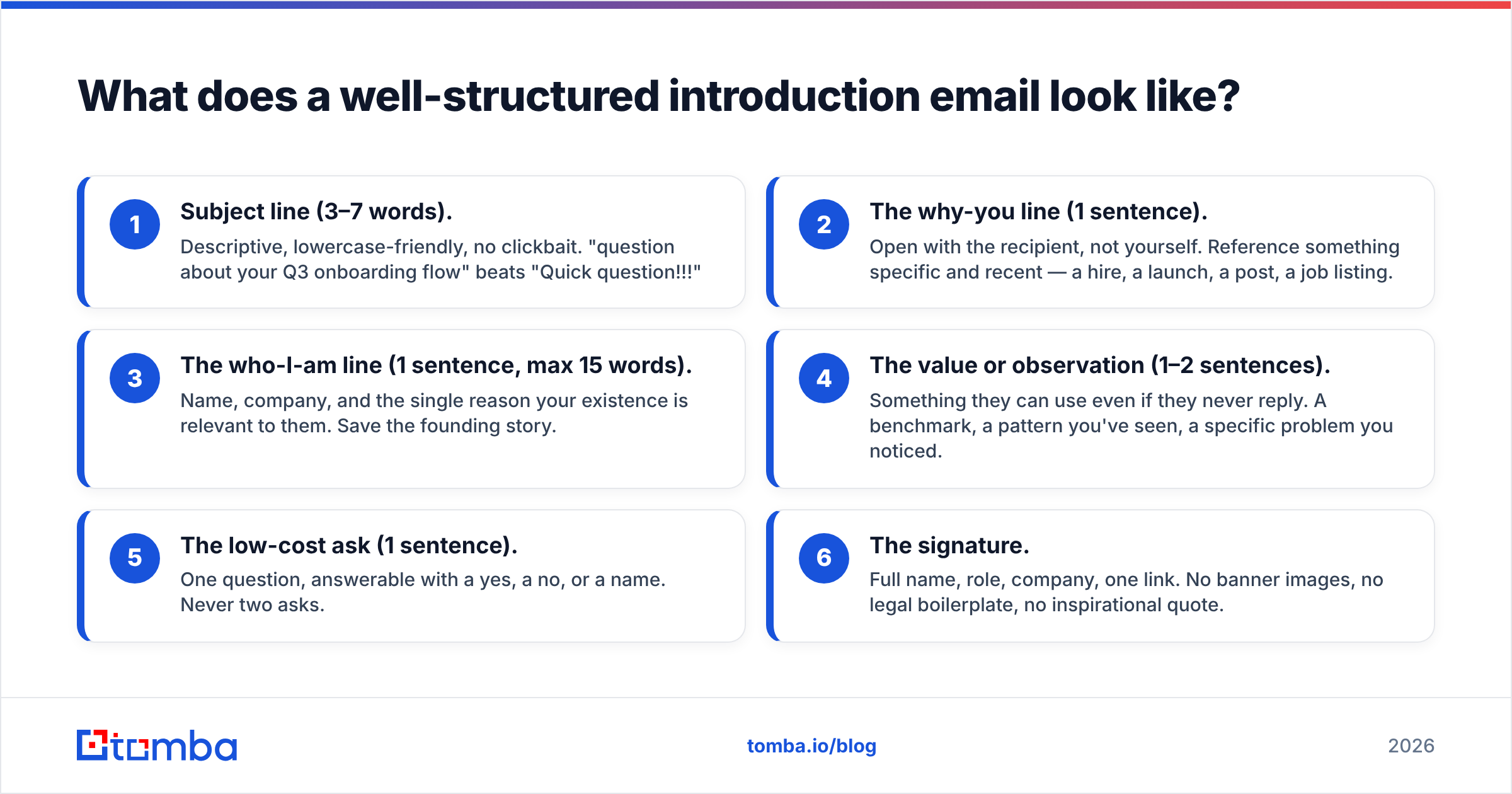
Six components, in this order. Each one earns the right to the next.
- Subject line (3–7 words). Descriptive, lowercase-friendly, no clickbait. "question about your Q3 onboarding flow" beats "Quick question!!!"
- The why-you line (1 sentence). Open with the recipient, not yourself. Reference something specific and recent — a hire, a launch, a post, a job listing.
- The who-I-am line (1 sentence, max 15 words). Name, company, and the single reason your existence is relevant to them. Save the founding story.
- The value or observation (1–2 sentences). Something they can use even if they never reply. A benchmark, a pattern you've seen, a specific problem you noticed.
- The low-cost ask (1 sentence). One question, answerable with a yes, a no, or a name. Never two asks.
- The signature. Full name, role, company, one link. No banner images, no legal boilerplate, no inspirational quote.
That structure lands between 50 and 125 words. Anything longer and you're asking the reader to invest before they've decided you're worth it.
A note on the P.S. line: it works, and it's read at a disproportionate rate, but only if it carries something genuinely optional — a relevant resource, a shared connection, a mutual customer. A P.S. that repeats the ask is just the ask again in a smaller font.
Which introduction format should you use?#
The four common scenarios have genuinely different rules. Sending a cold-format email into a warm referral is the fastest way to waste a good intro.
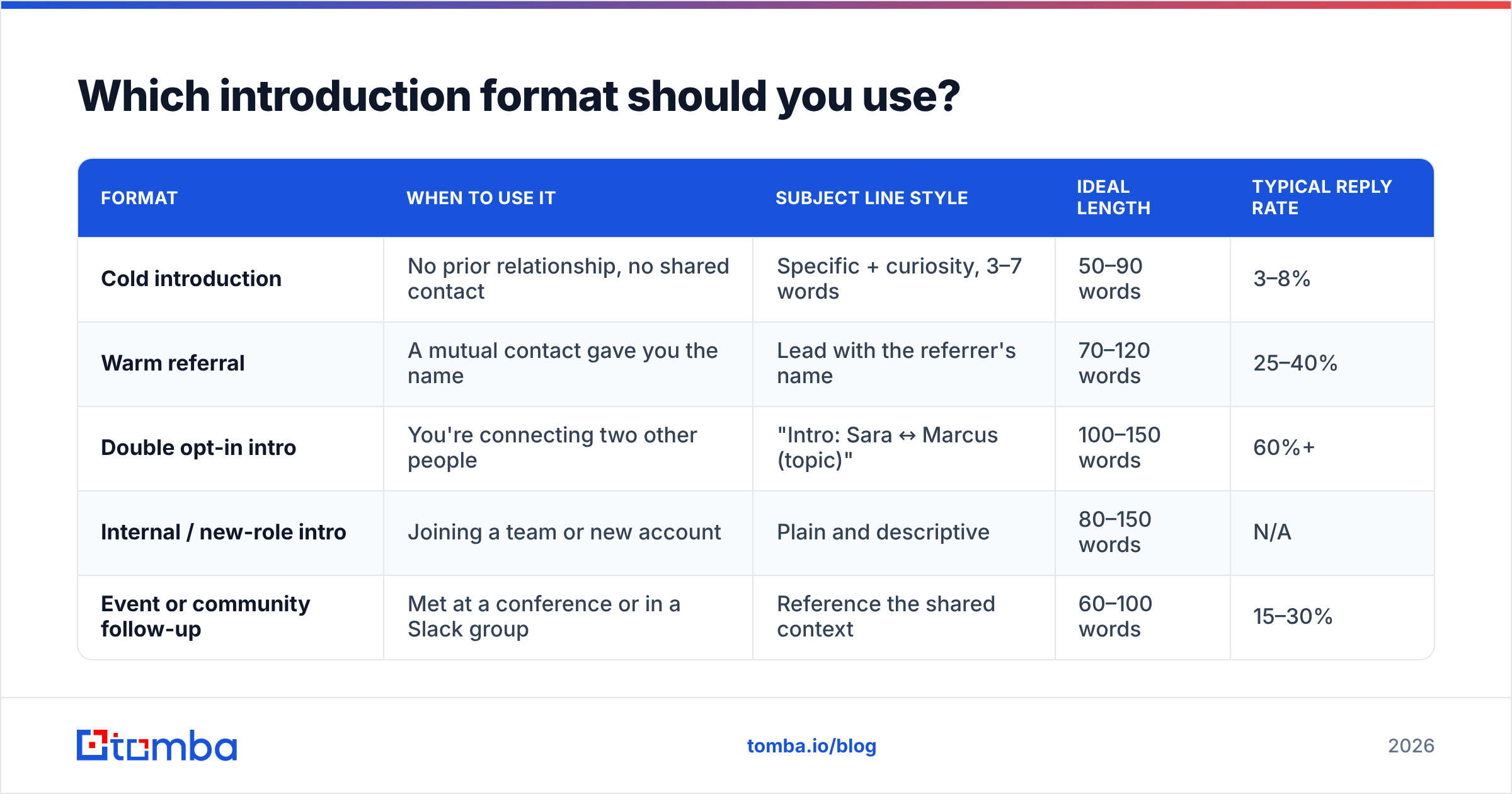
| Format | When to use it | Subject line style | Ideal length | Typical reply rate |
|---|---|---|---|---|
| Cold introduction | No prior relationship, no shared contact | Specific + curiosity, 3–7 words | 50–90 words | 3–8% |
| Warm referral | A mutual contact gave you the name | Lead with the referrer's name | 70–120 words | 25–40% |
| Double opt-in intro | You're connecting two other people | "Intro: Sara ↔ Marcus (topic)" | 100–150 words | 60%+ |
| Internal / new-role intro | Joining a team or new account | Plain and descriptive | 80–150 words | N/A |
| Event or community follow-up | Met at a conference or in a Slack group | Reference the shared context | 60–100 words | 15–30% |
Reply-rate ranges here are directional benchmarks from B2B outbound reporting, not guarantees — they shift wildly by industry, seniority, and list quality. Treat them as relative comparisons: a warm referral is worth roughly five cold emails, and a proper double opt-in intro is worth about ten.
The double opt-in deserves special attention because it's the one most people skip. The rule: never introduce two people without asking both privately first. Sending an unsolicited intro puts the recipient in the position of either taking a meeting they don't want or looking rude to a mutual contact. That's not a favor — it's an obligation you handed them without asking. Ask both sides, get a yes, then connect.
What are the subject line rules for an introduction?#
Your subject line is a promise about the body. Break it once and you're filtered permanently.
- Length: 3–7 words, under 45 characters. Mobile clients truncate past that.
- Case: Sentence case or lowercase. All-caps and Title Case both read as marketing.
- Punctuation: One mark maximum. No exclamation points on first contact.
- Forbidden: "Re:" or "Fwd:" on an email that is neither. It's the single fastest way to burn trust, and modern filters increasingly flag it.
- Personalization: Company name works. First name in the subject line is now so common it reads as automated.
If you're stuck, a subject line generator is fine for volume ideation, but run the output through one filter: would you send this to someone whose respect you want to keep? If not, rewrite it.
When do you CC, BCC, or forward?#
The CC field is where etiquette failures become public. The rules:
- CC is for people who need to know but don't need to act. Adding an executive to pressure the recipient is a visible power move, and everyone on the thread sees it.
- BCC on an introduction email is only correct in one situation: moving yourself off a thread after connecting two people ("moving myself to BCC"). Using BCC to secretly loop in a third party is a genuine breach — assume it will be discovered.
- Forwarding an intro request rather than writing a fresh one is lazy but sometimes right, provided you strip anything the new recipient shouldn't see. Read the full quoted chain before you hit send. Every time.
- Reply-all on any introduction thread larger than four people should be treated as a deliberate decision, not a reflex.
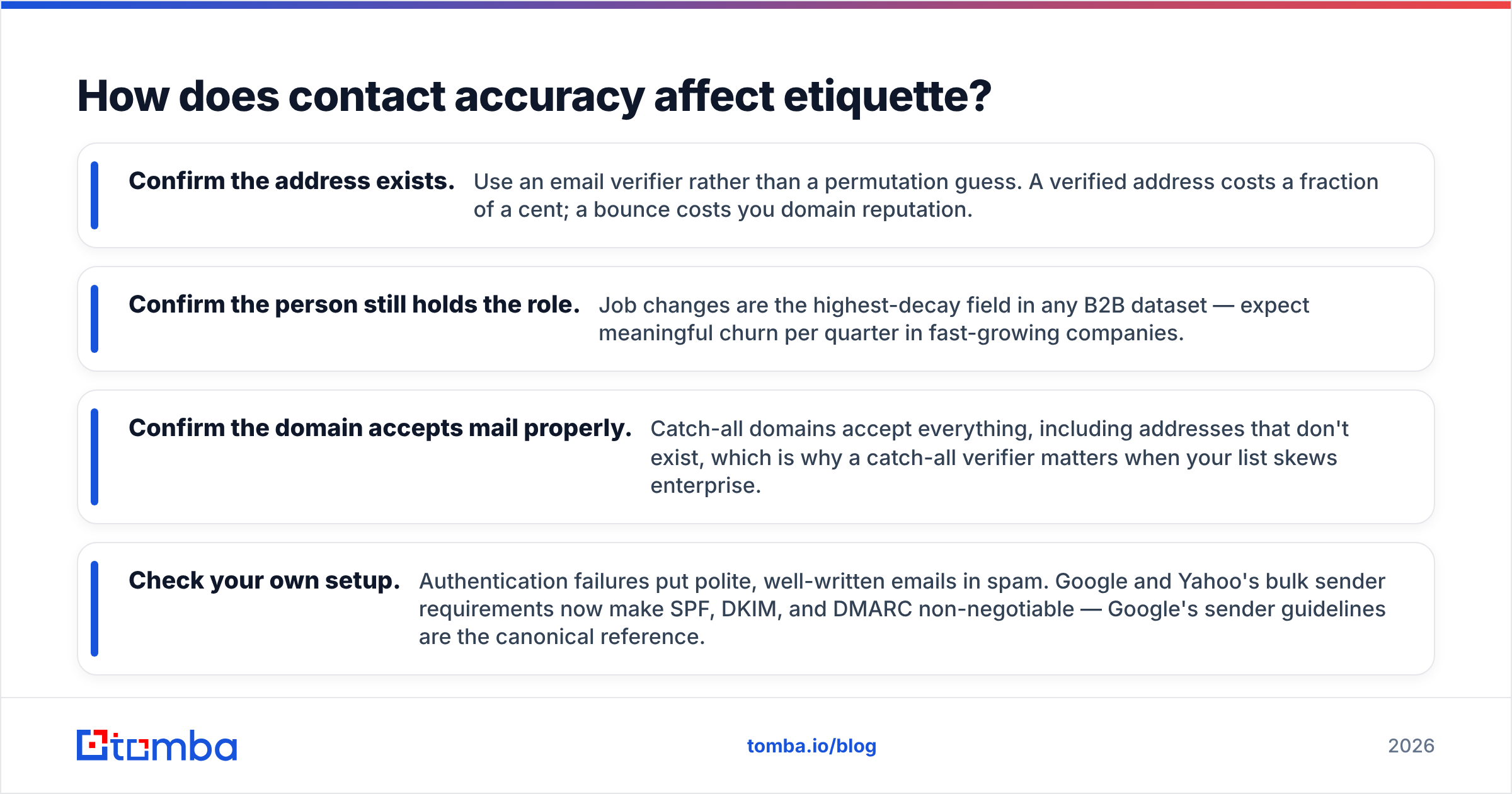
How does contact accuracy affect etiquette?#
This is the part that gets skipped in every etiquette guide, and it's the part with the highest cost.
Sending an introduction to a guessed address — firstname.lastname@company.com because that's usually the pattern — does three things. It bounces. It damages your sender reputation, which means your next email to a correct address is more likely to hit spam. And, worst case, it lands with the wrong person entirely, which is a small privacy incident with your name on it.
There's also the reverse failure: sending a personalized "I saw your recent post about X" email to someone who left the company eight months ago. That's not a data problem the recipient sees — it's a competence signal.
Practical hygiene before you send an introduction:
- Confirm the address exists. Use an email verifier rather than a permutation guess. A verified address costs a fraction of a cent; a bounce costs you domain reputation.
- Confirm the person still holds the role. Job changes are the highest-decay field in any B2B dataset — expect meaningful churn per quarter in fast-growing companies.
- Confirm the domain accepts mail properly. Catch-all domains accept everything, including addresses that don't exist, which is why a catch-all verifier matters when your list skews enterprise.
- Check your own setup. Authentication failures put polite, well-written emails in spam. Google and Yahoo's bulk sender requirements now make SPF, DKIM, and DMARC non-negotiable — Google's sender guidelines are the canonical reference.
Tools in this category differ mainly in how they handle uncertainty. Some return a confident-looking address for every query; others return nothing rather than a guess. For introduction emails specifically, you want the second behavior. A tool that says "not found" saves you a bounce. Tomba's email finder sits in that camp, as do peers like BookYourData, which built its reputation on verified-at-source B2B contact data rather than pattern inference. Both approaches are defensible — the point is knowing which one your tool uses before you trust it with a first impression.
What are the templates worth stealing?#
Cold introduction (technical buyer):
Subject: your ingestion pipeline docs
Hi Priya — read your engineering post on cutting ingestion latency last month; the part about backpressure handling was the clearest write-up I've seen.
I'm Marc, I work on data quality tooling at [Company]. We see the same pattern at about 40 teams: the latency fix holds until schema drift starts silently dropping records.
Is schema validation something your team owns, or does that sit with platform?
— Marc
Double opt-in introduction (after both said yes):
Subject: Intro: Sara Okonjo ↔ Marcus Lee (RevOps tooling)
Sara — Marcus runs RevOps at Northwind and rebuilt their lead routing last year, which is exactly the problem you described.
Marcus — Sara is VP Growth at Ardent; they're at the stage Northwind was in 2024.
You've both agreed to connect, so I'll get out of the way. Moving myself to BCC.
— Dana
Warm referral:
Subject: Dana Whitfield suggested I reach out
Hi Marcus — Dana Whitfield mentioned you're rebuilding lead routing this quarter and thought a 15-minute comparison of notes might be useful.
I'm Sara, VP Growth at Ardent. We went through the same migration in Q1 and made two decisions I'd undo.
Worth a call, or would a written summary be more useful?
— Sara
Notice what none of them contain: an attachment, a calendar link, a company boilerplate paragraph, or the phrase "I hope this email finds you well." More cold-email starting points live in the email templates library, and HubSpot's sales blog is a reliable neutral source for format research.
What breaks etiquette instantly?#
- Attachments on first contact. They trigger filters and read as presumptuous.
- Calendar links before consent. You're asking someone to schedule time with a stranger.
- Tracking pixels with no disclosure, in jurisdictions where that's a compliance question rather than a style question.
- Following up more than four times without a response. Silence is an answer.
- "Just bumping this to the top of your inbox." Everyone knows what happened.
- Using the recipient's first name more than twice in a short email. It reads as a mail merge, because it usually is one.
- Sending on Friday at 4pm and following up Monday at 8am.
Where should you start?#
Pick one format from the table above, write it in under 125 words, and read it aloud before sending. If it sounds like something you'd say to a person standing in front of you, send it. If it sounds like a press release, delete the first two sentences and try again — the real opening is usually sentence three.
Then fix the layer underneath the writing. Etiquette is wasted on an address that doesn't resolve. Run your list through Tomba's Email Finder to get verified, current addresses tied to real people rather than pattern guesses — the free tier covers 25 searches a month so you can test accuracy on names you already know before committing, and paid plans start at $49/mo on Tomba pricing. Good manners and good data are the same investment: both are about not wasting someone else's time.
Related guides#
Ready to find emails that actually work?
Join 150,000+ professionals who stopped guessing and started sending. Free credits on signup — no credit card required.
Get the Tomba newsletter
Practical outbound tactics and product updates — once every two weeks.
About the author