40 Email Headline Examples That Get Opened (2026 Guide)
Forty email headline examples pulled from cold outreach, newsletters, and re-engagement sends — with the formula behind each one, the open-rate range you should expect, and the six patterns that quietly kill deliverability.
TL;DR
- An "email headline" is the subject line plus the preview text — inbox clients render them as one unit, so write them as one unit.
- Short beats clever. Subject lines in the 3–7 word range consistently out-open 10+ word lines, mostly because mobile clients truncate around 35–45 characters.
- Specificity is the single biggest lever: a headline naming a company, number, or event beats a generic benefit statement almost every time.
- The 40 examples below are grouped by send type — cold outreach, follow-up, newsletter, re-engagement, event, and launch — with the formula behind each one so you can rebuild it for your own list.
- Headlines can't rescue a bad list. If 20% of your addresses bounce, your sender reputation drops and even a great subject line lands in spam.
What is an email headline, and is it the same as a subject line?#
An email headline is what the recipient reads before deciding to open: the subject line, the preheader (preview text), and — increasingly — the sender name rendered next to it. Technically the subject is just one email header field, but functionally, Gmail and Outlook stitch subject and preheader into a single line of scannable text on mobile. Treat them as one headline.
Think of it like a newspaper stand. The subject line is the headline; the preheader is the standfirst underneath. A great headline with a blank standfirst (or worse, "View this email in your browser") wastes half your real estate.
Three practical consequences:
- Write the preheader deliberately. It gets roughly the same number of eyeballs as the subject. Leaving it to auto-fill from the first line of your body copy is the most common unforced error in B2B email.
- Budget characters for mobile. iOS Mail shows roughly 35–40 characters of subject; Gmail on Android shows a bit more. Anything past that is a bonus, not a plan.
- The sender name is part of the headline. "Sarah at Ramp" outperforms "Ramp Marketing Team" because it reads like a person, not a broadcast.
What makes an email headline get opened in 2026?#
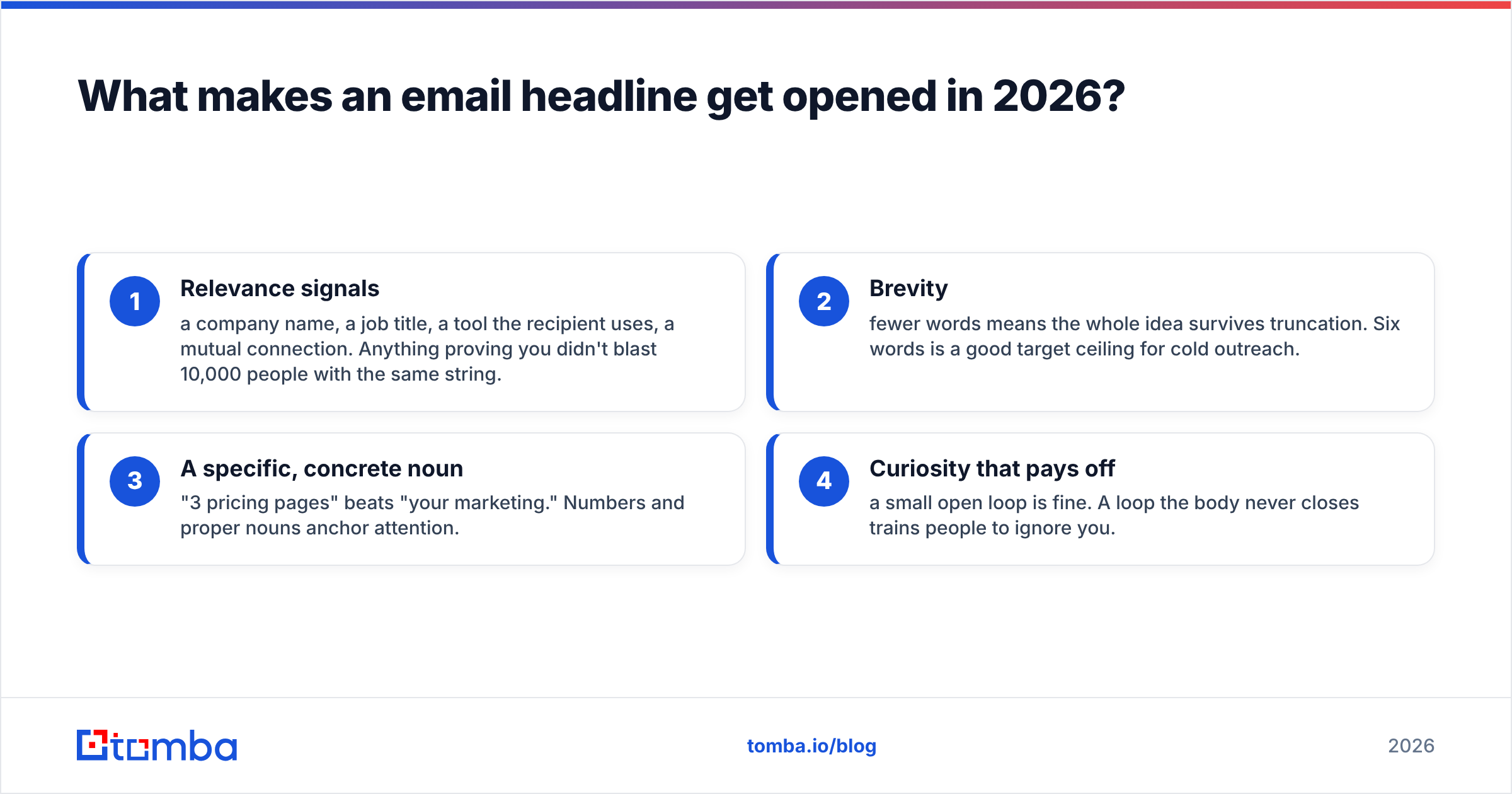
Four things, roughly in order of impact:
- Relevance signals — a company name, a job title, a tool the recipient uses, a mutual connection. Anything proving you didn't blast 10,000 people with the same string.
- Brevity — fewer words means the whole idea survives truncation. Six words is a good target ceiling for cold outreach.
- A specific, concrete noun — "3 pricing pages" beats "your marketing." Numbers and proper nouns anchor attention.
- Curiosity that pays off — a small open loop is fine. A loop the body never closes trains people to ignore you.
What doesn't work anymore: urgency theater ("LAST CHANCE!!!"), fake reply prefixes ("Re: our chat" when there was no chat), and emoji spam. Gmail's bulk sender guidelines explicitly tie spam-complaint rates to inbox placement, and deceptive subject lines are the fastest way to earn complaints. HubSpot's email marketing research has repeatedly found personalized, specific subject lines out-performing generic ones — and the gap widens as inbox filtering gets stricter.
Sorry — that renders as: 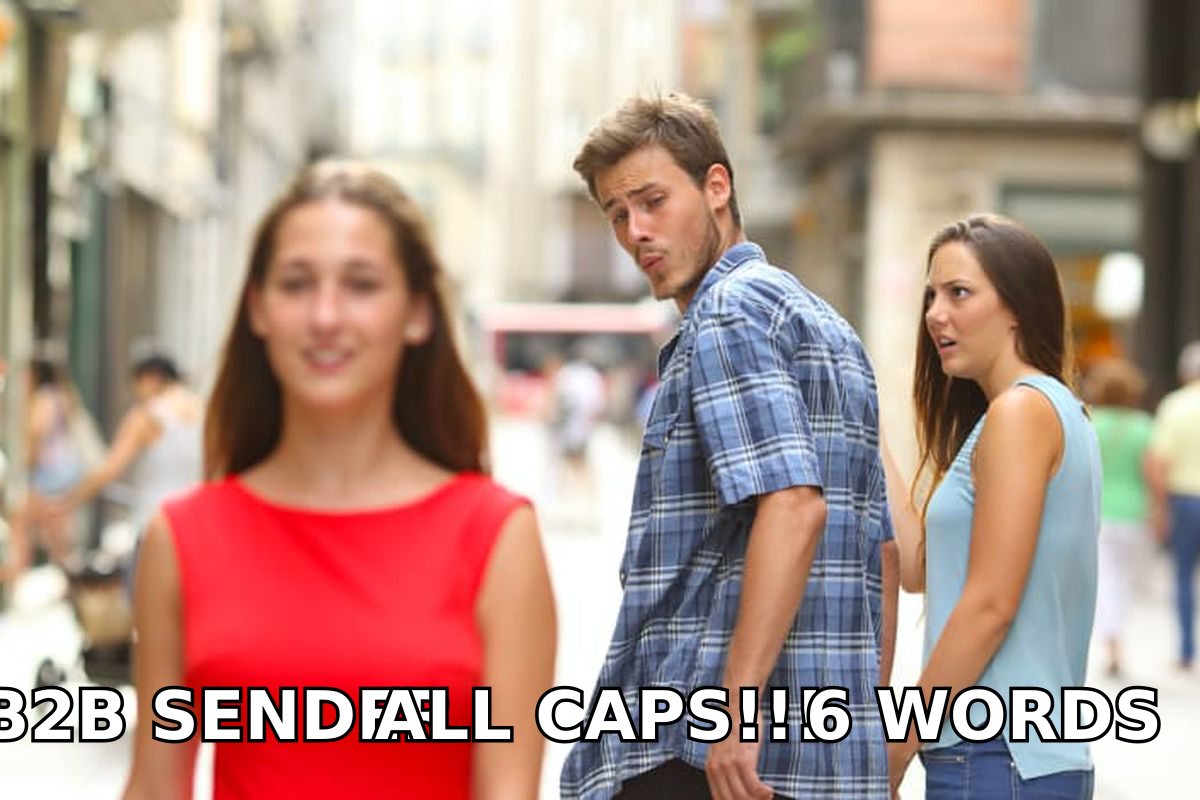
Which email headline formulas actually work?#
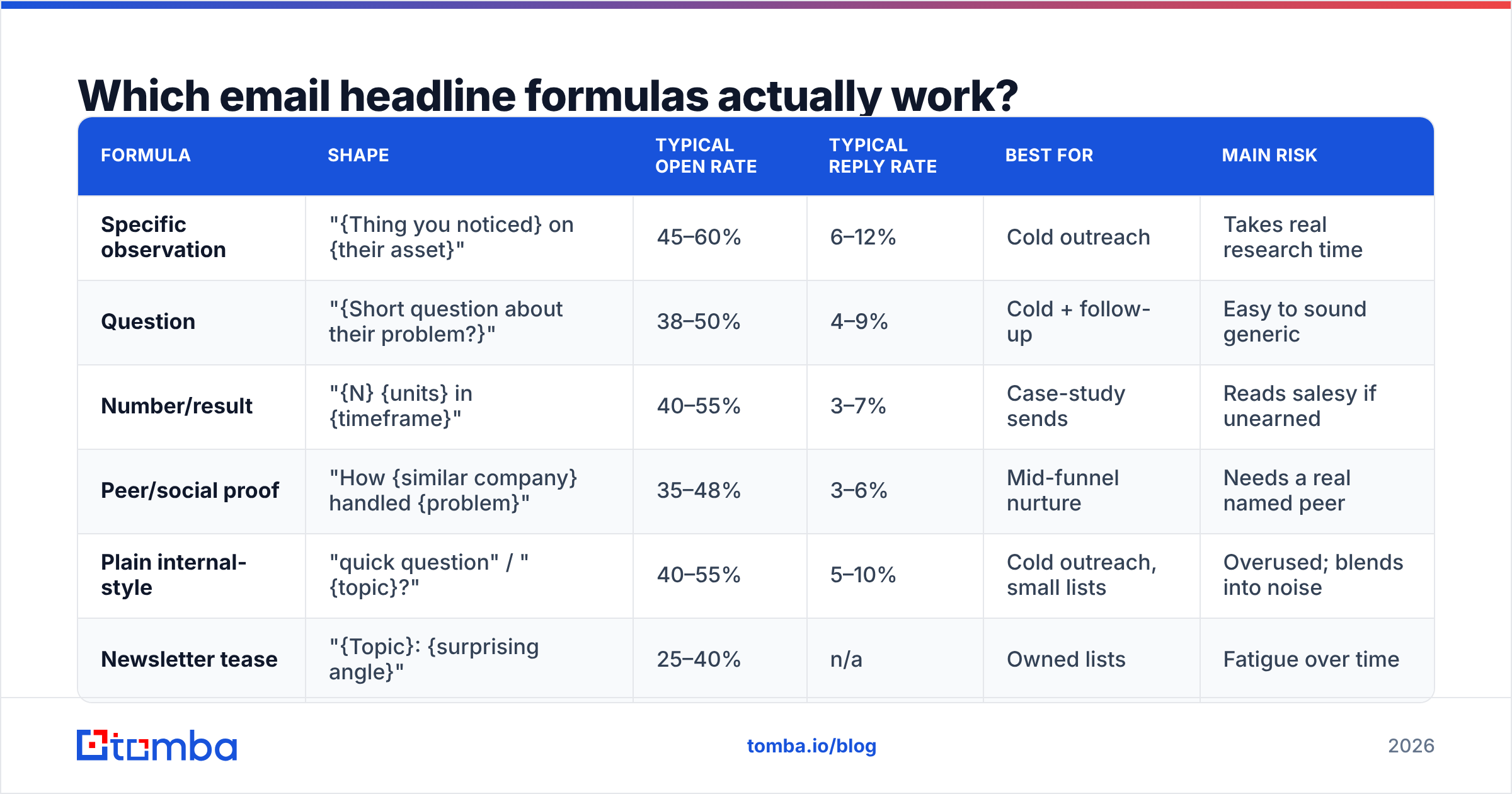
Here are the six formulas the examples below are built from, with realistic performance ranges for B2B sends to a verified list. Treat these as directional benchmarks, not promises — your industry, list age, and sender reputation move them more than the words do.
| Formula | Shape | Typical open rate | Typical reply rate | Best for | Main risk |
|---|---|---|---|---|---|
| Specific observation | "{Thing you noticed} on {their asset}" | 45–60% | 6–12% | Cold outreach | Takes real research time |
| Question | "{Short question about their problem?}" | 38–50% | 4–9% | Cold + follow-up | Easy to sound generic |
| Number/result | "{N} {units} in {timeframe}" | 40–55% | 3–7% | Case-study sends | Reads salesy if unearned |
| Peer/social proof | "How {similar company} handled {problem}" | 35–48% | 3–6% | Mid-funnel nurture | Needs a real named peer |
| Plain internal-style | "quick question" / "{topic}?" | 40–55% | 5–10% | Cold outreach, small lists | Overused; blends into noise |
| Newsletter tease | "{Topic}: {surprising angle}" | 25–40% | n/a | Owned lists | Fatigue over time |
The pattern across all six: none of them rely on hype. They rely on being about something.
What are the best email headline examples for cold outreach?#
Ten cold-outreach headlines, each with the formula in brackets so you can rebuild it.
- "your pricing page vs. Gong's" — [specific observation] Names a real competitor. Implies you actually looked.
- "question about the Series B hiring plan" — [question] Ties to a public event. Feels internal.
- "37 open SDR roles — how are you ramping them?" — [number] The number does the qualifying for you.
- "saw the Zapier integration went live" — [specific observation] Congratulations without the word "congratulations."
- "quick question, {FirstName}" — [plain] Boring, effective, badly overused. Use sparingly.
- "how Ramp solved this before the IPO" — [peer proof] Only send if the story is real and public.
- "is {Company} still using Marketo?" — [question] Tech-stack triggers create genuine curiosity.
- "two things about your careers page" — [number] "Two things" beats "some thoughts."
- "wrong person? happy to be redirected" — [plain] Great as a first or second touch to a large account.
- "{Competitor} just changed their pricing" — [specific observation] Timely, useful, and not about you.
Notice what's absent: no "Boost your revenue by 300%," no "Unlock growth," no emoji. Every one of these could plausibly have been typed by a colleague.
What are good follow-up and re-engagement headlines?#
Follow-ups fail when they announce themselves as follow-ups. "Just following up" adds zero new information — it only reminds the recipient they already ignored you once.
Follow-up examples:
- "one more idea on the onboarding flow" — adds value instead of pressure.
- "closing the loop on this" — clean, low-pressure breakup line.
- "should I stop emailing?" — the honest breakup. Gets surprisingly high reply rates.
- "forwarding in case it got buried" — assumes good faith.
- "new data since my last note" — only send if there is actually new data.
- "3-line version of my last email" — respects their inbox. Then actually make it three lines.
Re-engagement examples (dormant subscribers):
- "you haven't opened us since March" — radical transparency works.
- "is this still useful?" — a genuine question, and a great list-hygiene trigger.
- "we changed the format — worth another look?" — gives a reason for the reset.
- "last email unless you click" — clear stakes, no manipulation.
- "what we shipped while you were away" — flatters and informs.
- "unsubscribe in one click (or stay)" — counterintuitive, but it protects your sender reputation by pushing dead weight off the list.
That last one matters more than it looks. Re-engagement campaigns are where most bounces surface. Run addresses through an email verifier before the send rather than discovering the decay through a spike in hard bounces.
What are strong newsletter, event, and launch headlines?#
Newsletter:
- "The 4-day week experiment that failed" — a negative outcome is more interesting than a success.
- "Nobody is buying AI SDRs anymore. Here's why." — a claim, then a promise to justify it.
- "Issue 42: the pricing teardown" — numbering builds ritual.
- "We were wrong about attribution" — admitting error is the most under-used newsletter hook in B2B.
- "6 charts on the 2026 SaaS funding slowdown" — count plus format plus topic.
- "Your competitors' cold email templates, annotated" — voyeurism is a legitimate hook.
Event and webinar:
- "30 minutes, Thursday, on outbound in 2026" — the format is the headline.
- "Ask the Stripe RevOps lead anything" — sell the person, not the webinar.
- "Recording's up (28 min)" — the runtime raises click-through measurably.
- "Two seats left for the Tuesday session" — scarcity that's actually true.
- "Skip the webinar — here's the deck" — very high open rate, very low resentment.
Product launch:
- "Bulk verification is live" — plain announcement, no adjectives.
- "You asked for CSV export. It's here." — credits the reader.
- "What's new: 3 changes to the API" — changelog format, easy to scan.
- "We cut lookup latency by 40%" — a number the reader can verify.
- "The feature we almost didn't ship" — story hook.
- "Now free on the starter plan" — pricing changes are always news.
- "Deprecating v1 on March 30" — bad news gets the highest open rates of anything you'll ever send. Use that responsibly.
If you want to generate variations of these against your own product, the subject line generator produces alternates from a topic prompt, and the subject line tester scores length, spam-trigger words, and mobile truncation before you queue the send.
Which email headline patterns should you avoid?#
Six patterns that reliably underperform, and what to do instead:
- Fake reply and forward prefixes — "Re:" or "Fwd:" on a first touch. It works once, generates a complaint, and costs you domain reputation. Replace with an honest specific observation.
- All caps and multiple exclamation points — filters weight these heavily, and readers discount them instantly. Replace with a number.
- Vague benefit claims — "Transform your pipeline." No noun, no proof, no reason to open. Replace with the concrete thing you'd say out loud.
- Over-personalization tokens — "{FirstName}, {Company} needs this in {City}" reads like a mail merge misfire. One token is plenty.
- Curiosity gaps with no payoff — "You won't believe what happened." The open rate spikes, the reply rate craters, unsubscribes climb. Replace with curiosity the body actually resolves.
- Spam-trigger stacking — "free," "guarantee," "act now," "risk-free" in the same line. One is survivable; four is a filter magnet. Run drafts through a spam checker before a large send.
The through-line: every one of these optimizes for the open at the expense of the relationship. Open rate is also the least reliable metric you track — Apple Mail Privacy Protection pre-fetches images and inflates it. Judge headlines on replies and clicks, not opens.
How should you test email headlines?#
Keep the test honest, or you'll ship conclusions built on noise.
- One variable per test. Change the subject, hold the body, send time, and segment constant. If you change two things, you learn nothing.
- Mind your sample size. Below roughly 1,000 recipients per variant, a 3-point difference in open rate is usually noise. For small B2B lists, batch several sends before drawing conclusions.
- Measure downstream. Track reply rate and meetings booked, not opens. A headline that opens 8 points lower but replies 3 points higher is the better headline.
- Re-test quarterly. Winners decay. A format that works in Q1 gets copied by every vendor in your category by Q3.
- Log everything. A simple sheet with subject, segment, send date, opens, replies, and unsubscribes will outperform any tool you buy in year one.
One caveat worth stating plainly: if your list has decayed, your A/B results are measuring bounce noise, not copy. B2B contact data goes stale at roughly 25–30% per year as people change jobs. Comparing tools on that basis is a whole separate exercise — G2's email marketing category is a reasonable starting point for vendor research, and platforms like BookYourData, Apollo, and Tomba all approach list freshness differently.
How does list quality change headline performance?#
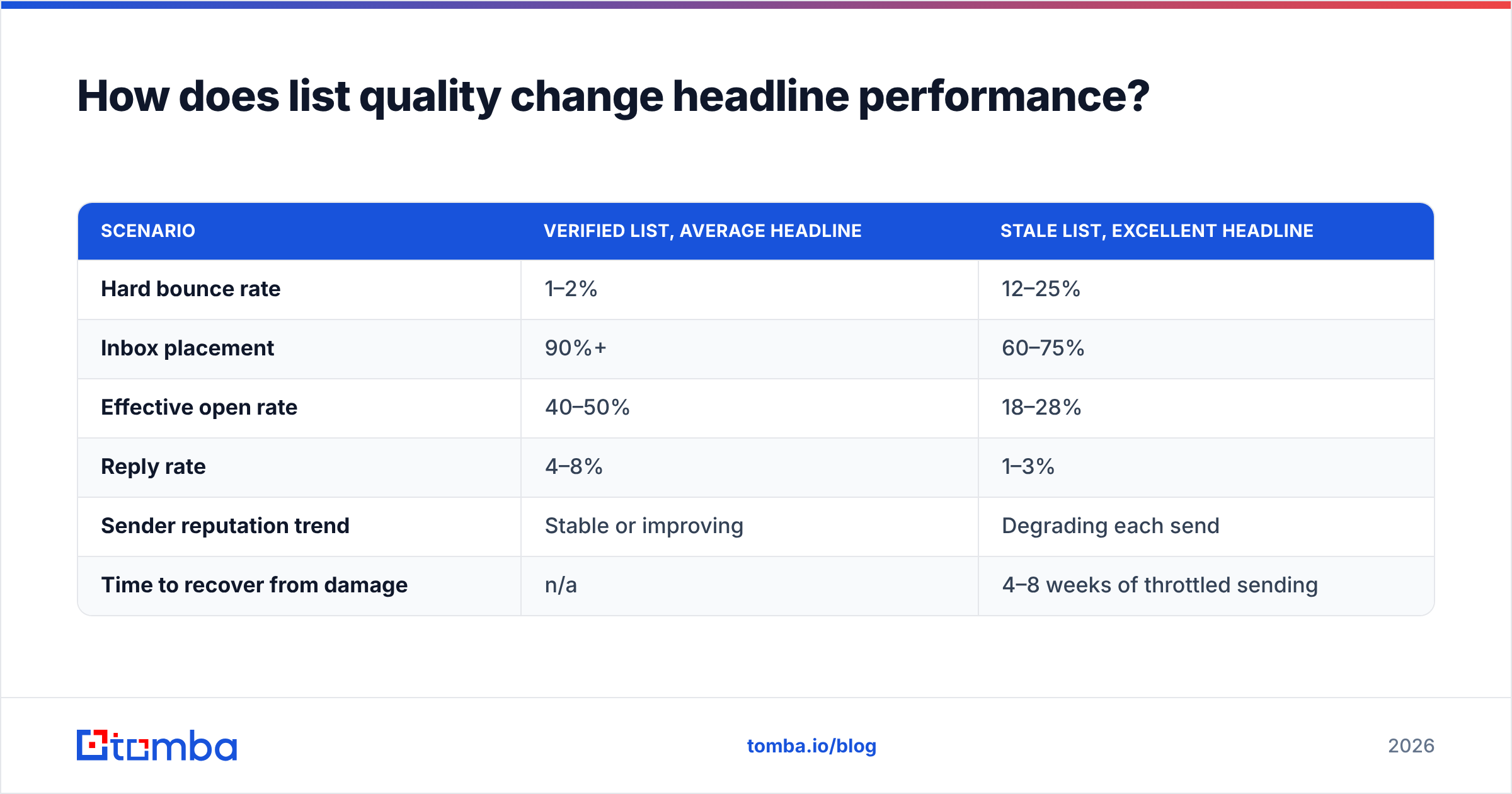
More than the copy does, in most cases. Here's the comparison that matters:
| Scenario | Verified list, average headline | Stale list, excellent headline |
|---|---|---|
| Hard bounce rate | 1–2% | 12–25% |
| Inbox placement | 90%+ | 60–75% |
| Effective open rate | 40–50% | 18–28% |
| Reply rate | 4–8% | 1–3% |
| Sender reputation trend | Stable or improving | Degrading each send |
| Time to recover from damage | n/a | 4–8 weeks of throttled sending |
A brilliant headline delivered to a spam folder is worth exactly zero. The order of operations is: clean the list, warm the domain, then optimize copy. Teams that reverse this spend months A/B testing their way around a deliverability problem.
Practically, that means running your addresses through verification before every major campaign, catching catch-all domains separately, and pulling fresh contacts when a title changes. If you're building lists from company domains rather than buying them, domain search is usually the cheaper starting point than a static database export that ages the moment you download it.
Which headline should you use for your next send?#
Pick by send type, not by which one sounds cleverest:
- Cold, high-value account → specific observation. Do the research; it's worth the 90 seconds.
- Cold, at volume → short question or plain internal-style line. Six words maximum.
- Follow-up → new information, or an honest breakup. Never "just following up."
- Newsletter → a claim or a surprising negative. Number your issues.
- Re-engagement → transparency plus an easy exit.
- Launch → plain announcement with a verifiable number.
Then write the preheader as a second sentence that extends the subject rather than repeating it. That single habit will do more for your click-through rate than the next twenty headline variations you test.
Before you optimize another subject line, make sure the emails behind it are real. Tomba's Email Finder locates verified professional addresses by name, company, or domain — with confidence scoring on every result, so you know what you're sending to before you send it. The free tier includes 25 searches per month, and paid plans start at $49/mo (Starter), $99/mo (Growth), and $249/mo (Pro) if you need bulk volume and API access. See full Tomba pricing for credit limits by plan. Clean the list first; the headlines get easier after that.
Related guides#
Ready to find emails that actually work?
Join 150,000+ professionals who stopped guessing and started sending. Free credits on signup — no credit card required.
Get the Tomba newsletter
Practical outbound tactics and product updates — once every two weeks.
About the author