9 Best Email Hippo Alternatives for 2026 (Tested & Compared)
Email Hippo is a solid verifier with a thin prospecting story. Here are nine alternatives compared on accuracy, catch-all handling, API depth and real per-1,000 cost — plus which one fits your list size.

TL;DR
- Email Hippo is a genuinely accurate verifier with strong compliance credentials, but it verifies emails you already have — it does not find them, and its pay-as-you-go credits get expensive above ~100k/month.
- If you need find + verify in one workflow, Tomba, BookYourData and Findymail are the closest fits. If you only need bulk hygiene, MillionVerifier and Bouncer win on price per 1,000.
- Catch-all domains are the real differentiator. Most tools return "unknown" and still charge you; only a handful attempt a real verdict.
- Expect $0.30–$4.00 per 1,000 verifications depending on volume and vendor. Anyone quoting a flat rate is hiding tiers.
- Pick by list size and workflow, not by G2 badge count. The decision table near the end maps tool → use case in one row each.
What is Email Hippo and what does it actually do?#
Email Hippo is a UK-based email verification company that has been running since 2014. It splits its product into three named services: MORE (bulk list verification through a web app), CORE (real-time single-address verification via API), and ASSESS (risk and fraud scoring on an address — domain age, disposable detection, social footprint).
What it does well is narrow and real: syntax checks, MX and SMTP probing, disposable-domain detection, role-account flagging, and an unusually serious compliance posture (ISO 27001, GDPR-first data handling, UK data residency). If you are a regulated business that gets asked "where is our data processed" by procurement, that matters more than a 2% accuracy delta.
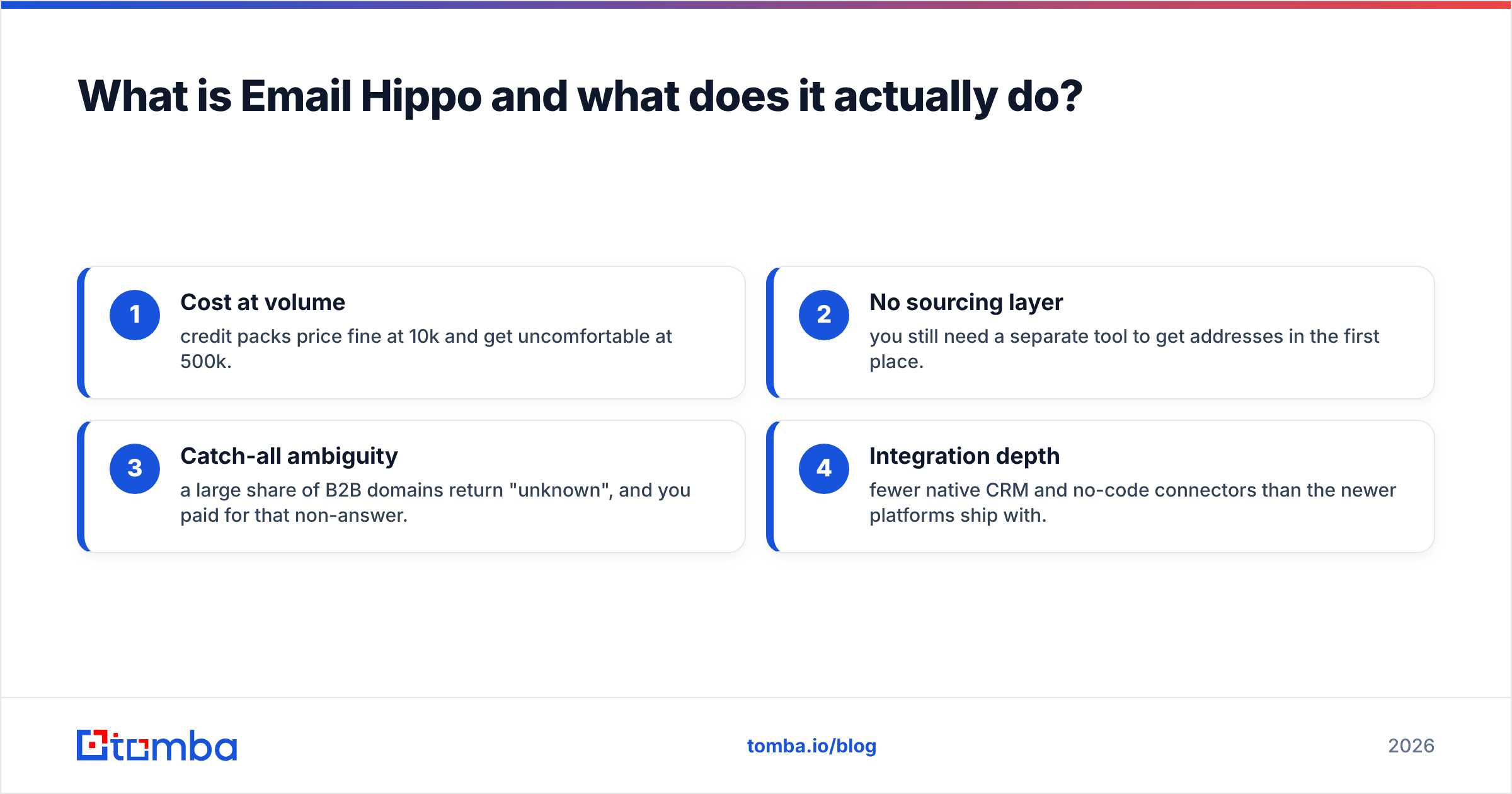
What it does not do is find anyone. Email Hippo takes a list you already have and tells you which addresses are safe to send to. That is one step of a prospecting pipeline, not the pipeline. Most teams searching for email hippo alternatives are hitting one of four walls:
- Cost at volume — credit packs price fine at 10k and get uncomfortable at 500k.
- No sourcing layer — you still need a separate tool to get addresses in the first place.
- Catch-all ambiguity — a large share of B2B domains return "unknown", and you paid for that non-answer.
- Integration depth — fewer native CRM and no-code connectors than the newer platforms ship with.

How should you evaluate an email verification tool in 2026?#
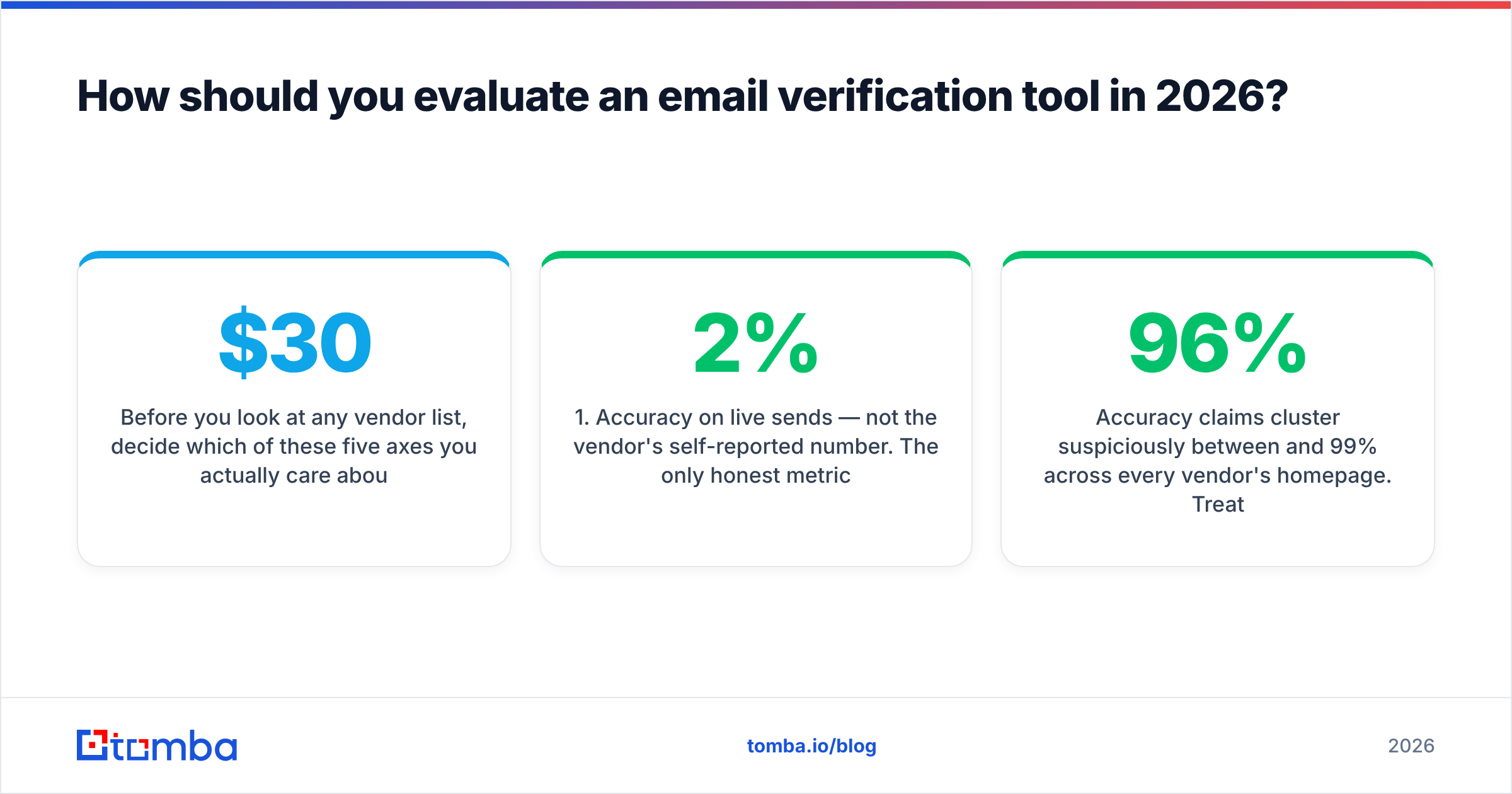
Before you look at any vendor list, decide which of these five axes you actually care about. Ranking tools without this step is how teams end up paying enterprise prices for a hygiene job a $30 tool would have done.
- Accuracy on live sends — not the vendor's self-reported number. The only honest metric is your bounce rate after verification. Anything under 2% is healthy; under 1% is excellent. A verifier claiming 99% accuracy that leaves you at 4% bounces is lying to one of you.
- Catch-all resolution — accept-all domains (common on Microsoft 365 and Google Workspace tenants) accept every address at the SMTP layer. A tool that returns "unknown" and bills you has done nothing. Tools that attempt pattern inference plus secondary signals earn their price here.
- Sourcing vs. hygiene — do you need addresses discovered, or only cleaned? Buying two tools is fine, but you should do it deliberately.
- Real cost per 1,000 at your volume — list price at 5k is marketing. Compute your cost at your actual monthly volume, including the credits burned on unknowns.
- API and workflow depth — rate limits, webhook support, bulk endpoints, native CRM sync, spreadsheet add-ins, and whether the free tier is enough to test properly.

Accuracy claims cluster suspiciously between 96% and 99% across every vendor's homepage. Treat those as marketing floors, not measurements. Run the same 500-address control list through two or three tools, send to the results, and compare bounce rates. That test costs about $20 and settles arguments that otherwise last a quarter.
Which are the best Email Hippo alternatives right now?#
1. Tomba — best when you need to find and verify in one place#
Tomba's core product is the email finder, with an email verifier, domain search, catch-all handling, phone finder and enrichment sitting alongside it. That combination is the main structural difference from Email Hippo: you go from "I know this company" to "I have a verified, deliverable address" without exporting a CSV between two vendors.
Practical strengths: a catch-all verifier that returns a real verdict on accept-all domains rather than a shrug, bulk processing for list work, a documented Tomba API with an MCP server and CLI for engineering teams, plus Sheets, Excel, Airtable and HubSpot connectors.
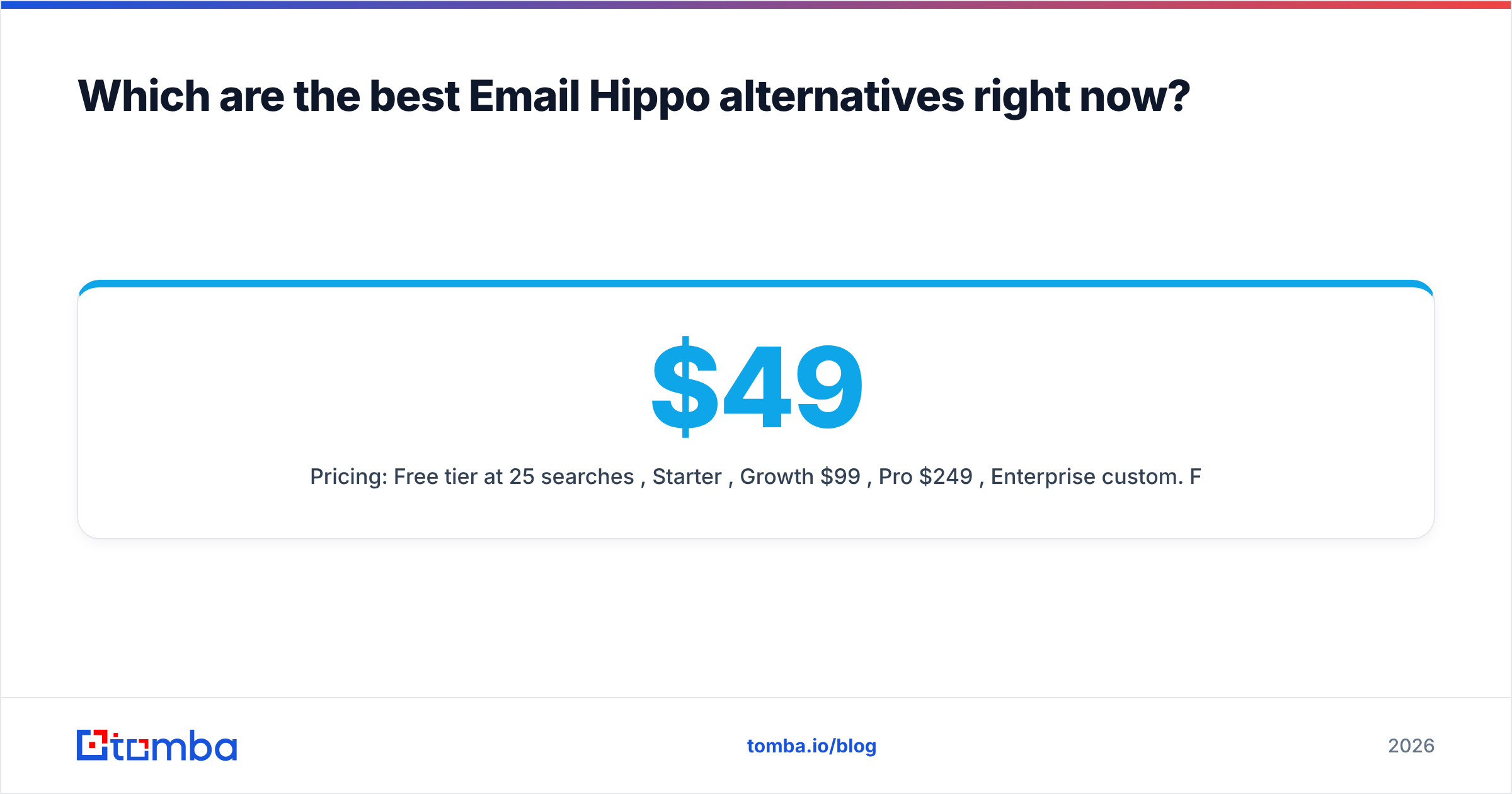
Pricing: Free tier at 25 searches/month, Starter $49/mo, Growth $99/mo, Pro $249/mo, Enterprise custom. Full Tomba pricing is public — no "contact sales" wall to see a number.
Weak spot: if you have zero sourcing need and only ever clean purchased lists, you are paying for a finder you will not touch. Pure-hygiene tools will be cheaper per 1,000.
2. BookYourData — best when you want the list itself, pre-verified#
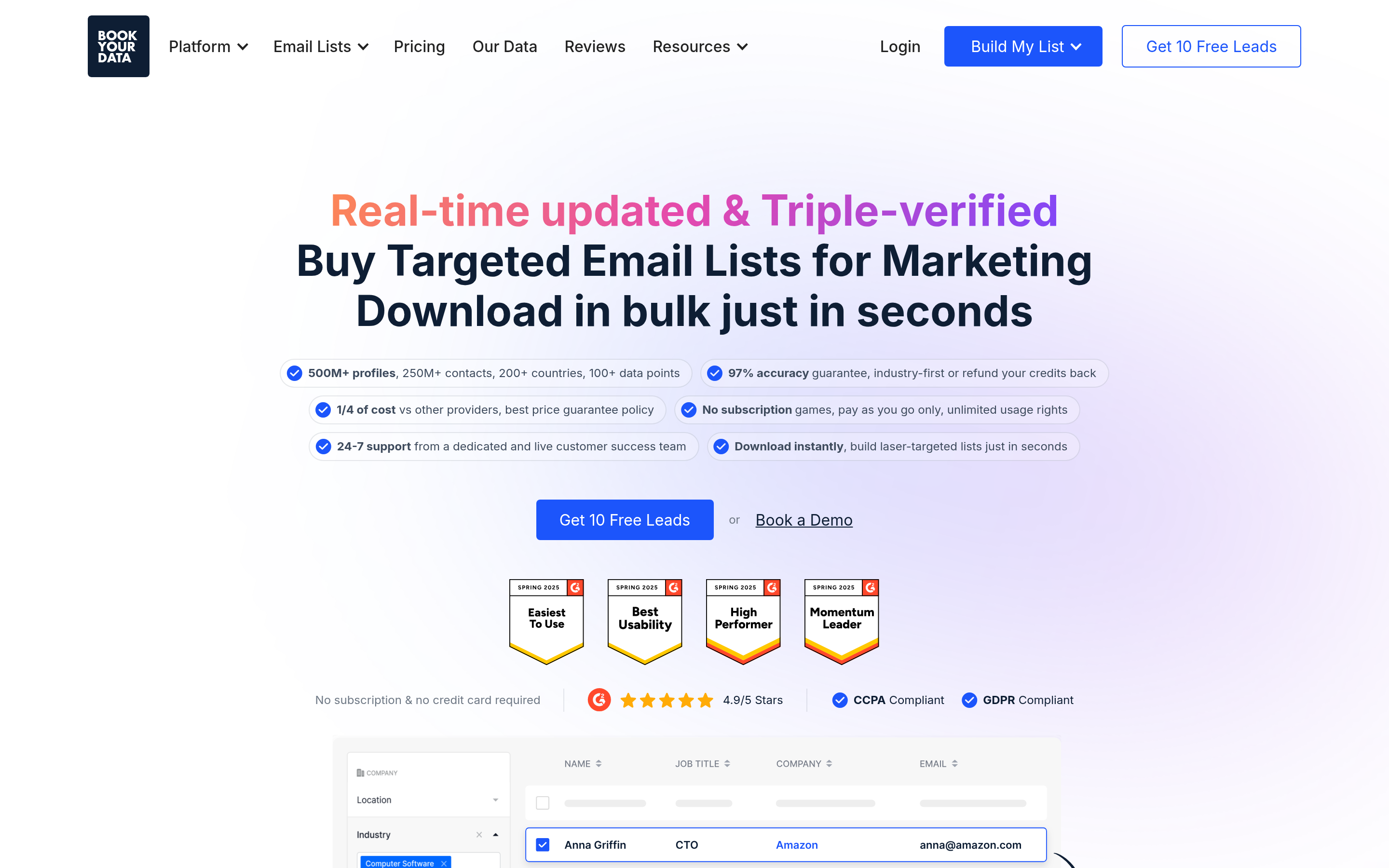
BookYourData takes a different route: instead of verifying your list, it sells you a filtered one with a bounce guarantee attached. You build a segment by industry, title, geography and company size, then buy exactly those contacts. It is a strong option for teams that do not have a source list to clean and do not want to spend weeks building one, and the pay-as-you-go model means no monthly commitment sitting on your card. Treat it as complementary to a verifier rather than a replacement — the two solve adjacent problems well.
3. ZeroBounce — the closest like-for-like swap#
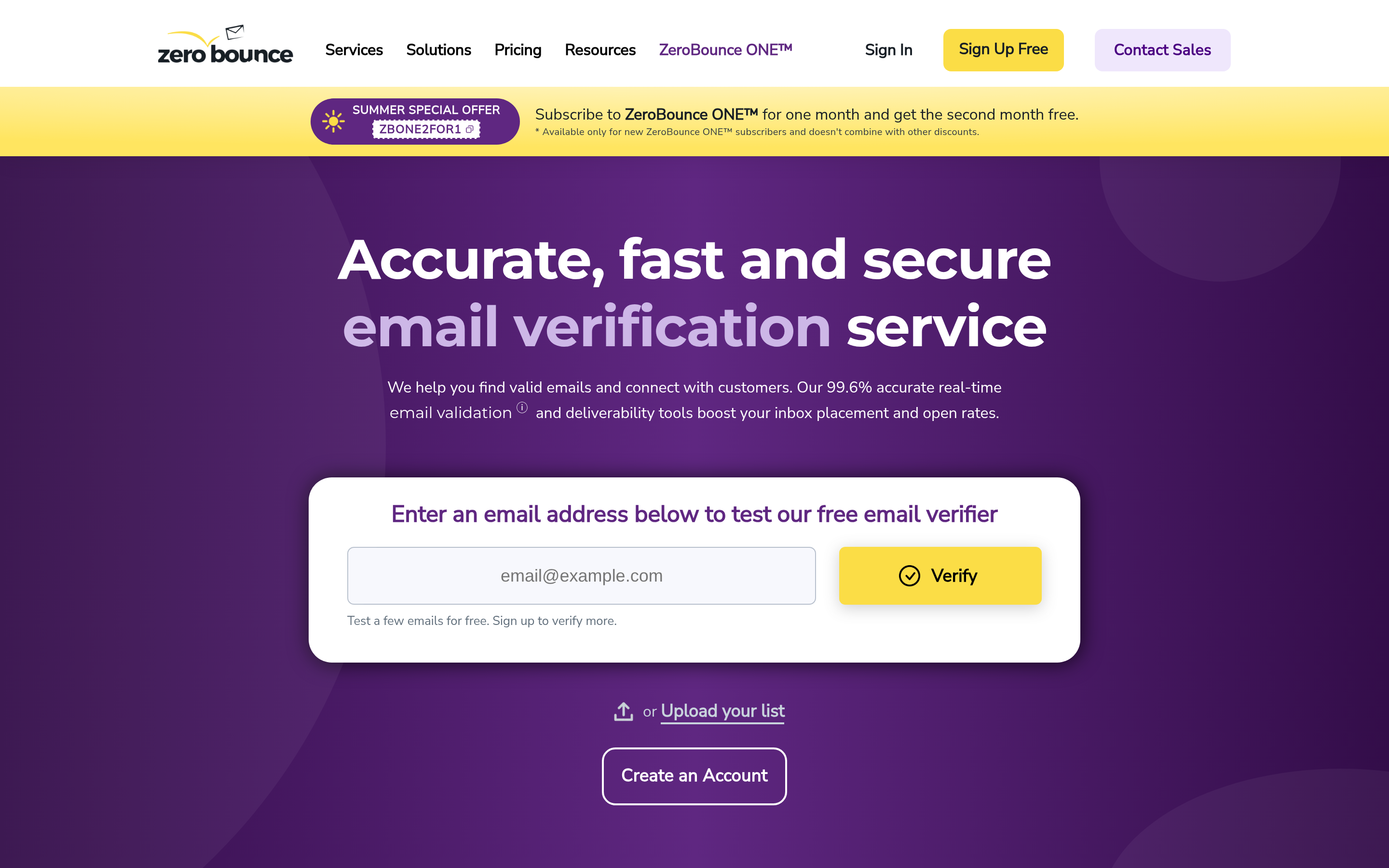
ZeroBounce is the most direct Email Hippo substitute: bulk verification, real-time API, activity data, abuse and spam-trap detection, and a deliverability toolkit (inbox placement tests, blacklist monitoring, DMARC monitoring). If you like Email Hippo's shape but want more deliverability tooling bundled, this is the low-risk move. It is not the cheapest per 1,000, and the feature sprawl means you will pay for modules you may not use. See our ZeroBounce alternative breakdown for a deeper comparison.
4. MillionVerifier — best cost per 1,000 for big lists#
Aggressively cheap at volume, with a simple promise: you are not charged for unknowns. For a 500k-address hygiene job, the difference against premium vendors is measured in thousands of dollars, not hundreds. The interface is plain and the API is basic. No sourcing, no enrichment, no deliverability suite. That focus is exactly why it wins on price.
5. Bouncer — best UX and EU data handling#
Bouncer is the tool people describe as "just pleasant to use." Clean dashboard, fast bulk processing, GDPR-aligned EU infrastructure, and a Toxicity Check that flags complainers and spam traps before you send. Pricing sits mid-market. If Email Hippo's compliance story was the reason you chose it, Bouncer keeps that while modernising the interface — see our Bouncer alternative notes.
6. Clearout — best value in the mid-tier#
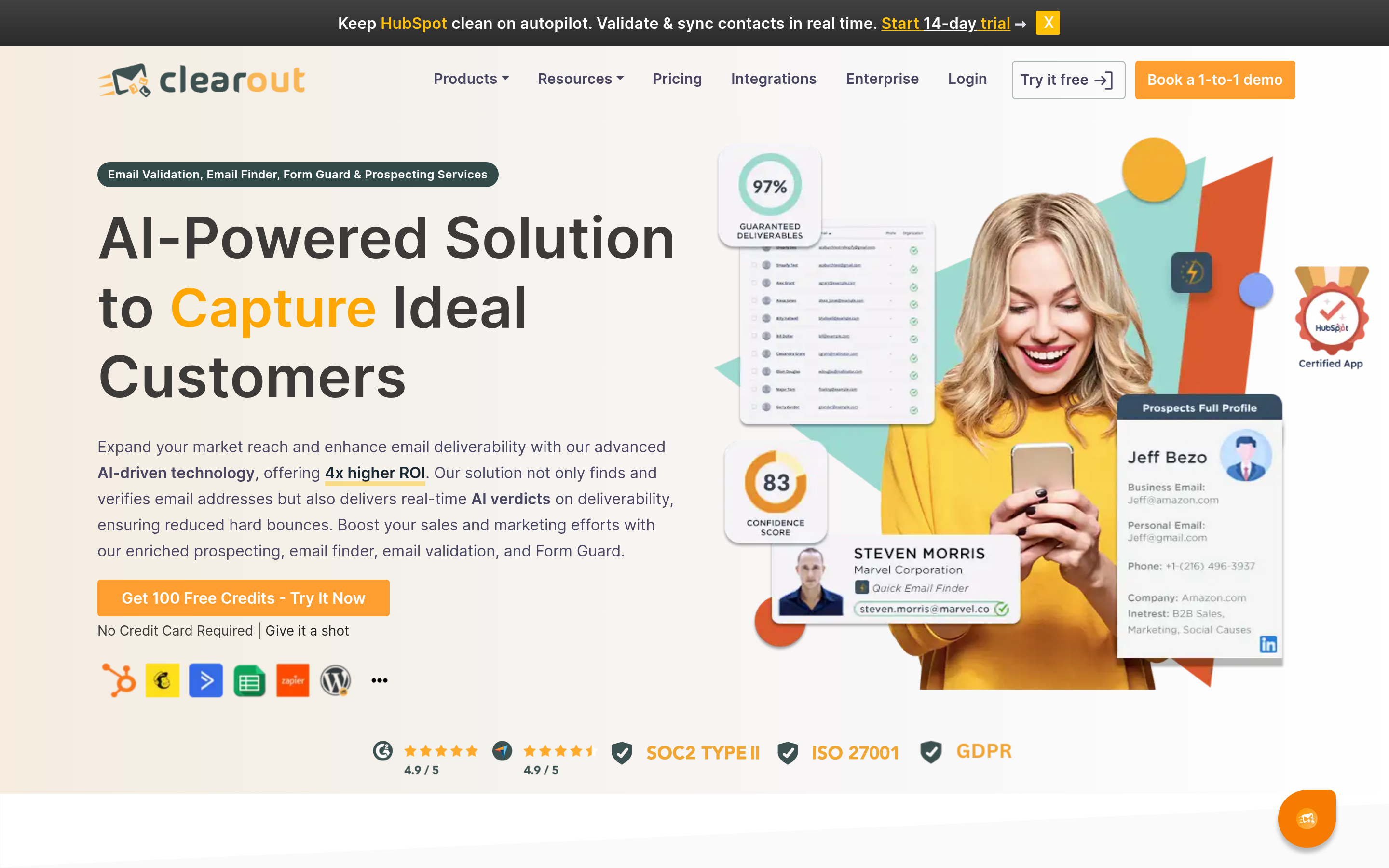
Clearout does the standard verification set plus a decent catch-all engine and a small prospecting layer. Credits never expire, which quietly matters if your sending is seasonal. Free tier is usable for evaluation. Reporting is thinner than the premium tools.
7. Debounce — best pay-as-you-go for occasional cleaning#
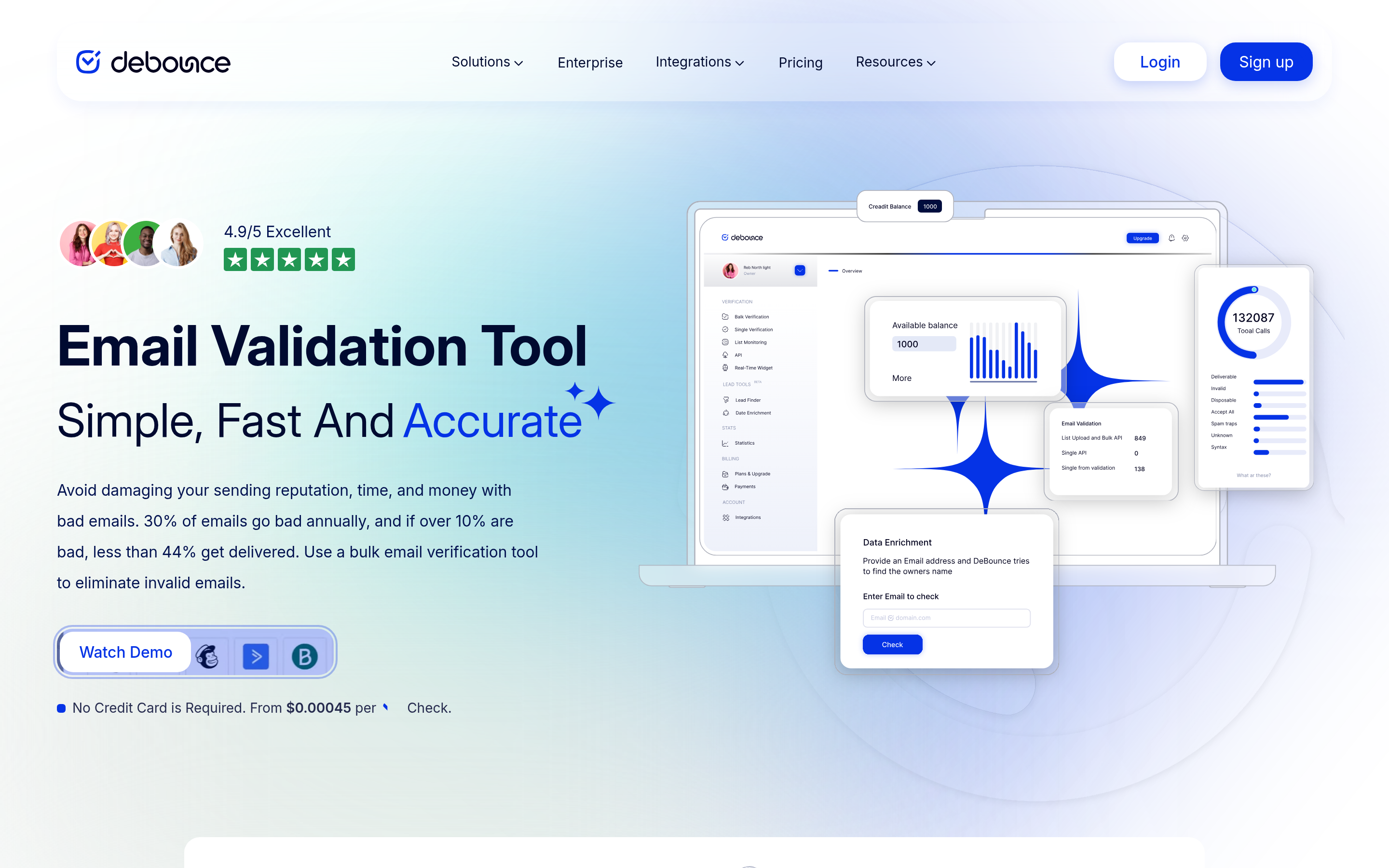
If you verify a list four times a year, subscriptions are waste. Debounce's credit packs are cheap, do not expire, and cover the essentials: syntax, disposable, role, accept-all detection. Not a platform, and it is not trying to be. Compare on the Debounce alternative page.
8. Findymail — best for LinkedIn-sourced lists#
Findymail is built around exports from LinkedIn and Sales Navigator, with verification bundled in. If your prospecting starts in LinkedIn rather than in a CRM export, the workflow fit is strong. Outside that specific motion it is less compelling.
9. Emailable — best for high-frequency API verification#
Emailable focuses on real-time API verification with fast response times and a straightforward integration story — good for signup-form validation where a slow verifier costs you conversions. Bulk features exist but are not the headline.
How do these Email Hippo alternatives compare on price and features?#

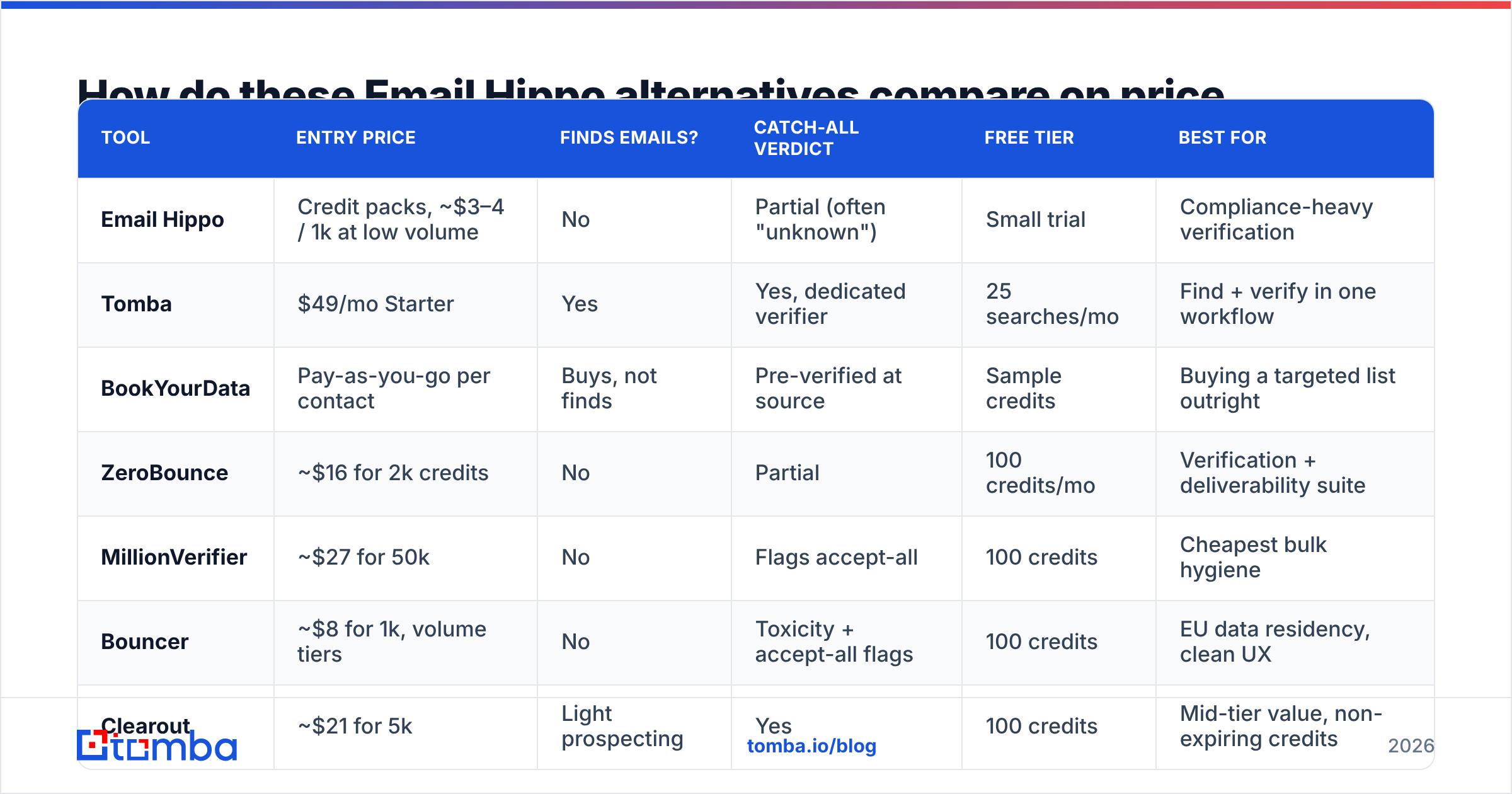
Prices below are typical published rates at the time of writing and move regularly. Always confirm on the vendor's own pricing page before you commit — especially at volumes over 100k, where nearly every vendor negotiates.
| Tool | Entry price | Finds emails? | Catch-all verdict | Free tier | Best for |
|---|---|---|---|---|---|
| Email Hippo | Credit packs, ~$3–4 / 1k at low volume | No | Partial (often "unknown") | Small trial | Compliance-heavy verification |
| Tomba | $49/mo Starter | Yes | Yes, dedicated verifier | 25 searches/mo | Find + verify in one workflow |
| BookYourData | Pay-as-you-go per contact | Buys, not finds | Pre-verified at source | Sample credits | Buying a targeted list outright |
| ZeroBounce | ~$16 for 2k credits | No | Partial | 100 credits/mo | Verification + deliverability suite |
| MillionVerifier | ~$27 for 50k | No | Flags accept-all | 100 credits | Cheapest bulk hygiene |
| Bouncer | ~$8 for 1k, volume tiers | No | Toxicity + accept-all flags | 100 credits | EU data residency, clean UX |
| Clearout | ~$21 for 5k | Light prospecting | Yes | 100 credits | Mid-tier value, non-expiring credits |
| Debounce | ~$10 for 5k | No | Flags accept-all | 100 credits | Occasional pay-as-you-go cleaning |
| Findymail | ~$49/mo | Yes | Bundled | Limited trial | LinkedIn-sourced prospecting |
Two things fall out of that table.
First, the cheap tools are cheap because they do one thing. MillionVerifier at roughly $0.50 per 1,000 is not undercutting ZeroBounce on the same product — it is selling a smaller product. That is a feature if hygiene is all you need.
Second, the "finds emails" column is the real fork in the road. Tools that only verify will always have a per-1,000 price advantage, and will always leave you shopping for a source. Decide which problem you are actually solving before you compare decimals.

Is switching from Email Hippo actually worth it?#
Sometimes no. Here is an honest test.
Stay with Email Hippo if: your compliance team already signed off on it, your volume is under ~50k/month, you have a separate sourcing tool you like, and your bounce rate is under 2%. Switching costs are real — API rewrites, re-integrations, re-testing — and "slightly cheaper" rarely covers them.
Switch if any of these are true:
- You are paying twice. A finder plus a verifier plus an enrichment tool is three invoices doing one job. Consolidating usually cuts 30–40% of spend before you negotiate anything.
- Your volume crossed six figures. Above ~100k/month, per-1,000 pricing dominates everything else. Run the arithmetic; the gap between the cheapest and most expensive vendor at 500k is not marginal.
- Catch-alls are half your list. If you are discarding thousands of accept-all domains because your tool won't commit to a verdict, you are throwing away pipeline. This is the single most common reason teams move.
- You need workflow, not an endpoint. Chrome extension, spreadsheet add-in, CRM sync, MCP server for AI agents — if your team lives in HubSpot and Sheets, an API-only vendor creates permanent friction.
Before you migrate, do the control test: take 500 addresses of known status, run them through both tools, and compare deliverable counts and bounce rates on a real send. Vendor accuracy pages are not evidence. Cross-check reviews on G2 for support responsiveness and billing surprises, which no feature table captures.
What does a sane verification workflow look like?#
Independent of which tool you pick, the sequence that keeps bounce rates low:
- Source deliberately. Find addresses by domain and name rather than scraping, so you know the provenance of every record.
- Verify at ingestion, not at send. Cleaning right before a campaign means you are cleaning stale data. Verify when the record enters your CRM.
- Re-verify anything older than 90 days. B2B email decays at roughly 2–3% per month through job changes. A list verified in January is meaningfully wrong by April.
- Segment by risk, don't just delete. Deliverable → send. Risky/catch-all → send from a secondary domain at low volume. Invalid → remove permanently.
- Watch bounce rate as the scoreboard. It is the only number that tells you whether your verifier is earning its price.
Teams that do these five things see bounce rates settle under 2% regardless of vendor. Teams that skip step 2 and step 3 blame the verifier for a process problem.
Which Email Hippo alternative should you pick?#
Short version, by situation:
- Find and verify in one workflow → Tomba
- Buy a pre-verified targeted list → BookYourData
- Like-for-like swap with more deliverability tooling → ZeroBounce
- Cheapest possible bulk hygiene → MillionVerifier
- EU data residency with a modern UI → Bouncer
- Occasional, no-subscription cleaning → Debounce
- LinkedIn-first prospecting → Findymail
If your bottleneck is getting verified addresses rather than cleaning ones you already have, start with the Tomba Email Finder. The free tier gives you 25 searches a month — enough to run your own control test against whatever Email Hippo is returning today — and Starter is $49/mo when you are ready to scale. Find the address, verify it, handle the catch-all, push it to your CRM, all without a second invoice.
Related guides#
Ready to find emails that actually work?
Join 150,000+ professionals who stopped guessing and started sending. Free credits on signup — no credit card required.
Get the Tomba newsletter
Practical outbound tactics and product updates — once every two weeks.
About the author