Email Hippo vs Kaspr: Verification vs Contact Data in 2026
Email Hippo verifies addresses you already have. Kaspr finds new ones on LinkedIn. Here is how the two actually compare on accuracy, pricing, coverage, and which one belongs in your outbound stack.
TL;DR — what you actually need to know#
- These tools do not compete. Email Hippo is an email verification engine. Kaspr is a LinkedIn-first contact data tool that surfaces phone numbers and emails. Comparing them head-to-head only makes sense once you decide which problem you have.
- Pick Email Hippo if you already own a list — CRM exports, form signups, a purchased database — and you need to know which addresses are safe to send to.
- Pick Kaspr if your reps live inside LinkedIn Sales Navigator and you want mobile numbers alongside emails, one profile at a time.
- Neither covers the full loop. Email Hippo will not find you a new contact. Kaspr's verification depth is thinner than a dedicated validator's, and its per-seat pricing scales badly across a team.
- The consolidation play: a single API that does find + verify + enrich (Tomba, Dropcontact, BookYourData depending on your region and volume) usually beats paying two vendors and stitching them together.

What is Email Hippo, exactly?#
Email Hippo is a UK-based email verification provider that has been running since 2014. Its core product, Email Hippo, answers one question with a lot of nuance: is this address real, and should you send to it?
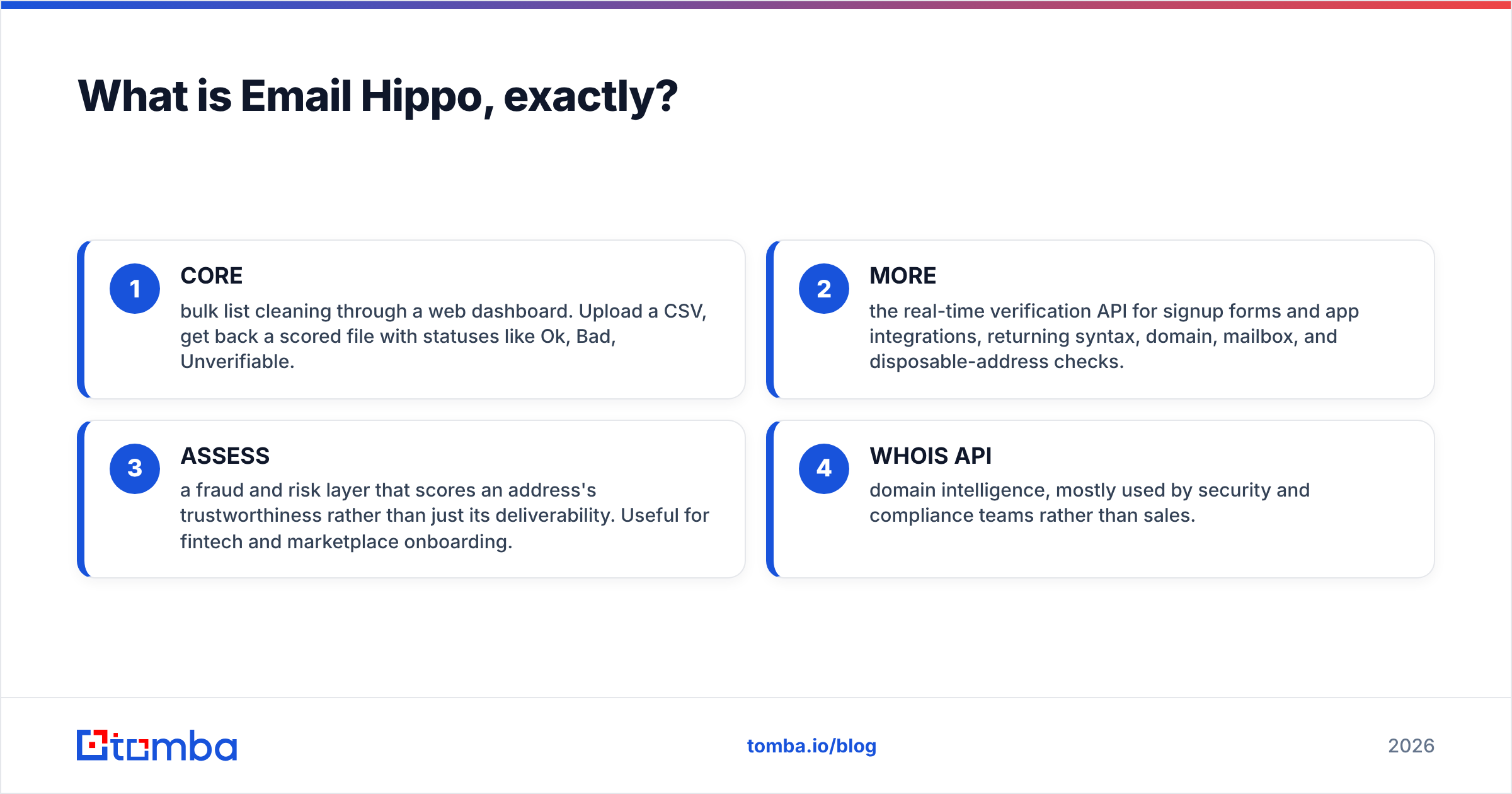
The stack breaks into a few pieces:
- CORE — bulk list cleaning through a web dashboard. Upload a CSV, get back a scored file with statuses like Ok, Bad, Unverifiable.
- MORE — the real-time verification API for signup forms and app integrations, returning syntax, domain, mailbox, and disposable-address checks.
- ASSESS — a fraud and risk layer that scores an address's trustworthiness rather than just its deliverability. Useful for fintech and marketplace onboarding.
- WHOIS API — domain intelligence, mostly used by security and compliance teams rather than sales.
What Email Hippo does not do: it will not tell you the email address of a VP of Engineering at a company you have never contacted. There is no search index, no LinkedIn extension, no prospecting layer. It is a gate, not a well.
That focus is the product's strength. Verification vendors that also sell data have an awkward incentive — flagging their own records as risky hurts the other half of the business. Email Hippo has no such conflict.
What is Kaspr, and who is it for?#
Kaspr is a B2B contact data tool built around a Chrome extension that runs on LinkedIn. Open a profile, click the extension, and Kaspr returns phone numbers, email addresses, and company details. It was acquired by Cognism in 2022 and now sits as the lighter, self-serve, SMB-facing product in that family.
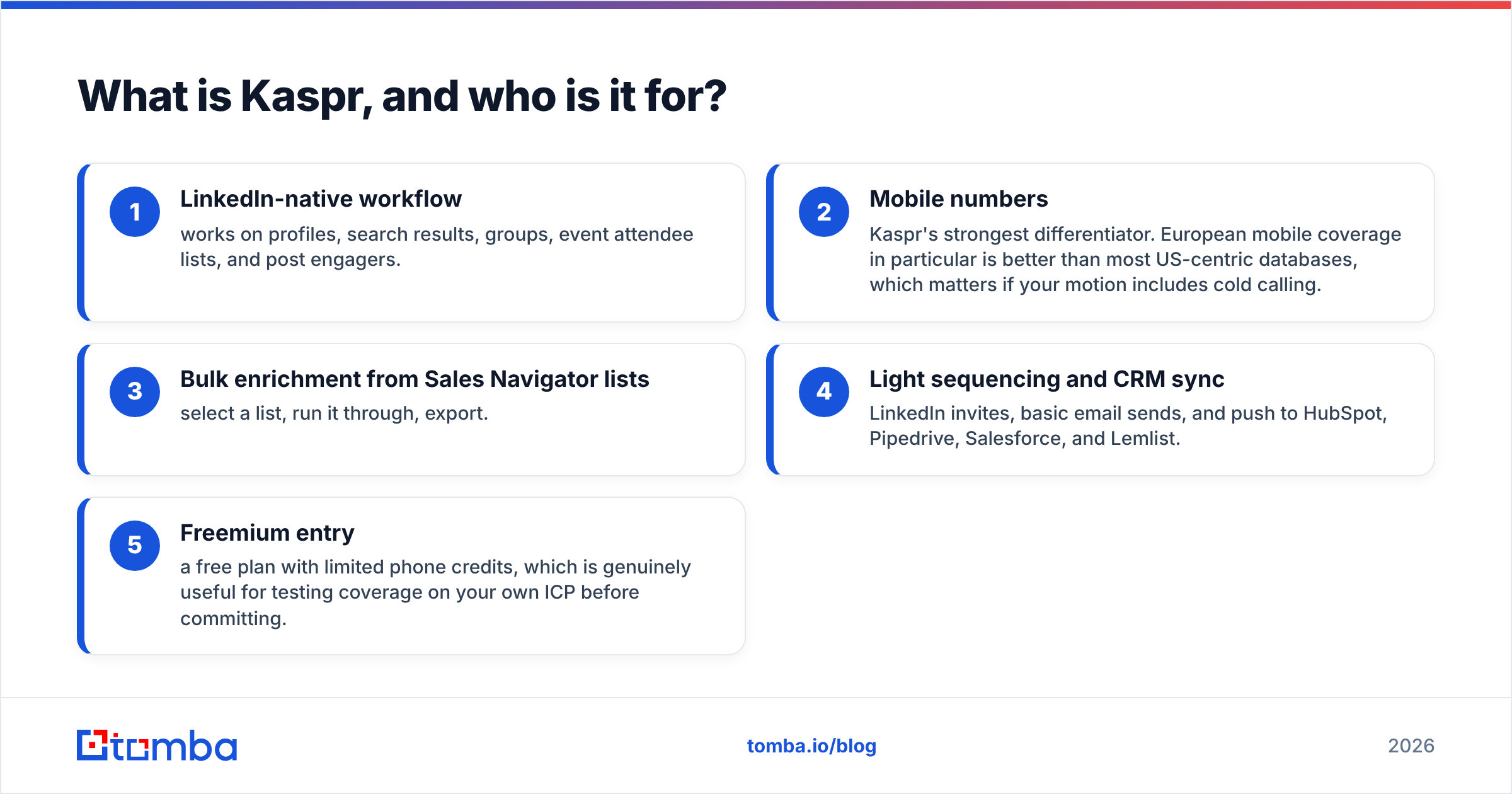
The pitch is speed at the individual-rep level:
- LinkedIn-native workflow — works on profiles, search results, groups, event attendee lists, and post engagers.
- Mobile numbers — Kaspr's strongest differentiator. European mobile coverage in particular is better than most US-centric databases, which matters if your motion includes cold calling.
- Bulk enrichment from Sales Navigator lists — select a list, run it through, export.
- Light sequencing and CRM sync — LinkedIn invites, basic email sends, and push to HubSpot, Pipedrive, Salesforce, and Lemlist.
- Freemium entry — a free plan with limited phone credits, which is genuinely useful for testing coverage on your own ICP before committing.
What Kaspr does not do well: bulk hygiene on a list you already own. If you hand it 40,000 CRM records of unknown quality, it is the wrong instrument. It also charges per user, so a five-rep team pays five times, whether or not all five hit their credit ceiling.
Email Hippo vs Kaspr: how do they compare side by side?#
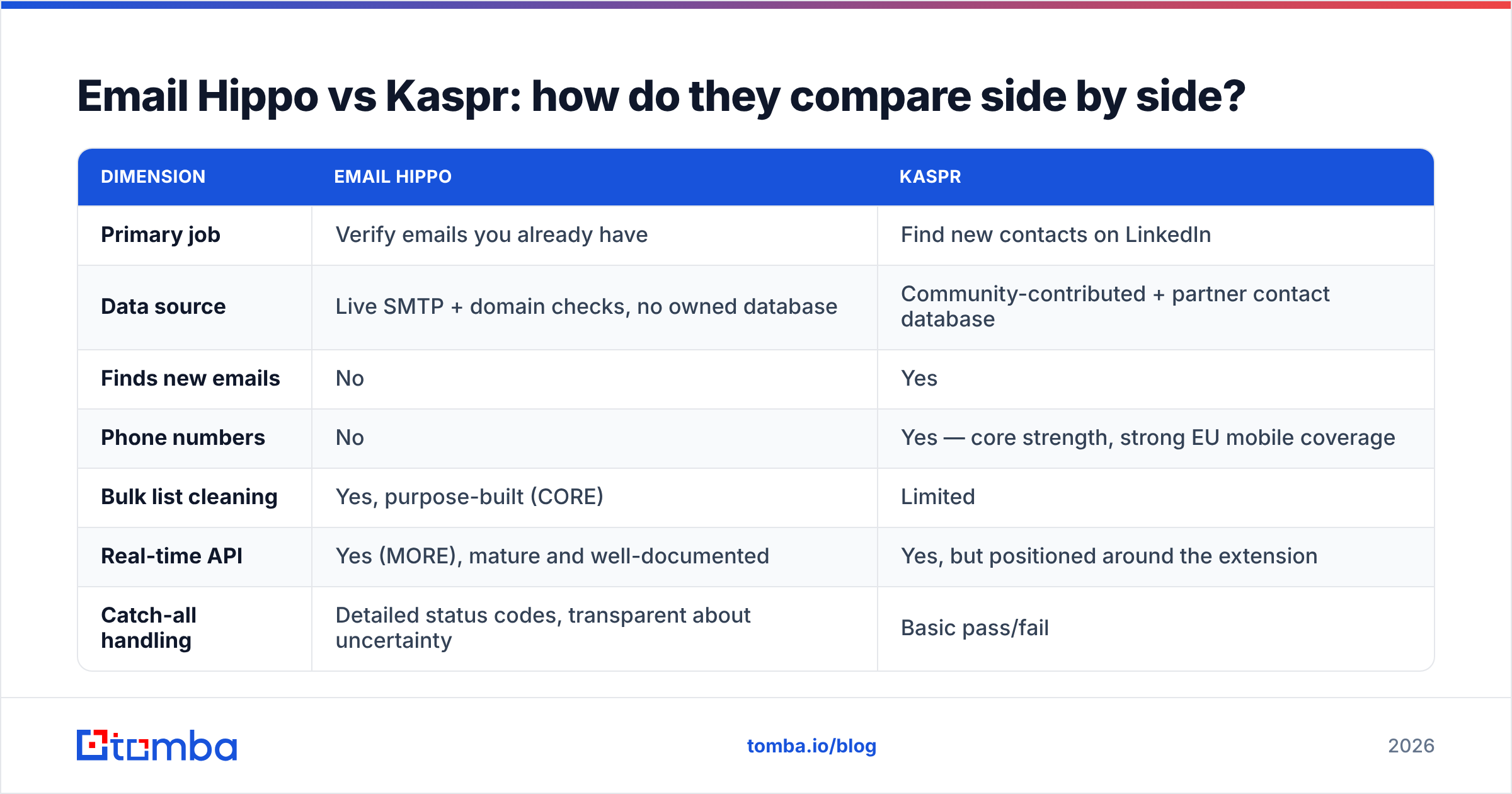
| Dimension | Email Hippo | Kaspr |
|---|---|---|
| Primary job | Verify emails you already have | Find new contacts on LinkedIn |
| Data source | Live SMTP + domain checks, no owned database | Community-contributed + partner contact database |
| Finds new emails | No | Yes |
| Phone numbers | No | Yes — core strength, strong EU mobile coverage |
| Bulk list cleaning | Yes, purpose-built (CORE) | Limited |
| Real-time API | Yes (MORE), mature and well-documented | Yes, but positioned around the extension |
| Catch-all handling | Detailed status codes, transparent about uncertainty | Basic pass/fail |
| Chrome extension | No | Yes — the main interface |
| Pricing model | Credit packs + monthly subscription, not per-seat | Per user, per month |
| Free entry point | Limited free trial credits | Free plan with monthly phone credits |
| Best for | RevOps, deliverability owners, product signup flows | SDRs and founders prospecting inside LinkedIn |
| Weak spot | Cannot source contacts | Per-seat cost, thin bulk hygiene |

Which one is more accurate?#
They are measuring different things, so "accurate" has to be defined twice.
For Email Hippo, accuracy means verdict correctness. Does an address marked "Ok" actually accept mail, and does an address marked "Bad" actually bounce? Independent tests and G2 reviews consistently put Email Hippo in the reliable tier — typically 95%+ agreement with real send outcomes on clean, non-catch-all domains. Its more interesting property is honesty about the grey zone: rather than guessing on catch-all domains, it flags them as unverifiable and lets you decide. Vendors that confidently score every catch-all as valid are usually inflating their own accuracy claim.
For Kaspr, accuracy means data freshness and match rate. Two numbers matter: what percentage of profiles return any contact, and what percentage of returned contacts are still correct. Kaspr's email match rate on European mid-market profiles is solid; its phone match rate is where it beats most competitors, though "phone found" often means a company switchboard rather than a direct mobile. Expect meaningful variance by geography — US coverage is decent, EU is strong, APAC and LATAM are thinner.
The practical consequence: Kaspr's output still needs verification before you send. A contact database returns what it last knew to be true. Only a live check tells you whether the mailbox exists today. That is why teams end up buying both — and why running the finder's own email verifier in the same pass removes a whole step.
One more thing worth knowing about catch-all domains: roughly a fifth of B2B domains accept mail for every address at the SMTP layer, which makes standard verification useless on them. If a large chunk of your ICP sits behind Microsoft 365 tenants configured this way, a dedicated catch-all verifier matters more than the headline accuracy percentage either vendor advertises.
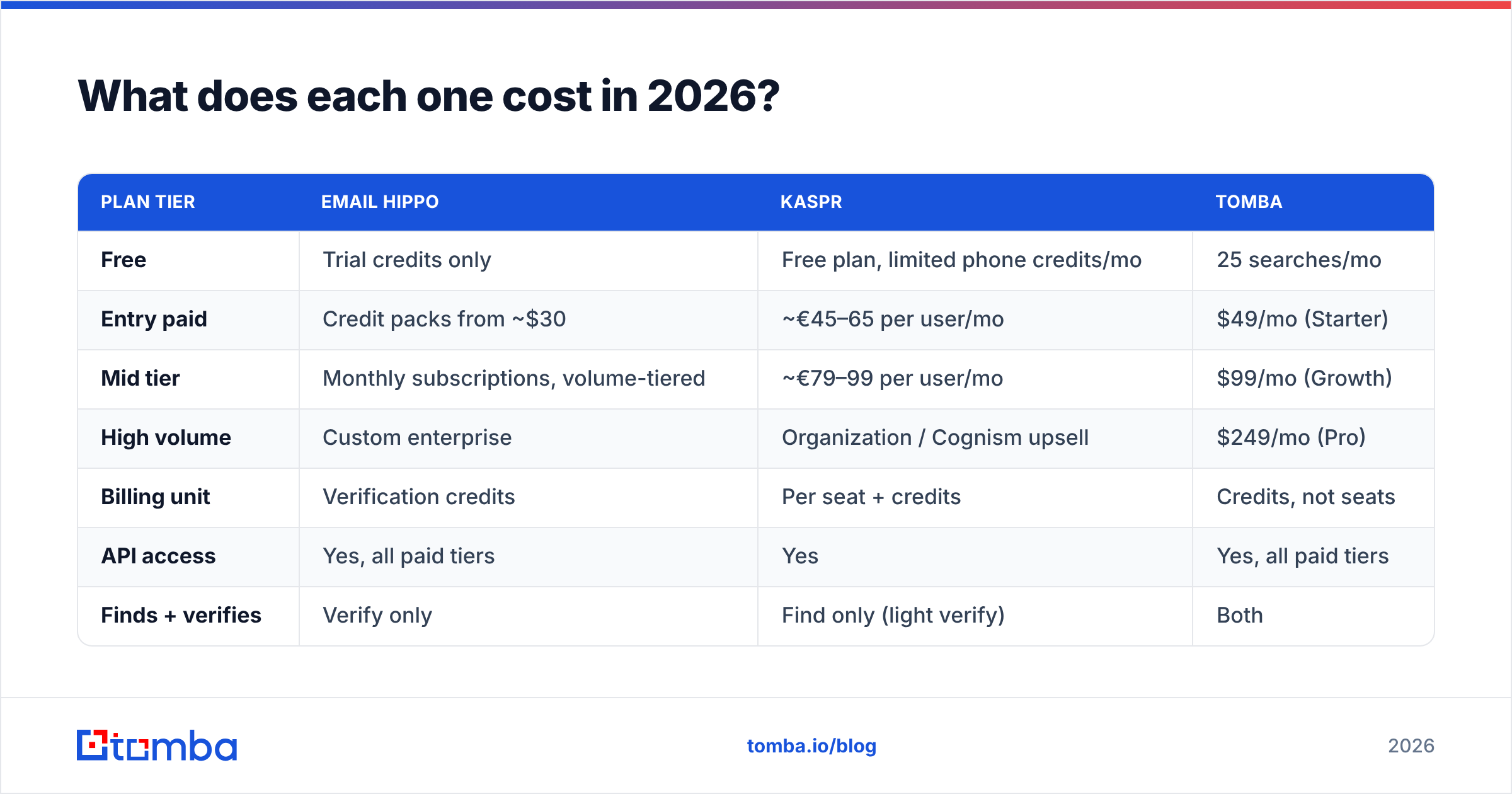
What does each one cost in 2026?#
Both vendors move their pricing, so treat these as shape rather than gospel and check the live pages before you buy.
| Plan tier | Email Hippo | Kaspr | Tomba |
|---|---|---|---|
| Free | Trial credits only | Free plan, limited phone credits/mo | 25 searches/mo |
| Entry paid | Credit packs from ~$30 | ~€45–65 per user/mo | $49/mo (Starter) |
| Mid tier | Monthly subscriptions, volume-tiered | ~€79–99 per user/mo | $99/mo (Growth) |
| High volume | Custom enterprise | Organization / Cognism upsell | $249/mo (Pro) |
| Billing unit | Verification credits | Per seat + credits | Credits, not seats |
| API access | Yes, all paid tiers | Yes | Yes, all paid tiers |
| Finds + verifies | Verify only | Find only (light verify) | Both |
The structural difference matters more than the sticker price. Email Hippo and Tomba charge for volume. Kaspr charges for seats. A three-person SDR team on Kaspr's business tier lands near €240/month before anyone runs a single bulk job. The same budget on a credit-based tool buys far more throughput and can be shared across the whole GTM org — see Tomba pricing for how credit pooling changes the math at team size.
Where Kaspr earns its seat cost is phone data. If cold calling is a real channel for you, a validated mobile number is worth more than several hundred emails, and you should price it that way. If you never call, you are paying for an asset you do not use — a phone finder bolted onto a credit plan is the cheaper way to keep the option open.

Do you actually need both tools?#
Here is the workflow most teams end up with when they buy both:
- Rep prospects in Sales Navigator, pulls contacts with Kaspr.
- Export lands in a spreadsheet.
- Spreadsheet gets uploaded to Email Hippo for verification.
- Clean rows get pushed to the CRM or sequencer.
- Someone forgets step 3 during a busy week and bounce rate spikes.
That fifth step is not a hypothetical — it is the single most common cause of sudden email deliverability collapse in small outbound teams. Manual handoffs between tools decay under deadline pressure.
Two ways to fix it:
- Automate the seam. Wire Kaspr → Email Hippo → CRM through Zapier or Make so verification cannot be skipped. Works, adds latency and a third bill.
- Collapse the stack. Use one provider that finds and verifies in the same call, so an unverified address never exists in your pipeline in the first place.
The second option is why consolidated platforms have taken share from point solutions since 2024. When the email finder and the verifier share an index, you get a confidence score with the result instead of a second invoice.
What are the best alternatives to Email Hippo and Kaspr?#
If neither shape fits, the realistic shortlist:
- Tomba — find + verify + enrich on one credit pool. Domain search, LinkedIn finder, catch-all verification, phone lookup, and an API/CLI/MCP surface for engineering-led teams. Credit-based, not per-seat. Best fit when you want one vendor for the whole contact lifecycle.
- BookYourData — a strong choice when you want to buy a targeted list rather than build one profile by profile. Pay-as-you-go, no subscription lock-in, with a bounce guarantee on delivered records. Different motion from both tools here: you filter and download instead of prospecting live.
- ZeroBounce / NeverBounce — direct Email Hippo substitutes if verification is all you need and you want a second quote.
- Cognism — the enterprise tier above Kaspr, with phone-verified mobile data and compliance tooling. Priced accordingly.
- Apollo.io — database plus sequencer plus dialer in one. Broadest feature set, most bloat, and data quality that varies more than any of the above.
For a deeper look at how the pure-play finders stack up on match rate and cost per valid email:

Which should you choose?#
Decide by the bottleneck you actually have, not by feature count.
Choose Email Hippo if: you own a large list of uncertain quality, you run a product signup form that needs real-time validation, you care about fraud signals as well as deliverability, or your compliance team wants a UK/EU-based processor. Its API documentation is genuinely good and its status codes are more granular than most competitors'.
Choose Kaspr if: your reps prospect inside LinkedIn every day, phone is a live channel, you are targeting European accounts, and your team is small enough that per-seat pricing does not compound. The free plan makes it cheap to test coverage against your specific ICP — do that before signing anything.
Choose neither if: you are paying two vendors to complete one workflow. That is the most common outcome of this comparison, and it is the one worth avoiding. A team spending roughly $80/month on verification and €79/user/month on contact discovery is spending more than a consolidated plan costs, while shipping more manual steps and more risk.
Run a real test before you commit. Take 100 contacts you already know the answer for — closed-won accounts, your own colleagues, people who have replied to you this quarter. Push them through each tool. Measure match rate, verdict accuracy, and how many records you had to touch by hand. That single hour beats every comparison article, this one included.
Ready to stop paying two vendors for one job?#
If your real problem is "I need correct email addresses I can send to today," you do not need a finder and a verifier on separate contracts. Tomba's Email Finder returns addresses with a confidence score and live verification built into the same call — by domain, by name, by company, or in bulk — starting free with 25 searches per month and $49/mo on Starter, priced by credits rather than seats so the whole team can share one pool. Test it against your own known-good list, compare cost per valid email to your current stack, and keep whichever wins.
Related guides#
Ready to find emails that actually work?
Join 150,000+ professionals who stopped guessing and started sending. Free credits on signup — no credit card required.
Get the Tomba newsletter
Practical outbound tactics and product updates — once every two weeks.
About the author