Email Icebreakers: 15 Openers That Actually Get Replies
Most cold email openers are filler your prospect scrolls past. Here are 15 email icebreakers with the research behind them, the 5 to delete today, and how to source them in under 90 seconds per lead.
TL;DR
- An email icebreaker is the first 1–2 sentences after the greeting. Its only job is to buy you the next three seconds — not to charm, not to compliment.
- The openers that work reference something the recipient did or decided, not something their company published. "I saw your post" is weak. "You moved billing in-house in Q1" is strong.
- Personalization has a ceiling. Past roughly 20 seconds of research per lead, reply-rate gains flatten while your send volume collapses.
- Five icebreaker types are actively hurting you in 2026: weather openers, fake mutual connections, "quick question," flattery about a website redesign, and anything starting with "I hope this email finds you well."
- None of it matters if the email bounces. Clean the list first, then worry about the first line.
What is an email icebreaker, exactly?#
An email icebreaker is the opening line that sits between "Hi Sarah," and your actual reason for writing. It is not your value proposition, and it is not small talk. Think of it as the handshake at a conference — nobody remembers a good one, but a bad one colors everything that follows.
Structurally, a cold email has four moving parts:
- Subject line — earns the open.
- Icebreaker — earns the next three seconds of attention by proving you are not a bot.
- Relevance bridge — connects what you noticed to why you are writing.
- Ask — one specific, low-friction next step.
Most reps obsess over part 1 and part 4 and treat part 2 as decoration. That is backwards. The subject line gets you into the preview pane, but the icebreaker is what stops the thumb. On mobile — where the majority of B2B email is now first triaged — your icebreaker is often visible in the preview text alongside the subject line. It is doing double duty whether you designed it to or not.
The failure mode is predictable: reps write an icebreaker that proves they did research, rather than one that proves the research was relevant. Those are different goals. Telling someone their company raised a Series B tells them you read TechCrunch. Telling them their new VP of Ops inherited three overlapping billing systems tells them you understand their week.
Why do most email icebreakers fail?#
Six reasons, in rough order of how often I see them in audited sequences:
- They are about the company, not the person. Funding rounds, awards, and office openings are public and generic. Everyone in that prospect's inbox referenced the same funding round that week.
- They compliment something the recipient did not build. "Love the new website" lands with a thud when the recipient is a Head of Finance who has never touched the CMS.
- They are transparently templated. Any sentence with a
{{company}}seam showing — "I've been following {{company}} for a while now" — reads as merge-field spam. Recipients pattern-match this in under a second. - They delay the point. Three sentences of throat-clearing before the reason for the email trains the reader to scroll past your next one too.
- They flatter. Adults in a professional context read unearned praise as a manipulation attempt, because it usually is.
- They reference something too old. A podcast appearance from 14 months ago signals that you scraped, not that you paid attention.

There is a seventh reason that has nothing to do with copy: the email never arrived. If your list has a 12% bounce rate, your icebreaker A/B test is measuring noise. Run the list through an email verifier before you spend a single hour on opener variants — otherwise you are optimizing the paint job on a car with no engine.
Which types of email icebreakers actually work?#
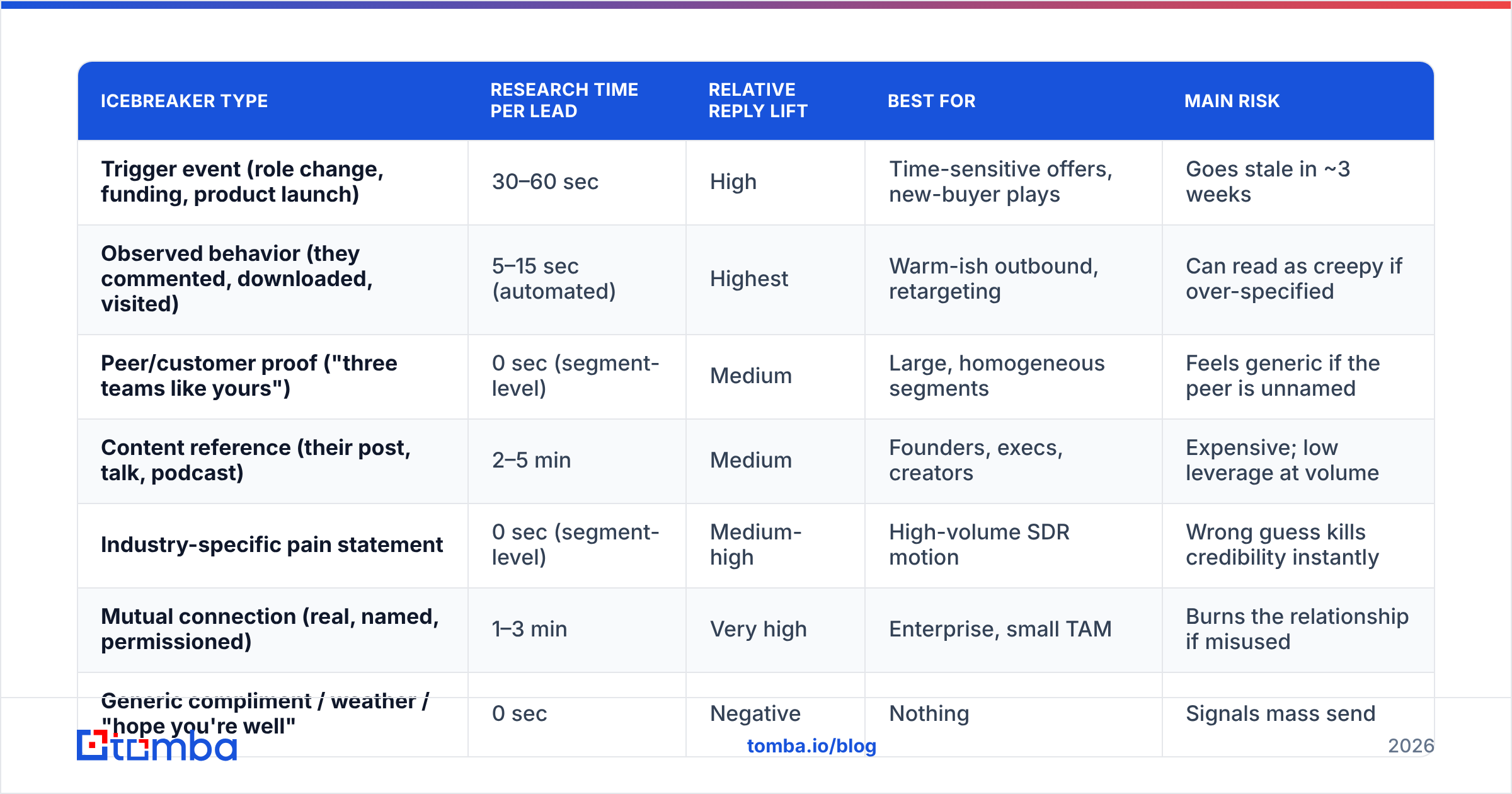
Not all personalization costs the same, and not all of it pays back the same. Here is how the main categories stack up in practice:
| Icebreaker type | Research time per lead | Relative reply lift | Best for | Main risk |
|---|---|---|---|---|
| Trigger event (role change, funding, product launch) | 30–60 sec | High | Time-sensitive offers, new-buyer plays | Goes stale in ~3 weeks |
| Observed behavior (they commented, downloaded, visited) | 5–15 sec (automated) | Highest | Warm-ish outbound, retargeting | Can read as creepy if over-specified |
| Peer/customer proof ("three teams like yours") | 0 sec (segment-level) | Medium | Large, homogeneous segments | Feels generic if the peer is unnamed |
| Content reference (their post, talk, podcast) | 2–5 min | Medium | Founders, execs, creators | Expensive; low leverage at volume |
| Industry-specific pain statement | 0 sec (segment-level) | Medium-high | High-volume SDR motion | Wrong guess kills credibility instantly |
| Mutual connection (real, named, permissioned) | 1–3 min | Very high | Enterprise, small TAM | Burns the relationship if misused |
| Generic compliment / weather / "hope you're well" | 0 sec | Negative | Nothing | Signals mass send |
The pattern is clear once you lay it out: behavior beats biography, and segment-level relevance beats bad individual-level personalization. A well-written pain statement aimed at a tight segment outperforms a clumsy compliment aimed at one person, and it scales to 500 sends instead of 30.
That last point is the one most teams get wrong. They assume personalization is a linear dial — more research, more replies. It is not. It is a curve that flattens hard. Two minutes of research does not produce twice the reply rate of one minute; it usually produces the same reply rate at half the volume.
What are 15 email icebreakers worth stealing?#
Adapt the specifics. The structure is the transferable part.
Trigger-based (use within 21 days of the event)
- "You picked up the RevOps function three weeks ago — usually that means inheriting someone else's reporting stack."
- "Saw the Denver office posting on the careers page. Field team going from 4 to 11 changes territory math fast."
- "Your Q3 release moved usage-based billing into the core product. That normally breaks the old invoicing workflow."
- "Noticed you consolidated onto a single CRM in June — congratulations, and also, condolences on the migration."
Behavior-based
- "You were on the pricing page twice last week, so I'll skip the pitch and answer the question directly: yes, it works with HubSpot."
- "You commented on Anita's post about SDR ramp time. The 'six-month ramp is a data problem' line is what got me writing."
- "Two people from your team downloaded the deliverability checklist last month. Guessing inbox placement is on someone's OKR."
Peer and pain-based
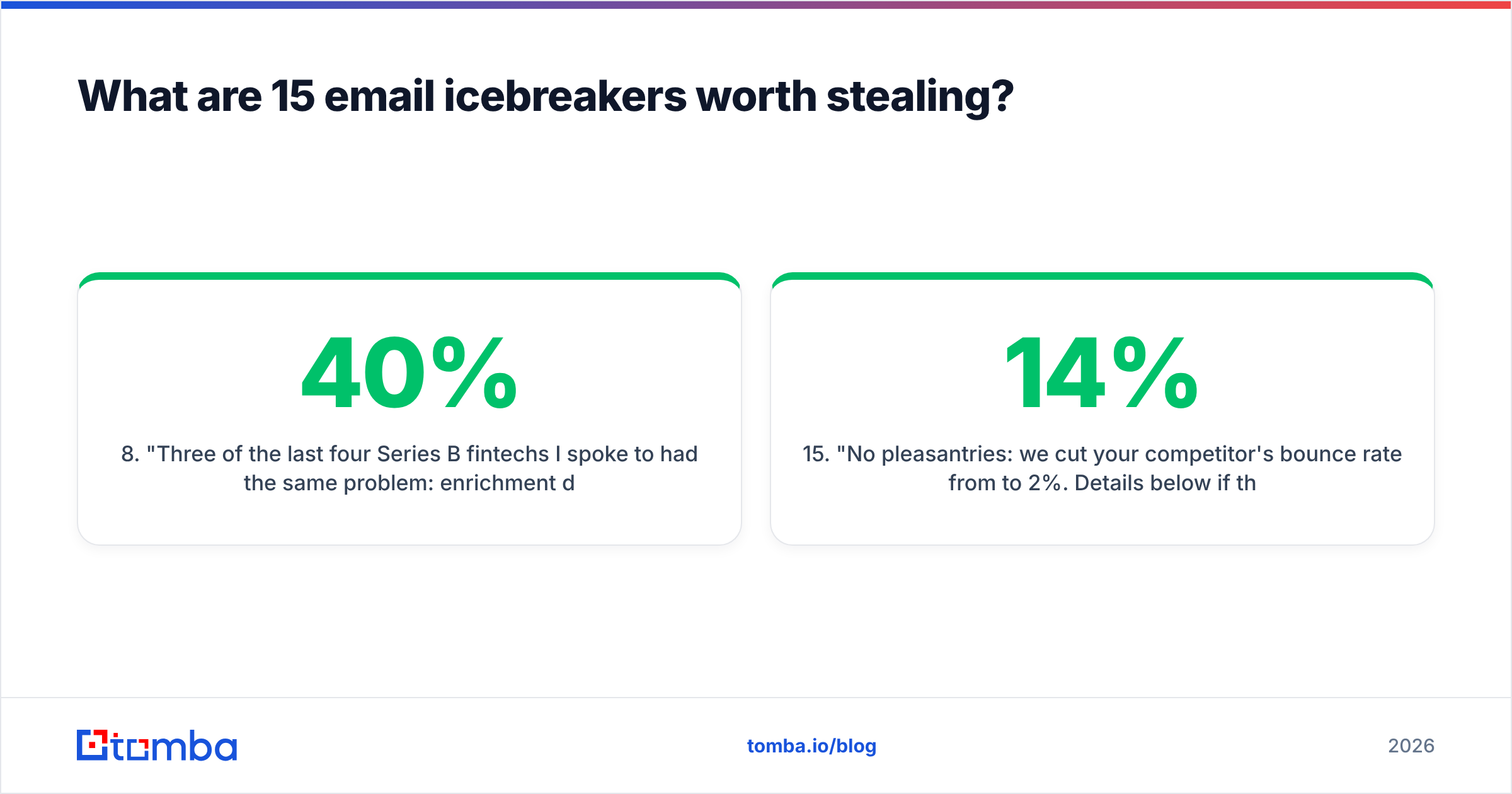
- "Three of the last four Series B fintechs I spoke to had the same problem: enrichment data that was 40% stale on arrival."
- "Most Heads of Demand Gen I talk to are being asked to cut CAC and raise pipeline in the same quarter. Assuming you're not exempt."
- "The teams running outbound at your scale usually hit a wall around 8,000 sends/month — not on volume, on list quality."
Content-based (reserve for high-value accounts)
- "Your talk at SaaStr made a point I've been stealing ever since: forecast accuracy is a data-hygiene problem wearing a management costume."
- "In your newsletter you wrote that most attribution models are 'confident fiction.' That's the reason I'm writing."
Direct, no-icebreaker openers (yes, these count)
- "Cold email, 30 seconds, then I'm out of your inbox."
- "I'll be direct — this is a pitch. Here's the one number that makes it worth reading."
- "No pleasantries: we cut your competitor's bounce rate from 14% to 2%. Details below if that's a live problem."
Numbers 13–15 deserve a note. The fastest-improving pattern in 2026 outbound is the anti-icebreaker — explicitly naming the email as cold and buying goodwill with honesty instead of a manufactured connection. It works because it is the one thing a mass-merge sequence never does. It also fails badly if the rest of the email is a wall of text, so pair it with brutal brevity.
Which 5 email icebreakers should you delete today?#
Cut these from every template in your library:
- "I hope this email finds you well." The single most reliable signal of a mass send. It has been in the top spam-pattern lists that vendors like HubSpot have flagged for years, and buyers now scan for it as a delete trigger.
- "Quick question —" followed by a five-paragraph email. The mismatch between promise and reality costs you more credibility than the opener buys.
- Weather, sports, or holiday openers. Zero relevance, zero information about your prospect, and instantly dated.
- "We're both connected to [name]" when you have never spoken to that person. This is the only icebreaker that can generate a complaint to a mutual contact.
- "Love what you're doing over at [company]!" Meaningless enthusiasm. If you cannot name the specific thing, do not gesture at the general thing.
One more that is technically fine but overused into uselessness: congratulating someone on a work anniversary pulled from LinkedIn. Every automation tool fires that one. Your prospect got nine of them that morning.
How do you research icebreakers without burning an hour per lead?#
The answer is not "personalize less." It is "personalize from data you already have in a structured field." Manual research is expensive because it is unstructured. Move it into columns and it becomes cheap.
A workable 90-second-per-lead workflow:
- Build the list at the company level first. Use a domain search to pull every relevant contact at a target account in one pass, rather than hunting people one at a time. You want role coverage before you want depth.
- Enrich into structured fields. Job title, tenure in role, headcount growth, tech stack, and recent role change should live in columns — not in a browser tab you are reading. Contact enrichment turns "research" into a merge field.
- Write one icebreaker per segment, not per person. Group by trigger type (new-in-role, recently funded, hiring for X, using competitor Y). Ten segments cover 500 leads. Then spend your real writing time on ten sentences instead of five hundred.
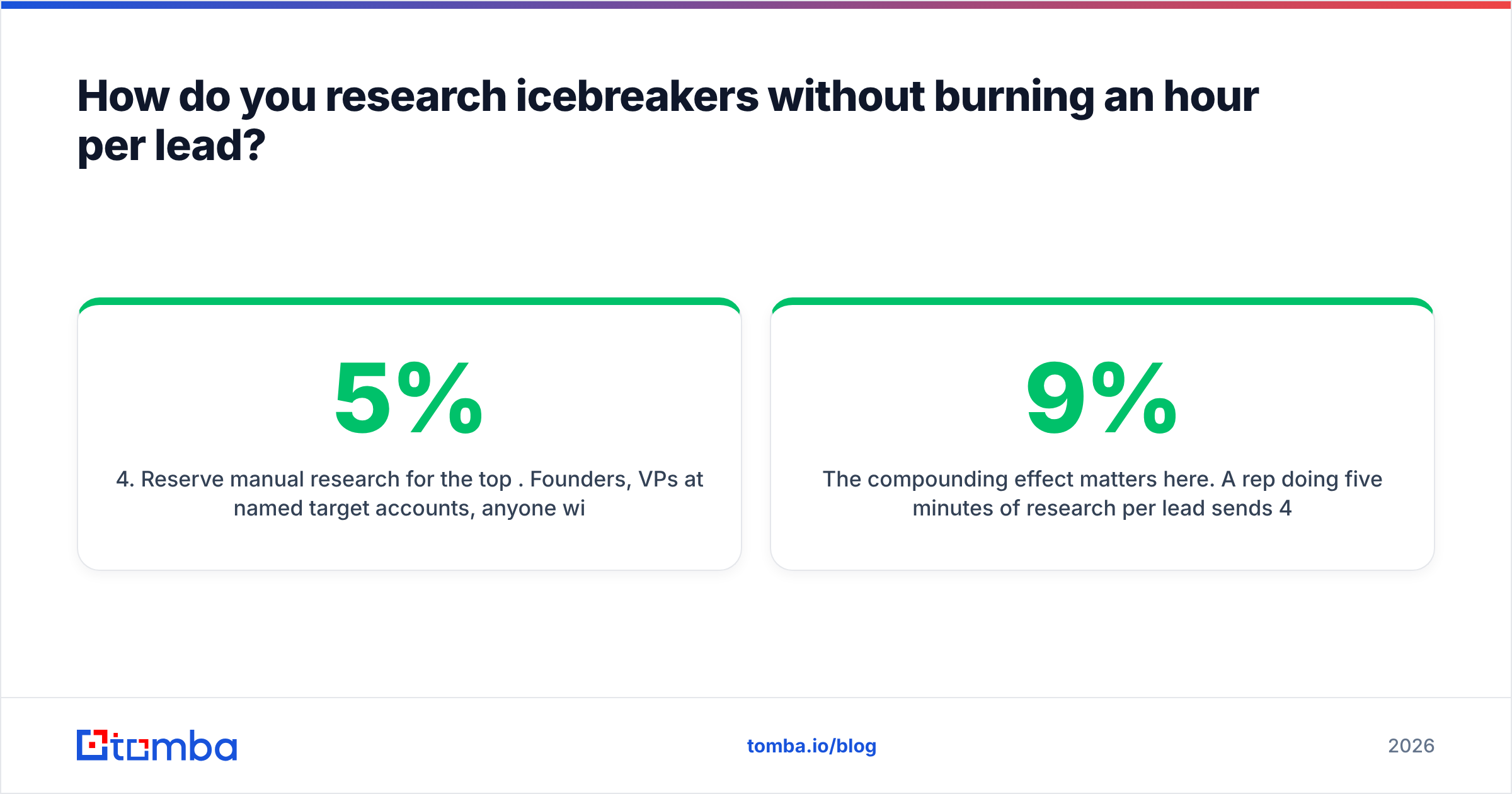
- Reserve manual research for the top 5%. Founders, VPs at named target accounts, anyone with a personal newsletter. That is where the content-based icebreaker earns its two minutes.
- Verify before you write. Sequencing a beautiful opener to an address that hard-bounces damages your sending domain and teaches you nothing. Verification is the cheapest step in the chain and the one most often skipped.
The compounding effect matters here. A rep doing five minutes of research per lead sends 40 emails a day at a 9% reply rate — about 3.6 replies. A rep doing 90 seconds per lead sends 150 at a 6% reply rate — 9 replies. The less-personalized rep wins by a factor of 2.5, and that gap widens as list size grows. Depth only wins when your total addressable market is small enough that every account genuinely matters.
Do icebreakers matter more than subject lines or deliverability?#
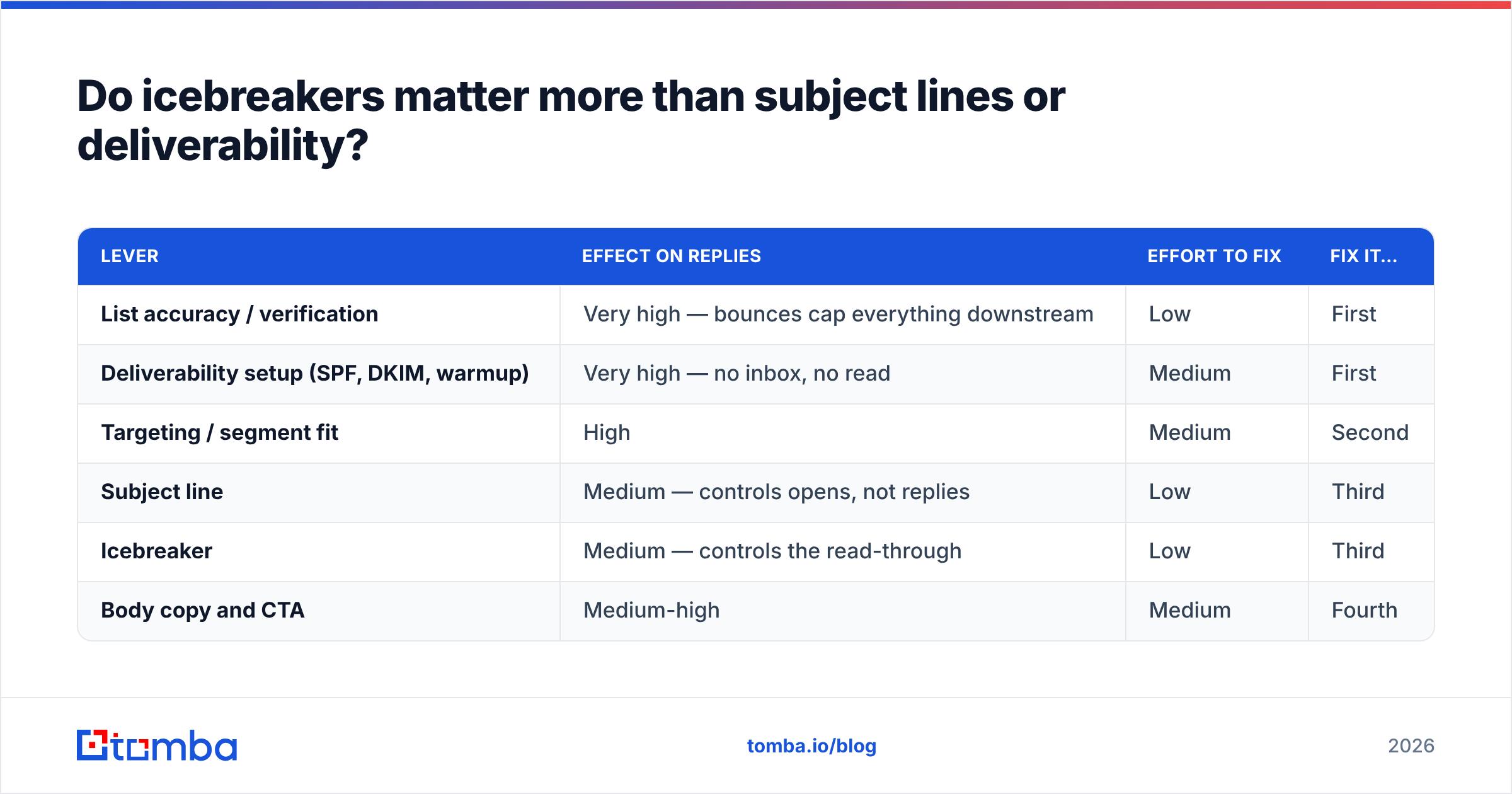
No — and the ordering is worth being honest about.
| Lever | Effect on replies | Effort to fix | Fix it… |
|---|---|---|---|
| List accuracy / verification | Very high — bounces cap everything downstream | Low | First |
| Deliverability setup (SPF, DKIM, warmup) | Very high — no inbox, no read | Medium | First |
| Targeting / segment fit | High | Medium | Second |
| Subject line | Medium — controls opens, not replies | Low | Third |
| Icebreaker | Medium — controls the read-through | Low | Third |
| Body copy and CTA | Medium-high | Medium | Fourth |
An icebreaker is a multiplier on an existing foundation, not a substitute for one. If your email deliverability is broken, a perfect opener changes nothing, because nobody sees it. If your targeting is wrong, a perfect opener makes an irrelevant email slightly more polite.
But once the foundation is sound, the icebreaker is one of the cheapest levers available. Rewriting ten opening lines takes an afternoon. Fixing a domain reputation takes six weeks. That asymmetry is why it is worth doing properly — and worth testing properly, one variable at a time, with enough volume per variant to mean something. Review sites like G2 are full of teams who swapped tools when the actual problem was a first line nobody read past.
How should you test email icebreakers?#
Three rules that keep tests honest:
- One variable per test. If you change the icebreaker and the CTA, you learned nothing.
- Minimum 300 sends per variant. Below that, you are reading noise as signal. Cold email reply rates are low enough that small samples swing wildly.
- Measure replies, not opens. Open tracking has been unreliable since privacy-protection features started pre-fetching images. Your response rate is the only metric that survives contact with reality.
Test in this order: segment fit → icebreaker → CTA → subject line. Subject lines go last because they affect opens, and opens are the metric you trust least. If you need a starting bank of variants to test against, a subject line generator gives you a spread to work from, but treat the output as raw material, not finished copy.
And log what you learn. The single biggest waste in outbound is the team that discovers a great icebreaker pattern in March and has forgotten it by June because it lived in one rep's head.
Where to start#
Pick your two highest-volume segments. Write one trigger-based icebreaker and one pain-based icebreaker for each. Delete every "hope this finds you well" from your template library. Run 300 sends per variant. That is a two-week project that will teach you more than another quarter of tweaking subject lines.
Before any of it, though, fix the input. Every icebreaker in this post assumes the email lands in a real inbox belonging to a real person in the role you think they hold. That is a data problem, not a copywriting problem. The Tomba Email Finder pulls verified professional addresses by domain, name, or company, so the openers you spend your afternoon writing actually get read — with a free tier of 25 searches a month to test the accuracy on your own list before you commit, and paid plans starting at $49/month. Check the current Tomba pricing if you are scaling past a few hundred prospects a month.
Good icebreakers are worth writing. They are worth nothing at all sent to an address that does not exist.
Related guides#
Ready to find emails that actually work?
Join 150,000+ professionals who stopped guessing and started sending. Free credits on signup — no credit card required.
Get the Tomba newsletter
Practical outbound tactics and product updates — once every two weeks.
About the author