Email Intro Sample: 9 Openers That Get Replies in 2026
Most intro emails die in the first two lines. Here are nine email intro samples that survive, scored line by line, plus the structure and the deliverability checks behind them.
TL;DR
- An email intro sample is only useful if you copy its structure, not its words — the reusable part is the sequence: relevance trigger, specific observation, low-friction ask.
- The first two lines decide everything. Most inboxes show roughly 60-90 characters of preview text, so your opener competes before the email is even opened.
- Nine samples below cover cold outbound, warm referral, LinkedIn follow-up, recruiter outreach, partnership, investor, re-engagement, event follow-up, and self-introduction after a job change.
- Openers that name a specific, checkable fact about the recipient outperform flattery openers ("love what you're building") by a wide margin in every published benchmark we've seen.
- None of it matters if the address bounces. Verify before you send — a 12% bounce rate will torpedo a perfect intro.
What is an email intro sample, and why do most of them fail?#
An email intro sample is a short template for the first 2-4 sentences of an email to someone who does not know you. It is not the whole email. It is the part that decides whether the rest of the email gets read.
Most samples floating around fail for one reason: they were written to be copied verbatim, which means they were written to be generic. "I hope this email finds you well. My name is X and I work at Y, a leading provider of Z." That opener has been sent several billion times. Your prospect's brain filters it the way it filters an airline safety card.
The samples in this post are built differently. Each one has a swappable slot — a place where you insert something only you could know about this specific person. That slot is the entire value of the email. Everything around it is scaffolding.
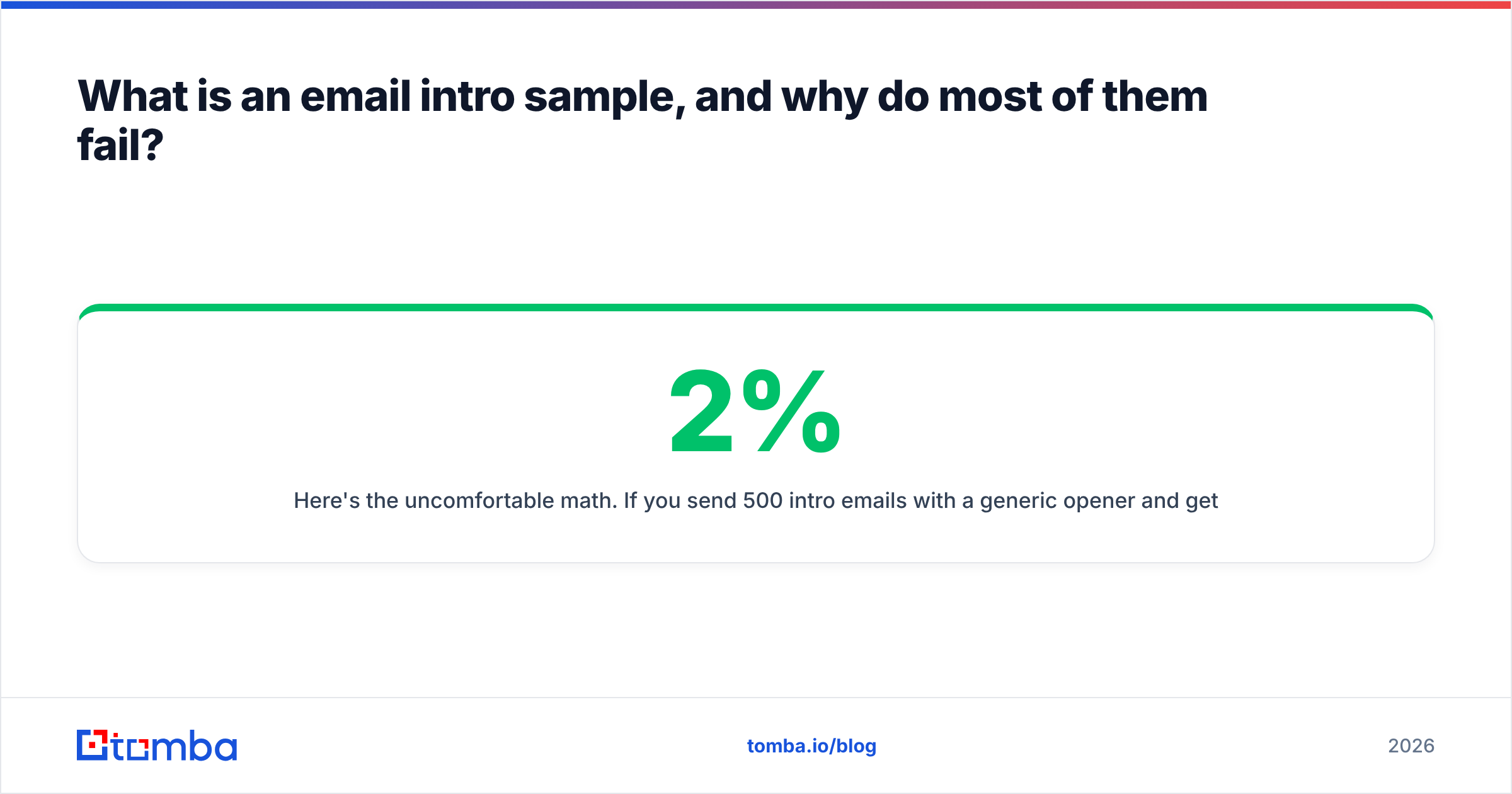
Here's the uncomfortable math. If you send 500 intro emails with a generic opener and get a 2% reply rate, you got 10 replies. If a specific opener moves you to 7%, you got 35 replies from the same list. Same volume, same product, same offer — 3.5x the pipeline, purely from the first two lines.
What are the five parts of an intro email that actually works?#
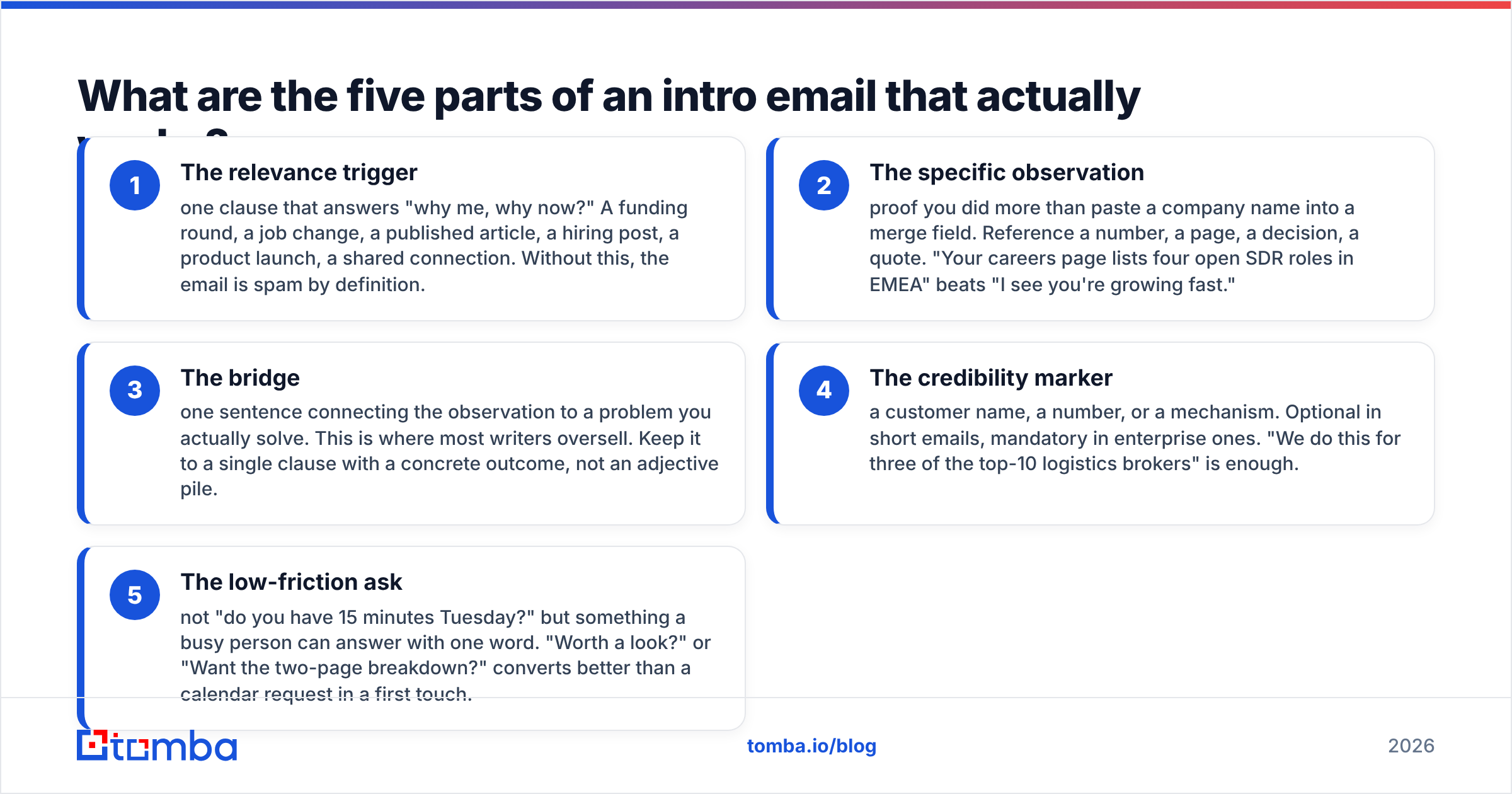
Every intro sample below is assembled from the same five components. Learn these and you can write your own instead of hunting for templates.
- The relevance trigger — one clause that answers "why me, why now?" A funding round, a job change, a published article, a hiring post, a product launch, a shared connection. Without this, the email is spam by definition.
- The specific observation — proof you did more than paste a company name into a merge field. Reference a number, a page, a decision, a quote. "Your careers page lists four open SDR roles in EMEA" beats "I see you're growing fast."
- The bridge — one sentence connecting the observation to a problem you actually solve. This is where most writers oversell. Keep it to a single clause with a concrete outcome, not an adjective pile.
- The credibility marker — a customer name, a number, or a mechanism. Optional in short emails, mandatory in enterprise ones. "We do this for three of the top-10 logistics brokers" is enough.
- The low-friction ask — not "do you have 15 minutes Tuesday?" but something a busy person can answer with one word. "Worth a look?" or "Want the two-page breakdown?" converts better than a calendar request in a first touch.
Cut any of these and the email still works. Cut the relevance trigger and it doesn't.
What does a good email intro sample look like?#
Nine samples. Swappable slots are in brackets. Keep the brackets in your own doc so you never send one unfilled — the classic Hi {FirstName} disaster is still happening in 2026.
1. Cold outbound (trigger: hiring signal)
Saw you posted three new AE roles in [Chicago] this month. Usually when a team ramps that fast, list-building becomes the bottleneck before quota does. We cut sourcing time for [similar company] from about six hours a week per rep to under one. Worth a look?
Why it works: the trigger is public, checkable, and time-bound. The bridge names a bottleneck the reader has probably already complained about internally.
2. Cold outbound (trigger: funding)
Congrats on the [Series B]. The part that usually breaks post-raise isn't headcount, it's data hygiene — new reps inherit a CRM nobody cleaned. We handle that for [customer]. Happy to send the 90-second version if useful.
Why it works: it skips the congratulation-only email everyone else sends after a raise and immediately pivots to a specific post-raise failure mode.
3. Warm referral
[Mutual contact] mentioned you're rebuilding the outbound motion at [company] and said we should talk. She and I worked together on [specific project] last year. Two things she thought would be relevant — want me to just put them in an email?
Why it works: the referrer's name is in the first four words, and the ask is "should I keep typing," which costs the reader nothing.
4. LinkedIn-to-email follow-up
We connected on LinkedIn after your post about [attribution modeling]. You made a point about [multi-touch being theater] that I've been arguing internally for a year. Here's the data we pulled that supports it — [one-line finding]. No ask, just thought you'd want it.
Why it works: it earns the second email by giving something away in the first. Pair this with a proper LinkedIn outreach cadence and it becomes a repeatable play, not a one-off.
5. Recruiter to candidate
Your [open-source contributions to the Rust async runtime] are the reason I'm writing — we have a systems role where that's the day job, not a side quest. [Team of 9, remote-first, $180-220k]. Interested in the details, or should I leave you alone?
Why it works: it names a specific artifact, states compensation up front, and gives an explicit opt-out. Candidates reply to honesty at a rate that surprises most recruiters.
6. Partnership / BD
We both sell into [mid-market logistics] and we don't overlap — you own [routing], we own [contact data]. Three of our customers already use both. Worth a 20-minute call about a co-marketing test, or is now a bad quarter for it?
Why it works: it establishes non-competition immediately, which is the first objection any BD lead has.
7. Investor intro
[Company] does [one clause]. [Metric] grew from [X to Y] in [timeframe] with [team size]. You led [portfolio company]'s seed, which is the closest comp I've found to what we're doing. Deck attached if the numbers are interesting.
Why it works: three sentences, all facts, one of them about them. Investors read the metric line and decide; everything else is optional.
8. Re-engagement (gone quiet)
Last time we spoke in [March] you said [budget was frozen until the new fiscal year]. That's now — figured I'd check before I close the file. Still relevant, or should I stop?
Why it works: it quotes the reader's own words back to them and gives permission to say no. "Should I close the file?" is the single highest-reply-rate closing line in re-engagement testing.
9. Post-event follow-up
We talked at [SaaStr] near the [coffee line] about [how your team handles catch-all domains]. You said you'd lost about [30%] of a list to bounces. That's the exact problem we fixed for [customer] — two paragraphs on how, if you want them.
Why it works: physical detail ("near the coffee line") triggers actual recall in a way "great meeting you at the conference" never does.
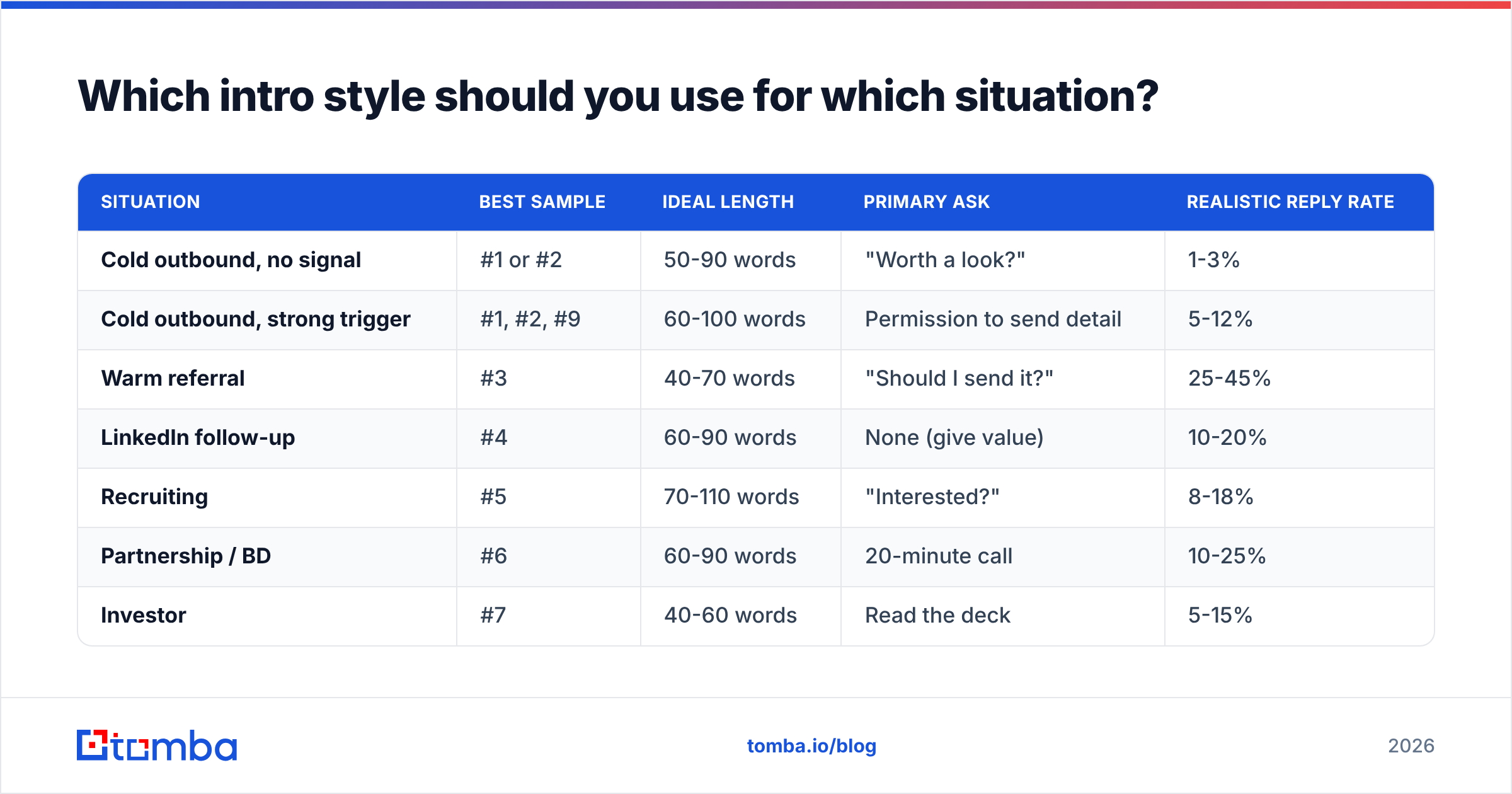
Which intro style should you use for which situation?#
Not every sample fits every context. Pick by relationship temperature and what you're asking for.
| Situation | Best sample | Ideal length | Primary ask | Realistic reply rate |
|---|---|---|---|---|
| Cold outbound, no signal | #1 or #2 | 50-90 words | "Worth a look?" | 1-3% |
| Cold outbound, strong trigger | #1, #2, #9 | 60-100 words | Permission to send detail | 5-12% |
| Warm referral | #3 | 40-70 words | "Should I send it?" | 25-45% |
| LinkedIn follow-up | #4 | 60-90 words | None (give value) | 10-20% |
| Recruiting | #5 | 70-110 words | "Interested?" | 8-18% |
| Partnership / BD | #6 | 60-90 words | 20-minute call | 10-25% |
| Investor | #7 | 40-60 words | Read the deck | 5-15% |
| Re-engagement | #8 | 25-45 words | "Still relevant?" | 15-30% |
Two things jump out. First, the warmer the relationship, the shorter the email — warm intros don't need scaffolding. Second, cold outbound with a real trigger performs 3-5x cold outbound without one, which is why the sourcing step matters more than the copywriting step.
Reply-rate ranges here are directional, drawn from vendor benchmark reports and our own customer data. Your industry, seniority target, and list quality will move them substantially. Track your own numbers rather than trusting anyone's averages — including ours. If you need a refresher on how the metric is defined, the response rate entry covers the math.
What kills an intro email before anyone reads it?#
Five failure modes, ranked by how much damage they do.
- Bounces. A 10%+ bounce rate on a cold campaign gets your domain flagged fast. This is a data problem, not a copy problem, and no template fixes it. Run addresses through an email verifier before the first send.
- Subject lines that oversell. "Quick question" is burned. So is "Following up." Your subject should read like an internal email from a colleague. If you're stuck, a subject line generator gives you variants to A/B rather than one guess.
- The "I" opener. Count how many sentences start with "I" or "We." If it's more than one in the first paragraph, rewrite. The reader's name and their situation should appear before yours.
- Multiple asks. "Can we hop on a call, or check out our case study, or reply with a good time?" Three doors means zero decisions. One ask.
- Formatting that screams template. Merge-field artifacts, HTML signatures with three logos, tracking pixels on a first touch. Plain text, one link maximum, signature with a name and a role.
How do you personalize at scale without sounding like a robot?#
The trick is tiering, not automation. Split your list into three buckets before you write anything.
Tier 1 (top 50 accounts). Fully manual research. Read their blog, their earnings call, their job posts. One email each, 20 minutes each. These are the samples with two swappable slots.
Tier 2 (next 500). One researched variable per contact — a hiring signal, a tech-stack detail, a recent announcement — pulled programmatically and inserted into a fixed frame. This is where sample #1 and #2 live.
Tier 3 (the long tail). Segment-level personalization only. Everyone in "Series A fintech, 20-50 employees" gets the same email. Accept the lower reply rate; the volume carries it.
The failure most teams make is applying Tier 3 effort with Tier 1 expectations. HubSpot's sales team has written extensively about the same tradeoff, and Salesforce's own State of Sales research keeps finding that reps spend under a third of their time actually selling — which is exactly why the sourcing step gets rushed and the list quality collapses.
If you want a starting library rather than a blank page, the cold email templates collection covers the full sequence, not just the opener.
Does the intro matter if the address is wrong?#
No. And this is the part most template posts skip entirely.
An intro email has three points of failure, and copy is the last one:
- Does the address exist? A guessed pattern like
first.last@company.comis right maybe 60-70% of the time depending on the industry. The rest bounce. - Does it reach the inbox? Sender reputation, SPF/DKIM/DMARC alignment, and domain age all gate this before your subject line gets a vote.
- Does it earn a reply? Only now does the copy matter.
Teams obsess over step 3 and ignore steps 1 and 2. If you're sending to a list you scraped six months ago, roughly 20-25% of those addresses have rotted — job-change churn alone guarantees it. That's a quarter of your campaign hitting invalid mailboxes, dragging your sending domain down with it.
Catch-all domains are the nastier version of this. They accept everything at the SMTP layer and silently discard mail to non-existent users, which means your bounce rate looks fine while a chunk of your sends go nowhere. A dedicated catch-all verifier is the only way to separate real mailboxes from the void on those domains.
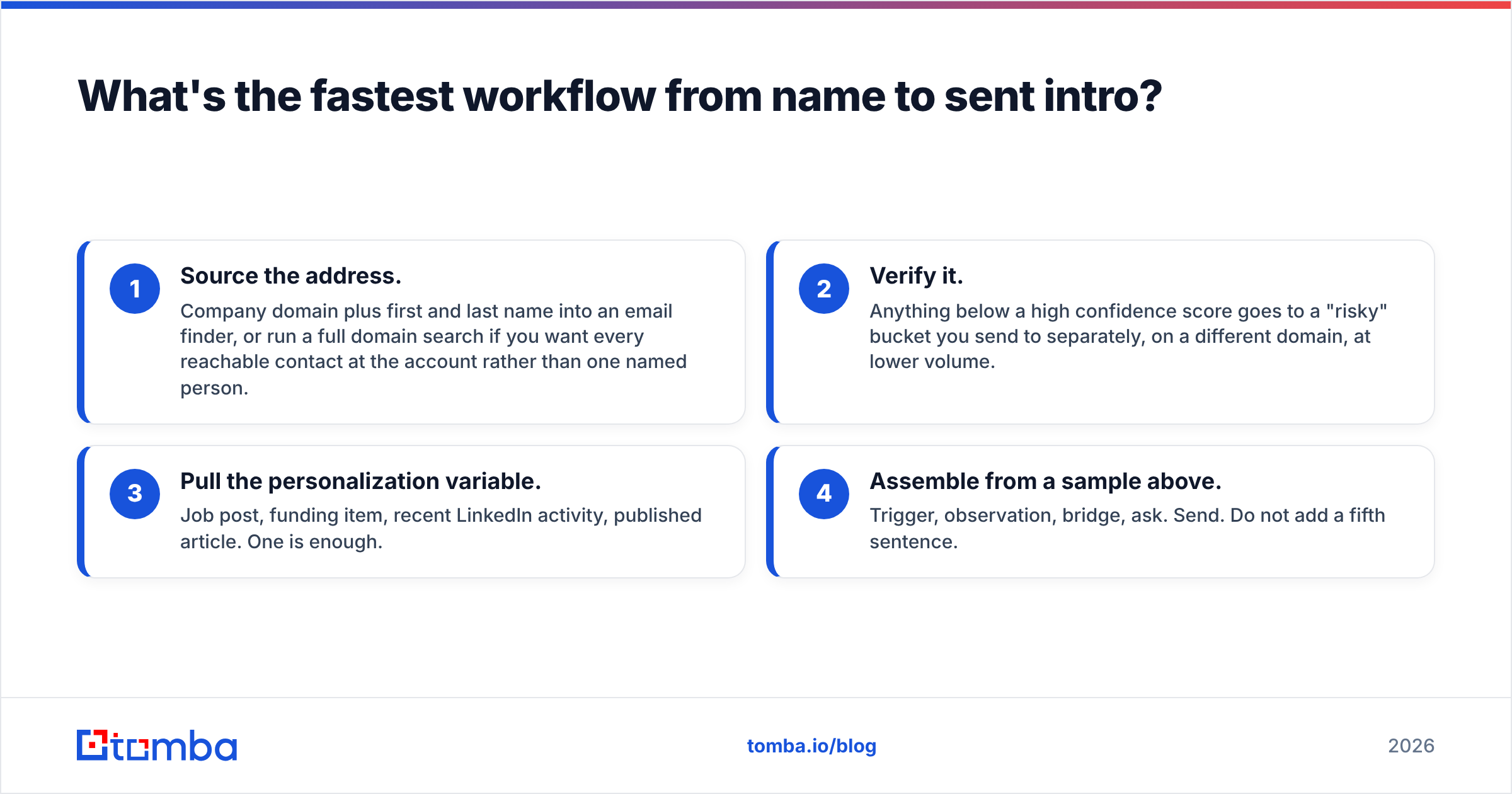
What's the fastest workflow from name to sent intro?#
Four steps, roughly 90 seconds per contact once it's set up.
- Source the address. Company domain plus first and last name into an email finder, or run a full domain search if you want every reachable contact at the account rather than one named person.
- Verify it. Anything below a high confidence score goes to a "risky" bucket you send to separately, on a different domain, at lower volume.
- Pull the personalization variable. Job post, funding item, recent LinkedIn activity, published article. One is enough.
- Assemble from a sample above. Trigger, observation, bridge, ask. Send. Do not add a fifth sentence.
For anything past 100 contacts, batch steps 1 and 2 rather than doing them one at a time — bulk processing turns an afternoon into a coffee break, and it forces you to look at list quality as a number instead of a vibe.
Where should you start?#
Pick one sample from the nine above that matches your most common situation. Write ten versions of it against ten real prospects. Send them. Count replies. Then change exactly one variable — the trigger, the ask, or the length — and send ten more.
That loop beats reading another 3,000-word template post, including this one.
The one thing worth fixing before you start the loop: your addresses. A great intro sent to a dead mailbox is indistinguishable from a bad intro, and you'll draw the wrong conclusion from the data. Run your list through the Tomba Email Finder to source verified professional addresses by name and domain, then check Tomba pricing — the free tier gives you 25 searches a month, enough to test the whole workflow before you commit to a plan. Fix the data first. The copy gets a lot easier after that.
Related guides#
Ready to find emails that actually work?
Join 150,000+ professionals who stopped guessing and started sending. Free credits on signup — no credit card required.
Get the Tomba newsletter
Practical outbound tactics and product updates — once every two weeks.
About the author