How to Write an Email Introduction Response That Gets a Meeting
Someone just vouched for you in writing. The reply you send in the next hour decides whether that goodwill becomes a meeting or dies in a thread nobody answers. Here is the exact structure, timing, and templates.
TL;DR
- An email introduction response is the reply you send after a mutual contact connects you to someone. It is the highest-converting message you will ever write, and most people waste it on "Great to e-meet you!"
- Reply within 24 hours, move the introducer to BCC in your first line, and thank them once — not three times.
- The body of the reply needs exactly three things: proof you did homework, one specific reason to talk, and two concrete time slots.
- Never attach a deck, never send a calendar link with no context, and never CC the introducer into the scheduling back-and-forth.
- If the warm intro never lands, the fallback is a well-researched direct email — not another follow-up to the person who introduced you.
What is an email introduction response?#
An email introduction response is your reply to a message where a third party connects two people who have not met. Think of it like being handed the microphone at someone else's wedding. The room is already listening because the host said you were worth listening to. Your only job is to not waste the goodwill.
There are two roles in any intro thread, and they need different replies:
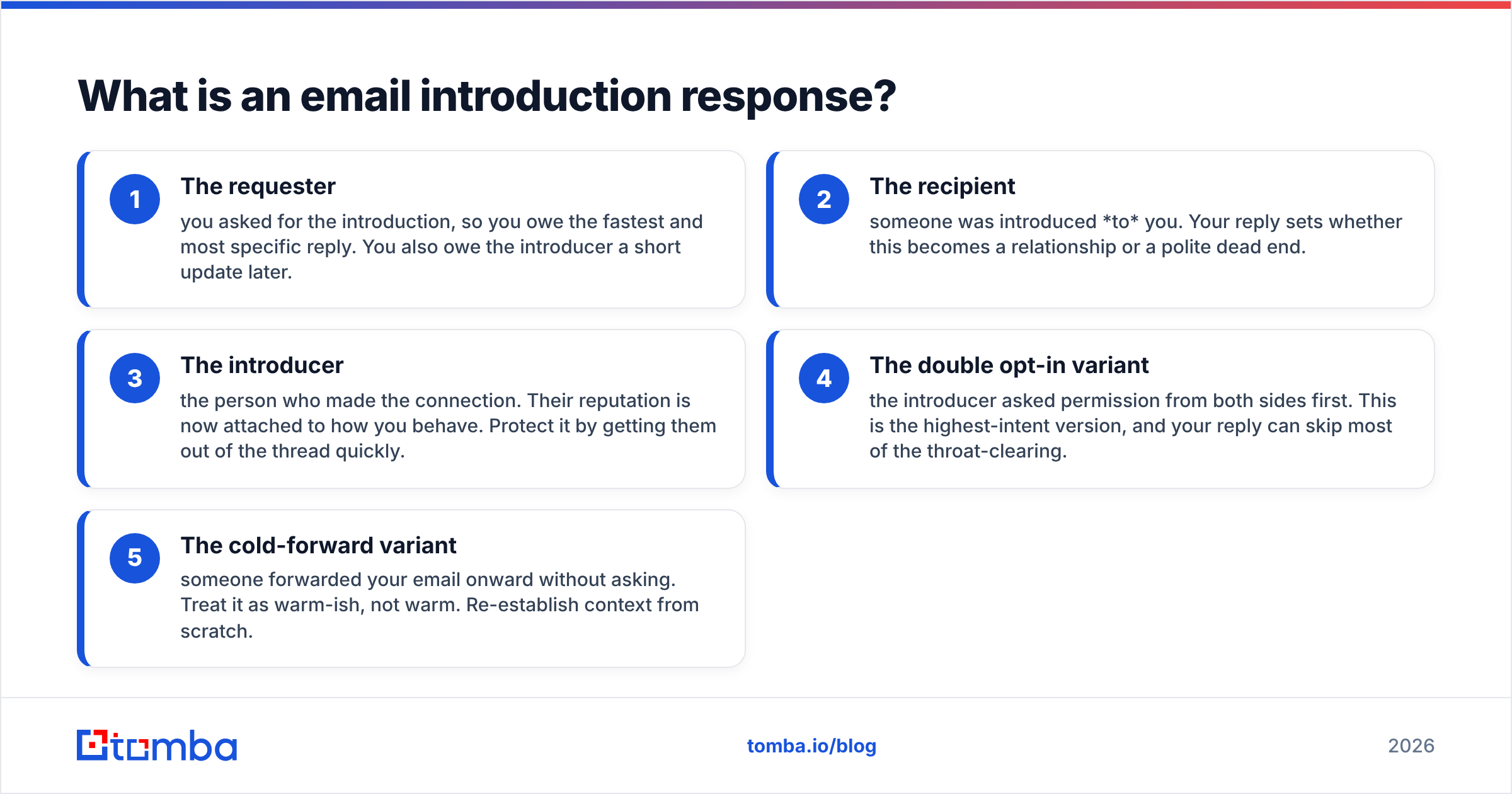
- The requester — you asked for the introduction, so you owe the fastest and most specific reply. You also owe the introducer a short update later.
- The recipient — someone was introduced to you. Your reply sets whether this becomes a relationship or a polite dead end.
- The introducer — the person who made the connection. Their reputation is now attached to how you behave. Protect it by getting them out of the thread quickly.
- The double opt-in variant — the introducer asked permission from both sides first. This is the highest-intent version, and your reply can skip most of the throat-clearing.
- The cold-forward variant — someone forwarded your email onward without asking. Treat it as warm-ish, not warm. Re-establish context from scratch.
Knowing which role you are in changes the entire message. A requester who writes like a recipient sounds entitled. A recipient who writes like a requester sounds desperate.
Why does the first reply decide the deal?#
Because the intro already did the hard part. Trust transfer is the single most efficient thing in B2B: the recipient is not evaluating you from zero, they are borrowing someone else's opinion of you. Research summarized across sales organizations consistently shows referred and introduced opportunities close at multiples of cold-sourced ones — HubSpot's sales resources have covered this pattern for years, and every rep who has worked both motions has felt it.
That borrowed trust has a half-life. It is highest in the first few hours after the intro email lands and drops fast. A reply on day four does not just arrive late — it signals that this connection was not a priority, which is exactly the opposite of the message the introducer sent on your behalf.
Here is the part most people miss: the recipient is also silently grading you on thread hygiene. Do you make the introducer read six more emails about scheduling? Do you reply-all with a 400-word pitch? Those are the moments where a warm intro quietly becomes a "let's circle back in Q3."

What should an email introduction response include?#
Five components, in this order. Anything else is padding.
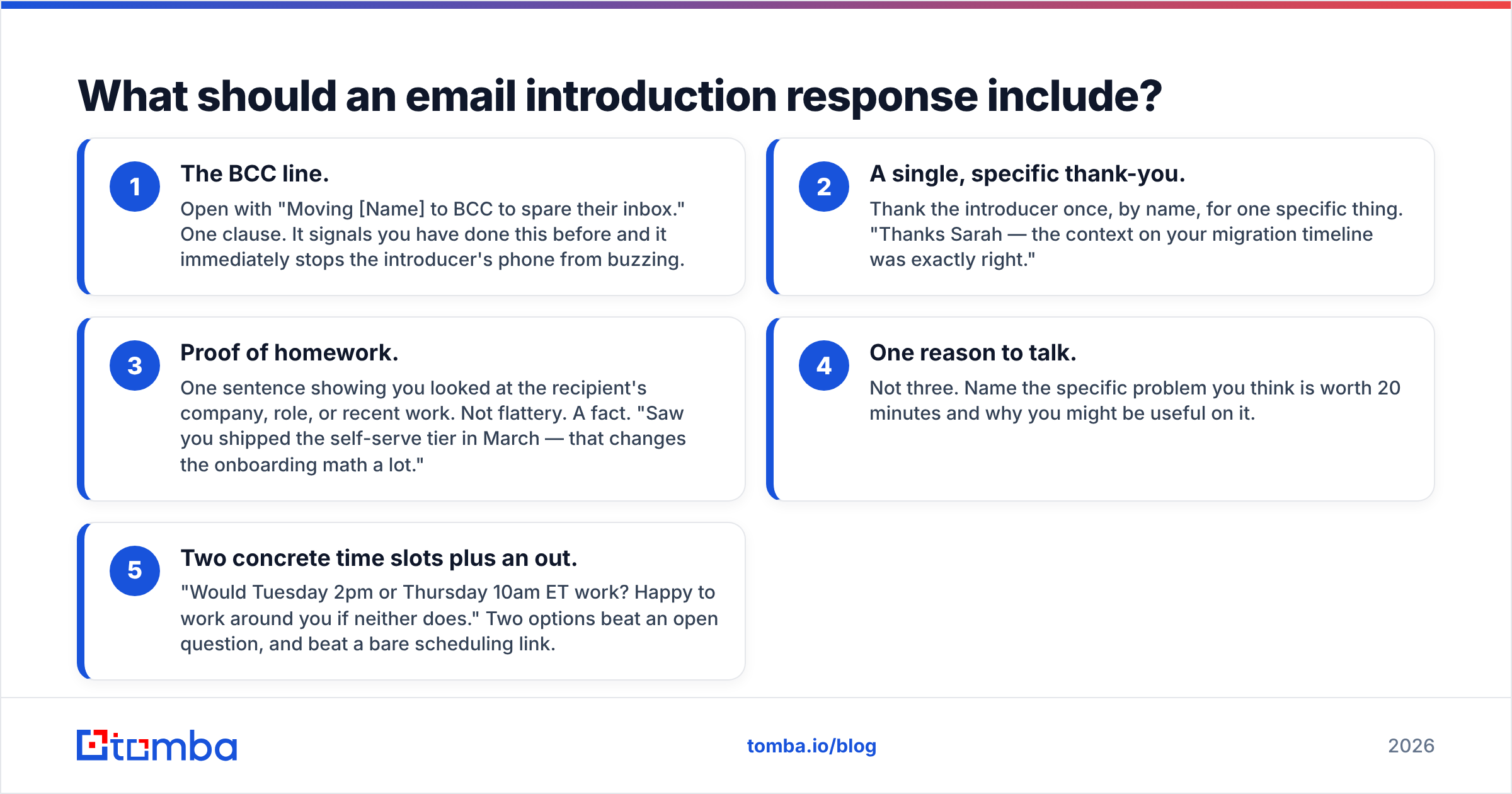
- The BCC line. Open with "Moving [Name] to BCC to spare their inbox." One clause. It signals you have done this before and it immediately stops the introducer's phone from buzzing.
- A single, specific thank-you. Thank the introducer once, by name, for one specific thing. "Thanks Sarah — the context on your migration timeline was exactly right."
- Proof of homework. One sentence showing you looked at the recipient's company, role, or recent work. Not flattery. A fact. "Saw you shipped the self-serve tier in March — that changes the onboarding math a lot."
- One reason to talk. Not three. Name the specific problem you think is worth 20 minutes and why you might be useful on it.
- Two concrete time slots plus an out. "Would Tuesday 2pm or Thursday 10am ET work? Happy to work around you if neither does." Two options beat an open question, and beat a bare scheduling link.
That is a five-to-seven sentence email. If yours is longer, you are pitching, not replying.
Is a short reply better than a detailed one?#
Yes, with one exception. Compare the common formats:
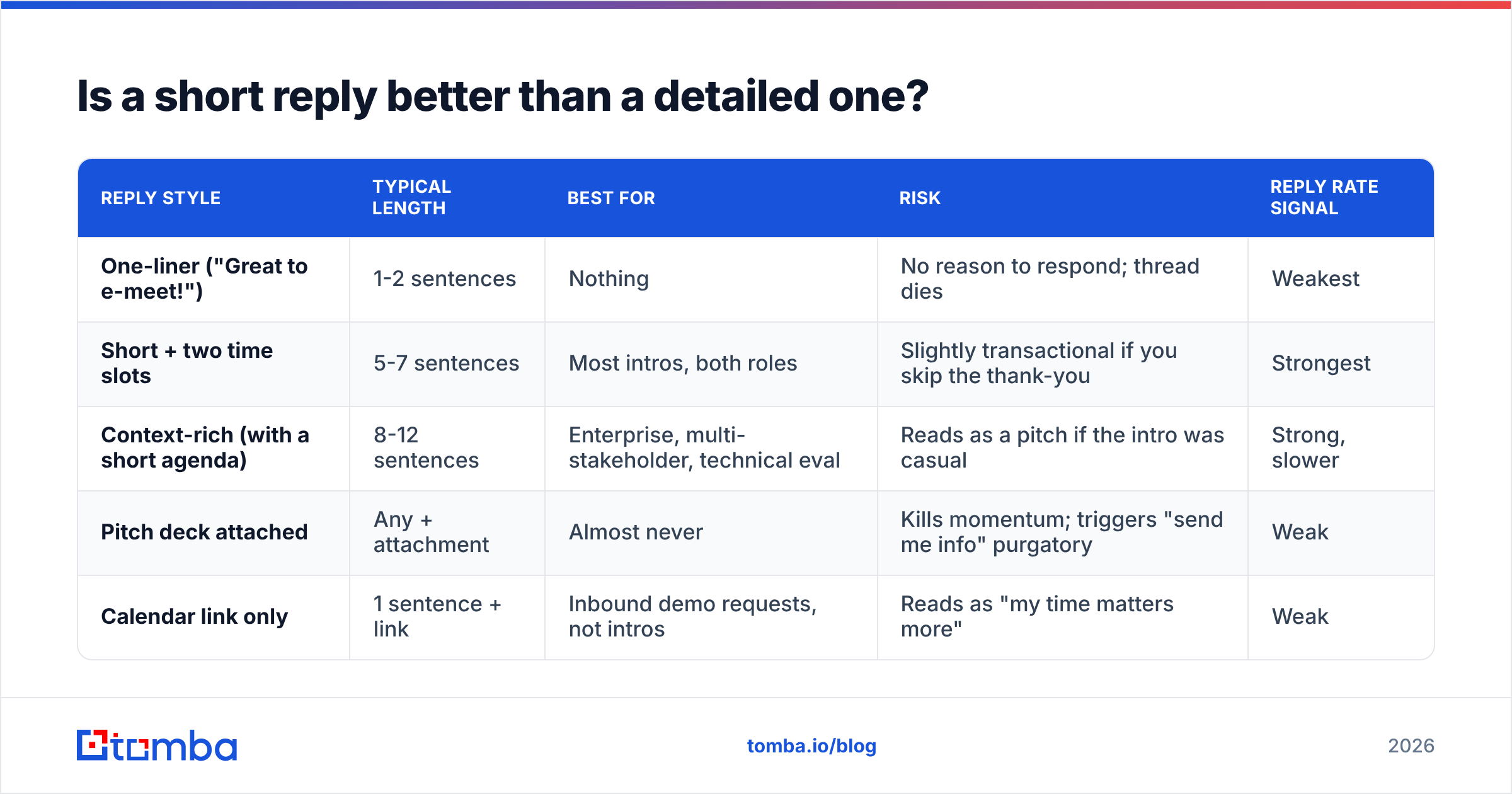
| Reply style | Typical length | Best for | Risk | Reply rate signal |
|---|---|---|---|---|
| One-liner ("Great to e-meet!") | 1-2 sentences | Nothing | No reason to respond; thread dies | Weakest |
| Short + two time slots | 5-7 sentences | Most intros, both roles | Slightly transactional if you skip the thank-you | Strongest |
| Context-rich (with a short agenda) | 8-12 sentences | Enterprise, multi-stakeholder, technical eval | Reads as a pitch if the intro was casual | Strong, slower |
| Pitch deck attached | Any + attachment | Almost never | Kills momentum; triggers "send me info" purgatory | Weak |
| Calendar link only | 1 sentence + link | Inbound demo requests, not intros | Reads as "my time matters more" | Weak |
The exception is a technical or committee-driven intro. If the recipient is a VP of Engineering being introduced by their CTO, a short agenda of three bullets ("what we'd cover") raises reply quality because it lets them decide who else to bring.
Should you move the introducer to BCC or keep them CC'd?#
Move them to BCC on your first reply. This is table stakes etiquette, and it is the fastest signal that you know how professional threads work. BCC exists precisely for this: the introducer sees you replied and did it promptly, then falls out of the thread automatically.
Two things people get wrong:
- Dropping them silently. Removing the introducer with no note reads as ungrateful. Always say you are doing it and why.
- Keeping them CC'd through scheduling. Four emails about Tuesday vs Thursday landing in the inbox of someone who did you a favor is how you stop getting favors.
The one time to keep the introducer in the thread: when they explicitly said they want to join the call, or when they are an internal champion who is being deliberately kept accountable to the process.
What do good email introduction response templates look like?#
Three you can adapt. Keep the structure; replace every specific.
Template 1 — You requested the intro (you are selling or asking)
Subject: Re: Intro — [Your Name] <> [Their Name]
Sarah — moving you to BCC, thank you for making this happen.
[Name], good to meet you. Sarah mentioned your team took ownership of outbound data quality this year. We ran into the same thing at [Company] — the fix was less about tooling and more about how we handled catch-all domains, which cost us about 18% of a list before we caught it.
Worth 20 minutes to compare notes? Tuesday 2pm or Thursday 10am ET both work on my end, and I can flex if neither does.
[Your Name]
Template 2 — You were introduced to someone (you are receiving)
Marc — BCC'ing you, appreciate the intro.
[Name], nice to meet you. I looked at what you published on pipeline forecasting last month — the section on stage-weighted vs. time-decay models matched what we're arguing about internally right now.
I'm not sure yet whether there's a fit, but I'd rather find out in 20 minutes than over email. Does Wednesday afternoon or Friday morning work? If this isn't the right moment, just say so and I'll follow up in a quarter.
[Your Name]
Template 3 — Double opt-in, both sides already agreed
Thanks Priya — moving you to BCC.
[Name], since Priya already gave us both the context, I'll skip the setup. The specific thing I'd like your read on: how you handled data governance when you moved from three tools to one.
Thursday 11am or Friday 3pm ET? I'll send an invite whichever you pick.
[Your Name]
If you want a wider library to adapt for the follow-up messages after the intro call, our cold email templates collection covers the sequences that follow, and the subject line generator helps when the thread branches into a new subject.
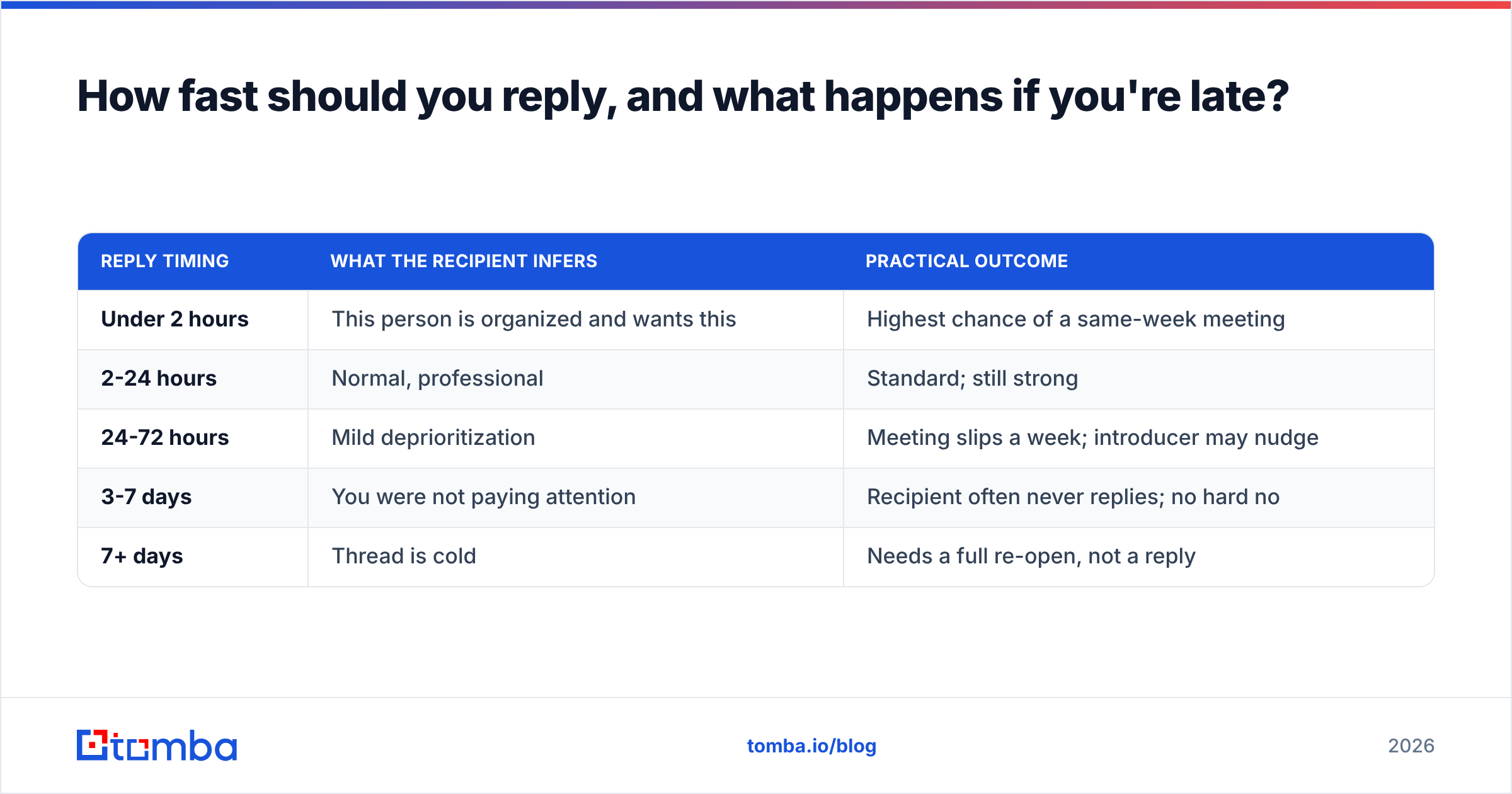
How fast should you reply, and what happens if you're late?#
Speed is the cheapest lever you have. Nothing else in this post costs zero effort.
| Reply timing | What the recipient infers | Practical outcome |
|---|---|---|
| Under 2 hours | This person is organized and wants this | Highest chance of a same-week meeting |
| 2-24 hours | Normal, professional | Standard; still strong |
| 24-72 hours | Mild deprioritization | Meeting slips a week; introducer may nudge |
| 3-7 days | You were not paying attention | Recipient often never replies; no hard no |
| 7+ days | Thread is cold | Needs a full re-open, not a reply |
If you are past a week, do not send "Sorry for the delay!" as your opening line — it makes lateness the headline. Open with the substance, acknowledge the gap in one short clause near the end, and give a reason to still take the call.
What mistakes kill an email introduction response?#
The failure modes are boringly consistent:
- Thanking three times. Once is gracious. Three times reads as anxious.
- Reply-all with a pitch. The introducer now watches you sell in their inbox. This is the fastest way to never get introduced again.
- Asking an open scheduling question. "When works for you?" outsources the work. Two slots plus a flexible out converts better.
- Attaching anything on the first reply. Attachments create a decision ("do I open this?") before the relationship exists.
- Copying a LinkedIn opener. The intro already established credibility. Re-pitching yourself undoes it.
- Ignoring the introducer afterward. Send them a two-line update within a week: what happened, and thank you. This is how you get the next five intros. It is the same relationship logic behind good social selling — the follow-through is the product.
- Letting the thread die on a "sounds good." If nobody proposed a time, nothing happened. Someone has to send the invite. Make it you.

What if the warm introduction never arrives?#
At some point you run out of people who can introduce you. Warm intros do not scale past your second-degree network, and pretending otherwise is how pipeline dries up in Q3.
The honest answer is that you rebuild the "warm" part manually: research, relevance, and accurate contact data. A direct email that names a real detail about the recipient's business outperforms a generic intro-style email, even without a mutual connection. What it cannot survive is a bad address — a bounce on the first send damages sender reputation and takes weeks to unwind.
That is the practical role of an email finder in this workflow: not to replace introductions, but to make the fallback path viable. You identify the right person, confirm the address resolves, and write the same five-sentence structure you would have written in an intro reply — minus the BCC line, plus one extra sentence establishing why you are in their inbox at all. Tomba's plans run from a free tier at 25 searches per month up to $49/mo Starter and $99/mo Growth, so the fallback path is cheap to test before you commit; full Tomba pricing is public.
For a broader read on how buyers evaluate this category and where the tools genuinely differ, vendor-neutral review sites like G2 are more useful than any single vendor's comparison page — including ours.
How do you follow up after the intro reply?#
Three beats, then stop:
- Day 0 — your reply with two time slots.
- Day 3 — if no response, one short bump on the same thread. Two sentences. Re-offer times. Do not add the introducer back in.
- Day 8 — a graceful close. "Sounds like the timing isn't right — I'll stop here. If it changes, my door is open." This message gets replies surprisingly often, because it removes pressure.
After beat three, go quiet for a quarter. Also send the introducer a two-line update regardless of outcome. Reporting back is the single highest-leverage habit in referral selling, and almost nobody does it. Tracking what actually converts here — measured properly, not by gut feel — is what separates teams with a real response rate benchmark from teams guessing.
What does a good intro-reply system look like at team scale?#
If more than two people at your company handle intros, standardize three things and leave the rest to the individual: the BCC-and-thank opening, the two-slot close, and the day-3 / day-8 follow-up rhythm. Everything in the middle — the homework sentence and the reason to talk — must be written fresh. That is the part that cannot be templated without sounding templated.
Store the skeletons somewhere your team actually opens, log intro-sourced opportunities separately in your CRM so you can prove the channel's value, and make "update the introducer" a required field on the opportunity. The teams that treat referrals as a tracked channel rather than happy accidents are the ones who still have pipeline when outbound gets harder.
Ready to make the fallback path work as well as the warm one? When the introduction does not materialize, the next best thing is reaching the right person directly with an address you know is valid. Start with the Tomba Email Finder — find the decision-maker by name or domain, verify before you send, and apply the same five-sentence structure that makes intro replies convert. The free tier gives you 25 searches a month to test it against your own list before you pay anything.
Related guides#
Ready to find emails that actually work?
Join 150,000+ professionals who stopped guessing and started sending. Free credits on signup — no credit card required.
Get the Tomba newsletter
Practical outbound tactics and product updates — once every two weeks.
About the author