How to Write an Email Introduction to an Unknown Person
Writing to someone who has never heard of you is a structural problem, not a wording problem. Here is the five-part anatomy, three tested templates, and the delivery checks that decide whether a stranger ever sees your intro.
TL;DR
- An email introduction to an unknown person fails for structural reasons, not stylistic ones: no proof you know who they are, no reason the message arrived today, and no ask small enough to answer in one line.
- The five-part anatomy that works: verified address → specific trigger → one-sentence identity → single relevant claim → micro-ask. Everything else is decoration.
- Warm-path intros (mutual connection, referral, trigger event) outperform pure cold intros by 3-6x on reply rate. Exhaust those before you write cold.
- Delivery is half the battle. A 20%+ bounce rate on a stranger list will suppress the inbox placement of every other email you send that week.
- Length target: 70-125 words, one ask, one link maximum. Longer intros to strangers correlate with lower reply rates in nearly every published cold-email dataset.
What counts as an email introduction to an unknown person?#
It is any first-contact email where the recipient has no prior relationship with you, your company, or the person who sent it. No demo request, no newsletter signup, no conference badge scan. You are a name in an inbox that receives roughly 120 other messages that day.
That definition matters because it changes what your email has to accomplish. A follow-up email only needs to move a conversation forward. A cold introduction has to do four jobs in about eight seconds of attention:
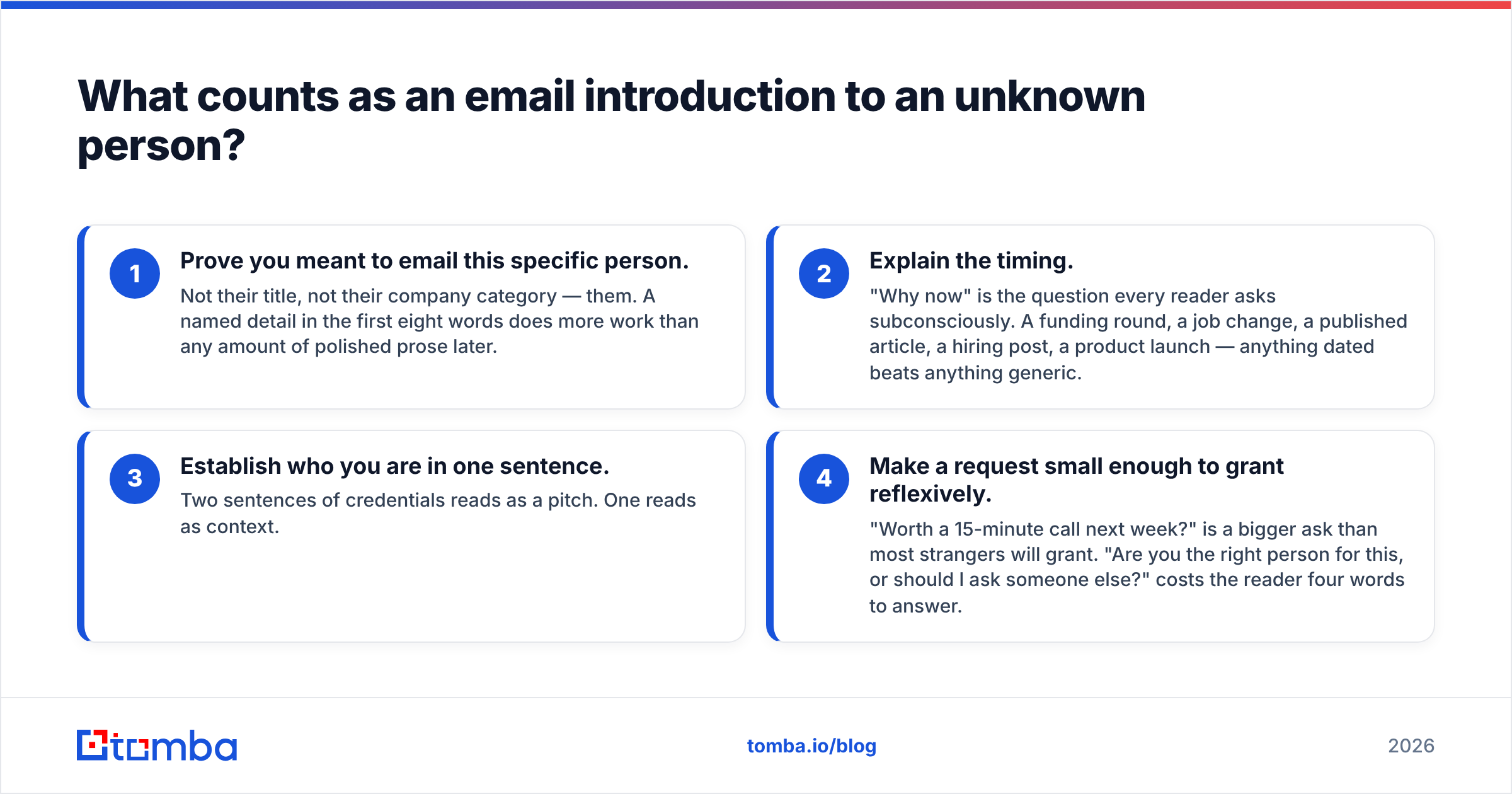
- Prove you meant to email this specific person. Not their title, not their company category — them. A named detail in the first eight words does more work than any amount of polished prose later.
- Explain the timing. "Why now" is the question every reader asks subconsciously. A funding round, a job change, a published article, a hiring post, a product launch — anything dated beats anything generic.
- Establish who you are in one sentence. Two sentences of credentials reads as a pitch. One reads as context.
- Make a request small enough to grant reflexively. "Worth a 15-minute call next week?" is a bigger ask than most strangers will grant. "Are you the right person for this, or should I ask someone else?" costs the reader four words to answer.
Miss any one of those and the email still gets deleted. That is why rewriting your subject line for the fifth time rarely fixes a dead campaign — the problem is usually upstream.
Why do most cold introductions get ignored?#
Three reasons, in order of how often they actually apply.
The email never arrived. This is the invisible killer. If you sourced addresses by guessing patterns (first.last@, f.last@, firstname@), somewhere between 15% and 35% of them are wrong depending on the industry. Every hard bounce is a signal to the receiving mail provider that you are sending to a list you did not verify. Google's bulk sender guidelines are explicit that spam complaint rates and invalid recipients directly affect whether your future mail lands in the inbox. Run addresses through an email verifier before the first send, not after the first bounce report.
The email arrived but read as a template. Readers detect mail-merge structure instantly: a compliment about "your impressive work at {{Company}}", a paragraph about your product, three bullet points of benefits, and a calendar link. The tell is not the personalization token — it is that the email would still make sense if you swapped the recipient for anyone else with the same job title.
The ask was too expensive. Asking a stranger for 30 minutes is asking for something they give to maybe five people a month. Asking whether they own a problem costs them nothing. Start with the cheap ask and escalate only after a reply.
What does a reply-worthy introduction actually look like?#
Here is the five-part anatomy, with the job each part does:
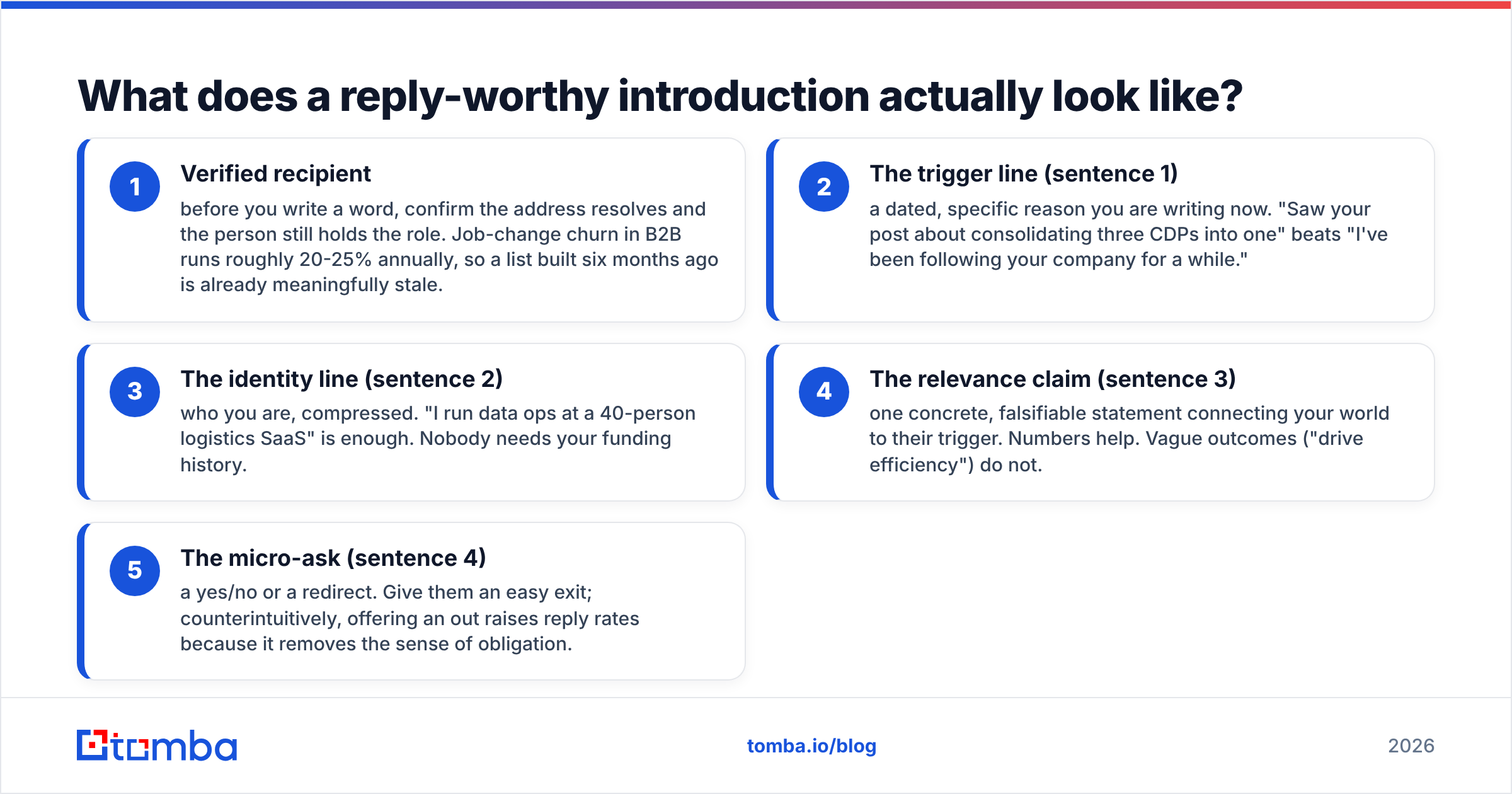
- Verified recipient — before you write a word, confirm the address resolves and the person still holds the role. Job-change churn in B2B runs roughly 20-25% annually, so a list built six months ago is already meaningfully stale.
- The trigger line (sentence 1) — a dated, specific reason you are writing now. "Saw your post about consolidating three CDPs into one" beats "I've been following your company for a while."
- The identity line (sentence 2) — who you are, compressed. "I run data ops at a 40-person logistics SaaS" is enough. Nobody needs your funding history.
- The relevance claim (sentence 3) — one concrete, falsifiable statement connecting your world to their trigger. Numbers help. Vague outcomes ("drive efficiency") do not.
- The micro-ask (sentence 4) — a yes/no or a redirect. Give them an easy exit; counterintuitively, offering an out raises reply rates because it removes the sense of obligation.
That is four sentences plus a signature. Roughly 80 words. If your draft is 200 words, you have added paragraphs that only serve you.
Which introduction approach should you use?#
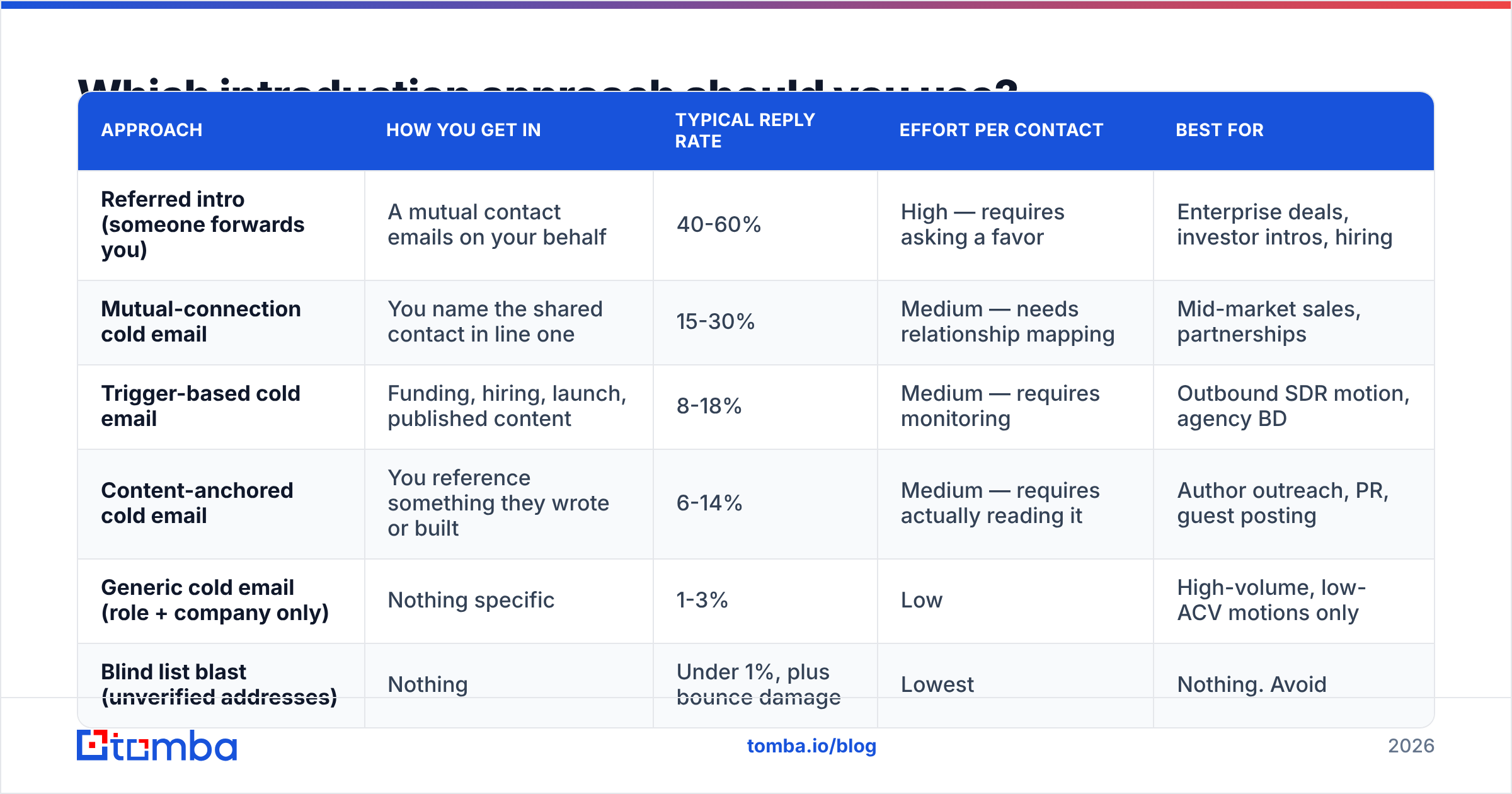
Not every "unknown person" is equally unknown. Before writing a pure cold email, check whether a warmer path exists — the difference in outcomes is not marginal.
| Approach | How you get in | Typical reply rate | Effort per contact | Best for |
|---|---|---|---|---|
| Referred intro (someone forwards you) | A mutual contact emails on your behalf | 40-60% | High — requires asking a favor | Enterprise deals, investor intros, hiring |
| Mutual-connection cold email | You name the shared contact in line one | 15-30% | Medium — needs relationship mapping | Mid-market sales, partnerships |
| Trigger-based cold email | Funding, hiring, launch, published content | 8-18% | Medium — requires monitoring | Outbound SDR motion, agency BD |
| Content-anchored cold email | You reference something they wrote or built | 6-14% | Medium — requires actually reading it | Author outreach, PR, guest posting |
| Generic cold email (role + company only) | Nothing specific | 1-3% | Low | High-volume, low-ACV motions only |
| Blind list blast (unverified addresses) | Nothing | Under 1%, plus bounce damage | Lowest | Nothing. Avoid |
The pattern is consistent: every step up the table trades volume for specificity, and specificity is what a stranger is actually responding to. If you are sitting at a 1-3% reply rate, the fix is usually to move up one row, not to send more of the same.
How do you find and confirm the right person to email?#
Sending a great introduction to the wrong inbox is the same as sending a bad one. Three steps, in order:
Identify the actual owner of the problem. For a 200-person company, that is rarely the CEO. Look for the person whose job title contains the function you affect, then confirm on their LinkedIn or the company's team page that they still hold it.
Resolve the address, don't guess it. Pattern-guessing produces a list that looks complete and is quietly 25% wrong. A domain search returns the addresses a company actually uses along with the pattern it follows, which is a different thing from a permutator's best guess. For one-off outreach, an email finder resolves name + domain to a single address with a confidence score attached.
Check the confidence score before you send. Anything flagged as catch-all needs separate handling — a catch-all domain accepts everything at the SMTP layer, so a "valid" result there tells you almost nothing. Route those through a catch-all verifier or accept that they carry more risk and cap how many you include in a single send.
If you are working author outreach or PR specifically, resolving the byline rather than the generic press inbox roughly doubles your odds — a generic press@ address is a shared mailbox that nobody owns.
What should the subject line say when nobody knows you?#
Short and literal. Subject lines that try to be clever read as marketing; subject lines that read like an internal note from a colleague get opened. Practical rules:
- 3-6 words. Mobile clients truncate around 35-40 characters.
- Lowercase or sentence case. Title Case Reads Like A Newsletter.
- No brackets, no emojis, no "Re:" fakery. Fake reply threading is the fastest way to lose trust in the first second.
- Name the specific thing. "your Q3 hiring post", "the Redshift migration", "question re: your API docs".
- Never promise what the body doesn't deliver. Open rate is not the metric that pays you.
If you want to pressure-test variants before a send, run them through a subject line tester rather than guessing which one "feels" better.
What do three working templates look like?#
Template 1 — Trigger-based (most reusable)
Subject: your Series B + data hygiene
Hi Dana — saw the $18M round announced Tuesday. Congrats.
I run RevOps at a 60-person logistics SaaS. When we went from 40 to 120 reps, our CRM duplicate rate hit 31% within two quarters and it cost us about six weeks of pipeline reporting.
Is data hygiene on your list for the next two quarters, or is that a 2027 problem for you?
— Ben
Template 2 — Mutual connection
Subject: Priya suggested I reach out
Hi Marcus — Priya Raman mentioned you rebuilt the whole partner onboarding flow at Northwind last year.
I'm doing the same thing at a smaller company and I'm stuck on the approval step. Priya thought you'd have a strong opinion.
Would you be open to a 10-minute call, or would a couple of questions over email be easier?
— Ben
Template 3 — Content-anchored (author or expert outreach)
Subject: your post on catch-all domains
Hi Sofia — your piece on why SMTP checks fail against catch-all servers is the only clear explanation I've found. The part about the 4xx deferral was new to me.
I'm writing something adjacent for a B2B audience and would like to cite your framing, with a link back.
Any objection — and is there anything you'd correct if you rewrote it today?
— Ben
Every one of these follows the same skeleton: trigger, identity, relevance, easy-out ask. Swap the specifics, keep the structure. If you want more starting points, the cold email templates library covers other scenarios, but treat any template as a frame to fill, not text to send.
What kills replies even when the writing is good?#
- Sending on an unwarmed domain. A brand-new sending domain pushing 200 cold emails on day one will land in spam regardless of copy quality. Ramp over 3-4 weeks and watch your sender reputation.
- Two asks in one email. "Book a call, and also here's our whitepaper" splits attention and gets neither.
- Images and tracking pixels in a first-touch email. Plain text to a stranger. Rich HTML in a cold intro correlates with worse placement and reads as bulk.
- Following up four times with no new information. Each follow-up should add something — a relevant case, a new trigger, a genuine last-check. "Just bumping this" burns goodwill.
- Ignoring the reply you got. A "not me, talk to Alex" is a win. Most senders let those sit for three days and lose the thread.
- No physical address or unsubscribe path. For commercial email, the FTC's CAN-SPAM rules require an opt-out mechanism and a valid postal address. In the EU and UK, GDPR-based legitimate-interest rules are stricter still. Check jurisdiction before you scale.
How do you know whether it's working?#
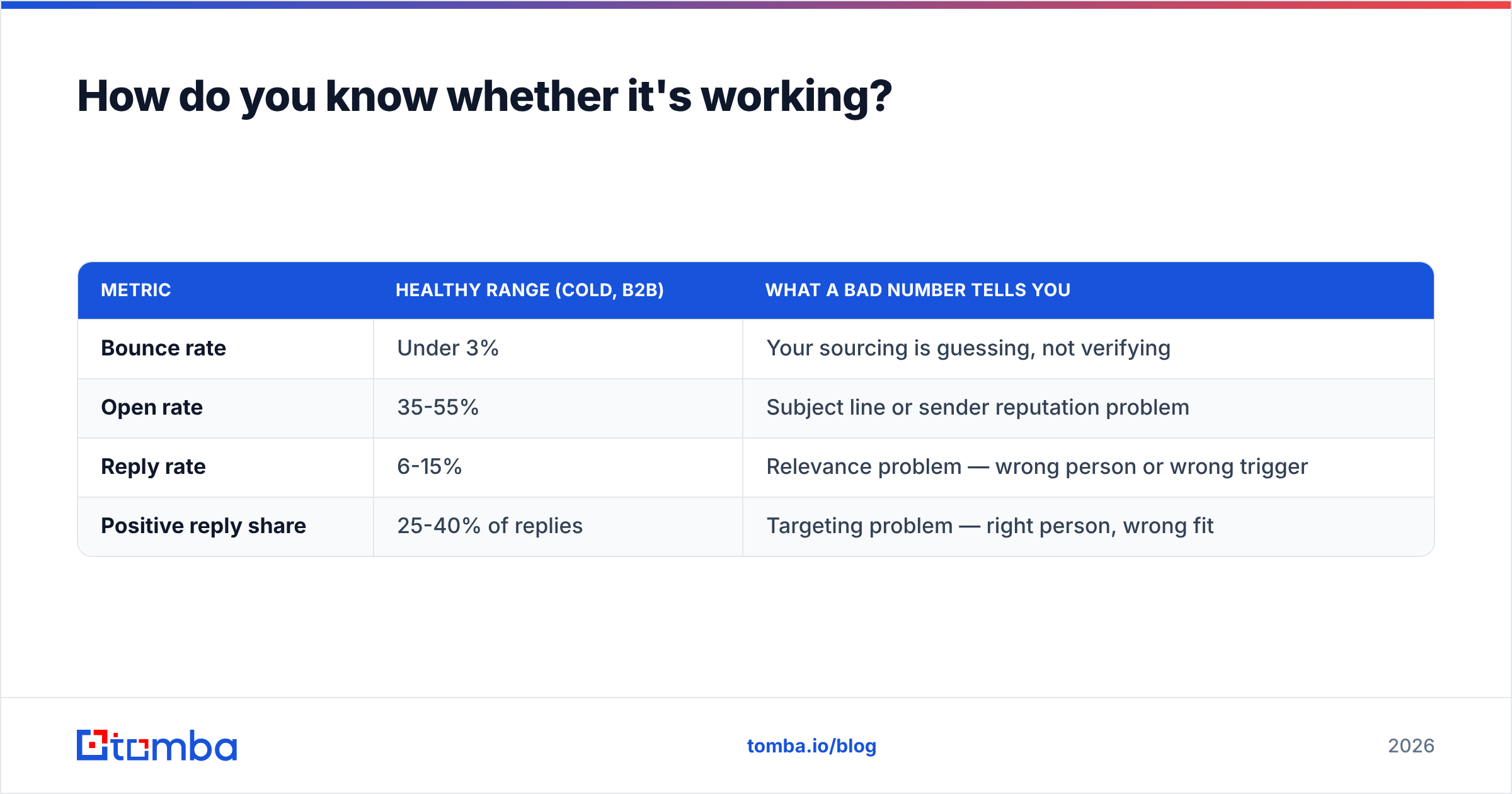
Track three numbers per campaign, not just one:
| Metric | Healthy range (cold, B2B) | What a bad number tells you |
|---|---|---|
| Bounce rate | Under 3% | Your sourcing is guessing, not verifying |
| Open rate | 35-55% | Subject line or sender reputation problem |
| Reply rate | 6-15% | Relevance problem — wrong person or wrong trigger |
| Positive reply share | 25-40% of replies | Targeting problem — right person, wrong fit |
The order matters. Fix bounce first, then reputation, then relevance. Optimizing copy while 20% of your list is invalid is like tuning an engine with a hole in the fuel tank. If you want the broader definitions, the response rate entry breaks down how these are usually calculated, and vendor-neutral review sites like G2 are useful for sanity-checking any reply-rate claim a tool puts in its marketing.
Start with an address you can trust#
Every rule above assumes the email reaches a real inbox belonging to the real person. That assumption breaks more often than most teams realize, and it breaks silently — bounces get buried in a reporting tab while the campaign "underperforms" for reasons that look like copy.
Get the sourcing right first. The Tomba Email Finder resolves a name and domain into a verified professional address with a confidence score, so you know before you send whether you are writing to a person or to a void. The free tier covers 25 searches a month, which is enough to test the workflow on a real list; paid plans start at $49/mo on Starter and $99/mo on Growth if you need volume — full details on Tomba pricing. Write the four sentences well, send them to an address that exists, and cold introductions stop being a numbers game.
Related guides#
Ready to find emails that actually work?
Join 150,000+ professionals who stopped guessing and started sending. Free credits on signup — no credit card required.
Get the Tomba newsletter
Practical outbound tactics and product updates — once every two weeks.
About the author