Email Lead Generation in 2026: The Complete Playbook
Most email lead generation advice stops at "write better subject lines." The real bottleneck is list quality. Here's the full 2026 playbook: sourcing, verifying, sequencing, and measuring B2B email leads.
TL;DR
- Email lead generation in 2026 is a data problem first and a copy problem second. A 6% bounce rate kills a campaign faster than a mediocre subject line ever will.
- The three sourcing methods that still work: intent-triggered outbound, gated content with progressive profiling, and enrichment of traffic you already have.
- Budget roughly 60% of your tooling spend on data (finding, verifying, enriching) and 40% on sending, sequencing, and reporting. Most teams do the opposite.
- Verify every address before it enters a sequence. Verification is the cheapest insurance policy in the stack — usually under $0.004 per contact.
- Measure reply rate and meetings booked per 1,000 sends. Open rate has been unreliable since Apple Mail Privacy Protection, and it got worse in 2026.
What is email lead generation?#
Email lead generation is the process of identifying a person who fits your ideal customer profile, obtaining a valid business email address for them, and using email as the first channel to convert them into a qualified opportunity. It covers both directions: inbound (someone gives you their email in exchange for something) and outbound (you find the address yourself and reach out cold).
The distinction matters more than people admit. Inbound email leads arrive pre-warmed but slowly and in whatever volume the market decides. Outbound email leads arrive on your schedule, at a volume you control, but with zero prior relationship. Almost every B2B team that hits a revenue target runs both, and the plumbing is different for each.
Here's the useful mental model: think of your email list like a restaurant's walk-in fridge. Inbound is produce delivered by suppliers who found you. Outbound is produce you go out and select yourself. Either way, if you don't check what's spoiled before service, the dish fails — and no amount of plating (copywriting) saves it.
Why do most email lead generation programs fail?#
They fail at the data layer, and then blame the copy layer. In practice, four failure modes account for the overwhelming majority of dead campaigns:
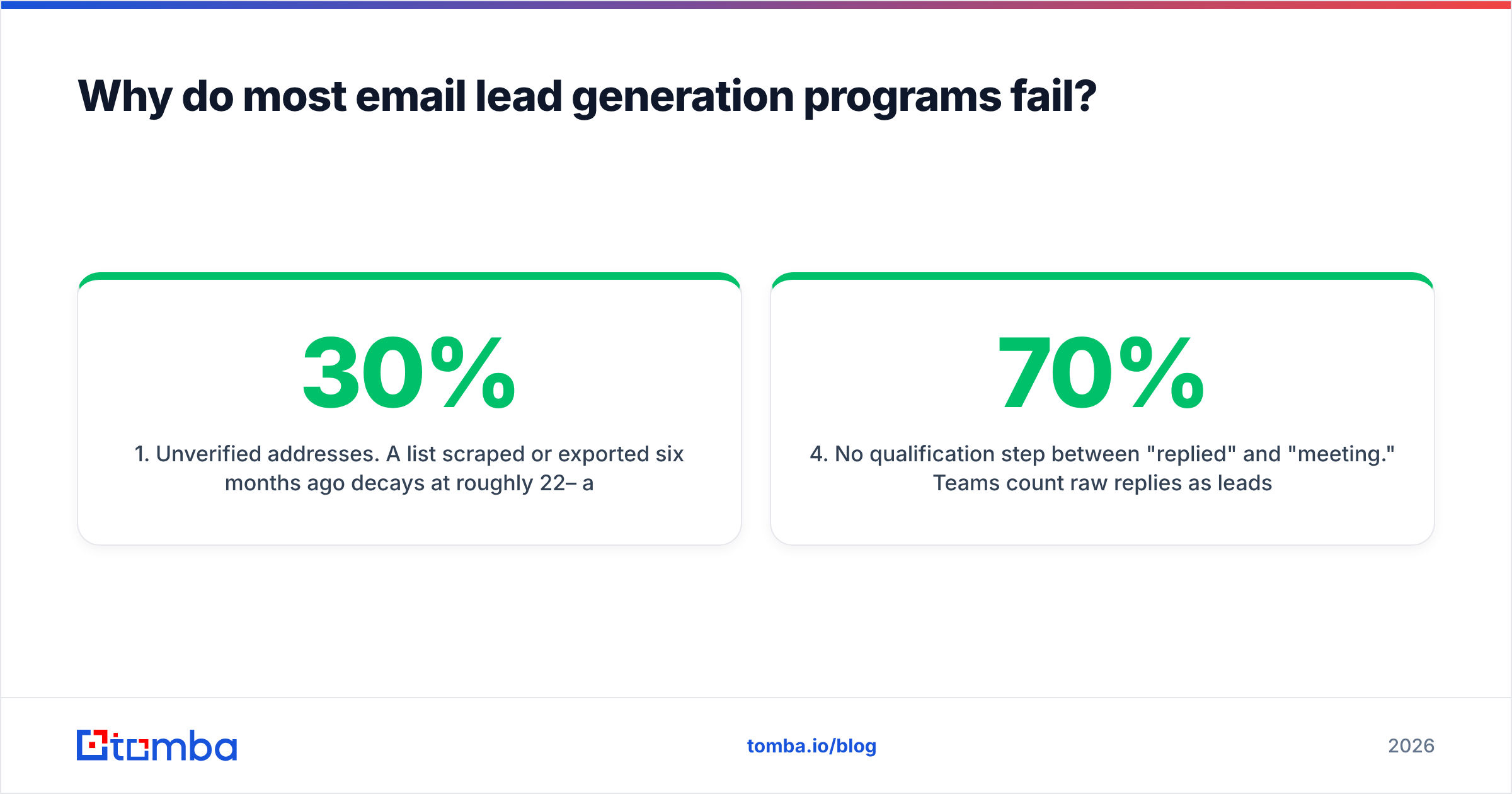
- Unverified addresses. A list scraped or exported six months ago decays at roughly 22–30% per year as people change jobs. Send to it cold and you'll see bounce rates north of 8%, which is enough for Google and Microsoft to start filtering your domain.
- Wrong-persona targeting. The address is valid, the human is real, and they have no budget authority for what you sell. This looks like a copy problem in the dashboard (low reply rate) but it is a targeting problem.
- Sending infrastructure that outran reputation. New domain, no warmup, 400 sends on day three. The addresses were fine; the mailbox was not trusted yet.
- No qualification step between "replied" and "meeting." Teams count raw replies as leads, then wonder why sales rejects 70% of them.
Fixing #1 and #2 usually doubles reply rate without touching a single word of the email. That's not a hypothetical — it's the most common before/after we see when teams move from an exported list to a verified, ICP-filtered one.
Which email lead generation channels actually produce pipeline?#
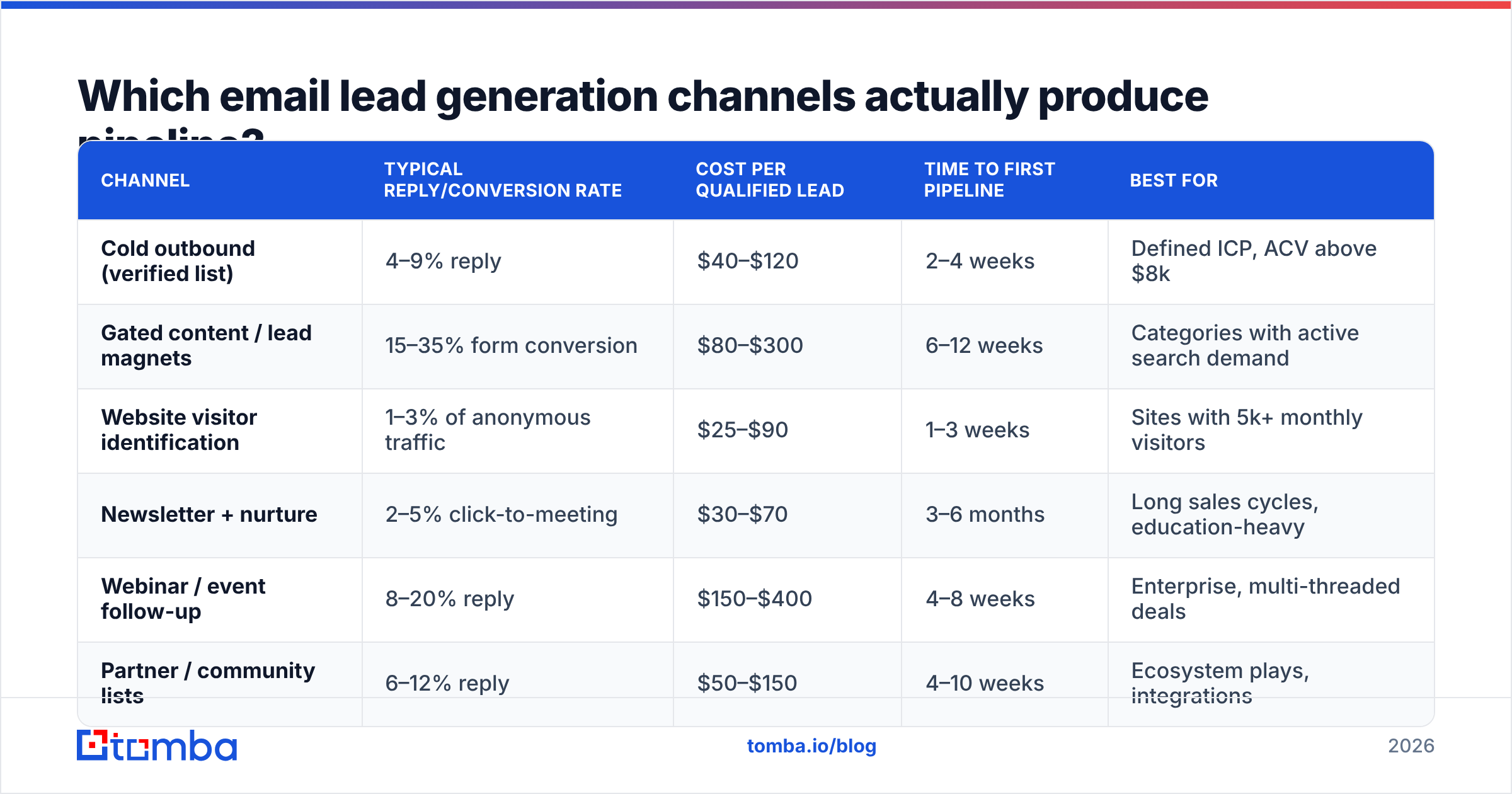
Not all channels convert at the same rate or cost the same per opportunity. Here's how the main options stack up for a typical mid-market B2B seller in 2026:
| Channel | Typical reply/conversion rate | Cost per qualified lead | Time to first pipeline | Best for |
|---|---|---|---|---|
| Cold outbound (verified list) | 4–9% reply | $40–$120 | 2–4 weeks | Defined ICP, ACV above $8k |
| Gated content / lead magnets | 15–35% form conversion | $80–$300 | 6–12 weeks | Categories with active search demand |
| Website visitor identification | 1–3% of anonymous traffic | $25–$90 | 1–3 weeks | Sites with 5k+ monthly visitors |
| Newsletter + nurture | 2–5% click-to-meeting | $30–$70 | 3–6 months | Long sales cycles, education-heavy |
| Webinar / event follow-up | 8–20% reply | $150–$400 | 4–8 weeks | Enterprise, multi-threaded deals |
| Partner / community lists | 6–12% reply | $50–$150 | 4–10 weeks | Ecosystem plays, integrations |
Two observations. First, cold outbound has the shortest time-to-pipeline of anything on this list, which is why it survives every prediction of its death. Second, website visitor identification is the most underused line in the table — you already paid for that traffic, and visitor identification turns anonymous sessions into named accounts you can email.
If you're picking one to start, start with the channel where you already have an asset. Traffic but no list? Visitor reveal. List but no traffic? Outbound. Neither? Gated content, and accept the longer ramp.
How do you build an email lead list that doesn't bounce?#
This is the part most guides skip, so here's the actual sequence:
- Define the ICP as filters, not adjectives. "Mid-market SaaS" is useless. "Companies with 50–500 employees, using HubSpot or Salesforce, with a job posting for a demand-gen role in the last 90 days" is a query you can run.
- Source companies before contacts. Build the account list first — from a B2B database, your CRM's closed-lost pile, G2 category pages, or funding announcements. Contacts sourced without an account thesis are noise.
- Find the addresses by domain, not by guesswork. Run each company domain through a domain search to pull the real people and the company's actual email pattern. Pattern-guessing (
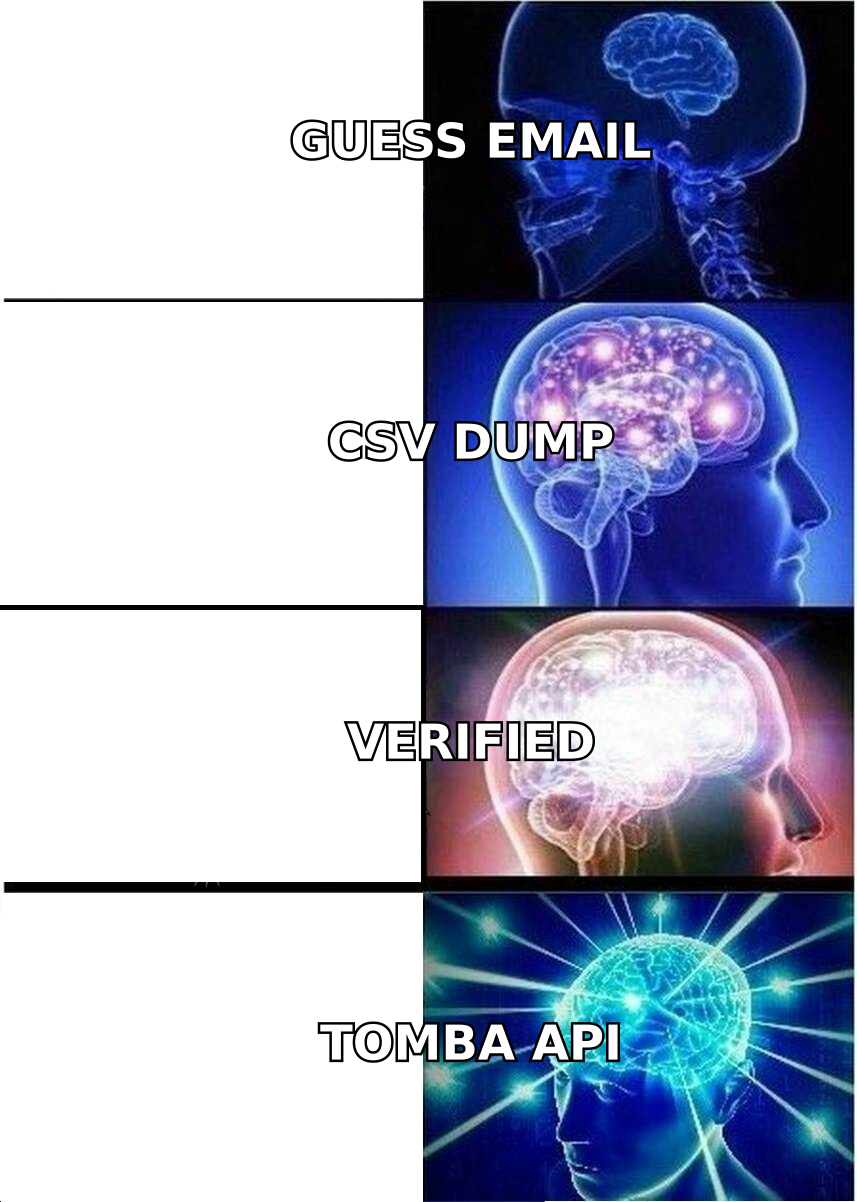
first.last@) works maybe 60% of the time and quietly poisons your bounce rate the other 40%. - Verify every address, no exceptions. Run the list through an email verifier before it touches a sequencer. Discard hard bounces, hold "risky" results for a separate low-volume test, and handle catch-all domains with a dedicated catch-all check rather than a coin flip.
- Enrich for personalization inputs. Title, seniority, tech stack, recent funding, headcount trend. You need at least one non-obvious fact per contact or your first line reads like a template — because it is one.
- Suppress aggressively. Existing customers, open opportunities, competitors, anyone who unsubscribed anywhere in your org, and anyone a teammate emailed in the last 90 days. Skipping this step is how two SDRs email the same VP in the same week.
Run those six steps and a 1,000-contact list typically ends up around 700–800 usable contacts. That shrinkage is the point. The 200 you removed were the ones that would have damaged your sender reputation.
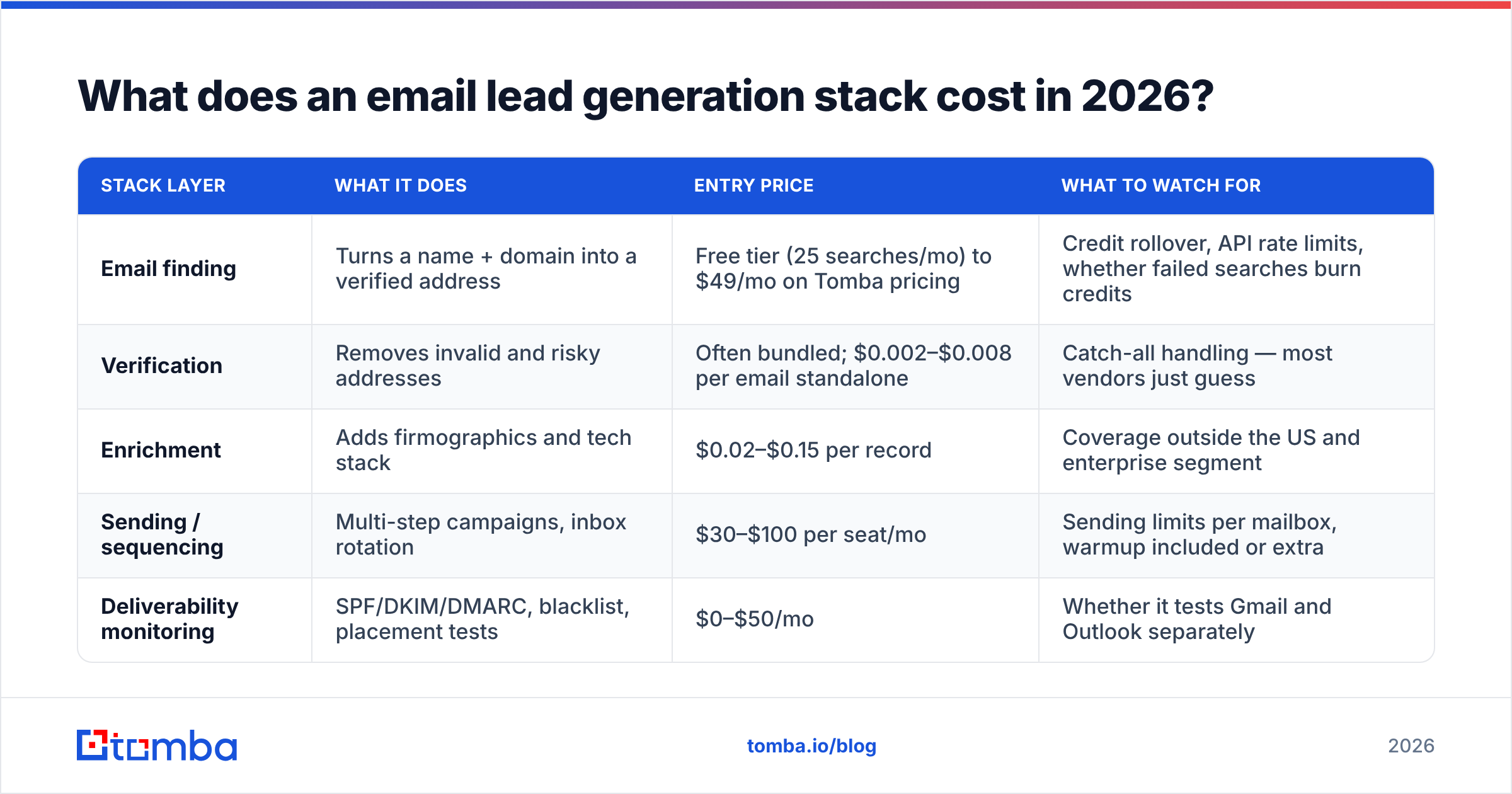
What does an email lead generation stack cost in 2026?#
The stack has consolidated. You need four functions — find, verify, send, track — and you can cover them for less than most teams assume.
| Stack layer | What it does | Entry price | What to watch for |
|---|---|---|---|
| Email finding | Turns a name + domain into a verified address | Free tier (25 searches/mo) to $49/mo on Tomba pricing | Credit rollover, API rate limits, whether failed searches burn credits |
| Verification | Removes invalid and risky addresses | Often bundled; $0.002–$0.008 per email standalone | Catch-all handling — most vendors just guess |
| Enrichment | Adds firmographics and tech stack | $0.02–$0.15 per record | Coverage outside the US and enterprise segment |
| Sending / sequencing | Multi-step campaigns, inbox rotation | $30–$100 per seat/mo | Sending limits per mailbox, warmup included or extra |
| Deliverability monitoring | SPF/DKIM/DMARC, blacklist, placement tests | $0–$50/mo | Whether it tests Gmail and Outlook separately |
A realistic two-person outbound team lands between $180 and $400 per month all-in. Compare that to a single closed deal and the math stops being interesting very quickly.
The trap is buying an all-in-one platform for the sequencer and inheriting whatever data quality it happens to ship with. Data and sending are separable purchases, and separating them lets you swap the weak component without rebuilding the whole motion.
How do you write cold emails that get replies?#
Assume the reader is on a phone, in a hallway, with 40 unread messages. Every structural choice follows from that.
Keep it under 90 words. Long emails don't get read more carefully; they get read less. If you need three paragraphs to explain the value, the targeting is wrong.
Lead with the observation, not the introduction. "Saw you're hiring two SDRs in Berlin" outperforms "I'm reaching out because" by a wide margin. The observation proves you did work, which is the only currency you have with a stranger.
Ask for one thing, and make it small. "Worth a look?" converts better than "Do you have 30 minutes Thursday?" The first is a yes/no; the second is a calendar negotiation with someone who doesn't know you.
Skip the attachments, tracking pixels, and images. Each one is a small deliverability tax. Plain text with one link — or zero links in the first message — sends cleanest.
Follow up three times, then stop. Most replies land on messages two and three. After four, you're generating spam complaints, not pipeline. If you want a starting point, the cold email templates library is a faster path than a blank page.

One more thing on personalization: it scales badly on purpose. Genuinely researched first lines take 3–5 minutes each. If you're sending 500 emails a week, you cannot do that for every contact. The workable compromise is tiered — deep personalization for your top 50 accounts, segment-level personalization (industry, role, trigger event) for everyone else.
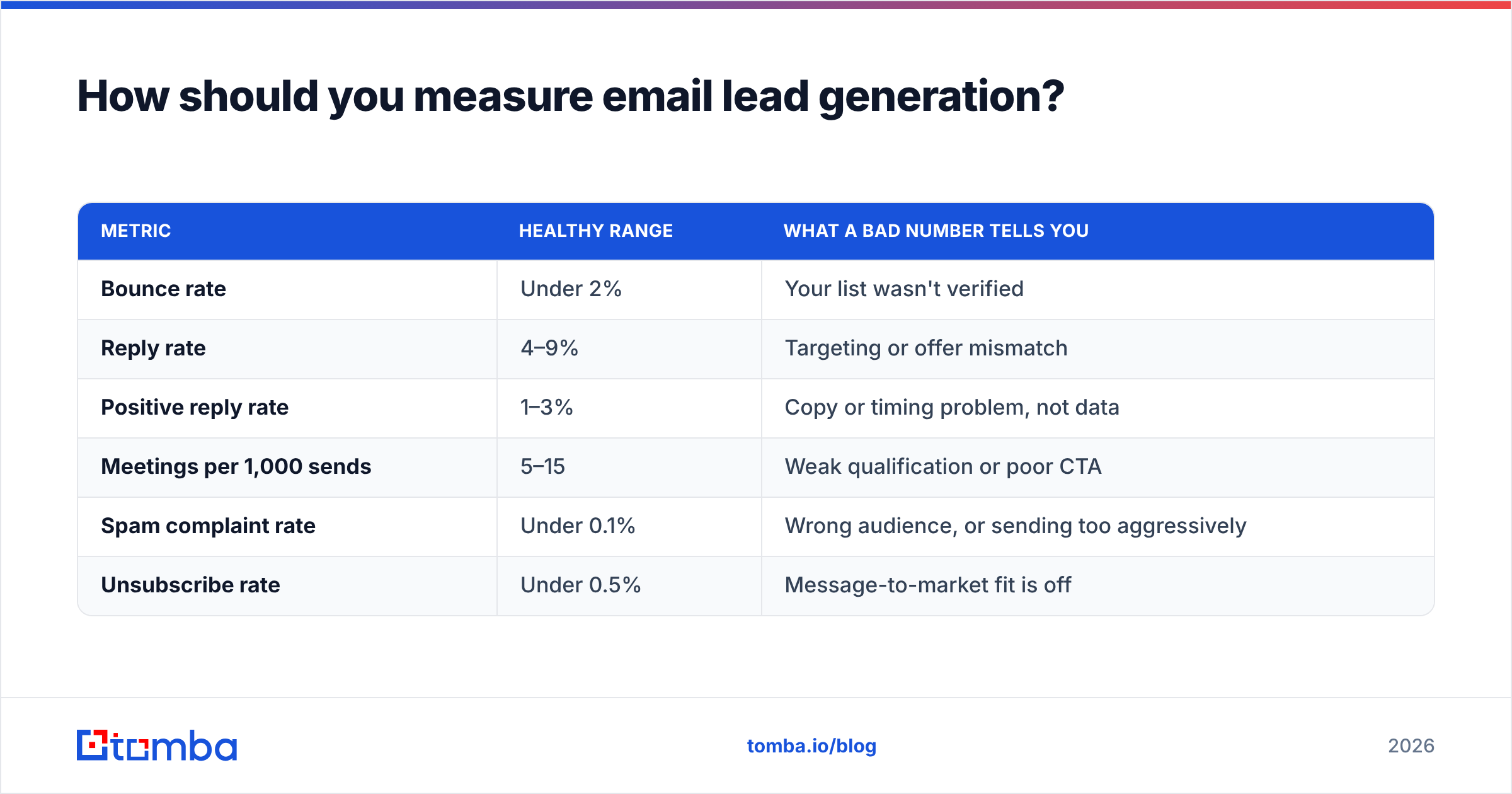
How should you measure email lead generation?#
Open rate stopped being a reliable metric when Apple Mail Privacy Protection started pre-fetching images, and it hasn't recovered. Track these instead:
| Metric | Healthy range | What a bad number tells you |
|---|---|---|
| Bounce rate | Under 2% | Your list wasn't verified |
| Reply rate | 4–9% | Targeting or offer mismatch |
| Positive reply rate | 1–3% | Copy or timing problem, not data |
| Meetings per 1,000 sends | 5–15 | Weak qualification or poor CTA |
| Spam complaint rate | Under 0.1% | Wrong audience, or sending too aggressively |
| Unsubscribe rate | Under 0.5% | Message-to-market fit is off |
Report on the funnel weekly, but don't change more than one variable per week. Teams that rewrite the copy, swap the list, and change the sending domain in the same sprint learn nothing from the result.
The number that ultimately matters is cost per meeting held. Everything above it is diagnostic. For benchmarks across the wider category, G2's lead intelligence category and HubSpot's marketing research are both reasonable places to sanity-check your own response rate against peers.
Is inbound or outbound better for email lead generation?#
Neither wins outright — they fail in different ways, which is the argument for running both.
Outbound fails when your ICP is broad or your ACV is low. If you can't name the 500 companies that should buy, cold email becomes a volume game you'll lose to spam filters. Inbound fails when nobody is searching for your category yet, or when the sales cycle is so long that content-driven leads take three quarters to mature.
The practical split for most teams under $10M ARR: outbound carries the near-term number, inbound compounds the long-term one. Fund outbound to hit this quarter, fund content to make next year's outbound cheaper — because prospects who have heard of you reply at roughly twice the rate of those who haven't.
What compliance rules apply to email lead generation?#
Short version: B2B cold email is legal in most of the world, with conditions.
Under CAN-SPAM (US), you need accurate headers, a non-deceptive subject line, a physical postal address, and a working unsubscribe honored within 10 business days. No prior consent required.
Under GDPR (EU/UK), you can rely on legitimate interest for B2B outreach, but you must document the balancing test, email a business role rather than a personal address where possible, and honor objections immediately. Some member states layer additional rules on top — Germany and Italy are stricter than most. The official GDPR text is worth 20 minutes of your legal team's time before you scale volume.
Canada's CASL is the strictest of the three and effectively requires implied or express consent. If Canada is a core market, treat it as an opt-in-only motion.
Practical hygiene regardless of jurisdiction: keep a permanent global suppression list, include a one-click unsubscribe, never obscure who you are, and delete data on request within 30 days.
Where should you start this week?#
Pick one ICP segment, build a list of 200 verified contacts, write one sequence of three emails, and send it over two weeks. Don't build the full stack first. A single clean 200-contact test tells you more about your market than a quarter of planning.
If the reply rate lands above 4%, scale the same motion. If it lands below 2%, the problem is almost always the list or the segment — not the words.
When you're ready to build that list, Tomba Email Finder is the fastest way to go from a company domain to verified, deliverable contacts. Search by domain, name, or company, verify in the same workflow, and export straight into your sequencer — the free tier gives you 25 searches a month to test the accuracy on your own accounts before you pay anything. For larger runs, the bulk email finder processes entire account lists at once, and the Tomba API wires the whole thing into whatever stack you already run.
Related guides#
Ready to find emails that actually work?
Join 150,000+ professionals who stopped guessing and started sending. Free credits on signup — no credit card required.
Get the Tomba newsletter
Practical outbound tactics and product updates — once every two weeks.
About the author