Email Lead Generation Services in 2026: Costs, Risks, Verdict
Agencies, data vendors, and DIY stacks all sell you the same promise: qualified email leads. Here's what each actually costs per booked meeting — and when outsourcing stops making sense.
TL;DR
- Email lead generation services split into four models: full-service agencies ($3,000–$8,000/mo), managed data vendors ($500–$2,500/mo), self-serve data platforms ($49–$249/mo), and pure list brokers (per-record pricing).
- The single biggest cost driver is not the service — it's bounce rate. A 12% bounce rate on a 5,000-send month can cost you the sending domain, which is worth more than any agency retainer.
- Agencies are worth it when you lack an SDR, need a new market tested in 60 days, or your ACV is above ~$25,000. Below that, the math almost never clears.
- A self-serve stack (data source + verification + sequencer) runs $250–$400/mo and matches agency output once someone owns it for 5 hours a week.
- Ask every vendor three questions: where does the data come from, what is the verified-bounce SLA, and who owns the domains you send from.
What are email lead generation services?#
"Email lead generation services" is a catch-all for anyone who will hand you a list of business email addresses — and often send to them on your behalf. The label covers wildly different products at wildly different prices, which is exactly why buyers get burned.
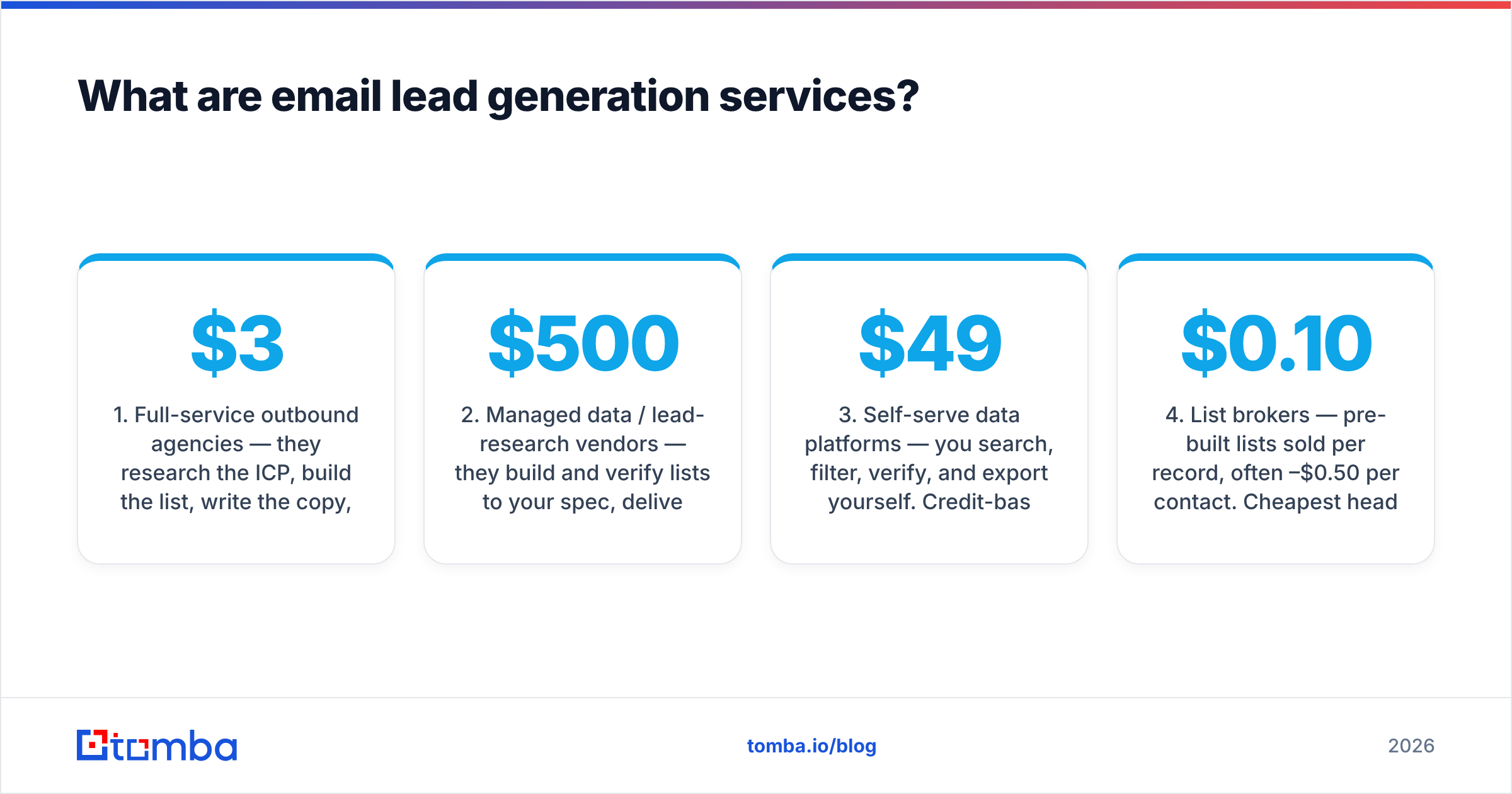
Four distinct models sit under the term:
- Full-service outbound agencies — they research the ICP, build the list, write the copy, buy and warm sending domains, run the sequences, and hand you replies. Retainers typically run $3,000–$8,000/mo with a 3-month minimum. You get meetings; you don't get the asset.
- Managed data / lead-research vendors — they build and verify lists to your spec, delivered as CSV or pushed into your CRM. No sending. $500–$2,500/mo depending on volume and research depth.
- Self-serve data platforms — you search, filter, verify, and export yourself. Credit-based, $49–$249/mo for most teams. This is where tools like Tomba, Apollo, and BookYourData live, though each optimises for a different slice.
- List brokers — pre-built lists sold per record, often $0.10–$0.50 per contact. Cheapest headline price, worst average data quality, and the source of most deliverability disasters.
The distinction that matters: do you keep the asset? Agencies rent you outcomes. Data platforms sell you an asset you keep — a verified contact list, a repeatable process, and sending domains under your own control.

How much do email lead generation services actually cost?#
Headline pricing lies. What matters is cost per booked meeting, and that depends on data accuracy, reply rate, and how much of your team's time gets consumed.
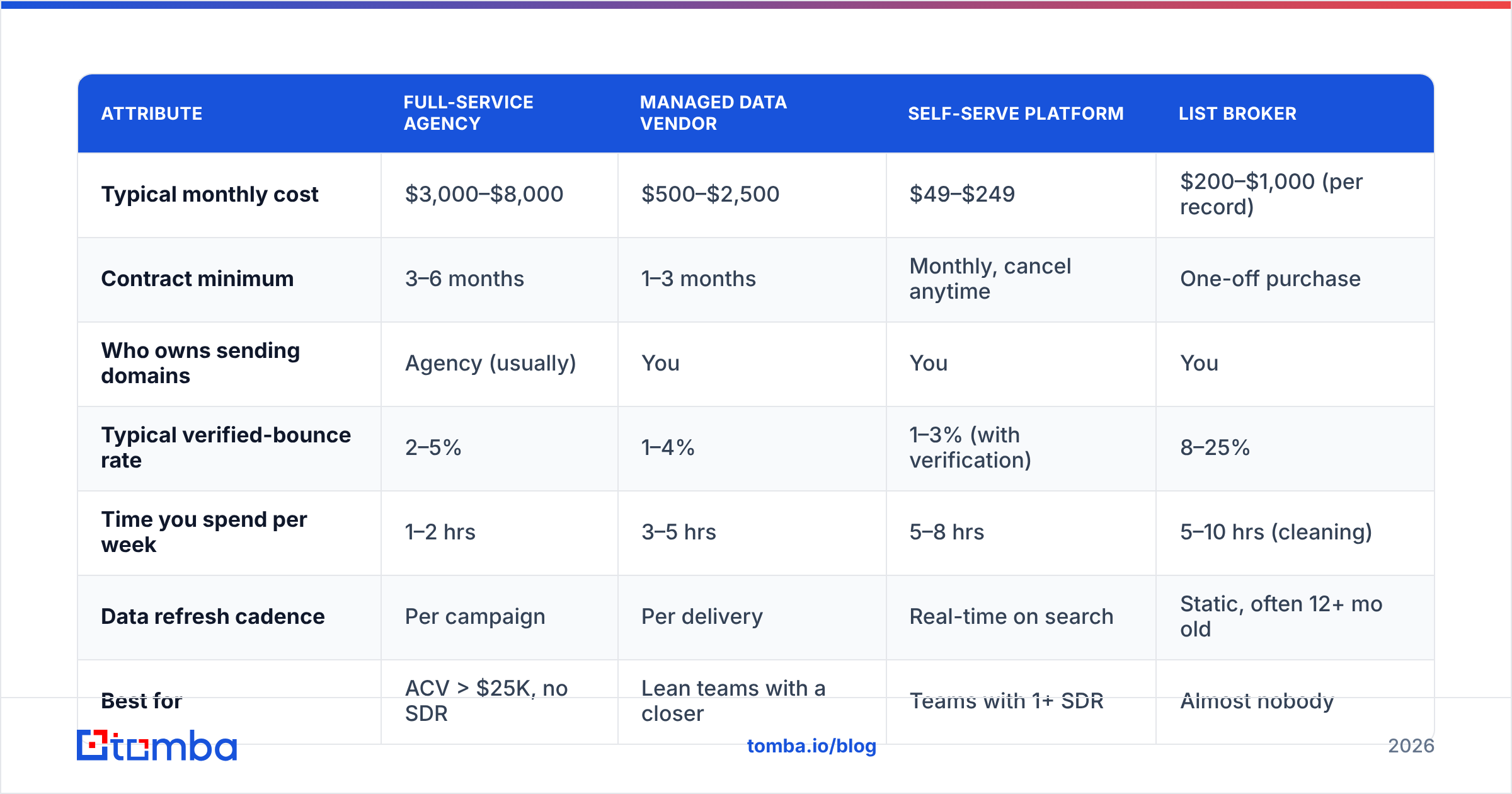
Here's the honest comparison across the four models, assuming a mid-market B2B seller targeting 2,000 net-new contacts a month:
| Attribute | Full-service agency | Managed data vendor | Self-serve platform | List broker |
|---|---|---|---|---|
| Typical monthly cost | $3,000–$8,000 | $500–$2,500 | $49–$249 | $200–$1,000 (per record) |
| Contract minimum | 3–6 months | 1–3 months | Monthly, cancel anytime | One-off purchase |
| Who owns sending domains | Agency (usually) | You | You | You |
| Typical verified-bounce rate | 2–5% | 1–4% | 1–3% (with verification) | 8–25% |
| Time you spend per week | 1–2 hrs | 3–5 hrs | 5–8 hrs | 5–10 hrs (cleaning) |
| Data refresh cadence | Per campaign | Per delivery | Real-time on search | Static, often 12+ mo old |
| Best for | ACV > $25K, no SDR | Lean teams with a closer | Teams with 1+ SDR | Almost nobody |
| Ramp to first send | 3–5 weeks | 1–2 weeks | Same day | Same day |
Run the math for a typical mid-market case. An agency at $5,000/mo that books 12 meetings costs $417 per meeting. A self-serve stack — say $99/mo for data, $37/mo for a verification top-up, $97/mo for a sequencer, plus 6 hours a week of an SDR's time at a loaded $45/hr — comes to roughly $1,313/mo. At 10 meetings, that's $131 per meeting, and you keep the list, the domains, and the playbook.
The agency wins on speed and on not consuming headcount. It loses on unit economics the moment you have anyone who can own the process.
Why does data accuracy matter more than price?#
Because bounces compound, and price doesn't.
Every hard bounce is a signal to mailbox providers that you don't know who you're emailing. Google and Microsoft both tightened bulk-sender requirements in 2024, and Google's published guidance sets a spam-complaint threshold of 0.3% — with the explicit note to keep it under 0.1%. Bounce rate isn't in that spec, but it feeds directly into the reputation score that decides whether your mail lands in inbox or spam. Most deliverability practitioners treat 2% as the ceiling and 5% as the point where you stop sending and clean.
Do the damage math. A list with a 15% bounce rate — perfectly normal for a broker list — sent to 2,000 contacts means 300 hard bounces in a week. That's enough to tank a warm domain. Replacing a burned sending domain costs 4–6 weeks of warmup, and any in-flight sequences die with it. That's a bigger loss than three months of agency fees.
This is why the verification layer isn't optional. Whatever service you buy, the list should be verified within days of sending, not months. An email verifier run immediately before import catches the ~2–3% of addresses that decay every month from job changes alone. For domains that accept everything, a dedicated catch-all verifier is the difference between a usable segment and a guess.
The ordering matters: find, verify, then send. Teams that skip step two save $30 and lose a domain.
What separates a good vendor from a bad one?#
Three questions, asked before you sign anything.
1. Where does the data come from? A credible vendor publishes its sourcing. Public web crawls, opt-in contributor networks, partner data, and direct verification are all defensible; "proprietary" with no elaboration is not. Tomba documents its data sources publicly, and BookYourData is similarly explicit about its human-verified, opt-in sourcing model — that transparency is the baseline you should demand, not a bonus feature. If a vendor won't answer, assume the answer is "scraped and resold."
2. What's the bounce SLA, and what happens when it's missed? Serious vendors offer a bounce guarantee — typically 95–98% deliverable, with credits refunded on any address that hard-bounces. Vague "high-quality data" claims with no refund mechanism mean the vendor carries no risk. You do.
3. Who owns the infrastructure? If an agency sends from domains it registered, your reply history, your reputation, and your unsubscribe list live in their account. When the contract ends, you start from zero. Insist on domains registered under your own account, even if the agency configures them.
Add a fourth if the vendor sells into the EU or UK: ask how they handle GDPR legitimate-interest documentation and data-subject deletion requests. B2B outbound is workable under legitimate interest, but only with records showing why each contact was relevant. Vendors that shrug at this question are a compliance liability you're inheriting.
Should you outsource or build the stack in-house?#
Outsource when at least two of these are true:
- Your ACV is above $25,000. One extra closed deal absorbs a year of retainer.
- You have zero outbound headcount and no plan to hire. Agencies buy you a functioning motion in weeks instead of quarters.
- You're testing an unfamiliar market or geography. A specialist agency's existing data and messaging patterns for that segment beat your first three guesses.
- You need volume that a single SDR physically can't hit — 15,000+ sends/mo across multiple domains.
Build in-house when:
- Your ACV is under $15,000. The unit economics don't survive a retainer.
- You already have an SDR or a founder doing sales. The marginal cost of adding data tooling is a rounding error against salary already spent.
- Your ICP is narrow and weird. Nobody outside your company knows that "regional MSPs with 20–50 techs running ConnectWise" is the buyer. Generic research teams will hand you the wrong 2,000 names.
- You want compounding assets. Every verified contact, every reply-tested subject line, and every warmed domain stays yours.

The honest middle path most teams land on: buy data self-serve, hire a freelance copywriter for the sequence, and keep sending in-house. That's roughly $400/mo all-in and it outperforms a $4,000 retainer for most sub-$25K-ACV businesses.
What does a working in-house stack look like?#
Five components, and none of them are exotic.
- A source of truth for contacts. Either a searchable B2B database you filter by industry, headcount, and role, or a discovery flow where you start from target company domains and pull the relevant people. Domain search is the workhorse here — feed it a company URL, get back the addresses and the company's email pattern.
- A verification pass. Non-negotiable. Run every address before it enters the sequencer, and re-run any list older than 30 days.
- Enrichment. Job title, seniority, company size, and tech stack give your copy something to personalise on. Without it, you're sending "Hi {{first_name}}" and hoping.
- A sequencer with domain rotation. Instantly, Smartlead, and Saleshandy all do this. Spread volume across 3–5 secondary domains, cap at 30–50 sends per mailbox per day, and warm each for at least three weeks before real traffic.
- A CRM sync. Replies that live only in a shared inbox are replies you'll lose. Push everything into HubSpot, Pipedrive, or Salesforce on day one.
For teams doing this at volume, the bulk email finder collapses steps 1–3 into one upload: drop a CSV of companies and names, get back verified addresses with enrichment attached. Teams with engineers usually skip the UI entirely and hit the Tomba API from whatever internal tooling they already run.
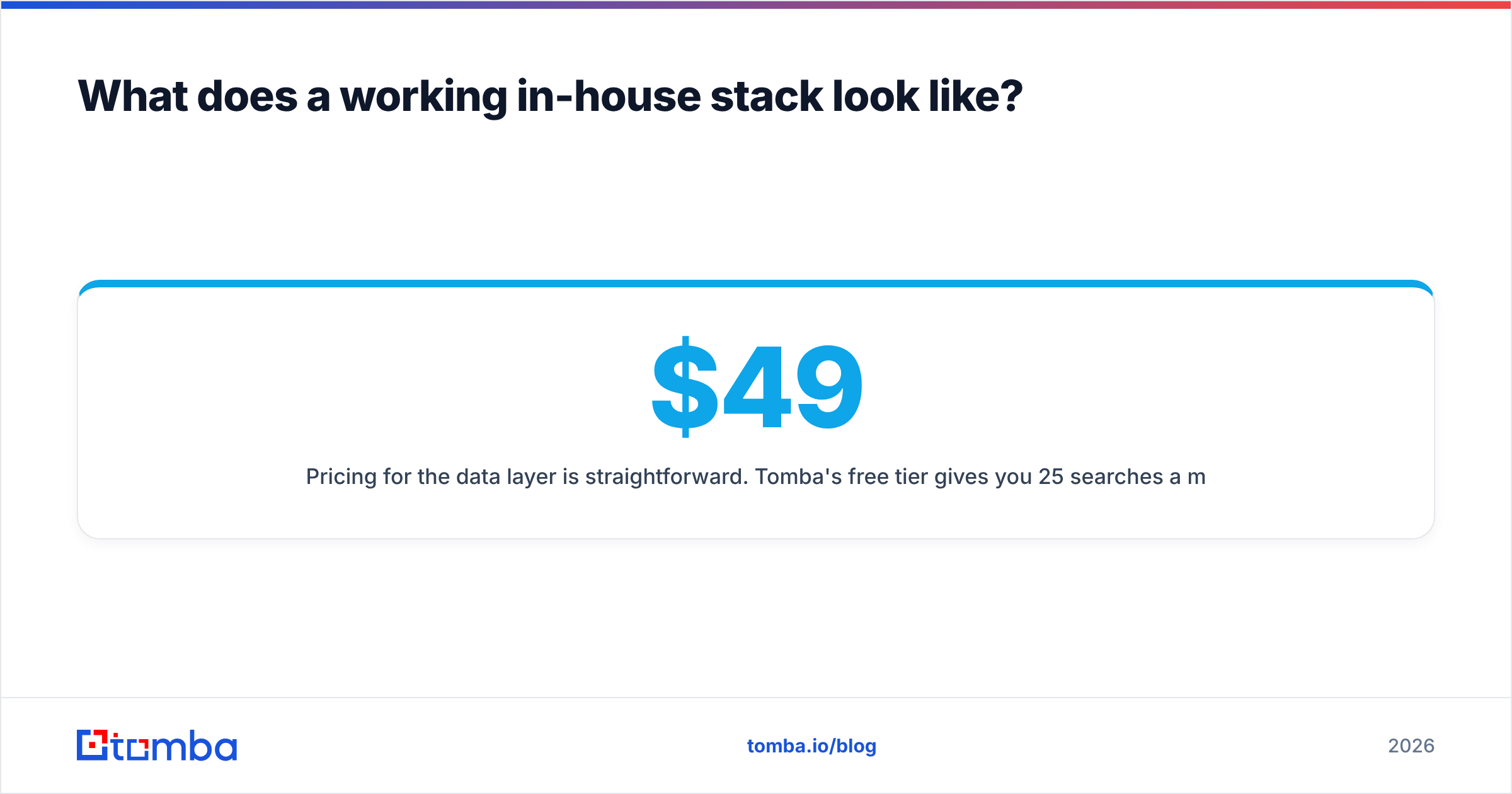
Pricing for the data layer is straightforward. Tomba's free tier gives you 25 searches a month to test accuracy on your own ICP before paying anything; Starter is $49/mo, Growth $99/mo, and Pro $249/mo — full Tomba pricing is public, with no seat minimums or annual lock-in. Compare that to the $3,000/mo floor on agency retainers and the decision gets simple for most teams under $25K ACV.
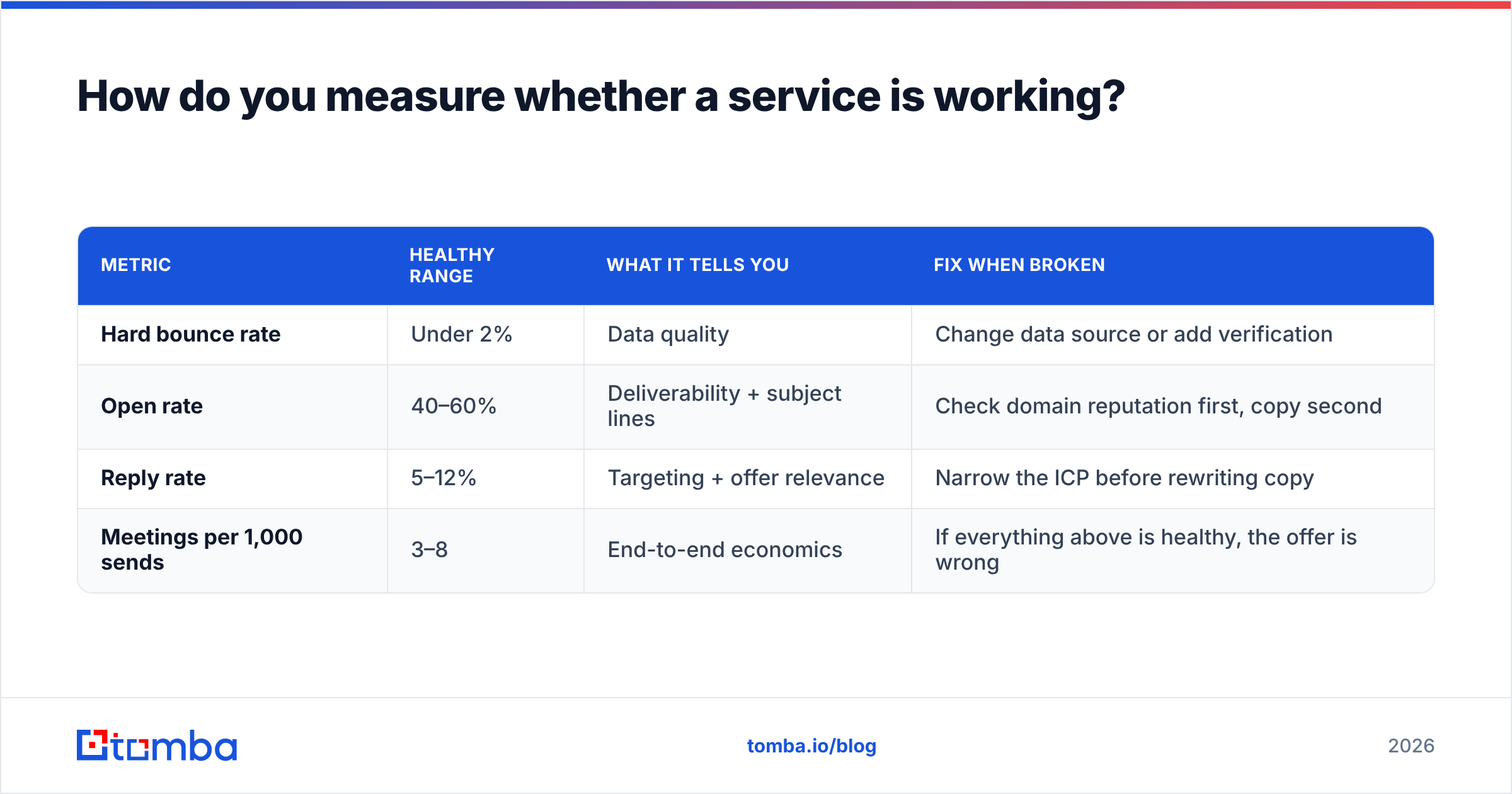
How do you measure whether a service is working?#
Track four numbers. Ignore the rest.
| Metric | Healthy range | What it tells you | Fix when broken |
|---|---|---|---|
| Hard bounce rate | Under 2% | Data quality | Change data source or add verification |
| Open rate | 40–60% | Deliverability + subject lines | Check domain reputation first, copy second |
| Reply rate | 5–12% | Targeting + offer relevance | Narrow the ICP before rewriting copy |
| Meetings per 1,000 sends | 3–8 | End-to-end economics | If everything above is healthy, the offer is wrong |
The sequencing of diagnosis matters. Low reply rate with healthy opens is a targeting or offer problem — rewriting the email body won't fix it. Low opens with a clean bounce rate is a sender reputation problem, and no amount of copy work solves that. High bounces are always a data problem, full stop.
Give any service 6–8 weeks before judging. Warmup, list build, and the first sequence cycle eat the first month. Agencies that promise meetings in week two are either sending to a stale pre-built list or overstating what's possible.
What are the red flags in an email lead generation contract?#
- Guaranteed meeting counts with no qualification criteria. A "meeting" that's a no-show or a student researching a paper still counts against the guarantee. Define the qualification bar in writing.
- Data sourced from a single scrape with no refresh. Ask when the records were last verified. If the answer is a quarter or a year, walk.
- Domains registered in the agency's name. Covered above. Non-negotiable.
- No opt-out handling. You are legally responsible for suppression, not the vendor. Ask to see the suppression workflow.
- Six-month minimums with no exit clause. Three months is a reasonable test window. Six with no out is a vendor hedging against its own results.
- Reply-rate promises above 15%. Sustained double-digit reply rates happen in narrow niches with strong offers. Promised as a baseline, it's a sales tactic. Check the vendor's G2 reviews for what customers actually report versus what sales claims.
The bottom line#
Email lead generation services aren't a scam, but they're mispriced for most buyers. If your deal sizes are large and your team is thin, an agency buys real speed. Everyone else is paying a 10x markup for list building and sequence management that one person can run in five hours a week.
The part nobody can outsource is data quality. Whether you hire an agency or build it yourself, the bounce rate on your list decides whether any of it works — and that comes down to where the contacts came from and how recently they were checked.
Start there. Use the Tomba Email Finder to build and verify your first 500 contacts against your actual ICP, on the free tier, before you sign anything. If the accuracy holds on names you can independently confirm, you have your answer about whether you need a $5,000 retainer at all.
Related guides#
Ready to find emails that actually work?
Join 150,000+ professionals who stopped guessing and started sending. Free credits on signup — no credit card required.
Get the Tomba newsletter
Practical outbound tactics and product updates — once every two weeks.
About the author