Email Nurture Sequence Examples That Actually Convert in 2026
Five real email nurture sequences — lead magnet, trial, demo no-show, dormant lead, and post-purchase — with timing, subject lines, and the metrics that tell you when a sequence is broken.
TL;DR
- A nurture sequence is not a drip campaign. Drips send on a clock; nurture sequences branch on behavior and stop when the contact converts or goes cold.
- The five sequences worth building first: lead-magnet follow-up, free-trial activation, demo no-show recovery, dormant-lead reactivation, and post-purchase expansion.
- Timing beats volume. Most B2B nurture sequences that underperform are sending 6–8 emails in 10 days to a contact who downloaded one PDF.
- Every sequence needs an exit condition, a plain-text variant, and a verified list — bounces above 2% will wreck the deliverability of your cold outbound too, since they usually share a domain.
- Copy templates below are structural, not sacred. Swap the proof, keep the shape.
What Is an Email Nurture Sequence, Exactly?#
An email nurture sequence is a pre-built series of emails triggered by something a contact did — downloading an asset, starting a trial, booking and missing a call — that moves them from mild interest toward a buying conversation.
The everyday version: a nurture sequence is the follow-up you'd do manually if you had one prospect. You'd send the thing they asked for, wait a couple of days, share something related, then check whether they need help. Automation just makes that repeatable across 400 people without turning it into spam.
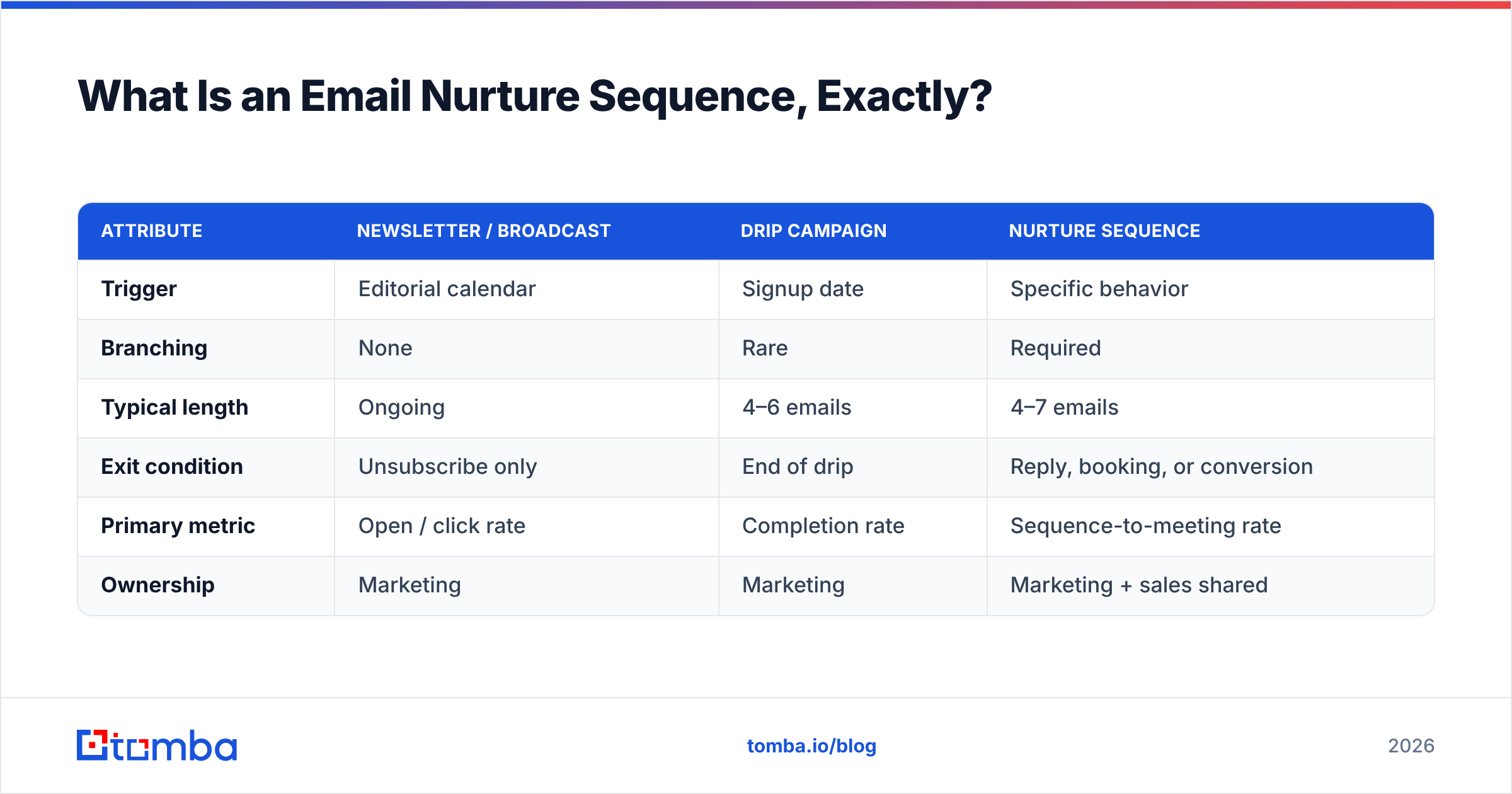
Three things separate a nurture sequence from a generic drip:
- It's behavior-triggered. The clock starts when the contact does something, not when a marketer hits "send."
- It branches. Opened but didn't click gets a different email three than clicked-and-visited-pricing.
- It has an exit. Booking a call, replying, or unsubscribing pulls the contact out immediately. A sequence that keeps firing after someone replies is the fastest way to look like a robot.
The distinction matters for measurement. Broadcast newsletters are judged on open and click rate. Nurture sequences are judged on sequence-to-meeting rate — what percentage of entrants reach a sales conversation. That number is usually between 2% and 8% for mid-funnel B2B, and if yours is under 1%, the problem is almost never the subject lines.
| Attribute | Newsletter / broadcast | Drip campaign | Nurture sequence |
|---|---|---|---|
| Trigger | Editorial calendar | Signup date | Specific behavior |
| Branching | None | Rare | Required |
| Typical length | Ongoing | 4–6 emails | 4–7 emails |
| Exit condition | Unsubscribe only | End of drip | Reply, booking, or conversion |
| Primary metric | Open / click rate | Completion rate | Sequence-to-meeting rate |
| Ownership | Marketing | Marketing | Marketing + sales shared |
Why Do Most Nurture Sequences Underperform?#
Because they were written as a content calendar rather than as a conversation. Four failure patterns show up over and over in audits:
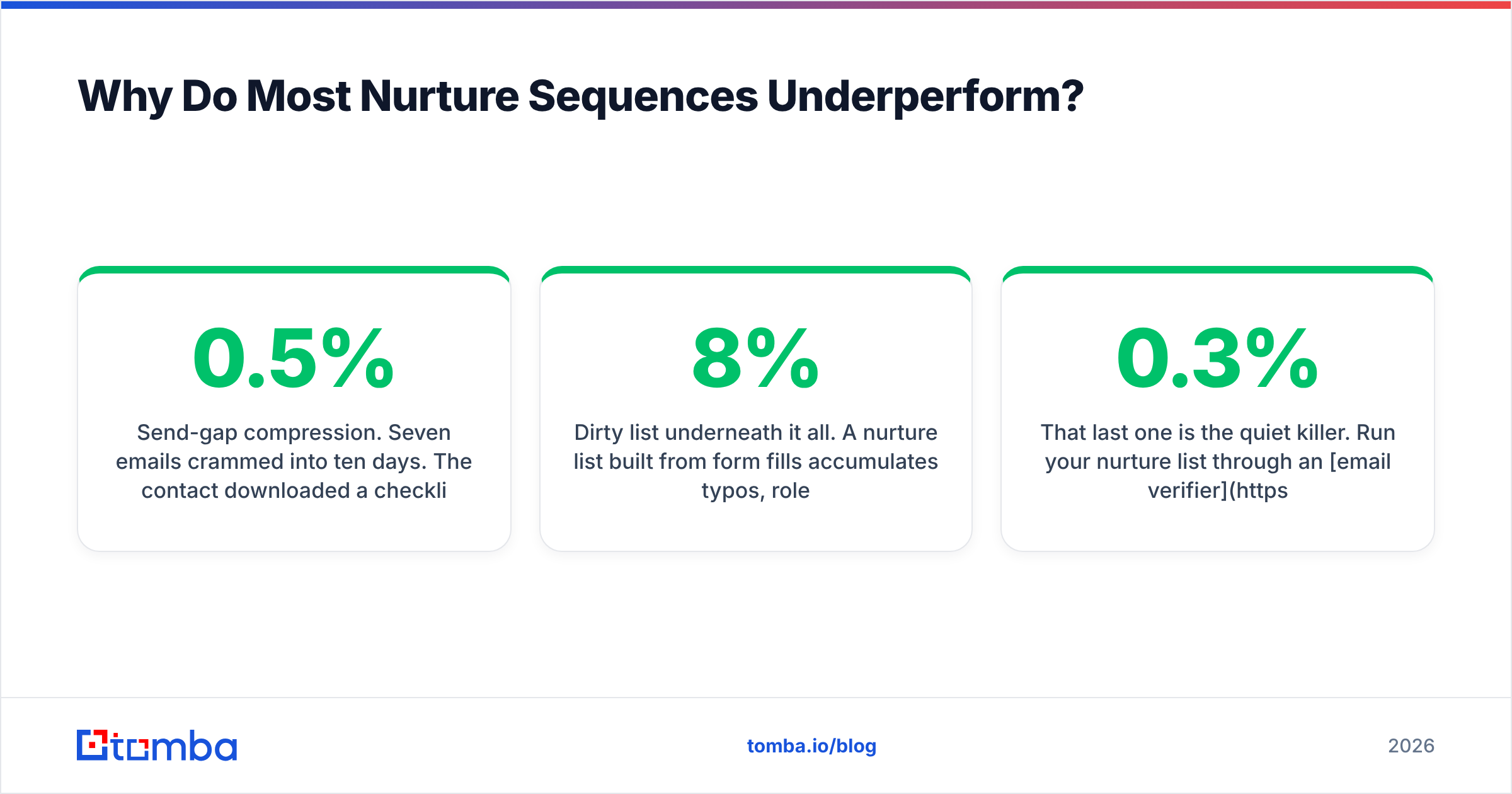
- Send-gap compression. Seven emails crammed into ten days. The contact downloaded a checklist; they did not ask for a pen pal. Unsubscribe rates above 0.5% per send are the tell.
- No behavioral branch. Everyone gets the same email four whether they clicked twice or never opened. You're spending your best asset on people who aren't reading, and repeating basics to people who are ready.
- Sales handoff never happens. The sequence ends with "check out our blog" instead of a person. Mid-funnel nurture exists to produce conversations, not pageviews.
- Dirty list underneath it all. A nurture list built from form fills accumulates typos, role accounts, and departed employees. Six months in, 8% of your list bounces, your domain reputation drops, and every campaign from that domain — including the cold outbound your SDRs run — starts landing in Promotions.
That last one is the quiet killer. Run your nurture list through an email verifier before any re-engagement push, and re-verify quarterly. Google's own sender guidelines put spam complaint rates under 0.3% as a hard requirement — nurture lists drift over that line faster than cold lists because people forget they ever signed up.
What Does a Lead-Magnet Nurture Sequence Look Like?#
This is the workhorse. Someone downloaded a template, guide, or calculator. They are interested in a problem, not in you.
Sequence length: 5 emails over 18 days. Exit: reply, meeting booked, or pricing page visit (which routes them to a sales-triggered sequence instead).
Email 1 — immediate. Deliver and set expectations.
Subject: Your [asset name] (+ the one section people skip)
Here's the [asset]: [link]
Most people jump straight to section 3. The part that actually changes the number is section 1 — the assumptions table. Fill that in first or the rest is guesswork.
If you get stuck, reply and tell me what you're trying to figure out. I read these.
Plain text. No header image. Deliverability on email 1 sets the inbox placement pattern for the rest of the sequence.
Email 2 — day 2. Adjacent problem, zero pitch.
Reference the asset, then teach one specific thing they'll hit next. If the download was a cold email template pack, email 2 is about how often the sending domain is the reason replies dried up — not the copy.
Email 3 — day 5. Proof, sized to their segment.
A short customer story with a number in the first line. "A 12-person agency went from 40 to 190 qualified replies a month after fixing two things." Not a case-study PDF. Three sentences and a link.
Email 4 — day 10. Branch here.
- Clicked email 2 or 3: soft offer. "Want me to look at your setup? 15 minutes, I'll tell you what I'd change."
- Opened, no clicks: resend the asset with a different angle in the subject line.
- No opens: switch subject-line style entirely and send from a different sender name on the same domain.
Email 5 — day 18. The permission close.
Subject: Should I stop?
I've sent you a few things since you grabbed the [asset]. If this isn't useful, reply "stop" and I'll take you off — no hard feelings.
If it is useful, the one thing I'd do next is [specific action]. Happy to walk through it.
The "should I stop" email reliably outperforms every other email in the sequence on reply rate. It works because it's the only one that asks a question the reader can answer in one word.
How Do the Five Core Sequences Compare?#
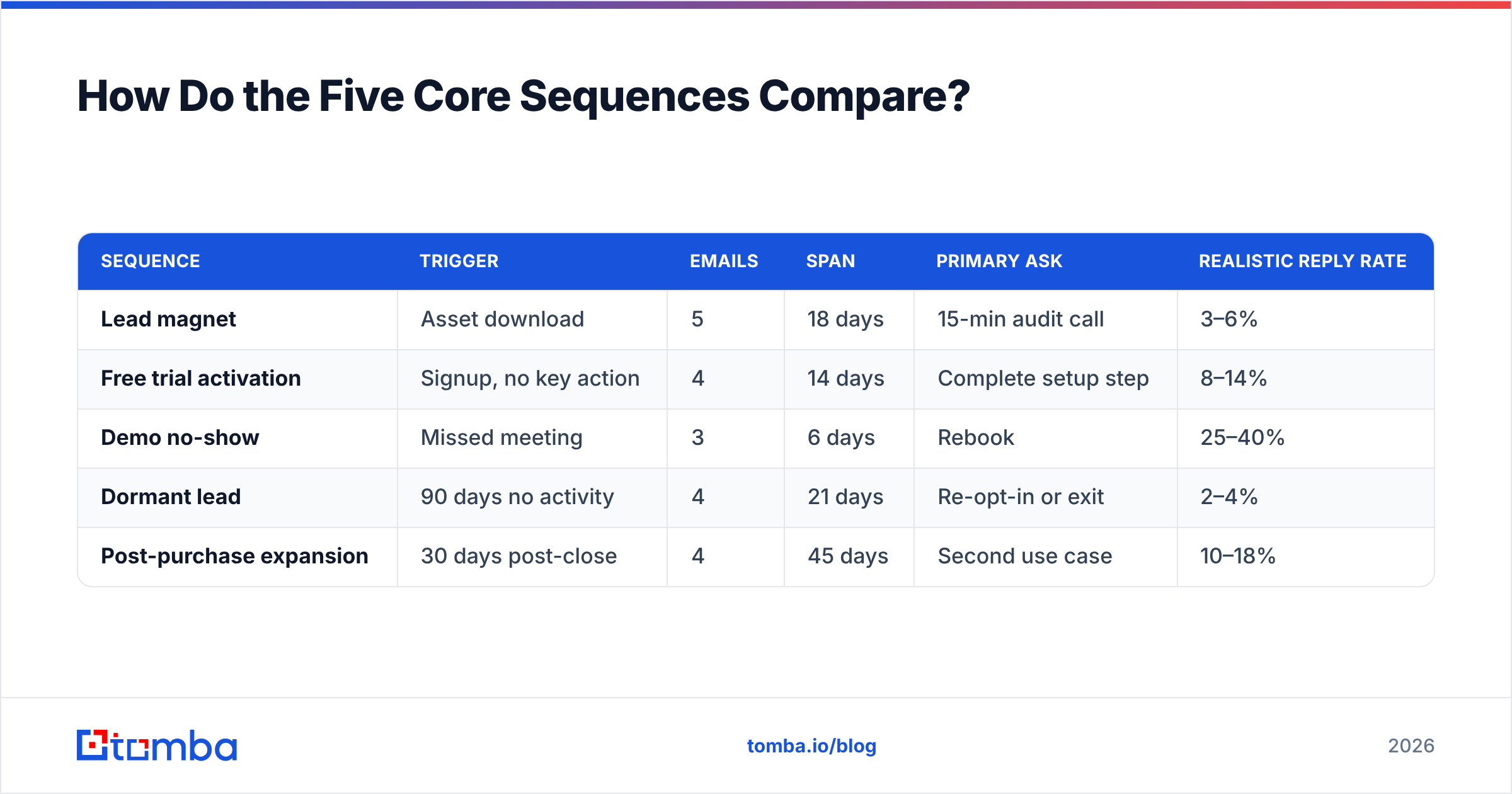
Different triggers demand different pacing and different asks. Here's how the five sequences most B2B teams need actually differ:
| Sequence | Trigger | Emails | Span | Primary ask | Realistic reply rate |
|---|---|---|---|---|---|
| Lead magnet | Asset download | 5 | 18 days | 15-min audit call | 3–6% |
| Free trial activation | Signup, no key action | 4 | 14 days | Complete setup step | 8–14% |
| Demo no-show | Missed meeting | 3 | 6 days | Rebook | 25–40% |
| Dormant lead | 90 days no activity | 4 | 21 days | Re-opt-in or exit | 2–4% |
| Post-purchase expansion | 30 days post-close | 4 | 45 days | Second use case | 10–18% |
Two observations from that table. First, demo no-show recovery is the highest-ROI sequence you can build and almost nobody automates it — the contact already agreed to talk to you, so a three-email rebook sequence over six days converts at rates the rest of your funnel can't touch. Second, dormant-lead sequences have terrible reply rates by design; their job is list hygiene as much as revenue. A 2% reply rate plus a clean removal of the other 98% is a win.
The free-trial activation sequence, in detail#
Email 1 (hour 1): one action, one link. Not a feature tour. "You're in. The fastest first win is running one domain through search — here's the 40-second version."
Email 2 (day 3, only if the action wasn't taken): remove the obstacle. "Most people stall here because of [specific thing]. Here's how to get past it."
Email 3 (day 7): show the outcome someone similar got in week one. Segment by company size if you have it.
Email 4 (day 12, trial ending): the honest ask. "Your trial ends Friday. If it's not a fit, tell me what was missing — that feedback is genuinely useful. If it is, here's the plan that matches your volume."
Trial sequences fail when they're written by product marketing and describe features. They work when they're written to get one specific action completed, because activation predicts retention far better than engagement does.
How Do You Get Nurture Contacts in the First Place?#
Two sources, and they behave differently.
Inbound. Form fills, content downloads, webinar registrations. High intent, low volume, and — this is the part teams underestimate — full of junk. People type gmial.com. They use info@. They enter a personal address and then never check it. Before a form-fill list enters a sequence, it should be verified and enriched, or you're nurturing a mailbox nobody reads.
Outbound-sourced. Contacts you found and qualified yourself. These need a shorter, more direct sequence with an explicit reason-for-reaching-out in email 1, since there's no prior relationship to reference. Build these lists with a domain search against target accounts, then verify before the first send.
For either source, contact enrichment is what makes branching possible. You can't segment by company size, role seniority, or tech stack if all you have is an email address and a first name. The branch logic in email 4 above only works if the record has attributes to branch on.
One practical note on catch-all domains: a large share of enterprise B2B domains accept everything at the SMTP layer, so a standard verifier returns "unknown" rather than valid or invalid. Those contacts shouldn't be dropped — they should be routed to a catch-all verifier and, if still ambiguous, sent through a shorter, lower-volume version of the sequence so a bounce cluster doesn't hit your main domain.
What Timing and Cadence Actually Work?#
Start from the trigger's urgency, not from a template.
- Hot triggers (demo no-show, pricing page visit, trial signup): first email within 1 hour, then 48-hour gaps. Interest decays fast and the contact still remembers the context.
- Warm triggers (content download, webinar attendance): first email immediate, then 2 → 3 → 5 → 8 day gaps. Widening intervals signal patience rather than desperation.
- Cold triggers (dormant lead, list re-engagement): 5 → 7 → 9 day gaps, maximum four emails, and an explicit opt-out ask in the last one.
- Post-purchase: 7 → 14 → 21 day gaps. Nobody wants an upsell in week one.
- Send windows: Tuesday–Thursday, 8–10am in the recipient's timezone, holds up across most B2B datasets — but your own reply-time data beats any benchmark. Pull the timestamps of your last 200 replies and send into that window.
- Hard cap: no more than 2 emails to the same contact in any 7-day window across all sequences. This requires a global frequency rule, not per-sequence logic, and it's the single most common gap in marketing automation setups.
The compounding cost of ignoring rule 6: contacts enrolled in three sequences at once receive a burst, mark it as spam, and take your sender reputation down with them. HubSpot's research on email frequency consistently finds unsubscribe rates climbing sharply past two sends per week for non-newsletter audiences.
Which Metrics Tell You a Sequence Is Broken?#
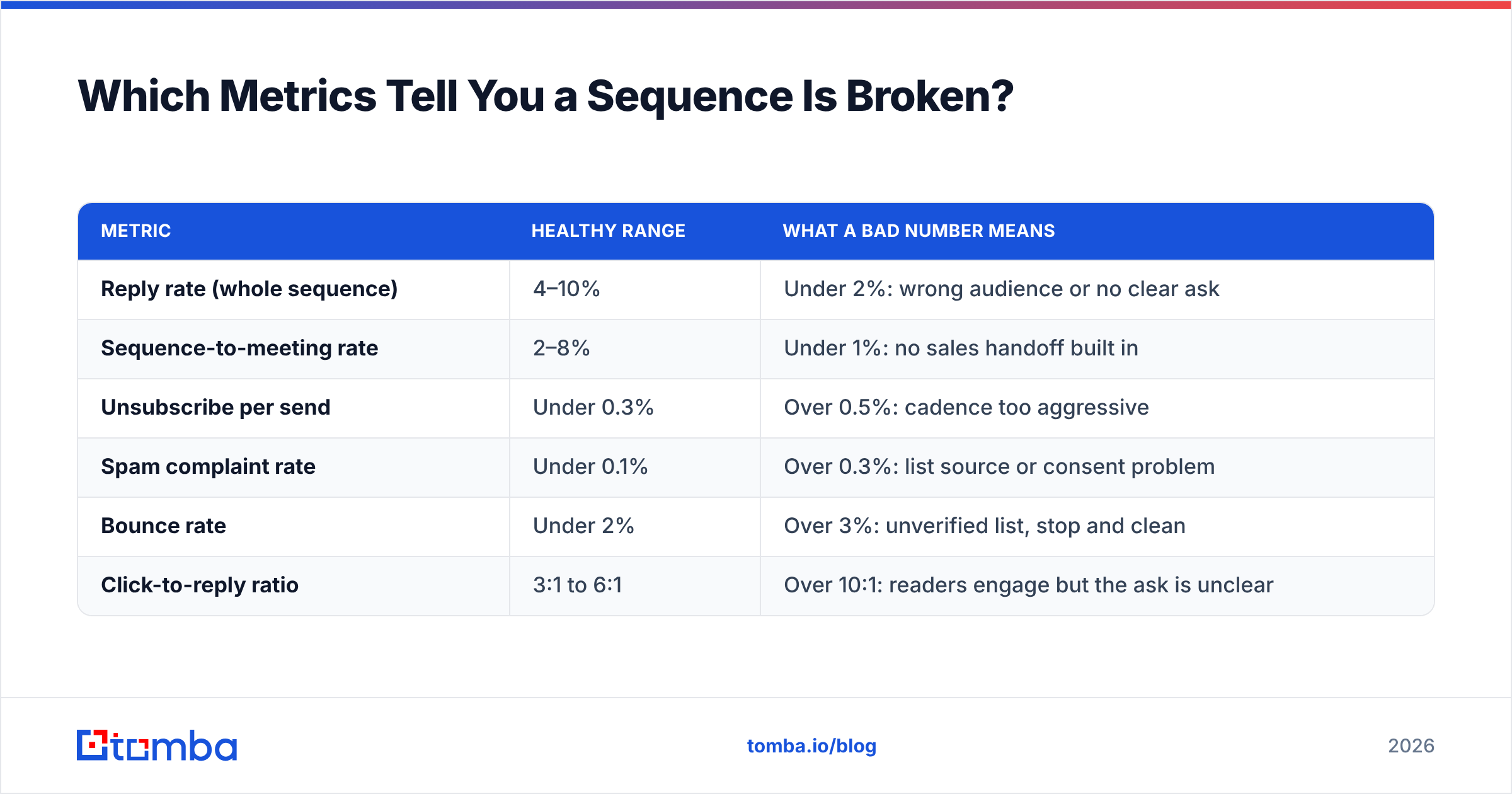
Open rate is now close to useless as a primary signal — Apple Mail Privacy Protection inflates it and mailbox providers pre-fetch images. Judge sequences on these instead:
| Metric | Healthy range | What a bad number means |
|---|---|---|
| Reply rate (whole sequence) | 4–10% | Under 2%: wrong audience or no clear ask |
| Sequence-to-meeting rate | 2–8% | Under 1%: no sales handoff built in |
| Unsubscribe per send | Under 0.3% | Over 0.5%: cadence too aggressive |
| Spam complaint rate | Under 0.1% | Over 0.3%: list source or consent problem |
| Bounce rate | Under 2% | Over 3%: unverified list, stop and clean |
| Click-to-reply ratio | 3:1 to 6:1 | Over 10:1: readers engage but the ask is unclear |
The click-to-reply ratio is the underrated one. Lots of clicks and no replies means people find your content interesting and your request confusing. Fix the last two sentences of each email before you touch anything else.
Track these per-email, not just per-sequence. A sequence with a 5% overall reply rate might be four dead emails and one that works — and knowing which one lets you cut the other four and double your send-to-reply efficiency overnight.
How Do You Build These Without a Six-Month Project?#
Three-week build, in order:
Week 1 — data. Export your current list. Verify it. Segment by source, role, and last activity date. Kill contacts with no engagement in 12 months rather than trying to reactivate everyone; the reactivation sequence should be a scalpel, not a shotgun. Enrich what survives so branching is possible.
Week 2 — write two sequences, not five. Start with demo no-show (highest conversion, three emails, ships in a day) and lead-magnet follow-up (highest volume). Write them in plain text. Read every email out loud; if you wouldn't say the sentence to someone at a conference, delete it.
Week 3 — instrument and launch. Set exit conditions before you turn anything on. Set the global 2-per-7-days frequency cap. Route replies to a human inbox that's actually monitored. Then enroll 50 contacts, not 5,000, and read the first replies yourself.
For teams comparing platforms to run this on, G2's marketing automation category is a reasonable neutral starting point — but the platform matters far less than the list quality feeding it. A mediocre tool with a verified, enriched list outperforms an enterprise suite pointed at stale form fills every time.
If you're sourcing new contacts to feed these sequences, the Tomba Email Finder gets you verified, role-matched addresses by domain, name, or company — with a free tier of 25 searches a month to test the accuracy on accounts you already know, and paid plans from $49/mo when you're ready to scale. Verify first, sequence second; every nurture metric on this page depends on that order.
Related guides#
Ready to find emails that actually work?
Join 150,000+ professionals who stopped guessing and started sending. Free credits on signup — no credit card required.
Get the Tomba newsletter
Practical outbound tactics and product updates — once every two weeks.
About the author