Email Opening Lines That Get Replies: 2026 Guide
Your first sentence decides whether the rest of the email gets read. Here are the email opening lines that actually earn replies in 2026 — plus the ones burning your list.
TL;DR
- Your opening line is read in the preview pane before the email is opened. It is not a warm-up — it is the second subject line.
- "I hope this email finds you well" and "My name is X from Y" are the two highest-cost openers in B2B. They spend the reader's attention on nothing.
- The four opener patterns that consistently outperform: the observed trigger, the specific compliment with proof, the peer reference, and the direct problem statement.
- Personalization only works when it's verifiable and recent. A researched line on a bad email address still bounces — clean data comes first.
- Test openers as a variable in isolation. Same subject line, same body, same CTA, 200+ sends per variant before you call it.
What Are Email Opening Lines, and Why Do They Decide the Reply?#
An email opening line is the first sentence of the body — the one that appears in the inbox preview text right after the subject line. In Gmail, Outlook, and every mobile client, that preview shows roughly 40–90 characters of your first sentence before the reader has decided anything.
Think of it like the first ten seconds of a phone call. The subject line got the phone picked up. The opening line is what you say before "hello?" turns into "who is this?" If you spend that moment on pleasantries, you have already told the reader this message is about you.
The mechanical reality in 2026: most B2B inboxes are triaged on mobile, in bulk, with a thumb. The reader is not evaluating your argument. They are answering one binary question — is this about me, or about the sender? Your opening line answers it in under two seconds.
That's why openers are measured differently from subject lines. A subject line drives open rate. An opening line drives the reply rate — the metric that actually maps to pipeline.
Which Email Opening Lines Should You Delete Immediately?#
Four categories account for most of the damage. Each one has a specific failure mode.
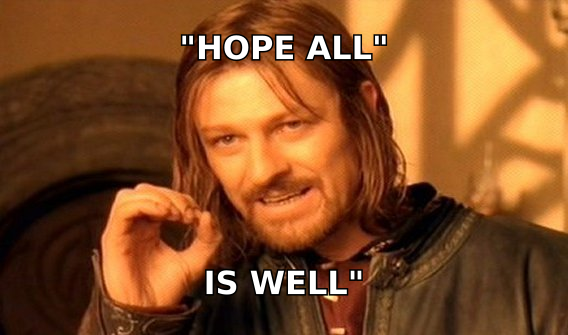
- The wellness pleasantry. "I hope this email finds you well." It's not offensive — it's invisible. Worse, it burns your entire preview-text allowance on a phrase that appears in millions of other emails that morning. The reader's pattern-matcher classifies it as bulk before the second sentence.
- The self-introduction. "My name is Sarah and I'm an Account Executive at Acme." Your name is already in the From field. Your title tells the reader you're paid to send this. Introductions belong after you've earned twenty seconds, not before.
- The fake-familiar hook. "Quick question for you!" or "Not sure if you're the right person…" These signal a template. Prospects who receive twenty cold emails a week have seen every one of these openers this month.
- The unearned compliment. "I love what you're doing at [Company]!" with nothing behind it. If the compliment could be pasted into any company's email unchanged, it reads as automated flattery — which is worse than no personalization at all.
The unifying flaw: all four are sender-centric. They cost the reader attention and return nothing.
What Are the Best Email Opening Line Patterns in 2026?#
Here are the four patterns that survive contact with a skeptical inbox, with the structure and a real-shaped example for each.
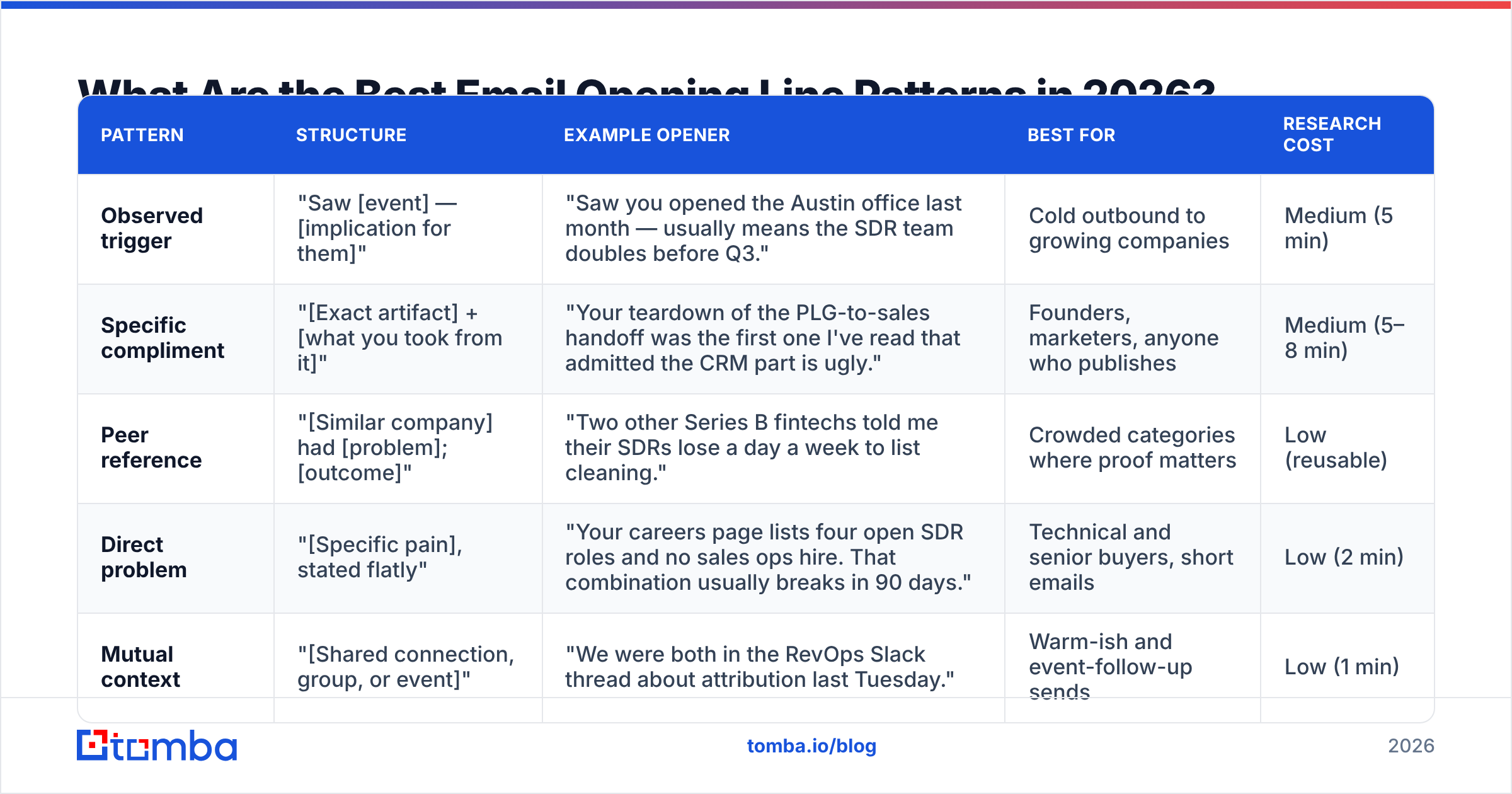
| Pattern | Structure | Example opener | Best for | Research cost |
|---|---|---|---|---|
| Observed trigger | "Saw [event] — [implication for them]" | "Saw you opened the Austin office last month — usually means the SDR team doubles before Q3." | Cold outbound to growing companies | Medium (5 min) |
| Specific compliment | "[Exact artifact] + [what you took from it]" | "Your teardown of the PLG-to-sales handoff was the first one I've read that admitted the CRM part is ugly." | Founders, marketers, anyone who publishes | Medium (5–8 min) |
| Peer reference | "[Similar company] had [problem]; [outcome]" | "Two other Series B fintechs told me their SDRs lose a day a week to list cleaning." | Crowded categories where proof matters | Low (reusable) |
| Direct problem | "[Specific pain], stated flatly" | "Your careers page lists four open SDR roles and no sales ops hire. That combination usually breaks in 90 days." | Technical and senior buyers, short emails | Low (2 min) |
| Mutual context | "[Shared connection, group, or event]" | "We were both in the RevOps Slack thread about attribution last Tuesday." | Warm-ish and event-follow-up sends | Low (1 min) |
A few notes on choosing between them:
- Observed trigger wins when timing is the whole argument — funding, hiring, a product launch, a leadership change.
- Specific compliment only works with a real artifact. Cite the title, the argument, or a line. Vague praise is worse than none.
- Peer reference is the most scalable, because the research is done once per segment rather than once per prospect.
- Direct problem is underused and performs disproportionately well with engineering, finance, and C-level readers who prefer bluntness to warmth.
- Mutual context is the highest-converting of the five but has the smallest addressable list.
How Long Should an Opening Line Be?#
Under 15 words, ideally under 12. The preview pane truncates around 90 characters on desktop Gmail and closer to 45 on iOS Mail. If your value signal lands at word 22, the reader never saw it.
Write the opener, then cut every word that doesn't carry information. "I was doing some research on your company and noticed that you recently" → "Saw."
Is Personalization Still Worth the Time in 2026?#
Yes — but only the kind that is verifiable, recent, and specific. Generic personalization tokens have been fully commoditized by AI writing tools, which means the appearance of personalization now signals automation rather than effort.
The test: could this sentence be true of 500 other companies? If yes, it isn't personalization — it's a mail merge with extra steps.
There's a tiering approach that keeps this economically sane:
- Tier 1 (top 50 accounts): 8–10 minutes of research each. Observed trigger or specific compliment. Written by a human.
- Tier 2 (next 500): 2 minutes each. Peer reference or direct problem, with one verifiable detail — headcount, tech stack, job posting.
- Tier 3 (long tail): Segment-level personalization only. One opener per persona per industry, no per-contact research.
Research from HubSpot's sales data and buyer-behavior work published by Gartner both point the same direction: relevance to the buyer's current situation outperforms surface-level customization. The opener is where that relevance is proven or lost.
And one hard prerequisite most guides skip: a perfect opening line on a bad address is worth zero. If your bounce rate is above 3%, opener testing is noise — you're measuring deliverability, not copy. Clean the list first with an email verifier, then optimize the words. If you're prospecting into companies rather than named individuals, domain search gets you the verified contact set before you spend a minute on research.
How Do You Write Opening Lines for Follow-Ups?#
Follow-ups have a different job. The reader has already ignored you once, so the opener has to add new information — not re-request attention.
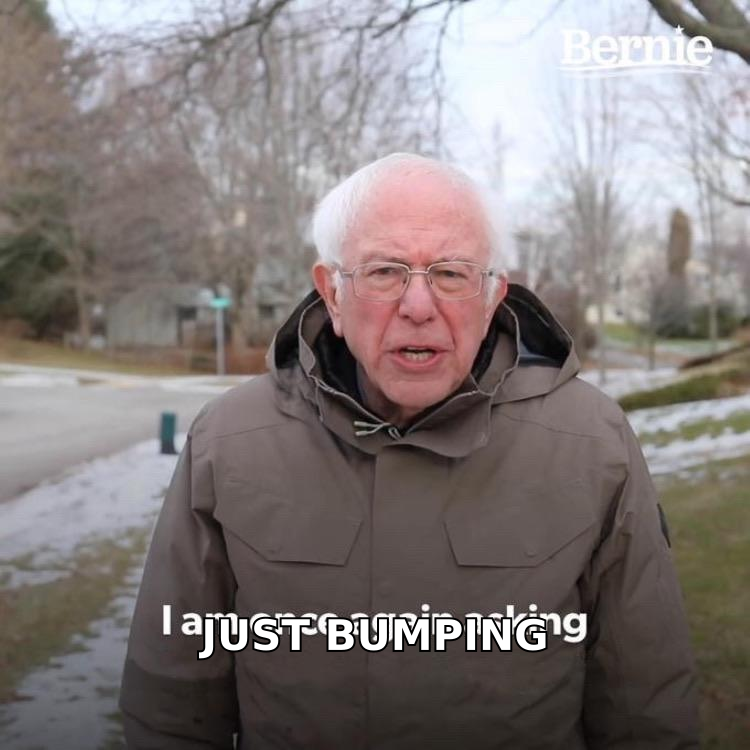
Delete these: "Just following up." "Bumping this to the top of your inbox." "Did you see my last email?" All three explicitly tell the reader that this message contains nothing new.
Use these instead:
- New information. "Your competitor just shipped the same integration — different angle than last time." Gives a reason for the email to exist.
- Reframe the ask. "Wrong ask last time. Not a demo — just whether list hygiene is even on the roadmap this quarter."
- Permission close. "Assuming this isn't a priority — should I close the file?" Loss aversion does real work here, and the reply rate on breakup emails is often the highest in the sequence.
- Value drop. "Pulled the three fintechs in your segment that solved this. No ask, just thought it was useful."
Sequence math matters too. If every follow-up opens with a reference to the previous email, you've built a sequence about your emails rather than the prospect's problem. Each message should stand on its own — a reader who never saw email one should still understand email three.
How Do You Test Email Opening Lines Properly?#
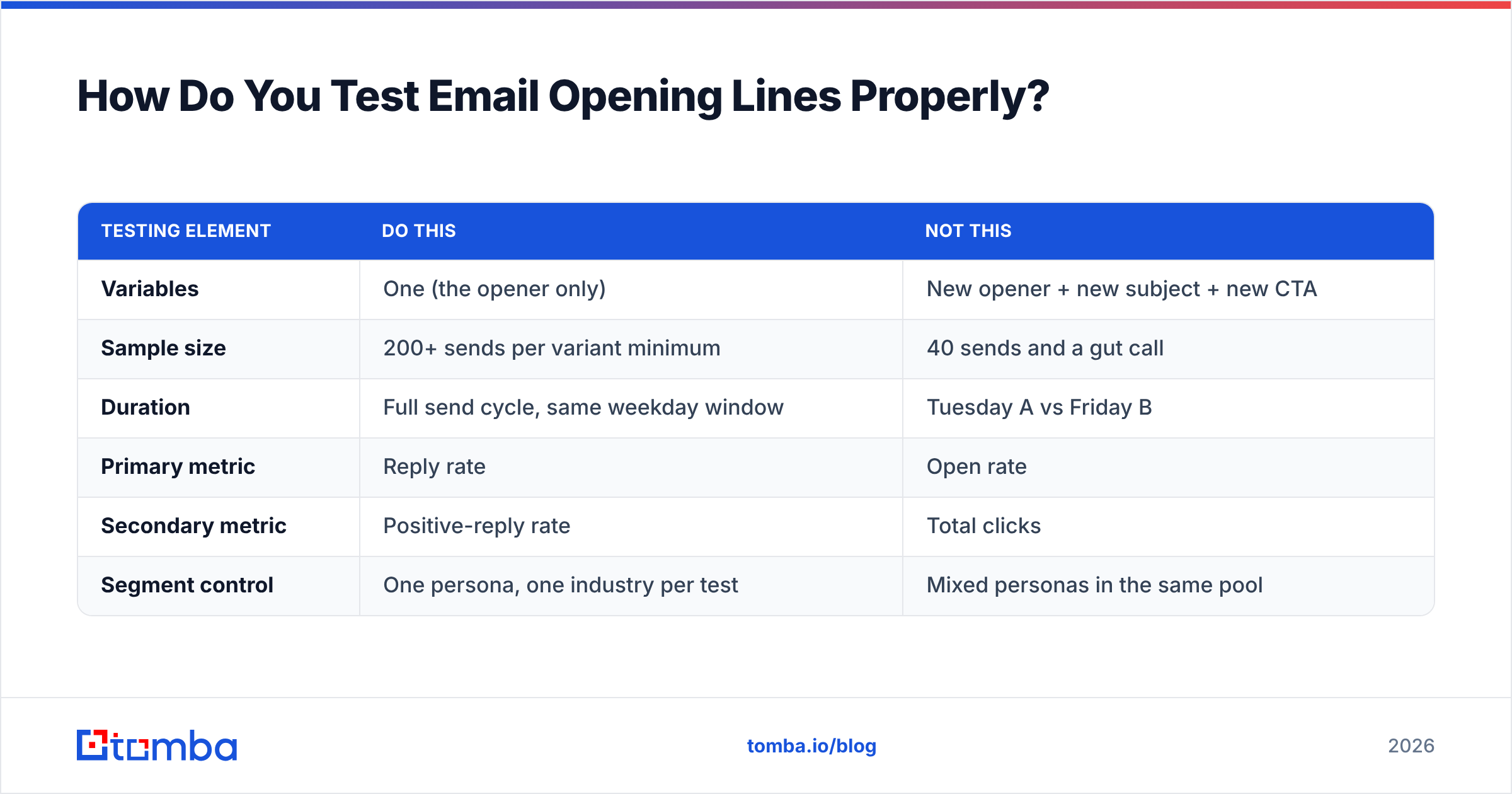
Most teams "test" openers by changing the whole email and declaring a winner. That produces confident nonsense. Here's the discipline:
| Testing element | Do this | Not this |
|---|---|---|
| Variables | One (the opener only) | New opener + new subject + new CTA |
| Sample size | 200+ sends per variant minimum | 40 sends and a gut call |
| Duration | Full send cycle, same weekday window | Tuesday A vs Friday B |
| Primary metric | Reply rate | Open rate |
| Secondary metric | Positive-reply rate | Total clicks |
| Segment control | One persona, one industry per test | Mixed personas in the same pool |
Reply rate is the metric because the opener's job is to convert an open into a read, and a read into a response. Open rate is contaminated by Apple Mail Privacy Protection and pre-fetch bots, and has been unreliable as a standalone signal for years.
Track positive reply rate separately. An opener that provokes "please remove me" is generating replies while destroying sender reputation. Volume of replies is not the goal; volume of conversations is.
A practical cadence: run one opener test per persona per month. Keep a winners file. Retire any opener that's been in rotation more than a quarter — patterns get burned as competitors copy them, and what worked in January reads as templated by April.
What Does a Complete Opener-to-CTA Email Look Like?#
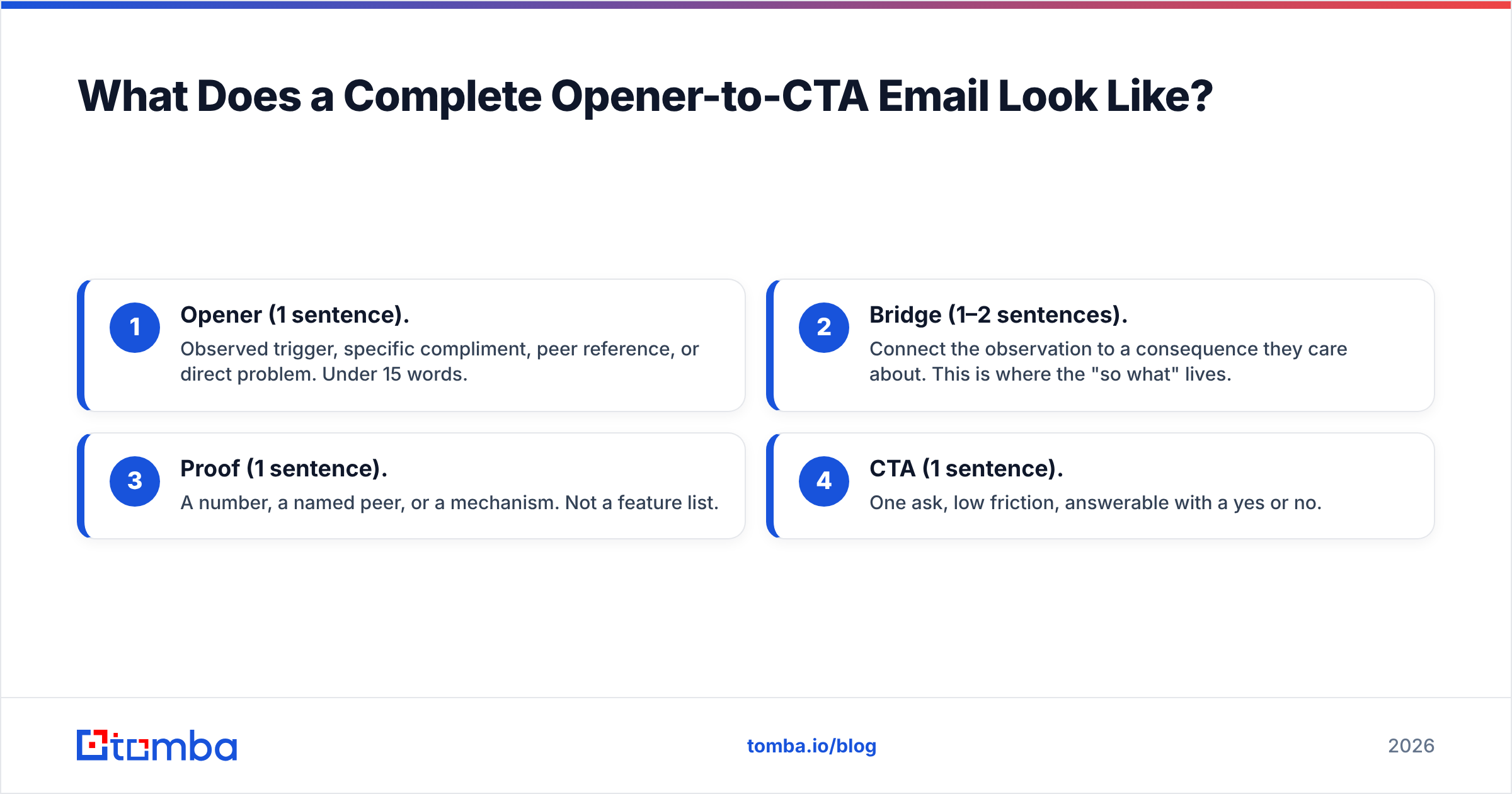
Structure beats inspiration. A working cold email has four moves, and the opener is only the first.
- Opener (1 sentence). Observed trigger, specific compliment, peer reference, or direct problem. Under 15 words.
- Bridge (1–2 sentences). Connect the observation to a consequence they care about. This is where the "so what" lives.
- Proof (1 sentence). A number, a named peer, or a mechanism. Not a feature list.
- CTA (1 sentence). One ask, low friction, answerable with a yes or no.
Worked example:
Saw you posted three SDR roles in two weeks and no ops hire alongside them.
Usually that means whoever's building lists is about to become the bottleneck — new reps burn their first month on data instead of conversations.
Two other Series B teams cut list-building time by roughly 60% by verifying before import instead of after bounces.
Worth a 10-minute look at how your list flow works today?
Total: 71 words. The opener does one job — prove this email was written about them — and then gets out of the way.
If you want a starting library rather than a blank page, the cold email templates collection covers the standard sequence shapes, and the subject line generator pairs with opener testing since the two are read as a single unit in the inbox.
Which Tools Help You Get Opening Lines Right?#
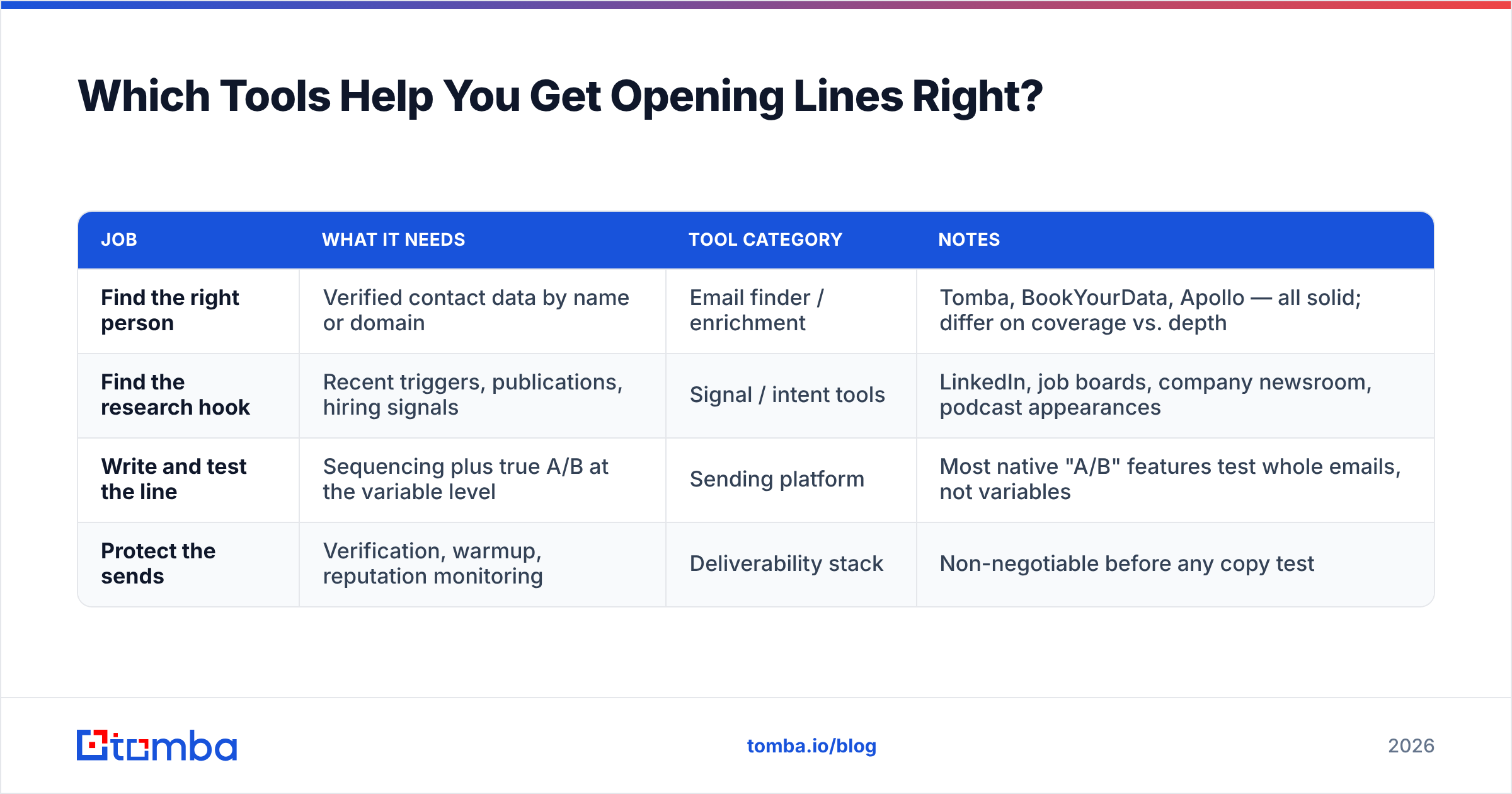
There are three distinct jobs, and most teams conflate them.
| Job | What it needs | Tool category | Notes |
|---|---|---|---|
| Find the right person | Verified contact data by name or domain | Email finder / enrichment | Tomba, BookYourData, Apollo — all solid; differ on coverage vs. depth |
| Find the research hook | Recent triggers, publications, hiring signals | Signal / intent tools | LinkedIn, job boards, company newsroom, podcast appearances |
| Write and test the line | Sequencing plus true A/B at the variable level | Sending platform | Most native "A/B" features test whole emails, not variables |
| Protect the sends | Verification, warmup, reputation monitoring | Deliverability stack | Non-negotiable before any copy test |
On the data layer specifically: coverage and accuracy are what determine whether your researched opener ever gets read. Tomba pricing starts with a free tier at 25 searches per month, then $49/mo (Starter), $99/mo (Growth), and $249/mo (Pro), which puts per-contact costs low enough that Tier-2 personalization stays viable at volume. BookYourData takes a different approach with pay-as-you-go credits and a strong verified-database angle — a good fit if you'd rather buy a clean list outright than run searches. Check both against your own ICP with a sample before committing; vendor-reported accuracy is a starting point, not evidence. Third-party review data on G2 is useful for spotting consistent complaints across a category.
For the research hook itself, no tool replaces reading. Job postings, earnings calls, and the prospect's own published work are where the non-generic openers come from. If your prospects write, the author finder turns an article byline into a contact — which is the cleanest path from "I read your piece" to actually reaching the person who wrote it.
Common Questions About Email Opening Lines#
Should I use the prospect's first name in the opener? It's neutral. Name tokens are so common that they neither help nor hurt. What matters is the sentence after the comma.
Do questions work as opening lines? Only if the question is specific enough that it couldn't be asked of anyone else. "Quick question about your Q3 hiring plan given the four open SDR roles" works. "Quick question for you" doesn't.
How different should openers be across a sequence? Completely different. Each email in a sequence should use a different pattern — trigger, then peer reference, then direct problem. Repetition of structure reads as automation even when the words change.
Does AI-written personalization work? It works for drafting and fails for judgment. AI is good at rephrasing a hook you found; it's bad at deciding which hook matters. Use it after the research, not instead of it.
What about emoji or lowercase openers? Lowercase can work in founder-to-founder outreach and reads as sloppy everywhere else. Skip emoji in B2B cold outreach — some filters weight them, and the upside is marginal.
Start With Data That Actually Delivers#
The best opening line in your library is worthless if it lands on an address that bounces. Sequence the work correctly: verified contacts first, researched hook second, tested opener third.
Start by building a clean, verified contact list with the Tomba Email Finder — search by name, company, or domain, get confidence-scored results, and export straight into your sequencer. The free tier gives you 25 searches a month to test coverage against your own ICP before you pay anything. Then spend your research time where it compounds: on the first sentence.
Related guides#
Ready to find emails that actually work?
Join 150,000+ professionals who stopped guessing and started sending. Free credits on signup — no credit card required.
Get the Tomba newsletter
Practical outbound tactics and product updates — once every two weeks.
About the author