Email Opening Lines That Get Replies: 2026 Playbook
Most cold emails die in the first nine words. Here are the opening-line patterns that still earn replies in 2026, the ones that quietly tank your reply rate, and how to test them without burning your list.
TL;DR
- Your opening line has one job: buy the second sentence. It is not where you pitch, and it is not where you introduce yourself.
- The openers that still work in 2026 are observation-led (something true about their world), trigger-led (something that just changed), or peer-led (someone like them did something). Everything else is filler.
- "I hope this email finds you well," "My name is X and I work at Y," and "I'll keep this brief" are reply-rate taxes. Cut them and you gain a line of real content for free.
- Personalization only pays when the personalized fact is relevant to the problem you solve. A compliment about their podcast does nothing for a procurement pitch.
- No opener survives bad data. A great first line sent to a bounced or role-based inbox scores zero. Fix deliverability and contact accuracy before you A/B test adjectives.
What makes an email opening line actually get replies?#
An opening line earns a reply when it proves, in under fifteen words, that a human who understands the recipient's situation wrote this specific email.
That is the whole mechanism. Think of it like a doorstep conversation. If a stranger knocks and opens with "How are you today?", you already know a script is coming and you start closing the door. If they open with "Your gutter is detaching above the porch — I noticed it from the street," you listen, because they clearly looked at your house.
Technically, three things are happening at once in a strong opener:
- Relevance signal. The reader's brain runs a fast binary check: is this about me, or about the sender? Openers that start with "I," "We," or "Our" fail this check in the first token.
- Effort signal. Something in the sentence could not have been auto-generated for 5,000 people. That single fact is what separates a read from an archive.
- Curiosity debt. The line should leave a small gap the next sentence closes. Complete, self-contained openers give the reader permission to stop.
Miss all three and it doesn't matter how sharp your CTA is. Most prospects decide in the preview pane, where they see your subject line, sender name, and roughly the first 40–90 characters of body copy depending on client. That preview is your opening line.
Why do most cold email opening lines fail?#
Because they are written to make the sender comfortable, not to make the reader curious.
Here are the five failure patterns that show up in almost every underperforming sequence:
- The throat-clear. "I hope this email finds you well." It's polite wallpaper. It burns your entire preview-pane budget saying nothing, and experienced buyers read it as a template tell.
- The résumé. "My name is Sam and I'm the Head of Growth at Acme, a platform that helps..." Nobody asked. Your identity is in the signature and the sender field.
- The fake familiarity. "Just following up on my last note!" when there was no prior relationship. It reads as manipulation and it damages trust for the whole sequence.
- The permission ask. "Do you have 15 minutes this week?" in sentence one. You've asked for a commitment before you've earned a second of attention.
- The AI-generated compliment. "I was really impressed by Acme's commitment to innovation." Generic praise scraped from a homepage is now instantly recognizable, and in 2026 it actively signals automation.
There's also a quieter failure that has nothing to do with copy: the email never got seen. If your domain reputation is weak or your list has decayed, your opener is irrelevant because you're landing in spam. Email deliverability is the gate; copy is what happens after you're through it.
Which opening line formulas work in 2026?#
Six patterns consistently outperform in cold outbound. Each one is a template for thinking, not a fill-in-the-blank you should paste verbatim.
- The trigger opener. Anchor on a change: a funding round, a job posting, a new office, a leadership hire, a product launch. Example: "Saw you're hiring three SDRs in Austin this quarter — usually that means the current pipeline math isn't holding." Triggers work because they carry an implicit timestamp: this email is about now.
- The observation opener. State something concretely true about their setup that you actually checked. Example: "Your careers page lists Salesforce and Outreach, but your inbound form still routes to a shared inbox." Specificity is the proof of effort.
- The peer-proof opener. Lead with a comparable company, not with your product. Example: "Two other Series B fintechs in your space moved off manual list-building last quarter for the same reason." Buyers care far more about what similar companies did than what your software does.
- The contrarian opener. Open with a claim they might disagree with. Example: "Most RevOps teams blame low reply rates on copy. It's almost always the data." Disagreement is a reply trigger — people answer to correct you.
- The question-with-a-premise opener. Not "Do you struggle with X?" but a question that assumes a specific situation. Example: "How are you handling verification now that catch-all domains are ~30% of B2B inboxes?" It's answerable in one line, which lowers the cost of replying.
- The one-line referral opener. If you have any connective tissue — a shared investor, a mutual contact, a community — say it first and say it plainly. Example: "Priya at Northwind suggested I reach out about your EU expansion." This outperforms everything else on this list when it's true. Never fake it.
Notice what all six have in common: the word "I" appears late or not at all, and every one of them can be written in under twenty words.
How do the main opener types compare?#
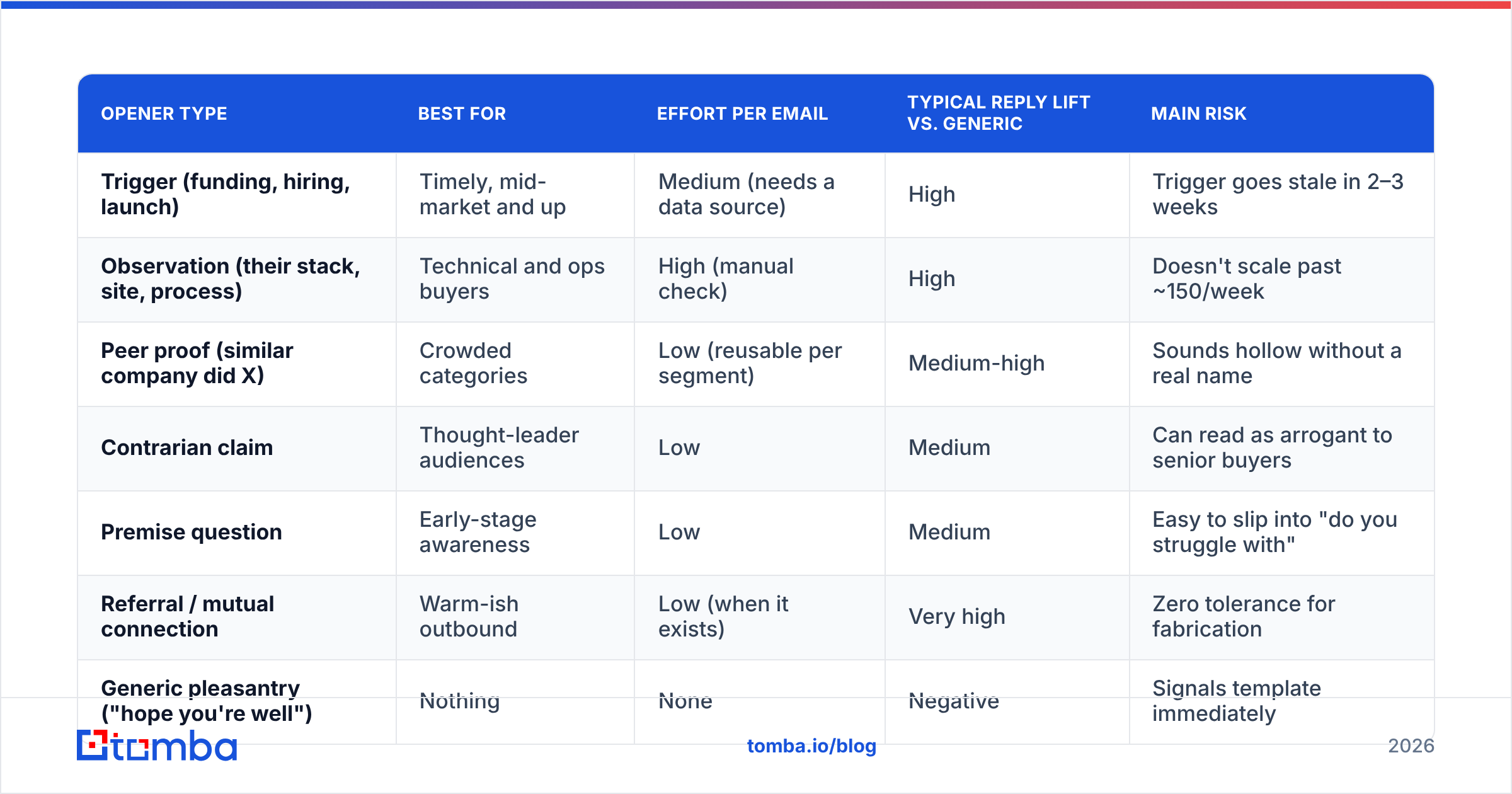
| Opener type | Best for | Effort per email | Typical reply lift vs. generic | Main risk |
|---|---|---|---|---|
| Trigger (funding, hiring, launch) | Timely, mid-market and up | Medium (needs a data source) | High | Trigger goes stale in 2–3 weeks |
| Observation (their stack, site, process) | Technical and ops buyers | High (manual check) | High | Doesn't scale past ~150/week |
| Peer proof (similar company did X) | Crowded categories | Low (reusable per segment) | Medium-high | Sounds hollow without a real name |
| Contrarian claim | Thought-leader audiences | Low | Medium | Can read as arrogant to senior buyers |
| Premise question | Early-stage awareness | Low | Medium | Easy to slip into "do you struggle with" |
| Referral / mutual connection | Warm-ish outbound | Low (when it exists) | Very high | Zero tolerance for fabrication |
| Generic pleasantry ("hope you're well") | Nothing | None | Negative | Signals template immediately |
The practical read on this table: build your sequence from peer proof and premise questions for volume, and reserve observation and trigger openers for your top 20% of accounts where a human can spend three minutes.
Should you personalize every opening line?#
No — and this is where most teams waste the largest amount of time.
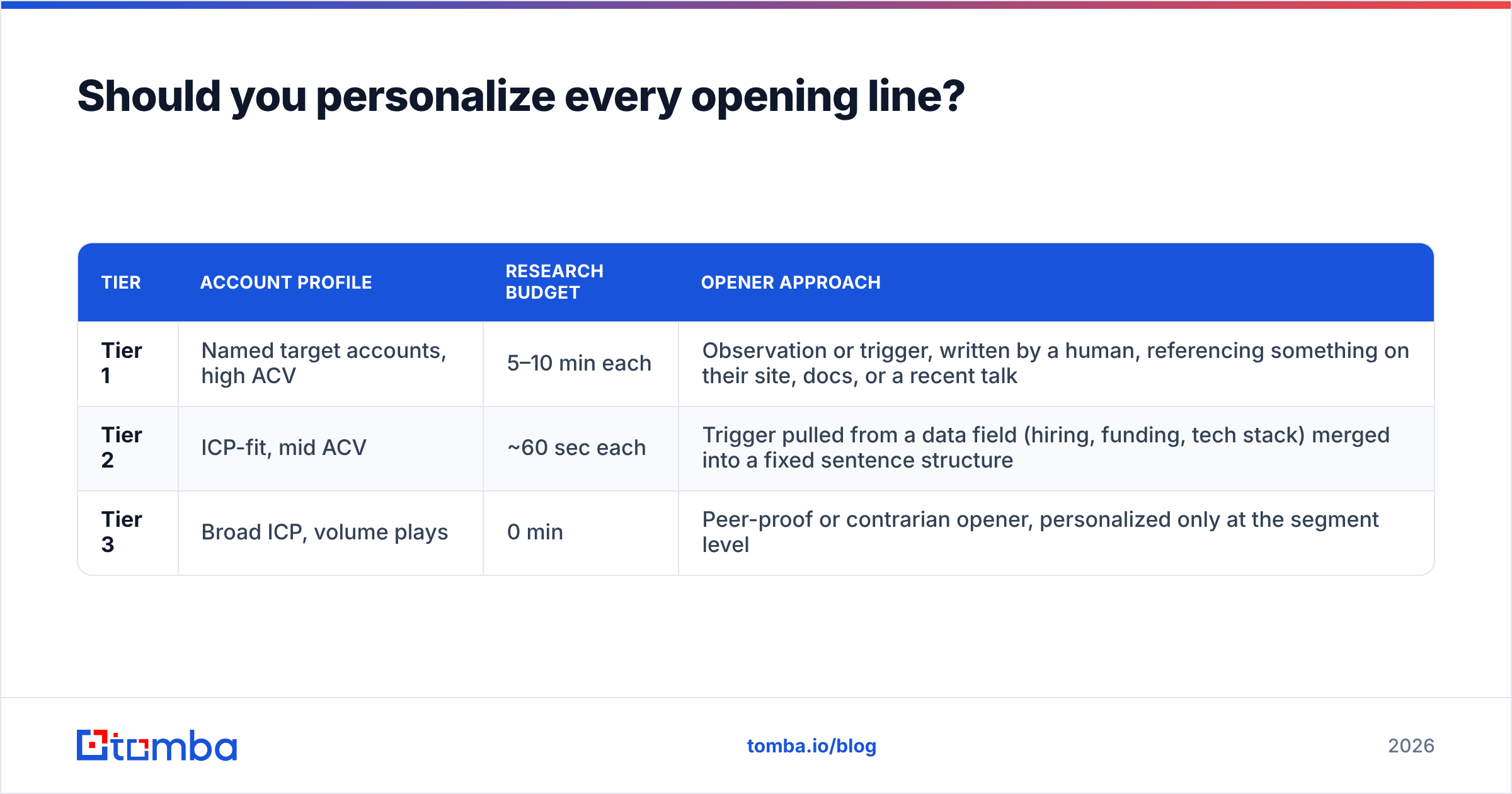
Personalization has a cost curve. Manually researching every prospect gets you a better opener and roughly one-tenth the volume. The correct answer is tiering, not maximalism.
| Tier | Account profile | Research budget | Opener approach |
|---|---|---|---|
| Tier 1 | Named target accounts, high ACV | 5–10 min each | Observation or trigger, written by a human, referencing something on their site, docs, or a recent talk |
| Tier 2 | ICP-fit, mid ACV | ~60 sec each | Trigger pulled from a data field (hiring, funding, tech stack) merged into a fixed sentence structure |
| Tier 3 | Broad ICP, volume plays | 0 min | Peer-proof or contrarian opener, personalized only at the segment level |
The rule that matters: the personalized fact must connect to the problem you solve. Mentioning that their CEO ran a marathon is personalization; it is not relevance. Mentioning that they just posted three SDR roles is both — because it implies a pipeline problem you can speak to.
One more nuance. Segment-level personalization often beats individual-level personalization at scale, because a sentence written for "Series B fintech RevOps leads" can be genuinely sharp, while a scraped individual detail is usually shallow. Teams that publish research on outbound conversations, like the analysts at Gong, consistently find that specificity about the situation moves deals more than trivia about the person.
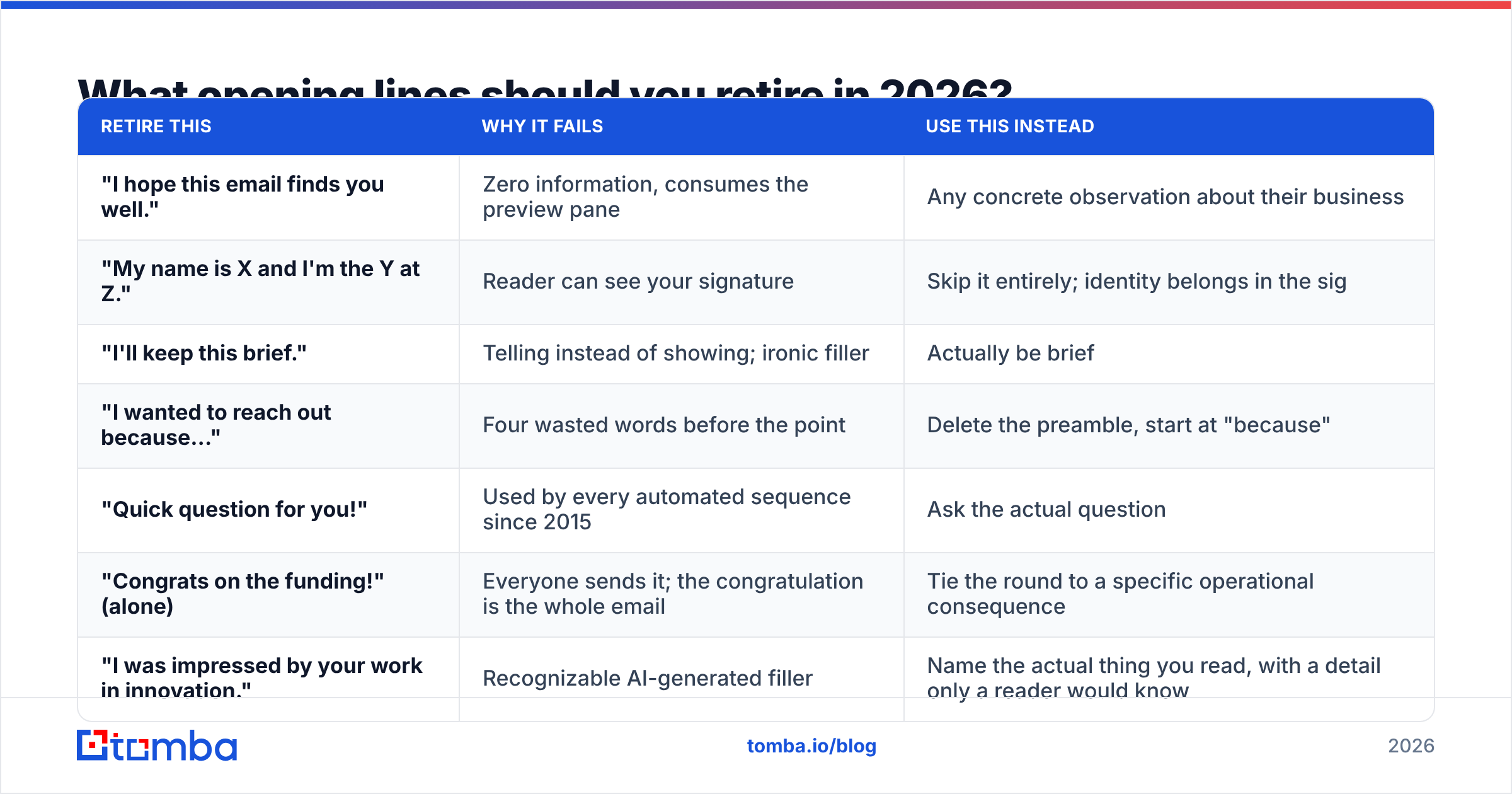
What opening lines should you retire in 2026?#
Kill these on sight. For each one, there's a direct replacement that does the same job without the tax.
| Retire this | Why it fails | Use this instead |
|---|---|---|
| "I hope this email finds you well." | Zero information, consumes the preview pane | Any concrete observation about their business |
| "My name is X and I'm the Y at Z." | Reader can see your signature | Skip it entirely; identity belongs in the sig |
| "I'll keep this brief." | Telling instead of showing; ironic filler | Actually be brief |
| "I wanted to reach out because..." | Four wasted words before the point | Delete the preamble, start at "because" |
| "Quick question for you!" | Used by every automated sequence since 2015 | Ask the actual question |
| "Congrats on the funding!" (alone) | Everyone sends it; the congratulation is the whole email | Tie the round to a specific operational consequence |
| "I was impressed by your work in innovation." | Recognizable AI-generated filler | Name the actual thing you read, with a detail only a reader would know |
How do you test opening lines without wrecking your results?#
Treat openers like a variable in an experiment, not like a taste question in a Slack thread.
Isolate one variable. If you change the opener, the subject line, and the CTA in the same test, you learn nothing. Hold everything else constant, including send time and sender.
Get to a real sample size. Reply rates are low-frequency events. A 200-email split will not distinguish a 4% opener from a 6% opener with any confidence. Plan for 500+ sends per variant per segment before you declare anything, and re-run winners quarterly since openers decay as they get copied.
Measure reply rate, not open rate. Apple Mail Privacy Protection has made open tracking directionally useless for years. Response rate and positive-reply rate are the only opener metrics that survive scrutiny. Meeting-booked rate is better still, if your volume supports it.
Segment before you conclude. An opener that wins with founders often loses with enterprise procurement. Analyze by persona and company size, not in aggregate — an aggregate win can hide two segment-level losses.
Watch the negative signal. Track unsubscribes, spam complaints, and hostile replies per variant. An opener that pulls a slightly higher reply rate while doubling complaints is a net loss for your domain.
Pair opener tests with a subject-line baseline. If your subject line is doing the heavy lifting, opener differences flatten out. Running a quick pass through a subject line tester before you launch keeps that variable from contaminating the test.
If you want a broader framework for sequence-level experimentation, HubSpot's sales blog has a deep archive on outbound testing methodology, and the general statistical caveats around campaign measurement in email marketing apply here too.
Does the opener matter more than the data behind it?#
No. And this is the uncomfortable part of any copy-focused article.
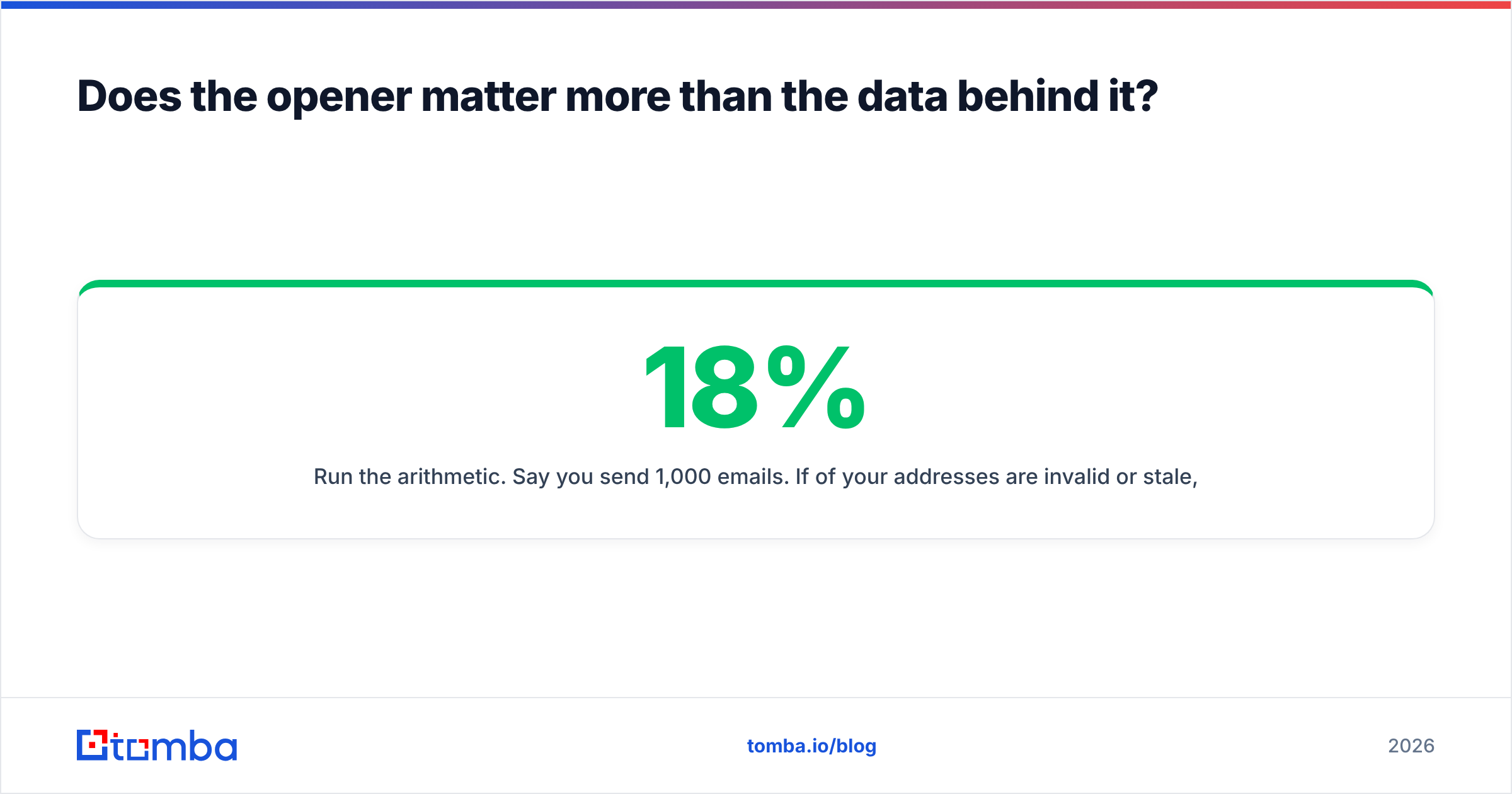
Run the arithmetic. Say you send 1,000 emails. If 18% of your addresses are invalid or stale, 180 of them never arrive, and the bounce spike drags your sender reputation down, which reduces inbox placement for the remaining 820. Now assume your opener rewrite improves reply rate from 4% to 6% — a genuinely excellent result. On 820 delivered emails that's roughly 16 extra replies. Cleaning the list to 98% valid, by contrast, recovers 160 sends and protects placement on everything else you send that month.
The order of operations is fixed:
- Deliverability foundation — authenticated domain, warmed inbox, sane send volume.
- Contact accuracy — verified addresses, correct role, current company. Run a email verifier pass before every campaign, not once a quarter.
- Targeting — right persona at right-fit accounts.
- Opener and body copy — the topic of this article.
- CTA and follow-up cadence.
Copy is the highest-leverage lever once the three below it are solid. Optimizing step four while step two is broken is the outbound equivalent of tuning an engine with two flat tires.
Vendors in this space differ meaningfully on how they source and refresh contact records — providers like BookYourData lean on curated, human-checked B2B lists, while API-first tools focus on real-time lookup and verification. Both approaches are legitimate; what matters is that you know when your data was last confirmed and that you verify at send time rather than trusting a file you exported in March.
What does a full opener-to-CTA email look like?#
Here's a Tier 2 email built entirely from the rules above. Fourteen words in the opener, no introduction, one ask.
Subject: three SDR roles, one shared inbox
Saw the three SDR openings in Austin — that usually lands before the routing is ready.
Two other Series B teams we work with hit the same wall: new reps burning their first month rebuilding lists by hand because the CRM records were 40% stale.
They fixed it by verifying contacts at enrichment time instead of at send time. Cut ramp by about three weeks.
Worth a look at how your records are holding up?
— Sam
Count what isn't there. No greeting filler. No company boilerplate. No feature list. No "15 minutes on your calendar." The opener does one job — prove this is about them — and hands off cleanly.
Where should you start this week?#
Pick one sequence, delete every opening line in it, and rewrite each one so that the first five words describe the prospect's situation. That single edit typically frees up 8–12 words of preview-pane real estate and removes the strongest template tell in your copy. Then run it against a clean list for two weeks and compare positive-reply rate against your previous baseline.
If you find that your replies still lag after the rewrite, the problem is almost certainly upstream of the words. Bounces, catch-all domains, and job-changed contacts quietly cap every campaign no matter how good the first sentence is.
That's where Tomba Email Finder fits. Use it to find and confirm the professional address behind a name and domain before the email ever goes out, so the opener you just spent an hour sharpening actually reaches a human inbox. The free tier covers 25 searches a month, and paid plans start at $49/mo on Tomba pricing if you're running real outbound volume. Get the data right, then let the copy do the work it's supposed to do.
Related guides#
Ready to find emails that actually work?
Join 150,000+ professionals who stopped guessing and started sending. Free credits on signup — no credit card required.
Get the Tomba newsletter
Practical outbound tactics and product updates — once every two weeks.
About the author